Chapter 1: The Stain on Raw Silk
Have you ever envisioned a scenario where the sanctuary of a family holiday shatters into a theater of cruelty? Picture this: a glittering Christmas Eve dinner where your sister-in-law intentionally empties a bottle of vintage red wine over your elderly parents, and your husband’s aristocratic family merely sips their tea, watching the humiliation with amused, glittering eyes. I did not scream. I did not weep. I simply leveled a gaze of absolute, glacial calm at the man I had married and informed him he had precisely five minutes to drag his sister to her knees for an apology. If the clock ran out, our next conversation would be mediated by a judge in family court.
The waning days of December in Greenwich, Connecticut, are always defined by a predatory, bone-aching chill that sweeps off the Long Island Sound. Yet, crossing the threshold of the sprawling, ivy-choked estate where my husband’s family resided, one was met with a suffocating wall of artificial warmth. Crystal chandeliers cast fractured light over imported marble, and the air was thick with the scent of roasted truffles and burning birch wood. It was a fortress I had purchased with the marrow of my own bones, funded by my relentless corporate ascent. I had foolishly placed the deed in my husband Thaddius’s name, a naive peace offering to ensure my in-laws lived their twilight years wrapped in unearned opulence.
My name is Saraphina. My roots are buried deep in the dry, unforgiving dirt of a rural farming town in Kansas, where my earliest memories are framed by endless, sun-scorched wheat fields and the relentless hum of locusts. After a decade of cutthroat maneuvering in the digital market, I now stand at the helm of an e-commerce empire yielding eight-figure revenues. I bought the sprawling lawns. I leased the fleet of European cars. I even carved out an obscenely lucrative, entirely fabricated executive role for my sister-in-law, Cordelia, within my own corporate headquarters. And yet, beneath the veneer of their forced smiles, I was nothing more than a wealthy peasant—a country bumpkin who had somehow managed to buy her way into the suffocating pretensions of East Coast Old Money.
Tonight was the Sterling family’s grand holiday gala. My biological parents had braved their first cross-country flight from the heartland to hold their granddaughter. They stood lingering near the towering mahogany doors, looking impossibly fragile. They wore their Sunday best—garments washed so many times the fabric had grown ghostly thin, yet pressed with a fierce, quiet dignity. My father, Harlon, clutched a vacuum-sealed package of venison jerky he had cured in his own smokehouse. My mother, Ulleia, cradled jars of artisanal apple butter and a woven basket of heirloom squash pulled from the frozen earth just days prior.
A lump the size of a stone formed in my throat. I hurried to relieve them of their humble, beautiful offerings.
In the grand dining hall, my husband’s bloodline was already taking their places at a table draped in pristine, snow-white linen. My mother-in-law, Aurelia, held court on a velvet settee. She clutched a bone-china cup of imported chamomile, offering my parents a greeting so frigid it could have frosted the windows. The rest of the extended family offered curt, dismissive nods, their eyes raking over my parents’ sensible shoes and weathered hands with undisguised contempt. Gentle to their core, my parents merely smiled, bowing their heads in polite deference before retreating to a secluded corner at a smaller, secondary table.
The banquet commenced in a cacophony of clinking silver and hollow laughter. The Sterlings boasted about upcoming ski excursions in the Swiss Alps and debated the merits of obscure luxury watchmakers. My parents ate in a state of terrified silence, chewing meticulously, paralyzed by the fear of dropping a single crumb on the immaculate tablecloth. Sitting beside them, serving them slices of roasted pheasant, a dark, venomous ache bloomed in my chest. I am a CEO who dictates market trends, I thought bitterly, yet I cannot protect the people who gave me life from being treated like stray dogs in a house I paid for.
It was then that Cordelia rose from her seat.
She began circling the room, wielding a bottle of vintage Napa Valley Cabernet Sauvignon. She was draped in a ridiculously sheer designer gown, the neckline glittering with a diamond pendant she had purchased using funds she had manipulated out of my personal account just weeks prior.
As she sidled up to my parents’ small table, I saw the malicious glint in her eye a fraction of a second too late. Cordelia brought the heel of her stiletto down hard against the table leg. The heavy glass bottle tipped.
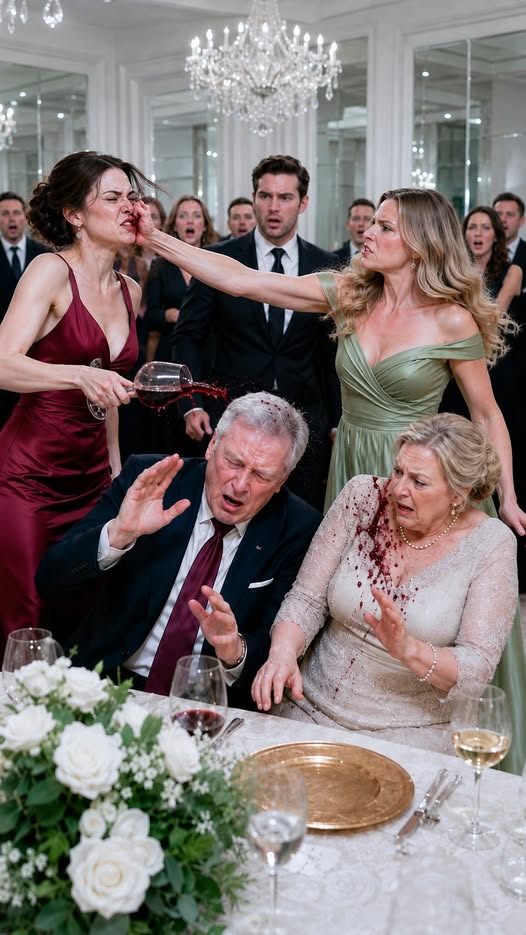
A cascade of dark, crimson liquid erupted. It struck my mother first, instantly destroying the elegant, ivory raw-silk blouse I had gifted her for her birthday. The cold wine pooled on the table and splashed violently upward, splattering across my father’s deeply lined, weather-beaten face.
A heavy, suffocating silence dropped over the room.
My heart hammered against my ribs like a trapped bird. I lunged forward with a handful of linen napkins, frantically dabbing at my mother’s trembling shoulders, my voice cracking as I asked if she was hurt.
I expected a gasp. I expected a frantic apology. Instead, Cordelia stepped back, a sickening, triumphant smirk stretching across her painted lips. She rolled her eyes, her voice echoing off the vaulted ceiling like a cracking whip.
“Honestly,” she sneered, her tone dripping with venom, “this is exactly what happens when you invite clueless hillbillies to a civilized dinner. They huddle in the corners, get underfoot, and cause me to waste a five-hundred-dollar vintage. It’s pathetic.”
The words struck me with the force of a physical blow. I snapped my head up, my vision tinting red with a feral, unadulterated fury. But the true dagger to my heart wasn’t Cordelia’s cruelty. It was the gallery of spectators.
Aurelia calmly lifted her teacup, blowing away the steam with an expression of mild, detached amusement, as if watching a mildly entertaining peasant comedy. Around the grand table, cousins and aunts pressed manicured fingers to their lips, stifling cruel giggles as they pointed at my soaked, disoriented parents.
I whipped my head around to find my husband. Thaddius sat at the head of the table. His eyes were glued to the glowing screen of his iPhone. He had seen the entire assault. He had heard every vile syllable. Yet, his shoulders slumped as he actively shrank into his chair, choosing to become invisible rather than defend his wife or her family.
My mother’s hand, slick with wine and shaking violently, grabbed my wrist. She used a faded cotton handkerchief to wipe the crimson droplets from my father’s cheek. She forced a bright, agonizingly fake smile.
“It’s fine, Sara,” she whispered, her voice trembling. “She just tripped. Please, baby, don’t make a fuss. Let’s not ruin their Christmas.”
That devastating submissiveness—the realization that they were willing to swallow unimaginable degradation just to keep my fractured marriage intact—shattered the final, crumbling wall of my patience. Seven years of writing checks, biting my tongue, and funding this carnival of vampires had achieved nothing.
I released my mother’s hand. I stood up, smoothing the front of my dress. The air in the room was thick with the irritating, buzzing laughter of the Sterlings. I walked with slow, measured steps until I stood directly beside Thaddius. Before he could react, I snatched the phone from his manicured fingers.
He flinched, looking up with a pathetic mixture of annoyance and terror.
I leaned in, my voice devoid of shouting, yet loud enough to crack the glass in the windows. “You have exactly five minutes, Thaddius,” I enunciated, stripping every ounce of warmth from my tone. “Five minutes to make your sister crawl over there, get on her knees, and beg my parents for forgiveness. If that clock runs out, my next call is to my attorney. We will see each other in family court.”
The laughter died instantly. Aurelia slammed her bone-china cup onto its saucer, glaring at me as if I had just committed blasphemy. Cordelia crossed her arms, thrusting her chin into the air, banking on her brother’s spineless nature to protect her.
Thaddius grit his teeth, lunging weakly for his phone. “Are you insane, Saraphina?” he hissed. “It’s just a spilled drink! The shirt goes to the dry cleaners. I am not making my sister humiliate herself in front of the whole family just because your folks don’t know how to navigate a dining room. Sit down and stop acting like trash.”
I didn’t blink. I simply watched the second hand on the grandfather clock in the corner sweep downward.
One minute. Two minutes. Thaddius crossed his arms and looked at the ceiling.
My father rushed over, his eyes bright with unshed tears. “Sara, please,” Harlon rasped, his calloused hands gripping my arm. “We’re old. We don’t care about the pranks of children. Just live in peace with your husband.”
I looked down at his rough hands—hands that had bled into the soil to feed me. A new, terrifying clarity washed over my soul. I would not allow the people who breathed life into me to be a punchline for a single second longer.
The clock chimed. Five minutes were up.
No one moved.
So be it, I thought. The war begins now.
Chapter 2: The Harvest of Betrayal
I retrieved my personal cell phone from my pocket. Without breaking eye contact with Cordelia’s mocking face, I dialed the direct line of my corporate Director of Human Resources. He answered on the second ring.
“Draft the termination paperwork for Cordelia Sterling, effective immediately. Cause: gross misconduct,” I ordered, my voice ringing out like a bell in the silent room. “Lock all her internal corporate accounts, revoke her building access, and wipe her company devices remotely. Tonight.”
Cordelia’s jaw dropped. The arrogant smirk vanished, replaced by a mask of chalky, unfiltered horror.
Before anyone could scream, I initiated a second call, this time to my VIP wealth manager. “Suspend the automatic wire transfers for the Tribeca penthouse mortgage,” I commanded. “As of this exact second, the occupant is entirely responsible for her own liabilities.”
A shrill, blood-curdling shriek tore from Cordelia’s throat. The reality of losing her six-figure phantom salary and her Manhattan real estate in the span of thirty seconds broke her mind. She lunged at me, her manicured claws aiming for my face.
Before she could close the distance, a massive shadow stepped from the hallway. Callum, my personal security driver, intercepted her with effortless grace, pinning her arms to her sides as she thrashed and wailed.
Aurelia sprang from her velvet throne. Her face was contorted into a demonic mask of rage. She pointed a trembling finger at my face. “You ungrateful, low-class witch!” she screeched. “You think a few dollars makes you better than us? You harass my daughter in my home? If you walk out that door, you trailer-trash nobody, don’t you ever come back!”
I met her psychotic glare with eyes as dead as winter ice. “Your home?” I whispered, taking a step toward her. “The marble you’re standing on was bought with my blood and sweat. The food in your stomach was paid for by my labor. Keep the house warm, Aurelia. My lawyers will be seizing it by the end of the quarter.”
I pivoted sharply, grasping my parents by their hands. “Leave the coats,” I instructed them gently. “Everything in this house is infected. We are leaving.”
I marched my parents out the grand double doors, leaving behind a symphony of chaos—Cordelia’s sobbing, Aurelia’s unhinged shrieking, and the pale, paralyzed silence of the coward I once called a husband.
The freezing night air hit us like a physical blow as we passed the wrought-iron gates, but it cleared the toxic fog from my brain. Callum held the doors of the armored SUV open. As I slid into the back seat beside my parents, my mother was shivering violently, still frantically trying to rub the wine out of her silk blouse with a dry napkin. My father stared out the tinted window, his fists clenched so tightly his knuckles were white.
“Drive to the academy,” I ordered Callum.
Despite the holiday, my six-year-old daughter, Clementine, was at her elite international school participating in a late-night winter pageant. The drive was suffocatingly silent. I held my mother’s icy hand, a tidal wave of guilt washing over me for dragging these pure souls into the swamp of my marital failure.
When we arrived, I hurried into the auditorium. Clementine, dressed in a glittering angel costume, spotted me and let out a squeal of pure joy, launching herself into my arms. She was a deeply empathetic child, perceptive beyond her years. When I carried her out to the SUV, her eyes widened at the sight of her grandparents.
She scrambled into Harlon’s lap, but her smile immediately vanished. Her tiny finger pointed at the massive, dark stain on Ulleia’s chest. “Grandma?” she asked, her brow furrowing. “Did someone hurt you? Why are you dirty?”
My mother choked on a sob, turning her face toward the window to hide her tears. “I’m just clumsy, my little bird,” she lied softly. “I spilled some juice.”
Clementine looked back at me, her gaze uncharacteristically hard. “I don’t like the big house,” she declared, her high voice cutting through the dark cabin. “The people there make Grandma sad. I want to stay with you and Grandpa.”
Out of the mouths of babes. Clementine had sensed the coldness, the passive-aggressive slights her grandmother had thrown her way. She knew exactly where the love was real.
I directed Callum to a luxury high-rise penthouse in Manhattan. I had secretly leased it a month prior, a subconscious safety net I had built when the shadows of my marriage first began to lengthen. It was immaculate, warm, and secure.
After drawing hot baths for my parents and putting a surprisingly calm Clementine to sleep, I padded out to the living room. The city lights of New York bled through the floor-to-ceiling windows. My mother was weeping softly on the sofa, begging me to reconsider, terrified that the stigma of divorce would ruin my life.
My father remained silent. Later, long after my mother had cried herself to sleep, I found Harlon sitting alone in the dim light of the kitchen. A glass of stale water sat untouched before him. I brewed a pot of strong ginger tea and set a steaming mug in front of him.
He looked at me, his eyes mapping the exhaustion on my face. Slowly, his calloused hand reached into the pocket of his worn cardigan. He pulled out a faded, burgundy velvet pouch. With trembling fingers, he unfolded a yellowed, fragile piece of paper and slid it across the glass table.
“Look at this, Sara,” he rasped, his voice heavy with unseen ghosts.
I leaned in. It was a bill of sale. A deed transfer for three hundred acres of prime Kansas wheat fields—the entirety of our ancestral land, the very soil I had played in as a child.
I froze. The date on the document was stamped four years ago.
Four years ago. The exact time my company was suffocating under a massive supply chain collapse. I had been facing total bankruptcy, drowning in debt, rejected by every bank on the eastern seaboard. And then, a miracle had occurred: an anonymous angel investor had wired a massive lump sum into my corporate accounts, saving my life’s work.
I looked up at my father, the breath knocked completely out of my lungs.
“We saw you dying of stress, baby girl,” Harlon whispered, staring at his rough hands. “We pulled together everything we had. We sold the land. We wired it through a broker so you wouldn’t know. If you knew it was our retirement, your pride wouldn’t have let you take it.”
He reached out, his rough thumb wiping a stray tear from my cheek. “You were always my greatest treasure, Sara. The dirt didn’t matter. We just wanted you to stand tall, so you’d never have to bow your head to anyone.”
A dam broke inside me. Hot, agonizing tears flooded my vision. I collapsed onto my knees on the cold hardwood floor, burying my face in my father’s lap, sobbing with a violence that tore at my throat.
For four years, I had used the lifeblood of my peasant parents to build an empire. And I had used the fruits of that empire to clothe, feed, and pamper a family of aristocratic parasites who had just poured wine on the people who sold their soul to save me.
As my father stroked my hair, a profound, terrifying metamorphosis took place within the dark corners of my mind. The submissive, peacemaking wife withered and died on that floor. In her place, something cold, calculating, and entirely ruthless opened its eyes.
“I promise you, Dad,” I whispered into the dark, my voice devoid of tears. “I am going to take back every single cent. I am going to burn their world to ash.”
Chapter 3: The Boardroom Guillotine
The winter sun breaking over the Manhattan skyline the next morning felt sharp and sterile. I dressed in a tailored, charcoal-grey blazer, pulled my hair into an immaculate, severe bun, and marched into the mahogany-paneled office of my attorney, Jefferson. He was a legal predator, a man who specialized in high-net-worth asset recovery and corporate bloodshed.
I laid the financial architecture of my life bare on his desk. The Greenwich estate. The Tribeca condo. The luxury vehicles. The six-figure allowances siphoned to Aurelia. Jefferson tracked the paper trail with a predatory gleam in his eye, assuring me that proving the origin of funds would make asset recovery highly probable.
Then, his finger tapped against a red-sealed folder.
“This is the breach in the hull, Saraphina,” Jefferson warned, his tone dropping an octave. “The 30% equity stake you transferred to Thaddius.”
I tasted copper. Years ago, battered by Aurelia’s constant psychological warfare about how a “true Sterling man” needed to hold power, and manipulated by Thaddius’s promises that the shares were purely for networking optics, I had foolishly signed over nearly a third of my company.
“With this,” Jefferson explained, tapping his gold pen, “he can call a hostile shareholder meeting. Worse, he can liquidate his position to a third-party competitor before a judge can freeze it. If he sells, the company is fractured.”
“File for an emergency injunction,” I ordered, my voice hard as flint. “Freeze all accounts, freeze the real estate, and place a judicial lock on those shares. He doesn’t touch a dime.”
Leaving the law firm, I went straight to my corporate headquarters. The air hummed with the frantic energy of the Q4 holiday rush. I bypassed the floor entirely and locked myself in the CEO suite, summoning my executive assistant, Vance.
Vance entered carrying a stack of files marked highly confidential. He locked the door and pulled the blinds.
“I ran the forensic audit on Cordelia’s accounts like you asked last night,” Vance said, his face grim. He slid a ledger across my desk. “She’s been falsifying vendor invoices for six months. She’s embezzled over three hundred thousand dollars to fund her personal shopping.”
I let out a dark, hollow laugh. The sheer audacity.
“There’s more,” Vance hesitated, sliding a manila envelope toward me. “I tracked the secondary corporate card attached to Thaddius’s name. And… I pulled the dashcam audio from his company SUV.”
I ripped open the envelope. Dozens of high-resolution photographs spilled onto my desk. They featured Thaddius, the man who claimed to be working late every Tuesday, aggressively making out with a stunning, younger woman outside the Waldorf Astoria. I recognized her instantly: Laurelai, a high-end corporate acquisitions consultant who frequented our industry galas.
I stared at the receipts for diamond tennis bracelets and penthouse suites, all paid for by my sweat. But it was the audio file Vance played next that turned my blood to liquid nitrogen.
Through the laptop speakers, Thaddius’s arrogant voice echoed. “I’ll download the Q1 strategic roadmaps and the VIP client database by Friday,” he promised. Laurelai purred in response, “The board at Apex Holdings is drooling, baby. Fifty million in cash for your 30% stake and the data. We buy the estate in the Hamptons, you dump the farm girl, and we’re golden.”
A freezing chill ran down my spine. This wasn’t just infidelity. This was a sophisticated corporate espionage ring. Thaddius was conspiring to sell the company my parents had sacrificed their farm for, handing it over to my largest competitor for a $50 million payday.
I didn’t cry. I didn’t scream. I looked up at Vance.
“Convene an emergency meeting of the Board of Directors for 1:00 PM,” I commanded. “And tell IT to enact a hard firewall. Lock Thaddius out of the entire ecosystem. Now.”
At 1:00 PM, the grand executive boardroom was suffocatingly tense. The heads of every department sat around the vast glass table, confused by the sudden summons. I stood at the head, projecting the company’s financial charts onto the massive screen.
Without preamble, I dropped the guillotine.
“Effective immediately,” I announced, my voice slicing through the room, “Cordelia Sterling is terminated for gross corporate fraud and embezzlement. Furthermore, Thaddius Sterling is stripped of his title as Vice President, and all his executive privileges are permanently revoked.”
Chaos erupted. Thaddius was the CEO’s husband; this was a corporate earthquake. Before the murmurs could escalate, I signaled Vance. The projector flashed Cordelia’s forged invoices, followed immediately by the IT logs showing Thaddius’s unauthorized attempts to download encrypted client databases.
The shock turned into a cold, collective fury. The board members, men and women who had bled alongside me to build this company, stared at the evidence of treason.
Suddenly, the heavy oak doors crashed open.
Thaddius stormed in, his face flushed a violent, ugly crimson, fighting off two security guards. His silk tie was askew. “What is the meaning of this?!” he roared, pointing a shaking finger at me. “My keycard is bricked! IT locked my laptop! Have you lost your mind?!”
I walked slowly around the table until I was standing inches from his chest.
“You have zero legal authority to be in this building, Thaddius,” I stated, my voice echoing in the dead silent room. “Your conspiracy to sell stolen trade secrets to Apex Holdings, along with the evidence of your sister’s felony embezzlement, has been handed to federal authorities. If you do not walk out that door right now, you will be dragged out in handcuffs.”
The rage drained from his face, replaced by a pale, visceral terror. He realized I knew everything. In a frantic, humiliating display of panic, he raised his hand to slap me.
He never made contact. The head of security tackled him from the side, slamming him into the plush carpet and pinning his arms brutally behind his back.
“Escort the trespasser out,” I ordered, turning my back on him.
As Thaddius was dragged away, spitting curses and thrashing like a trapped rat, my phone vibrated in my pocket. It was an unknown number. I stepped into the hallway and answered.
“Saraphina?” a cultured, female voice asked. “My name is Genevieve. My father is the CEO of Apex Holdings. We need to meet immediately. I have something that belongs to you.”
Chapter 4: The Architecture of Ruin
I met Genevieve at a secluded, dimly lit espresso bar in the West Village. I arrived expecting an ambush. Instead, I found a woman my own age, radiating an aura of understated elegance and deep exhaustion.
Without a word, she slid a sleek, silver encrypted flash drive across the marble table.
“I just returned from London to take over my father’s acquisitions department,” Genevieve explained, sipping her black coffee. “I was horrified to discover the tactics his VP was using. They hired Laurelai as a honey-trap to seduce your husband, manipulate him into corporate theft, and orchestrate a hostile takeover to destroy your life’s work.”
I stared at the drive. “Why are you giving this to me? You’re sabotaging your own family’s conglomerate.”
Genevieve offered a sad, sharp smile. “Business should be a battlefield of innovation, not a slaughterhouse of broken marriages. I refuse to let my father’s legacy be built on the bones of another self-made woman. Everything you need to prove fraud and nullify your husband’s share transfer is on that drive.”
I clasped her hand, a silent oath of gratitude passing between us. When your own family bleeds you dry, sometimes salvation comes from the enemy’s camp.
I delivered the drive to Jefferson. The evidence was nuclear. With proof of a malicious conspiracy to liquidate marital assets to harm the corporate entity, the judge granted an absolute legal freeze on the 30% block of shares. Thaddius’s fifty-million-dollar dream evaporated into thin air.
The retaliation from the Sterlings was swift and pathetic. The next morning, my phone was bombarded with texts from Thaddius. When his pleas for mercy were ignored, he pivoted to psychological warfare.
“My mother is in the cardiac ICU at Mount Sinai,” he texted, the desperation practically dripping from the screen. “Massive heart attack from the stress of Cordelia’s impending arrest. Please, Sara. Meet me at the cafe across the street. We need your help to pay for her care.”
I smiled a cold, razor-sharp smile. I grabbed my designer coat and headed for the hospital.
I found Thaddius slumped in a booth at the crowded hospital cafe. He looked destroyed—unshaven, bloodshot eyes, trembling hands. Seeing me, he launched into a theatrical, sobbing monologue about Aurelia’s failing heart and begging me to unfreeze his accounts just to save her life.
I let him cry for three uninterrupted minutes. Then, I pulled out my phone and dialed the Chief of Cardiology at Mount Sinai—a personal friend whose wing I had funded two years prior. I put the phone on speaker in the middle of the table.
“Doctor,” I asked calmly. “Can you confirm a patient disturbance regarding Aurelia Sterling?”
The doctor’s voice echoed out of the speaker. “Yes, Saraphina. An older woman came in faking chest pains, demanding a VIP suite. When triage confirmed she was perfectly healthy, she threw a hysterical tantrum in the lobby. Security threw her out twenty minutes ago.”
Thaddius’s jaw snapped shut. All the color drained from his face, leaving him looking like a corpse.
I ended the call. I reached into my tote bag and threw the glossy photographs of him making out with Laurelai directly into his face. They scattered across the table, mixed with the receipts for the diamonds.
“Your mother is as healthy as a horse, Thaddius,” I whispered, leaning over the table. “The only terminal disease in your family is greed. I’ve filed for a fault-based divorce. I’ve handed the corporate espionage evidence to the feds. See if Laurelai will visit you when you’re wearing an orange jumpsuit.”
I walked out of the cafe, leaving him weeping into his hands, entirely broken.
But a cornered animal is the most dangerous.
That Friday afternoon, I drove to Clementine’s school for pickup. I parked a half-block away due to traffic. As I walked toward the iron gates, a blood-curdling scream shattered the crisp winter air.
My daughter’s scream.
I sprinted toward the entrance. Through the crowd of horrified parents, I saw Aurelia. She looked utterly deranged, her hair wild, violently yanking Clementine by the arm. My six-year-old was sobbing hysterically, clinging to the wrought-iron fence, screaming for help.
“She’s a kidnapper!” Aurelia shrieked to the murmuring crowd, spewing venomous lies. “My daughter-in-law is a psycho! I’m taking my granddaughter away from that trash!”
A primal, blinding rage overtook me. I didn’t think; I acted. I shoved my way through the panicked crowd, lunged at the wicked woman, and slammed my shoulder into her chest.
Aurelia released my daughter with a gasp, stumbling backward until she lost her footing and collapsed hard onto the icy pavement. I swept Clementine up into my arms, shielding her trembling body with my own.
“I am her mother!” I roared at the crowd, pulling out my phone and dialing 911. “I am reporting an attempted kidnapping and assault by this woman!”
Realizing she was surrounded by wealthy parents recording her meltdown on their phones, and hearing the distant wail of police sirens, the madness drained from Aurelia’s eyes. Panic set in. She scrambled to her feet and sprinted down the block, fleeing like a coward.
The police took the report and pulled the high-definition security footage from the school. That night, as I rocked my traumatized, feverish daughter to sleep, I knew the endgame had arrived. The beast had bared its teeth at my child. It was time to put it down for good.
Chapter 5: A Symphony of Justice
The day of reckoning arrived in the cold, cavernous halls of the Manhattan Family Court. I sat beside my father and Jefferson, my posture rigid, my heart beating with the slow, steady rhythm of a predator about to strike.
Across the aisle, the architects of my misery were crumbling. Thaddius looked hollowed out, wearing a suit that suddenly looked three sizes too big. Aurelia sat behind him, trembling, hiding her face behind dark sunglasses.
The judge called the session to order. Thaddius’s pathetic attorney stood, stuttering through a desperate plea for an equitable division of assets, citing Thaddius’s “integral role” in my company and demanding the 30% equity payout.
Jefferson stood up. He didn’t argue; he simply unleashed an avalanche.
He submitted the forensic audit of Cordelia’s embezzlement. He submitted the financial records proving my sole funding of the marital assets. He dropped the glossy infidelity photos onto the public record.
And then, he deployed the kill shot: Genevieve’s dossier. The emails, the audio recordings, the drafted contracts with Apex Holdings.
“Your Honor,” Jefferson boomed, his voice echoing off the marble. “The respondent did not merely commit adultery. He engaged in a malicious, premeditated conspiracy to liquidate marital assets via corporate espionage to harm the petitioner.”
To seal the tomb, Jefferson submitted the school security footage of Aurelia’s feral attack on Clementine, paired with a severe psychological evaluation of my daughter’s trauma.
The judge’s face contorted in absolute disgust.
The gavel slammed down like a thunderclap. The ruling was total and merciless. A fault-based divorce was granted. One hundred percent of the marital assets—the Greenwich estate, the Manhattan penthouse, the cars, and the corporate shares—were legally restored to my sole possession. Thaddius was ordered out with nothing but his clothes. An ironclad, permanent restraining order was placed against the entire Sterling family, severing their access to Clementine.
As court adjourned, the tension finally snapped. In the echoey hallway, a destroyed Thaddius turned to his mother. Stripped of his fortune, his mistress, and his pride, he lost his mind. He screamed that everything was her fault, raising his hand and slapping his own mother across the face in front of the bailiffs.
We didn’t pause to watch the rats consume each other. I took my father’s arm and walked out into the blinding, beautiful afternoon sun.
The aftermath was a cleansing fire. Cordelia was indicted on federal fraud charges, dragged from her penthouse in handcuffs. Aurelia, evicted from her social circles and buried in debt, suffered a total nervous breakdown. Thaddius, abandoned by Laurelai and blacklisted from the corporate world, was reduced to delivering food on a rented scooter in the freezing rain to survive.
I sold the Greenwich estate, wiping the stain of their existence from my ledger.
With the recovered funds and my soaring corporate revenue, I bought a sprawling, magnificent estate in the Hudson Valley. It was a sanctuary of ancient oak trees, crystal-clear lakes, and vast greenhouses where my father could plunge his hands into the rich, dark soil, cultivating life once more.
That Christmas Eve, our new home smelled of roasted prime rib, cinnamon, and fresh pine. Clementine’s laughter echoed through the vaulted, rustic halls, completely free of fear. I sat my parents at the head of a massive oak table, pouring them a glass of the finest wine.
When it was time for gifts, I handed my mother a meticulously wrapped box.
Ulleia opened it, her breath catching in her throat. It was the ivory raw-silk blouse—the one ruined by Cordelia’s malicious spill. But it was no longer ruined. I had taken it to a master tailor. Over the dark, jagged stain, the tailor had woven a stunning, intricate embroidery of crimson roses, using the shape of the spill as the foundation for a masterpiece.
My mother wept, pulling me into an embrace that smelled of apple butter and unconditional love. The embroidery was our family’s crest now: a symbol of how we took their toxicity, their venom, and transformed it into unshakeable, beautiful armor.
I had learned the most terrifying lesson a woman can learn: the limitless, destructive power of her own dignity.