Chapter 1: The Upholstery Caste System
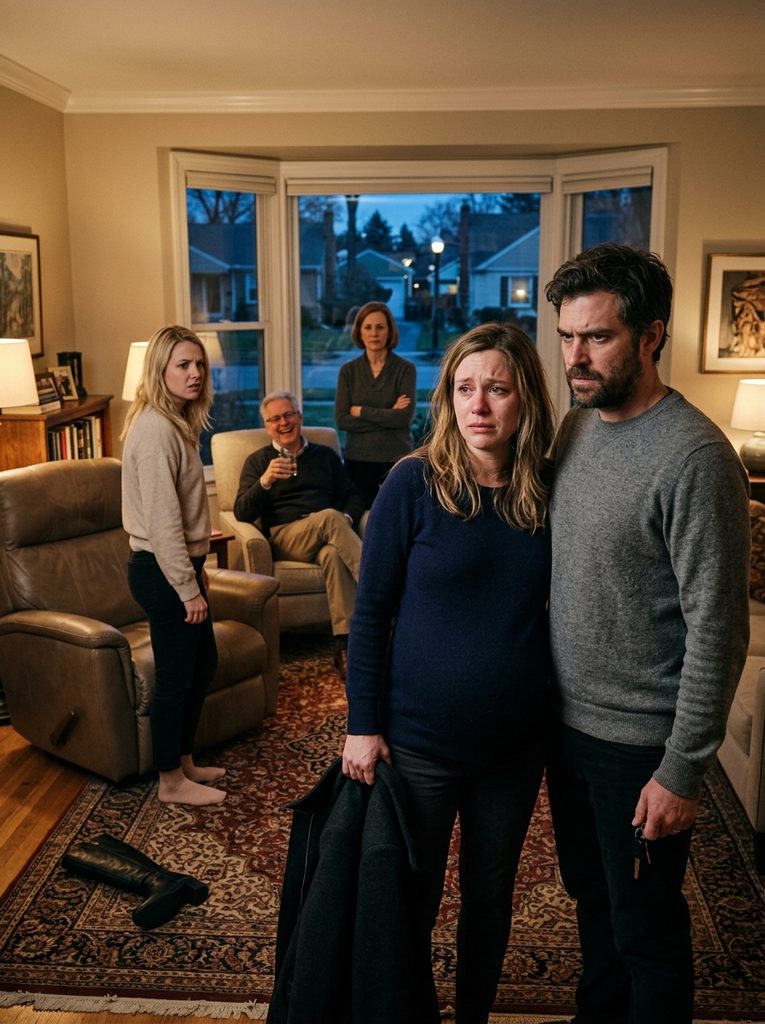
My thirty-two-year-old sister unlaced her leather loafer and launched it like a crude ballistic missile at my seven-month pregnant wife.
The crime? My wife had dared to rest her aching spine in my sister’s designated chair at our parents’ house.
My father, Ron, threw his head back and barked a genuine, belly-deep laugh.
“Pregnancy hormones,” he chuckled, slapping his denim-clad knee.
“Everybody just relax.”
My mother, Linda, wiped her hands on a floral dish towel,
surveyed the scene, and delivered the sentence that permanently fractured our bloodline.
“Clare, honey,” she cooed, her voice dripping with weaponized midwestern sweetness.
“Maybe just sit on the floor next time.
You know how she gets about that chair.”
My wife, Clare, slowly stood up, her face a mask of terrifying, arctic calm.
She wordlessly reached for her wool coat.
I grabbed my car keys.
Then, I pulled my phone from my pocket.
That was the precise fraction of a second I realized my family had successfully established a rigid,
unbreachable caste system based entirely on living room upholstery.
And it was the moment I decided to burn their kingdom to the ground.
Three days later, a crisp, vinyl For Sale sign would be hammered into their front lawn.
But before I detail why my parents reacted to that wooden stake as if I had personally harvested their organs for a traveling circus, a little context is required.
First, my name is Ian.
I am thirty-six years old, and I operate a trio of high-volume culinary establishmenTS.
Because my entire adult existence has consisted of neutralizing intoxicated patrons, repairing catastrophic deep-fryer malfunctions at midnight, and preventing line cooks from eviscerating one another over missing ceramic ramekins, my threshold for absolute nonsense is stratospheric.
You have to possess a deadened nervous system to survive hospitality.
A normal civilian sees thick black smoke billowing from a kitchen door and thinks, Fire. A restaurateur sees that same smoke and thinks, God, is that expensive smoke?
I once had a lead dishwasher abandon his station in the middle of a brutal Valentine’s Day service because,
in his words, the gravitational pull of the moon was actively disrespecting his aura.
I handed him a twenty-dollar bill, dialed my cousin, and scrubbed scorched porcelain until two in the morning.
When I say I am a difficult man to provoke, understand that my patience has been deep-fried in commercial-grade pandemonium for fifteen years.
Second, my family operated under a convenient, collective amnesia regarding the fact that the roof over their heads legally belonged to me.
They knew, of course.
In the same way people vaguely know how combustible engines work, but still act outraged when their car runs out of gas.
Five years prior, Ron and Linda had steered themselves into a catastrophic financial abyss.
My father had taken an aggressively early retirement because, as he eloquently phrased it, his boss was a moron.
Ron had clocked twenty-seven years at that logistics firm.
Over that tenure, he had survived fourteen different regional managers.
According to him, every single one was a certified idiot.
At a certain point, one must entertain the mathematical probability that the common denominator in the equation is not upper management.
My mother treated currency as a fleeting, unwanted guest.
If her checking account held five hundred dollars, she reliably spent five hundred and sixty, treating the overdraft fee as a necessary tax on her vibrant lifestyle.
They refinanced their mortgage twice, bled the equity dry, and then Ron dumped the remaining liquidity into his buddy Marty’s “revolutionary” mobile barbecue concept.
The concept, it turned out, was an unventilated grill duct-taped inside a rusty utility trailer.
Marty branded it Smoke Wheels.
The fire marshal branded it an illegal hazard.
The insurance underwriters laughed until they hung up.
When the bank was ninety days away from foreclosing on my childhood home, I stepped in.
I didn’t hand them cash.
Their debt structure was so convoluted that my certified accountant required a dry-erase board, three espressos, and the grim expression of a priest preparing for a violent exorcism just to map it out.
I quietly paid off the staggering arrears, assumed legal ownership of the deed, gutted the rotting plumbing, installed a new architectural roof, and permitted my parents to reside there rent-free.
Our singular verbal contract was that they cover basic utilities and property taxes.
I wanted them to age with dignity.
That, looking back through the lens of history, was my cardinal sin.
If you provide human beings with a complimentary three-bedroom house for half a decade, their brains cease to process the arrangement as a monumental act of grace.
It morphs into a fundamental human right, akin to oxygen, Wi-Fi, or in my sister Tessa’s case, exclusive domain over a singular piece of furniture.
Tessa was thirty-two and had nested in our parents’ spare bedroom for eleven of the last twelve years.
There was a brief, ten-month anomaly when she cohabitated with a bartender named Kyle.
Kyle eventually returned her to the premises.
Tessa was the undisputed golden child.
Ron and Linda vehemently denied this, deploying the classic parental propaganda: We love you both equally,
just differently. Translated from family-speak, that means one child receives endless emotional and financial subsidies, while the other child is exclusively contacted when the basement floods or the router needs resetting.
I was the router child.
Tessa was the displaced royalty.
She rotated through vocations roughly every nine monThS. She had been a holistic nail technician, a canine aura reader, a bespoke candle artisan, and, for six bizarre weeks, a “digital nomad” who never actually crossed the Ohio state line.
At the time of the footwear assault, she was launching an empire centered on selling “intention-based home accessories.” When I pressed for a definition, she claimed they were objects imbued with emotional frequencies.
I called them paperweighTS. She didn’t speak to me for a fortnight.
It was the most peaceful two weeks of my year.
And then, there was The Chair.
It was a gargantuan, faded burgundy recliner dominating the living room.
It had belonged to our grandfather, possibly constructed during the Roosevelt administration.
It was not mere furniture; it was a sovereign landmass.
If you dropped it into the Pacific Ocean, China would build an airstrip on it.
Tessa had claimed it during her sophomore year of high school, and her annexation remained legally binding in my parents’ eyes ever since.
Guests were cautioned.
Cousins were briefed.
I once watched my mother physically intercept an eighty-year-old aunt with a hip replacement to steer her toward a stiff wooden rocker, simply because Tessa might venture downstairs later.
Clare knew none of this lore.
She was hauling around seven months of our first child.
Her center of gravity had become its own diplomatic territory.
We had arrived for a casual Saturday lunch.
Tessa was asleep upstairs.
My mother was wrestling with dry chicken in the kitchen.
Clare’s lower back was screaming, so she sighed and sank into the plush burgundy velvet of the recliner.
I noticed instantly.
But because I am a rational adult residing in a society governed by the rule of law, I assumed no blood would be shed.
I was terribly naive.
Three minutes later, Tessa descended the staircase.
She froze halfway across the carpet.
I have witnessed executive chefs discover a walk-in freezer failure with less visceral horror on their faces.
She pointed a trembling finger.
“You’re in my chair.”
Clare glanced over her shoulder, assuming Tessa was addressing the family golden retriever.
“Oh.
I’m just resting my back.
It’s very comfortable.”
“No,” Tessa snapped.
“My chair.
Move.”
Clare shot me a look—the specific telepathy spouses exchange when they stumble into a cult ritual they weren’t briefed on.
“Tessa,” I intervened gently.
“She’s carrying a human being and her sciatica is acting up.
Sit on the sofa.”
Tessa glared at me as if I had demanded she drink from a stagnant puddle.
“I always sit there.”
“Well, today you are exploring new topographies,” I replied.
Tessa locked eyes with my wife.
“Move.”
Clare did not raise her voice.
“I am comfortable.
I will get up in ten minutes.”
That was when the shoe took flight.
Fortunately, Tessa possessed the athletic coordination of a decorative fern.
The loafer sailed a foot wide of Clare’s head, ricocheted off a framed portrait of Ron, and plummeted into a crystal bowl of salted pretzels on the coffee table.
Silence descended.
I looked at the shoe.
I looked at the innocent pretzels.
“Did you just throw footwear at me?” Clare whispered.
“You defied me,” Tessa spat.
Then came my father’s booming laughter, dismissing the assault as hormonal hysteria.
Then came my mother’s suggestion that my pregnant wife assume the position of a medieval serf on the hardwood.
As we walked briskly to my SUV, I dialed my real estate broker.
Her name is Melissa.
She possesses the warmth of a sniper and the efficiency of a guillotine.
She had negotiated the commercial lease for my second restaurant.
“Ian,” she answered on the second ring.
“Melissa.
The residential property on Brookfield.
The one my family occupies.”
“I have the file.
What’s the situation?”
“List it.”
A brief pause.
The sound of a keyboard clacking.
“Tomorrow morning?”
“Ian, it’s Saturday afternoon.”
“Then Monday at dawn.
”
Clare buckled her seatbelt, staring at me with wide eyes.
“Are your current occupants vacating?” Melissa asked smoothly.
“They are about to,” I said.
“Market price.
I want it liquidated.”
“Do they know?” Melissa inquired.
I glanced through the bay window of the house.
My father was casually retrieving the loafer from the crushed pretzels, handing it back to my sister with a gentle pat on her shoulder.
“No,” I said.
Melissa inhaled sharply.
“I’ll bring two wooden signs.”
“Why two?”
“Because,” Melissa purred,
“I have a distinct feeling something violent is going to happen to the first one.”
Chapter 2: Capitalism Arrives at 8:15 AM
Melissa hammered the steel posts of the For Sale sign into the manicured front lawn at precisely 8:15 AM on Monday.
At 8:22 AM, my cell phone, resting on the stainless-steel prep counter of my downtown kitchen, began to vibrate with the intensity of a seismic event.
First Ron.
Then Linda.
Then Ron again.
Then Tessa.
Then an unlisted local number.
My sous chef, Miguel, paused mid-chop,
eyeing the dancing phone.
“We got a health inspector breathing down our necks, boss?”
“Worse,” I muttered, wiping my hands on a side towel.
“My family has just discovered the brutal reality of capitalism.”
I finally accepted a call from Ron.
“What in the hell is planted in my front yard?” he bellowed over the line.
“I imagine it’s Kentucky Bluegrass, Dad.”
“The sign, Ian! Why is there a realtor’s billboard on my property?”
“Because the asset is entering the open market.”
The silence that followed was exquisite.
You could have bottled that silence and sold it as a premium mindfulness retreat.
“You cannot sell our home,” Ron finally choked out.
“Check the county registry, Ron.
It is very aggressively my home.”
I heard a scuffle, and Linda snatched the receiver.
“Ian Thomas! What is this madness?”
“Saturday clarified our dynamic, Mom.
I am liquidating the arrangement.”
In the background, Tessa’s shrill voice pierced the audio. “This is financial abuse! Tell him it’s abuse!” The woman who had utilized a leather slip-on as a projectile weapon against a pregnant woman was suddenly moonlighting as a scholar of human rights violations.
“You are punishing our entire family over a tiny misunderstanding!” Linda cried.
“Which part did I fail to grasp? The incoming projectile, or your suggestion that my wife nest on the floorboards?”
“I said maybe sit on the floor,” Linda defended, clinging to the qualifier like a life raft.
Apparently, cruelty is perfectly acceptable if you dress it up in hesitant phrasing. Maybe sleep in the snow.
Maybe forage for your own food.
Ron wrestled the phone back.
“You’re acting like a petulant child holding a grudge.”
“Then this transition should be seamless,” I replied, my voice dropping to a deadpan flatline.
“Adults understand basic property law.
Have your bags packed by closing.” I terminated the call.
Ten minutes later, Tessa dialed in.
I answered solely because occasionally the universe provides free, premium-tier entertainment.
“You are not doing this to me,” she hissed.
“My corporate headquarters are here.”
I had genuinely forgotten.
Tessa ran her intention-based accessory fraud out of the guest room.
By “headquarters,” she meant a dozen cardboard boxes, a thermal label printer, and forty-six ceramic moons she had bulk-ordered from a Vietnamese wholesaler and marked up four hundred percent as “ethically sourced lunar vessels.”
“Then your global supply chain is relocating,” I said.
“Where am I supposed to go, Ian?!”
I stared at the ceiling of my kitchen, a slow smile spreading across my face.
I considered telling her to try the floor.
I really did.
But in comedy, just like in cooking a perfect ribeye,
timing is everything.
You cannot deploy the ultimate punchline prematurely.
“You are thirty-two years of age,” I said smoothly.
“I highly recommend exploring the thrilling, emerging industry known as apartment leasing.”
She called me a sociopath and hung up.
By Tuesday afternoon, the situation devolved into pure, unadulterated farce.
Ron bypassed me and called Melissa directly, attempting to legally cancel the listing.
Melissa, who had the title deed memorized, politely asked him to verify his legal standing.
“I am not on the paper,” Ron argued, “but in every way that matters, I am the lord of that manor.”
Melissa informed him that real estate law, tragically, is not governed by vibes.
An hour later, Linda marched into the yard with a thick black Sharpie and taped a piece of cardboard over Melissa’s sign.
It read: NOT ACTUALLY FOR SALE. Melissa drove over and tore it down.
Linda replaced it with: SALE PENDING FAMILY DISCUSSION. There was no pending sale, and there was certainly no discussion.
It was just an escalating turf war between a licensed broker and a woman discovering that permanent marker does not override municipal records.
Melissa eventually replaced the entire wooden rig.
She was a prophet.
That evening, Tessa escalated the conflict to the digital realm.
She posted a lengthy, tear-soaked manifesto on Facebook, accusing me of violently evicting my “elderly, frail parents” for corporate greed.
Ron was sixty-three, played aggressive pickleball four days a week, and had recently tried to frame a backyard deck single-handedly.
Labeling him frail was less a medical diagnosis and more an ambitious piece of fiction.
Unfortunately for Tessa,
she included the Zillow link to my property in her post to prove her victimization.
Because I had poured eighty thousand dollars into renovating the kitchen with quartz countertops, high-end stainless appliances, and refinished the original oak floors, her viral post backfired spectacularly.
People weren’t outraged; they were shopping.
Melissa texted me at 9:00 PM. Your sister is accidentally running a masterclass in digital marketing.
We have triple the normal traffic.
Can we legally send her a commission check? I replied.
Don’t encourage the hostage-takers, Melissa shot back.
By Wednesday, we had eleven formal viewing requesTS. That was when my parents discovered the most horrifying aspect of attempting to sell a house you are squatting in: strangers come inside.
Ron physically blocked the front door for the first viewing.
Melissa called me from the driveway. He’s acting like a palace guard.
He won’t let the buyers cross the threshold.
Give him the legal twenty-four-hour notice of entry, I said. We host an open house this Saturday.
The family intelligence network kicked into overdrive.
Aunts and uncles crawled out of the woodwork.
Uncle Mark left a voicemail quoting scripture about “family helping family.” I texted him back, reminding him they had enjoyed sixty months of rent-free shelter.
He replied that it didn’t count because I was wealthy.
The ancient economic principle of toxic families: if one relative achieves financial stability, all other relatives are immediately entitled to temporary socialism.
On Friday night,
cousin Megan texted me a screenshot of a private message she had received from Tessa.
Tessa: I’m going to make sure the place looks like a toxic waste dump tomorrow.
Nobody is buying my chair’s house.
The intelligence service was highly efficient, and the war was about to begin.
Chapter 3: The Siege of the Burgundy Recliner
Saturday morning broke with a crisp, mocking sunshine.
Melissa arrived at the property armed with surgical shoe covers, glossy trifold brochures, artisanal bottled water, and the steeled facial expression of a negotiator stepping into a bank robbery.
I parked my SUV across the street.
I attended not just to protect my investment, but because I would have happily paid the price of admission for the ensuing theater.
Clare wisely opted to stay home, noting that standing on her swollen feet for three hours while my family experienced the crushing weight of consequences sounded less appealing than a root canal.
I unlocked the front door and stepped inside.
Ron was seated on the sofa, arms crossed tight over his chest, scowling at the drywall.
Linda was aggressively pushing a vacuum cleaner back and forth over an already spotless rug,
weaponizing the appliance’s motor noise.
And Tessa? Tessa was entrenched in the burgundy recliner.
Melissa looked at me.
I looked at Melissa.
Some human behaviors transcend the boundaries of language.
“What is she doing?” Melissa whispered, adjusting her blazer.
“She is defending ancestral territory,” I replied.
Tessa had also been busy with a pad of neon yellow sticky notes.
She had plastered them across the house.
I peeled one off the pristine hallway drywall.
It read: BASEMENT FLOODS HOURLY.
(The basement was bone dry and hermetically sealed).
Another on the kitchen island read: NEIGHBORS BREED ATTACK DOGS. (The neighbors were an elderly lesbian couple who owned a deaf, toothless pug).
A third on the bathroom mirror warned: POSSIBLE BLACK MOLD.
Melissa systematically walked the perimeter, removing the libelous stationery.
Tessa shadowed her, slapping new ones down the moment Melissa turned her back.
It was a low-budget psychological thriller involving office supplies and real estate licensing requiremenTS.
At 10:00 AM, the first wave of buyers breached the perimeter.
A young professional couple wandered into the kitchen, tracing their fingers admiringly over the quartz.
Linda immediately ambushed them.
“Just so you know,” she whispered conspiratorially, “the oven emits a terrifying electrical burning smell when you bake.”
It did not.
I had installed the Bosch unit eight months prior.
Ron cornered a retired teacher in the hallway.
“The municipal property taxes in this zip code amount to highway robbery,
” he grumbled.
Technically a factual statement, but hardly a required seller’s disclosure.
Then, the young couple drifted into the living room.
Tessa remained fiercely glued to the recliner, staring straight ahead like a Buckingham Palace guard.
The young woman smiled politely at the imposing piece of furniture.
“Oh, wow.
Will that vintage chair be included in the sale?”
Tessa bared her teeth.
“Absolutely not.”
I stepped out of the kitchen shadow.
“Absolutely, yes.”
Tessa’s head whipped toward me so violently I thought her cervical spine might snap.
“What?!”
“The buyer is entitled to all fixtures and designated furnishings,” I smiled.
“You cannot sell my chair!” she shrieked, half-rising from the cushion.
“It came with the house! It belonged to Grandpa!”
“Excellent,” I nodded to the couple.
“We will legally describe it as a period antique.”
Tessa stood up fully.
It was a historic moment.
The threat of capitalism was the only force in the universe powerful enough to voluntarily extract her from the cushion.
Melissa sidled up to me, whispering out of the corner of her mouth.
“Ian, I can easily list it under contract exclusions.”
“Don’t you dare,” I whispered back.
The recliner was no longer just a piece of wood and fabric.
It was the physical manifestation of justice.
It was karma with lumbar support.
Over the next hour, a parade of strangers navigated the hostile environment.
Linda tried to convince a family of four that the property was a superhighway for aggressive raccoons.
She described one incident from 2019 as if the property bordered a radioactive wildlife reserve.
Ron chimed in, claiming he had to physically fight the beast off the porch.
The animal had weighed twelve pounds and had fled at the sound of a wind chime.
And then, the ultimate complication walked through the door.
A woman named Denise and her husband stepped into the foyer.
Denise’s eyes widened as she spotted me.
She was a regular patron at my flagship restaurant.
“Ian?” she smiled, extending a hand.
“I had no idea you were the developer behind this listing.”
Ron’s ears pricked up like a hunting dog.
He saw his window of opportunity.
He marched over, inserting himself between me and the potential buyer.
“It is actually our multi-generational family home,” Ron announced, his voice dripping with fabricated sorrow.
“Ian is liquidating it from under us because he is throwing a tantrum.”
Denise looked at me, raising a sculpted eyebrow.
“That is a remarkably accurate summary of events,” I agreed cheerfully.
Denise’s husband cleared his throat.
“Are there currently tenants holding a lease?”
“Yes,” I said.
“Temporary occupanTS.”
“We are not temporary!” Ron barked.
Melissa materialized from the ether, flashing a smile that could freeze vodka.
“The premises will be delivered completely vacant upon closing, sir.”
“No, it won’t!” Ron challenged.
Somewhere in the distance, a dog barked.
The tension was thick enough to carve with a steak knife.
That was the exact moment Tessa bounded down the staircase.
She was carrying the heavy, detached seat cushion of the burgundy recliner in her arms.
I still cannot fathom the tactical reasoning behind this—perhaps she believed that physically dismantling the chair would deter offers.
She marched into the foyer and announced to Denise, “This entire predatory eviction is happening because his entitled wife tried to steal my sacred chair!”
Denise blinked, bewildered.
“Your sacred chair?”
“My seven-month pregnant wife sat in the chair for a grand total of three minutes,” I clarified.
“You are intentionally omitting what she did!” Tessa screamed at me.
I leaned against the wall, crossing my arms.
“I am fascinated, Tessa.
Please, educate the room.
What did my pregnant wife do to the upholstery?”
“She knew it was my spiritual center!”
Denise’s husband slowly looked at the detached cushion clutched to Tessa’s chest.
He asked the singular question every sane person in the room was begging to know.
“So… what actually happened?”
I locked eyes with Denise.
“Tessa hurled a loafer at my pregnant wife’s head.”
The husband stared at Tessa.
Tessa jutted out her chin and tightened her grip on the cushion.
“She defied me.”
There are rare, crystalline moments in life where you can actively watch strangers rapidly recalculate the psychological stability of an entire bloodline.
This was one of those momenTS. Denise’s gaze shifted from the feral woman clutching a cushion,
to the red-faced patriarch blocking the door, to me, standing there with the serene posture of a monk.
And somehow, miraculously, instead of bolting for their sedan, the sheer, unhinged circus of it all cemented their desire for the property.
Maybe the regional housing inventory was just that desperate.
Denise and her husband submitted a formal offer that evening.
So did the young professional couple.
So did a man who had spent forty minutes measuring the drywall.
Tessa’s frantic sabotage had generated an aura of fierce competition.
We accepted Denise’s offer.
Thirty thousand dollars over asking price.
And the burgundy recliner was legally bound to the contract.
Chapter 4: Geometric Vengeance
When I formally notified my parents that the sale was executed, the fallout was biblical.
Linda wept openly.
Ron screamed about contacting the Supreme Court.
Tessa produced a sound from her throat that resembled a blender trying to purée a handful of silverware.
“You sold my chair?!” Tessa shrieked.
“I sold the real estate,” I corrected.
“The chair was merely a contractual sweetener.”
“But it holds my emotional energy!”
“Then it will provide excellent feng shui for Denise.”
The ensuing two weeks constituted the most profoundly entertaining relocation process in modern history.
Linda began scouring rental listings and was utterly scandalized to discover that property managers expected financial compensation every thirty days.
“Do you have any concept of what a two-bedroom unit costs in this economy?” Linda wailed over the phone.
“I do.
I write commercial leases for a living.”
“It’s extortion! You’ve ruined us!”
“You have lived absolutely rent-free for sixty months, Mom.
That doesn’t mean I broke the economy; it means you’ve been living inside a subsidized terrarium.”
I offered to cover their security deposit and the first month’s rent.
It was not born of guilt, but of a desperate desire to ensure the property was vacant for the final walkthrough.
They rejected my initial offering because the apartment was thirteen hundred square feet.
“It’s a shoebox,” Linda complained.
They rejected a second because it lacked a kitchen island.
Linda cooked perhaps four times a fiscal quarter.
The island, I realized, was strictly required as a staging ground for her unopened credit card bills.
Eventually, Ron demanded they be allowed to move into one of my other investment properties.
I declined.
He accused me of harboring a vendetta.
I told him I was harboring a legal deed.
Tessa’s housing crisis was even more spectacular.
She secured a one-bedroom apartment on the third floor of an older complex.
It possessed no elevator.
She called me, breathless and furious.
“The stairs are a nightmare, Ian! It’s a vertical climb!”
I smiled into the receiver.
I had waited seventeen agonizing days to deploy the payload.
“Well, Tessa,” I whispered.
“Maybe you should just sit on the floor between flighTS.”
The silence on the line was absolute perfection.
She hung up.
It was worth every single penny I had spent on the house.
Moving day arrived with a grim, overcast sky.
Ron and Linda had hired professional movers.
Tessa, operating under the delusion that moving companies were “instruments of capitalist exploitation,” had demanded I send my restaurant prep cooks to haul her belongings for free.
I refused.
I arrived at the property at noon to verify their departure.
Denise and Melissa were standing on the front lawn, waiting to conduct the final closing walkthrough.
I walked up the driveway and encountered a logistical masterpiece.
Ron and Tessa were wedged in the front doorway, desperately trying to wrestle the mammoth burgundy recliner out of the house.
According to the signed addendum, the chair was Denise’s property.
Tessa had unilaterally decided that contract law did not apply to items possessing spiritual auras.
The chair was jammed sideways in the standard doorframe.
Ron was trapped behind it in the foyer.
Tessa was yanking from the porch.
Neither could move an inch.
“Pivot it!” Tessa screamed.
“I am pivoting!” Ron bellowed, his face the color of a bruised plum.
“There is no more pivot to give!”
I stood on the concrete walkway.
Melissa covered her mouth.
Denise watched with wide, fascinated eyes.
“This,” I announced to the women, “is the most compelling argument for purchasing fully furnished real estate I have ever witnessed.”
“Ian! Stop standing there and help me!” Tessa screeched.
“I cannot aid and abet grand larceny,” I replied.
“That chair belongs to Denise.”
Denise raised a polite hand.
“For the record, I don’t actually want the chair.
It smells faintly of dust and hostility.”
“Perfect!” Tessa yelled, giving a massive heave.
“However,” Denise continued,
a wicked glint in her eye, “after experiencing this dynamic, I feel a deep moral obligation to keep it on principle alone.”
I nearly hugged her.
Ron finally dug his heels into the hardwood and gave a monumental shove.
The chair scraped forward six inches.
Then, the rusted mechanical lever on the side hooked violently onto the metal strike plate of the doorframe.
With a sound like a gunshot, the spring-loaded footrest exploded open.
The kinetic force launched Ron backward into the foyer, where he collapsed into a pile of decorative throw pillows.
The recoil sent Tessa tumbling backward off the threshold and onto the damp lawn.
The burgundy recliner remained wedged perfectly upright in the doorframe, the extended footrest jutting out like a drawbridge.
It looked as though an invading army had successfully established a beachhead and refused to yield.
No one was physically injured.
Tessa’s dignity was obliterated, but thankfully, that was a phantom asset to begin with.
She slowly stood up, brushing wet grass from her yoga panTS. She looked around the empty porch for a place to collect herself.
The sofa was packed.
The patio furniture was in the U-Haul.
The sacred chair was hopelessly jammed in the architecture.
Defeated, exhausted, and out of options, my sister slowly sank down and sat squarely on the grass.
The floor of the earth.
I looked at her.
She glared at me.
I did not say a word.
Sometimes, the cosmos scripts the joke with such divine perfection that the only respectful action is to remain completely silent and let the punchline breathe.
Chapter 5: The Mechanical Click of Justice
The closing was finalized the following morning.
My parents settled into a modest apartment ten minutes away.
In a shocking twist of fate, the reality of automated monthly rent drafts motivated Ron to secure a part-time consulting gig.
Linda joined a community gardening co-op and began texting me relentless photos of heirloom tomatoes.
She still maintained I overreacted, but she never again suggested my wife occupy the floor.
Tessa’s intention-based accessory business collapsed four months later.
She cited a “toxic consumer fixation on price poinTS.
” She eventually secured employment at a regional furniture outlet.
The universe, devoid of any subtlety, placed her in the showroom selling sofas and reclining chairs.
Two months after the great eviction, Clare gave birth to our beautiful daughter, Lily.
My parents visited the maternity ward.
Tessa claimed she was burdened with inventory checks and did not attend.
I felt no loss.
I assumed the saga of the burgundy recliner was closed.
I was wrong.
A month after Lily was born, Denise returned to my restaurant for dinner.
She waved me over to her booth.
“We finally finished renovating the living room,” Denise beamed.
“We got rid of that hideous burgundy monstrosity.”
“What did you do with it?” I asked, feeling a strange twinge of nostalgia for the veteran of my family’s civil war.
“My husband listed it on Facebook Marketplace.
Free to a good home.
You must pick it up.” She pulled out her smartphone.
“You will appreciate this, Ian.
The buyer’s profile picture was quite familiar.”
I stared at the screen.
It was Tessa.
My sister had driven a rented cargo van back to her former neighborhood, claimed the chair off the curb, and somehow hauled the behemoth up three flights of stairs to her apartment.
I called her that night.
“You reclaimed the throne?”
A heavy pause.
“How did you find out?”
“I know Denise.
How did you get it up a vertical stairwell?”
“I hired movers,” Tessa mumbled.
“The financially exploitative ones?”
She hung up on me.
I later learned from Linda that the extraction cost Tessa two hundred and eighty dollars.
The chair had survived a real estate transaction, a family mutiny, a doorway siege, and it now resided on the third floor with a woman who had previously claimed she couldn’t afford rent.
That was the coda, I thought.
But the universe had one final movement in the symphony.
Three weeks later, Linda called me, laughing so hysterically she could barely draw breath.
“Tessa’s chair broke!” Linda wheezed.
“The frame?”
“The motor! The electric reclining mechanism died while she was fully extended!”
Because the chair was colossal and crammed into a tiny apartment,
the jammed footrest pinned Tessa horizontally against a heavy bookshelf.
She couldn’t exit normally; she had to combat-roll sideways over the armrest just to escape.
Ron had driven over with a toolbox but couldn’t bypass the rusted gears.
They called a technician.
The tech informed them the motor was obsolete, and a custom replacement would cost six hundred dollars.
Tessa refused to pay, citing the chair’s “sentimental energy.”
For months, the recliner remained permanently frozen in a half-reclined state—too steep to sleep on,
too angled to sit upright.
It was a flawless physical manifestation of Tessa’s entire career trajectory.
During the holidays, Clare and I stopped by Tessa’s apartment to drop off a gift.
We stepped into the cramped living room.
There it was.
The burgundy beast, tilted awkwardly, one side propped up by a stack of outdated IKEA catalogs.
Tessa saw me staring at it.
She pointed a defensive finger.
“Don’t.”
I raised my hands in surrender.
“I haven’t uttered a syllable.”
Then, little Lily, now a wobbly one-year-old,
toddled across the carpet.
She made a direct beeline for the broken chair.
Tessa’s eyes widened in horror.
For one terrifying, magnificent heartbeat, history prepared to repeat itself.
Lily reached out, placing her chubby hands on the sacred velvet cushion.
Tessa inhaled sharply, opening her mouth to issue a command.
Clare stared at her.
I stared at her.
Ron and Linda held their breath.
Five adults waited in agonizing silence to see if a thirty-three-year-old woman was about to initiate a territorial dispute with an infant.
Tessa closed her mouth.
She swallowed hard.
Lily hoisted herself up, plopped her diapered bottom onto the cushion, and let out a delighted giggle.
Tessa stood in the center of her own living room, looking around.
Her small sofa was buried under unfolded laundry and shipping boxes.
She had nowhere to sit.
“Honey,” Linda whispered gently.
“Do you want me to move some of these boxes for you?”
Tessa shook her head, a hollow look in her eyes.
Slowly, she lowered herself down, crossing her legs on the cheap carpet of the floor.
I lasted exactly six seconds.
I clamped my jaw.
I fought the urge with every fiber of my being.
But the words were already formed.
“You know, Tessa,” I said into the quiet room.
“Maybe next time.”
Clare kicked me viciously in the ankle.
Ron suddenly developed a violently fake coughing fit.
Linda stared intently at the popcorn ceiling.
Tessa told me to go straight to hell.
Lily clapped her hands in delight.
And from deep within the bowels of the ancient burgundy recliner, a broken gear settled, letting out one small,
deeply satisfying, mechanical click.