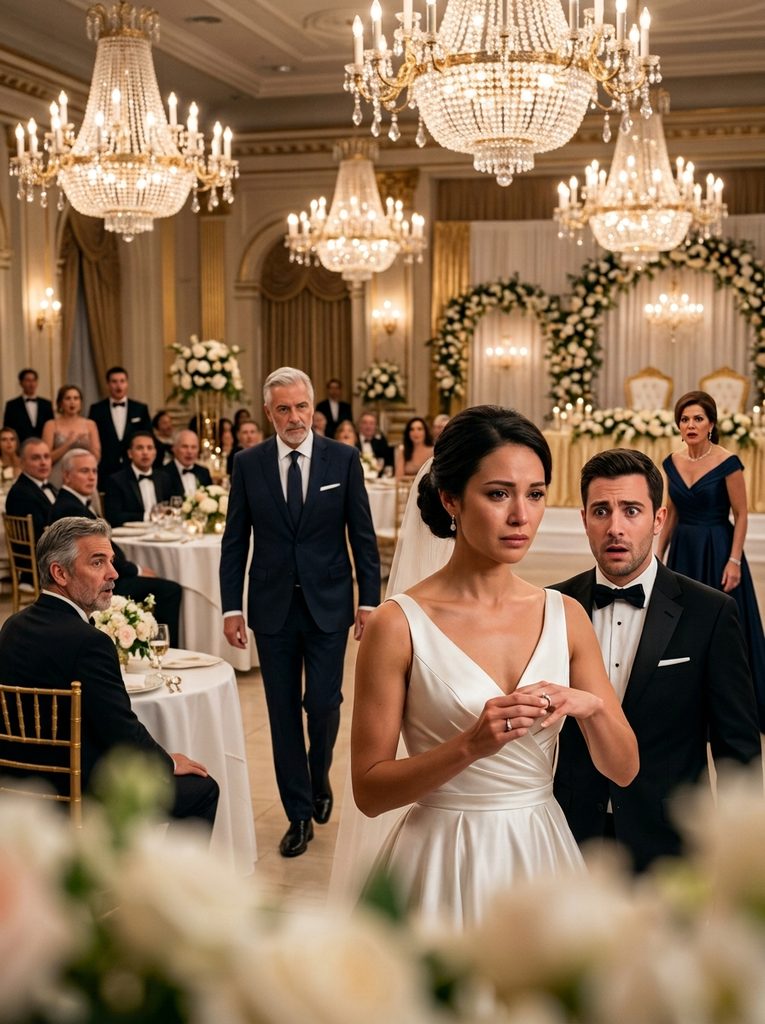
Marcus actually took a step backward.
Richard gave a disbelieving laugh. “You remember me.”
“Of course I remember you.”
Dad rose, and the two men shook hands.
There was nothing dramatic about it. No grand announcement. No display of power.
Yet somehow that ordinary handshake felt more significant than anything Beatrice had said from the head table.
Richard looked genuinely emotional.
“You disappeared.”
Dad smiled faintly. “Retirement has certain advantages.”
“You call refusing every invitation and changing your phone number retirement?”
“I call it peace.”
A few people nearby laughed uncertainly.
Richard did too.
I stared at my father.
“Dad?”
He glanced toward me and immediately noticed the ring in my hand.
His expression changed.
Not anger.
Concern.
“What happened?”
Before I could answer, Beatrice stood.
“There has been a misunderstanding.”
Her voice sounded much smaller now.
Richard turned toward her.
“A misunderstanding?”
Marcus hurried forward.
“Mr. Sterling, this is a private family matter.”
Richard studied him for a moment.
“I gathered that.”
Marcus swallowed.
I almost felt sorry for him.
Almost.
Richard had not raised his voice, yet Marcus suddenly looked like an employee who had walked into a meeting without reading the report.
Dad looked at me again.
“Valerie?”
I took a breath.
Then I told him.
Not dramatically.
Not angrily.
I repeated Beatrice’s expectations exactly as she had presented them: my salary going into an account she controlled, future property being placed solely in Marcus’s name, and the declaration that his family would always outrank mine.
Dad listened without interrupting.
When I finished, his expression was unusually difficult to read.
Then he asked Marcus one question.
“Is that what you want?”
Marcus opened his mouth.
Closed it.
Beatrice answered for him.
“Our family has traditions.”
Dad kept his eyes on Marcus.
“I asked your son.”
Marcus stared at the floor.
“That isn’t exactly what I want.”
The words hurt more than I expected.
Not because they were cruel.
Because they were weak.
“Then why didn’t you say so?” I asked.
Marcus looked at me.
“You know my mother.”
“Yes,” I said. “I’m beginning to.”
Several people shifted awkwardly.
Dad touched my elbow.
“Would you like to leave?”
I looked around the banquet hall.
Three months of planning.
Flowers I had chosen with Marcus.
Place cards my mother and I had arranged late into the night.
Friends who had traveled across the country.
A photographer standing near the wall, deliberately pointing his camera toward the floor.
This was supposed to have been a celebration before our civil ceremony on Monday.
Instead, I felt as though I had arrived at the final examination for a life I had never agreed to live.
“I think I should,” I said.
Marcus stepped forward.
“Valerie, please.”
I stopped.
For four years, I had loved that voice.
I knew the sleepy version of it when he answered the phone at midnight.
The excited version when he received his first major promotion.
The embarrassed version when he tried to sing.
The gentle version he used with my mother when she worried too much about something small.
That was what made everything so complicated.
Marcus was not a monster.
He was not cruel.
He was a man I loved who had spent much of his life surrendering decisions to a mother he feared disappointing.
And tonight, when he had been forced to choose between her expectations and my dignity, he had asked me to apologize.
“I need time,” I said.
“How much?”
“I don’t know.”
His eyes fell to the ring still resting in my palm.
“Are you ending everything?”
“I’m stopping Monday.”
He went still.
The civil signing.
Our legal marriage.
Two days away.
Beatrice inhaled sharply.
“You cannot simply cancel a marriage because of one disagreement.”
I looked at her.
“This is not a disagreement about table decorations.”
Richard coughed into his hand, suspiciously like he was hiding a smile.
Dad picked up my coat.
My mother, Elena, appeared beside us moments later. She had spent most of the evening talking with relatives near the back of the room and had missed the beginning of the confrontation.
One look at my face told her enough.
“We’re leaving?”
“Yes.”
She squeezed my hand.
No questions.
That simple gesture nearly undid me.
As we walked toward the exit, Richard followed.
“Samuel, may I call you tomorrow?”
Dad hesitated.
Then nodded.
“I suppose fifteen years is long enough.”
Richard smiled.
Before leaving, I looked back.
Marcus remained beside the head table.
Beatrice was talking rapidly into his ear.
But Marcus was not listening.
He was watching me.
For the first time that night, he looked less embarrassed than lost.
My parents lived in the same modest house where I had grown up.
That evening, I found myself sitting at their kitchen table wearing a formal dress while my mother made tea.
There was something almost absurdly comforting about it.
The clock above the refrigerator ticked.
My childhood photographs were still attached to the wall with magnets.
Dad sat across from me.
I placed the engagement ring on the table.
None of us spoke for a while.
Finally, I looked at him.
“Who is Richard Sterling?”
Dad lifted an eyebrow.
“You know who he is.”
“You know what I mean.”
Mom placed three mugs on the table.
“I told you this day would come.”
Dad sighed.
“You say that about everything.”
“Because eventually I’m right.”
Despite myself, I smiled.
Dad wrapped both hands around his tea.
“Years ago, before Sterling Industries became what it is today, Richard and I worked together.”
I blinked.
“Together how?”
“I was a consultant.”
“That sounds suspiciously vague.”
“It is intentionally vague.”
“Dad.”
He smiled.
“All right.”
He leaned back.
“Twenty-two years ago, Sterling Industries was a much smaller company. Richard’s father had recently died, and Richard inherited a business with good people and terrible finances.”
I listened.
“I had spent years working in corporate restructuring,” Dad continued. “Mostly quietly. Companies hired me when they had problems they didn’t want advertised.”
That part surprised me less.
Dad had always been good with numbers.
Growing up, I thought every father could glance at a page of figures and immediately notice something wrong.
“I worked with Richard for nearly six years,” he said.
“Doing what?”
“Helping him rebuild the company.”
I stared.
Sterling Industries employed more than forty thousand people.
Marcus talked about the company constantly.
To him, Richard Sterling was practically legendary.
“You helped build Sterling?”
Dad shook his head.
“Richard built Sterling. I helped him avoid a few expensive mistakes.”
Mom sat beside him.
“A few?”
Dad gave her a look.
She smiled into her tea.
I suddenly understood why Richard had walked past Marcus as though he were furniture.
“Why have you never told me?”
Dad looked genuinely puzzled.
“Why would I?”
“Because it’s… important.”
“To whom?”
“To me!”
He smiled.
“You were thirteen when I stopped consulting. You were more interested in volleyball.”
“That is not the point.”
“It is exactly the point. I was your father. I preferred that job.”
His answer was so typical of him that my frustration disappeared.
Then I remembered something.
“Richard said he had been looking for you.”
Dad’s expression became more serious.
“Yes.”
“Why?”
He was quiet for several seconds.
“There was one matter we never finished.”
Mom looked at him sharply.
“Samuel.”
“I know.”
Their exchange immediately caught my attention.
“What matter?”
Dad rubbed his thumb slowly along the handle of his mug.
“Nothing that concerns tonight.”
“Dad.”
“Valerie, you have enough to think about.”
That was exactly the kind of sentence guaranteed to make me think about nothing else.
My phone buzzed.
Marcus.
I looked at the screen.
Twelve missed messages.
I opened the newest one.
Please talk to me before you decide anything permanent.
I put the phone facedown.
Mom watched me.
“Do you still love him?”
I hated how quickly the answer came.
“Yes.”
Dad nodded.
“That makes decisions harder.”
I looked at him.
“You’re not going to tell me to leave him?”
“No.”
“After tonight?”
“Marriage is your decision.”
Mom reached across the table.
“But love is not the same thing as trust.”
I swallowed.
“I trusted him.”
“Perhaps,” Dad said gently, “the question is whether he knows how to deserve that trust when it costs him something.”
That stayed with me.
The following morning, Marcus arrived at my apartment carrying coffee.
He looked exhausted.
I almost did not let him in.
Then I remembered Dad’s words.
Trust had to cost something.
Maybe listening did too.
I opened the door.
Marcus held out the coffee.
“Peace offering.”
“This requires more than coffee.”
“I know.”
He placed it on the counter.
For several moments, we stood in the living room surrounded by unopened wedding gifts.
Finally, Marcus said, “I’m sorry.”
I waited.
“I’m sorry I told you to apologize.”
“Why did you?”
He looked toward the window.
“Because my mother was making a scene.”
“She was making demands about my money.”
“I know.”
“And your solution was for me to apologize.”
His shoulders dropped.
“I panicked.”
There it was.
Not an excuse.
An admission.
“My whole life,” he continued, “when Mom gets upset, everyone learns to calm her down. My father did it. My sisters do it. I do it.”
“So you expected me to learn too.”
“Yes.”
The honesty surprised me.
Marcus looked ashamed.
“I didn’t even realize how terrible that sounded until I heard myself explaining it.”
I sat down.
He remained standing.
“Did you know what she was going to say?”
“Not all of it.”
“Some?”
He nodded.
My stomach tightened.
“She mentioned combining finances after marriage. I assumed she meant you and me having a joint account.”
“The account she planned to oversee?”
“I swear I didn’t know that.”
I believed him.
That did not solve everything.
But I believed him.
“What about property in your name?”
He shook his head.
“No.”
“Family priority?”
He hesitated.
That hesitation answered me.
“She’s said similar things before,” he admitted.
“And you never told me?”
“I thought she’d change once she knew you better.”
I almost laughed.
“Marcus, we’ve been together four years.”
“I know.”
“You weren’t waiting for her to change. You were waiting for me to adapt.”
He sat across from me.
That sentence seemed to hit him.
For a while, neither of us spoke.
Then Marcus said, “Cancel Monday.”
I looked up.
“What?”
“Cancel it.”
“You wanted me to reconsider last night.”
“I do. But not by Monday.”
He rubbed his hands together.
“I don’t want you marrying me because deposits are paid and relatives bought plane tickets.”
For the first time since the banquet, something in my chest loosened.
“I’m moving out of Mom’s investment accounts,” he continued.
I frowned.
“What investment accounts?”
Marcus looked confused.
“The family trust.”
“I thought your father’s estate was divided years ago.”
“It was.”
Something in his expression shifted.
“Wait.”
He stared at me.
“What did your father do for Sterling Industries?”
I stiffened.
“Why?”
“Because Mom called me at three this morning.”
“What does that have to do with Dad?”
“She was furious about Richard Sterling recognizing him.”
Marcus leaned forward.
“She said something I didn’t understand.”
“What?”
“She said, ‘Of all the families you could have married into, you chose Samuel Bennett’s daughter.’”
My pulse slowed.
“What does that mean?”
“I don’t know.”
Marcus took out his phone.
“But then she said something stranger.”
He opened a message from Beatrice.
There were only two lines.
Do not discuss family finances with Valerie until I speak to our attorney.
Especially not the Westbridge account.
I stared at the screen.
“What is the Westbridge account?”
Marcus shook his head.
“I have no idea.”
That afternoon, Dad met Richard Sterling at a quiet café near the river.
I only knew because Mom accidentally mentioned it while we were talking.
Apparently, Dad had made her promise not to interfere.
Apparently, Mom’s definition of not interfering did not include keeping secrets from her daughter.
By six o’clock, Dad called me.
“Can you come over?”
His voice was calm.
Too calm.
I drove there immediately.
Richard Sterling was sitting in our living room.
The CEO whose photograph appeared in business magazines was holding one of Mom’s flowered teacups.
He looked strangely normal.
Dad gestured toward the sofa.
“Sit.”
I did.
Richard leaned forward.
“I owe your father an apology.”
“For what?”
“Fifteen years ago, Samuel discovered irregularities connected to an investment partnership that did business with Sterling.”
Dad looked toward the window.
Richard continued.
“Nothing criminal was proven. But your father believed certain transactions were misleading.”
My mind went immediately to Marcus’s message.
“Was the partnership called Westbridge?”
Richard stopped.
Dad turned toward me.
“How do you know that name?”
My throat went dry.
“Marcus’s mother told him not to discuss something called the Westbridge account.”
Richard and Dad exchanged a long look.
My heartbeat accelerated.
“Valerie,” Dad said slowly, “what exactly did she say?”
I repeated the message.
Dad stood.
He walked to the bookshelf and pulled out an old wooden document box I had seen dozens of times growing up.
He unlocked it.
Inside were several folders.
One was labeled:
WESTBRIDGE CAPITAL — 2011.
Dad removed it and sat beside me.
“There’s something you need to understand,” he said.
“Beatrice didn’t first meet our family yesterday.”
I stared at him.
“What?”
Dad opened the folder.
Inside was an old photograph.
Richard Sterling stood outside an office building, considerably younger.
Dad was beside him.
And several feet away stood a woman in a cream-colored business suit.
Beatrice.
Younger.
Smiling.
Holding a folder marked Westbridge.
I looked at my father.
“You knew Marcus’s mother?”
Dad shook his head.
“Not socially.”
Richard spoke instead.
“Fifteen years ago, Beatrice was one of Westbridge Capital’s financial representatives.”
The room went silent.
Then Dad turned another page.
There, beneath a series of typed numbers, was a signature I recognized from holiday cards and wedding invitations.
Beatrice Holloway.
And suddenly, her strange words to Marcus made sense.
She had not been shocked because Richard Sterling knew my father.
She had been frightened because she knew exactly who my father was.
For several minutes, I simply stared at Beatrice’s signature.
Marcus’s mother.
My almost-mother-in-law.
A woman who had spent the previous evening lecturing me about protecting family assets had once worked for an investment partnership my father had investigated.
The coincidence felt too precise.
But Dad immediately warned me against jumping to conclusions.
“A signature is not guilt,” he said.
I looked at him.
“Then what is it?”
“Evidence that our lives crossed before any of us realized.”
Richard nodded.
“Samuel is right.”
I glanced between them.
“Both of you look worried.”
Richard set down his teacup.
“Because Westbridge was complicated.”
Dad opened another folder.
The paperwork inside was old but meticulously organized.
“That company handled private investments for executives, small businesses, and family estates,” he explained. “Some transactions involved Sterling Industries.”
“And something went wrong?”
“Not exactly.”
That answer frustrated me.
Dad noticed.
“Valerie, real financial problems are rarely as simple as someone taking a suitcase full of money. Sometimes bad decisions are technically permitted. Sometimes people sign documents they do not fully understand. Sometimes people allow fear to influence decisions.”
That sounded less like an explanation and more like a warning.
“Did Beatrice do something wrong?”
“I don’t know.”
“You investigated her company.”
“Yes.”
“And?”
Dad exchanged another look with Richard.
This time Richard answered.
“Westbridge recommended several investment structures that created serious conflicts of interest. Samuel raised concerns. Before the internal review was completed, the partnership dissolved.”
“Why?”
“Several senior partners retired unexpectedly. Others moved their clients elsewhere.”
“And Beatrice?”
“She left finance.”
I remembered what Marcus had told me years earlier.
His mother had once worked in banking but stopped after Marcus’s father became successful in commercial real estate.
I had never asked more.
“Did Dad expose Westbridge?”
“No,” Richard said.
Dad shook his head.
“The evidence was incomplete.”
“So you walked away?”
“We documented everything.”
“Then why were you looking for Dad?”
Richard sat back.
“Because three months ago, Sterling Industries began preparing an acquisition. During the legal review, an old Westbridge account appeared.”
My stomach tightened.
“What account?”
Richard looked at Dad.
Dad nodded.
“The Holloway Family Investment Account.”
Marcus.
His sisters.
Possibly Beatrice.
I remembered Marcus’s text.
Especially not the Westbridge account.
“Does Marcus know?”
“I doubt it,” Richard said.
“That’s why Beatrice panicked.”
“Possibly.”
Dad closed the folder.
“Or perhaps she panicked because she believed I might discuss something she has spent years trying to forget.”
The distinction mattered.
One possibility made Beatrice calculating.
The other made her human.
I was not yet sure which was closer to the truth.
Marcus came to my parents’ house that evening.
I had called him because I no longer believed secrets were helping anyone.
When he entered the living room and saw Richard Sterling, he stopped so abruptly that Mom nearly walked into him carrying a plate of cookies.
“Sir.”
Richard smiled.
“Tonight, Richard is fine.”
Marcus looked as though being asked to call his CEO Richard was somehow more terrifying.
He sat beside me.
Dad explained Westbridge.
Marcus listened without interrupting.
When Beatrice’s photograph appeared, he went pale.
“My mother told us she stopped working when my father asked her to.”
Dad studied him.
“That may be true.”
“She never mentioned Westbridge.”
“That may also be true.”
Marcus rubbed his forehead.
“What is the Holloway Family Investment Account?”
Richard answered carefully.
“An old investment structure connected to your parents’ assets.”
“Is there something wrong with it?”
“We don’t know yet.”
Marcus looked at me.
I could see embarrassment returning.
“Valerie, I swear—”
“I know.”
He stopped.
“You do?”
“I know you didn’t create an investment account when you were probably still in college.”
A small, tired smile crossed his face.
Dad pushed the folder toward him.
“Your mother deserves a chance to explain.”
Marcus looked surprised.
“You want to talk to her?”
“I think you should.”
His smile disappeared.
“I’m not sure she’ll tell me.”
“Then ask without accusing her.”
Dad’s advice was simple.
Marcus stared at the photograph.
“My entire life, my mother has treated money like something that could disappear overnight.”
That sentence changed the atmosphere.
I turned toward him.
“What do you mean?”
Marcus shrugged.
“Everything has to be protected. Accounts separated. Property titled correctly. Emergency funds. Backup emergency funds.”
I thought of the banquet.
Protect the family assets.
I had heard arrogance.
Maybe there was fear beneath it too.
That did not excuse what Beatrice had demanded.
But explanations and excuses were not the same thing.
“Was your family ever poor?” Mom asked.
Marcus gave a humorless laugh.
“According to Mom, we were always one disaster away from being poor.”
Richard glanced toward Dad.
Something unspoken passed between them.
Marcus asked Beatrice to meet us the next morning.
To my surprise, she agreed.
We chose my parents’ home instead of hers.
Neutral territory.
Mom placed tea on the coffee table and disappeared into the kitchen, although I noticed she left the door open.
Beatrice arrived exactly at ten.
She looked immaculate.
But tired.
She stopped when she saw Richard.
“Of course.”
Marcus stood.
“Mom.”
“What is this?”
“A conversation.”
Her eyes moved toward the folder on the table.
The color drained from her face.
Dad remained seated.
“Hello, Beatrice.”
She looked at him for a long moment.
“Samuel Bennett.”
“You remember me.”
“It would be difficult not to.”
Her voice contained no affection.
But not hatred either.
Something more complicated.
Marcus gestured toward a chair.
“Please sit.”
She did.
I had expected defensiveness.
Instead, Beatrice looked suddenly older than she had at the banquet.
Marcus spoke first.
“What is the Westbridge account?”
Beatrice closed her eyes.
For one second.
Then opened them.
“My greatest mistake.”
No one moved.
Marcus frowned.
“What does that mean?”
She folded her hands in her lap.
“When your father and I were newly married, we had almost nothing.”
Marcus blinked.
“You told us Grandpa helped Dad start his first business.”
“He did. Eventually.”
She stared at her hands.
“But before that, your father and I lost nearly everything.”
This was clearly new information to Marcus.
“How?”
“A property investment.”
She gave a faint, embarrassed smile.
“We thought we were clever. We were twenty-eight. Everyone at the time seemed to be making money in real estate.”
Dad said nothing.
“We borrowed too much,” she continued. “The market turned. Your father’s business failed. We sold our apartment. For six months, we lived with your grandparents.”
Marcus sat slowly.
“You never told us.”
“No.”
“Why?”
“Because your father was ashamed.”
Her voice softened.
“And I was terrified.”
For the first time, I could see the younger woman she must have been.
Not the commanding matriarch from the banquet.
A frightened young mother watching security disappear.
She turned toward Dad.
“When I joined Westbridge, I promised myself I would never be financially vulnerable again.”
Dad nodded.
“You were good at your job.”
“I was ambitious.”
“That too.”
Richard leaned forward.
“What happened with the Holloway account?”
Beatrice’s mouth tightened.
“My supervisor advised me to move part of our family investments into one of Westbridge’s private structures.”
“Your own employer’s product,” Richard said.
“Yes.”
“Which created the conflict Samuel questioned.”
“Yes.”
Marcus looked confused.
“Was it illegal?”
“No,” Dad said.
“Then what was wrong?”
Beatrice answered before he could.
“I did not tell your father everything.”
Marcus went still.
She continued.
“The investment carried higher risks than he understood. I convinced myself it was acceptable because other employees were doing the same thing.”
“You signed Dad’s name?”
“No.”
She looked horrified.
“Never.”
The tension in Marcus’s shoulders eased slightly.
“He signed the documents himself. But I explained the risks poorly.”
“Intentionally?” I asked.
Beatrice looked at me.
Her answer took several seconds.
“Yes.”
It was the first completely unguarded thing I had ever heard her say.
“I wanted him to agree.”
Her voice dropped.
“And when Samuel began reviewing Westbridge, I thought my career was finished.”
Dad folded his hands.
“But it wasn’t.”
“No.”
“You resigned.”
“Because I knew you were right.”
Silence settled over the room.
Beatrice turned toward Richard.
“When Westbridge dissolved, I transferred the investment into a private family structure.”
“The account still exists,” Richard said.
“Yes.”
Marcus looked at her.
“Why did you tell me not to discuss it with Valerie?”
Beatrice’s expression changed.
That was the question she had hoped no one would ask.
“Because I recognized her father.”
“At the banquet?”
“Immediately.”
“You knew who Valerie was this whole time?”
“No.”
She shook her head.
“Bennett is common. Samuel never discussed his children at Westbridge. I met him perhaps six times.”
“Then why did you say, ‘Of all the families you could marry into’?”
Her composure slipped.
“Because I was embarrassed.”
Marcus stared.
“Embarrassed?”
“I spent years building a life where no one knew how uncertain our early marriage had been.”
Her voice grew unsteady, though she never cried.
“I wanted my children to feel secure.”
Marcus looked toward the floor.
“You wanted us to believe security meant controlling everything.”
Beatrice flinched.
It was subtle.
But everyone saw it.
“You don’t understand what it feels like to lose your home.”
“No,” Marcus said. “Because you never told me.”
That was the deepest wound in the room.
Not the money.
The secrecy.
Beatrice looked at him.
“I wanted to protect you.”
“And somehow that became deciding everything for us.”
Her face tightened.
“I advised you.”
“You managed me.”
He spoke without anger.
That somehow made the words stronger.
“Mom, I’m thirty-five.”
She looked away.
Marcus continued.
“You picked my accountant. You pushed me toward the company position I have now. You insisted on reviewing my investments.”
“I was helping.”
“I know.”
He paused.
“That’s the problem. I always knew you meant well, so I never learned to tell you no.”
I thought of the banquet.
Apologize to my mother.
There was the pattern.
Not villainy.
Habit.
Years of it.
Beatrice finally looked at me.
“I owe you an apology.”
The room became very quiet.
I waited.
“What I said at the banquet was unacceptable.”
It sounded difficult for her.
Not because she did not believe it.
Because apologies did not seem to come naturally to her.
“I convinced myself I was protecting Marcus,” she continued. “But I treated you as if joining our family required surrendering yourself.”
I nodded.
“That’s exactly how it felt.”
“I know.”
“Do you?”
She held my gaze.
“I do now.”
I believed she was trying.
That mattered.
It did not erase what happened.
But it mattered.
After Beatrice left, Marcus and I walked through the neighborhood.
Children rode bicycles along the sidewalk. Someone nearby was mowing a lawn. A dog barked behind a wooden fence.
Ordinary Saturday sounds.
Our wedding was supposed to happen Monday.
The thought seemed impossible.
Marcus shoved his hands into his pockets.
“I don’t know what happens now.”
“Neither do I.”
“Do you want your ring back?”
I looked at him.
He immediately corrected himself.
“That sounded terrible.”
“A little.”
“I mean someday.”
I smiled despite everything.
“Someday is different.”
He nodded.
We walked another block.
Then Marcus said, “I’m going to move out of the family financial structure.”
I stopped.
“Because of me?”
“No.”
He looked at the pavement.
“Because I realized yesterday that I don’t know which choices in my life are actually mine.”
That was the first thing he had said that gave me real hope.
Not because he was choosing me over his mother.
I did not want that.
I wanted him to choose himself.
“I think you should figure that out,” I said.
“Even if the answer isn’t you?”
The question hurt.
But I answered truthfully.
“Especially then.”
He looked at me for a long moment.
“I love you.”
“I love you too.”
For once, neither of us treated those words as a solution.
They were simply true.
Two weeks passed.
We canceled the civil signing.
Our families returned gifts where necessary.
Friends asked questions.
Most received a simple answer: we were taking time.
Marcus moved into a small apartment closer to work.
He found a financial adviser his mother had never met.
He also began seeing a counselor.
He told me that during our second coffee after the canceled wedding.
“I thought you’d laugh.”
“Why would I laugh?”
“Because apparently my biggest problem is that I’m thirty-five and still terrified of disappointing my mother.”
“That sounds expensive.”
He laughed.
The easy sound of it reminded me why I had loved him.
Meanwhile, Richard and Dad finished reviewing the Westbridge records.
No hidden fortune appeared.
No crime emerged.
No dramatic scandal.
Instead, they found something quieter.
And, in some ways, more meaningful.
Dad asked Beatrice to join us again.
This time, she arrived without armor.
No formal suit.
No pearls.
Just trousers, a cardigan, and an expression of nervous curiosity.
Dad placed three folders on the table.
“The Holloway account is legitimate,” he said.
Beatrice exhaled.
Richard continued.
“But there’s something unusual about it.”
Beatrice frowned.
“What?”
“Your husband changed the beneficiary instructions twelve years ago.”
Her face went still.
Marcus leaned forward.
“What instructions?”
Dad opened the document.
“According to this, after your father died, part of the account was supposed to establish a charitable education fund.”
Beatrice stared at the page.
“That’s impossible.”
“It’s signed.”
She took it.
Her hands trembled slightly.
Marcus moved closer.
“What education fund?”
Beatrice whispered, “Your father never told me.”
There was another document.
A letter.
Sealed years earlier and held with the account paperwork.
Dad passed it to Marcus.
On the envelope, in handwriting Marcus immediately recognized, were three words.
For my family.
Marcus looked at his mother.
Beatrice pressed one hand to her mouth.
“Open it,” she whispered.
Marcus carefully unfolded the letter.
His father had been dead for nine years.
And now, through a forgotten account that had caused so much fear, he had left behind something none of them had ever expected.
Marcus read the first paragraph silently.
Then he stopped.
His eyes filled.
He looked at his mother.
“Mom.”
“What does it say?”
Marcus swallowed.
“He knew.”
“Knew what?”
“He knew you were afraid of losing everything.”
Beatrice stared at him.
Marcus looked down at the letter again.
Then he read aloud the sentence his father had written more than a decade earlier:
“I hope one day Beatrice understands that security is not something we can lock inside an account. It is knowing the people we love will still sit beside us when the numbers change.”
No one spoke.
Beatrice lowered her head.
For years, she had built her family around protecting money because she believed money was what kept a family safe.
Her husband had understood something she had not.
And apparently, before his death, he had left one final instruction intended to prove it.
Marcus turned the page.
Then his expression changed.
“There’s something else.”
Dad nodded.
“There is.”
Marcus looked at me.
According to the letter, his father had created the education fund for a very specific reason.
Not for his own children.
Not for future grandchildren.
But for families who had lost homes and financial stability during difficult times.
The exact kind of family Marcus and his parents had once been.
And there was one final condition attached to the fund.
Beatrice had to decide whether to activate it.
After all these years of trying to protect what her family possessed, Marcus’s father had left her one last choice:
Keep the money inside the family.
Or use it to give other families the second chance they had once desperately needed themselves.
Beatrice read her husband’s letter three times.
No one rushed her.
The afternoon sunlight moved slowly across my parents’ living-room floor while the rest of us sat quietly.
Finally, she folded the letter along its original crease.
“How much is in the fund?”
Richard named the figure.
Beatrice inhaled.
It was substantial.
Not enough to transform her family’s lifestyle.
But enough to help many people.
Marcus watched his mother carefully.
“You don’t have to decide today.”
“Yes,” she said.
“I do.”
Richard started to object.
She shook her head.
“I’ve spent half my life postponing decisions until I felt safe enough to make them.”
Her voice was calm.
“I don’t think safe enough exists.”
She looked at Marcus.
“Your father understood that before I did.”
Marcus sat beside her.
Beatrice touched the letter.
“When we lost our first home, I promised myself it would never happen again.”
She gave a small, sad laugh.
“I thought fear could be useful if I organized it properly.”
Dad smiled gently.
“Fear is very organized.”
Beatrice actually laughed.
It was the first time I had ever heard her laugh at herself.
Then she looked at Richard.
“Activate the fund.”
Marcus stared.
“You’re sure?”
“No.”
She smiled faintly.
“But I’m going to do it anyway.”
Something shifted in the room.
Not forgiveness exactly.
Forgiveness was too large to happen in one conversation.
It was possibility.
The Holloway Family Education Fund officially launched four months later.
Beatrice surprised everyone by becoming deeply involved.
At first, I assumed she would treat the program like another financial portfolio.
Budgets.
Rules.
Forms.
And, yes, there were plenty of those.
But then something unexpected happened.
She began meeting applicants.
Not to judge them.
To understand them.
Parents returning to school after losing jobs.
Young adults whose families had experienced financial setbacks.
People trying to rebuild careers after businesses failed.
One evening, she called me.
We had spoken only occasionally since the canceled wedding.
“Valerie?”
“Hi, Beatrice.”
“There’s a woman applying to the program who reminds me of myself.”
I sat straighter.
“In what way?”
“She thinks losing money means she failed her children.”
I waited.
“What did you tell her?”
A long pause.
“That I spent thirty years believing the same thing.”
Her voice softened.
“And that perhaps I was wrong.”
It was the closest thing Beatrice had ever given me to vulnerability.
“Do you want to have lunch?” she asked.
I nearly dropped my phone.
“Lunch?”
“Yes.”
“Just us?”
“If that makes you uncomfortable—”
“No.”
I smiled.
“Lunch sounds good.”
Marcus and I did not immediately become engaged again.
That surprised nearly everyone.
Especially our relatives.
Apparently, canceling one wedding caused people to become intensely invested in the schedule of the next one.
But we refused to rush.
We started dating again.
That was Marcus’s idea.
Our first second-first-date was at a tiny Italian restaurant where we had eaten during our first year together.
He arrived holding one flower.
Not roses.
A sunflower.
“Why?”
“You once said roses are predictable.”
“I said that four years ago.”
“I remember things.”
I smiled.
“Selective things.”
“Important things.”
We talked for three hours.
Not about weddings.
Not about his mother.
Not about Richard Sterling.
We talked about ourselves.
What we wanted.
Where we wanted to live.
Whether we wanted children someday.
How we would handle finances.
How much help we were comfortable accepting from either family.
What traditions mattered.
Which ones did not.
They were conversations we should have had before ordering invitations.
That embarrassed me at first.
Later, it taught me something.
Love can make two people feel close enough that they assume agreement where none has actually been discussed.
Marcus and I had loved each other.
But we had allowed unspoken expectations to occupy the spaces where honest conversations should have been.
So we filled those spaces.
Slowly.
Six months after the banquet, Marcus left his position at Sterling Industries.
When he told me, I was surprised.
“Did Richard fire you?”
Marcus laughed.
“No.”
“Did you quit because everything feels awkward?”
“No.”
“Then why?”
He hesitated.
“Because I realized I accepted that job for the wrong reason.”
I knew immediately.
“Your mother.”
“She thought working for Sterling would give me stability.”
“And now?”
“Now I want to build something I actually chose.”
He had been quietly developing a consulting service for small businesses.
Nothing glamorous.
Budget planning.
Operations.
Helping owners understand finances before problems grew.
I smiled.
“That sounds suspiciously like my father.”
Marcus groaned.
“I knew you’d say that.”
Dad was delighted.
Richard pretended to be offended.
Beatrice surprised Marcus most.
She listened to his plan and asked only one question.
“Do you want advice?”
Marcus stared at her.
“What?”
“Advice,” she repeated. “Do you want it?”
He looked toward me as if checking whether I had heard correctly.
I tried not to laugh.
“Yes,” he said.
“I do.”
She gave him three suggestions.
Then stopped.
No instructions.
No demands.
No phone calls to accountants behind his back.
When we drove home, Marcus was quiet.
Finally he said, “That might be the greatest conversation I’ve ever had with my mother.”
“All because she asked permission?”
“You have no idea.”
Actually, I did.
My relationship with Beatrice changed too.
We would never become the kind of women who called each other every morning.
We were too different.
She liked schedules.
I liked flexibility.
She considered arriving ten minutes early dangerously close to being late.
I had once boarded an airplane while they were announcing my name.
But we began understanding one another.
At lunch one afternoon, she said, “I need to apologize for something else.”
I put down my fork.
“The banquet?”
“Beyond that.”
She looked uncomfortable.
“I assumed your family was financially ordinary.”
I raised an eyebrow.
“That sounds almost like an insult.”
“It was an assumption.”
She sighed.
“I thought you were marrying upward.”
I laughed before I could stop myself.
Beatrice looked offended for approximately two seconds.
Then she laughed too.
“My father lives in the same house he bought thirty-two years ago,” I said.
“I know.”
“And he drives a twelve-year-old car.”
“I know.”
“And half his shirts have paint stains.”
“I have noticed.”
“But because Richard respected him, you realized appearances can be misleading.”
Beatrice nodded.
“Yes.”
I studied her.
“Would it have mattered if my father had actually been an ordinary retired accountant?”
Her expression became serious.
“No.”
I waited.
She corrected herself.
“It should not have mattered.”
That answer meant more.
Because it was honest.
Nearly a year after the canceled wedding, Marcus invited me to the riverwalk.
It was early autumn.
Leaves scattered across the path, and people sat outside cafés drinking coffee beneath patio heaters.
We reached the bench where we had once argued about whether pineapple belonged on pizza.
Marcus stopped.
“Oh no,” I said.
“What?”
“You have the face.”
“What face?”
“The serious face.”
He smiled nervously.
Then he reached into his coat.
I stared.
“Marcus.”
“I know.”
“You said no surprises.”
“This is a small surprise.”
“That box is not small in meaning.”
He laughed.
Then, before opening it, he said, “I need to ask you something first.”
I folded my arms.
“All right.”
“If we ever marry, who controls your paycheck?”
“Me.”
“Correct.”
“And yours?”
“Me.”
“Excellent start.”
“If we buy a house?”
“Both names.”
“If our families need us at the same time?”
“We decide together.”
“If my mother offers unsolicited financial advice?”
“We move to another country.”
He laughed.
“Reasonable.”
Then his expression softened.
“I don’t want you to marry the person I was trying to be for everyone else.”
My throat tightened.
“I want you to marry me.”
Not his mother’s son.
Not Richard Sterling’s employee.
Not a man performing success.
Just Marcus.
He opened the box.
My original engagement ring was inside.
I recognized the tiny scratch along the band.
“You kept it?”
“You left it at your parents’ house. Your dad gave it to me three months later.”
I made a mental note to question Dad.
Marcus held the ring.
“I could have bought another one.”
“I’m glad you didn’t.”
“So am I.”
He did not kneel.
I was grateful.
This did not feel like a performance.
It felt like a conversation between two people who finally understood the question.
“Valerie Bennett,” he said, “would you consider marrying me again?”
“Consider?”
“I’m trying not to pressure you.”
I laughed through tears.
“Yes.”
His eyes widened.
“Yes, you’ll consider it?”
“Yes, I’ll marry you.”
He exhaled so dramatically that a couple walking nearby smiled at us.
Marcus slipped the ring onto my finger.
It fit exactly as before.
But nothing else felt the same.
And that was a good thing.
Our second wedding plan looked nothing like the first.
Thirty-six guests.
A garden ceremony behind my parents’ house.
Mom arranged the flowers.
Dad built an archway and complained about the instructions.
Richard Sterling arrived carrying a toolbox because Dad refused to admit the archway leaned slightly left.
The two of them spent forty minutes debating measurements while everyone else drank lemonade.
Beatrice did not organize anything.
At least not without asking.
Two weeks before the wedding, she called.
“Would you like me to do something?”
I considered giving her a harmless job.
Then decided trust required more than harmless jobs.
“Yes.”
“Really?”
“Really.”
“Could you handle the seating?”
Silence.
Then Beatrice said, with enormous seriousness, “I would be honored.”
Marcus later told me she created seven seating charts.
He convinced her to use only one.
Progress.
On the wedding morning, Beatrice came upstairs while I was getting ready.
Mom was fastening my necklace.
Beatrice stood in the doorway.
“You look beautiful.”
“Thank you.”
She held a small box.
My stomach tightened reflexively.
Then I opened it.
Inside was not jewelry.
It was an old photograph.
Marcus’s parents in their twenties, standing in front of a tiny apartment building.
His mother was pregnant.
His father had one arm around her.
They looked young, tired, and impossibly happy.
“Our first apartment,” Beatrice said.
“The one you lost?”
“Yes.”
She smiled.
“For years, I hated this photograph because it reminded me of being poor.”
She touched its edge.
“Now it reminds me that we were happy before we had anything worth protecting.”
I did not know what to say.
She saved me.
“I thought perhaps you and Marcus should have it.”
I hugged her.
For one second, she stiffened.
Then she hugged me back.
The ceremony was simple.
Dad walked beside me through the garden.
When we reached Marcus, Dad whispered, “Still time to run.”
I stared at him.
He smiled innocently.
Mom heard and smacked his arm.
Marcus laughed.
So did I.
That was how I knew everything was going to be all right.
Not perfect.
Never perfect.
But ours.
After the ceremony, Richard raised a glass.
“I was told my speech has been limited to four minutes.”
Beatrice nodded firmly from her seat.
Richard sighed.
“Apparently some power structures remain intact.”
Everyone laughed.
Then he looked toward my father.
“Many years ago, Samuel Bennett taught me something important. A good business is not measured only by what it owns. It is measured by what it is willing to protect.”
His gaze moved toward Marcus and me.
“I think families are similar.”
Dad lowered his eyes, embarrassed by attention as always.
Richard smiled.
“And sometimes the most important thing to protect is another person’s freedom to remain themselves.”
Marcus squeezed my hand.
Across the garden, Beatrice lifted her glass.
A year later, the Holloway Family Education Fund awarded its hundredth scholarship.
Beatrice asked me to attend the small celebration.
During the reception, a woman approached her.
“You changed my daughter’s life,” she said.
Beatrice immediately shook her head.
“Your daughter changed her own life. We simply helped with tuition.”
The woman hugged her.
I watched from across the room.
Dad appeared beside me.
“You’re smiling.”
“So are you.”
“I’m eating cake.”
“You can do both.”
He looked toward Beatrice.
“People surprise us.”
“Yes.”
“Usually when we stop deciding who they are before they get a chance to change.”
I glanced at him.
“Is that advice?”
“Observation.”
“You sound suspiciously wise.”
“Age creates an illusion of wisdom.”
I laughed.
Across the room, Marcus was helping Richard understand an app on his phone.
Richard appeared deeply offended by technology.
Beatrice joined them.
Within seconds, she took the phone.
Marcus looked at me and mouthed, Here we go.
But then Beatrice stopped.
She handed the phone back.
“You try.”
Marcus blinked.
Then smiled.
That small moment meant more to me than anyone else in the room could possibly understand.
Some families change through grand declarations.
Ours changed through smaller things.
An apology.
A canceled wedding.
A difficult conversation.
A mother learning to ask before advising.
A son learning that disagreement was not disloyalty.
A father finally opening an old box of documents.
And two people learning that love did not require surrender.
That evening, Marcus and I walked home together.
His consulting business was growing.
My career was thriving.
Our finances were separate where we wanted independence and shared where partnership made sense.
No one controlled anyone’s paycheck.
No one ranked our families.
And when Sunday dinners collided, we alternated.
Beatrice complained exactly once.
Then she caught herself.
“I am expressing a preference,” she announced.
Marcus whispered to me, “She learned therapy language.”
I nearly choked on my water.
Life did not become perfect.
Life became honest.
And honesty, I learned, was far more useful.
Sometimes I still thought about that first banquet.
The silence.
The ring in my palm.
The moment I believed my future had collapsed in front of everyone.
For a long time, I wished that evening had never happened.
Now I understood differently.
If Beatrice had remained silent, I might have married Marcus two days later without understanding the patterns surrounding us.
Marcus might have continued confusing peace with obedience.
Beatrice might have spent the rest of her life believing fear was the same thing as responsibility.
Dad might never have reopened the Westbridge file.
And Marcus’s father’s letter might have remained unread in a forgotten account.
The wedding that failed had not destroyed our family.
It had forced us to build one deliberately.
One choice at a time.
Months after our second wedding, I asked Marcus something while we washed dishes.
“Do you remember what you thought when Richard walked toward Dad that night?”
Marcus groaned.
“I thought my career was over.”
“That’s romantic.”
“I was having a stressful evening.”
“What did you think after you learned who Dad was?”
Marcus dried a plate.
“That I was an idiot.”
“Also romantic.”
He smiled.
“Then I realized something.”
“What?”
He put down the towel.
“I spent years trying to impress powerful people.”
“And?”
“The most impressive man in the room was the one who didn’t need anyone to know he was important.”
I smiled.
“Dad would hate hearing you say that.”
“I know.”
“So naturally we should tell him.”
“Absolutely.”
Marcus kissed my forehead.
From the living room, my phone rang.
It was Beatrice.
I answered.
“Hello?”
“Valerie, I have a question.”
Marcus leaned close enough to listen.
“What question?”
“Sunday dinner. Your parents are available next week, correct?”
“Yes.”
“I was thinking we could host everyone.”
Marcus raised his eyebrows.
Beatrice continued.
“But before I make plans, I wanted to ask whether that works for you.”
I looked at Marcus.
He smiled.
A year earlier, those words would have sounded ordinary.
Now they sounded like evidence of an entire family learning how to love differently.
“That works for us,” I said.
“Wonderful.”
She paused.
“And Valerie?”
“Yes?”
“I’m glad you took off the ring that night.”
I was speechless.
Beatrice laughed softly.
“Don’t sound so shocked.”
“I’m trying.”
“If you hadn’t,” she said, “none of us would have been forced to change.”
I looked at the ring now resting on my hand.
Same ring.
Different promise.
“I’m glad too.”
When the call ended, Marcus wrapped an arm around me.
“What did Mom want?”
“Dinner.”
“That sounded dangerously normal.”
“It was.”
He smiled.
Then we returned to the dishes, talking about groceries, weekend plans, work, and whether we should finally replace the kitchen table.
Nothing dramatic.
Nothing extraordinary.
Just the quiet life we had nearly missed because we had once mistaken keeping everyone happy for building a happy family.
And this time, every important choice belonged to us.