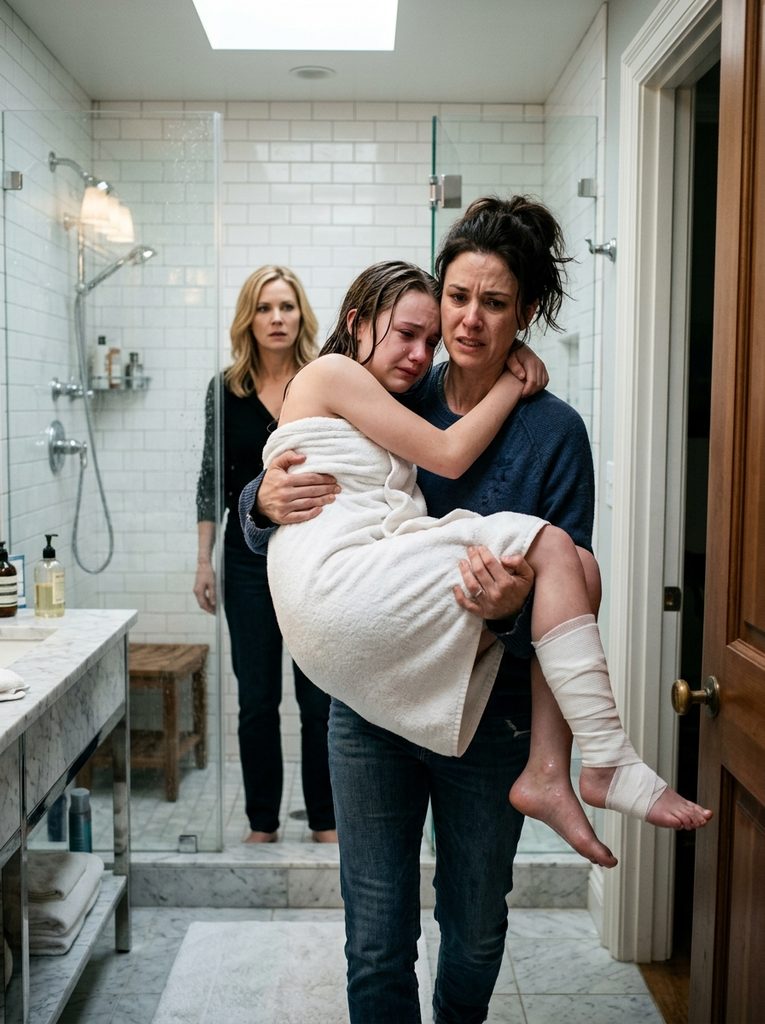
I opened the bathroom door and found my daughter stranded on a shower stool, her injured leg wrapped in waterproof bandage, while her stepmother stood directly in front of her.
In Rachel’s hand was a used menstrual pad held inches from my daughter’s face. Her voice was cold as she said, “Nobody else is going to take you.”
The bathroom light was harsh enough to make everything painfully clear. My daughter, Sophie, gripped the edge of the stool with one trembling hand, desperately protecting her injured leg.
Her cheeks were soaked with tears. She was not screaming or arguing. She was simply sitting there, completely still, as though movement might somehow make everything worse.
For several seconds, nobody noticed me.
Then Sophie looked toward the doorway.
“Dad?”
The word came out barely louder than a whisper.
Rachel spun around.
The expression on her face changed instantly.
“What are you doing home?”
I did not answer.
My eyes remained on Sophie.
“What happened?”
Rachel immediately stepped between us.
“You’re misunderstanding this.”
“Move.”
“David, listen—”
“Move away from my daughter.”
Something in my voice finally made her step aside.
I crossed the bathroom and crouched beside Sophie.
Three weeks earlier, Sophie had fractured her ankle during volleyball practice. Her doctor had ordered limited movement while the injury healed.
She needed crutches around the house and a waterproof protective covering while showering. Rachel knew every instruction because she had attended one appointment with us.
Yet Sophie’s crutches were nowhere inside the bathroom.
“Where are your crutches?”
Sophie looked at Rachel.
That tiny glance told me more than any explanation could have.
I stood.
“Where are they?”
Rachel folded her arms.
“She was being disrespectful, so I put them outside until she learned to stop talking back.”
I stared at her.
“You took mobility aids away from an injured child?”
“She could have called me.”
“With what?”
Silence.
Sophie’s phone was normally beside her constantly.
I looked around.
Nothing.
“Where is her phone?”
Rachel sighed dramatically.
“I confiscated it.”
My stomach tightened.
Then I remembered what I had just seen in Rachel’s hand.
“Why were you holding that near her face?”
Rachel immediately tossed it into the trash.
“That wasn’t what it looked like.”
“Then explain what it was.”
“She made a disgusting mess and refused to clean it.”
Sophie shook her head.
“No, Dad.”
Rachel turned sharply.
“Stop lying.”
Sophie flinched.
I noticed.
Not ordinary surprise.
A practiced reaction.
That frightened me more than Rachel’s words.
I looked at Sophie.
“You can tell me.”
Her lower lip trembled.
“I started my period while showering.”
She looked embarrassed saying it.
“There weren’t any pads in here, and she wouldn’t bring me one.”
My chest tightened.
Sophie continued.
“I couldn’t get downstairs without my crutches.”
Rachel interrupted.
“She was perfectly capable of figuring something out.”
“She has a fractured ankle.”
“She’s fifteen, David. Stop treating her like a baby.”
I ignored her.
“What happened next, Sophie?”
My daughter stared at the floor.
“I asked her for help.”
Her voice became quieter.
“She got angry.”
“Why?”
“Because I called you.”
I reached for my phone.
There were no missed calls from Sophie.
Then I understood.
“You tried calling me?”
She nodded.
“Three times.”
“I didn’t receive anything.”
“She took my phone.”
Rachel stepped forward.
“Because she was deliberately trying to undermine me while you were working.”
I looked at Rachel.
“Get out of the bathroom.”
“Excuse me?”
“Now.”
“This is my house too.”
“And that is my injured daughter sitting there without her crutches.”
Rachel opened her mouth.
I pointed toward the hallway.
“Out.”
She finally left.
I closed the door.
Then I found a clean towel, helped Sophie cover herself comfortably, and retrieved her crutches from the hallway closet where Rachel had hidden them.
I expected Sophie to calm down once Rachel was gone.
Instead, she started crying harder.
“Dad, please don’t leave me alone with her tonight.”
Everything inside me stopped.
I sat beside her.
“I won’t.”
She looked directly into my eyes.
“Promise?”
“I promise.”
That should never have been a difficult promise for a father to make.
Yet the relief on Sophie’s face told me she had desperately needed to hear it.
I helped her dress and brought her downstairs.
Rachel was waiting in the kitchen.
“This has gotten completely ridiculous.”
I walked past her.
“David!”
I helped Sophie onto the sofa and elevated her injured leg exactly as the doctor had instructed.
Then I returned to the kitchen.
“What else has happened?”
Rachel stared at me.
“Nothing has happened.”
“That wasn’t my question.”
“You’re letting a teenager manipulate you.”
I had heard that phrase before.
Many times.
Over the previous year, whenever Sophie complained about Rachel, there was always an explanation.
Teenage attitude.
Jealousy.
Blended-family adjustment.
Hormones.
Boundary testing.
I had believed those explanations because they were convenient.
Rachel and I had married two years earlier.
At first, she and Sophie seemed friendly.
They cooked together.
Watched movies.
Went shopping.
Then gradually something changed.
Sophie became quieter.
She stopped eating dinner with us regularly.
She spent more time in her bedroom.
When I asked why, Rachel said teenagers naturally withdrew from parents.
I believed her.
That realization made me feel sick.
“What else?” I asked again.
Rachel rolled her eyes.
“You seriously believe her over your wife?”
“I believe what I just saw.”
“You walked into one moment without context.”
“Then give me context that makes taking crutches from an injured fifteen-year-old acceptable.”
She had none.
Instead, she attacked Sophie.
“She hates me.”
“No.”
“She has always wanted us divorced.”
“No.”
“She deliberately creates problems whenever you’re not home.”
Something suddenly clicked.
Whenever I was home.
I turned toward the living room.
Sophie was staring at us.
I walked back and sat across from her.
“Does Rachel treat you differently when I’m gone?”
Her eyes immediately filled again.
“Yes.”
One word.
That was enough.
“How long?”
She hesitated.
“Almost a year.”
I felt as though someone had removed the floor beneath me.
“A year?”
She nodded.
“What does she do?”
Rachel entered the room.
“This conversation is over.”
I stood between them.
“No, it isn’t.”
“David, she’s lying.”
I looked at Sophie.
“Keep talking.”
What followed was not one dramatic revelation.
It was dozens of small ones.
Meals withheld because Sophie supposedly had an attitude.
Her bedroom searched without explanation.
School projects thrown away because her desk was messy.
Messages deleted from her phone.
Clothes hidden.
Insults about her appearance.
Threats that I would eventually choose my marriage over my daughter.
Each incident alone could have been dismissed as conflict.
Together, they formed a pattern I could no longer ignore.
Then Sophie said something that shattered me.
“She says Mom died because she wanted to get away from us.”
I stood completely still.
My first wife, Emily, had died from cancer when Sophie was eight.
Rachel knew that.
She knew how deeply Sophie still missed her mother.
“You said that?”
Rachel’s face changed.
“I was angry.”
“You told my daughter her dead mother wanted to escape her?”
“That isn’t exactly what I said.”
Sophie whispered from behind me.
“It is.”
I stopped arguing.
There are moments when discussion becomes pointless because enough information has already been revealed.
I went upstairs.
Rachel followed.
“What are you doing?”
I pulled a suitcase from the closet.
Her expression hardened.
“You cannot be serious.”
I opened it.
“Pack what you need for several days.”
“This is my home.”
“Then I’ll take Sophie somewhere else tonight.”
Rachel stared at me.
“You’re choosing her?”
The question stunned me.
Sophie was my daughter.
There should never have been a competition.
“If you see protecting an injured child as choosing sides, then yes.”
Rachel began crying.
She apologized.
Then blamed stress.
Then blamed Sophie.
Then blamed me for working too much.
Finally, she threatened divorce.
None of it changed what I had seen.
Within an hour, Sophie and I were at my sister Karen’s house.
Karen opened the door wearing pajamas.
One look at Sophie’s face and she stopped asking questions.
“Come inside.”
That night, Sophie slept in Karen’s guest bedroom.
I barely slept at all.
I sat in the kitchen replaying the previous year.
Every warning sign looked obvious now.
But warning signs often become obvious only after someone finally stops explaining them away.
The following morning, I called Sophie’s doctor.
Her ankle was examined again.
Fortunately, no significant additional injury had occurred.
Then I contacted her school counselor.
That conversation revealed another piece.
Sophie’s grades had declined slightly.
She had stopped attending an after-school science club she once loved.
Teachers had noticed she seemed anxious whenever dismissal approached.
Nobody knew why.
I did now.
Over the following days, Sophie slowly told me more.
I never pushed.
I simply listened.
Sometimes the stories seemed almost trivial.
Rachel intentionally washing Sophie’s favorite sweater incorrectly.
Removing family photographs containing Emily.
Criticizing her food.
Calling her ungrateful.
Other stories were harder.
Rachel repeatedly told Sophie that if she complained, I would send her to live with relatives because maintaining my new marriage mattered more.
That lie explained everything.
Sophie had not remained silent because she trusted Rachel.
She remained silent because she was afraid of losing me.
And I had unknowingly helped create that fear by dismissing earlier complaints as normal teenage conflict.
That truth hurt.
I apologized to Sophie.
Not once.
Many times.
“I should have listened sooner.”
She looked at me quietly.
“I thought you were happy.”
“That never makes what happened acceptable.”
“I didn’t want to ruin your marriage.”
“You are not responsible for my marriage.”
That became something I repeated until she finally seemed to believe it.
My relationship with Rachel ended.
There were arguments, attorneys, accusations, and long conversations I never imagined having when we exchanged wedding vows.
But the most important decision had already been made inside that bathroom.
My daughter would not be left alone with someone she feared.
Months passed.
Sophie’s ankle healed.
The crutches disappeared into the garage.
She returned to science club.
Her grades improved.
Slowly, laughter returned to our house.
One Saturday afternoon, I found her sitting at the kitchen table surrounded by wires, sensors, and pieces from an old robotics kit.
For a moment, I simply watched.
She looked up.
“What?”
“Nothing.”
“You’re staring.”
“I missed seeing this.”
She smiled.
Then she handed me a screwdriver.
“Make yourself useful.”
I laughed.
That ordinary afternoon meant more to me than she understood.
People sometimes imagine protecting their children requires recognizing obvious danger immediately.
I wish that were always true.
Sometimes danger arrives gradually.
It hides behind reasonable explanations.
It calls cruelty discipline.
It calls humiliation correction.
It calls isolation boundaries.
And sometimes a parent desperately wants peace so badly that he accepts explanations he should have questioned.
I cannot change the year Sophie spent believing she had to remain silent.
I cannot erase the things Rachel said.
But I can make sure my daughter never doubts one thing again.
She has somewhere to go.
She has someone who will listen.
She has a home where asking for help is never treated as weakness.
Several months after that afternoon, Sophie came downstairs carrying the waterproof covering that had once protected her injured ankle.
She held it up.
“Can I throw this away?”
“Absolutely.”
She dropped it into the trash.
Then she paused.
“Dad?”
“Yeah?”
“Thanks for opening the bathroom door that day.”
My throat tightened.
“I should have opened my eyes much earlier.”
She hugged me.
For several seconds, neither of us spoke.
I remembered exactly how she had looked beneath that harsh bathroom light, stranded on the stool and terrified that nobody would believe her.
Then I looked at her now.
Standing confidently.
Laughing again.
Planning for college.
Arguing about music.
Leaving robotics equipment across my kitchen table.
Being fifteen.
Exactly as she should have been allowed to be.
That bathroom door became the dividing line between two versions of our family.
Before it, I believed keeping everyone together meant preserving peace.
After it, I understood something far more important.
A family is not protected by keeping every relationship intact.
Sometimes protecting a family means ending the relationship that is hurting someone inside it.
And whenever I remember Rachel telling Sophie she had nowhere to go, I remember the promise I made while kneeling beside my daughter.
She was wrong.
Sophie had somewhere to go.
She had me.
And I would spend the rest of my life making sure she never had reason to doubt that again.