The scent of stargazer lilies will forever make my stomach turn.
My name is Joyce Peterson. I am thirty-eight years old, and for the entirety of my adult life, I have been a registered nurse. Exactly six days before the world as I knew it collapsed, I had stood in a sunlit bedroom, gently washing my dying grandmother’s hair in a basin of warm, lavender-scented water. I remember the fragility of her scalp beneath my fingertips, the way she hummed a tuneless melody as the suds rinsed away.
Less than a week later, I stood in the fellowship hall of Grace Lutheran Church in Kettering, Ohio, surrounded by eighty relatives, listening to my mother publicly dismantle my life.
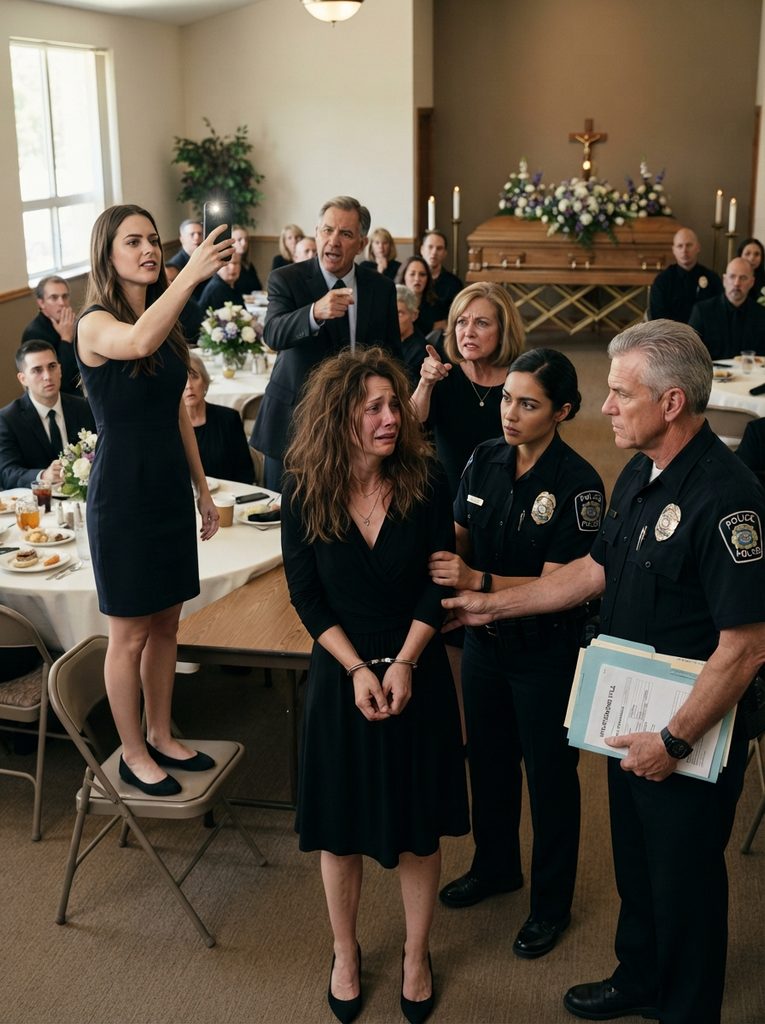
The funeral service had concluded. The luncheon was underway. I had just picked up a heavy cardboard box of my grandmother’s photo albums, adjusting the strap of my black tote bag over my shoulder, intending to slip out the side door. That was when my father, Dale Peterson, marched back into the hall from the parking lot. He wasn’t alone. Flanking him were two uniformed police officers.
The low hum of eighty Voss family members chewing on ham sandwiches and reminiscing ground to an agonizing, immediate halt.
“That’s her,” my father barked, his finger thrusting through the stale church air, pointing directly at my chest. “There has been a sworn complaint on file since yesterday afternoon, and she is attempting to carry my mother’s stolen property out the door right now.”
I froze. The heavy box of memories dug into my ribs. The silence in that room was absolute, a suffocating vacuum that swallowed all the air.
My mother, Caroline, rose slowly from the family table. She held a light blue folder, the tab on the side neatly labeled Joyce in her immaculate, looping cursive. She didn’t look at me. She handed the folder to the older of the two cops, an officer whose silver name tag read Kessler.
Then, she pivoted to face the crowd. Because, in my family, the crowd was always the entire point.
“She stole from a dying woman,” my mother announced, her voice pitched with that perfect, trembling vibrato of a grieving daughter. “She is a nurse. She knew exactly what she was doing. She took the wedding ring right off her hand.”
A collective gasp rippled through the folding chairs. I set the cardboard box down on the linoleum floor. My mind raced, trying to form a defense, but I could only manage the single, most crucial truth I had breath for.
“I hold her power of attorney,” I said, my voice shaking but loud enough to carry.
My father didn’t let the sentence breathe. “Forged!” he shouted, stepping closer. “She is a registered nurse. She knows exactly how to manipulate a confused, vulnerable old woman. She isolated my mother. She was alone with her every single day. Nobody else was allowed in that house.”
That last part was a line he’d stolen directly from my mother, a narrative they’d been workshopping for months.
Officer Kessler flipped open the blue folder. From where I stood, I could see bank statements mutilated by thick strokes of yellow highlighter, alongside a page bearing a notary’s embossed stamp. He scanned the documents for a long, torturous moment. Then, he looked up, his gaze shifting from the papers to me, and finally to the eighty people watching him with bated breath.
“Ma’am,” Kessler sighed, his voice heavy with the weight of the room. “I’m going to need you to come with us.”
“Handcuff her,” my father demanded, stepping into the officer’s space. “Walk her past the casket. I want everyone to see what she is.”
Kessler didn’t verbally reply, but he reached to his belt. The metallic rasp of the cuffs sliding from their pouch echoed off the high vaulted ceiling. The steel was ice-cold against my wrists—wrists that, just days prior, still carried the faint scent of the shampoo I’d used on the woman currently lying in the sanctuary.
As they clicked shut, a scraping sound drew my attention. My older sister, Brittany, the golden child who had never once made my father repeat a command, had climbed onto a metal folding chair. Her smartphone was hoisted high above the crowd, the red recording light blinking like a beacon.
“For everyone asking in the group,” Brittany narrated, her tone bright, performative, and utterly venomous. “Yes, this is my sister. Yes, she is a nurse. Though, not for much longer.” She paused, reading something off her screen. “Thank you, Jessica. Yes, it’s disgusting.” She tilted the lens straight down at my face as I was paraded past her. “Say goodbye to your career, Joyce. Grandma died ashamed of you.”
I didn’t argue. I didn’t scream. Silence was the only defense in that room they could not edit in post-production.
As Kessler steered me toward the double doors leading into the dim sanctuary, my father leaned in close to the officer. The microphone on a phone held high by a woman standing ten feet away is a remarkably sensitive piece of technology.
I heard my father’s hushed, urgent whisper.
“Cuff her before she gets to that lawyer of hers.”