The Forensic Ledger of a Dying Vow
Chapter 1: The Congealed Feast
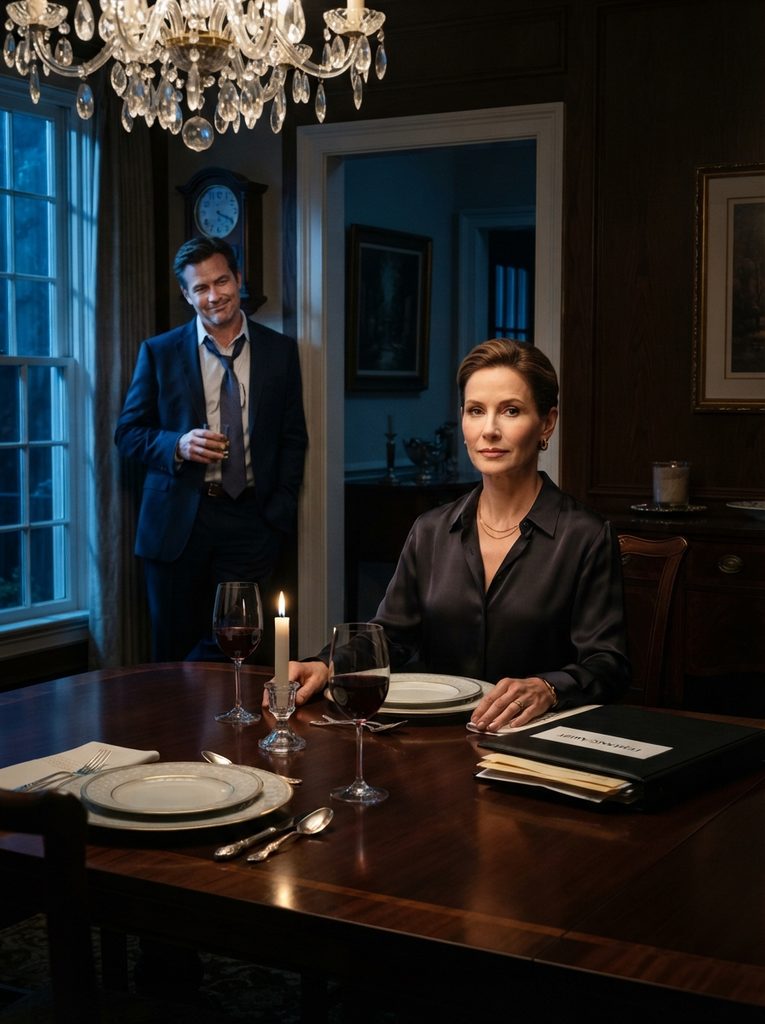
The silence of an empty home has its own acoustics. For fourteen consecutive hours, that silence had reverberated against the wainscoting of our dining room, punctuated only by the rhythmic, mechanical click of the grandfather clock in the foyer. Seven o’clock had arrived and vanished. Eight o’clock passed with the dying hum of rush-hour traffic along the boulevard. Ten o’clock brought a chill that crept beneath the doorframe. By midnight, the world outside was as dormant as the graveyard three miles east, but I remained seated at the head of the mahogany table, motionless, watchful, and entirely awake.
Before me sat the monument to an illusion. The slow-braised beef short ribs I had set to simmer before sunrise were long past salvation. The rich, velvety reduction of burgundy, shallots, and rosemary had cooled into a gelatinous, purple-black ring around the gilded perimeter of my grandmother’s heirloom bone china. The tapered ivory candles, lit at a quarter to six with a hope that now felt distinctly theatrical, had burned down into misshapen, waxy corpses drowning in their own tallow. Across the linen runner, a centerpiece of white gardenias—cut fresh from the courtyard that morning—had begun to brown at the edges, suffocated by the stale, conditioned air of an unconsummated anniversary. Seven years of marriage had distilled down to this tableau: two plates, two silver forks, two lead-crystal goblets filled with unsipped Cabernet, and one woman keeping vigil over a corpse.
At precisely 12:47 in the morning, the heavy iron latch of the front door clicked.
The door did not swing open with the sheepish creak of a contrite husband. It yielded with the deliberate, heavy shove of a conqueror returning to an outpost he had already decided to burn. Nathaniel crossed the threshold into the foyer, his polished Oxfords clicking against the herringbone white oak floors we had hand-selected in a salvage yard outside Austin seven summers ago. He did not call out my name. He did not loosen his tie with an exhausted sigh. He stood beneath the chandelier, rolled his shoulders, and smirked.
It was the expression of a gambler who believed he had palmed the deck.
He strolled toward the dining room, trailing a scent that hit me before his shadow crossed the archway: small-batch Kentucky bourbon, woodsmoke, and a cloying, narcotic perfume laced with jasmine and tuberose—a fragrance that retailed for six hundred dollars an ounce and belonged to no one in my ancestral lineage. He was wearing his charcoal three-piece suit, the bespoke wool ensemble I had purchased for his thirty-fourth birthday to bolster his confidence among senior partners. He looked immaculate. He looked exhilarated. He looked like a man intoxicated by the audacity of his own treason.
He leaned an elbow against the fluted wood of the doorframe, crossing one ankle over the other. The smirk deepened, tugging at the corner of a mouth I had kissed ten thousand times.
“Still awake, Teresa?” he murmured, his baritone thick with artificial amusement. “You always were stubborn about your schedules.”
I said nothing. I did not shift my posture. I merely watched him with the clinical, unblinking focus that had sustained me through a decade of interrogating high-tier tax conspirators.
“I suppose you want the routine,” he continued, taking two measured steps toward the table and resting his knuckles against the edge of the mahogany. “The frantic story about a stranded client on the tarmac at Bush Intercontinental. The dead phone battery. The desperate sprint to make it home before the clock struck twelve. But I think we’re past the point of insulting each other’s intelligence, aren’t we?”
He waited for me to demand an explanation. He waited for the voice to waver, for the tears to prick the corners of my eyes, for the physical tremor that signals the onset of emotional collapse. I gave him the stillness of granite.
“Her name is Cordelia Marsh,” he said, rolling the syllables over his tongue as though savoring a rare vintage. “Yes, that Cordelia Marsh. Chief Executive of Marsh Development Holdings. We’ve been seeing each other since last autumn. Nearly a full year, Teresa.”
He straightened up, his chest swelling beneath the tailored vest. “She understands the calculus of this city. She moves eighty-million-dollar capital investments with a signature while you’re busy filing paperwork for civil servants. With her, I’m not just a cog in an acquisitions firm; I’m the architect of a skyline. She makes me feel like a man who actually matters. And I am not going to apologize for it. I haven’t felt a single second of regret since the night it started.”
He leaned in closer, desperate for an impact. He wanted the shattered goblet. He wanted the shrill, theatrical scream, the fingernails raking across linen, the classic, desperate plea of a blindsided wife. Nathaniel had spent seven years operating under the domestic assumption that control belonged to whoever held the loudest voice in the room. He had scripted this grand, devastating reveal on his drive across the Westloop, anticipating every beat of my destruction.
I leaned forward. With a steady hand, I picked up my silver salad fork. I sliced a small, cold piece of the braised short rib, dragged it through the congealed wine reduction, and lifted it to my lips.
I chewed thoroughly. The fat was cold and waxen, but I swallowed it with deliberate ease.
I laid the fork down with a barely audible chime against the china. I took my linen napkin, dabbed the corners of my mouth, folded the fabric into a sharp rectangle, and rose from my chair. Without acknowledging his presence by so much as an inch of eye contact, I picked up my plate and my wine glass, walked steadily past his shoulder, and stepped into the kitchen.
Behind me, the smirk evaporated into an indignant gasp.
“Teresa!” he barked, his heavy leather soles pivoting abruptly as he pursued me across the threshold. “Did you hear a word I just said to you? Stop acting like an automaton! Your husband just told you his marriage is over, that he’s been sleeping with the most powerful developer in southeast Texas, and you’re clearing the damn dishes?”
I turned on the brushed-brass faucet, watching the stream of hot water soften the grease on grandmother’s china.
“You are emotionally dead,” Nathaniel sneered, his voice climbing an octave, vibrating with the rage of an actor whose audience had stood up and walked out before the second act. “Cold. Methodical. Hollow. This is why I strayed, Teresa! This exact, suffocating, robotic detachment! You care more about federal dockets and spreadsheets than you ever cared about your own flesh and blood. Cordelia breathes fire. You’re just a block of ice with a government badge.”
I turned the brass knob, shutting off the water. I dried my hands on a crisp linen tea towel, hung it neatly over the handle of the oven, and walked past him into the hallway.
“Answer me!” he roared, lunging forward to grab my forearm.
I did not flinch; I simply turned my head, my eyes locking onto his wrist with the cold, assessing weight of an executioner measuring a neck. He froze, his fingers hesitating an inch from my skin before dropping back to his side. He knew that look. He had seen it only twice before—once when a drunk at a charity gala attempted to put hands on me, and once when an armed subject tried to run a roadblock outside Beaumont.
“Sleep in the master suite if you wish,” I said, my tone as level as a freshly poured foundation. “I will be in the guest wing.”
I entered the study, pulled the solid oak door shut, and turned the heavy brass deadbolt until it settled into the frame with an authoritative, metallic thud.
He believes he is the protagonist of a tragedy, I thought, letting out my first breath of the evening. He doesn’t realize he is merely the subject of an indictment.