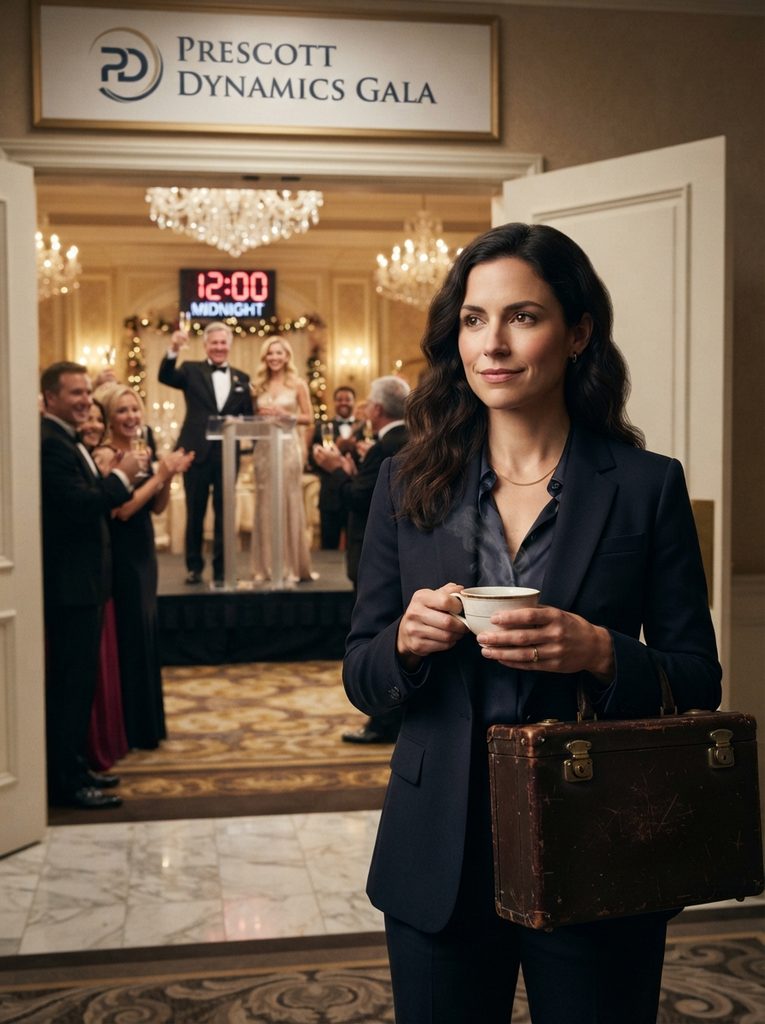
My Father Banned Me From His New Year’s Eve Gala Because “You Make Everyone Uncomfortable.” At Midnight, He Raised A Glass To His “Perfect Family.” At 12:01 A.M., My Sister Called Me Sobbing: “What Did You Do? Dad Saw The News—He Can Barely Breathe!” I Took A Sip Of Tea And Said, “He Found Out Too Late.”
My father banned me from the most important New Year’s Eve celebration our family had ever hosted because, according to him, I made people uncomfortable. He expected me to spend midnight alone while my stepsister was publicly crowned as his successor. Instead, I sat in my apartment with my late mother’s leather briefcase beside me and watched their gala live. At exactly 12:01 a.m., my stepsister called, sobbing, “What did you do?” By then, what my father had hidden for years was already on every screen in the ballroom.
### Part 1
The message from my father arrived at 10:07 on the morning of December 30 while I was standing in the operations warehouse holding a clipboard and arguing with a freight company about forty-seven missing refrigeration components. The loading bay smelled like cardboard, diesel exhaust, and burnt coffee, and somewhere behind me a forklift kept making that sharp electronic beep that gets inside your skull after an hour. I glanced at my phone expecting another vendor complaint and found eight words from the man who had raised me: “Don’t come tomorrow. You make everyone uncomfortable.”
For a few seconds, I honestly thought he had sent it to the wrong person. Tomorrow was the annual Prescott Dynamics New Year’s Eve gala at the Bellweather Hotel, a two-hundred-guest event attended by clients, board members, suppliers, local reporters, investors, and employees who had been saving cocktail dresses and tuxedos for months. My mother had started the tradition when I was twelve, back when Prescott Dynamics was still operating from a converted machine shop and the “gala” meant folding tables, supermarket champagne, and my mother taping silver paper stars to the walls herself.
I called my father before I could talk myself out of it. He answered on the fourth ring with music playing behind him and said, “Megan, I’m in the middle of something,” as though I had interrupted him instead of responding to his command. “You told me not to attend the company gala,” I said. “I want to hear you say why.”
He sighed so deeply that I could picture him rubbing the bridge of his nose. “Because every year you show up looking miserable, you sit there like somebody forced you to come, and people notice. This year needs to feel optimistic.” I looked down at my steel-toed shoes, the navy sweater I had worn because our warehouse heater had failed again, and the grease mark on my wrist from crawling beneath a damaged conveyor that morning. “So optimism has a dress code now?”
“Don’t make this difficult,” he said. “Lauren will represent the family. She understands how to work a room.” Lauren was my stepsister, thirty years old, photogenic, socially effortless, and somehow senior vice president of strategic development despite occasionally asking me what EBITDA meant. She had joined Prescott Dynamics three years earlier after leaving an event-planning company and had immediately received an office twice the size of mine.
I said, “Mom helped create that gala.”
The silence changed.
My father’s voice hardened. “Your mother has been gone for five years, Megan. At some point, you need to stop using her as a reason to resist every change.”
That landed exactly where he intended it to. I stared through the open loading dock at a pale December sky and remembered my mother, Diane Prescott, wearing safety glasses over her reading glasses because she always forgot to switch them. She had been an engineer before she was a founder, the kind of woman who could discuss licensing strategy with a lawyer and then spend twenty minutes helping a technician diagnose a jammed press.
“I’m not resisting change,” I said. “I’m working.”
“And Lauren is leading.”
There it was.
Tomorrow night wasn’t simply a party. I had heard whispers for weeks that my father intended to announce Lauren as executive vice president and “future leader” of Prescott Dynamics. He had never discussed it with me, even though I had spent nine years in the company and currently managed the operations teams responsible for almost forty percent of our annual revenue.
My father continued, softer now, using the tone he always used when he wanted cruelty to sound reasonable. “Stay home tomorrow. Enjoy yourself. Order something good. Start the new year without turning everything into a conflict.”
“You’re telling me not to attend my own family’s company celebration because my presence bothers you.”
“You make people uncomfortable,” he repeated. “I’m trying to avoid a scene.”
I almost laughed.
I had never caused a scene at one of those events. What I had done was refuse to laugh when Lauren claimed credit for projects she hadn’t touched. I had corrected my father when he exaggerated quarterly numbers in front of vendors. I had declined to pose for a “family leadership” photograph after discovering my mother’s name had been removed from the company history display in the lobby.
Apparently accuracy had become uncomfortable.
“Fine,” I said.
My father paused, probably surprised. “Fine?”
“I won’t come.”
“That’s the mature choice.”
He hung up.
I stood still long enough for one of my supervisors, Carlos Medina, to approach and ask, “You okay?” Carlos had worked with my mother during the early years and had the unnerving ability to read my face before I knew what expression I was making. I slipped my phone into my pocket and said, “Apparently I’ve been given New Year’s Eve off.”
He studied me but didn’t push. “Then take it.”
.
“I might.”
What my father didn’t know was that I had already started taking something else.
Six days earlier, on Christmas Eve, I had gone to the old family house to retrieve a box of ornaments my mother had left me. My father and his wife, Patricia, were attending a charity dinner, which meant I had the attic to myself without Patricia following me around asking whether I “really needed” things that had belonged to my mother.
The attic smelled like cedar boards and dust. I found the ornament box behind a broken lamp, but when I dragged it forward, the corner caught on something wedged beneath an old cedar chest. It was my mother’s leather briefcase.
Dark brown. Scratched near the handle. Brass latches.
I recognized it instantly.
My father had spent nearly a year looking for that briefcase after Mom died.
He claimed it contained old insurance documents.
That afternoon, alone beneath a bare attic bulb, I discovered he had lied about that too.
The combination was three numbers. I tried Mom’s birthday first and nothing happened, then mine.
Click.
Inside were folders, certificates, a small flash drive, two handwritten notebooks, and a sealed envelope with my name on it.
I had only read the first page of the envelope before I stopped breathing normally.
My mother hadn’t left me sentimental letters.
She had left me leverage.
.
And after my father told me to stay away from New Year’s Eve, I finally understood why he had spent five years making sure I never knew it existed.
### Part 2
I didn’t confront him.
That surprised even me.
For years, whenever my father hurt me, I reacted first and thought later. I challenged him in hallways, sent long emails he ignored, and once walked out of Thanksgiving dinner after Patricia announced that Lauren should inherit my mother’s jewelry because “she actually attends formal events.” Every reaction became evidence in the family story that Megan was emotional, difficult, jealous, still grieving, unable to move on.
So on Christmas Eve, sitting cross-legged on the cold attic floor, I forced myself to do the one thing they never expected from me.
I became quiet.
The envelope contained a letter written in my mother’s precise handwriting, along with copies of legal documents I only partly understood. She explained that during the final year of her illness, she had reorganized her ownership in Prescott Dynamics because she had grown concerned about “future dilution of founding control.” My father had always presented himself publicly as the company’s principal founder, but Mom’s records told a different story.
She had owned fifty-one percent.
More importantly, months before she died, she had transferred those shares into an irrevocable family trust.
The sole beneficiary was me.
The acting trustee was an attorney named Graham Hale.
I knew the name. Mr. Hale had attended my mother’s funeral and disappeared from our lives shortly afterward. My father once called him “an ambulance-chasing parasite” when I asked why he had stopped handling company business.
At 8:15 the morning after Christmas, I called the number printed on a yellowed business card inside the briefcase.
A receptionist answered.
“Graham Hale’s office.”
I nearly hung up. Instead I said, “My name is Megan Prescott. I’m Diane Prescott’s daughter.”
The silence on the other end lasted perhaps two seconds, but it felt much longer.
Then the receptionist said, “Ms. Prescott, Mr. Hale has been waiting for this call for five years.”
I met him on December 27 in an office on the thirty-third floor of a glass building downtown. Graham Hale was in his late sixties, silver-haired, thin, and so composed that I immediately understood why my father hated him. His office smelled faintly of leather and coffee, and the city beneath his windows looked clean and distant beneath winter sunlight.
He spread the documents across a conference table and spent nearly three hours explaining them.
My mother had anticipated resistance.
The trust could not be revoked by my father, Patricia, the board, or even me. My mother’s fifty-one-percent interest remained legally intact, and because I had reached the required age stated in the trust two years earlier, certain control rights should already have been activated.
“Should have been?” I asked.
Graham leaned back. “Your father represented to the board that Diane’s controlling shares were tied up in unresolved estate litigation.”
“They weren’t?”
“No.”
“So everybody believed him?”
“Not everybody.”
That was the first moment I understood the problem was larger than inheritance.
Graham opened another folder. Inside were corporate resolutions, bank records, and emails printed in chronological order. He explained that one former finance officer had contacted him two years earlier after noticing unusual transactions, but she resigned before gaining access to the underlying accounts. Recently, a second whistleblower had sent supporting records.
I scanned a page filled with transfers between Prescott Dynamics, a consulting company owned by Patricia, and several holding accounts. The amounts were not small.
“What is this?”
“That,” Graham said, “is why I strongly recommend you do nothing impulsive.”
Over the next forty minutes, he showed me payments for renovations on my father’s lake house billed as “executive client facilities,” luxury travel charged to business development, Lauren’s personal apartment deposit disguised as a relocation expense, and a six-figure consulting arrangement paid to a company Patricia had formed only weeks earlier.
My stomach turned.
I had spent the previous year cutting overtime, renegotiating vendor contracts, and telling employees we couldn’t replace aging equipment because cash flow was tight.
Meanwhile, they had been using company money like a private checking account.
“Does Dad know you have this?”
“Your father knows questions have been raised. He does not know what we have.”
I stared at the city beyond the glass.
“Can we stop him?”
Graham folded his hands. “Yes.”
That answer came too easily.
“How?”
“With your authority under the trust, combined with sufficient evidence, we can demand an emergency board review. Depending on what the audit confirms, the board could suspend him.”
I thought of Lauren’s gala announcement.
“Tomorrow night he’s going to introduce her as the company’s future leader.”
Graham nodded. “I know.”
“You know?”
He slid a printed internal memo toward me. It described a proposed restructuring to be announced at midnight on New Year’s Eve. Lauren would receive expanded executive authority and a new stock incentive package, while several voting procedures would be changed.
My father wasn’t merely promoting her.
He was trying to build a structure around himself before my mother’s trust could surface.
“Can he dilute my shares?”
“Not lawfully under the existing agreements. But if nobody challenges the representations being made, confusion becomes useful.”
That sounded exactly like my father.
For years he hadn’t needed to erase me officially. He had simply moved me farther from information, meetings, and decisions until everyone assumed I didn’t belong near them.
“What do you need from me?” I asked.
“Patience.”
I laughed once. “Everybody keeps asking me for that.”
“This time it serves you.”
We arranged a forensic review. Graham brought in a former federal financial investigator named Helen Park and a corporate governance specialist. I spent December 28 answering questions about projects, approvals, passwords, internal cost centers, and people who had quietly disappeared from the company after disagreeing with my father.
By December 29, Helen had found enough to make my skin cold.
The suspicious transactions weren’t random.
Someone had systematically moved money through categories I controlled operationally but could not authorize financially, making it look as though losses belonged to my division.
“They were preparing a narrative,” Helen said.
“What narrative?”
“That operations were deteriorating under you.”
I sat back.
Suddenly the comments from my father made sense. His complaints about my “poor leadership energy.” Lauren mentioning at Thanksgiving that maybe I would be happier “somewhere smaller.” Patricia asking whether I had considered taking a year off to travel.
They hadn’t simply been sidelining me.
They were preparing to blame me.
That night I barely slept.
Then, the next morning, my father sent his message banning me from the gala because I made everyone uncomfortable.
By lunchtime, Graham called.
“We confirmed the last piece.”
I closed my office door. “What piece?”
“Your father’s team prepared a board packet for tomorrow night. After Lauren’s announcement, they intend to recommend removing you from operations in January.”
I watched snow spit weakly against my window.
“For cause?”
“Operational mismanagement.”
I almost admired the symmetry.
They were going to use money they had taken to prove that I had failed.
“What happens if we act before the gala?” I asked.
“We can seek immediate relief.”
“And if we wait until midnight?”
Graham was quiet.
Then he understood.
“Megan.”
“They want a public announcement,” I said. “Let them have one.”
### Part 3
Graham argued with me for nearly twenty minutes.
Not because what I proposed was illegal, but because lawyers generally prefer controlled rooms, careful language, and outcomes that don’t unfold beneath chandeliers in front of two hundred witnesses. I wasn’t asking him to embarrass anyone for entertainment. I wanted every corporate filing, board resolution, and leadership change to become effective at the precise moment my father believed he was finalizing mine.
“If we proceed,” Graham said, “this must be governance, not theater.”
“Agreed.”
“You do not touch their event systems.”
“I don’t need to.”
He studied me.
The Bellweather gala had a financial-news display integrated into the ballroom’s media system because Prescott Dynamics was a publicly followed regional manufacturer with several institutional investors. At midnight, the event traditionally displayed market headlines, company announcements, and a prerecorded corporate message.
If our board action became official at midnight, the news would travel without my help.
I didn’t need to hijack a screen.
I only needed to stop protecting my father from reality.
The emergency board process began quietly that afternoon. Three independent directors received sealed evidence packets through outside counsel. Two called Graham within an hour. One called me directly.
Her name was Judith Lane, a retired aerospace executive who had known my mother for twenty years.
“Megan,” she said, “why didn’t you bring this to me sooner?”
“Because until six days ago, I didn’t know the trust existed.”
There was a long breath on the line.
“Your father told us Diane’s interest was tied up indefinitely.”
“I know.”
“And you’re certain these documents are authentic?”
“They’ve been verified.”
Judith’s voice changed from shock to something colder. “Then we have a serious problem.”
By six that evening, the independent directors had authorized an emergency audit session for the following day. My father was informed only that governance concerns had been raised and that outside counsel required preservation of financial records.
He called me at 6:42.
I let it ring.
He called again.
Then Patricia texted: “Your father says you’re stirring things up at work. Please don’t punish everyone because you’re upset about the party.”
That message almost made me smile.
Even now, they thought the party was the center of my world.
I put my phone facedown and continued reviewing transaction reports with Helen.
The deeper we looked, the uglier it became. Patricia’s consulting company had billed Prescott Dynamics hundreds of thousands of dollars for branding work that several employees said had never occurred. Lauren’s “strategic travel” included resort stays, private dinners, spa charges, luxury car services, and a weeklong European trip scheduled during a period when she had told the office she was visiting clients in Chicago.
Then Helen found something that made even Graham swear under his breath.
My father had used my digital approval code on two internal transfer authorizations.
I stared at my initials beside transactions I had never seen.
“How?”
“Your executive credentials were accessed from headquarters on days your badge records show you were at the West Plant,” Helen said.
I remembered both days. One had been an equipment inspection. The other was a fire-suppression compliance audit.
“Who logged in?”
“We’re tracing it.”
For the first time, anger overpowered strategy.
I stood so quickly my chair rolled into the wall. “He was willing to put my name on it.”
Graham said, “Sit down.”
“I’m not sitting down.”
“Megan.”
I pressed both palms against the conference table and stared at those signatures.
My father hadn’t merely chosen Lauren over me. He hadn’t simply allowed Patricia to erase my mother from photographs or humiliated me at dinners.
He had prepared a paper trail that could make me look complicit.
Or responsible.
Graham waited until I finally sat.
“This is why your mother created the trust.”
I looked at him.
“You think she knew he was capable of this?”
“I think Diane understood personalities extremely well.”
That evening, he gave me one of my mother’s notebooks from the briefcase.
Most pages were engineering calculations, patent notes, supplier names, and meeting reminders. But near the back, written about nine months before she died, was a single paragraph:
Robert loves the company, but sometimes I fear he loves being seen as the man who built it more than he loves what we actually built. Megan sees the work. That matters.
I read it three times.
My father’s name was Robert.
For five years I had wondered whether Mom would have been disappointed by how little power I had, how often I stayed quiet, how easily I let myself become invisible.
Instead, she had seen exactly who I was.
And apparently exactly who he was.
The emergency board meeting began at 3:00 p.m. on December 31 by secure video. I sat beside Graham in his office while Judith and two other independent directors appeared on screen.
My father joined from a suite at the Bellweather Hotel.
He wore his tuxedo shirt with the collar still open.
His face changed when he saw me.
“What is she doing here?”
Judith answered before I could. “Ms. Prescott is participating as controlling beneficiary under the Diane Prescott Family Trust.”
My father went completely still.
Then he laughed.
Not because anything was funny.
Because denial was his first instinct whenever reality arrived without permission.
“That trust has no operative authority.”
Graham said, “It does.”
My father looked at me.
I had never seen fear appear on his face so quickly.
“You found the briefcase.”
There it was.
Confirmation.
Not surprise.
Recognition.
“You knew,” I said.
He recovered almost immediately. “I knew your mother had some old documents. I also knew she was heavily medicated and confused near the end.”
My entire body went cold.
Graham interrupted. “We will not characterize Diane Prescott’s legal capacity without evidence. Her trust was executed months before her final hospitalization, witnessed independently, and repeatedly reviewed.”
My father’s jaw tightened.
For the next two hours, auditors walked the board through transfers, false expense classifications, unauthorized access to my credentials, and Patricia’s consulting contracts. My father blamed accounting. Then Patricia. Then junior employees. Then “administrative sloppiness.”
When Lauren’s expenses appeared, he called them legitimate business development.
Judith asked, “Was a six-thousand-dollar designer handbag necessary to secure a client?”
My father said nothing.
At 5:27 p.m., the independent board members voted to suspend him from executive authority pending a full investigation.
The vote became effective at midnight.
My father stared at the screen.
Then at me.
“This is what you wanted?”
“No,” I said.
“What do you call this?”
“I call it what happens when records finally get read.”
His face twisted.
“You’re humiliating this family.”
I almost reminded him that twelve hours earlier he had banned me from attending because I embarrassed him.
Instead, I said, “You should get ready. Your guests are arriving.”
For once, my father had no response.
At 11:41 that night, I was sitting on my couch in an old gray sweater with a mug of peppermint tea, watching the gala livestream on my laptop.
My mother’s leather briefcase rested beside me.
Onscreen, Lauren was glowing in a gold dress beneath crystal chandeliers, smiling for cameras as though the emergency board meeting had never happened.
And when my father stepped onto the stage at 11:58, microphone in hand, I realized something disturbing.
He was still planning to make the announcement.
### Part 4
The ballroom looked exactly the way my father liked the world to look: polished, expensive, and obedient.
Tall arrangements of white roses surrounded the stage. Silver balloons floated near the ceiling, waiters moved between tables carrying champagne, and a jazz quartet played beneath a staircase wrapped in tiny lights. On the screen behind my father, a glossy video showed factory floors, product launches, smiling employees, and my father shaking hands with politicians and executives.
My mother appeared nowhere.
Neither did I.
I should have been angry.
Instead, I felt strangely calm.
My father adjusted his cuff and smiled at the room.
“Ladies and gentlemen, friends, partners, and members of the Prescott Dynamics family, tonight is about looking forward.”
People applauded.
Beside the stage, Patricia sat with one hand resting on Lauren’s arm. She wore emerald silk and my mother’s diamond drop earrings.
I recognized them immediately.
My father had told me they were lost.
The sight of those earrings hurt more than I expected.
Not because I wanted the jewelry.
Because stealing a dead woman’s place apparently hadn’t been enough. Patricia had needed her things too.
My father continued. “Every successful company eventually reaches a moment when a new generation must step forward.”
Lauren lowered her eyes with rehearsed modesty.
The camera zoomed toward her.
I checked the clock.
11:59:17.
My phone buzzed.
A text from Graham.
“Final filing accepted. Effective 12:00.”
Another appeared from Judith.
“Do not engage with Robert tonight.”
I smiled faintly.
I had no intention of engaging with anybody.
My father lifted his champagne glass.
“It gives me enormous pride to recognize Lauren Whitmore as—”
The countdown animation appeared behind him.
The crowd cheered.
Ten.
Nine.
Lauren rose.
Eight.
Patricia kissed her cheek.
Seven.
My father laughed and motioned for everyone to stand.
Six.
I wrapped both hands around my mug.
Five.
For years, I had imagined justice as something loud. A slammed door. A courtroom speech. My father finally apologizing in front of everyone he had convinced that I was the problem.
Four.
I had been wrong.
Justice sounded like a clock.
Three.
Two.
One.
The ballroom erupted.
Confetti cannons fired.
People shouted, “Happy New Year!”
My father hugged Lauren.
Patricia raised both arms.
And my laptop clock changed to 12:00.
For roughly fifteen seconds, nothing happened.
I felt my stomach tighten.
Then the corporate display behind my father changed automatically from the countdown to its scheduled financial-news feed.
A banner appeared.
PRESCOTT DYNAMICS ANNOUNCES EMERGENCY GOVERNANCE RESTRUCTURING.
My father turned.
The smile disappeared from his face.
The ballroom noise thinned unevenly as people noticed the screen.
Another line appeared beneath it.
CEO ROBERT PRESCOTT SUSPENDED PENDING INDEPENDENT FINANCIAL INVESTIGATION.
Someone near the front said, “What the hell?”
The camera operator stopped moving.
Then the next headline populated.
DIANE PRESCOTT FAMILY TRUST CONFIRMED AS 51% CONTROLLING INTEREST.
My name appeared beneath it.
Megan Prescott.
The room went quiet so quickly that the jazz musicians actually kept playing for several seconds before realizing nobody else was making noise.
My father stared at the screen.
Behind him, an automated market-news narrator began reading the filing in a smooth, indifferent voice.
The filing did not accuse anyone of crimes. Graham had been meticulous about that.
It reported facts.
An independent investigation had identified unauthorized related-party transactions, disputed executive expenses, irregular access to company credentials, and financial controls requiring immediate review.
That was enough.
Guests reached for phones.
Investors opened news alerts.
Employees began whispering.
Lauren stood beside her chair, frozen.
Then one of the display panels rotated to a list of board actions.
Robert Prescott — suspended.
Patricia Whitmore Consulting — contracts frozen.
Lauren Whitmore — proposed promotion withdrawn pending review.
My father stepped backward.
For the first time in my life, I saw him without the force field of certainty around him.
He looked old.
Not weak.
Not innocent.
Just suddenly unable to control what everyone else was allowed to know.
Patricia reached for him, but he pulled away.
Lauren stared down at her phone as messages flooded the screen.
Someone in the ballroom shouted a reporter’s question.
The livestream audio became chaotic.
My father grabbed the microphone.
“There has clearly been a misunderstanding.”
That sentence was so perfectly him that I nearly laughed.
He had spent years turning deliberate choices into misunderstandings.
The microphone squealed.
“I assure everyone here that Prescott Dynamics remains strong, and certain internal family matters are being exploited by individuals with personal grievances.”
Personal grievances.
Even now.
Judith Lane stood from a table near the front.
I hadn’t known she was attending.
She did not need a microphone.
“This is a board action, Robert,” she said.
The room went silent again.
My father stared at her.
Judith added, “Do not misrepresent it.”
That broke something.
Not physically.
Socially.
The room shifted away from him.
People who had been smiling at my father minutes earlier avoided his eyes. One major supplier left his table and walked toward Judith. Two investors began speaking urgently near the ballroom doors.
Patricia grabbed her purse.
Lauren disappeared from view.
At 12:01, my phone rang.
Her name glowed on the screen.
Lauren.
I considered ignoring it.
Then I answered.
I heard crying before she spoke.
“Megan?”
I said nothing.
Behind her were muffled voices and what sounded like a restroom hand dryer. She had probably hidden in one of the hotel bathrooms.
“What did you do?”
Her voice shook so hard that the last word cracked.
I took a sip of tea.
“I didn’t do anything tonight that your mother and my father hadn’t already done to themselves.”
“Turn it off.”
“I can’t.”
“Call somebody and stop it. Dad saw the news. He can barely breathe.”
I set my mug down.
For years, Lauren had watched my father diminish me and treated the empty space he created as an opportunity. She had accepted my projects, my office, my invitations, even my mother’s place at the head table, and never once asked whether any of it belonged to her.
“Tell him he found out too late.”
“Megan, please.”
“You should go back to the ballroom.”
“What am I supposed to say to everyone?”
“The truth would be new.”
I ended the call.
Thirty seconds later, my father called.
Then Patricia.
Then Lauren again.
I switched my phone to silent.
The livestream continued.
My father left the stage surrounded by board members and hotel security, not because he was being arrested or physically removed, but because he no longer had authority to command the room. Patricia followed, furious now, her face tight with humiliation.
Lauren stayed behind.
She stood beside the abandoned head table while strangers photographed the screen above her.
I expected to feel triumphant.
Instead, I felt exhausted.
I closed the laptop.
The apartment became very quiet.
Outside my window, fireworks flashed between buildings, blue and white and red, followed by distant booms that rolled through the glass.
I opened my mother’s briefcase.
Beneath the legal documents was the sealed folder I had not yet read.
Graham had told me to save it until after the board vote.
On the front, in my mother’s handwriting, were five words.
For Megan, when Robert chooses.
My hands went cold.
I opened it.
And after the first paragraph, I understood that the company money was not the oldest thing my father had hidden from me.
### Part 5
My mother’s letter was dated eleven months before she died.
She began by apologizing.
Not for the trust, and not for keeping documents from me, but for something that reached much further back.
When I was nineteen, I had been accepted into an engineering program at Stanford. I remembered opening the email at the kitchen counter and screaming so loudly that my mother ran downstairs thinking I was hurt. Three weeks later, my father told me the financial aid package had fallen through and the family business was under too much strain to cover tuition.
So I attended a state university forty minutes from home.
I never resented it.
At least, I thought I didn’t.
My mother’s letter said she had created an education trust for me when I was twelve.
It had been fully funded.
My tuition had never been a problem.
Robert had convinced her that I had changed my mind about Stanford.
My father had told each of us a different story.
I put the letter down and stared at the wall.
The apartment smelled faintly of peppermint, but my tea had gone cold.
Mom wrote that she discovered the lie two years later while reviewing personal accounts. When she confronted my father, he defended it by saying he had “protected the company’s future” because he needed me nearby.
I read that sentence again.
Needed me nearby.
Not loved me nearby.
Needed.
My mother continued.
After graduation, I had received an offer from a medical-device manufacturer in Boston. I remembered losing it when the company abruptly withdrew after “reference concerns.”
According to Mom, my father had called them.
He had told the hiring manager I was unreliable under pressure.
I pressed my fingers against my mouth.
That was the moment my whole adult life rearranged itself in my head.
I had stayed at Prescott Dynamics because I believed the outside world had rejected me.
My father had designed the rejection.
He wanted my work.
He just didn’t want me powerful enough to understand its value.
The next morning, New Year’s Day, I arrived at headquarters at 8:52 carrying my mother’s briefcase.
The lobby was almost empty. Deflated silver balloons from the company’s smaller employee celebration hovered near the ceiling, and somebody had left paper cups beside the reception desk.
My mother’s portrait was still missing.
For now.
The boardroom doors were open.
My father sat at one end of the table with Patricia beside him.
Lauren sat near the windows wearing black slacks and a cream sweater instead of her gold dress.
Nobody looked as though they had slept.
Graham sat to my right.
Helen sat across from him with three audit binders.
I took the chair at the head of the table.
My father laughed once.
It was dry and bitter.
“Enjoying yourself?”
“No.”
“Could’ve fooled me.”
Patricia leaned forward. “Megan, whatever anger you have toward us, we can handle privately.”
“Financial misappropriation isn’t private.”
“Misappropriation,” she repeated, offended by the word. “Robert approved those expenses.”
“He didn’t own the money personally.”
My father slapped his palm against the table.
“You think you understand this company because you found a briefcase?”
I looked at him.
“No. I understand this company because I’ve worked inside it for nine years.”
“You ran warehouses.”
“I ran the warehouses that fulfilled the contracts Lauren posed beside in photographs.”
Lauren flinched.
For once, I didn’t soften my words to protect her.
My father leaned back.
“So this is revenge.”
“No.”
“What else would you call publicly humiliating your family at midnight?”
“I didn’t schedule your misconduct.”
His eyes narrowed.
He had probably expected anger.
Anger gave him something to fight.
Calm left him alone with facts.
Graham slid resignation documents across the table.
“The board is offering a voluntary separation pathway while the investigation continues. Mr. Prescott resigns as chief executive and board chair. Mrs. Whitmore’s consulting agreements terminate immediately. Ms. Whitmore’s executive authority is suspended pending review of her participation.”
Patricia stared at the papers.
“This is insane.”
Helen opened one of the audit binders.
“Would you prefer we discuss the consulting invoices first?”
Patricia stopped talking.
My father looked at me.
“What do you want?”
That was the first honest question he had asked me in years.
“I want the company protected.”
“No. What do you want from me?”
I thought about the letter in my briefcase.
I could have asked why he sabotaged Stanford.
Why he sabotaged Boston.
Why he had spent years convincing me I was fortunate to have the scraps he gave me.
Instead, I said, “I want you to stop pretending this happened because I’m angry.”
He looked away.
“You did this.”
Patricia suddenly began crying.
Not delicately.
Her face collapsed.
“Megan, please. We can repay things. We can sell assets. Your father made mistakes, but destroying him doesn’t bring Diane back.”
I looked at the diamond earrings she was still wearing.
My mother’s earrings.
“Take those off.”
Patricia froze.
“What?”
“The earrings.”
She touched them instinctively.
My father said, “For God’s sake.”
“They belonged to my mother.”
Patricia’s face reddened.
“Robert gave them to me.”
“And Robert told me they were missing.”
The room became still.
Slowly, Patricia unclipped the first earring.
Then the second.
She placed them on the table.
They made two tiny clicking sounds against the wood.
That sound affected me more than anything from the gala.
My father watched me put them into my mother’s briefcase.
Then he signed.
Patricia signed after him.
Lauren didn’t.
She pushed her document away.
“I didn’t steal anything.”
Helen said, “Several expenses were paid directly for your benefit.”
“I didn’t know where the money came from.”
“Then cooperate with the review.”
Lauren looked at me.
“You’re really going to do this?”
“I’m really going to find out what happened.”
“I’m your sister.”
“Stepsister.”
Her face changed.
“That’s cruel.”
“No. Cruel was letting me spend years thinking I failed at things Dad secretly sabotaged.”
My father looked up sharply.
He knew exactly what I meant.
Lauren looked between us.
“What is she talking about?”
My father said, “Nothing.”
I opened the briefcase.
“Mom left a letter.”
The color drained from his face.
Patricia whispered, “Robert?”
For the first time, Lauren wasn’t looking at me like an enemy.
She was looking at him.
And suddenly I realized there might be things he had hidden from her too.
### Part 6
Lauren followed me into the hallway after the meeting.
“Megan.”
I kept walking.
“Megan, stop.”
I turned near the executive elevators. Morning sunlight reflected off the glass walls, cold and bright, and somewhere downstairs a janitor’s vacuum hummed across the marble lobby.
“What?”
She looked younger without gala makeup.
Not innocent.
Just less protected.
“What did your mother’s letter say?”
“My mother.”
She closed her eyes. “Fine. What did Diane’s letter say?”
“That Dad interfered with my college plans and a job offer.”
Lauren folded her arms tightly.
“Why would he do that?”
“To keep me here.”
She stared through the glass toward the city.
Then she said, “He did something similar to me.”
That surprised me enough to stay.
“When?”
“Three years ago.”
She told me she had been offered a partnership track at the event firm where she worked before joining Prescott Dynamics. My father convinced her the company was failing and that her manager planned to replace her. Weeks after Lauren quit, she discovered the firm hadn’t been failing at all.
“Why didn’t you go back?”
“Pride.”
That sounded believable.
She laughed bitterly. “He told me you hated me because I was everything you weren’t.”
I said nothing.
“He said you resented that I knew how to deal with people, that you were always jealous of Mom and me.”
“Patricia helped remove my mother’s photographs from the house.”
Lauren winced.
“I know.”
“And you moved into my old room.”
“I know.”
“You accepted my projects.”
“I know.”
“So don’t stand here and make yourself another victim.”
Her eyes filled, but she nodded.
“I’m not.”
That answer disarmed me more than an excuse would have.
Lauren rubbed her hands together.
“I liked winning.”
There it was.
“At least you’re admitting it.”
“I liked him choosing me over you because I spent most of my childhood watching my own father choose everybody else over me. Robert made me feel important.”
“And I was the price.”
“Yes.”
She whispered it.
No excuses.
No demand for forgiveness.
For the first time since I’d known Lauren, I respected something she said.
That didn’t mean I trusted her.
“You should cooperate with Helen.”
“I will.”
I stepped toward the elevator.
“Megan?”
I turned.
“What happens to us?”
I knew what she meant.
Family dinners.
Birthdays.
Christmas.
The carefully staged photographs my father valued more than the people inside them.
“I don’t know.”
“Can we fix it?”
“No.”
She flinched.
I softened my voice, not the answer.
“Some things can improve. That doesn’t mean they go back.”
The elevator opened.
I left.
Over the next six weeks, Prescott Dynamics felt like a building being rewired while people were still living inside it.
Every department seemed to contain some quiet consequence of my father’s management.
Promotions had gone to loyalists instead of performers. Safety upgrades had been delayed while executive spending increased. Three experienced women had left senior roles after being labeled “difficult” for questioning Patricia’s influence.
I met with employees in groups of ten.
No stage.
No cameras.
No inspirational slogans.
I asked what was broken.
Then I listened.
Carlos from operations gave me a list that filled three pages.
“Our equipment is older than Lauren’s handbag collection,” he said.
I laughed for the first time in weeks.
We replaced two machines immediately.
The board named Judith interim chair and asked me to serve as acting chief executive during the investigation.
My first instinct was to decline.
Graham asked why.
“Because I don’t want everyone thinking I grabbed the company the second Dad fell.”
“Do you want the job?”
I looked through the conference room window toward the production floor.
“Yes.”
“Then do it well.”
So I accepted.
Not as my father’s daughter.
Not as my mother’s heir.
As the person who already knew where the company hurt.
The investigation concluded in March.
Patricia’s consulting company had received more than $800,000 in questionable payments over four years. My father had authorized most of them. Lauren had benefited from company-paid personal expenses, but investigators found no evidence that she controlled the transfers or understood their classification.
She still resigned.
“I don’t deserve an executive title here,” she told the board.
That was the smartest professional decision I had ever seen her make.
My father avoided criminal prosecution after full repayment agreements, civil settlements, cooperation, and the fact that some accounting issues fell into gray areas his attorneys fought aggressively. But he lost his job, his board seat, his reputation inside the company, and much of his personal fortune.
He and Patricia sold the lake house first.
Then the city home.
They moved to a two-bedroom rental twenty miles away.
My father called me forty-three times between January and April.
I answered once.
It was early March.
“Megan,” he said. “We need to talk like family.”
“We’re talking.”
“Not through lawyers.”
“You lost the right to demand access to me without boundaries.”
“I’m your father.”
“You keep saying that like it’s a job title you can’t be fired from.”
He went quiet.
Then his voice cracked.
“I did what I thought was best.”
I looked at my mother’s portrait hanging in the lobby outside my office.
“No. You did what kept you powerful.”
“I was trying to keep the company together.”
“You sabotaged my education.”
“I kept you close.”
“You falsified my approval trail.”
“I didn’t know accounting was doing that.”
“Dad.”
Silence.
“You knew.”
Another silence.
Longer.
Finally he said, “I never thought it would go this far.”
That sentence told me everything.
He wasn’t sorry he had done it.
He was sorry consequences had exceeded his forecast.
“I have to go.”
“Megan, wait.”
I ended the call.
That afternoon, Lauren came to headquarters carrying a cardboard box.
Inside were photographs.
Dozens of them.
My mother.
And me.
Pictures Patricia had removed from the family house years earlier.
Lauren set the box on my desk.
“I found these in storage while Mom was packing.”
My throat tightened.
There was one photograph of Mom and me standing beside the company’s first production line.
I was fourteen.
She had her arm around my shoulder.
On the back, in her handwriting, were three words.
She sees everything.
I looked up at Lauren.
“Thank you.”
She nodded.
Then she left without asking for anything.
It wasn’t forgiveness.
But for the first time, it felt like the beginning of truth.
### Part 7
By summer, the story people had told about me for years had become almost funny.
Apparently I wasn’t antisocial.
I just hated pretending.
I wasn’t bad with people.
I simply preferred technicians, plant supervisors, warehouse crews, engineers, and blunt clients over cocktail parties where everyone said “We should have lunch” without meaning it.
And I wasn’t uncomfortable with leadership.
I was uncomfortable with performance replacing competence.
Prescott Dynamics posted its strongest operating quarter in four years that June.
We cut executive perks, reinvested in production, reopened a training program my father had canceled, and created an internal promotion review so one person could no longer hand titles to relatives over better-qualified employees.
I also changed the name of the company’s annual engineering scholarship.
The Diane Prescott Innovation Scholarship.
At the ceremony, I placed my mother’s photograph beside the podium.
No dramatic speech.
No mention of my father.
Just her name where it belonged.
Lauren attended quietly in the back row.
She had taken a project coordinator job at a regional nonprofit and, from what I heard, was starting close to the bottom.
Afterward she approached me beside the empty chairs.
“You did good.”
“So did Mom.”
She nodded.
We stood in silence.
Then she said, “Mom wants me to ask if you’ll come to dinner.”
“No.”
“I told her you’d say that.”
“Then why ask?”
“Because she made me promise.”
I almost smiled.
Lauren shoved her hands into her jacket pockets.
“She keeps saying everybody needs to heal.”
“People who caused the wound always love group healing.”
Lauren laughed despite herself.
“She’s angry at you.”
“I can live with that.”
“She’s also angry at Dad.”
“That’s their marriage.”
“What about him?”
“What about him?”
“Have you seen him?”
“No.”
I knew where he lived.
I knew he had started consulting informally for a small distributor because our settlement prohibited him from representing Prescott Dynamics or contacting certain clients.
I also knew he had started telling mutual acquaintances that he had “stepped back for health and family reasons.”
Still editing the story.
Still trying to control the lighting after the stage had collapsed.
In August, he came to my house.
No warning.
I was watering basil on the back patio when the doorbell rang.
When I opened the front door, my father stood on the porch wearing khakis and a pale blue shirt I remembered from better years.
He had lost weight.
His hair looked grayer.
For one dangerous second, I saw the father who taught me to ride a bicycle.
Then I remembered the man who called Boston.
“Can I come in?”
“No.”
His mouth tightened.
“I drove forty minutes.”
“That wasn’t my decision.”
“Megan.”
I stayed in the doorway.
He looked past me into the house as though searching for evidence of my life.
“I hear the company is doing well.”
“It is.”
“You changed suppliers.”
“Yes.”
“You dropped Hensley.”
“They had quality issues.”
“They were loyal for twenty years.”
“They were overpriced for ten.”
He almost smiled.
For a moment, we sounded like we used to when I was twenty-two and still believed debate meant respect.
Then he said, “I’m proud of you.”
My stomach tightened.
There had been a time when those words could have controlled me for weeks.
Now they simply sounded late.
“Okay.”
He blinked.
“That’s all?”
“What do you want me to say?”
“I thought maybe after some time—”
“No.”
“I haven’t even finished.”
“You’re going to say enough time has passed and we should rebuild the family.”
His face changed.
I had guessed exactly right.
“Megan, carrying anger forever isn’t healthy.”
“I’m not angry forever.”
“You won’t even let me inside.”
“That’s a boundary, not an emotion.”
He looked toward the street.
A lawn mower buzzed somewhere down the block.
Finally he said, “I made mistakes.”
“You made choices.”
“I was under pressure.”
“So was Mom.”
“That’s not fair.”
“There it is.”
“What?”
“The moment where your apology becomes my responsibility.”
He rubbed both hands over his face.
“I don’t know what you want from me.”
“Nothing.”
That hurt him.
I saw it.
Oddly, it hurt me too.
Not because I wanted to punish him.
Because I finally understood that indifference wasn’t dramatic.
It was quiet.
And final.
He looked at me for a long time.
“I thought keeping you close would protect you.”
“You kept me small because small people don’t threaten you.”
“I loved you.”
“I believe you.”
That surprised him.
I continued.
“But you loved control more.”
His eyes reddened.
For a moment I thought he might cry.
I didn’t rescue him from it.
“I’m sorry,” he whispered.
I believed he meant it.
Maybe not perfectly.
Maybe not enough.
But sincerely, in that moment.
“Thank you for saying it.”
“Can we start again?”
“No.”
His face fell.
“I forgive parts of what happened because I don’t want to carry them. That doesn’t mean you get your old place in my life back.”
“I’m your father.”
“Yes.”
“And that means something.”
“It means a lot. That’s why what you did mattered so much.”
He nodded slowly.
Then he stepped backward.
I expected one final argument.
He didn’t give me one.
He walked down my front path toward his car.
At the curb, he turned.
“Your mother would be proud of you.”
This time, I smiled.
“I know.”
I closed the door.
Two months later, Judith entered my office carrying a folder.
“We have a problem,” she said.
I looked up.
“What kind?”
“The kind your father may not have created.”
She placed a contract in front of me.
At the bottom was my mother’s signature.
And according to the date, it had been signed three months after she died.
### Part 8
For about ten seconds, I couldn’t move.
My mother’s signature was unmistakable.
The long D in Diane. The tight angle of the P. The tiny upward stroke she always added at the end of Prescott.
But the date was impossible.
“What is this?”
Judith sat across from me.
“A patent licensing amendment discovered during archive digitization.”
Prescott Dynamics held several valuable industrial patents developed during my mother’s engineering years. The amendment transferred certain licensing rights to a shell company I had never heard of.
“Who owns the company?”
“That’s what we’re tracing.”
My first thought was my father.
Of course it was.
Old habits survive even after the people attached to them lose power.
I called Graham.
For two weeks, our legal team followed corporate registrations through three states before identifying the original beneficial owner.
It wasn’t my father.
It was a former general counsel named Martin Keene, a man who had left Prescott Dynamics four years before Mom died.
Keene had forged the amendment after her death and quietly collected licensing payments through a third party for years.
The discovery changed something important inside me.
For months I had treated every hidden document like another possible betrayal by my father.
This one wasn’t.
When Graham informed him because several historic corporate approvals required clarification, my father surprised us.
He provided old emails, calendars, and handwritten meeting notes that helped prove Keene’s fraud.
No bargaining.
No request to see me.
No attempt to use cooperation as a ticket back into my life.
He simply helped.
The company recovered most of the licensing rights and eventually reached a substantial settlement.
Afterward, I sent my father a short message.
“Your records helped. Thank you.”
He replied three minutes later.
“Your mother would have wanted it fixed.”
That was all.
I didn’t answer.
And for once, he didn’t send another message.
By December, nearly a year had passed since the New Year’s Eve gala.
The Bellweather Hotel called in October to ask whether Prescott Dynamics wanted to reserve the ballroom again.
I almost said no.
Then Carlos overheard me discussing it with my assistant.
“You cancel that party because of Robert, he still owns a piece of it.”
That annoyed me because he was right.
So we booked the ballroom.
But we changed nearly everything.
No head table.
No family seating chart.
No giant executive portrait wall.
Employees could bring partners, friends, parents, or whoever mattered to them.
The catering staff probably thought I had lost my mind when I replaced the seven-course plated dinner with food stations, because half our night-shift technicians had complained for years that the fancy dinners never contained enough actual food.
At 7:00 p.m. on December 31, I walked into the Bellweather wearing a dark blue dress and my mother’s earrings.
For the first time, the room didn’t feel like my father’s stage.
It felt like a party.
Carlos shouted my name from near the bar.
Helen was talking with Judith.
Engineers danced badly.
Warehouse supervisors laughed beside salespeople who finally knew their names.
Near the entrance, I spotted Lauren.
She looked nervous.
“You came.”
“You invited me.”
“I invited every former employee from the last eighteen months.”
“Romantic.”
I laughed.
She handed me a small wrapped box.
“What is this?”
“Open it later.”
“Why?”
“Because I don’t want to cry at a corporate party.”
“That has never stopped this family before.”
She groaned.
Inside the box, which I eventually opened twenty minutes later in a quiet hallway, was one of Mom’s old silver star ornaments from those early machine-shop New Year’s parties.
Lauren had found it while sorting Patricia’s storage unit.
A note was taped beneath it.
This belongs where the story started.
I carried the star back into the ballroom and hung it carefully from a small decorative tree near the company-history display.
The display now began with two photographs.
My father and mother standing outside the first workshop.
Not just Mom.
Not just him.
Both.
I had thought about removing my father from company history.
It would have been emotionally satisfying.
It also would have been dishonest.
He had helped build Prescott Dynamics.
He had also nearly damaged it beyond repair.
Both things were true.
At 11:45, Lauren found me near the windows.
“Are you nervous?”
“About midnight?”
“Yeah.”
“No.”
“I am.”
“Why?”
She looked around the ballroom.
“Last year changed my entire life in fifteen seconds.”
“Mine changed before midnight.”
She nodded.
“Do you ever wish you had done it differently?”
I thought about that.
“I wish Dad had.”
“That’s not what I asked.”
“It’s my answer.”
At 11:58, Judith pushed a microphone into my hand.
“You’re CEO. Say something.”
“I hate speeches.”
“Everyone knows.”
The room laughed when I walked onto the small stage and announced that Judith had threatened my employment unless I spoke for ninety seconds.
I looked out at nearly three hundred people.
Last year, I had watched this room through a laptop because my father believed my presence would ruin the mood.
Now people were waiting for me.
Not because I was Diane Prescott’s daughter.
Not because I controlled fifty-one percent.
Because we had survived a hard year together.
“I’m not going to give you a speech about fresh starts,” I said. “January first doesn’t magically erase December thirty-first.”
A few people laughed.
“But I learned something this year. Starting over doesn’t always mean rebuilding what broke. Sometimes it means admitting that something is finished and building differently.”
The room grew quiet.
I glanced at my mother’s portrait.
“Prescott Dynamics spent too many years confusing loyalty with silence. We’re not doing that anymore.”
Applause rose slowly, then spread.
I lowered the microphone.
“That’s enough emotional growth for one evening. Somebody start the countdown.”
The screen lit up.
Ten.
Nine.
Lauren stood beside Carlos.
Eight.
Judith raised her glass.
Seven.
My phone buzzed in my hand.
A message.
Dad.
I hesitated.
Then opened it.
“Happy New Year, Megan. I won’t call. Just wanted you to know I’m thinking of you and your mother.”
Six.
I read it once.
Five.
There was no demand.
No guilt.
No “we need to talk.”
Four.
For the first time, he had respected the distance I asked for.
Three.
I typed three words.
“Happy New Year.”
Two.
Send.
One.
The ballroom erupted.
Confetti fell.
Music filled the room.
Lauren hugged me without warning, then immediately stepped back.
“Sorry. Boundary.”
I laughed.
“That one was okay.”
She smiled.
Outside the windows, fireworks burst above the city.
At exactly 12:01 a.m., my phone remained silent.
No frightened call.
No crisis.
No father gasping at a screen.
No family demanding I fix the consequences of choices they had made.
Just music, voices, bright lights, and the silver star from my mother’s first New Year’s party turning slowly on the little tree beside us.
A year earlier, my father had told me I made everyone uncomfortable.
He was right in one way.
I made people uncomfortable when they depended on my silence.
I made them uncomfortable when numbers didn’t match, when stories changed, when credit went to the wrong person, when power expected obedience.
For years, I thought that meant something was wrong with me.
Now I knew better.
Some rooms are only comfortable because everyone inside has agreed not to tell the truth.
I didn’t need those rooms anymore.
I had built a different one.
And this time, nobody had to disappear so someone else could belong.
THE END!