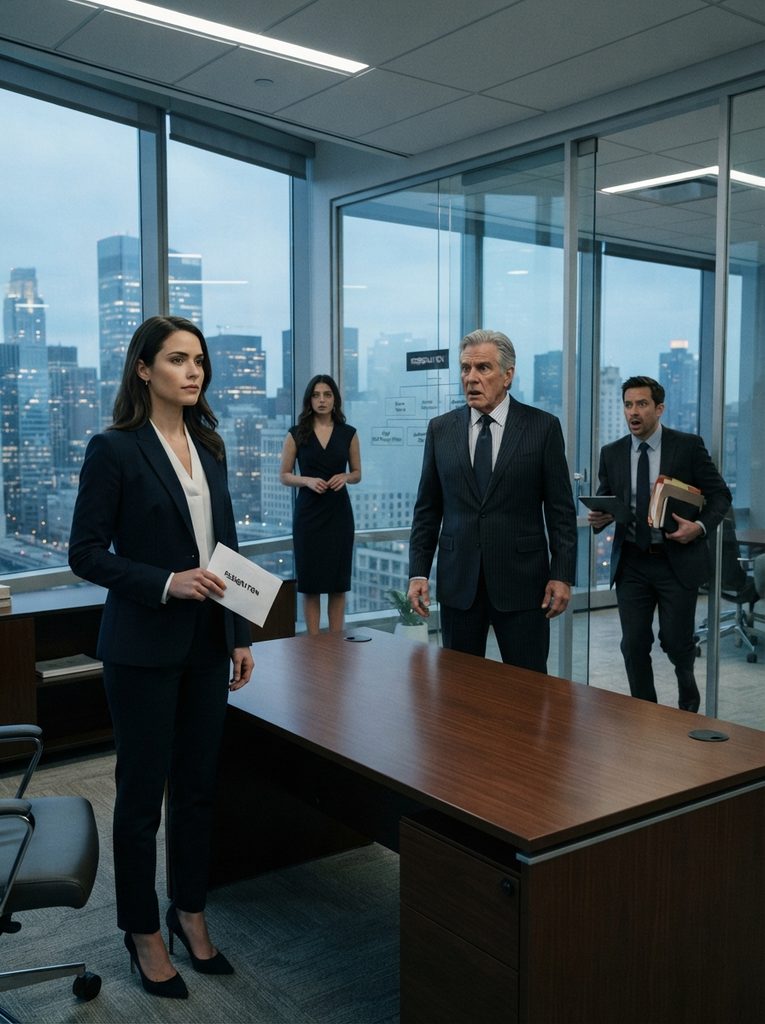
The fluorescent fixtures hummed in an unforgiving, institutional frequency, bleaching the color from the mahogany table and sharpening every jawline into an accusation. At the far end of the executive suite sat my father, Arthur Vance, the founder and chief executive officer of Vanguard Enterprise Solutions. He sat with his elbows anchored to the leather armrests, his hands tented, his silver signet ring catching the cold overhead glare.
When he spoke, his cadence was measured, devoid of fury, which made it far more lethal.
“You are suspended indefinitely, Elena,” he said, the timbre of his voice vibrating through the glass-walled perimeter. “Until you tender a formal, unconditional apology to your sister.”
Across the table, the corporate secretary’s Montblanc pen froze mid-stroke over her legal pad.
To my left, my sister, Julianne Vance, tilted her chin upward. Her eyelashes fluttered in a choreographed pantomime of wounded vulnerability, her lips parting as if she were swallowing down an ocean of unearned hurt. But around the corners of her mouth, tucked beneath layers of curated victimhood, lingered the ghost of a triumphant smirk. It was a curve of the lips I had cataloged since childhood—the unmistakable expression of someone who understood that she did not need truth on her side so long as she owned the adjudicator.
I stood behind the lectern, the presenter’s remote cold and slick in my palm. Behind me, the massive display screen remained frozen on slide forty-two: an unvarnished audit of Julianne’s flagship account, Hamilton Global Logistics. The numbers on that screen were crimson, incontrovertible, and damning. They told a tale of gross negligence, blown budgets, phantom milestones, and structural collapse.
Yet no one in the room was looking at the slide.
Not one department head met my gaze. Men and women whose careers I had insulated for six years suddenly found their leather portfolios, their manicured cuticles, or the condensation on their water tumblers infinitely captivating. The air had gone thin and stale, pressurized by an unwritten corporate law: When the patriarch draws a line, you do not stand on the side of the sacrifice.
I did not flinch. I did not drop my gaze. My pulse, usually a frantic snare drum during these orchestrated family ambushes, slowed into a flat, steady march.
“All right,” I said.
Two syllables. No inflection. No defensive tremor.
If my father had possessed the operational foresight he so aggressively claimed in trade publications, that quiet acquiescence would have terrified him. He was accustomed to my counter-arguments, my exhaustive binders of documentation, my desperate pleas for systemic reason. For fifteen years, he had operated on the comfortable premise that my devotion to the enterprise would always make me malleable.
He did not know that a bridge does not collapse while it groans under strain; it collapses only after it goes dead, rigid, and utterly silent.
I grew up in a household where quietness was celebrated as the ultimate domestic virtue. “A peaceful home is a righteous home,” my father would lecture over Sunday dinners, slicing his roast beef with surgical exactitude. It took me three decades to recognize that within the Vance household, peace was merely a euphemism for submission, and harmony was the code word for a rigid, autocratic hierarchy.
Julianne had mastered that hierarchy before she could properly tie her shoes. When we were children, during a fourth-grade regional science fair, Julianne forgot her presentation materials at home. Rather than face the teacher’s mild reprimand, she broke into breathless, theatrical sobs in the main hallway. My father arrived at the school within twenty minutes, sweeping past the principal with the gravity of a diplomat handling an international crisis. He berated the instructor, bought Julianne an expensive motorized diorama kit from an upscale hobby store downtown, and patted her curls while she beamed through her drying tears.
I had spent four weeks gathering river water samples in mason jars, cataloging microscopic algae under a plastic lens. When I quietly pointed out that Julianne hadn’t written a single sentence of her own poster board, my father rested a heavy, calloused hand on my shoulder.
“Elena,” he had murmured, his tone dripping with an intoxicating poison disguised as wisdom. “Your sister is sensitive. The world will be hard enough on her. You have a spine of steel. Be the reasonable one.”
The reasonable one. It was not praise; it was an assignment of unpaid labor. It was a life sentence.
The pattern solidified into bone. I remember the humid June afternoon during my senior year of high school when the courier delivered a thick, textured envelope from the Massachusetts Institute of Technology. My name was printed across the center in crisp, embossed font. I stood on the cold kitchen tiles, my knuckles white against the paper, feeling the weight of four years of sleepless nights, advanced placement exams, and solitary sacrifice finally paying their dividend.
When my father walked in, shedding his tailored suit jacket, I offered him the letter with trembling hands.
He skimmed the first two sentences, nodded once with the enthusiasm of a man reviewing a routine dental invoice, and tossed it onto the kitchen counter beside the utility bills. He didn’t even bother to unfold the scholarship addendum.
“Good,” he said, turning toward the refrigerator. “Solid work.”
Ten minutes later, the front door flew open. Julianne burst into the foyer, holding her left hand high in the air, a two-carat diamond ring glittering under the chandelier. Her high school boyfriend, the son of a prominent county commissioner, had proposed in the bed of his pickup truck.
Within ninety seconds, my father had uncorked a bottle of vintage champagne. Relatives were telephoned; neighbors were summoned across manicured lawns; the house swelled with laughter, clinking crystal, and breathless declarations of marital majesty. By midnight, my acceptance letter was buried underneath a grease-stained stack of catering napkins and half-empty flute glasses.
That was the evening I internalized the baseline operating principle of my family: Substance is invisible; spectacle is currency.
When my mother passed away three years later, the last structural support of our family disintegrated. My mother had been the quiet dampener in the system, the woman who would place a warm hand against the nape of my neck when she saw me burning midnight oil over algorithmic equations, the one who would subtly redirect my father’s heavy-handed favoritism. She was the only person capable of pulling him back from the edges of his own vanity.
With her gone, Julianne faced zero resistance. She learned that every mistake could be washed away with tears, every fiscal shortfall could be reframed as an act of creative bravery, and every technical disaster she engineered could be deposited onto my desk for silent, urgent repair.
Now, in the executive conference room, my father leaned back in his chair, mistaking my quietness for broken pride.
“Take the rest of the week,” Arthur added, gesturing vaguely toward the door with an air of dismissive benevolence. “Clear your head. When you’re ready to put this company and your family above your personal vanity, Julianne will accept your apology. Not before.”
Julianne gave a delicate sniffle, lowering her gaze with practiced modesty. “I just want us to be a team again, Elena. That’s all I’ve ever wanted.”
I switched off the projector. The blue light died instantly, plunging the presentation screen into ink-black darkness. I packed my laser remote into its velvet case, picked up my leather folder, and looked directly into my sister’s wide, false eyes.
You think you’ve backed me into a corner, I thought, my heart beating in a rhythm so calm it felt predatory. You have no idea that you’ve just unlocked the cage.