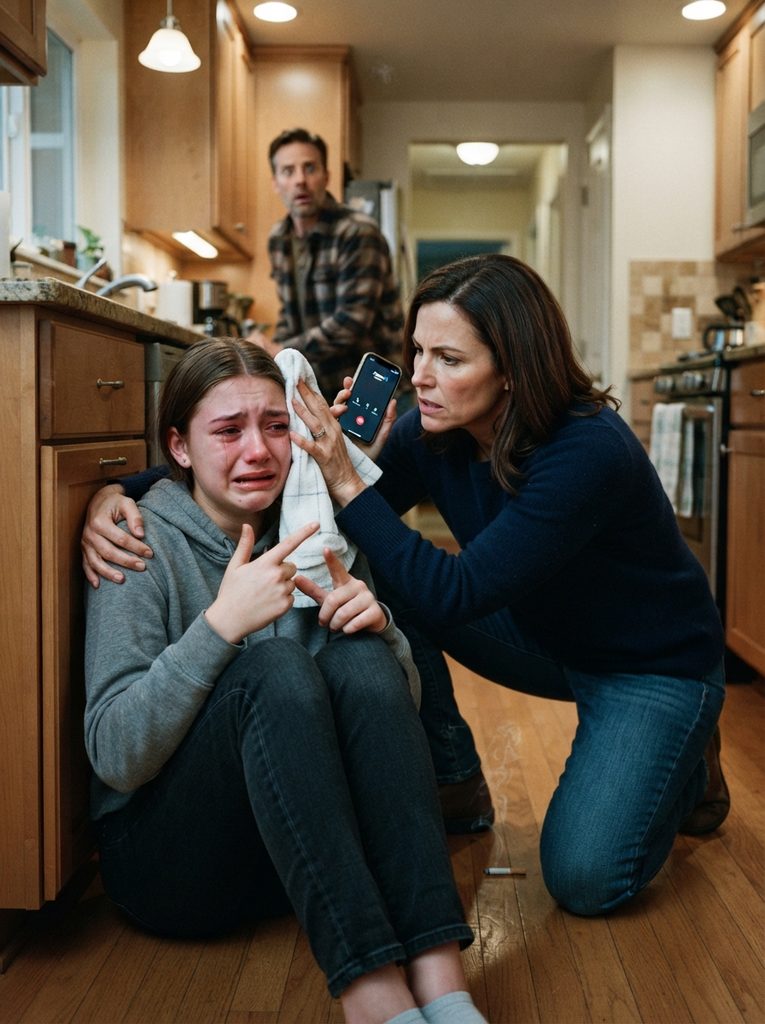
The handbag struck Mark’s temple hard enough to make him stumble backward into the kitchen counter.
The cigarette dropped from his hand and rolled across the tile.
For half a second, nobody moved.
Then I saw my daughter.
Emma was nine years old, profoundly deaf, terrified, and crouched beside the kitchen table with both hands raised protectively near her head.
“Mommy!”
She couldn’t hear herself say it.
But I understood.
I always understood.
I dropped the handbag and moved between her and Mark.
“What did you do?”
Mark stared at me as though I were the dangerous person in the room.
“She ignored me.”
My mind couldn’t process the sentence.
“What?”
“I told her three times to come downstairs.”
I looked at him.
Then at Emma.
“She couldn’t hear you.”
“She was looking right at the television.”
“Her hearing devices weren’t on.”
“She knew I was talking.”
I stared at the man I’d married eleven years earlier.
Emma had been diagnosed with profound hearing loss when she was fourteen months old.
Mark knew exactly what that meant.
He knew she relied heavily on visual communication.
He knew she couldn’t simply choose to hear someone shouting from another room.
Yet he stood there describing disability as disobedience.
Emma grabbed the back of my sweater.
Her hands were shaking.
I turned toward her and signed:
YOU ARE SAFE.
She looked toward her father.
I signed again.
LOOK AT ME.
Her eyes returned to mine.
SAFE.
Mark stepped forward.
“Don’t undermine me.”
I immediately stood.
“Stay back.”
“Laura.”
“Do not come near her.”
He laughed.
A short, disbelieving laugh.
“She’s my daughter too.”
“Then you should have protected her.”
His face hardened.
“You have spent nine years making excuses for her.”
That sentence changed everything.
Until then, I had believed Mark struggled to understand Emma.
Maybe he became frustrated.
Maybe he didn’t fully comprehend what daily life with profound hearing loss required.
But this wasn’t misunderstanding.
He resented her disability.
And apparently, that resentment had become something far worse.
I reached for my phone.
Mark noticed.
“Who are you calling?”
“911.”
His expression changed instantly.
“Don’t be ridiculous.”
I dialed.
“Put the phone down.”
I backed toward Emma.
“No.”
“You attacked me.”
“You were hurting our child.”
“I was disciplining her.”
The emergency dispatcher answered.
I gave our address.
Then I said the sentence that made Mark stop moving.
“My husband injured our nine-year-old daughter. She needs medical help.”
He stared at me.
“You’re destroying this family.”
I kept the phone against my ear.
Emma watched our faces.
She couldn’t hear the argument.
But she could read fear.
Children become experts at that.
I signed:
HELP COMING.
Mark moved toward the back door.
The dispatcher asked whether he was leaving.
“Yes.”
“Do not follow him.”
I didn’t.
My priority was Emma.
Always Emma.
Mark opened the door, then turned.
“You’ll regret this.”
I looked directly at him.
“No.”
For the first time in years, I knew exactly what I was saying.
“I’ll regret not seeing you clearly sooner.”
He left.
I locked the door.
Then I sat beside Emma.
She immediately climbed against me.
Her entire body trembled.
I kept signing.
SAFE.
MOM HERE.
HELP COMING.
She buried her face against my chest.
Within minutes, sirens approached.
Paramedics arrived with police.
The kitchen suddenly filled with people.
Emma became overwhelmed.
Too many strangers.
Too many mouths moving.
Too many people trying to communicate simultaneously.
“Stop.”
Everyone looked at me.
“She can’t hear you.”
The room quieted.
I explained her communication needs.
One paramedic crouched where Emma could clearly see his face.
He spoke slowly while I signed.
He needed to examine her.
Was that okay?
Emma looked at me.
I nodded.
She agreed.
They treated the immediate injury carefully, then prepared to transport her for specialist evaluation.
A police officer asked what happened.
I explained what I had witnessed.
Then he asked whether Mark had ever hurt Emma before.
“No.”
The answer came automatically.
But Emma suddenly moved.
She was watching us.
Then she signed:
YES.
I froze.
“What?”
She repeated it.
DAD HURT BEFORE.
My stomach dropped.
The officer couldn’t understand the signs.
I could.
“When?”
Emma looked frightened.
I signed:
YOU ARE NOT IN TROUBLE.
She stared at me.
Then she showed me.
Not every detail.
Enough.
Grabbing.
Shoving.
Punishments when I wasn’t home.
Her father becoming furious when she didn’t respond quickly enough.
My knees nearly gave out.
“How long?”
Emma shrugged.
She didn’t understand exactly what I was asking.
Children measure time differently.
Fear even more so.
I looked at the officer.
“This wasn’t the first incident.”
That sentence was almost impossible to say.
Because admitting it meant accepting something else.
My daughter had been unsafe inside our home.
And I hadn’t known.
At the hospital, everything became more controlled.
A specialist examined Emma.
A qualified interpreter was brought in so she could communicate independently rather than relying entirely on me.
That mattered.
Emma deserved her own voice.
Not my interpretation of it.
I sat outside during part of the interview.
That was one of the hardest things I’d ever done.
Every instinct told me to stay beside her.
But professionals explained why speaking with Emma independently was important.
So I waited.
A detective joined me.
“We located your husband.”
I looked up.
“Where?”
“At his brother’s house.”
“Is he coming here?”
“No.”
I exhaled.
Only then did I realize I’d been holding my breath.
The detective asked whether our home had cameras.
“No.”
Then I remembered the doorbell system.
It wouldn’t show the kitchen.
But it recorded arrivals and departures.
Maybe that mattered.
“What about messages?”
I opened my phone.
Years of messages with Mark.
Most were ordinary.
Groceries.
Schedules.
Bills.
Then I searched Emma’s name.
The results looked different now.
Emma ignored me again.
You need to stop babying her.
She understands perfectly well when she wants something.
I’m done letting her disability run this house.
I stared at that final message.
He had sent it eight months earlier.
I’d replied:
She’s not doing it intentionally.
His response:
That’s what you always say.
At the time, I’d considered it another disagreement between exhausted parents.
Now it felt like a warning I’d missed.
The detective asked me to preserve everything.
I did.
Emma remained at the hospital for hours.
Her injury required treatment and follow-up care.
But doctors were optimistic about her physical recovery.
I held onto that.
Physical recovery.
The emotional part would take longer.
That evening, Emma asked for me.
I entered her room.
She was sitting beneath a white blanket watching cartoons with captions.
I sat beside her.
She signed:
DAD MAD?
I swallowed.
YES.
Her face fell.
Then she asked:
MY FAULT?
My heart broke.
NO.
I signed it forcefully.
NO.
She watched me.
I continued.
YOU CANNOT CONTROL DEAF.
YOU DID NOTHING WRONG.
She stared at my hands.
Then she began crying.
I held her.
For several minutes, neither of us needed language.
Later, she signed:
DAD SAYS I DON’T LISTEN.
I almost couldn’t breathe.
The cruelty of that sentence wasn’t lost on me.
A deaf child being accused of refusing to listen.
I signed:
DAD WAS WRONG.
Emma studied my face.
Then:
YOU BELIEVE ME?
YES.
ALWAYS.
She hugged me again.
That night, I called an attorney.
Her name was Rebecca Shaw.
A friend had used her during a difficult custody case.
Rebecca answered despite the late hour.
I explained what happened.
She didn’t waste time.
“Do you intend to remain married?”
“No.”
The answer surprised me with how easily it came.
No hesitation.
No mourning.
No bargaining.
Just no.
“Then tomorrow we begin protecting Emma legally as well as physically.”
We did.
Emergency court proceedings.
Protective measures.
Custody filings.
Documentation.
Medical records.
Police reports.
Messages.
Everything became evidence.
Mark immediately began telling another story.
According to him, I was unstable.
I’d attacked him without warning.
Emma was confused.
The injury had been accidental.
He had merely been trying to teach her responsibility.
Each version contradicted the previous one.
Then my mother-in-law called.
“Laura, you need to think carefully.”
“I have.”
“Mark could lose everything.”
I looked through the hospital window at Emma sleeping.
“He should have thought about that.”
“He’s her father.”
“Yes.”
“Doesn’t that mean anything?”
“It means he had an even greater responsibility to protect her.”
Silence.
Then she said:
“He doesn’t understand deafness the way you do.”
I almost laughed.
“Emma is nine.”
“He tried.”
“No.”
I looked at my daughter.
“Emma has spent nine years trying to understand a world built for people who hear. Mark could have spent nine years learning her world.”
I ended the call.
That distinction stayed with me.
For years, everyone expected Emma to adapt.
Watch faces.
Read lips.
Use technology.
Learn signs.
Navigate classrooms.
Explain herself.
Ask people to repeat things.
Why had we demanded so little adaptation from the adults around her?
I began seeing everything differently.
Mark had treated accessibility like special treatment.
It wasn’t.
It was communication.
Respect.
Parenting.
Emma came home several days later.
Not to our house.
My sister Natalie opened her home to us.
She immediately learned more sign language.
Not because anyone forced her.
Because Emma lived there.
The first phrase Natalie mastered was:
DO YOU WANT PANCAKES?
Emma laughed when she saw it.
Then corrected Natalie’s hand position.
Soon they had their own morning routine.
For the first time in months, Emma began relaxing.
That’s when I realized how tense she’d previously been.
She stopped constantly watching doorways.
She stopped flinching when someone approached unexpectedly.
She began leaving her hearing devices on the nightstand without worrying somebody would become angry when she couldn’t respond.
Those changes told their own story.
One evening, I asked why she hadn’t told me earlier.
Emma became quiet.
Then she signed:
DAD SAID YOU WOULD CHOOSE HIM.
I had to look away.
When I looked back, I signed:
I CHOOSE YOU.
Emma immediately corrected me.
NO.
I didn’t understand.
She continued:
CHOOSE RIGHT.
I started crying.
My nine-year-old understood something I’d spent years avoiding.
It wasn’t about choosing one family member over another.
It was about choosing what was right.
Months passed.
The divorce proceeded.
The criminal investigation followed its own separate course.
I stopped giving Emma updates she didn’t need.
Children shouldn’t carry adult legal battles.
Instead, we built routines.
School.
Therapy.
Appointments.
Movie nights.
Pancakes.
Ordinary things became healing.
We eventually moved into a small townhouse.
Emma chose her bedroom.
Purple walls.
Glow-in-the-dark stars.
A flashing doorbell system so she could know when someone arrived.
Visual smoke alarms.
Lights connected to household alerts.
For years, I’d considered these modifications practical necessities.
Now I saw them differently.
They told Emma:
This home expects you.
This home includes you.
This home doesn’t punish you for experiencing the world differently.
One Saturday morning, I accidentally called Emma from the hallway.
She didn’t respond.
For half a second, my stomach tightened.
Then I remembered.
Of course she didn’t.
I walked into her room.
She was drawing.
I tapped the light switch twice.
She looked up.
I signed:
BREAKFAST.
She smiled.
COMING.
That was it.
No anger.
No accusation.
No punishment.
Just communication.
I stood in the doorway afterward and thought about how unbelievably simple respect could be.
Mark had treated Emma’s deafness like defiance.
It never was.
Years later, Emma asked me about the handbag.
She was old enough by then to understand more of what happened.
“You really hit Dad with your purse?”
I laughed awkwardly.
“Apparently.”
She smiled.
“What was inside it?”
“Everything.”
Wallet.
Keys.
Makeup.
Notebook.
Phone charger.
Probably three months of receipts.
Emma laughed so hard she nearly fell off the sofa.
For years, I’d remembered that handbag with horror.
She turned it into something ridiculous.
Maybe that was healing too.
Today, Emma is confident.
Funny.
Stubborn.
Brilliant.
She speaks when she wants.
Signs constantly.
And she has absolutely no patience for people who assume deafness means helplessness.
I’m proud of that.
But the lesson I carry isn’t about the dramatic moment I entered the kitchen.
It’s about everything that should have happened before it.
Believe behavioral changes.
Pay attention to fear.
Learn how your child communicates.
Never allow one adult’s anger to become the emotional weather governing an entire home.
And never confuse disability with disobedience.
Emma didn’t need punishment for being unable to hear.
She needed adults willing to meet her where she was.
That night, Mark told everyone I had destroyed our family by calling police.
He was wrong.
A family isn’t preserved by hiding what happens inside it.
A family is preserved by making home safe for the people with the least power.
I couldn’t undo what Emma experienced.
But I could make one promise and spend the rest of my life keeping it.
Nobody would ever again teach my daughter that something fundamental about her made her deserving of cruelty.
She was deaf.
She was different from me.
She experienced the world through other pathways.
None of that made her broken.
None of it made her disobedient.
And none of it ever gave another person permission to hurt her.
The day I finally understood that completely was the day my marriage ended.
But it was also the day Emma’s home began becoming safe again.