My name is Clare Donovan, and the evening my husband demanded the dissolution of our marriage, he looked more liberated than shattered.
We had been bound together by vows for seven years. We shared a picturesque, quiet suburban home with a wrap-around porch, a joint bank account, and four-year-old twins, Noah and Lily. To the outside world, to the neighbors who waved over manicured hedges, ours was the kind of partnership defined as unshakable.
At least, that was the fiction I had been living inside.
The fracture happened on a unremarkable Tuesday. The scent of roasted chicken still lingered in the air. Daniel walked into our master bedroom just as I was folding laundry. He didn’t pace. He didn’t sigh. He simply stepped to the oak dresser, placed a crisp, white envelope onto the polished wood, and delivered the blow with a terrifying absence of emotion.
“I want a divorce.”
There was no preamble, no rising tension, no warning signs that I had managed to interpret. I stopped, a small cotton shirt held limp in my hands, and just stared at him. The man I had shared a bed with for nearly a decade looked entirely alien.
“Why?” The word barely scraped its way out of my throat.
“I simply don’t love you anymore.”
That was the entirety of his explanation. A single, hollow sentence to detonate a family. He didn’t offer apologies. Instead, he smoothly transitioned into a chillingly rehearsed monologue about shared guardianship, suggesting we handle the division of assets like civilized adults to prevent things from becoming financially ruinous.
I didn’t shatter a glass. I didn’t fall to my knees and beg for a second chance. A strange, numbing preservation instinct took over. I simply looked into his flat, unreadable eyes and nodded.
“Okay.”
For some inexplicable reason, my calm acceptance seemed to rattle him. A tremor of unease cracked his composed facade. He had prepared for a hysterical wife; he had not prepared for a stone wall.
The subsequent weeks dissolved into a sterile blur of attorney consultations, endless financial disclosures, and the awkward choreography of temporary parenting schedules. Almost overnight, Daniel morphed into a caricature of the ultimate father. He was suddenly present for every preschool pickup, eagerly attending pediatric dental appointments, and curating a sudden, vibrant portfolio of photographs at local playgrounds. He was doing all the things I had spent the last four years begging him to participate in.
It felt performative. It felt deeply wrong. But my attorney, Rebecca Shaw—a woman with eyes like chipped ice and a mind like a steel trap—advised me to maintain my composure. “Let him play the hero,” she had said. “Courts look at long-term patterns, not sudden bursts of enthusiasm.”
Then came the morning of our first preliminary custody hearing.
Daniel sat at the petitioner’s table beside his high-priced counsel, looking impeccably groomed and perfectly prepared. I sat across the heavy center aisle, my heart hammering against my ribs, with Noah and Lily nestled closely beside my mother in the gallery. The mahogany walls of the courtroom felt oppressive, the air heavy with the scent of floor wax and impending judgment.
The presiding judge, a stern-faced woman with silver hair, directed several probing inquiries to both legal teams regarding the temporary living arrangements. The discussion was dry, clinical, and completely detached from the human heartbeat of our family.
That was when my son, Noah, began to squirm.
He reached out, his tiny fingers tugging desperately at the fabric of my sleeve. “Mommy…” he whispered, his voice trembling.
“Not now, sweetheart,” I murmured, placing a gentle hand over his.
But his little face tightened into a mask of pure, unadulterated panic. The judge had just mentioned the schedule for the twins’ overnight weekend visits at Daniel’s new residence.
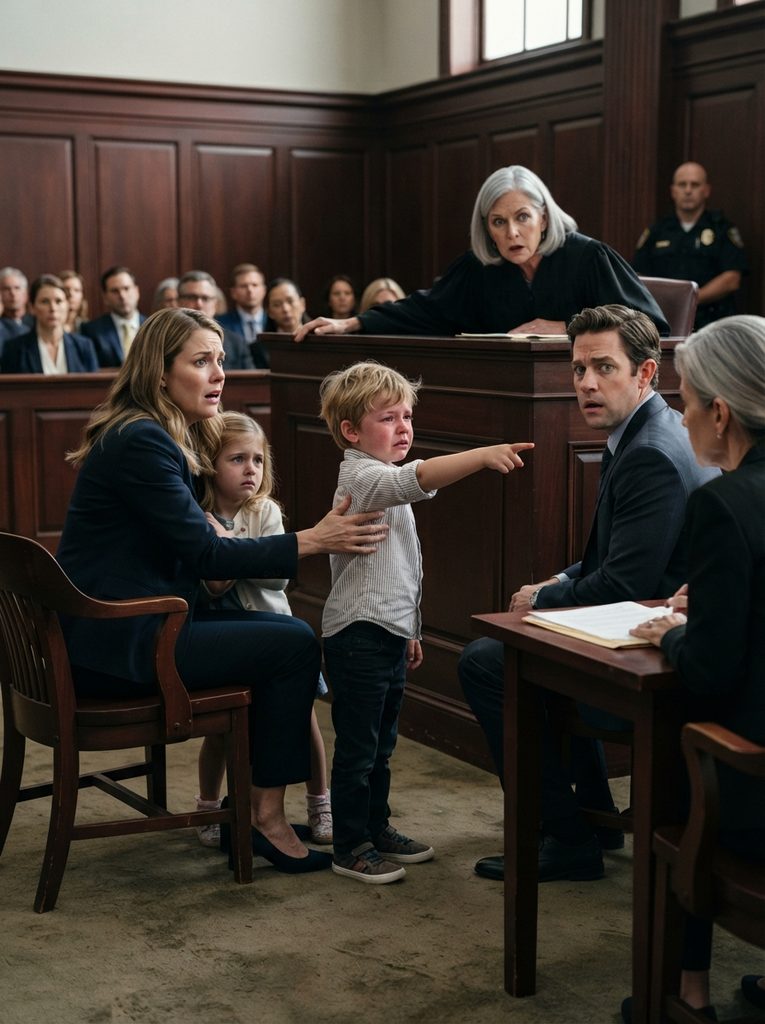
Suddenly, Noah scrambled out of his seat. He stood upright in the middle of the solemn courtroom. A court bailiff took a step forward, gently raising a hand to ask the child to sit back down. But my four-year-old son ignored the officer. He locked his wide, tear-filled eyes directly onto the judge. I could see his small shoulders vibrating.
“Please,” Noah’s voice cracked, echoing in the cavernous room. “Please don’t make Lily sleep at Daddy’s house.”
The entire courtroom plunged into an absolute, suffocating silence.
Across the aisle, all the color drained from Daniel’s face, leaving him the shade of old parchment.
The judge slowly lowered her reading glasses, leaning over the high wooden bench. Her tone softened instantly. “Why not, Noah?”
My son raised a trembling arm and pointed a tiny, accusatory finger directly at his father. Then, in a whisper that somehow carried to every corner of the room, he delivered a sentence that would haunt me for the rest of my life.
“Because Daddy said next time… he won’t let her wake up.”
I couldn’t breathe.
Daniel shot up from his chair so violently it nearly tipped over backward. “He doesn’t know what he’s saying!” he bellowed, his composure entirely shattered. His attorney immediately grabbed his forearm, yanking him back down.
The judge slammed her gavel, pointing a sharp finger at Daniel. “Not another word from you, Mr. Donovan.”
She immediately halted the proceedings. The judge understood that questioning a traumatized child in open court was a dangerous line to cross. She called for an emergency recess, ordering that both children be escorted out into the hallway with my mother while the attorneys approached the bench for a private conference.
Rebecca leaned toward me, her grip on my arm surprisingly strong. “Do not ask Noah anything,” she ordered, her voice a low, urgent hiss.
Every maternal instinct screaming in my blood demanded that I sprint into the corridor, pull my son to my chest, and demand to know exactly what was happening in that house. But the terrifying gravity in Rebecca’s eyes stopped me. I nodded, swallowing the bile rising in my throat.
The judge swiftly issued an emergency order, temporarily suspending all of Daniel’s unsupervised overnight visits until Noah’s chilling statement could be thoroughly assessed by a court-appointed child psychologist.
Daniel was apoplectic. As we exited the chamber, he hissed across the aisle, “This is your doing, Clare! You’re coaching him to say this garbage!”
The accusation stung, but not for the reason he thought. The true, agonizing pain was the realization that I hadn’t even known my own son was living in terror.
I pushed through the heavy wooden double doors into the bright corridor. Lily immediately ran to me, wrapping both her chubby arms around my knees. But Noah stood frozen, refusing to even glance in his father’s direction.
Daniel took a step toward them, forcing a tight, artificial smile. “Hey, buddy—”
A uniformed court officer stepped smoothly between them, holding up a broad hand. “Sir, please step back.”
That was when Noah finally broke. He didn’t wail or throw a tantrum. He simply turned, buried his face deep into the heavy wool of my mother’s winter coat, and whispered something so quietly I couldn’t hear it.
My mother’s entire body went completely rigid. Her eyes widened, staring blankly at the far wall.
“Mom?” I asked, my voice shaking. “What did he say?”
Rebecca stepped in front of me, shielding me from the scene. “Clare. Stop. We let the professionals handle it from here.”
As I watched my mother stroke Noah’s hair, her hands trembling violently, I knew with sickening certainty that the nightmare had only just begun.