For twenty seven years, my husband Mark and my mother Florence could barely stand to be in the same room. They argued over the smallest things, and they exchanged cold looks across holiday dinners. They could turn an ordinary family gathering into something so uncomfortable that everyone else learned to speak very carefully. I used to tell myself they were simply like oil and water, but even that comparison was far too harmless. Oil and water can sit quietly in the same glass without making Christmas dinner completely unbearable, but Mark and Florence simply could not.
For nearly three decades, I never understood why they carried such deep hatred for each other. Neither of them would ever tell me the truth, no matter how much I begged.
Then my mother passed away quite suddenly. At her funeral service, I saw Mark standing alone beside her closed wooden coffin in the sanctuary. I could not hear everything he said from across the aisle, but one sentence reached me with chilling clarity.
“I kept our little thing, Florence,” he muttered under his breath.
Then he leaned closer to her coffin and whispered a final sentence. “It will stay hidden forever under the weeping willow.”
That night, I took a rusted shovel out to my mother’s backyard in Madison. What I dug up made me call the emergency services in a total panic, and it forced me to confront a secret that had been hidden from me for almost thirty years.
My husband and my mother hated each other for twenty seven long years. I could probably count the number of pleasant conversations they had shared without using my hands, because the exact answer was zero.
One Thanksgiving afternoon at our home in Madison, Florence looked across the dining table at Mark with a critical glare. “Are you still doing odd contract work?” she asked him with a tight lip.
Mark slowly put down his silver fork and took a long breath. “I own the construction company, Florence,” he replied coldly.
“I know,” she said as she took a slow sip of her red wine. “I was just making conversation.”
“You could have fooled me,” Mark muttered back, staring right at her.
I reached under the table and kicked Mark’s shin to stop the argument before it started. Across from us, our daughter Samantha, who was sixteen at the time, looked between them and shook her head. “And people wonder why I prefer eating dinner up in my bedroom,” Samantha muttered to herself.
Nobody laughed at her joke because the tension in the room was simply too heavy. Later that night, I cornered Mark while he was hanging up his winter coat in the hallway closet.
“Why do you let my mother get to you so easily?” I asked him, leaning against the wall.
He gave a dry, humorless laugh as he adjusted his hanger. “Because she tries her absolute best to get under my skin every single day,” he replied.
“She only does it because you always react to her,” I told him gently.
“No, she does it because she hates me and thinks that gives her permission to treat me like dirt,” Mark insisted, slamming the closet door shut.
“She does not treat you like dirt,” I said softly, though I knew I was lying.
Mark gave me a cold look. “Be honest with yourself for once, Hannah,” he said.
“Fine,” I admitted with a heavy sigh. “Sometimes she does, but you are not exactly warm with her either.”
He pulled his jacket back off the hook harder than necessary. “We just do not get along, and that is all there is to it,” he snapped.
That was always his standard answer whenever I brought up their constant fighting. And whenever I asked my mother about it, she gave me the exact same line. “Mark and I are simply from completely different worlds,” Florence would tell me with a dismissive wave of her hand.
For many years, I fully believed that simple explanation. Mark had grown up poor in a small town and started working tough construction jobs when he was seventeen years old. Florence had built a very successful corporate accounting firm in Milwaukee almost entirely from scratch. They had vastly different backgrounds, completely different personalities, and entirely different ideas about money, status, and personal success. So I simply assumed that their background differences were the root cause of the friction.
Part 2: The Cracks in the Wall
That assumption lasted until one humid summer afternoon, about twelve years into my marriage. Mark and Florence were having another intense argument inside her brightly lit kitchen. I walked into the house through the back screen door just as my mother raised her voice.
“Do not stand there and act like you are some kind of saint!” Florence barked at him, pointing a finger.
Mark’s entire face hardened as he leaned against the counter. “I never said I was a saint,” he spat back.
“You have lied to my daughter every single day of your marriage,” Florence said in a harsh whisper.
I stopped dead in the doorway, staring at both of them. “Mom?” I called out, my heart dropping into my stomach.
Both of them turned toward me instantly, their faces going completely pale.
“What on earth are you talking about?” I asked, looking between my mother and my husband.
Florence stared right at Mark without flinching. “You know exactly what you did,” she said quietly.
Mark stared back at her in absolute silence, refusing to say a word. That complete silence frightened me far more than any shouting match ever could. Mark always defended himself aggressively against any accusation, but not that day. He just stood there in total, icy silence.
I waited until Mark and I drove home and walked into our own living room before confronting him. “What did my mother mean by that?” I demanded, standing between him and the hallway.
Mark unlaced his heavy boots near the front door without looking up. “It was nothing, so just drop it,” he murmured.
“She said you have lied to me every single day of our marriage,” I insisted, my voice rising. “You did not even deny it when she said it.”
He looked up at me with tired eyes. “Hannah, your mother absolutely hates me,” he said softly.
“Why does she hate you so much?” I asked, stepping closer to him.
“She is holding onto a very old grudge,” he replied, turning his eyes away from mine.
“What old grudge?” I demanded, feeling a knot tighten in my chest.
“You should ask her,” Mark said, walking past me toward the stairs.
And that effectively ended our conversation for the night. It was not because I actually believed his weak excuse, but because I finally understood something terrible. Neither my mother nor my husband ever intended to tell me the actual truth.
Then there was the issue of my mother’s beloved weeping willow tree. Florence had planted that tree in her back garden around the exact time Mark and I got married. At the time, I did not think anything unusual of the new sapling. Over the years, however, that weeping willow became almost sacred to her. She protected that specific spot in her yard fiercely against anyone who went near it.
When the tree grew larger and its thick roots cracked part of her expensive stone walkway, I made a casual suggestion. “Mom, you might have to remove the willow before it ruins the whole patio,” I said.
She looked at me with pure horror, as if I had just suggested burning her entire house to the ground. “Absolutely not,” she snapped instantly.
“Mom, it is severely damaging the stone path,” I pointed out logically.
“Then I will simply hire someone to replace the stone path,” she declared flatly.
I laughed at the time because I genuinely thought she was just being dramatic about her gardening. I did not understand the dark truth behind her obsession back then.
Years earlier, when our daughter Samantha was about five years old, she had taken a bright yellow plastic shovel into the yard. She started digging around the thick base of the weeping willow trunk. Florence happened to see her through the kitchen window while pouring coffee. My mother dropped her glass mug onto the floor, where it shattered into pieces, and ran outside frantically.
“Samantha, get away from there right now!” my mother screamed at the top of her lungs.
I had never heard my mother yell at my young daughter with such intense fear and rage before. Samantha froze instantly, looking terrified. Florence rushed over and violently grabbed the plastic shovel right out of her small hands.
“Do not ever dig in this dirt!” Florence yelled, her hands trembling uncontrollably.
Samantha immediately burst into tears, terrified by her grandmother’s reaction. I rushed out the back door to see what was happening. “Mom, what on earth is wrong with you?” I yelled, pulling Samantha behind my back.
Florence stared down at the disturbed pile of dark dirt with wide, terrified eyes. Her face had gone completely drained of color, making her look like a ghost. Then she looked up at Samantha and her tone softened slightly. “I am so sorry, sweetheart, but you cannot play here,” she whispered.
My mother never explained why she had reacted so violently to a child digging in the yard. Not that afternoon, not weeks later, and not in the years that followed. Years afterward, I would remember the sheer terror on her face far more clearly than anything she had actually said to us.
Part 3: The Burial Ground
Then my mother passed away. It happened so quickly that none of us were prepared for it. She suffered a massive stroke at home, followed by severe complications in the ICU. After three painful days in the hospital bed, she could no longer speak to any of us. Mark came with me to the hospital every single day, sitting quietly in the visitor chairs.
On the morning she passed away, Mark stood beside her hospital bed for almost ten minutes after the nurses left the room. I watched him quietly from the dimly lit doorway. For one brief moment, I wondered whether death had finally erased whatever deep resentment had stood between them for all those years. I was utterly wrong.
At the funeral reception held at St. Peter Church in downtown Madison, guests were drinking coffee and eating sandwiches. Samantha was sitting near the entrance, talking quietly with one of my older cousins. I looked around the noisy room and suddenly realized Mark was nowhere to be found. I walked back toward the quiet chapel to look for him.
My mother’s dark coffin was still resting near the alter in the empty chapel. As I reached the heavy wooden doorway, I heard Mark’s deep voice echoing off the walls.
“I kept our little thing, Florence,” Mark said in a heavy voice.
I froze behind the doorway, holding my breath so he would not hear me. Mark was standing directly beside the coffin, his back partly turned toward the aisle. One of his hands rested heavily on the polished wood edge. He looked down at my mother’s still face for a very long moment.
“No one ever found out,” he whispered into the silent room.
I could not move a single muscle, my heart slamming against my ribs.
Then he leaned in closer to her coffin and whispered his final words. “It will stay hidden forever under the weeping willow.”
My entire body went completely cold, and a terrifying chill ran down my spine. I stepped backward into the hallway softly before he could turn around and see me standing there. I do not remember walking back to the reception hall, nor do I remember a single word anyone said to me for the rest of the afternoon. I only remember one single question repeating in my head over and over again. What on earth was buried beneath my mother’s weeping willow tree?
That night after the funeral, Mark fell asleep almost immediately from sheer exhaustion. I lay beside him in the dark room for twenty minutes, staring up at the white ceiling. Then I quietly got out of bed, pulled on my coat, and grabbed my car keys.
I drove through the quiet streets of Madison until I reached my mother’s dark house. The massive weeping willow tree stood behind the empty house, its long branches moving gently in the cool night wind. I went directly into the detached garage and grabbed a heavy steel shovel from the wall.
For the first ten minutes of digging through the hard dirt, I felt completely insane. For the next ten minutes, as the hole grew deeper, I felt completely terrified of what I might find.
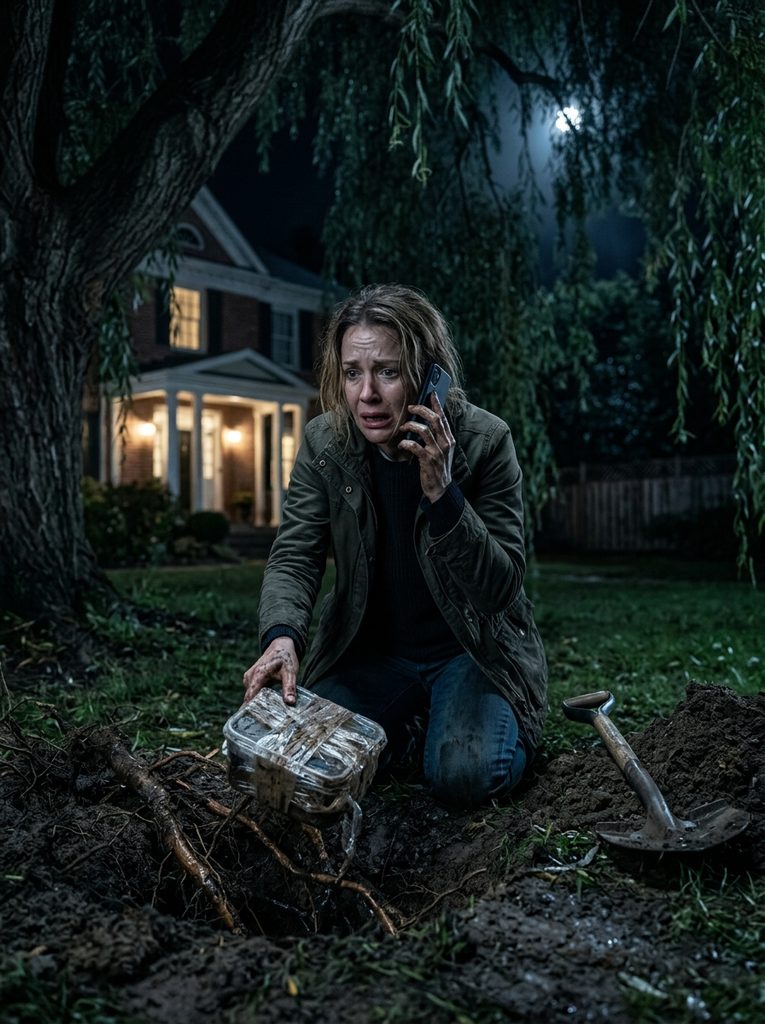
Then the metal blade of my shovel struck something hard beneath the tree roots. I froze instantly in the dark. My heart began pounding wildly against my chest as I dropped the shovel onto the grass. I fell to my knees and started frantically clearing the wet dirt away with my bare hands.
There was a heavy plastic container buried about two feet underground. It had been wrapped tightly in several thick layers of old black trash bags to protect it from moisture. I pulled the heavy box out of the ground and carried it onto the lit back porch. My hands were shaking so violently that I could barely undo the plastic latches on the container.
Inside the box were official paper documents, faded hospital records, a tiny plastic baby bracelet, a pink knitted hat, and a small card stamped with tiny faded pink footprints. I sat down heavily on the cold porch floor, my breath hitching in my throat.
Then I saw the official letterhead of the hospital printed across the top of the records. It was from Mercy Medical Center right here in Madison, the exact hospital where Samantha had been born twenty seven years ago. My stomach tightened into a painful knot as my hands trembled over the paper.
Until that exact moment, I had been afraid of discovering some terrible crime or affair that had poisoned the relationship between my mother and my husband. Now I realized with overwhelming terror that the secret had everything to do with me.
Suddenly, my mind was hurled back twenty seven years to the night of my daughter’s birth. Samantha’s delivery had been extremely difficult and traumatic for my body. There had been an emergency surgery, and my blood pressure had crashed to dangerous levels. I distinctly remembered hearing muffled panic from the doctors around my bed before everything went completely black.
When I woke up many hours later in a quiet recovery room, Mark and Florence were sitting beside my bed. The very first thing I had gasped out was a simple question. “Is the baby okay?” I had asked them.
Mark had gently squeezed my pale hand and smiled down at me. “She is perfectly okay, honey,” he had replied softly.
That single sentence was all I had ever known about that fateful night. Or at least, it was all I had ever been told by the two people I trusted most in the world.
Now, sitting on the cold porch, I was staring directly at official medical delivery records. My full name was typed at the top, along with Mark’s signature as the father. Under the birth details section, it read: Delivery, Emergency C-Section.
Then I saw the specific typed words that made the entire world feel like it was spinning out of control. Two female infants.
I read those three words again, my eyes scanning the ink over and over. Two.
The official medical record continued below that line in cold terms. Twin A: Live birth, robust health. Twin B: Neonatal death due to severe respiratory distress.
I completely stopped breathing as tear droplets fell onto the yellowed paper. I had given birth to twin girls that night. Samantha had a twin sister, a second daughter I had never known existed for twenty seven years. And according to the buried documents, that sweet baby girl had passed away just hours after birth, before I had ever regained consciousness to hold her.
Part 4: Confrontation
A sudden, sharp thought stopped my tears in their tracks. How did I know this official document was telling me the absolute truth? Mark and my mother had hidden this entire tragedy from me for nearly three decades, burying the evidence deep in the ground behind my back. Why should I trust a single thing either of them had ever told me about that night?
I pulled my cell phone out of my coat pocket with shaking fingers and dialed 911 immediately.
While I waited for the police cruisers to arrive at the house, I kept frantically going through the contents of the plastic box. Near the bottom, I found a faded white envelope filled with old handwritten letters. The very first letter was written in my mother’s recognizable cursive handwriting, and it was addressed directly to Mark.
“Mark, we need to tell Hannah the truth,” the letter read. “What we did in those first few days may have been understandable because she was critically ill in the ICU, but every single day we continue this lie makes it ten times worse.”
Directly behind it, I found Mark’s written reply on a torn piece of notebook paper. “It is still not the right time, Florence,” he had written back in crude handwriting. “Hannah is barely sleeping as it is, and she is finally bonding with Samantha. I will not put her through this emotional damage right now.”
There were dozens more letters stacked inside that envelope, spanning many long years. Six months after the birth, Florence wrote again begging him to confess. Then another letter after one year, then another two years later, and another after five years. My mother had spent decades begging my husband to tell me the truth about my dead child. And yet, an angry question burned in my mind: why had she never simply walked into my room and told me the truth herself?
I was sitting on the wooden porch steps surrounded by scattered medical papers when a police car pulled into the driveway. Two patrol officers walked around the side of the house with flashlights turned on. One of them was a kind officer named Deputy Martinez.
She crouched down beside me on the porch. “Ma’am, are you Hannah?” Deputy Martinez asked gently.
“Yes, I am,” I managed to whisper, clutching the pink knitted baby hat in my fist.
“You reported finding something buried in the backyard?” she asked, shining her light toward the fresh pile of dirt.
I pointed toward the open plastic container resting beside me.
Deputy Martinez leaned closer and looked inside the box. “What exactly is this?” she inquired softly.
I tried to answer her question, but my voice broke completely into a sob. “My daughter,” I gasped out.
Deputy Martinez looked at me with deep concern. “What do you mean by that, ma’am?” she asked.
I shook my head quickly to clarify. “No, there is not a body buried out here, only official papers,” I sobbed, catching my breath. “I had another daughter twenty seven years ago.”
The two officers exchanged a quick, serious look in the dark. I explained everything to them as best I could through my tears. I told them about my mother’s funeral that afternoon, Mark’s overheard words by the coffin, the weeping willow tree, the shovel, and the buried hospital records.
Deputy Martinez carefully read through several pages of the medical reports using her flashlight, paying close attention to the seals. “Do you have any actual reason to believe this medical record is fake?” she asked me carefully.
I looked right into her eyes. “I have twenty seven years of reasons not to trust a single word from the people who buried it,” I stated firmly.
Deputy Martinez did not answer right away. Instead, she asked for the hospital name, the date of delivery, and my driver’s license. She walked back toward her patrol car and made several phone calls to the county health authorities while her partner took photos of the buried box. Almost an full hour passed in total silence before Deputy Martinez returned to the porch.
She sat down right beside me on the cold step. “The records department at Mercy Medical Center just confirmed the filing from twenty seven years ago,” Deputy Martinez said softly. “You delivered two infants that night under your name, resulting in one surviving infant and one neonatal death.”
I closed my eyes tightly as a heavy weight crushed my chest. “So my baby really did die that night,” I whispered.
“Yes, ma me,” Deputy Martinez replied with deep sympathy.
For a long moment, I felt completely hollow inside, as if all the air had been pulled from my lungs. Then a massive wave of grief came crashing over me. “My sweet little girl,” I wept openly, covering my face with my shaking hands. “She died all alone, and I never even got to hold her or know she existed.”
Deputy Martinez glanced down at the old letters inside the container. The police had successfully answered the terrifying question that had haunted me in the dark, but their confirmation made the coming confrontation with Mark infinitely worse. For twenty seven years, Mark had known our daughter existed and had died. Now he was the only person left alive who could tell me why he decided I never deserved to know.
Part 5: The Unraveling
I drove back home just as the morning sun was beginning to rise over Madison. I walked through the front door and found Mark standing alone in the dark kitchen, holding a cold cup of coffee.
“Where on earth have you been all night?” Mark asked, turning toward me with worried eyes.
I did not say a single word. I simply picked up the plastic box and slammed it down onto the kitchen table between us. Mark’s eyes landed on the dirt covered plastic, and his entire face immediately emptied of all color.
“You recognize this container, do you not?” I asked, my voice dangerously calm.
Mark slowly sank down into a wooden kitchen chair, staring at the floor.
“I had twins that night,” I stated, staring down at him. “One of my baby girls died, and you and my mother chose to hide it from me for twenty seven years.”
Mark kept his head down, refusing to meet my eyes. “Did I miss any part of the story, Mark?” I asked softly.
He said nothing at all.
“No, I did not,” I whispered.
Then I reached out and slapped him across the face with all the strength left in my body. I had never hit another human being in my entire life, and the loud cracking sound shocked both of us in the quiet room. Mark touched his red cheek with his hand, but he did not get angry or yell back at me. Part of me almost wished he would fight back, but he just sat there broken.
“How could you do this to me?” I screamed at him, my voice cracking with pure agony. “I am her mother! I had every right in the world to mourn my child, and you stole that from me!”
“You nearly died on that operating table!” Mark pleaded, looking up at me with tears in his eyes. “Your blood pressure completely crashed, and you were barely conscious for days! The doctors told me that any extreme emotional stress could kill you!”
“Then why did you not tell me six months later when I was healthy?” I shrieked, slamming my hand on the counter. “Or a year later? Or five years later?”
Mark looked down at his hands, unable to answer.
“You stole my grief from me!” I sobbed out.
“There was simply never a good time to bring it up!” he cried out defensively.
I stared at him with complete disgust. “There was never going to be a good time to tell your wife her baby died!” I shouted, my voice echoing through the entire house. “But in twenty seven long years, you should have found just one single day to be honest with me!”
He looked at me helplessly. “I was only trying to protect you from the pain,” he whispered.
“Protect me?” I asked, laughing bitterly through my tears.
“You were finally happy back then,” Mark insisted, his voice breaking. “You were raising Samantha and healing. What was I supposed to do? Walk into the nursery one day and tell you that there had been another baby and she was dead in the ground?”
“Yes!” I screamed at the top of my lungs. “Yes, Mark! You were supposed to tell me that my daughter existed!”
He looked at me with deep desperation. “What would knowing the truth have actually changed about our lives?” he asked softly.
Something inside my heart went completely still and cold. “It would have changed everything,” I said quietly, shaking my head. “It would have changed absolutely everything.”
“She was my little girl too,” I said, tears streaming down my face. “You did not have the right to decide that I was not allowed to love her or mourn her.”
Mark looked away from me, his jaw trembling.
“My mother wanted to tell me the truth, didn’t she?” I asked, looking at the letters on the table.
He remained completely silent.
“She kept begging you to let her tell me,” I said, pointing at his handwritten replies. “She wanted to tell me!”
“No,” Mark said quietly, his voice raspy. “She agreed with my decision at first when you were sick.”
“And what about afterward?” I demanded.
Mark’s face completely crumpled, and he buried his face in his hands. He was the sole reason the lie had continued for decades, refusing every single plea my mother had made.
For the first time in my life, I realized what Mark had really been protecting all those years. He was not protecting my fragile heart; he was protecting himself from my inevitable rage.
“Why, Mark?” I whispered, stepping closer to the table. “Why did you keep refusing?”
Mark slammed his palm down onto the wooden table with a loud bang. “Because I was absolutely terrified that you would hate me forever!” he yelled, tears spilling over his cheeks.
The entire kitchen went completely silent after his outburst. That was the very first honest thing he had said to me all night long.
I stared down at my husband of nearly thirty years with profound sadness. “So your brilliant solution was to lie to me for twenty seven years just to guarantee that I would hate you in the end anyway,” I said softly.
His shoulders folded inward, and he wept silently at the table.
In that quiet morning light, I finally understood why my mother and my husband had hated each other with such intense fury for twenty seven years. Florence was certainly not innocent in this tragedy; she had willingly agreed to the cowardly lie when I was desperately ill in the ICU. Then she had spent decades carrying the heavy burden of that secret without ever finding the courage to break her silence directly to me.
But every single time my mother looked at Mark across a holiday dinner table, she saw the selfish man who actively chose silence day after day. And every time Mark looked at her, he saw the one person in the world who held the ultimate power to ruin his life with the truth. Their twenty seven years of bitter hatred finally made complete sense to me.
“Pack your bags and get out of my house,” I told Mark quietly.
He did not argue with me or offer another excuse. He simply stood up and walked out the door.
Part 6: A Name for the Silent
Two days later, I called Samantha over to my mother’s empty house. She was twenty seven years old now, an adult with her own life. We sat across from each other at the dark wooden table in my mother’s kitchen. I reached into my coat pocket and placed the tiny pink knitted hat onto the table between us.
Samantha looked down at the soft yarn with a confused expression. “What is this, Mom?” she asked gently.
“It belonged to your sister,” I told her, keeping my voice steady.
Samantha stared at me for a moment, then let out a nervous little laugh. “My what?” she asked. “Mom, I do not have a sister.”
“You did have a sister, Samantha,” I said softly.
Her face changed instantly, the confusion turning into deep shock as she saw the serious look in my eyes. I sat there and told her every single detail of what I had uncovered. I told her about the buried container, the emergency C-section, the hidden hospital records, and the decades of bitter letters between her father and her grandmother.
Halfway through my explanation, Samantha stood up from her chair without saying a word and walked over to the kitchen window, staring out at the backyard. When I finally finished talking, she remained standing at the window for a very long time in total silence.
Finally, she turned around, her eyes red and filled with tears. “So I was actually born a twin?” she whispered.
“Yes, sweetheart,” I replied, my voice shaking. “You were a twin.”
“And Dad knew about this my whole life?” she asked, her voice cracking.
“Yes,” I said softly.
“And Grandma knew too?” she asked.
“Yes, she did,” I confirmed.
Samantha pressed her hand tightly over her mouth as heavy tears spilled down her face. She started crying uncontrollably, overwhelmed by the sudden revelation of her lost identity. I walked over to her, and we wrapped our arms around each other, sobbing in the exact same kitchen where my mother had guarded that painful secret for so many years.
After a long time, Samantha pulled back slightly and wiped her nose with a tissue. “Did she ever have a name?” she asked me softly.
That single question destroyed whatever strength I had left. I had spent two agonizing days reading through every single document inside that buried plastic box. There were formal hospital admission forms, cold death certificates, written letters of argument, baby footprints, and a plastic identification bracelet. But there was not a single name written anywhere on those papers. To the hospital and to my family, she had simply been Twin B.
“I do not think they ever gave her a name,” I told Samantha, fresh tears falling down my cheeks.
Samantha looked right into my eyes with incredible determination. “Then we should give her a name right now,” she declared firmly.
She took my hand in hers, and together we walked out the back screen door into the yard. The large weeping willow tree was beginning to drop its leaves in the cool autumn breeze. Samantha walked up to the tree and placed her palm gently against the rough bark of the trunk.
“So this is why Grandma lost her mind when I tried to dig here with my toy shovel,” Samantha whispered softly.
I nodded my head silently, standing beside her. “She was desperately trying to protect the box,” I said.
Samantha looked up at the long branches swaying above us. “I think it was much more than that, Mom,” she said quietly. “I think planting this tree was Grandma’s only way of remembering her without breaking her promise.”
We stood beneath the shade of those long branches for a very long time, holding hands in total comfort. Then, together, we chose a name for my lost daughter.
We named her Clara. It was simply a beautiful, gentle name that both of us had always loved. But from that day forward, she was no longer a nameless, forgotten secret buried beneath the dirt. She was Clara. She was my beloved daughter, and she was Samantha’s twin sister.
I am legally separated from Mark now, and he lives in a small apartment across town. Samantha still speaks to her father occasionally, but their relationship will never be the same as it used to be. Twenty seven years of deliberate silence cost him a bond that neither a tearful apology nor good intentions could ever repair.
As for me, I am still learning how to navigate the complicated process of grieving a child I never got the chance to hold in my arms. Last Sunday afternoon, Samantha and I bought several pots of small white flowers and brought them to my mother’s backyard. Together, we planted them in a circle directly beneath the weeping willow tree.
This time, when Samantha dug her shovel deep into the dark earth, no one ran out to stop her. No one screamed her name in pure panic, and no one grabbed the shovel away from her hands. We simply stood there together in the quiet sunlight and remembered the sweet little girl whose entire existence had been kept in the dark for so long.
For twenty seven long years, that weeping willow tree had been a dark place where a painful secret was buried away from the world. Now, finally, it was a peaceful place where we could love and remember her forever.
THE END.