They discarded the only woman who had ever truly loved me out into a torrential Carolina downpour, tossing her aside as if she were a broken porcelain teacup.
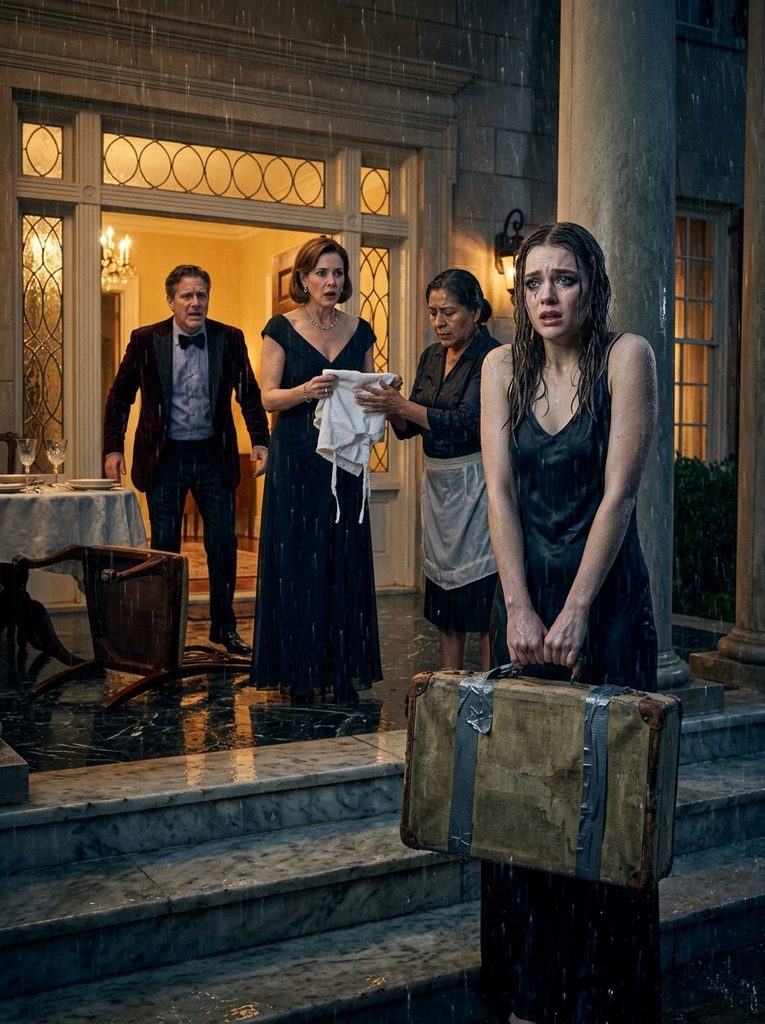
By the time my feet hit the slick wood of the veranda, her luggage was already abandoned to the elements. It was a pathetic, battered thing—a faded canvas suitcase with a handle painstakingly mended with layers of silver duct tape. It held every single worldly possession she had gathered over nearly three decades of backbreaking labor. My younger sister had hurled it through the grand double doors of our Charleston estate, leaving it to lie face-down in the freezing, punishing rain.
Standing perfectly framed in the grand entryway, safely shielded from the damp chill, was my father, Reginald Sinclair. He wore a tailored velvet dinner jacket. His expression was not one of anger, nor even of guilt. It was an expression of profound, aristocratic boredom. He remained utterly untouched by the human tragedy unfolding on his porch.
When my voice finally broke through the paralyzing shock, I had begged him. I asked if we couldn’t, at the very least, offer her a financial cushion—some token of grace after twenty-seven years of unbroken, flawless service to our family.
My father didn’t even look at her. He kept his gaze fixed on the storm, utilizing that flat, deadened tone he reserved exclusively for things he deemed vastly beneath his social station.
“Staff does not receive severance, Elodie,” he stated, his voice clipping the humid air.
And the woman who had essentially breathed life into my lungs stood there on the edge of the porch, soaking wet, and said absolutely nothing. Her name was Ofelia.
She had plated my breakfast every single morning since I was old enough to chew. She had patiently taught me to read, dragging her finger beneath the syllables of storybooks at the scarred wooden kitchen table. She had kept vigil by my bedside through every fever, every phantom terror, and she had physically absorbed every tear I had ever shed into her own shoulder.
I could not stand on that pristine, columned porch and watch her only suitcase lie in the mud like common garbage.
The cold rain plastered my dark hair to my cheeks as I stepped out from the shelter of the overhang. I walked into the storm. I bent my knees, gripped the tape-mended handle, and lifted her heavy bag from the rising puddles.
I did not know it then, with the rain soaking through my silk evening dress, but that one infinitesimal act of rebellion—that one instinctive choice of love—was the spark destined to detonate a toxic secret buried in the foundations of that mansion for twenty-seven years.
Because Ofelia watched me. She watched the child she had meticulously raised choose her over the gilded, untouchable family that was currently throwing her away.
As I turned back toward the porch, carrying her wet bag, a seismic shift occurred in her posture. Something ancient and fierce rose up in her dark, lined face. It was an expression I had never once witnessed in all my life—a raw, unbridled sovereignty that had been forcefully held underwater for nearly three decades, finally breaking the surface, gasping for air.
Slowly, deliberately, she reached behind her waist. Her nimble fingers untied the stiff bow of the white cotton apron she had worn every single day I had ever known her. That apron was so deeply woven into my perception of her that I wasn’t entirely sure I had ever seen her silhouette without it.
She pulled the damp white fabric off over her head. Her movements were unnervingly calm. She folded it carefully into a pristine, perfect square, matching corner to corner, just the way she folded the fine estate linens.
Stepping up onto the dry shelter of the porch, she walked directly toward my mother, Vivien, who had drifted out from the parlor to stand like a phantom behind my father’s shoulder. Ofelia extended her arms and placed that folded white square gently, yet with the weight of an anvil, directly into my mother’s manicured hands.
“I think,” Ofelia said, her voice shaking with a terrifying, quiet gravity, “it is finally time she knew.”
My mother went completely, horrifically white. All the expensive, carefully applied color drained from Vivien’s face in a single heartbeat. It was the exact visceral reaction of a person who suddenly feels the earth open up beneath their expensive heels.
And my father—the man who had stood there so monumentally bored, so incredibly far above the petty squabbles of the working class—moved with a violent, panicked speed. He jerked backward so fast that the antique mahogany chair sitting just inside the foyer scraped violently against the marble and crashed to the floor, the sound echoing like a gunshot.
The untouchable, aristocratic patriarch was suddenly, undeniably terrified.
“You swore!” Reginald bellowed. The cultured, flat tone was entirely gone, replaced by a raw, guttural fear I had never heard bleed from his throat. “You swore to me on your life that you would take this to your grave!”
I stood on the slick bricks in the pouring rain. My hands tightly gripped a stranger’s ruined suitcase, yet, in that breathless moment, two absolute truths slammed into my chest simultaneously.
The first was that my entire, carefully curated existence was about to be irreversibly incinerated.
The second was that the soaking wet woman standing in front of me, in her plain, threadbare dress, stripped of her domestic armor, was not, and had never been, just the housekeeper.