The first thing I recognized was the orange lettering.
It appeared on a folded receipt lying beside Evan’s backpack. The sporting-goods store’s logo ran across the top.
For one foolish second, relief passed through me. He had bought something for his bicycle. Perhaps all the secrecy had an ordinary explanation.
Then I saw what the receipt listed.
A child’s bicycle helmet. Two replacement brake cables. A set of lights. A lock.
No bicycle.
Beside the receipt lay three small packages wrapped in brown paper. One had a name written across it in Evan’s careful handwriting.
For Mia.
“Mom.” Evan’s voice was barely audible. “Please don’t look at that.”
I lifted my eyes to him.
The scrape on his face from Saturday was still there. Beneath it, his skin had gone almost white. Sal stood a few feet behind him, holding a dish towel in both hands.
“What happened?” I asked.
Evan glanced toward the other employees. One of them quietly stepped into the dining room. The others followed, leaving us with the hum of the refrigerator and water dripping from an open tap.
Sal turned the tap off.
“Is he hurt?” I asked.
“No,” Sal said. “He’s all right.”
“Then why did you call me? Why was he shouting?”
Evan crouched and reached for the packages.
“Don’t,” I said.
His hand stopped.
I hated the sharpness in my voice. But the phone call still rang in my ears. Your son tried to do it again.
I looked at Sal. “Tell me what that means.”
Sal didn’t answer immediately. He looked at Evan.
That small hesitation frightened me more than anything I had seen on the floor.
“Did somebody take your money?” I asked my son. “Is someone making you give it to them?”
“No.”
“Then what happened near the creek?”
Evan pressed his lips together.
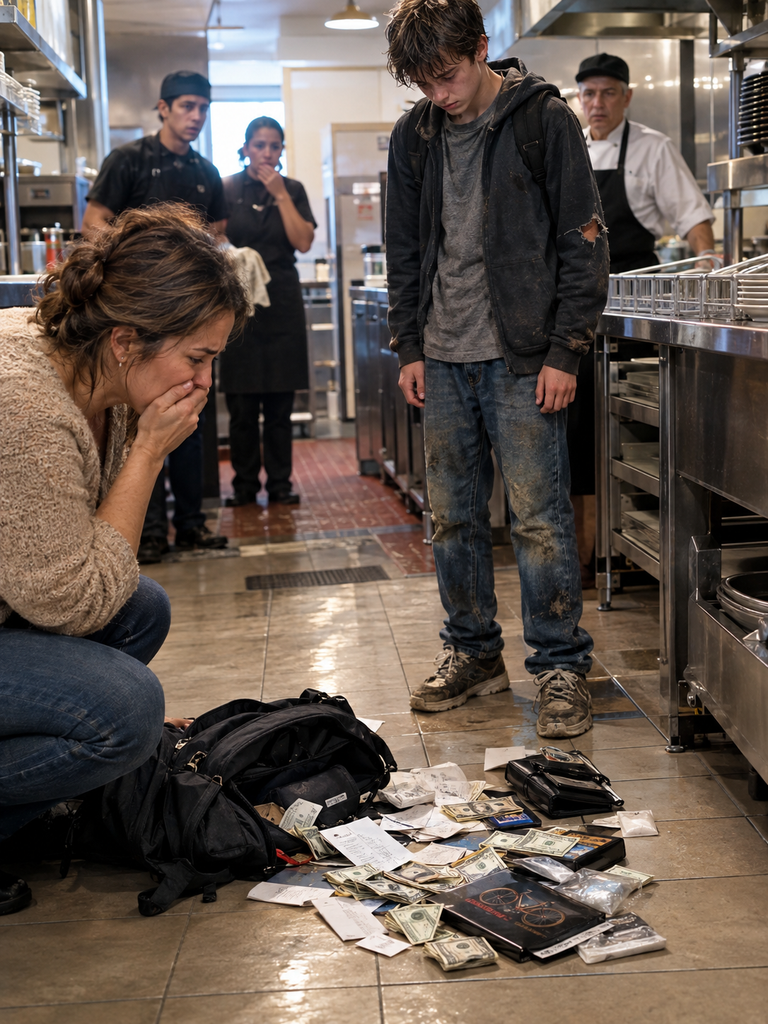
I crouched across from him, with the scattered contents of his backpack between us.
“You came home muddy, with your shirt torn and your face scraped. You wouldn’t tell me where you’d been. Today, your boss called and asked me to come here because you ‘tried to do it again.’”
“I know how it sounds.”
“Then help me understand.”
His eyes went to the packages. I followed his gaze.
One was marked Mia. Another said Ben. The third had no name, only a street address I didn’t recognize.
There were more receipts, too. A hardware store. A pharmacy. A grocery store. Some were months old, their edges soft from being folded and unfolded.
“Evan,” I said, “who are these people?”
“They’re kids.”
My hands went cold again.
“What kids?”
“Kids who need bikes.”
I stared at him.
He tried to gather a handful of loose bills, but they slid through his fingers. He left them where they were.
Sal pulled out a chair from a little table against the kitchen wall. “You might want to sit down.”
“Please stop saying that.”
He nodded and pushed the chair back under the table.
Evan looked at me at last. “The money’s mine, Mom. Every dollar I earned, Sal paid me. You can ask him.”
“I know you worked for it. I’m asking what you did with it.”
“I bought parts.”
“For whose bikes?”
Evan swallowed. “Mia’s. Ben’s. Before them, some other kids’.”
I looked again at the brown packages. They were small enough to hold lights or bells. One corner had split, showing a strip of bright blue ribbon.
None of it explained the creek. It didn’t explain the cash I had seen in his bedroom.
“Why would you do that?” I asked.
Evan’s face tightened.
I heard my own question then. It had come out as an accusation.
“I mean,” I said more gently, “how did this start?”
Sal reached for a folded paper near my knee.
Evan caught his wrist. “I’ll tell her.”
Sal let go.
Evan picked up the paper and smoothed it against his jeans. It was a child’s drawing. Two stick figures rode bicycles beneath a huge yellow sun. One bicycle was black with orange wheels.
At the bottom, in uneven letters, someone had written: THANK YOU FOR LETTING HIM RIDE TOO.
I read it twice.
“Who drew this?”
“Mia.”
“And who’s ‘him’?”
“Her little brother.”
For a moment, Evan seemed to forget the people standing around him. He looked at the drawing the way he used to study picture books when he was small, tracing details with his eyes.
“Her brother has trouble with his balance,” he said. “He can ride one of those little bikes with the wide back wheels. But theirs was broken.”
“So you bought him one?”
“I fixed one.”
Sal cleared his throat. “Maybe we should go into my office.”
Evan shook his head. “I can say it here.”
“You don’t have to make it harder,” Sal said.
“It’s already hard.”
That was the first moment I understood that Evan had been carrying something much heavier than the money in his backpack.
I sat in the chair Sal had offered. Evan remained on the floor.
“Start at the beginning,” I said. “Please.”
He looked down at the drawing.
“The bike in the store was real,” he said. “I wanted it.”
“I know.”
“I still do, kind of.”
“Okay.”
“When I started here, Sal had an old blue bike behind the diner. Somebody had left it by the dumpster. He was going to throw it away.”
“It was rusted through in places,” Sal said.
“The frame wasn’t,” Evan corrected him.
Sal gave a small, tired smile. “The frame wasn’t.”
Evan had asked if he could take it. After his shift, Sal had shown him how to remove the chain and check the tires. Over the next few Saturdays, Evan used part of his pay to buy a tube, brake pads, and paint.
I pictured him at the diner while I believed he was simply washing dishes. I pictured the red skin around his knuckles.
“What did you plan to do with it?” I asked.
“Sell it. Put the money toward mine.”
That was an answer I understood. It felt like solid ground.
“Then Mia came in,” he said.
She had come to the diner with her mother and younger brother on a rainy afternoon. Her mother worked nearby and had enough money for one meal to split between the children. Evan noticed the boy looking through the back window at the blue bike.
He went outside and asked the boy if he liked bicycles.
“The bike didn’t even have a seat yet,” Evan said. “But he asked if it was fast.”
Evan’s mouth twitched, then the expression vanished.
“He asked if it was fast, and I said it would be.”
A week later, Mia came back alone with a handful of coins. She asked Sal whether the person fixing the blue bike would sell it to her. She had been collecting change to buy something her brother could ride.
“She didn’t know it needed different wheels,” Evan said. “Or that it wouldn’t fit him. She just saw a bike.”
“What did you tell her?”
“I said it wasn’t for sale.”
I could imagine how that had sounded to a little girl holding out her savings.
“Then I asked Sal if we could find one that would work,” Evan added.
They had found a smaller damaged bicycle through a customer. The customer gave it to Sal when he heard what they planned to do. A mechanic down the street helped them choose the right rear wheels and showed Evan how to fit them securely.
That was the first bike Evan finished.
He brought it to Mia’s family after work, with Sal driving. Mia had made the drawing the next day.
I studied the black bicycle with orange wheels.
“She remembered the bike you wanted,” I said.
Evan nodded. “I told her about it.”
Something about that undid me. He had told a little girl about his own dream while spending his money on her brother’s.
But I still had questions, and one of them was urgent.
“Sal drove you that time. What happened on Saturday?”
Evan’s gaze dropped to the scrape on his face.
“Before we get to that,” Sal said, “there’s something I should explain.”
Evan gave him a warning look.
Sal ignored it. “After Mia’s brother, people started bringing us bicycles they didn’t use. Most weren’t safe to ride as they were.”
“How many?”
“Eleven have come through here,” Evan said. “We finished seven.”
I looked from one of them to the other.
“Seven?”
“Not all for kids,” Evan said. “One went to a man who uses it to get to work.”
“And you paid to fix them?”
“Some of the parts.”
“How much of your pay?”
He didn’t answer.
“Evan.”
“Most of it.”
I thought of him standing at the sporting-goods window, knowing the bike’s price down to the dollar. I thought of how he had told me, every time I asked, that he was almost there.
“You could have told me,” I said.
“I was going to.”
“When?”
“When I knew it would work.”
“What would work?”
Evan folded Mia’s drawing once, carefully, along its old crease.
Before he could answer, Sal said, “There’s another reason those bikes started coming here.”
His voice sounded rough.
He reached into his shirt pocket and took out a faded photograph. The edges were curled. I recognized my husband before Sal handed it to me.
He was standing behind this very diner, holding a bicycle upright by the handlebars. He wore the gray coat I had finally given away the year before. Beside him stood Sal, a little younger, with one hand resting on the shoulder of a grinning boy.
I touched my husband’s face in the picture.
“I’ve never seen this.”
“He didn’t tell you?” Sal asked.
“No.”
“He didn’t tell many people.”
The kitchen seemed to recede around me.
My husband had stopped at this diner often. I knew that much. Some mornings, he came home with coffee in a paper cup and claimed Sal made the only decent eggs in town.
But he had never mentioned the photograph.
“The kid in the picture is my grandson,” Sal said. “When my daughter had to move suddenly, he came to live with me. I had trouble getting him to school while I opened the diner. Your husband found that bike, repaired it, and taught my grandson how to use the safer route.”
I stared at him.
“He did it after work,” Sal continued. “Then he stayed to help me fix another one. And another.”
Evan watched my face closely.
“He was doing this?” I asked.
“For a while. Nothing organized. If someone brought a broken bike, he’d see what he could do.”
I looked down at the photograph again. My husband’s smile was familiar. The story was not.
For three years, grief had made me think I knew the exact shape of what we had lost. Then a man handed me a picture of a whole piece of my husband’s life I had never seen.
“Why didn’t you tell me?” I asked Sal.
“I meant to, after he died.” His eyes filled. “I came to the service. You were surrounded by people. I thought I’d call another day, and then I waited too long.”
There was nothing I could say to that. I had done the same thing with people who loved my husband. Some conversations had felt impossible to survive, so I kept putting them off.
“Evan found the picture in my office,” Sal said. “I showed him where we used to work on the bikes.”
Evan stared at the tiles.
“That’s why you chose this job?” I asked him.
“Partly.”
“What was the other part?”
“The bike in the window.”
It was such a plain answer that I nearly laughed. My son had started out wanting exactly what he said he wanted. Somewhere between the first paycheck and the sixth month, things had changed.
Sal crouched and began gathering receipts. Evan stopped him.
“I need to tell her the rest.”
“Yes,” I said. “You do.”
Evan drew a breath.
“For a while, I thought I could do both. Fix bikes and save for mine. Sal let me use the space out back. Some people gave us parts.”
“But parts still cost money.”
“And helmets. We can’t give a kid a bike with bad brakes or no helmet.”
I looked at the packages.
“What’s in those?”
“A bell and lights for Mia’s brother. Ben needs a lock. The last one has a replacement grip and a note for Mr. Palmer.”
Mr. Palmer was the man who rode to work.
“Why were they in your backpack?”
“I was taking them out after my shift.”
“Where?”
Evan hesitated.
“Across the creek.”
The room grew still.
“The same creek where you fell?”
“It’s not far if you use the footbridge.”
“Did you use the footbridge on Saturday?”
“No.”
“Why?”
“The footbridge is closed. Some of the boards broke after the rain.”
“Then how did you get across?”
“I didn’t. I was going to, but the bank gave way before I reached the water.”
I stared at his scraped face.
“You told me you slipped down the bank.”
“I did.”
“You left out why you were there.”
“Yes.”
“And today?”
He looked toward Sal, then back at me. “I was going to take the packages. I thought the path might be dry enough.”
Sal stood. “I found his bag by the back door. I’d already told him the path was off limits. He tried to leave while I was on the phone with you.”
“That was the shouting?”
“Part of it. I grabbed his backpack. The zipper broke.”
Evan rubbed his forehead. “I yelled because I knew you were talking to Mom.”
“You were right,” Sal said.
I closed my eyes for a moment. On the drive here, I had imagined people hurting Evan, threatening him, taking what he earned. I had not imagined him trying to cross a closed creek path with bicycle lights and a lock.
Fear turned to anger so quickly that I had to steady my voice.
“You could have been badly hurt.”
“I know.”
“Do you? You came home with a scrape and tried again.”
“I stayed away from the water Saturday.”
“You were on a bank that collapsed.”
“I know,” he said again, quieter.
“Why was it so important to deliver these today?”
“They’ve been waiting. Ben’s bike is finished, but he can’t lock it up at school without this.”
“Ben can wait for a lock.”
“It’s more than that.”
Evan looked down at his hands. The skin around his fingers was dry and red.
I waited.
“He’s moving next week,” he said. “His mom found a better job on the other side of town. She said the bus doesn’t go close enough to his school.”
“So the bike will help him get there?”
“Yeah. Sal’s checking the route with her. There are busy roads, so he might have to walk part of it.” Evan picked at a loose thread on his jeans. “I promised he’d have it before they moved.”
“And you thought that promise mattered more than getting home safely?”
“I thought I could keep it and be safe.”
“You were wrong.”
He nodded, but I could see how much it cost him.
Sal spoke from behind us. “I told him I would deliver everything myself.”
“You close late,” Evan said.
“I have a car.”
“You said you needed to fix the freezer today.”
“The freezer can wait.”
I looked at Sal. “Why didn’t you call me Saturday night?”
“Because Evan told me he’d slipped on his walk home. I didn’t know he’d tried the creek path until this morning.”
Evan closed his eyes.
“You lied to Sal, too?” I asked.
“Yes.”
There it was. The part of this story that could not be softened by good intentions.
He had lied to me for months about the money. He had lied to Sal about the fall. He had tried to make another trip after both of us had reason to stop him.
I reached for Mia’s drawing and set it beside the receipts.
“I’m proud that you helped those people,” I said. “I’m also furious with you.”
“I know.”
“I don’t think you do yet.”
His chin trembled. He looked down before I could see more.
I turned to Sal. “Why did you ask whether I knew what he did with every paycheck? You made it sound like something terrible.”
“I know. I’m sorry.” He leaned against the prep table. “I called because he tried to leave again. I thought if I started with the creek, he’d grab his bag and run. I wanted you to understand why he kept trying.”
I remembered the fear in Sal’s voice and the crash when the backpack hit the floor. He had been frightened, too.
“But there’s something else,” Sal said.
Evan stood so abruptly that the chair behind me rattled.
“Sal.”
“You’ve told her what you spent,” Sal said. “Tell her what you were saving.”
Evan shook his head.
“You showed me a stack of cash in your room,” I said. “Was that for parts?”
He shook his head again.
“Then what was it for?”
His eyes filled.
“I wasn’t going to give it away.”
“That’s okay. You don’t have to give away everything you earn.”
“It was for you.”
The refrigerator motor clicked off. In the sudden quiet, I heard a dish being set down in the dining room.
“What do you mean?”
Evan reached into the open backpack and pulled out a small notebook I hadn’t noticed. Its cover was stained near the corner. He turned several pages and handed it to me.
At the top of one page was a number.
I knew it immediately. It was the amount still owed on the repair bill for our car.
The car had broken down four months earlier. I had paid for most of the repair, but I was making monthly payments on the rest. Evan had seen me going through the bills at the kitchen table. I had no idea he knew what the balance was.
Beneath the number, he had written smaller amounts in a column. Some were marked parts. Others were marked car. At the bottom, a total had been circled twice.
My throat closed.
“You can’t pay my car bill.”
“I haven’t.”
“You were planning to.”
“I was saving enough to help.”
“That isn’t your responsibility.”
“I know you keep saying that.”
“Because it’s true.”
“But the car gets you to work. You said if it broke again, you didn’t know what you’d do.”
I remembered saying that into the phone to my sister. I had thought Evan was upstairs.
“I was scared,” I told him. “I was talking through a bad day. I should have explained it to you.”
He gave a small shrug. It was the same shrug he had used when I asked about the cash.
“I wanted you to stop worrying.”
The missing bicycle had been only part of the secret. Evan had been trying to carry a piece of my fear as well.
I stared at the page until the numbers blurred.
“And ‘almost there’?” I asked.
“I meant it at first. About the bike. Then I meant the car bill.” He wiped his nose with his sleeve. “But every time I got close, another bike needed something, and I spent some of it.”
Sal looked away.
I thought about the photograph of my husband. Evan must have found out about those old bicycles soon after starting work. He had wanted the black bike in the store, and he had watched us struggle since his father died. He had made room in his thirteen-year-old mind for both desires and somehow added other people’s needs as well.
“Why didn’t you tell me any of this?”
Evan looked miserable. “Because you would say I didn’t have to pay the bill.”
“I would.”
“And you’d say I should keep my money.”
“Yes.”
“And maybe you’d tell me to stop fixing bikes.”
“I would have wanted to know where you were going and whether it was safe.”
“That’s what I was afraid of.”
“You were right to be afraid of the creek part.”
“I know.”
I closed the notebook. “I need you to hear something. Your dad helped people with bicycles. I wish I’d known. But he was an adult. He could decide what he could afford, and he didn’t have to hide a dangerous route from his mother.”
A startled laugh escaped Sal. Evan’s mouth moved, too, though no sound came out.
“Helping is a good thing,” I continued. “It doesn’t give you a reason to scare the life out of me.”
“I’m sorry.”
I believed him. I was still shaking.
Sal put the photograph on the table beside me.
“There’s something I kept from both of you,” he said.
Evan frowned. “What?”
Sal rubbed his hands over the dish towel. “I thought I was handling it properly. Now I’m less sure.”
“What did you keep?” I asked.
“Evan’s pay was always his. I paid him for every hour he worked. But after he gave away that first bike, I started putting some of my own money aside whenever he bought parts.”
Evan stared at him. “You told me the diner couldn’t afford to pay for the bikes.”
“The diner couldn’t. This was mine.”
“You should’ve told me.”
“If I had, you would have spent your whole paycheck on parts.”
“I did spend most of it.”
“And I’m glad I kept the money aside.”
Sal went into his office. A drawer opened, then closed. When he returned, he carried a plain white envelope.
He placed it on the table but kept his hand over it.
“I intended to talk to your mother before I gave you this. I should have done it months ago. I kept putting it off because things seemed to be going well.”
He lifted his hand.
Inside the envelope were several folded bills and a note with amounts and dates. At the top, Sal had written: Bike fund.
Evan didn’t touch it.
“How much?” I asked.
“Enough for the bike in the window,” Sal said. “If it’s still there.”
Evan looked at him as though he had spoken in another language.
Sal gave a shaky breath. “Your dad was my friend. But that isn’t the only reason I did it. I watched you work hard, and I watched you give people things they needed. I wanted you to have something you wanted, too.”
For a long moment, nobody moved.
Then Evan pushed the envelope gently back toward Sal.
“You should keep it for the bikes.”
Sal shook his head. “I know you think that’s the right answer. I’ve had six months to decide what this money is for.”
“But Ben still needs—”
“Ben has his lock. It’s right there in your backpack.”
“Other bikes will come.”
“Yes,” Sal said. “We’ll figure those out when they come. I won’t accept this envelope back.”
Evan looked to me. I could see him searching my face for permission to want the bicycle.
It broke my heart that he needed it.
“You can take it,” I said.
“What about the car?”
“The car is mine to pay for.”
His expression fell, and I realized he had heard that as a refusal of his help.
I reached for his hand.
“I know why you saved that money,” I said. “Thank you. I mean that. We can talk about what you want to do with your savings. But you don’t need to solve my bills before you’re allowed to be thirteen.”
He stared at our hands.
“I don’t always know how worried you are,” he said.
“That’s because I’m your mother. Sometimes I talk about a problem before I know how to solve it. I should be more careful about what you overhear, and I should tell you when I’ve made a plan.”
“Do you have one for the car?”
“Yes. The payments are set. I can show you after dinner.”
“You don’t have to.”
“I want to. You’ve been guessing, and the guesses have frightened you.”
A tear landed on the back of my hand. Evan pulled his hand away to wipe his face, but I had seen it.
Sal returned to the prep table and began putting the scattered receipts into a pile, giving us a little privacy.
I looked around the kitchen. There was a box of mismatched bicycle parts under the far counter. Through the window in the back door, I could see a workbench beneath the diner’s awning. An old tire hung from a hook.
All this had existed a short drive from our house. Evan had spent months here, making something with his hands. I had known about the dishes, the grease, and the sore skin. I had missed nearly everything else.
“Can I see the bikes?” I asked.
Evan blinked. “Now?”
“If Sal has time.”
Sal nodded toward the dining room. “We’re between rushes. I can spare a few minutes.”
Evan led me through the back door.
The afternoon was bright. The workbench sat against the brick wall, with tools hung in careful rows. Two bicycles stood beside it. One was small and yellow, its front wheel removed. The other was a faded green adult bike with new brake cables still waiting to be fitted.
Evan stopped beside the yellow one.
“That’s for a girl who comes in with her grandpa,” he said. “The wheel wobbles. We’re trying to figure out if it can be fixed.”
“Can it?”
“Maybe. Sal says I have to ask the mechanic before we give it back.”
Sal nodded. “He’s learning that I’m annoyingly serious about brakes and wheels.”
I ran my fingers along the workbench. There were small scratches in its surface, and an old dark stain near one corner.
“Your dad worked here?” I asked.
“Right here,” Sal said.
I could almost see him leaning over a wheel, pushing his sleeves up, telling a joke while Sal pretended not to laugh.
For years, I had tried to protect Evan from the parts of grief I couldn’t manage. I had spoken of his father when Evan asked, but I had avoided the diner after the funeral without knowing I was avoiding it. Sal had waited too long to call. Evan had found the photograph on his own.
We had all been quiet in different ways.
“I wish you’d brought me here,” I told Evan.
“I thought it would make you sad.”
“It does.”
His shoulders sank.
“It makes me glad, too,” I said. “I can feel both.”
He looked at the workbench.
“Sal told me Dad messed up the first bike they fixed,” he said.
Sal raised an eyebrow. “I said he put the chain on backward the first time.”
“That sounds like him,” I said.
Evan smiled properly then. Just for a second.
Sal’s phone rang inside. He excused himself and went to answer it.
The moment he was gone, Evan said, “Am I allowed to keep working here?”
I had expected the question. I still needed a breath before answering.
“I don’t know about the hours yet. We need to talk about school, the trips, and what Sal expects you to do here.”
“I can stop going across the creek.”
“You will stop. Even when the footbridge reopens, you won’t make deliveries alone.”
“Okay.”
“And if you get hurt, I hear about it that day. If you’re late, you call. If your phone is dead, you ask Sal to call.”
“Okay.”
“I need you to tell me the truth about your money. You can choose how to spend what you earn, but we can’t talk properly if you keep telling me a story you made up.”
He scuffed the toe of his muddy sneaker against the pavement.
“I thought if you knew how much I had, you might need it.”
There was no selfishness in his voice. Only the worry I had unknowingly let settle there.
“I might need help sometimes,” I said. “When I do, I’ll ask other adults. I won’t take your savings without talking to you.”
He nodded slowly.
“And I want you to tell me when you’re worried about me,” I added. “Even if you think I won’t like hearing it.”
“Will you tell me when the car is okay?”
“Yes.”
He considered that. “Then I want to stay.”
“I know.”
I looked back at the bikes. The yellow one needed work. The green one needed a careful check. Evan had people waiting for him, and I could see why he cared.
“We’ll talk with Sal about a safe way to do this,” I said. “I’d like to meet the people you’re helping before you go to their homes.”
“That might embarrass Ben.”
“I can meet his mother.”
He thought about it, then nodded.
Sal came back outside, holding his phone.
“That was Ben’s mother,” he said. “I told her the delivery would have to wait.”
Evan’s face tightened.
“She said they’re coming into town tomorrow,” Sal continued. “She can pick up the bike here after the mechanic checks it.”
“Tomorrow?” Evan asked.
“Yes. She said Ben would like to meet the person who fixed it.”
Evan looked startled. “He doesn’t know?”
“He knows someone at the diner helped. His mother wanted to thank you in person.”
Evan turned to me. “Can you come?”
“I’d like that.”
The next day, we went back together.
It was a school day, so Evan came after class. I arrived early and sat at a table with coffee while Sal finished working. Through the back window, I watched Evan carry Ben’s bicycle to the mechanic, who checked the brakes one last time.
Ben and his mother arrived a few minutes later. He was a little younger than Evan, with a jacket that was too large in the shoulders. His mother shook Sal’s hand first, then looked toward the bicycle.
Evan suddenly seemed unsure of what to do with his own hands.
Ben didn’t give him time to worry.
“You fixed it?” he asked.
“With help,” Evan said.
Ben ran a finger over the new lock. “My mom said I have to learn the route with her before I ride to school.”
“That’s smart,” Evan said. “There’s a crossing near the library where you should get off and walk.”
They went over the route together at the table. Ben’s mother had marked it on a folded map. I listened as she asked Evan about the bike, and as Evan carefully told her which parts the mechanic had checked.
He sounded thirteen when Ben asked if it could go fast. He sounded like his father when he answered that stopping safely mattered just as much.
When they left, Ben walked the bike beside his mother. He looked back once and waved so hard the handlebars turned with him.
Evan waved back.
We stayed at the diner to speak with Sal. He agreed that Evan’s shifts would end at the time we set, and that deliveries would go through him and the families. The mechanic offered to check each finished bike before anyone rode it.
There were still things to settle. Evan and I needed to rebuild trust. I needed to pay closer attention when he came home with a rehearsed answer. Sal needed to call me if something at work put Evan at risk, even if Evan begged him not to.
None of that was solved by one conversation.
A week later, the black bicycle was still in the sporting-goods window.
Sal insisted on coming with us. He stood beside Evan while the clerk brought it out and adjusted the seat. Evan held the handlebars but didn’t climb on right away.
“It costs a lot,” he said.
Sal handed the envelope to the clerk. “I know exactly how much.”
Evan glanced at me.
“You can enjoy it,” I told him.
He swung a leg over the frame. For a moment, he sat very still, both feet planted on the floor. Then he gave the pedals a cautious turn and smiled.
That evening, he rode home beside my car on the quiet neighborhood street. I kept close enough to see him and far enough to give him room. At our driveway, he stopped, took off his helmet, and waited while I parked.
Later, I found him at the kitchen table with his savings notebook open.
I set my car payment statement beside it. We went through the numbers together. He asked two questions, and I answered both. Then he crossed out the total he had been trying to reach for me.
He drew a new line underneath and wrote: My savings.
For a while, he turned his pencil between his fingers.
“Can I still use some of it for the yellow bike?” he asked.
“Yes,” I said. “After the mechanic says it can be fixed.”
He nodded, satisfied, and closed the notebook.
Outside the window, his new bicycle leaned against the porch rail. Its orange letters caught the last of the afternoon light.
Evan looked at it, then at me.
“Dad really put a chain on backward?”
“Apparently.”
He smiled. “I wish I could’ve seen that.”
“So do I.”
He moved his chair closer to mine. For a few quiet minutes, we sat at the kitchen table together, with the bills between us and his bicycle waiting outside.
The Woman Humiliated at Table One Was the Only Person Who Could Release the Navy’s Newest Ship.
“Get out of that chair before I drag you out myself.”
Colonel Vanessa Drake planted both hands on Table One, rattling every glass as seventy-six-year-old Ruth Bennett remained seated.
The conversations nearest them weakened into nervous whispers.
Ruth’s weathered fingers rested beside an untouched dinner plate.
Her gray eyes moved from Vanessa’s hands to the colonel’s rigid face.
“I believe this seat was assigned to me,” Ruth said.
Vanessa straightened slowly, making the gold decorations across her white uniform catch the afternoon sunlight.
“You believe wrong.”
Several officers at nearby tables glanced toward the open doors overlooking San Diego Bay.
None of them stood.
None wanted to become involved in a confrontation with the Navy’s most ambitious logistics commander.
Ruth adjusted the skirt of her navy dress and looked at the handwritten place card.
Her name appeared beneath an embossed silver anchor.
“It says Ruth Bennett.”
“I can read,” Vanessa snapped.
“Then we agree on something.”
A few guests lowered their eyes to hide startled reactions.
Vanessa’s jaw tightened.
She picked up the place card, examined it, and crushed it inside her fist.
The thick paper crackled loudly.
“This table is reserved for people who matter.”
Ruth watched Vanessa drop the ruined card into her water glass.
The card floated between two melting ice cubes.
“And who decides that?” Ruth asked.
“Today, I do.”
Vanessa glanced toward the head table, where several admirals had not yet taken their seats.
The centerpiece displayed a model of the USS Resolute, the destroyer waiting outside for its ceremonial departure.
Its commissioning banner stretched across the banquet hall.
READY FOR TOMORROW.
The slogan had been printed beneath an image of the ship cutting through blue water.
Ruth followed Vanessa’s glance toward the banner.
A subtle uneasiness crossed her face.
Vanessa mistook it for fear.
“That’s better,” Vanessa said. “Now stand up.”
Ruth remained still.
A waiter carrying champagne paused behind Vanessa.
His tray trembled faintly.
Vanessa turned her head.
“Keep moving.”
“Yes, Colonel.”
The waiter hurried away.
Ruth looked around the hall, noticing officers, contractors, elected officials, shipyard representatives, and decorated veterans.
Dozens had seen Vanessa confront her.
Every one of them had decided that silence was safer.
“You have an audience,” Ruth said quietly.
“I have witnesses.”
“To what?”
“To your refusal to follow a lawful order.”
Ruth raised one eyebrow.
“This is a banquet hall.”
“It is a Navy function.”
“That does not make your temper lawful.”
Vanessa leaned closer.
Her perfume mixed with the smell of roasted vegetables and polished wood.
“You walked through the wrong door, took the most important seat, and embarrassed my staff.”
“No one on your staff stopped me.”
“They assumed an elderly woman wouldn’t have the nerve.”
Ruth’s thumb brushed the antique anchor hanging against her collarbone.
Its silver surface carried small scratches from decades of wear.
Vanessa noticed the movement.
“That trinket does not make you a sailor.”
“I never claimed it did.”
“Then stop pretending you belong here.”
Ruth looked toward the harbor again.
Beyond the open doors, sailors crossed the destroyer’s deck beneath brilliant California sunlight.
Signal flags snapped in the wind.
Workers removed the last ceremonial barriers from the pier.
A tugboat waited beyond the ship’s bow.
Everything appeared ready.
Yet Ruth’s gaze stayed fixed on the vessel.
“Something wrong with the ship?” Vanessa asked mockingly.
“That depends.”
“On what?”
“On whether everyone has done their job.”
Vanessa laughed once.
The sound was sharp and humorless.
“You wandered into the wrong building, and now you’re inspecting my ship?”
Ruth turned back.
“You called it your ship.”
“I oversee today’s departure.”
“That wasn’t my question.”
The guests nearest them became completely silent.
Vanessa’s face darkened.
Ruth could see the colonel calculating how much humiliation would force the old woman to leave.
She could also see Vanessa’s confidence growing because nobody had intervened.
A young lieutenant near the wall took one cautious step forward.
Vanessa noticed immediately.
“Lieutenant,” she called.
The young woman froze.
“Yes, ma’am?”
“Do you have a problem?”
“No, ma’am.”
“Then return to your assignment.”
The lieutenant stepped back.
Ruth studied her face.
The officer looked ashamed, but fear held her in place.
Vanessa turned toward Ruth with a satisfied smile.
“Even officers understand rank.”
“Rank without judgment is only decoration.”
The sentence landed harder than Ruth intended.
A murmur moved through the hall.
Vanessa’s smile disappeared.
She reached down and closed one hand around Ruth’s silver hair.
The movement happened so suddenly that several guests gasped.
Ruth’s chair scraped backward as Vanessa pulled.
Pain flashed across Ruth’s scalp.
Her knees struck the table’s underside.
A fork bounced against a plate.
“Stand up,” Vanessa hissed.
Ruth gripped the tablecloth, trying to keep her balance.
“Release me.”
Vanessa pulled harder.
Ruth rose awkwardly, her shoulder twisting as the chair toppled behind her.
Its wooden frame struck the floor with a heavy crack.
Someone whispered Vanessa’s name.
No one approached.
Vanessa dragged Ruth two steps from the chair before letting go.
Ruth stumbled against the table.
Her palm landed inside a bread plate.
A butter knife clattered onto the floor.
For several seconds, she said nothing.
She simply breathed through the pain while the room watched.
A reddish mark appeared near her hairline.
Vanessa smoothed her own sleeve.
“You were warned.”
Ruth straightened carefully.
Her body shook, though her gaze remained steady.
“That was assault.”
“That was assistance.”
A few guests exchanged troubled looks.
Ruth’s eyes moved among them.
“Did everyone hear that?”
Nobody answered.
Vanessa followed Ruth’s gaze.
“They heard an intruder refuse instructions.”
She seized Ruth’s dinner plate.
The meal included glazed salmon, potatoes, and bright vegetables arranged for the commissioning celebration.
Vanessa tilted the plate.
Ruth saw what was coming.
She did not retreat.
The food struck her dress with a wet slap.
Sauce spread across the navy fabric.
A piece of salmon slid down her skirt and landed beside her shoe.
The guests recoiled.
One woman covered her mouth.
Vanessa dropped the empty plate.
It shattered across the polished floor.
“Now your clothes match your manners,” she said.
Ruth looked down at the ruined dress.
She lifted one trembling hand and removed a piece of carrot from the fabric.
Her fingers closed around it.
The hall waited for tears, anger, or surrender.
Ruth displayed none.
“My husband chose this dress,” she said.
Vanessa rolled her eyes.
“Then he had poor taste.”
“He died before he saw me wear it.”
The words changed the air.
Even Vanessa hesitated.
The pause lasted only a second.
“His absence is not my responsibility.”
“No,” Ruth replied. “Your conduct is.”
Vanessa moved closer again.
“You still think you can lecture me?”
“I think someone should.”
Vanessa struck Ruth across the face.
The slap echoed beneath the high ceiling.
Ruth’s head turned sharply.
Her anchor necklace swung sideways.
A thin line of blood appeared where her lip met one tooth.
Several chairs scraped as guests instinctively rose.
Vanessa spun toward them.
“Sit down.”
Nobody moved at first.
“I said sit down.”
The guests obeyed one after another.
The surrender sounded like rain as chairs settled against the floor.
Ruth touched her lip.
Blood stained her fingertip.
She looked at the red mark without surprise.
Then she looked at the seated officers.
Some stared at their hands.
Others watched Vanessa with growing alarm.
A retired captain near the aisle started to stand again.
His wife caught his wrist.
Ruth saw the exchange.
“Please,” Ruth told him softly. “Stay where you are.”
Vanessa turned back with a contemptuous smile.
“Finally, a sensible decision.”
Ruth wiped her lip with a napkin.
“I wasn’t speaking for your benefit.”
Vanessa’s expression hardened.
She drove her polished shoe into the table’s nearest leg.
The entire table lurched.
Glasses overturned.
Silverware jumped.
A centerpiece slid toward the edge.
Vanessa kicked again.
The heavy table tipped sideways and crashed onto the floor.
Porcelain exploded beneath it.
Champagne flowed across white linen.
Guests recoiled from rolling glasses and flying fragments.
Ruth stepped backward just before the corner struck her knee.
The anchor necklace swung against her chest.
The banquet hall fell into shocked silence.
Outside, the destroyer’s preparations continued.
Metal chains rattled along the pier.
A bosun’s whistle sounded from the deck.
The ship’s horn released a low test note across the harbor.
Vanessa stood amid the wreckage, breathing heavily.
Ruth looked from the overturned table to the colonel.
“Are you finished?”
Vanessa laughed.
“You have no idea who you’re talking to.”
Ruth reached for the anchor pendant.
She centered it against her stained dress.
Her fingers stopped trembling.
When she spoke, her voice was quiet enough to force everyone nearer.
“That destroyer stays docked until I authorize its departure.”
For one suspended moment, Vanessa stared at her.
Then laughter burst from the colonel’s mouth.
It spread unevenly among three officers eager to please her.
Nobody else joined them.
Vanessa bent slightly at the waist, as though Ruth had delivered the evening’s finest joke.
“You authorize it?”
Ruth said nothing.
Vanessa pointed through the open doors.
“That vessel represents four billion dollars, thousands of workers, and years of naval planning.”
“I know what it represents.”
“You don’t know anything.”
Ruth looked toward the Resolute.
“I know more than you were told.”
Vanessa’s laughter slowed.
“Should I ask the Secretary of Defense to wait for your blessing?”
“That will not be necessary.”
“Perhaps the President should call you.”
“He already knows today’s conditions.”
A deeper silence filled the room.
Vanessa’s smile remained, but uncertainty entered her eyes.
She looked toward the head table.
The admirals were still absent.
“Who are you supposed to be?” she asked.
Ruth pressed the napkin against her bleeding lip.
“The woman you should have allowed to finish dinner.”
The destroyer’s horn sounded again outside.
Its powerful voice rolled through the open doors.
Then it stopped in the middle of the blast.
Not faded.
Stopped.
The abrupt silence seemed to press against every window.
On the pier, sailors halted.
A tugboat engine dropped to idle.
Signal flags continued snapping, but the departure crew no longer moved.
Vanessa turned toward the harbor.
“What happened?”
Nobody answered.
A communications officer near the doorway pressed two fingers against his earpiece.
His face changed.
He looked toward Ruth.
Vanessa noticed.
“Report.”
The officer swallowed.
“The Resolute has received a hold order.”
“From whom?”
“I’m verifying, ma’am.”
“Remove it.”
“I don’t have that authority.”
“You have my authority.”
The officer shook his head.
“That isn’t enough.”
Vanessa crossed the debris toward him.
“What did you say?”
Before he could answer, measured footsteps sounded in the corridor.
Admiral Thomas Mercer appeared in the doorway.
He was sixty-three, broad-shouldered, and normally unshakable.
Now he looked directly at Ruth’s necklace.
His pace stopped.
The officers nearest him followed his gaze.
Mercer’s face lost its color.
Vanessa straightened with visible relief.
“Admiral, we have an intruder.”
Mercer did not look at her.
Ruth released the anchor pendant.
It rested above the food stains on her dress.
The admiral lifted one hand toward security.
“Seal every exit.”
Two security officers closed the main doors.
Heavy locks engaged with metallic clicks.
Others moved across the harbor entrances and side corridors.
Conversation broke into frightened fragments.
Vanessa looked from the guards to Mercer.
“Admiral?”
“Colonel Drake, step away from Mrs. Bennett.”
Vanessa’s face tightened.
“She disrupted a controlled function.”
Mercer approached Ruth.
He saw the blood on her lip, the reddened scalp, and the food across her dress.
His eyes moved to the overturned table.
“What happened here?”
Vanessa answered first.
“She refused to leave a restricted seat.”
Ruth folded the bloodstained napkin.
“That is one description.”
Mercer faced the room.
“Who witnessed the confrontation?”
Nearly every hand rose.
Vanessa stared around her.
People who had remained silent now looked unwilling to share her risk.
Mercer turned back toward Ruth.
“Were you physically harmed?”
“Yes.”
“By Colonel Drake?”
“Yes.”
Vanessa stepped forward.
“She was combative.”
Mercer’s voice sharpened.
“Do not move.”
Vanessa stopped.
Ruth saw the first genuine fear enter the colonel’s expression.
It did not come from guilt.
It came from discovering that authority had shifted away from her.
Vanessa pointed at Ruth’s pendant.
“What is that necklace?”
Mercer’s gaze remained fixed on Vanessa.
“You should already know.”
“I’ve never seen it.”
“That is the problem.”
Ruth inhaled slowly.
Pain pulsed across her cheek, scalp, and lower back.
The hall appeared too bright now.
Every polished surface reflected the destruction around Table One.
Mercer removed his uniform jacket.
He offered it to Ruth.
She shook her head.
“Thank you, Admiral, but evidence should remain visible.”
Vanessa’s lips parted.
“Evidence?”
Ruth looked at her.
“You called them witnesses.”
Mercer addressed the security officers.
“Preserve every recording from this room and the corridor.”
Vanessa’s eyes moved toward the ceiling.
Small security cameras occupied each corner.
She had clearly forgotten them.
“Admiral, this is being exaggerated.”
Mercer finally faced her fully.
“A protected civilian authority was assaulted during a federal commissioning review.”
“I didn’t know who she was.”
“You did not need to know.”
Vanessa’s mouth closed.
Mercer’s voice remained controlled.
“She was an invited guest.”
“She took Table One.”
“She was assigned Table One.”
“The card could have been stolen.”
“Her name was printed on it.”
“She looked out of place.”
The sentence escaped before Vanessa could stop it.
Disgust moved through the room.
Ruth studied her carefully.
“What does authority look like, Colonel?”
Vanessa did not answer.
“Does it always wear ribbons?”
Still no response.
“Does it always arrive with an escort?”
Mercer glanced at Ruth.
She continued.
“Or did you decide an elderly widow could be humiliated without consequence?”
“I was protecting the event.”
“You were protecting your image.”
Vanessa looked toward the harbor.
The destroyer remained motionless.
Sailors had assembled along the rail, waiting for instructions.
“You cannot stop that ship,” Vanessa said.
Ruth’s gaze followed hers.
“I already did.”
Mercer stepped beside Ruth.
“The hold is confirmed.”
Vanessa’s face went pale.
“On what grounds?”
Ruth looked at the commissioning banner.
READY FOR TOMORROW.
The words no longer appeared celebratory.
They looked like a question.
“On the grounds that one unresolved safety certification remains under my authority,” Ruth said.
Vanessa frowned.
“You’re an inspector?”
“No.”
“A contractor?”
“No.”
“Then what possible authority could you hold?”
Ruth did not answer immediately.
Instead, she surveyed the silent banquet hall.
She saw the lieutenant Vanessa had intimidated.
She saw the waiter holding an empty tray against his chest.
She saw senior officers who had chosen caution over intervention.
The evening’s failure reached beyond one colonel.
That truth hurt more than the slap.
Mercer seemed to understand.
He lowered his voice.
“Mrs. Bennett, we can move somewhere private.”
“No.”
“You have every right to request privacy.”
“And they have every reason to hear this.”
Mercer nodded.
Vanessa took another step backward.
Broken porcelain shifted beneath her shoe.
“Am I under arrest?”
“That decision will follow an investigation,” Mercer said.
“So I am being detained because an old woman made a claim?”
A security officer near the door flinched.
Mercer’s face hardened.
“You are being detained because approximately one hundred witnesses watched you assault her.”
Vanessa pointed at Ruth again.
“She threatened a naval departure.”
Ruth’s expression remained calm.
“A threat describes something a person lacks the right to do.”
Mercer added, “Mrs. Bennett exercised an established authority.”
Vanessa’s voice became louder.
“Established by whom?”
Ruth touched the pendant.
“My husband.”
Vanessa laughed again, but nobody mistook it for confidence.
“Your dead husband controls Navy ships?”
“No.”
Ruth’s eyes returned to the Resolute.
“He helped design the system that controls whether this one survives an attack.”
The words drew every officer’s attention.
Mercer remained silent.
Ruth continued.
“Daniel Bennett led a civilian engineering team responsible for the Resolute’s integrated damage-control network.”
Recognition appeared on several faces.
A shipyard executive near the rear whispered Daniel’s name.
Vanessa heard him.
“Engineers do not command deployments.”
“Correct,” Ruth said.
“So your claim is meaningless.”
“No, Colonel. Your understanding is incomplete.”
Mercer stepped toward the ruined table and lifted the soaked place card from the overturned water glass.
He unfolded it carefully.
Beneath Ruth’s name, smaller lettering identified her role.
INDEPENDENT TRUSTEE, BENNETT MARITIME SAFETY FOUNDATION.
Mercer held the card where Vanessa could see it.
She read the words twice.
Her confidence weakened further.
“A charity trustee cannot hold a destroyer.”
Ruth looked at the shipyard executive.
“Mr. Coleman, would you explain?”
David Coleman rose reluctantly.
He was fifty-six, with tired eyes and a suit that appeared uncomfortable on him.
“The foundation funded the final redesign after the original suppression network failed testing.”
Vanessa looked at him.
“The Navy funded this vessel.”
“The foundation supplied protected patents without licensing fees.”
“That does not create command authority.”
“No,” Coleman replied. “The settlement agreement does.”
A nervous murmur spread across the room.
Ruth waited until it faded.
Her husband’s work had not been a ceremonial contribution.
The damage-control network managed fire isolation, flooding containment, toxic smoke removal, and emergency power distribution.
Without it, the Resolute could remain afloat while becoming unsurvivable for its crew.
Daniel had discovered the original control architecture could trap sailors behind automated bulkheads during cascading failures.
He refused to certify it.
The primary contractor tried to remove him.
Daniel mortgaged their home to fund an independent redesign.
Ruth spent four years helping him document failures, organize testing, and negotiate access to government laboratories.
When Daniel’s health collapsed, she became his legal representative.
When he died, she inherited responsibility for the final certification.
The Navy could use the patented network only under one condition.
An independent trustee had to confirm that reported defects were resolved before operational departure.
Vanessa stared at Ruth.
“You’re the trustee?”
“Yes.”
“Why wasn’t I told?”
“You were.”
Vanessa shook her head.
“I received no such briefing.”
Mercer’s disappointment deepened.
“The trustee review appeared in your commissioning packet.”
“That packet contained thousands of pages.”
“You signed the readiness acknowledgment.”
“My staff reviews technical attachments.”
“Your signature certified personal review of critical exceptions.”
Vanessa glanced toward her aides.
They avoided her eyes.
Ruth understood what had happened.
Vanessa had delegated the reading, accepted the praise, and ignored the remaining warning.
That pattern was exactly why Daniel had demanded independent oversight.
“I was scheduled to meet you before dinner,” Ruth said.
Vanessa’s face shifted.
A memory had surfaced.
“Your assistant called me,” Ruth continued. “He said you were unavailable.”
“I had senior guests.”
“I was your senior safety review.”
“You could have identified yourself.”
“I gave my name.”
“You should have explained your position.”
“It was printed on your schedule.”
Vanessa looked toward an aide.
The young commander swallowed.
“She was listed at four-thirty, ma’am.”
Vanessa glared at him.
“You never told me.”
“I reminded you twice.”
The room tightened around that admission.
Vanessa’s authority had once depended on everyone protecting her version of events.
Now each person was protecting the record.
Ruth spoke before Vanessa could attack the aide.
“I waited forty minutes.”
The colonel looked back at her.
“Then your staff moved my appointment until after dinner.”
“I manage an enormous operation.”
“You managed to find time to pull my hair.”
Vanessa’s cheeks reddened.
Mercer looked toward the lieutenant near the wall.
“Lieutenant Sarah Collins, come forward.”
The young officer crossed the room.
Her hands were clenched at her sides.
“Did Colonel Drake receive the exception report?”
“Yes, Admiral.”
“When?”
“Three weeks ago.”
“What was her response?”
Sarah hesitated.
Vanessa fixed her with a warning stare.
Mercer noticed.
“Answer without considering anyone’s rank.”
Sarah drew a breath.
“She told us not to delay the ceremony over another engineer’s complaint.”
Ruth’s stomach tightened.
“Another engineer?”
“Yes, ma’am.”
“Who submitted it?”
“Chief Systems Engineer Michael Torres.”
Coleman closed his eyes.
Ruth turned toward him.
“You knew?”
“I learned this morning.”
“What defect did he report?”
“A pressure fault in the forward fire-suppression manifold.”
The words struck Ruth harder than Vanessa’s hand.
That exact fault had killed two workers during the earliest prototype tests.
Daniel had spent his final year ensuring it could never be dismissed again.
“When was it discovered?” Ruth asked.
“Six days ago.”
“And no one informed my office?”
“We sent the report through the commissioning chain.”
Ruth turned to Vanessa.
“You received it.”
Vanessa’s face remained rigid.
“It was classified as noncritical.”
“By whom?”
“My readiness staff.”
Sarah spoke quietly.
“After Colonel Drake changed the designation.”
Vanessa spun toward her.
“That is false.”
Sarah flinched but remained standing.
“I processed the revision.”
“You processed my request for clarification.”
“You instructed me to replace red with amber.”
“I instructed you to correct an error.”
Ruth watched the frightened lieutenant.
“Do you have the original?”
Sarah nodded.
“I preserved it.”
Vanessa’s face changed again.
This time, fear overwhelmed anger.
“Why would you preserve superseded material?”
“Because the system recorded your direct edit.”
Vanessa stepped toward her.
A security officer immediately blocked the path.
“Remain where you are, Colonel.”
Vanessa looked at Mercer.
“You’re allowing a junior officer to accuse me publicly?”
“I am allowing a witness to answer.”
“This is insubordination.”
“No,” Ruth said. “This is accountability.”
Vanessa faced her.
“You planned this.”
Ruth stared at the woman who had dragged her by the hair.
“You believe I planned my own assault?”
“You arrived without an escort.”
“I was invited to dinner.”
“You sat in a provocative location.”
“I sat where your staff placed my name.”
“You kept your identity vague.”
“My identity was not required for basic decency.”
Applause almost began near the rear.
Mercer raised one hand, stopping it.
This was not a triumph.
A dangerous defect remained aboard a ship carrying hundreds of sailors.
Ruth looked toward the harbor.
“Where is Michael Torres?”
Coleman checked his phone.
“He is at the shipyard office.”
“Bring him here.”
Mercer nodded to an aide.
“Arrange immediate transport.”
Vanessa folded her arms.
“The departure ceremony is scheduled within the hour.”
“The ship will not depart,” Ruth said.
“You cannot delay a national event over a disputed valve.”
“It is not a valve.”
“Then enlighten us.”
Ruth approached the model destroyer displayed near the overturned table.
Her steps were careful because pain had begun stiffening her back.
She pointed toward the forward section.
“The manifold controls distribution during a major fire.”
She moved her finger along the miniature hull.
“If pressure collapses here, suppressant cannot reach three connected compartments.”
Several naval engineers stood.
Ruth continued.
“If automatic bulkheads close correctly, sailors inside may have less than four minutes before smoke blocks their escape.”
Vanessa’s arms slowly unfolded.
“The backup system would activate.”
“Only if the pressure sensors identify the failure.”
Coleman added, “The reported fault affects those sensors.”
Mercer’s gaze moved toward Vanessa.
“You called that noncritical?”
She looked at Coleman.
“You said the final trials passed.”
“They passed before the fault appeared.”
“A ship cannot remain perfect forever.”
“No,” Ruth replied. “That is why honest reporting exists.”
The anchor pendant felt heavy against her chest.
Daniel had worn it during every major test.
After his death, Ruth had placed it beside his photograph for six months.
She eventually began wearing it whenever unfinished work required courage.
Vanessa had seen an old trinket.
Mercer had recognized the emblem engraved on its back.
The emblem belonged to Daniel’s original seven-member safety team.
Only two members were still alive.
“What happens now?” Mercer asked.
Ruth looked at the ship beyond the doors.
“We inspect the manifold.”
“Tonight?”
“Immediately.”
“The ceremony?”
“Canceled.”
Vanessa stepped forward again.
“You cannot cancel it.”
Ruth’s gaze settled on her.
“I just did.”
The statement carried no satisfaction.
Hundreds of sailors had prepared for this day.
Families had traveled across the country.
Shipyard workers had waited years to watch the Resolute leave.
Yet ceremony could never outweigh lives.
Mercer spoke into his radio.
“Cancel departure operations and suspend commissioning events.”
A voice answered through static.
“Confirm full cancellation, Admiral.”
“Confirmed.”
Outside, sailors began lowering the departure flags.
The tugboat turned away from the ship.
Guests watched through the doors as months of planning stopped within seconds.
Vanessa appeared physically smaller.
“You’re destroying my career over a theoretical failure.”
Ruth’s expression hardened.
“No. You endangered sailors to protect your schedule.”
“The report was inconclusive.”
“Then you delay until it becomes conclusive.”
“That is easy for a civilian to say.”
Ruth’s eyes flashed.
“My husband died proving systems like this must not depend on convenient assumptions.”
Vanessa fell silent.
Ruth had not intended to discuss Daniel’s final months.
The memory arrived anyway.
He had conducted conference calls from a hospital bed.
He had reviewed pressure diagrams between chemotherapy treatments.
He had asked Ruth to promise that no deadline would ever silence a warning.
She had made that promise with both hands wrapped around his.
He died nine days later.
Mercer lowered his voice.
“Mrs. Bennett, did the foundation receive any informal notice?”
“No.”
Coleman looked troubled.
“One engineer tried contacting Daniel’s old address.”
Ruth turned.
“When?”
“Yesterday.”
“What happened?”
“The message bounced.”
“Why didn’t he use the trustee channel?”
Coleman hesitated.
“His access was revoked.”
“By whom?”
Nobody answered.
All eyes moved toward Vanessa.
She shook her head.
“I do not manage contractor access.”
Sarah spoke again.
“Colonel Drake requested his credentials be suspended.”
Vanessa’s breathing quickened.
“He violated communication protocol.”
“He reported a safety issue,” Ruth said.
“He bypassed command.”
“He followed the independent reporting clause.”
“He embarrassed my office.”
The confession entered the room before Vanessa recognized it.
Mercer’s expression became cold.
“So you understood the clause.”
Vanessa realized the contradiction.
She had claimed ignorance of Ruth’s authority.
Now she had admitted punishing someone for using the process Ruth supervised.
“I understood the general policy,” Vanessa said.
“But not the trustee’s identity?”
“I did not memorize civilian names.”
Ruth walked closer.
Vanessa did not retreat this time.
Ruth stopped several feet away.
“My name appears beneath Daniel’s on every licensing agreement.”
Vanessa said nothing.
“You knew exactly who I was scheduled to be.”
“I knew a foundation representative was coming.”
“You knew my name.”
“I didn’t connect it.”
“Because you never looked at my face?”
Vanessa’s gaze dropped briefly toward Ruth’s stained dress.
Ruth understood.
“No,” she said. “Because I did not look important enough.”
“That is not what I meant.”
“It is what you demonstrated.”
Mercer’s radio crackled.
Michael Torres had arrived at the security gate.
An escort was bringing him inside.
While they waited, medical personnel entered the banquet hall.
A Navy corpsman approached Ruth with a compact trauma bag.
“My name is Petty Officer Lewis. May I examine you?”
Ruth nodded.
Lewis inspected her scalp, cheek, lip, and pupils.
He asked whether she felt dizzy.
“A little.”
“We should take you to the hospital.”
“After the inspection.”
“Mrs. Bennett, you may have a concussion.”
“Then I’ll sit.”
The waiter who had witnessed the beginning retrieved an undamaged chair.
He placed it beside Ruth.
“I’m sorry,” he whispered.
“You didn’t hurt me.”
“I didn’t help.”
Ruth looked at his young face.
Fear and shame competed there.
“What is your name?”
“Eli Parker.”
“Why didn’t you intervene, Eli?”
He glanced toward Vanessa.
“I thought I’d lose my job.”
Ruth nodded.
“That fear was reasonable.”
His eyes lifted.
“That doesn’t make it right.”
“No,” Ruth said. “It makes the person who exploited it responsible.”
Eli swallowed.
“I should have done something.”
“You can do something now.”
“What?”
“Tell the truth when investigators ask.”
He nodded.
“I will.”
Ruth sat while Lewis cleaned the blood from her lip.
The sting brought tears to her eyes.
She refused to hide them.
Pain was not weakness.
Humiliation was not consent.
Across the hall, Vanessa stood between two security officers.
Her decorations still shone.
Her uniform remained immaculate.
Yet everyone now saw the difference between appearance and character.
Michael Torres entered ten minutes later.
He was forty-two, with tired brown eyes and grease beneath one fingernail.
He wore a wrinkled blue work shirt and carried a sealed document case.
He stopped when he saw Ruth.
“Mrs. Bennett?”
She recognized his surname from Daniel’s files.
“Your father worked on the original team.”
Michael nodded.
“Luis Torres.”
“He was a brave man.”
“He said the same about your husband.”
Ruth motioned toward the case.
“Show us the report.”
Michael placed it on an undamaged table.
Mercer, Coleman, and two naval engineers gathered around him.
Vanessa remained close enough to hear.
Michael removed pressure graphs, diagnostic logs, and photographs.
“The fault occurs during rapid pressure cycling,” he explained.
“It passed routine checks because those tests increase pressure gradually.”
Ruth studied the graphs.
“Did you repeat the rapid cycle?”
“Four times.”
“Results?”
“Three failures.”
A naval engineer leaned closer.
“Why wasn’t this included in the final readiness summary?”
Michael looked at Vanessa.
“My access ended before I could upload the full package.”
Vanessa interrupted.
“Because your method was unauthorized.”
“It was Daniel Bennett’s emergency test.”
“That protocol was retired.”
Ruth shook her head.
“No. It remains mandatory when sensor drift exceeds two percent.”
Michael pointed to a graph.
“Drift reached three-point-seven.”
Mercer exhaled slowly.
“What is the operational risk?”
Michael hesitated.
“Potentially catastrophic.”
The words erased any remaining doubt.
Vanessa looked around the hall.
“You’re treating a potential outcome as certainty.”
Ruth answered without raising her voice.
“Safety decisions concern consequences, not convenient probabilities.”
“I made a judgment call.”
“You altered evidence supporting that judgment.”
“I corrected a classification.”
“You blocked the engineer who challenged you.”
“He was disruptive.”
“You canceled his access before his test package uploaded.”
“He ignored command structure.”
“You ignored the reason that structure contains independent review.”
Vanessa looked toward Mercer.
“Admiral, you know departures face constant last-minute objections.”
“I also know which objections cannot be concealed.”
“I did not conceal anything.”
Sarah removed a tablet from her portfolio.
“I have the revision history.”
Vanessa stared at her.
Mercer accepted the tablet.
The screen showed Vanessa’s account changing the risk label from red to amber.
A second entry removed the report from the executive summary.
A third requested suspension of Michael’s credentials.
Vanessa’s shoulders lowered.
For the first time, she stopped arguing.
Ruth looked at the timeline.
The final modification occurred that morning.
Only hours before Vanessa confronted her.
“You knew I would review the file today,” Ruth said.
Vanessa remained silent.
“You expected me at four-thirty.”
Still nothing.
“You delayed my meeting and removed the warning.”
Vanessa’s voice became thin.
“I needed time.”
“For what?”
“To confirm the defect privately.”
“After departure?”
“No.”
“When?”
Vanessa looked toward the Resolute.
“During the coastal systems trial.”
Michael reacted first.
“You intended to cycle the manifold at sea?”
“With emergency crews prepared.”
“You cannot contain that failure during a live trial.”
“We would have isolated the compartment.”
“With sailors aboard?”
Vanessa closed her eyes briefly.
The room seemed to lean away from her.
Ruth understood the full danger.
Vanessa had not merely dismissed uncertainty.
She planned to use the crew as part of an unofficial test after the public departure protected her reputation.
“How many sailors?” Ruth asked.
Vanessa did not respond.
Mercer repeated the question.
“How many would be aboard?”
“Three hundred and twelve.”
A woman near the rear gasped.
Her son served on the Resolute.
Other family members began whispering names.
The abstract risk became husbands, daughters, brothers, and friends.
Ruth rose despite Lewis’s objection.
“Three hundred and twelve lives,” she said.
“We had precautions,” Vanessa replied.
“You had a ceremony you refused to postpone.”
“I had obligations.”
“So did Daniel.”
Vanessa’s eyes met hers.
Ruth touched the anchor pendant again.
“He understood that leadership means becoming unpopular before people die.”
The colonel’s composure fractured.
“You think I wanted anyone hurt?”
“No.”
“Then stop speaking as though I intended disaster.”
“Intent does not rescue sailors.”
“I spent twenty-four years building this career.”
“And you risked three hundred careers, families, and futures to protect it.”
Vanessa’s eyes filled with anger and something closer to panic.
“You don’t understand what delay would have meant.”
“Explain it.”
“Congressional scrutiny, lost funding, contractor penalties, public embarrassment.”
Ruth looked around the destroyed banquet hall.
“You chose humiliation over honesty.”
Vanessa followed her gaze toward the broken dishes.
Her own violence had made Ruth’s sentence unavoidable.
Mercer handed the tablet to an investigator.
“Colonel Drake, you are relieved of all duties pending formal proceedings.”
Vanessa’s chin trembled.
“You cannot do this publicly.”
Mercer’s voice remained steady.
“You created the public circumstances.”
“Let me leave with dignity.”
Ruth looked at the woman who had dragged her from a chair.
For one moment, anger urged her to refuse.
Then she remembered Daniel’s final request.
Do not let safety become revenge.
Accountability protected people.
Revenge only fed pain.
Ruth faced Mercer.
“Remove her without spectacle.”
Vanessa looked surprised.
Ruth continued.
“But preserve every charge and every witness statement.”
Mercer nodded.
“Agreed.”
The security officers stepped beside Vanessa.
She stared at Ruth.
“Why would you give me that?”
“I did not give you forgiveness.”
Ruth’s voice remained quiet.
“I gave this room a chance to behave better than you did.”
Vanessa lowered her eyes.
The officers escorted her toward the side exit.
Before reaching it, she stopped.
“Mrs. Bennett.”
Ruth waited.
Vanessa looked over her shoulder.
“I truly did not know.”
Ruth understood that Vanessa meant her identity.
“That is why this matters,” Ruth replied.
Vanessa’s face tightened.
“You should not need my biography before deciding not to assault me.”
No one spoke after that.
The side door closed behind Vanessa.
The sound was softer than the ship’s silenced horn.
Yet it marked the complete end of her authority.
Ruth turned toward Michael.
“How quickly can your team inspect the manifold?”
“Six hours for disassembly.”
“Replacement?”
“If the housing is damaged, two days.”
“And full testing?”
“Another day.”
Ruth looked at Mercer.
“The ship remains docked until all results are independently verified.”
“Understood.”
“Michael’s credentials are restored immediately.”
Mercer looked at Coleman.
“Make it happen.”
Coleman nodded.
Ruth addressed Sarah next.
“You preserved evidence under pressure.”
The lieutenant straightened.
“I almost deleted it.”
“But you didn’t.”
“I was afraid.”
“Courage usually includes fear.”
Sarah glanced toward the closed side door.
“My career may still be over.”
Mercer answered before Ruth could.
“No officer will face retaliation for truthful testimony.”
Sarah’s shoulders eased slightly.
Ruth knew promises could fail without structure.
“The foundation will monitor that commitment,” she said.
Mercer met her gaze.
“So will I.”
The guests remained standing among overturned chairs and abandoned plates.
Nobody knew whether the banquet should continue.
Ruth looked at the commissioning banner.
Celebration felt impossible.
Yet sending everyone away would allow them to escape reflection.
She walked to the nearest microphone.
Feedback squealed briefly through the speakers.
The hall flinched.
Ruth steadied herself against the podium.
“I was invited here to discuss a ship.”
Her voice carried across the room.
“Instead, we learned something about the people responsible for it.”
Several officers lowered their heads.
“A vessel survives because thousands of individuals perform ordinary duties honestly.”
She looked at Michael.
“An engineer repeats a test.”
Then she looked at Sarah.
“A lieutenant preserves a record.”
Her gaze found Eli.
“A witness chooses truth after fear.”
Finally, she looked toward the empty side door.
“A commander decides whether a deadline matters more than a warning.”
The hall remained silent.
“Today, many people failed.”
Ruth paused.
“I include those who watched cruelty and remained seated.”
The words hurt because they were true.
The retired captain near the aisle stood.
“I should have intervened.”
Ruth nodded.
“Yes.”
He appeared startled by her directness.
She continued.
“But guilt is useful only when it changes future behavior.”
Another officer rose.
“So what do we do now?”
“We repair the system.”
Ruth looked around the room.
“Not only the one aboard the ship.”
A few guests slowly nodded.
Mercer stepped toward the microphone.
“The commissioning banquet is concluded.”
Ruth touched his sleeve.
“Not yet.”
He looked at her.
She pointed toward the kitchen doors.
“Three hundred meals were prepared.”
“Yes.”
“The sailors working tonight should eat them.”
Mercer’s expression softened.
“I’ll arrange delivery.”
“And the families who traveled here?”
“We can provide transportation and accommodations.”
“Tell them the truth about the delay.”
Public affairs officers exchanged uneasy looks.
Mercer noticed.
“All of it?”
“Enough to restore trust,” Ruth said. “Do not hide a safety decision behind scheduling language.”
He considered the political consequences.
Then he nodded.
“We will disclose the defect and investigation.”
Ruth stepped away from the microphone.
The formal event dissolved into purposeful movement.
Catering staff packed meals.
Officers contacted families.
Engineers hurried toward the pier.
Investigators photographed Table One and collected broken plates.
Lewis guided Ruth toward a quieter corner.
“You are going to the hospital now.”
Ruth almost argued.
A wave of dizziness settled the matter.
“After I speak with the inspection team.”
“No.”
His firmness reminded her of Daniel.
She smiled despite her swollen lip.
“You have excellent command presence.”
“I have medical authority.”
“Apparently everyone does tonight.”
Lewis nearly smiled.
Mercer arranged a vehicle to Naval Medical Center San Diego.
Ruth insisted Michael ride with them.
During the short drive, sunlight flashed across the bay.
The Resolute remained at the pier.
Its flags had been removed.
Sailors moved across the deck with tool cases instead of ceremonial equipment.
Michael sat opposite Ruth.
“I tried reaching you.”
“I know.”
“I should have tried harder.”
“You followed the process Daniel created.”
“And the process failed.”
“No,” Ruth said. “A person tried to defeat it.”
Michael looked through the window.
“If you hadn’t attended tonight, the ship would be at sea.”
Ruth considered that.
“If Vanessa had simply let me eat, I would have reviewed the report afterward.”
“She delayed the meeting.”
“She could not delay the agreement.”
Michael studied the pendant.
“My father had one like that.”
“Every original team member did.”
“He lost his during a shipyard fire.”
Ruth unclasped the necklace.
She turned the anchor over.
Seven tiny initials were engraved on the back.
Luis Torres’s initials appeared beside Daniel’s.
Michael touched them gently.
“My father never told me.”
“They made the anchors after surviving that fire.”
“He said Daniel pulled him out.”
“Luis returned for Daniel.”
Michael looked at Ruth.
“So the necklace was never about rank.”
“No.”
“What did it mean?”
Ruth closed her hand around it.
“That nobody leaves while someone remains in danger.”
At the hospital, doctors diagnosed a mild concussion, a bruised cheek, and strained muscles along Ruth’s shoulder.
They wanted to keep her overnight.
She agreed only after Mercer promised hourly inspection updates.
Michael returned to the ship.
Sarah arrived later with Ruth’s purse and a clean Navy sweatshirt.
“I thought you might need something warm.”
“Thank you.”
Sarah placed the purse beside the bed.
She hesitated.
“May I ask a question?”
“Of course.”
“Why didn’t you reveal your position sooner?”
Ruth considered the easiest answer.
Pride would have been believable.
Testing Vanessa would have sounded dramatic.
Neither was true.
“I expected my name to be enough.”
Sarah nodded slowly.
“Not your title.”
“My name.”
The lieutenant sat beside the bed.
“I keep replaying the moment she grabbed you.”
“So do I.”
“I could have stopped her.”
“Perhaps.”
“I froze.”
“Yes.”
Sarah looked ashamed.
Ruth reached for her hand.
“The next moment will ask who you became because of this one.”
Sarah’s eyes filled.
“What if I freeze again?”
“Then practice before it comes.”
“How?”
“Speak during smaller wrongs.”
Ruth squeezed her fingers.
“Courage grows through repetition, just like cowardice.”
Sarah remained until Mercer arrived near midnight.
He carried a preliminary report.
The manifold housing contained a manufacturing fracture.
Michael’s rapid-cycle test had exposed it before complete failure.
Replacement components were available.
The departure delay would likely last four days.
Ruth read every page.
“Independent testing?”
“Your foundation may select the team.”
“Michael leads it.”
Mercer nodded.
“There is something else.”
Ruth waited.
“The investigators reviewed the banquet footage.”
“And?”
“Colonel Drake’s conduct was worse than several witnesses described.”
Ruth looked toward the dark hospital window.
Her reflection showed a swollen cheek and white bandage near her hairline.
“What happens to her?”
“She will face assault charges and military proceedings.”
“Because she attacked me?”
“Because she attacked a guest.”
Mercer sat in the chair Sarah had vacated.
“The safety concealment may result in additional charges.”
Ruth closed the report.
“Do not let my identity inflate the assault.”
Mercer looked confused.
“She should face what anyone would face for attacking any seventy-six-year-old woman.”
“That is not my decision.”
“It is your recommendation.”
He understood.
“You don’t want special treatment.”
“I want equal treatment.”
Mercer nodded.
“I will make that clear.”
Ruth examined his tired face.
“You recognized the necklace.”
“I met Daniel once.”
“When?”
“After the prototype fire.”
Ruth waited.
Mercer looked down at his hands.
“I was the junior officer who approved the original automated bulkhead test.”
The room became still.
“Daniel warned you?”
“Yes.”
“And you proceeded?”
“Yes.”
“Why?”
“I believed the contractor’s confidence.”
Ruth felt old anger awakening.
Two workers had died during that test.
Others carried injuries for life.
Mercer continued before she could speak.
“Daniel saved three men after the fire began.”
“Luis saved Daniel.”
“I know.”
Mercer’s voice weakened.
“I have spent twenty-two years trying to deserve the second chance those men never received.”
Ruth touched the pendant.
“That is why you recognized it.”
“Yes.”
“Why didn’t you tell me before?”
“I was ashamed.”
She looked at him for a long moment.
“Daniel never mentioned your name.”
“I know.”
“He chose not to burden me with it.”
“Probably.”
Ruth turned toward the report.
“Then honor that mercy by never hiding another warning.”
“I won’t.”
“And do not build a mythology around me.”
Mercer looked up.
“You stopped the ship.”
“The engineer found the fracture.”
“You exercised the authority.”
“Because Daniel created it.”
“You confronted Vanessa.”
“After she gave me little choice.”
Mercer almost smiled.
“You remain difficult to praise.”
“I have had practice.”
Four days later, Ruth stood on the same pier beneath clear morning sunlight.
Her cheek remained bruised.
Her lip had healed.
She wore a simple gray suit and Daniel’s anchor necklace.
The USS Resolute waited behind her.
This gathering was smaller than the banquet.
Crew families lined the pier.
Engineers stood beside sailors.
There were no chandeliers, elaborate centerpieces, or assigned tables.
Michael approached with the final certification package.
“All rapid-cycle tests passed.”
“Sensor drift?”
“Zero-point-two percent.”
“Backup distribution?”
“Verified under simulated failure.”
“Independent review?”
“Three signatures.”
Ruth inspected each page.
She did not rush.
Hundreds watched her, but their anticipation could not change the standard.
At the final page, she signed beneath Daniel’s printed name.
Michael released a breath.
“Certified?”
“Certified.”
A cheer began among the engineers.
It spread across the pier.
Ruth turned toward the ship.
Sailors stood along the rail.
Their faces carried relief rather than impatience.
Mercer approached the microphone.
“The Resolute is cleared for departure.”
Applause rolled across the water.
He looked toward Ruth.
“Mrs. Bennett, would you give the order?”
She shook her head.
“That belongs to the captain.”
Captain Elena Brooks stepped forward.
She was fifty-one, with sun-lined skin and steady eyes.
She offered Ruth a folded ship’s flag.
“Then accept this.”
Ruth took it.
The fabric felt heavier than expected.
“Daniel’s name has been added inside the damage-control station,” Brooks said.
Ruth’s throat tightened.
“He would argue against that.”
“We expected you might.”
Brooks smiled.
“The crew voted.”
Ruth looked toward the sailors.
One young sailor near the rail touched two fingers to an anchor patch on his chest.
Others repeated the gesture.
Not a salute.
A promise.
Nobody leaves while someone remains in danger.
Ruth pressed the folded flag against her heart.
The ship’s lines were released.
Tugboats moved into position.
The horn sounded across San Diego Bay.
This time, it completed its deep, unwavering call.
The Resolute eased away from the pier.
Ruth watched until water widened between the hull and shore.
Sarah stood nearby.
She had provided testimony and retained her assignment.
Michael had been appointed permanent chief safety engineer.
Eli had submitted a full witness statement.
He also began training banquet staff on reporting abusive conduct without risking employment.
The consequences reached beyond Vanessa.
Several senior officers received formal reprimands for failing to intervene.
The commissioning process underwent an independent review.
New procedures required direct acknowledgment of critical exceptions.
No commander could delegate that responsibility again.
The resolution was positive, but nothing became perfect.
Ruth still woke some nights feeling Vanessa’s hand in her hair.
Crowded rooms made her shoulders tense.
The navy dress Daniel chose could not be restored.
She kept it folded inside a box, stains and all.
It reminded her that dignity did not depend on remaining untouched.
Vanessa eventually pleaded guilty to assault and falsifying readiness records.
She lost her command and received a sentence shaped by both offenses.
Months later, Ruth received a letter from her.
The envelope remained unopened for two weeks.
When Ruth finally read it, she found no request for forgiveness.
Vanessa described the moment she understood her deepest failure.
It was not when Mercer detained her.
It was not when investigators found the altered records.
It was when Ruth said identity should not determine whether someone deserved protection.
Vanessa admitted she had measured people by uniforms, influence, and usefulness.
She had mistaken obedience for respect.
She promised to spend whatever remained of her career outside the Navy learning the difference.
Ruth did not know whether the promise would hold.
She wrote only three sentences in reply.
Accountability is not the end of your life.
What you do after it still matters.
Do not waste the lesson others paid for.
She mailed the response without removing any consequence.
Mercy did not require forgetting.
Compassion did not erase responsibility.
Six months after the Resolute departed, Ruth visited a waterfront diner near Harbor Island.
The restaurant had cracked red booths, strong coffee, and windows facing the bay.
She chose a table near the glass.
No number stood on it.
A server poured coffee and placed a slice of lemon pie before her.
“I didn’t order this.”
“Someone else did.”
Ruth followed the server’s glance.
Michael, Sarah, Eli, Mercer, and Captain Brooks occupied the next booth.
They raised their coffee cups.
Ruth shook her head.
“You people are terrible at surprises.”
Mercer smiled.
“We learned from the banquet.”
“That seems unlikely.”
Sarah slid into the seat opposite Ruth.
“We wanted to mark the Resolute’s first completed deployment.”
Michael placed a photograph on the table.
It showed the ship returning safely beneath a bright morning sky.
On the back, every crew member had signed their name.
Ruth ran her fingers across the ink.
“What happened during deployment?”
Brooks answered from the next booth.
“Nothing dramatic.”
“That is the preferred outcome.”
“The new system performed perfectly.”
Ruth looked at Daniel’s anchor resting against her blouse.
For years, unfinished work had made the necklace feel like a weight.
That morning, it felt different.
Not lighter.
Complete.
A family entered the diner with two young children.
The little boy noticed the anchor.
“Were you in the Navy?” he asked.
His mother looked embarrassed.
“I’m sorry. He asks everyone questions.”
Ruth smiled at him.
“No, I wasn’t.”
“Then why do you have that?”
“It belonged to someone who protected sailors.”
“Was he a captain?”
“No.”
“An admiral?”
“No.”
The boy frowned.
“What was he?”
“An engineer.”
The answer seemed to disappoint him.
Ruth leaned closer.
“He found dangers before ships reached them.”
The boy considered that.
“So he was a hero?”
Ruth looked through the window.
Far across the water, a gray vessel moved toward the horizon.
“Yes,” she said. “But he would have called it his job.”
The child returned to his family.
Sarah studied Ruth.
“You could have told him you stopped the Resolute.”
“I delayed it.”
“You saved lives.”
“We will never know whether the manifold would have failed.”
“Does that bother you?”
“No.”
Ruth lifted her coffee.
“Successful prevention rarely provides proof of the disaster it avoided.”
Mercer nodded.
“That makes it easy for people to dismiss.”
“It also means everyone came home.”
The table became quiet.
Outside, sunlight scattered across the bay.
Ruth unfolded the crew photograph again.
Among hundreds of signatures, someone had written a short message in the corner.
THANK YOU FOR MAKING US WAIT.
Her eyes filled.
She did not wipe them immediately.
Daniel should have been beside her.
That absence remained.
No successful inspection could repair it.
No ceremony could replace the years they lost.
Yet the work he began had survived him.
It lived in the ship crossing open water.
It lived in Michael’s refusal to silence a dangerous result.
It lived in Sarah’s decision to preserve an honest record.
It even lived in Mercer’s determination to transform an old failure into better leadership.
Ruth touched the message on the photograph.
At the banquet, Vanessa had believed Table One represented importance.
She believed proximity to admirals created authority.
She believed a uniform could turn cruelty into command.
Ruth now understood the table had mattered for another reason.
It placed an ignored widow exactly where everyone could see what they had become.
Some had failed that moment.
Others had changed because of it.
That was not a perfect ending.
It was something more useful.
It was an honest beginning.
The server returned with the coffee pot.
“Would anyone like a refill?”
Everyone raised a cup.
The server laughed.
Ruth turned the photograph over one final time.
The Resolute appeared small against the enormous blue water.
Still, it moved forward.
Daniel once told her that ships were built from steel, but trust kept them afloat.
She had thought he was being sentimental.
Now she knew he had been precise.
Ruth folded her hands around the warm coffee mug.
The anchor rested quietly above her heart.
Outside, a distant ship horn completed its call.
This time, nobody needed to stop it.
Part 2 : My Son Worked Six Months for a Bicycle
The house had grown quiet around us. A car passed outside, its tires whispering over the street, and Evan glanced toward the window.
“You can go ride it again,” I said.
“I know.”
But he stayed where he was.
He reached for the car payment statement and turned it so he could read the amount at the bottom. I watched his eyes move across the page. Months ago, I might have taken it from him and said he didn’t need to worry. Now I understood that he would worry whether I showed him the paper or not.
“That’s what’s left?” he asked.
“Yes.”
“And you pay this much every month?”
“Yes. It fits in the budget.”
He read the page again.
“You looked really scared when the car broke down.”
“I was. Then I talked to the repair shop and made a plan.” I tapped the payment schedule. “I should have told you about that part.”
“I thought you were still scared.”
“Some days I am. But the car is taken care of.”
He nodded, though he didn’t quite look relieved.
“What if something else breaks?” he asked.
“Then I’ll deal with it. I might need help from Aunt Claire, or I might have to change my budget again. I don’t know until it happens.”
“I could help.”
“You already have.” I looked at the notebook under his hand. “Knowing you wanted to help means a lot to me. But I want you to keep your savings.”
He pressed his lips together.
“I’m not saying I’ll never need help,” I added. “I’m saying that when I do, I’ll talk to other adults first.”
“Because I’m thirteen.”
“Because you’re my son.”
For the first time that evening, he looked directly at me.
“I thought if I bought the bike while you were paying for the car, you’d be upset.”
“No. I knew you wanted it. I was proud of you for working toward it.”
“I was going to buy it at first.”
“I know.”
“Then I gave Mia’s brother the other bike. I thought I could save again after that.” He ran a thumb along the notebook’s stained cover. “But Ben needed parts, and Mr. Palmer’s brakes didn’t work. Every time I put money away, there was something.”
“That must have been a hard choice.”
“It was,” he said, almost surprised that I understood. “I still wanted the bike.”
“You’re allowed to.”
“I know that now.”
He glanced toward the window again. Sal’s envelope lay on the table, empty except for his handwritten note. Evan picked it up and folded the flap closed.
“Sal saved all that without telling me.”
“He did.”
“You’re mad at him.”
“I was mad that he waited to call me about the creek. We talked about it.” I paused. “I’m grateful he looked after you. Both things are true.”
Evan considered that. “I was mad at him for grabbing my bag.”
“I noticed.”
“He thought I was going to run.”
“Were you?”
“I was going to take the packages.”
“That’s what he was trying to stop.”
“I know.” Evan gave a rueful little smile. “I yelled at him pretty loud.”
“He can handle an apology.”
“I’ll tell him tomorrow.”
He stood, took Mia’s drawing from his backpack, and held it by two corners. The paper had been folded so many times that the yellow sun was nearly split in half.
“Can we put this somewhere?” he asked.
I found a magnet shaped like a strawberry in the kitchen drawer. Evan placed the drawing on the refrigerator, between our grocery list and an old school photograph of him with two missing front teeth.
He stepped back to see if it was straight.
“Dad would’ve put it there,” he said.
“Yes, he would have.”
“He never told you about the bikes?”
“No.”
“That’s weird.”
“It is.” I looked at Mia’s careful letters. “Sal said your dad didn’t tell many people.”
Evan leaned against the counter. “I wish I’d known before.”
“Me too.”
“I wish I could ask him why he did it.”
I had imagined asking my husband so many things during the past three years. Why he had kept the photograph at the diner. Whether he had been worried about us before he died. What he would have said when Evan came home with red, sore hands and a plan to fix every bicycle in town.
“I think we’d have to let him answer for himself,” I said. “He might have said he liked working with Sal. Or that he couldn’t leave a broken bike sitting there.”
Evan smiled. “That sounds like him.”
Then his expression changed.
“Sometimes I barely remember his voice.”
I set down the glass I was holding.
“I know,” I said.
“I remember things he said. Just not exactly how he sounded.”
I walked over and stood beside him. He didn’t pull away when I put my arm around his shoulders.
“Do you remember when he tried to teach you to ride without holding the back of your seat?” I asked.
“He said he was holding on.”
“He let go almost immediately.”
“I fell into the grass.”
“And when you got up, you were so angry you made him promise to tell you the truth next time.”
“He did tell me. He said, ‘I’ll let go when you’re ready.’”
“And the next time?”
“He let go again.”
“You were ready.”
Evan was quiet for a moment.
“I remember him laughing when I made it to the end of the sidewalk,” he said.
“There’s some of his voice.”
He leaned against me. I held him until he straightened, then we looked at the drawing on the refrigerator together.
The next day, Evan called Sal before his shift. I heard him apologize for shouting and for trying to leave with the packages after Sal told him to wait. He listened for a while, said “I know” twice, and finally promised to come in through the front door so they could talk.
I drove him to the diner.
Sal was behind the counter when we arrived. He came around to meet us, and Evan repeated the apology in person.
“I should have called your mother Saturday,” Sal said. “I believed you when you told me you slipped walking home, but I knew you’d been taking that path before. I should have asked more questions.”
Evan gave a small nod.
Sal looked at me. “I should have told you about the bikes months ago.”
“Yes,” I said. “You should have.”
He accepted that without trying to explain it away.
We sat at a table before Evan’s shift and made plans. Sal would call if Evan was late leaving work or got hurt. Finished bicycles would stay at the diner until an adult could help deliver them. The mechanic would check each one before it went to anyone.
Evan listened with his arms folded. He didn’t enjoy having rules made around him, but he asked sensible questions about the bikes already waiting on the workbench.
By the time he put on his apron, he knew when Ben could collect his bicycle and when the mechanic would come.
The following afternoon, Ben arrived with his mother. He was younger than Evan and wore a jacket that was too big at the shoulders. Sal brought the bicycle out from the back, and Ben stopped so suddenly that his mother nearly walked into him.
“That’s mine?”
“If it fits,” Evan said.
Ben climbed on while his mother held the handlebars. The mechanic checked the seat height and reminded him to test the brakes before riding anywhere. They took the bike outside, where Ben pedaled one careful circle around the empty part of the parking lot.
When he stopped, he looked at Evan.
“How did you get the rust off?”
“With a lot of rubbing,” Evan said.
Ben laughed and asked if he could try another circle. His mother walked beside him. Evan watched until they reached the far end of the lot.
“He’ll have to learn the route before he rides to school,” Ben’s mother told us when they came back. “I’m taking him this weekend.”
“That’s good,” I said.
She thanked Evan for the bike, then thanked Sal and the mechanic as well. Evan told her about the lock and showed Ben how to use it. He looked embarrassed by her thanks, but he didn’t turn away.
On the drive home, he said, “I thought he’d be taller.”
“Will the bike fit him as he grows?”
“For a while. The seat can go up.” He watched the houses pass. “I’m glad we waited for his mom to pick it up.”
“Me too.”
“I was sure he’d need it that day.”
“You made him a promise. I understand why you wanted to keep it.”
“He got it in time.”
“He did.”
For weeks afterward, Evan and I settled into a new routine. He came home from the diner and told me what he had done, even when all he had done was wash dishes. When he wanted to buy a part, he checked his notebook first. I never asked him to account for every dollar. He showed me because we had agreed to be honest with each other.
I kept my part of that agreement, too.
When the next car payment cleared, I showed him the new balance. When I worried about a grocery bill, I told him I was working out the week’s budget and would let him know if there was a problem. Usually there wasn’t. Sometimes I was still quiet at the table, thinking. He learned he could ask what was on my mind.
Once, I caught myself saying, “Don’t worry about it,” and saw his face close.
“I’m sorry,” I said. “I’m tired, and I haven’t decided what to do yet. I’ll tell you when I know.”
He brought me a glass of water and went to do his homework. An hour later, I told him the answer I’d found. It was a small thing, but I could see him relax.
On Sundays, we sometimes went to the diner together. Sal put me to work sorting donated parts into boxes. I knew almost nothing about bicycle repairs, so Evan had to tell me the difference between a brake cable and a gear cable more than once.
He was patient with me. Sal was less so, but he made us lunch.
One Sunday, while Evan was in the back with the mechanic, Sal opened a drawer in his office and found another photograph of my husband. In this one, he was bent over the workbench, sleeves rolled up. His face was turned toward the bicycle wheel in his hands.
I took it home and placed it on the shelf with our family pictures.
That evening, Evan stopped in front of it on his way upstairs.
“Can I borrow this sometime?” he asked.
“Of course.”
“I want to show Mia. She drew the bike.”
I smiled. “I think she’d like to see who helped Sal start fixing them.”
Evan studied his father’s face for a few seconds longer, then went to bed.
Spring brought longer afternoons. After dinner, Evan often rode his new bicycle around the neighborhood. He cared for it carefully without treating it as something too precious to use. Some evenings he came home with mud on the tires and wind in his hair. I always heard him come in because the front door gave a familiar little rattle when he closed it.
One night, I was washing dishes when I heard that rattle and then the click of his helmet being hung by the door.
“How was the ride?” I asked.
“Good. I went as far as the park.”
He picked up a towel and started drying the plates beside me.
We worked quietly. Through the window, I could see his bicycle leaning against the porch rail. The orange letters on its frame were bright in the evening light.
After the last plate, Evan folded the towel over the oven handle.
“Mom?”
“Yeah?”
“I’m glad Sal called you.”
I turned toward him.
“I was so mad at him that day,” Evan said. “But I’m glad you came. I didn’t know how to tell you everything.”
“I’m glad he called, too.”
“I’m still sorry I scared you.”
“I know.” I touched the faint mark beside his cheek where the scrape had healed. “I’m glad you came home.”
He smiled, then looked past me toward Mia’s drawing on the refrigerator. Its crease was still visible, though the strawberry magnet held both sides flat.
“Do you think Dad would have liked my bike?” he asked.
“He would have asked to try it.”
“He’s too tall.”
“That wouldn’t have stopped him.”
Evan laughed. He took my hand for a moment before heading upstairs, leaving me by the sink with the kitchen light on and his bicycle waiting outside.
The Soldier They Mocked as “Supply” Was the Instructor Their Sergeant Never Expected to See Again.
“Try not to fail, Supply.”
Private First Class Derek Malloy snapped a kick toward Specialist Morgan Hale’s ribs before the whistle had sounded.
Staff Sergeant Grant Lowell lunged across the bright training mat and seized Derek’s shoulder.
He dragged Derek backward before the polished combat boot could connect.
“Stop right there.”
Derek staggered two steps, regained his balance, and glared over his shoulder.
The nearby soldiers fell silent beneath the humming ventilation fans.
Morgan had not moved.
Her hands remained raised, her feet planted lightly, and her expression revealed neither fear nor anger.
Lowell stepped between them and pointed toward the white boundary lines.
“You move when I start the exercise,” he said. “You stop when I end it.”
“I thought we were ready,” Derek replied.
“You thought wrong.”
Derek looked past Lowell at Morgan.
She stood near the opposite edge of the mat, wearing standard training gear and an unreadable expression.
Someone near the wall suppressed a laugh.
Another soldier whispered the word “Supply” like it explained everything.
Morgan heard it.
She gave no reaction.
Lowell released Derek’s shoulder and faced both soldiers.
“This is controlled contact,” he said. “Nobody is proving anything today.”
Derek rolled his shoulders impatiently.
Morgan adjusted her footing by less than an inch.
The movement was so small that almost nobody noticed.
Lowell noticed.
“Defend, redirect, and disengage,” he continued. “No reckless strikes and no personal grudges.”
“Understood,” Morgan said.
Derek gave her a crooked smile.
“Rules still matter,” Morgan added.
Her voice remained level, but the sentence erased several quiet laughs.
Lowell studied her stance again.
Something about it seemed familiar, although he could not identify why.
Her shoulders were relaxed.
Her elbows stayed close without appearing rigid.
Her weight rested evenly across both feet.
Most inexperienced soldiers either leaned forward or prepared to retreat.
Morgan did neither.
Derek bounced on his toes and glanced toward his friends.
They had been waiting all morning for this pairing.
He had spent three days promising that he would embarrass Morgan within thirty seconds.
Morgan worked in the brigade supply office.
Derek treated that assignment as proof that she lacked toughness.
He had called her “Warehouse Hale” during breakfast.
He had called her “Supply” during formation.
Now, surrounded by twenty soldiers, he expected the nickname to become permanent.
Lowell raised the whistle.
“Controlled contact,” he repeated. “Do I make myself clear?”
“Yes, Staff Sergeant,” Morgan answered.
Derek nodded without speaking.
Lowell’s gaze hardened.
“Say it.”
“Yes, Staff Sergeant.”
The whistle sounded.
Derek rushed forward immediately.
He threw a fast combination toward Morgan’s shoulders and chest.
Morgan shifted sideways.
His gloves crossed empty air.
Derek turned and attacked again.
Morgan stepped outside his reach, using only enough movement to avoid contact.
The watching soldiers murmured.
Derek’s confident grin remained, but tension appeared along his jaw.
“You seem nervous,” he said.
Morgan circled without answering.
Derek lunged.
She slipped past him again.
His right foot landed near the boundary line.
He recovered quickly and raised his guard.
Morgan remained near the edge, apparently giving him most of the mat.
Derek interpreted the retreat as fear.
Lowell recognized something different.
Morgan was measuring distance.
Every step invited Derek toward a specific position.
Every retreat made him travel farther than she did.
She was letting his confidence consume his energy.
“Keep moving,” Derek said. “You’ll run out of room.”
Morgan glanced briefly at the line behind her.
“Just keep running.”
A few soldiers exchanged confused looks.
Derek charged again.
This time, he increased his speed and threw three rapid attacks.
Morgan avoided the first.
She redirected the second with her forearm.
When the third came, she turned smoothly and guided Derek’s momentum past her.
His own force carried him forward.
His boots lost traction.
Derek struck the mat on one knee and caught himself with both hands.
A collective gasp filled the room.
Morgan stepped away immediately.
She did not celebrate.
She did not look toward the spectators.
She simply reset her stance.
Derek rose slowly.
His face reddened beneath the fluorescent daylight pouring through the high windows.
“That was training?” he demanded.
Lowell held the whistle near his chest.
“It was a clean redirection.”
“She tripped me.”
“No,” Lowell said. “You tripped over your own momentum.”
Several soldiers looked down, hiding smiles.
Derek turned toward Morgan.
Her hands had lowered slightly.
What he saw was not hesitation.
It was calm discipline.
The discovery disturbed him more than the fall.
“Where did you learn that?” he asked.
Morgan said nothing.
Derek stepped closer.
“Who taught you?”
Lowell moved between them again.
“That question has nothing to do with this exercise.”
Morgan looked at Derek without hostility.
“I only followed orders.”
Whispers spread along the wall.
Derek looked toward Lowell, expecting an explanation.
Instead, he saw the staff sergeant staring at Morgan’s left hand.
Her fingers had briefly formed a closed guiding frame before relaxing.
Lowell’s expression changed.
He had seen that exact movement before.
Not in this gym.
Not at Fort Carson.
He remembered dust, a damaged schoolhouse, and a line of frightened soldiers waiting for instructions.
He remembered a voice ordering everyone to remain low.
He remembered someone moving through chaos with that same controlled stillness.
Derek noticed Lowell’s silence.
“What is it?” he asked.
Lowell did not answer.
Morgan returned to her original position near the boundary.
Derek’s pride had faded, but stubbornness kept him on the mat.
He raised his fists again.
The watching soldiers leaned forward.
Something had shifted.
They were no longer waiting for Morgan to fail.
They were waiting to understand her.
Lowell looked from Morgan to Derek.
“Something is different.”
Derek stepped forward, desperate to recover the authority he had imagined possessing.
Morgan raised her guard and met his eyes.
“You have no idea.”
The whistle cut sharply through the room.
For one breath, nobody moved.
Then Derek attacked.
Build-Up
Derek crossed the mat with greater caution.
His earlier speed had carried confidence.
Now, every movement carried calculation.
Morgan remained near the edge, just as before.
She gave him space without surrendering control.
He tested her with a short movement toward her shoulder.
She did not react.
He shifted toward her opposite side.
She adjusted before his foot landed.
Derek stopped.
“How did you know?”
Morgan’s gaze stayed on his chest.
“Your hips moved first.”
A soldier named Travis Boone whispered to the man beside him.
“She reads him before he moves.”
Derek heard the comment.
His mouth tightened.
He attacked with a slower combination, hoping to conceal his intention.
Morgan blocked once, redirected once, and stepped away.
Her movements looked almost ordinary.
Only Lowell understood how difficult that simplicity was.
Untrained fighters wasted energy.
Experienced fighters often displayed their experience.
Morgan revealed nothing unnecessary.
She used exactly what each moment required.
Lowell blew the whistle.
“Reset.”
Derek backed away, breathing harder than he expected.
Morgan walked to her mark.
Her breathing remained steady.
Lowell approached her while the group repositioned.
“Hale,” he said quietly.
“Yes, Staff Sergeant?”
“Have we worked together before?”
“No.”
Her answer came too quickly to be accidental.
Lowell studied her face.
Morgan was thirty years old, according to the personnel roster.
She had transferred from Joint Base Lewis-McChord six months earlier.
Her file described logistics work, inventory management, and vehicle accountability.
Nothing in it explained what Lowell had just witnessed.
“Have you trained at Fort Irwin?” he asked.
Morgan’s eyes changed for a fraction of a second.
“No, Staff Sergeant.”
Lowell caught the hesitation.
Before he could continue, Derek called across the mat.
“Are we training or having a private meeting?”
Lowell turned.
“We are training your patience now.”
Several soldiers smiled.
Derek looked away.
Morgan stepped past Lowell and returned to the center.
Lowell watched the way she moved.
A memory pressed closer.
Eight years earlier, he had been a young sergeant attached to a convoy security element overseas.
Their team had stopped near an abandoned schoolhouse after an engine failure.
A routine delay became an emergency within seconds.
Lowell remembered noise, confusion, and orders colliding over the radio.
He remembered being separated from his team.
Most clearly, he remembered a female instructor from an attached assessment unit.
Her face had been hidden behind protective equipment and dust.
She had moved injured soldiers through a narrow corridor without allowing panic to spread.
Lowell never learned her full name.
Everyone called her Echo Six.
The memory seemed impossible.
Morgan Hale would have been barely old enough to serve then.
Lowell pushed the thought aside.
Derek raised his guard.
“Ready this time?”
Morgan looked toward Lowell.
She waited.
That small gesture exposed Derek’s earlier violation more effectively than any accusation.
Lowell raised the whistle.
“Begin.”
Derek approached without rushing.
Morgan allowed him to control the center.
He shifted left, then drove forward.
She moved back.
He followed.
She moved again.
Derek smiled as Morgan neared the line.
“Nowhere left.”
Morgan glanced toward his right shoulder.
Derek instinctively looked there.
She stepped past his left side.
The watching soldiers reacted with surprised laughter.
Derek spun around.
Morgan now stood near the center.
He occupied the boundary she had abandoned.
She had reversed their positions without touching him.
“Reset yourself,” she said.
“I don’t need advice from you.”
“Then stop asking questions.”
The laughter disappeared.
Derek advanced with renewed anger.
Lowell’s whistle sounded instantly.
“Control your emotions.”
“I am controlled.”
“No, you are embarrassed.”
Derek stared at him.
Lowell stepped closer.
“Embarrassment makes people reckless,” he said. “Reckless people hurt teammates.”
Derek lowered his hands.
His gaze moved toward Morgan.
“She came here to make me look stupid.”
Morgan’s expression finally changed.
A hint of disappointment crossed her face.
“I came because my name was on the schedule.”
“You could have told me.”
“Told you what?”
“That you knew this stuff.”
Morgan considered him for a moment.
“You never asked what I knew.”
The answer landed heavily.
During her six months at Fort Carson, Derek had never asked anything about her.
He had seen the supply patch and created a complete story around it.
To him, she counted boxes because she could not handle demanding assignments.
She processed equipment requests because she lacked field experience.
She remained quiet because she felt intimidated.
Every assumption had served him.
None had required evidence.
Lowell signaled for a water break.
The soldiers moved toward benches beneath the windows.
Bright Colorado sunlight stretched across the gym floor.
Beyond the glass, the Front Range rose sharply against a cloudless sky.
Morgan took a paper cup from the cooler.
She stood alone near the equipment cage.
Travis approached with another soldier, Elena Ruiz.
“That redirection was clean,” Travis said.
Morgan drank her water.
“Derek overcommitted.”
Elena folded her arms.
“You made him overcommit.”
Morgan glanced at her.
“You noticed.”
“My older brother coaches wrestling.”
“That explains it.”
Travis leaned closer.
“Seriously, where did you learn?”
Morgan crushed the paper cup gently.
“A few places.”
“That sounds mysterious.”
“It isn’t.”
Across the room, Derek watched them.
Two of his friends stood beside him, but neither seemed eager to joke.
He wiped sweat from his forehead.
“She got lucky,” he said.
His friend Carter Webb did not respond.
Derek looked at him.
“You disagree?”
“I think you should slow down.”
“She redirected me once.”
“Twice.”
“The second time wasn’t contact.”
Carter shrugged.
“She still put you where she wanted.”
Derek tossed his cup into the trash.
“You’re impressed by a supply clerk.”
“I’m impressed by what happened.”
Derek stepped closer.
“What side are you on?”
Carter frowned.
“There aren’t sides.”
Derek looked toward Morgan again.
For the first time, humiliation became something deeper.
It became isolation.
Lowell stood near the center, pretending to review his training notes.
In reality, he searched his memory.
Echo Six had used a particular phrase inside that damaged schoolhouse.
When a terrified soldier asked how she remained calm, she gave a simple answer.
I only follow the next order.
Morgan’s earlier words had been slightly different.
Still, the resemblance unsettled him.
Lowell looked toward her left wrist.
A pale line crossed the skin beneath her sleeve.
The instructor overseas had suffered an injury there while pulling open a damaged door.
Lowell remembered blood across a glove.
He remembered a helicopter lifting through dust.
He remembered asking another soldier for the instructor’s name.
The answer had been uncertain.
“Hale, maybe,” the soldier had said. “Something like Hale.”
Lowell closed his notebook.
The possibility made no sense.
Yet the feeling would not leave him.
“Break is over,” he called.
The soldiers returned.
Derek walked onto the mat first.
Morgan followed without urgency.
Lowell addressed the group.
“We are changing the exercise.”
Derek’s head turned sharply.
“Why?”
“Because adaptation is part of training.”
He placed two foam markers near the center.
“One partner advances,” Lowell explained. “The other protects the marked space without using excessive force.”
Derek looked at Morgan.
“So she can’t keep running.”
Morgan said nothing.
Lowell heard the satisfaction in Derek’s voice.
He also saw Morgan examine the markers.
She understood the actual challenge immediately.
Protecting a fixed position required different movement.
It removed her easiest defensive option.
Derek believed the change favored him.
Lowell was no longer certain it did.
Rising Tension
Morgan positioned herself between the foam markers.
Derek stood six feet away.
The soldiers formed a wider semicircle.
Lowell held the whistle but delayed the signal.
“Malloy, what is your objective?”
“Move her out of the marked space.”
“How?”
“Controlled pressure and legal contact.”
“Hale, your objective?”
“Maintain the position without escalating.”
Lowell nodded.
“Begin.”
Derek stepped forward cautiously.
Morgan lowered her center of gravity.
He pressed toward her left side.
She guided him away.
He shifted right.
She matched him.
Derek tried again with more force.
Morgan absorbed the pressure and turned him outward.
Her boots never crossed the markers.
Derek backed away.
“You did this before the Army.”
Morgan remained silent.
“That wasn’t a question,” he added.
“Then it does not need an answer.”
Derek moved forward again.
His shoulder approached hers.
Morgan placed one forearm between them and redirected him.
Derek’s boot crossed the boundary.
She remained inside.
A murmur traveled through the group.
Derek returned with frustration visible in his eyes.
He feinted left and drove right.
Morgan anticipated him.
Her hand touched his elbow, and his balance shifted.
She released him before he fell.
That mercy made the moment worse.
Derek knew everyone had seen it.
“You’re holding back,” he said.
Morgan’s expression remained calm.
“This is controlled training.”
“You think I need protection?”
“I think everyone deserves control.”
Derek looked toward Lowell.
“Let us work.”
“You are working,” Lowell said.
“I mean real contact.”
“No.”
Derek laughed bitterly.
“Because she can’t handle it?”
Lowell took one step forward.
“Because you currently cannot.”
Silence struck the room.
Derek’s face hardened.
Morgan looked toward Lowell, but he kept his attention on Derek.
“Your judgment is deteriorating,” Lowell continued. “That ends exercises and careers.”
“I haven’t broken any rule.”
“You attacked before the whistle.”
“You stopped me.”
“That does not erase the choice.”
Derek’s breathing deepened.
For several seconds, nobody moved.
Then Morgan stepped outside the markers.
“Staff Sergeant, may I speak?”
Lowell nodded.
“This exercise should continue.”
Derek stared at her.
Morgan kept her eyes on Lowell.
“He needs the repetition.”
A few soldiers exchanged glances.
The words could have sounded insulting.
Morgan delivered them without cruelty.
Lowell understood her intention.
Ending the exercise would leave Derek trapped inside his embarrassment.
Continuing might force him to confront it.
“You accept the risk?” Lowell asked.
“Yes.”
“This is not entirely your risk.”
“No,” Morgan agreed. “It belongs to everyone watching.”
Lowell studied her.
That answer carried the voice of an instructor.
Not a casual student.
Not a talented amateur.
Someone who understood that every mistake became a lesson for the group.
Lowell looked toward Derek.
“One more round.”
Derek nodded.
“If I stop it, you step away immediately.”
“Yes, Staff Sergeant.”
Morgan returned between the markers.
Lowell blew the whistle.
Derek approached more slowly.
This time, he watched Morgan’s hips.
She noticed.
He shifted his weight without committing.
Morgan did not move.
Derek tested another angle.
Again, she remained still.
His breathing settled.
The room grew quieter.
He finally advanced with a controlled step.
Morgan redirected him.
Instead of resisting, Derek allowed the movement and recovered.
He came back from another angle.
Morgan blocked his path.
He stopped before overcommitting.
Lowell felt the tension change.
Derek was learning.
Morgan was teaching him without announcing it.
For nearly a minute, neither soldier lost control.
Then Derek saw an opening.
Morgan’s right foot appeared too close to the boundary.
He accelerated.
His shoulder drove toward her center.
Morgan turned, guided his arm, and stepped behind him.
Derek’s momentum carried him between the markers.
Morgan now stood where he had started.
Derek stopped and looked down.
She had not defended the space.
She had surrendered it intentionally.
Confusion spread across his face.
“You lost the position.”
Morgan pointed toward the markers.
Derek stood between them.
“No,” she said. “I changed who needed to protect it.”
Derek turned toward her.
Before he could speak, Lowell blew the whistle.
“Exercise complete.”
The soldiers began talking at once.
Elena smiled openly.
Travis shook his head in disbelief.
Carter looked at Derek, waiting for his reaction.
Derek stepped out of the marked space.
“You changed the objective.”
Morgan removed her gloves.
“The objective was to control the position.”
“You were supposed to stay inside.”
“Staff Sergeant Lowell said to maintain it without escalating.”
“You left it.”
“And you stopped attacking once you occupied it.”
Derek looked toward Lowell.
He expected correction.
Lowell slowly nodded.
“She controlled the problem by changing your role.”
“That’s not what the drill meant.”
“It is exactly what the drill meant,” Lowell replied.
Derek’s voice rose.
“You’re rewriting the rules because she surprised you.”
Lowell walked toward him.
“No. You misunderstood the purpose because you only imagined one solution.”
Derek glanced around the room.
Nobody laughed now.
Their serious faces felt worse.
Mockery could have given him an enemy.
Attention forced him to face himself.
He pointed toward Morgan.
“She came here hiding something.”
Morgan pulled the second glove free.
“I completed every form the Army required.”
“That’s not what I mean.”
“Then say what you mean.”
Derek stepped closer.
“You let everyone think you were weak.”
Morgan’s eyes narrowed slightly.
“No. You decided I was weak.”
The sentence silenced him.
Lowell saw Morgan’s left sleeve pull back while she adjusted her glove.
The pale scar across her wrist became fully visible.
His memory returned with brutal clarity.
Dust filled a narrow corridor.
A damaged metal frame trapped two soldiers behind a door.
Echo Six wrapped a strap around her bleeding wrist and kept working.
Lowell had been one of those soldiers.
He remembered her voice beyond the twisted frame.
“Do not fight the pressure,” she had ordered. “Make it move where you need it.”
Those exact principles had shaped every movement Morgan used today.
Lowell felt the gym disappear around him.
For one heartbeat, he smelled hot metal and concrete dust.
He heard someone shouting for medical support.
He saw a gloved hand reaching through a broken doorway.
Morgan noticed him staring.
She pulled down her sleeve.
That deliberate motion confirmed more than the scar.
Lowell stepped toward her.
“Hale.”
“Yes, Staff Sergeant?”
“What unit were you attached to in 2018?”
Derek looked between them.
The soldiers stopped speaking.
Morgan’s face became guarded.
“My record lists my assignments.”
“I read your record.”
“Then you have the answer.”
“No,” Lowell said. “I have the version I was authorized to read.”
Morgan’s posture changed.
It was not defensive.
It was careful.
Lowell lowered his voice.
“Were you at Transit Point Archer?”
Morgan stared at him.
The name meant nothing to the other soldiers.
It clearly meant something to her.
Her jaw tightened.
Derek sensed the shift and stepped nearer.
“What was Transit Point Archer?”
Morgan looked toward the exit.
For the first time, she seemed uncomfortable.
Lowell immediately regretted asking publicly.
“Everyone take ten minutes,” he ordered.
Nobody moved.
“That was not a suggestion.”
The soldiers scattered slowly toward the benches.
Derek remained.
Lowell pointed toward the opposite wall.
“Malloy, take your break.”
“I’m part of this.”
“No, you are curious.”
Derek looked at Morgan.
“So is everyone else.”
Morgan folded her gloves together.
“He can stay.”
Lowell frowned.
“You do not owe him an explanation.”
“I know.”
Derek’s anger weakened.
Morgan had defended his presence after he had spent days insulting her.
He seemed unsure what to do with that generosity.
Lowell guided them toward an empty corner near the equipment cage.
Sunlight crossed Morgan’s face.
She looked younger there.
That made Lowell doubt himself again.
“You were at Archer?” he asked.
Morgan glanced toward Derek.
Then she looked back at Lowell.
“I was.”
Lowell’s breath caught.
“What team?”
Morgan paused.
“Training Assessment Detachment.”
Derek frowned.
“I’ve never heard of it.”
“You were not supposed to,” Morgan said.
Lowell gripped the edge of a metal shelf.
“Echo Six.”
Morgan’s eyes locked on his.
Nobody spoke.
The distant soldiers pretended not to watch.
Derek looked from one face to the other.
“What does that mean?”
Morgan answered quietly.
“It was a call sign.”
Lowell swallowed.
“You pulled three people from the east corridor.”
Morgan studied him more carefully.
“Four.”
“One died during evacuation.”
“No,” she said. “Four came out alive.”
Lowell shook his head.
“The driver didn’t make it.”
“He survived.”
“How do you know?”
“I visited him at Walter Reed.”
The room seemed to tilt beneath Lowell.
For eight years, he had believed the driver died.
He had carried that belief through every training cycle and every sleepless anniversary.
Morgan watched understanding reach him.
“His name is Anthony Briggs,” she said. “He lives outside Tucson now.”
Lowell’s eyes filled before he could stop them.
“He survived?”
“He teaches high school history.”
Derek’s expression changed completely.
The confrontation he expected had vanished.
Something far larger had entered the room.
Lowell looked at Morgan’s wrist.
“You opened that door.”
“We opened it.”
“You were bleeding.”
“So were you.”
“You told me to follow the next order.”
Morgan nodded once.
“You remembered.”
“I remembered the voice.”
Derek lowered his head.
The nickname “Supply” now sounded childish, even to him.
However, one question remained.
“If you were part of that team,” he asked, “why are you working in a supply office?”
Morgan looked toward the bright windows.
“That answer is longer.”
Lowell checked the clock.
“We have time.”
Morgan shook her head.
“The exercise comes first.”
Even now, she refused to place herself above the schedule.
Lowell recognized the instinct.
It was the same discipline that had kept frightened soldiers moving through that corridor.
“We will finish properly,” he said. “Then you will tell us whatever you choose.”
Morgan accepted that with a nod.
Derek remained quiet.
For the first time that morning, he followed her back toward the mat without trying to walk ahead.
Confrontation
The soldiers returned to formation.
Their attention moved between Morgan, Derek, and Lowell.
Nobody knew exactly what had happened near the equipment cage.
They knew it had changed all three people.
Lowell stood before the group.
“We are completing the final rotation.”
He looked directly at Derek.
“This is not a challenge match.”
Derek nodded.
“It is a controlled learning exercise.”
“Yes, Staff Sergeant.”
Lowell turned toward Morgan.
“Hale, you will lead.”
Morgan’s brow tightened.
“My assigned role was partner.”
“It has changed.”
She glanced toward the group.
Several soldiers straightened instinctively.
Morgan placed her gloves on the bench.
“What skill do you want demonstrated?”
“Recognition of momentum, emotional control, and safe disengagement.”
Derek looked down at the mat.
Those were precisely the areas where he had failed.
Morgan understood the choice.
She stepped into the center.
“Malloy, join me.”
Derek walked forward.
He expected her to embarrass him.
Instead, Morgan positioned him beside her, facing the group.
“The first mistake happened before contact,” she said.
Derek stiffened.
Morgan did not mention his insult.
She did not mention the early kick.
She pointed toward the boundary.
“He entered believing the outcome was already decided.”
Derek looked at her.
Morgan met his eyes briefly.
“That assumption narrowed his attention.”
Lowell watched the group.
Every soldier listened.
“When we expect an easy result, we ignore information,” Morgan continued. “Confidence becomes dangerous when it stops accepting evidence.”
She asked Derek to raise his guard.
He obeyed.
Morgan demonstrated his first approach at half speed.
“His movement was fast, but his intention appeared early.”
She touched her own hip.
“Power begins here.”
Then she touched her shoulder.
“Commitment often appears here.”
Finally, she indicated his front boot.
“Balance ends here when the mind moves faster than the body.”
Derek gave a reluctant smile.
“That explains the floor.”
A few soldiers laughed.
This time, the laughter included him.
The atmosphere softened.
Morgan stepped away.
“Attack slowly.”
Derek moved forward.
She guided him past her.
“Again.”
He repeated the motion.
She corrected his footing.
“Do not fight the redirection,” she said. “Recover through it.”
Lowell’s chest tightened.
Those were the words from Archer.
Morgan looked toward him.
She realized he recognized them.
Neither spoke about it.
Derek tried again.
This time, he recovered without stumbling.
Morgan nodded.
“Better.”
The single word affected him more than applause might have.
For several minutes, they repeated the exercise.
Morgan never used unnecessary force.
Derek stopped trying to defeat her.
He began trying to understand.
The watching soldiers saw the power dynamic change again.
Morgan held authority, but she did not use it to punish him.
Derek followed, but he did not appear diminished.
Humiliation had created resistance.
Instruction created respect.
Lowell ended the drill with one whistle blast.
Morgan and Derek stepped apart.
“Questions?” she asked.
Travis raised his hand.
“How did you know he would keep chasing you near the edge?”
“I didn’t know.”
Travis looked surprised.
“You looked certain.”
“Certainty and preparation are different.”
Morgan pointed toward the floor.
“I created several possible exits.”
She described the angles she had measured.
She explained how Derek’s speed removed some options while opening others.
Elena raised her hand next.
“Why give him the marked position?”
“Because he wanted it.”
“That seems backward.”
“People often stop pushing once they receive what they think they need.”
Morgan looked around the group.
“The safest victory sometimes gives the other person a responsibility.”
Derek glanced toward the foam markers.
He finally understood.
She had not escaped him.
She had transformed his goal into an obligation.
Carter raised his hand.
“Were you a combatives instructor?”
Morgan paused.
“Among other duties.”
Lowell stepped beside her.
“That deserves clarification.”
Morgan looked at him.
He waited, giving her the choice.
She folded her hands behind her back.
“I served with a small assessment team,” she said.
“We evaluated training methods for units operating in confined environments.”
Derek listened closely.
“We taught movement, evacuation, and decision-making under pressure.”
Morgan kept her description deliberately plain.
“We were temporarily attached wherever those skills were needed.”
Travis gestured toward her wrist.
“Was that how you got hurt?”
Morgan pulled her sleeve down again.
“Partly.”
Lowell intervened.
“Personal medical history is not part of this lesson.”
Travis lowered his hand.
“Sorry.”
Morgan nodded.
“It is fine.”
Derek raised his hand, surprising everyone.
Morgan acknowledged him.
“Why did you leave that team?”
A shadow crossed her face.
Lowell considered stopping the question.
Morgan answered before he could.
“I did not leave by choice.”
Nobody moved.
“My injuries removed me from operational assignments.”
She flexed her left hand unconsciously.
“The damage affected grip strength, sensation, and fine movement.”
Derek looked at the hand that had redirected every attack.
“You did all that with nerve damage?”
“Some days are better.”
The answer held no self-pity.
That made it heavier.
Morgan continued.
“I spent eighteen months recovering.”
She looked toward the windows.
“Doctors said I could remain in service, but not in my previous role.”
“So they sent you to supply?” Derek asked.
“I requested logistics.”
His surprise was immediate.
“You requested it?”
“Yes.”
“Why?”
“Because broken equipment can hurt people before any fight begins.”
Morgan’s voice became firmer.
“Missing armor matters. Expired medical supplies matter. Unserviceable vehicles matter.”
She glanced toward the group.
“Logistics is not where service becomes less important.”
Derek’s face reddened again.
This embarrassment differed from the earlier kind.
It came from recognizing his own ignorance.
Morgan did not rescue him from it.
She allowed the lesson to settle.
Lowell addressed the soldiers.
“How many of you inspected your protective equipment before entering?”
Only four hands rose.
Lowell’s gaze hardened.
“Hale inspected every set yesterday.”
Derek looked toward the equipment bench.
Morgan had arrived before dawn.
He remembered seeing her near the storage cages.
He assumed she was performing routine clerical work.
She had actually checked every helmet, pad, glove, and training weapon.
Lowell continued.
“She removed two damaged helmets from circulation.”
The soldiers looked at one another.
“One belonged to Malloy.”
Derek’s head lifted.
“What was wrong with it?”
Morgan answered.
“The inner shell had a fracture beneath the rear padding.”
He reached instinctively toward the back of his head.
“You found that?”
“Yes.”
“When?”
“Yesterday afternoon.”
Derek stared at her.
He had mocked her during breakfast less than twelve hours later.
She had already protected him from an injury he never knew existed.
Morgan showed no satisfaction.
She had performed her duty and expected no gratitude.
Derek’s voice dropped.
“You could have told me.”
“The replacement form was attached to your locker.”
“I didn’t read it.”
“I noticed.”
Several soldiers smiled, but Derek did not react angrily.
His defensiveness had exhausted itself.
“What else did you inspect?” Elena asked.
“All contact equipment.”
Morgan pointed toward the western storage racks.
“Three chest guards need new fasteners. Two mats have separation along their lower seams.”
Lowell frowned.
“The mats passed last month.”
“Only the visible surfaces were checked.”
Morgan walked toward the nearest boundary.
She lifted the edge and exposed a narrow split underneath.
“If this widens, someone’s foot could catch during rotation.”
Lowell crouched beside her.
The damage was difficult to see from above.
“How did you find it?”
“I check what movement hides.”
The sentence carried two meanings.
Lowell looked at Derek.
Derek understood both.
Morgan lowered the mat carefully.
“We can finish today, but this section should be removed afterward.”
Lowell stood.
“You already submitted the work order?”
“At 0620.”
“Of course you did.”
A faint smile appeared on Morgan’s face.
The soldiers relaxed.
Then the gym doors opened.
First Sergeant Angela Pierce entered with Captain Nathan Cole.
The formation straightened immediately.
Lowell called the room to attention.
Captain Cole lifted one hand.
“Carry on.”
Pierce surveyed the mats and noticed Morgan at the center.
“Hale, I received your inspection report.”
“Yes, First Sergeant.”
“You listed the entire western section as limited use.”
“That is correct.”
Derek glanced at Morgan.
Even during the exercise, she had positioned herself near the safer eastern edge.
What looked like retreat had also kept Derek away from damaged flooring.
Another earlier moment transformed in his memory.
She had not merely controlled him.
She had protected him without interrupting the training schedule.
Pierce approached the exposed seam.
“Hale identified adhesive failure across three connections,” she said.
Captain Cole crouched to inspect it.
“This section closes immediately.”
Lowell nodded.
“Yes, sir.”
Cole stood and studied Morgan.
“Specialist Hale, my office has been trying to locate you.”
Morgan’s expression tightened again.
“For what purpose, sir?”
“A personnel review.”
Lowell saw discomfort return to her posture.
Derek noticed it too.
Cole reached into a folder.
“You submitted a request to remain in logistics.”
“Yes, sir.”
“Brigade denied it.”
The words shocked the room.
Morgan’s composure slipped.
“Sir?”
“Not the assignment,” Cole clarified. “The limitation attached to your assignment.”
Morgan remained silent.
Cole held out the document.
“Medical review cleared you for expanded instructional duty last week.”
Her hand did not rise to take it.
For the first time, Derek saw genuine uncertainty on her face.
“I was not informed,” she said.
“That is why we were looking for you.”
Morgan glanced toward Lowell.
He understood before anyone explained.
She had believed her former life was permanently closed.
Now, an unexpected door stood open.
However, the expression on her face was not simple happiness.
It contained fear.
Pre-Reversal
Captain Cole placed the folder on the equipment table.
“This does not remove you from logistics,” he said.
Morgan kept her gaze on the document.
“It authorizes limited instruction within approved physical standards.”
First Sergeant Pierce stepped beside him.
“The brigade commander wants you considered for the resilience training cell.”
Derek looked toward Lowell.
The staff sergeant appeared proud, but cautious.
Morgan’s fingers curled slightly.
“I did not request reconsideration.”
“No,” Pierce said. “Staff Sergeant Lowell did.”
Morgan turned sharply.
Lowell shook his head.
“Not me.”
Pierce frowned.
“The recommendation carried your identification.”
“I submitted nothing.”
Captain Cole opened the folder.
“The supporting statement describes today’s training observations.”
Everyone looked toward the clock.
The session had not yet ended.
Cole examined the first page.
“It was entered forty minutes ago.”
Lowell’s face hardened.
“That is impossible.”
Morgan stepped toward the table.
“May I see it?”
Cole handed her the paper.
She read the first lines, then stopped.
Her expression became unreadable.
“Who wrote it?” Lowell asked.
Morgan turned the document around.
At the bottom was the name Anthony Briggs.
Lowell stared.
The surviving driver from Transit Point Archer had submitted the recommendation.
The man Lowell believed dead had somehow learned about Morgan’s reassignment.
Captain Cole explained what the document contained.
Briggs now served as a civilian advisor to an Army education program.
He had recently reviewed personnel for a new recovery and decision-making course.
Morgan’s name appeared in an archived after-action report.
The report had been restricted during an investigation.
Its release allowed Briggs to locate her current assignment.
“He recommended her three months ago,” Cole said.
“Why did the approval arrive now?” Pierce asked.
“Medical and legal reviews delayed it.”
Morgan looked at the signature.
Her thumb hovered above the page without touching it.
Derek watched her face.
The woman who had remained calm under every attack now seemed shaken by one familiar name.
“Is he really alive?” Lowell asked.
Morgan nodded.
“I told you.”
“I know. I’m still trying to believe it.”
Morgan handed the paper back.
Captain Cole closed the folder.
“You are not required to accept.”
The group remained silent.
Morgan looked around the gym.
Everyone expected immediate triumph.
They imagined she had been waiting for restoration.
They expected her to reclaim the respected role injuries had taken.
Her hesitation confused them.
“I need time,” she said.
Cole nodded.
“You have forty-eight hours.”
Pierce looked toward the damaged mats.
“Meanwhile, this section stays closed.”
“Yes, First Sergeant,” Lowell said.
The captain and first sergeant left as quickly as they had entered.
The doors closed behind them.
Conversation erupted across the room.
Lowell raised his voice.
“Quiet.”
The soldiers returned to attention.
Morgan remained beside the equipment table.
Derek looked at the folder.
“You’re going back to instruction.”
Morgan turned toward him.
“I have not decided.”
“Why wouldn’t you?”
The question escaped before he considered its weight.
Morgan looked at her left hand.
“Because being cleared is not the same as being ready.”
Derek lowered his voice.
“You looked ready today.”
“You saw one hour.”
“You controlled everything.”
“No,” Morgan said. “I controlled what you could see.”
The answer quieted him.
Lowell dismissed the group for lunch but asked Morgan and Derek to remain.
The others filed through the doors slowly.
Several offered Morgan respectful nods.
Travis started to speak, reconsidered, and simply said, “Good training.”
Morgan thanked him.
Elena stopped near the exit.
“For what it is worth, you already taught us.”
Morgan’s expression softened.
Elena left.
Soon, only Morgan, Derek, and Lowell remained in the bright gym.
The silence felt larger without spectators.
Lowell sat on the bench.
“You do not owe either of us this conversation.”
Morgan remained standing.
“But you want answers.”
“I spent eight years thinking Briggs died.”
“I understand.”
“No, I don’t think you do.”
Pain entered Lowell’s voice.
“I stopped looking because someone told me there were no survivors from that vehicle.”
Morgan sat at the opposite end of the bench.
“The report was sealed during the investigation.”
“They could have told us.”
“They should have.”
Lowell stared at the floor.
Morgan allowed the silence to continue.
Derek stood near the mat, unsure whether he belonged there.
Morgan gestured toward an empty chair.
“You can sit.”
He obeyed.
Lowell rubbed his hands together.
“What happened after the corridor?”
Morgan looked through the windows toward the distant mountains.
“We moved Briggs and the others to an alternate evacuation point.”
“The original helicopter left without them.”
“It had to.”
“I was on that helicopter.”
“I know.”
Lowell looked at her.
“You knew who I was?”
“I recognized your name this morning.”
“Why didn’t you say anything?”
“Because I did not know what you remembered.”
“You saved my life.”
Morgan’s jaw tightened.
“A lot of people did their jobs.”
“You opened the door.”
“Two engineers opened it.”
“You directed them.”
“Because someone had to.”
Lowell leaned forward.
“That does not make it smaller.”
Morgan said nothing.
Derek studied her lowered face.
He finally understood why praise made her uncomfortable.
The incident had not become a heroic memory for her.
It remained a room filled with injured people.
It remained a chain of decisions that could have failed.
It remained the place where her body changed forever.
Lowell’s voice softened.
“What happened to your wrist?”
Morgan flexed her fingers.
“The frame shifted while we moved the last person.”
“Briggs?”
“Yes.”
“You stayed after that?”
“Until evacuation.”
“How long?”
“Three hours.”
Derek looked at her hand again.
During their exercise, he had treated her restraint as weakness.
That hand had worked for three hours after being crushed.
He felt sick.
“I’m sorry,” he said.
Morgan looked toward him.
“For asking?”
“For everything.”
The apology seemed painfully small.
Derek continued anyway.
“I called you Supply like it was an insult.”
“Yes.”
“I attacked before the whistle.”
“Yes.”
“I wanted everyone to see you fail.”
“Yes.”
Each answer forced him to remain inside the truth.
Morgan did not soften it.
She also did not humiliate him.
Derek swallowed.
“You checked my helmet before I did.”
“It was my responsibility.”
“I made you the joke after you protected me.”
Morgan leaned back slightly.
“What do you think should happen now?”
Derek had expected forgiveness or condemnation.
The question demanded more.
“I should apologize in front of the group.”
“That addresses the words.”
“I should accept whatever discipline Staff Sergeant Lowell assigns.”
“That addresses the rule violation.”
Derek searched for another answer.
“I should stop treating assignments like they define someone’s value.”
Morgan watched him.
“That addresses the habit.”
Lowell remained silent.
Derek nodded slowly.
“I don’t know how to address the rest.”
“You cannot repair every mistake immediately.”
Morgan’s voice remained firm.
“You can change what you do next.”
Lowell looked at her.
“The next order.”
Morgan gave him a faint smile.
“The next order.”
For several moments, the gym felt connected to the distant corridor from eight years earlier.
The phrase had guided injured soldiers through chaos.
Now, it offered Derek a way through shame.
It also offered Lowell a way through grief built upon false information.
Perhaps it could offer Morgan something too.
Lowell glanced toward the folder.
“What frightens you about accepting?”
Morgan did not pretend confusion.
“Failing publicly.”
Derek looked surprised.
“You weren’t afraid of that today.”
“I expected no other outcome from today.”
“What does that mean?”
Morgan’s eyes remained on the mat.
“If I failed here, people would confirm what they already believed.”
She touched her left wrist.
“If I return as an instructor, people will expect who I was before.”
Lowell understood.
“You cannot be that person again.”
“No.”
“Then do not teach as her.”
Morgan looked at him.
Lowell leaned forward.
“Teach as the person sitting here.”
“My limitations would affect the course.”
“Then include them.”
“That is not how those programs work.”
“It should be.”
Morgan shook her head.
“Students expect certainty.”
“No,” Lowell said. “They expect honesty that helps them survive.”
Derek spoke carefully.
“You knew exactly where the damaged mat was.”
Morgan glanced toward him.
“You used the edge to keep me away from it.”
“Yes.”
“You adapted around an injury and protected the exercise.”
Morgan said nothing.
Derek continued.
“That seems like something people should learn.”
The observation surprised all three of them.
Derek had finally seen beyond physical skill.
Morgan’s value was not preserved despite her injury.
Part of it had deepened because she understood adaptation personally.
She knew what happened when the expected solution disappeared.
She knew how to continue without pretending nothing had changed.
Lowell stood.
“You have forty-eight hours.”
Morgan nodded.
“You do not need to decide now.”
“I know.”
“But I want you to hear something.”
She waited.
“You were Echo Six at Archer.”
His voice remained steady.
“You were Specialist Hale in this gym.”
Morgan’s eyes shone.
“Both soldiers brought people safely through a dangerous space.”
She looked away.
Lowell picked up the folder and offered it to her.
“This is not an order.”
Morgan accepted it with her right hand.
Derek noticed that she protected the left without hiding it.
They walked toward the exit together.
Before leaving, Morgan looked back at the training mat.
The damaged seam remained exposed.
A narrow flaw beneath a normal surface had changed everything.
She understood that feeling better than anyone.
Reveal and Ending
The following morning, Derek arrived at the gym forty minutes early.
Morgan was already there.
She knelt beside the western mats with a maintenance specialist.
Bright sunlight spilled through the windows, illuminating fresh adhesive and replacement sections.
Derek stopped near the doorway.
Morgan looked up.
“You are early.”
“So are you.”
“I scheduled the repair.”
“I came to help.”
The maintenance specialist handed Derek a scraper.
“You can start on the old adhesive.”
Derek removed his jacket and knelt beside the mat.
For ten minutes, they worked without discussing yesterday.
The silence was not hostile.
It felt like a beginning that did not need performance.
Lowell entered carrying coffee.
He stopped when he saw them.
“Malloy, did someone order you here?”
“No, Staff Sergeant.”
“Then why are you here?”
Derek scraped another strip from the floor.
“I’m addressing the habit.”
Morgan hid a small smile.
Lowell handed her one coffee.
She looked at the cup.
“You remembered?”
“Black, no sugar.”
“From Archer?”
“From yesterday’s break room.”
Morgan accepted it.
“That is less dramatic.”
“I prefer accurate memories now.”
The words carried quiet pain.
Morgan nodded.
Lowell had called Anthony Briggs the previous evening.
The conversation lasted nearly three hours.
Briggs described his evacuation, recovery, and years of rehabilitation.
He also explained why Morgan’s name had stayed hidden.
Her team had been operating under temporary authorities during a disputed mission review.
Several records remained sealed until the previous year.
Briggs assumed Morgan had continued instructing.
When he learned about her logistics assignment, he began the review.
“He wants to speak with you,” Lowell said.
Morgan stared into her coffee.
“I gave him your number.”
“You still had it?”
“He made sure I wrote it down.”
Morgan’s smile appeared briefly.
“That sounds like Anthony.”
Derek continued scraping, but his movements slowed.
He sensed that the conversation was private.
Morgan noticed.
“You do not have to pretend you cannot hear us.”
Derek looked up.
“I was trying to be respectful.”
“Keep trying.”
He smiled.
Lowell sat on the nearest bench.
“Have you decided?”
Morgan looked toward the folder resting beside her jacket.
“Not entirely.”
“You have another day.”
“I know.”
She took a slow breath.
“I will accept a temporary instructional assessment.”
Lowell’s face brightened.
“Temporary?”
“I need to know what my hand can tolerate.”
“That is reasonable.”
“I also want to remain attached to logistics.”
Derek looked puzzled.
“You can do both?”
Morgan nodded.
“The authorization allows a split assignment.”
“You would really choose supply after getting another opportunity?”
Morgan looked around the repaired floor.
“Yes.”
Derek waited for the old shame to return.
It did not.
He no longer heard “supply” as a lesser word.
He saw inspected helmets, repaired mats, and equipment that returned people safely home.
Morgan continued.
“I know what happens when critical gear fails.”
She touched the edge of the new mat.
“I also know instruction means little without preparation behind it.”
Lowell nodded.
“What would you teach?”
“Decision-making under pressure.”
“That sounds broad.”
“It needs to be.”
She looked toward Derek.
“Technical skill matters. Assumptions often decide whether people use that skill correctly.”
Derek understood that he had become part of her proposed lesson.
To his surprise, he did not resent it.
“Could yesterday become a case study?” he asked.
Morgan raised an eyebrow.
“You want people studying your mistakes?”
“No.”
He paused.
“But maybe that is why they should.”
Lowell smiled into his coffee.
Morgan considered Derek carefully.
“If we use it, the lesson includes my mistakes too.”
“You didn’t make any.”
“I allowed the comments to continue before training.”
Derek frowned.
“That was my responsibility.”
“Your conduct was your responsibility.”
Morgan’s tone remained measured.
“However, silence can permit a harmful pattern to grow.”
She looked toward Lowell.
“I should have addressed it earlier.”
Lowell shook his head.
“I should have addressed it first.”
They stood within a triangle of shared responsibility.
Nobody escaped blame completely.
Nobody carried it alone.
That grounded balance mattered to Morgan.
A perfect victory would have left nothing useful behind.
Derek scraped the last strip of adhesive.
“What happens to me?”
Lowell set down his coffee.
“You will receive formal counseling for moving before the whistle.”
Derek nodded.
“You will also lead next week’s equipment inspection under Hale’s supervision.”
Morgan looked toward Lowell.
“That is not a punishment.”
“It will feel like one after the fourth storage cage.”
Derek almost laughed.
Lowell continued.
“You will apologize to the formation.”
“I planned to.”
“Good.”
The remaining soldiers arrived fifteen minutes later.
They entered noisily, then quieted when they saw the repaired mats.
Derek stood before the group without being asked.
Lowell gave him the floor.
Derek’s hands remained at his sides.
His discomfort was obvious.
That honesty gave the moment weight.
“Yesterday, I acted before the whistle,” he began.
“I ignored safety instructions because I wanted to prove something.”
Nobody interrupted.
“I also treated Specialist Hale’s assignment as evidence that she deserved less respect.”
Morgan stood near the equipment cage.
Derek did not look away from the group.
“That was wrong before I learned anything about her history.”
His voice strengthened.
“It would still be wrong if she had never trained anyone.”
Morgan’s expression changed slightly.
That distinction mattered.
Respect based only on a hidden heroic past would preserve the original prejudice.
Derek finally understood that.
“Specialist Hale inspected equipment that protected all of us,” he continued.
“I mocked work I did not understand.”
He looked toward her.
“I apologize.”
Morgan held his gaze.
“I accept the apology.”
Derek turned back toward the formation.
“I will also help inspect and repair this facility next week.”
Travis smiled.
“Can we supervise?”
Lowell answered immediately.
“No.”
The group laughed.
The tension loosened without disappearing entirely.
Some consequences would remain.
Derek’s counseling would enter his local record.
His friends would remember the fall.
Morgan would remember the kick that nearly landed before the whistle.
Forgiveness did not erase events.
It changed what people did with them.
Lowell moved to the center.
“Today’s lesson concerns preparation.”
He gestured toward Morgan.
“Specialist Hale will lead.”
Morgan walked onto the repaired mat.
She carried no gloves.
She held a cracked helmet instead.
Derek recognized it as his former equipment.
Morgan turned the helmet so everyone could see the hidden fracture.
“This passed a surface inspection,” she said.
She removed the interior padding.
The crack became visible beneath it.
“Damage often survives because people inspect only what confirms their expectations.”
The soldiers leaned closer.
Morgan pointed toward the shell.
“This helmet looked serviceable.”
Then she looked at Derek.
“A soldier can also look inexperienced, weak, careless, confident, or prepared.”
She turned toward the group.
“Appearance is information, but it is not proof.”
Lowell watched from the side.
Morgan no longer resembled the hidden figure from his memory.
She stood plainly before them as herself.
Her injured hand rested against the helmet.
Her logistics patch remained visible.
Neither detail reduced her authority.
“Today, you will inspect every item beneath its visible layer,” she continued.
“Afterward, we will discuss how the same habit applies to people and decisions.”
Elena raised her hand.
“Are you officially instructing us now?”
Morgan glanced toward Lowell.
“Temporarily.”
Lowell shook his head.
“For today, she is.”
Morgan accepted the correction.
“For today, I am.”
The group divided into teams.
Derek joined Morgan at the first table.
They removed padding, checked seams, tested fasteners, and recorded serial numbers.
Morgan corrected his methods without impatience.
When his attention drifted, she tapped the inspection sheet.
“Evidence first.”
Derek nodded.
“Assumptions second?”
“Questions second.”
“Then conclusions?”
“Only if the evidence supports them.”
By midday, they had identified six damaged items.
Two chest guards needed replacement.
A helmet strap had weakened near its anchor.
Three training gloves had split stitching beneath the cuffs.
Every defect had remained hidden during ordinary use.
Derek arranged them in a separate container.
“How many injuries did we avoid?”
Morgan shook her head.
“That cannot be measured.”
“Doesn’t that bother you?”
“No.”
“Why not?”
“Prevention rarely gives you a dramatic ending.”
She sealed the container.
“It gives someone an ordinary tomorrow.”
Derek looked at the damaged helmet again.
An ordinary tomorrow suddenly seemed valuable.
During lunch, the group walked to a diner outside Fort Carson’s main gate.
The Mountain View Diner served burgers, coffee, and oversized slices of apple pie.
Morgan usually ate alone at the counter.
That day, Elena invited her to a booth.
Morgan hesitated before sitting.
Derek took the opposite end.
Nobody mentioned Echo Six.
They talked about inspection schedules, weekend plans, and Colorado weather.
Travis complained about his aging pickup.
Elena described her daughter’s school play.
Derek argued that the Denver Broncos still had hope.
For Morgan, the ordinary conversation felt stranger than public respect.
She had spent months being visible only as a function.
People brought her shortages, forms, and complaints.
They rarely brought stories.
Now, they asked whether she preferred fries or onion rings.
She chose fries.
The decision made Elena laugh because Morgan treated the menu like a tactical document.
“You examine everything that seriously?” Elena asked.
“Only important decisions.”
“It is potatoes.”
“Exactly.”
Even Morgan laughed.
The sound surprised the table.
Across the diner, Lowell stood near the register.
He had stepped outside earlier to answer a call.
Now, he approached Morgan with his phone.
“Briggs.”
Morgan stopped smiling.
The table grew quiet.
Lowell placed the phone beside her.
“You do not have to answer here.”
Morgan picked it up.
She stared at the screen for several seconds.
Then she stood and walked toward the diner’s front window.
Outside, cars moved along the road beneath clear afternoon sunlight.
A gas station sign flickered across the intersection.
Families entered and left the diner.
Nothing about the moment looked historic.
Morgan accepted the call.
“Anthony?”
Her voice broke on the second syllable.
A man answered loudly enough that Lowell heard only the warmth, not the words.
Morgan closed her eyes.
“Yes,” she said. “It’s really me.”
She listened.
Her left hand pressed against the window frame.
The scar caught the sunlight.
“No, I didn’t disappear.”
Another pause followed.
“I thought everyone moved on.”
Her face tightened.
Then Anthony said something that made her laugh through tears.
Derek looked down at the table.
He understood that witnessing the call did not make it his.
Lowell watched openly.
His own eyes filled again.
Morgan listened for nearly a minute.
Finally, she answered.
“They offered a temporary assessment.”
Anthony spoke.
Morgan looked toward her fellow soldiers.
Derek was explaining the damaged helmet to Travis.
Elena was saving Morgan’s lunch from an approaching server.
Lowell stood nearby, carrying grief and relief together.
Morgan’s shoulders relaxed.
“I think I’m going to accept.”
Anthony responded.
Morgan wiped her cheek with the back of her hand.
“No promises,” she said. “One course first.”
She listened again.
“The next order,” she whispered.
When the call ended, Morgan remained near the window.
Traffic continued outside.
A delivery truck turned into the gas station.
Two children ran past the diner holding milkshakes.
The world had not changed for anyone else.
For Morgan, a sealed chapter had opened without demanding that she become her younger self again.
She returned to the booth.
Elena pushed the plate toward her.
“Your fries survived.”
“That is excellent logistics.”
The table laughed.
Lowell sat beside Derek.
“What did Briggs say?” he asked gently.
Morgan picked up one fry.
“He said he never recommended Echo Six.”
Lowell looked confused.
Morgan’s smile trembled.
“He recommended Morgan Hale.”
The difference settled over the table.
The hidden past had opened the door.
It did not own what came next.
Two weeks later, Morgan stood inside a smaller classroom on Fort Carson.
Twelve soldiers waited at desks.
Derek and Elena sat among them as volunteer participants.
Lowell observed from the back wall.
Morgan’s first instructional assessment concerned decisions under pressure.
She began by placing Derek’s cracked helmet on the table.
No dramatic introduction followed.
No one announced Archer.
Morgan simply turned the fracture toward the class.
“What do you see?” she asked.
A soldier raised his hand.
“A damaged helmet.”
Morgan nodded.
“What did you see before I removed the padding?”
“A normal helmet.”
“That difference is today’s lesson.”
For three hours, she taught them how assumptions narrowed choices.
She used the mat exercise without naming Derek.
He raised his hand and identified himself anyway.
A few students looked at him.
Derek did not shrink.
“I was the advancing soldier,” he said.
“What did you believe?” Morgan asked.
“That the other person was weaker.”
“What evidence supported that belief?”
“None.”
“What did the belief cost?”
“Control, awareness, and trust.”
Morgan nodded.
“What changed?”
“The evidence.”
She waited.
Derek corrected himself.
“No. My willingness to accept the evidence.”
Lowell smiled from the back.
Morgan continued the course.
Her hand weakened during the final demonstration.
Everyone saw her fingers tremble.
She stopped, adjusted the technique, and asked Elena to complete the movement.
No apology followed.
No shame entered the room.
The adaptation became part of the lesson.
Afterward, Captain Cole reviewed the assessment.
He approved Morgan for two instructional days each month.
She retained her logistics assignment.
The arrangement was smaller than the career she lost.
It was also real.
Derek completed his counseling and began weekly equipment inspections.
He never became Morgan’s closest friend.
Some distance remained between them.
Trust returned slowly because respect learned late required proof.
However, he stopped using assignments as insults.
When a new soldier called someone “just a clerk,” Derek corrected him before Morgan heard.
Three months later, Lowell received an envelope from Arizona.
Inside was a photograph of Anthony Briggs standing before a public high school.
His history students surrounded him beneath a banner welcoming veterans.
On the back, Anthony had written two sentences.
You did not leave me behind.
Neither did she.
Lowell carried the photograph to the supply office.
Morgan was checking vehicle repair requests.
He placed it beside her keyboard.
She turned it over and read the message.
For a long moment, neither spoke.
Then Morgan opened the bottom drawer of her desk.
Inside rested the temporary instructor authorization.
Beside it lay her logistics certification.
She placed Anthony’s photograph between them.
Lowell leaned against the doorway.
“Which one matters more?”
Morgan looked at the two documents.
“Wrong question.”
“What is the right one?”
She closed the drawer gently.
“What needs me next?”
Outside, soldiers crossed the bright motor pool.
Engines started.
Forklifts moved pallets between buildings.
A whistle sounded faintly from the training gym.
Morgan flexed her injured hand, lifted the next inspection report, and began reading beneath the first visible line.