Chapter 1: The Delivery Room Fractures
The harsh, fluorescent glare of Labor and Delivery Room Four buzzed like an angry hornet against my skull. Sweat plastered dark curls to my temples, my breath hitching in ragged, shuddering gasps as the final contraction released its vice-grip on my pelvis. The room smelled of antiseptic wash, warm blood, and the metallic tang of pure exertion.
Then came the sound that rendered the physical wreckage of my body irrelevant. A raspy, sputtering inhale, followed by a sharp, furious wail.
“Here she is,” Nurse Bianca murmured, her voice steady and practiced as she scooped the slick, crimson-streaked bundle and laid her directly onto the bare skin of my chest.
She was tiny, wrinkled like a velvet rose, her heart hammering against my sternum with the frantic rhythm of a hummingbird. In that singular, suspended beat of time, the entire universe contracted to the cadence of her breath. My niece. The child I had grown cell by cell beneath my own ribs.
At the foot of the bed, Melissa collapsed against the metal guardrail, her knuckles whitening as she pressed both hands over her mouth. Sobs tore from her chest—violent, beautiful sounds born of six agonizing years in the wilderness of infertility. Two failed cycles of in vitro fertilization, dozens of hormonal injections that left her bruised and hollowed out, and that catastrophic loss at eleven weeks that had nearly extinguished the light in her eyes entirely.
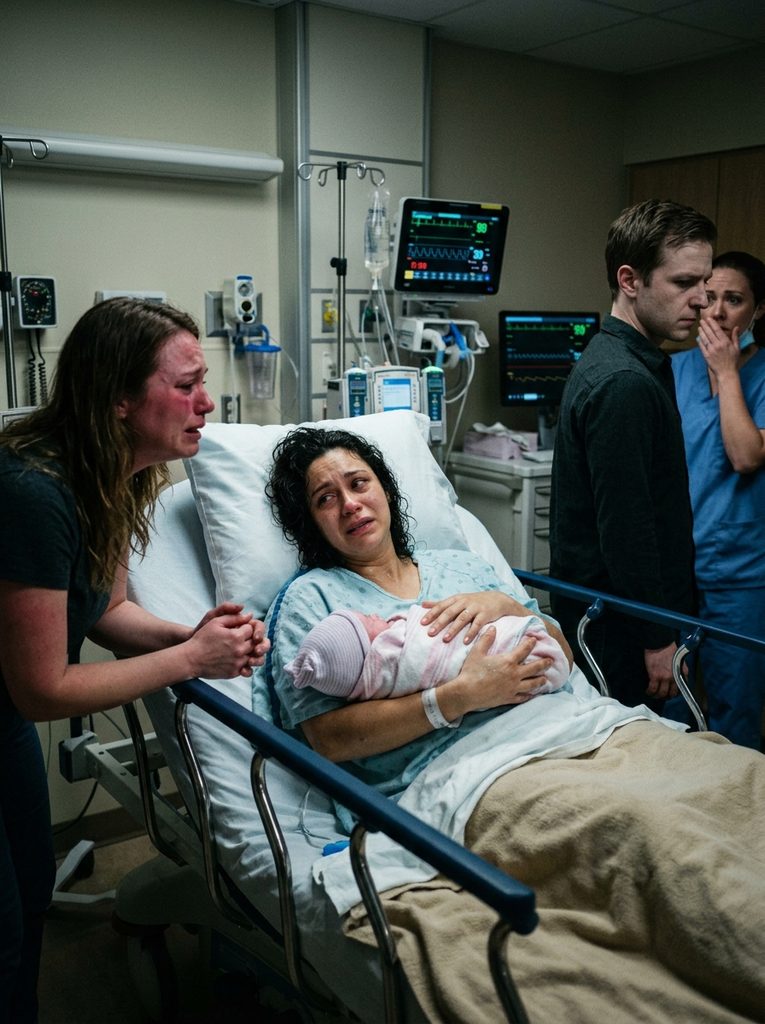
“She’s here,” Melissa choked out, tears carving clean lines through the powder on her cheeks. “Ryan, look at her. Look at our daughter.”
Behind her stood Ryan, my twin brother.
We had shared a womb before we shared a life. When our parents were crushed by an eighteen-wheeler on an icy stretch of Interstate 95 five years ago, it was Ryan who had slept on the sagging floor of my one-bedroom apartment for a month because the quiet in my home felt like drowning. When my son, Gabriel, was born seven years ago and his biological father vanished into the wind before the birth certificate was even filed, Ryan was the man who showed up with midnight diapers and taught my boy how to ride a two-wheel bicycle without training wheels.
We were each other’s bedrock. So last spring, when they sat across from me at their scarred oak kitchen table, their fingers intertwined until their skin went gray, and asked if I would consider gestational surrogacy, I hadn’t hesitated. I hadn’t even allowed him to reach the end of the sentence.
“Yes,” I had said, wrapping my hands over theirs. “Whatever it takes. We bring this baby home.”
Now, the child was here.
“Take her, Ryan,” I whispered, my voice cracked and dry. “Go hold your little girl.”
Ryan didn’t lunge forward with the eager delirium of a new father. He moved with a strange, mechanical hesitation, like a soldier traversing a minefield. His face was devoid of color, cast in the sick, greenish tint of the surgical lamps. When the nurse gently transferred the warm, swaddled flannel into the crook of his arm, he looked down at the bundle.
I watched my twin brother’s face.
I expected the tears that had flowed at our parents’ graves. I expected the luminous, protective pride he showed Gabriel. Instead, I saw a door slam shut behind his pupils. His jaw went slack, his shoulders dropping in an ugly, defeated slump. It wasn’t awe. It wasn’t shock. It was the sickening, cold retreat of a man realizing he has walked into an inescapable trap.
“Ryan?” Melissa asked, wiping her eyes, reaching out trembling arms. “Honey, let me hold her. Hand her to me.”
Ryan didn’t look at his wife. He didn’t step toward her. Very deliberately, his fingers peeled back the hem of the receiving blanket, rolling the infant slightly onto her stomach. He stared at the base of the child’s spine, his throat bobbing as he swallowed something foul.
Then, he turned back toward my bed.
The look he gave me was not the look of my brother. It was the blank, unfeeling stare of an absolute stranger.
“I’m sorry,” he said. The words came out flat, hollow, dead. “I can’t take her home.”
The room plummeted into absolute silence. The rhythmic beep of the fetal monitor behind my bed seemed to drop an octave.
“What did you say?” I rasped, struggling to push myself up on trembling elbows.
“Ryan, what are you talking about?” Melissa’s voice pitched upward, frantic, a nervous, bewildered laugh fluttering from her lips. “Give me our baby. Put her in my arms.”
Ryan took two rigid steps toward my mattress. Without looking at his wife, he placed the swaddled infant back onto my sweat-dampened abdomen.
“I have to give her up,” he whispered, his voice trembling now with an ugly, defensive tremor. “We aren’t keeping her. I’m not taking her with me.”
Chapter 2: The Lesion and the Aftermath
Air refused to enter my lungs. My pelvic bones ached, my muscles twitching with exhaustion, but the physical pain vanished beneath an avalanche of sheer, disorienting horror.
“Have you lost your mind?” I cried, clutching the baby to my chest as if shielding her from a predator. “Ryan, this is your daughter! You mortgaged your lives for this child! Look at her!”
Melissa was lunging across the bed now, her fingers catching the sleeve of his flannel shirt. “Why? Ryan, why are you saying this? Look at me! What is wrong with you?!”
Ryan ripped his arm away from his wife’s grasp. A dark, mottled crimson crept up his neck—the telltale flush of a boy caught in a catastrophic lie.
“Look at her back!” he snarled, the defensive cruelty in his tone bouncing off the tiled walls. “Just look at her! We can’t do this, Melissa. We can’t survive this.”
My hands were shaking violently as I turned the baby gently within the folds of the flannel. I peeled back the soft cotton at the base of her lumbar spine.
There, just above the crease of her tiny buttocks, sat a raised, fluid-filled sac no larger than a silver dollar, covered by a translucent membrane of paper-thin skin. It was angry, red, and unmistakable.
Spina bifida. A neural tube defect.
Melissa saw it over my shoulder. The sound that tore from my sister-in-law was not human; it was the gut-wrenching howl of an animal whose offspring had been mauled before its eyes.
“No,” Melissa shrieked, backing into a metal cart of sterile instruments, sending trays clattering against the linoleum. “No, no! The ultrasounds were clean! The maternal serum screens were negative! They told us she was healthy! Ryan, they told us she was perfect!”
“Well, she isn’t!” Ryan barked, his voice cracking into a hideous sob. “Look at her! Surgeries, Melissa. Wheelchairs. Catheters. Debt for the rest of our natural lives! I can’t do it! I won’t do it!”
Nurse Bianca charged back through the swinging doors, flanked by a resident physician and two pediatric specialists. “What is happening in here? Sir, step away from the patient! Ma’am, sit down!”
Melissa sank to the floor, her back sliding down the drywall, her face buried in her knees as dry heaves wracked her torso.
And Ryan?
My twin brother—the boy who had promised our dying mother that he would protect this family with his last drop of blood—looked at the weeping woman on the floor, looked at his newborn child in my arms, and backed toward the exit.
He didn’t offer a hand to his wife. He didn’t kiss the forehead of his daughter. He turned on his heel, pushed through the heavy double doors into the bright corridor, and vanished.
“He left,” I whispered into the sterile air, the words tasting like ash. “He actually left.”
Nurse Bianca was at my side instantly, her hand firm on my trembling shoulder. “Breathe, Ivy. Just look at me and breathe. The pediatric team is right here.”
A calm, middle-aged neonatologist, Dr. Patel, stepped forward, his gloved fingers impossibly gentle as he examined the infant resting against my chest. He used a sterile gauze pad to protect the lesion, his eyes warm, steady, and entirely free of panic.
“It’s a closed myelomeningocele,” Dr. Patel said softly, his voice cutting through Melissa’s muffled weeping on the floor. “The skin covering is intact. That’s good. That’s very good. It reduces the immediate risk of infection significantly.”
“Can she walk?” Melissa gasped from the floor, her voice raw, ruined. “Is she going to be paralyzed?”
“We won’t know the exact neurological impact until we complete an MRI and evaluate her lower-extremity reflexes,” Dr. Patel explained, kneeling slightly so Melissa could see his eyes. “Spina bifida is a spectrum, ma’am. This is located low on the lumbar spine. With modern neurosurgical closure—which we perform within forty-eight hours—and targeted physical therapy, many children with this presentation walk, run, and lead entirely independent, fulfilling lives. This is not a death sentence. It is a hurdle.”
Melissa didn’t look up. She sat on the linoleum, rocking herself back and forth, shattered not by the diagnosis, but by the vacancy where her husband had stood sixty seconds earlier.
The nurses helped Melissa into an adjacent recovery room, administering a sedative when her hyperventilation threatened to induce cardiac arrest. I was left alone in Room Four.
I looked down at the tiny girl. She had stopped crying. Her dark, slate-blue eyes squinted up at me, her tiny mouth forming an inquisitive ‘O’.
“Your name is Hope,” I whispered, tears finally escaping my lashes and soaking into the cotton blanket. “And nobody is throwing you away. I swear on our mother’s soul, you are not being discarded.”
Three days later, I was discharged.
Legally, the surrogacy paperwork named Ryan and Melissa as the intended parents, but Melissa was under seventy-two-hour psychiatric observation for acute shock, and Ryan had disconnected his cell phone. The hospital social worker, recognizing the immediate family kinship, released Hope into my temporary custody following her successful spinal closure surgery.
I brought the baby home to my small two-bedroom bungalow. Gabriel was staying with my neighbor for the afternoon, giving me time to sterilize bottles, organize prescription ointments, and set up the borrowed bassinet beside my bed.
At three o’clock the following morning, while the house slept beneath a blanket of autumn mist, the front doorknob rattled.
The brass key slid into the cylinder. The deadbolt clicked open.
I froze in the rocking chair, Hope sleeping peacefully against my collarbone.
A shadow filled the doorway of the kitchen. Ryan stepped into the amber glow of the stove light, his clothes wrinkled, his eyes hollowed out by days of sleeplessness, smelling of cheap coffee and absolute ruin.
Chapter 3: The Anatomy of a Coward
He didn’t step across the linoleum. He hovered near the entryway like a stray dog expecting a kick.
“Ivy,” he croaked.
“Don’t speak,” I whispered, my voice slicing through the quiet like a rusted scalpel. “If you wake Gabriel, or if you wake this child, I will take the cast-iron skillet off that stove and drive you into the street myself.”
Ryan flinched, his shoulders curling inward. “I needed to see you.”
“You needed to see me?” I stood up, cradling Hope securely against my chest, and walked to the kitchen island. “You abandoned your wife in a pool of afterbirth. You left your daughter on my chest like an unwanted package at a post office counter. For seventy-two hours, I have changed bandages over a neurosurgical incision on an infant who legally belongs to a ghost. What could you possibly have to say to me?”
“The bills, Ivy,” he choked out, collapsing onto one of the wooden barstools, his head falling into his hands. “The hospital social worker called me before I turned my phone off. She talked about pediatric neurosurgeons. Orthopedic braces. Physical therapy three times a week for the first five years. The copays alone are thousands a month.”
“Dr. Patel sat in that room and told you she has an incredible prognosis!” I hissed, leaning across the quartz counter until my face was inches from his. “She has movement in her toes, Ryan! Her reflexes are intact! She needs a family, she needs love, and she needs insurance that you have!”
“I don’t have insurance!” he exploded in a harsh, strangled whisper.
The kitchen clock ticked loudly on the wall.
Tick. Tack. Tick.
I stared at him. “What did you just say?”
Ryan lifted his face from his hands. The skin around his eyes was bruised, gray with exhaustion and self-loathing.
“I was laid off four months ago, Ivy,” he said, the truth finally tumbling out like bile. “The engineering firm downsized forty percent of the civil branch. Right after our twenty-week anatomy scan. The day after we found out she was a girl.”
My breath caught in my throat. “You… you put on a suit every single morning. I saw you leave for the train.”
“I sat in the Panera Bread by the interstate,” he whispered, his lip trembling violently. “Every day from eight-thirty to four-thirty. Sending out resumes. Doing phone interviews in my sedan behind the dumpster. Nothing, Ivy. Two hundred applications. Not a single offer that paid more than minimum wage.”
“The nursery,” I whispered, the memory of that pale green room flashing before my eyes. The hand-painted stars. The drawer full of designer doll-sized dresses. “The crib. Melissa told me you bought that Italian crib with your quarterly bonus.”
“Credit cards,” Ryan wept, tears spilling freely over his unshaven cheeks. “Three of them, completely maxed out. Thirty-four thousand dollars in unsecured debt. Our savings account has sixty-two dollars in it. When my severance ended six weeks ago, the COBRA coverage lapsed. Melissa doesn’t know. She thinks we’re fully insured under my executive policy.”
I had to grip the edge of the kitchen counter because the room suddenly seemed to tilt on its axis.
“So when you stood in that delivery room…” The realization dawned on me, cold, monstrous, and sickening. “When the doctor pulled down that blanket and you saw that lesion on her spine…”
“I didn’t see a sick baby,” Ryan sobbed, his voice breaking into pieces. “I saw a financial guillotine. I saw hundreds of thousands of dollars we don’t have. I knew the hospital would discover the insurance had lapsed within twenty-four hours. I knew Melissa would find out that her husband was an unemployed fraud who had run them into bankruptcy.”
“So you used your daughter,” I stated, each syllable falling like a block of lead.
Ryan clamped his hands over his ears. “Don’t say it like that!”
“No, Ryan! Look at me!” I reached across the island and violently dragged his wrists away from his face. “Look at this baby! You looked at this innocent, defenseless little girl, and you decided it was better to let your wife believe you were a heartless monster who hated disabled children than to admit you had lost your job! You weaponized her diagnosis to save your own pathetic pride!”
“I was trying to protect Melissa!” he screamed in a harsh, desperate whisper.
“You were protecting your ego!” I snarled back. “You were going to let Melissa spend the rest of her life in an asylum of grief, mourning a baby her husband rejected, rather than tell her you failed at capitalism! That isn’t protection, Ryan. That is emotional cowardice of the highest order!”
Hope shifted in my arms, letting out a soft, whimpering mewl. I immediately pulled her closer, swaying gently until her breathing evened out again.
Ryan sat on the stool, weeping silently, his body folding in on itself until he looked small, pathetic, and broken.
“What do I do, Ivy?” he whispered into the dark. “What do I do? She’ll never forgive me. If I tell her the truth, she’ll divorce me by sunrise.”
“Maybe she will,” I replied without a drop of pity. “And if she does, you will have earned every single inch of that solitude. But you are going to give her the truth. Tonight.”
“Ivy, please—”
“No,” I said, walking to the hallway hook and grabbing my car keys with one hand while holding Hope with the other. “You are driving to that hospital right now. Melissa was discharged to her sister’s house four hours ago; she’s sitting in that dark living room thinking her life is over. We are going over there together. You will look your wife in the eye and strip away every lie you’ve built, or so help me God, I will walk through her door and do it for you.”
Ryan looked at my face. He had seen that look only once before—when our parents died and I had stood between him and the predatory funeral directors who tried to upsell our grief.
He swallowed hard, wiped his nose on the sleeve of his jacket, and nodded.
“Okay,” he whispered. “Okay.”
Chapter 4: The Crucible of Truth
The streetlights outside Melissa’s sister’s colonial cast long, skeletal shadows across the dying autumn lawn.
We walked up the concrete steps in silence: Ryan leading the way with the gait of a condemned man ascending the gallows, and me behind him, holding two-week-old Hope swaddled in a thick fleece bunting against the midnight chill.
Ryan didn’t knock. He turned the brass handle and stepped inside.
The house was dark, save for a single floor lamp burning in the corner of the formal living room. Melissa sat on the sofa, still wrapped in an oversized knit cardigan that belonged to our mother. Her eyes were swollen, rimmed with deep purple shadows, staring blankly at an unread infant care booklet on the coffee table.
When the front door creaked shut, her head snapped up.
She saw Ryan first, and her expression curdled into something venomous and wounded. Then her eyes drifted to the bundle in my arms, and her breath caught with an audible, agonizing gasp.
“Why is she here?” Melissa whispered, rising slowly from the couch, her hands trembling at her sides. “Ryan… why did you bring her here? I can’t… I can’t look at her if you’re going to put her in foster care. I can’t survive that.”
“Sit down, Melissa,” I said gently, stepping past my brother. “Ryan has something he needs to tell you. And you are going to listen to every word.”
Melissa looked between us, fear flickering across her pale features. She sank back onto the cushions.
Ryan didn’t remain standing. He crossed the Persian rug, dropped to both knees before his wife, and pressed his forehead against her denim-clad knees.
“I lied to you,” Ryan began, his voice muffled by her clothing, shaking with a terror so raw it filled the room. “I lied to you about everything.”
Melissa went rigid. “What are you talking about?”
Over the next twenty minutes, the silence of that living room was systematically dismantled.
Ryan laid out the architecture of his deceit with brutal, agonizing clarity. He told her about the pink slip that arrived four months ago. He told her about the endless hours sitting in coffee shop booths, watching the cursor blink on job applications while his bank accounts withered to dust. He confessed to the three maxed-out credit cards, the fraudulent claims of bonuses, and the terrifying truth that their comprehensive healthcare had expired weeks before the delivery.
“When Dr. Patel said spina bifida,” Ryan sobbed, his hands gripping her ankles like an anchor in a hurricane, “all I heard was the sound of a judge declaring me bankrupt. I saw the collections notices. I knew they’d discover the insurance was gone. I knew you’d find out I couldn’t provide for our family. And I was so sick, so twisted with fear, that I thought if I blamed the baby… if I pretended it was about her spine… you would think I was cruel, but you would never know I was a failure.”
Melissa didn’t speak while he talked.
She sat entirely motionless, her breath coming in shallow, ragged intervals, her gaze locked on the top of her husband’s trembling head.
When he finally ran out of words, leaving only the sound of his ragged weeping in the room, Melissa slowly reached down. She didn’t stroke his hair. She took him by the chin and forced his face upward until his tear-streaked eyes met hers.
“You idiot,” she whispered.
The words were not soft. They were forged in iron.
“You absolute, cowardly idiot,” Melissa said, tears finally spilling over her lower lids. “You thought I loved you because of a title on a business card? You thought I wanted a nursery full of Italian furniture more than I wanted our child?”
“Melissa, the medical bills—”
“I would have cleaned office buildings at night!” she shouted, her voice shaking the framed pictures on the mantle. “I would have sold my mother’s wedding ring! I would have lived in a one-bedroom trailer with you and that baby, and I would have scrubbed floors until my fingers bled to pay for her physical therapy! How dare you make that decision for me? How dare you look at our daughter and throw her away to protect your pride?!”
Ryan squeezed his eyes shut, nodding against her palms, taking the lash of her words because he knew he deserved every stroke.
“I’m sorry,” he wept. “God, Melissa, I am so sorry.”
Melissa pushed him away, rising from the sofa. She turned her back on him, walking across the room to where I stood holding the baby.
Her hands were shaking so violently that I had to help her untie the ribbons of the fleece blanket. But as she peeled back the fabric, looking at Hope’s dark hair, her rosebud lips, and the neat, clean surgical dressing along her lower spine, Melissa’s face softened into something divine.
“Dr. Patel called me this morning, Melissa,” I whispered, stepping close so only she could hear. “Her spinal cord is intact. The neural pathway is clear. She needs early intervention, she needs orthotics when she starts cruising, and she needs parents who will fight for her. Medicaid covers the entire procedure retroactively because Ryan’s income dropped below the federal threshold four months ago. The hospital social worker already filed the hardship exemption. You don’t owe a single dime.”
Melissa let out a choked, half-strangled laugh through her tears. She reached out and lifted Hope from my arms, pulling the infant against her chest with an intensity that made the baby let out a tiny, indignant squeak.
“Hi, sweet girl,” Melissa sobbed, burying her nose in the baby’s dark curls. “Hi, Hope. Mama’s here. Mama’s got you.”
Ryan remained on his knees on the carpet, watching his wife hold their child, looking like a man who had survived an execution only to find himself exiled from the kingdom.
Melissa turned her gaze down toward him. The anger in her eyes hadn’t vanished—it would take months, perhaps years of counseling, transparent bank statements, and reconstructed trust to heal the canyon he had carved between them. But the cruelty had been excised. The lie was dead.
“Get off the floor, Ryan,” Melissa commanded quietly.
He swallowed hard, scrambling awkwardly to his feet, keeping his hands clasped before him like a penitent schoolboy.
“Tomorrow morning, you go to the state unemployment office,” she told him, her voice unwavering. “Then you go to the Medicaid intake desk and you sign every piece of paper Ivy prepared. And after that, you are going to call every contractor in this county until you find work swinging a hammer or digging ditches. Do you understand me?”
“Yes,” Ryan whispered. “Whatever you need. Anything.”
“And if you ever—if you ever—hide the truth from me again,” she added, her eyes flashing with cold, unyielding fire, “I will take our daughter and you will spend the rest of your life looking at her through a partition in a family court. Am I clear?”
“Crystal clear,” he choked out.
Melissa looked down at Hope, then extended one trembling arm outward.
Ryan hesitated for a fraction of a second before stepping forward. He wrapped his arms around his wife and his child, his forehead resting against Melissa’s temple, his broad shoulders heaving as he wept the tears he should have shed in Room Four.
I stood by the doorway, watching the three of them.
Outside, the first pale violet light of dawn was beginning to bleed across the horizon, chasing away the cold autumn mist. Down the street, the birds were starting their morning chorus, indifferent to the small, tectonic shifts of human grief and redemption.
I reached out, gently touched the edge of Hope’s soft blanket one last time, and quietly pulled the front door shut behind me.
My shift was over. My brother’s work had just begun. And for the first time since my parents died, the road ahead didn’t look like an accident waiting to happen—it looked like something we were finally strong enough to survive.