My 81-Year-Old Mom Needed A Place To Sleep For Just One Night After Her Flight Was Canceled. I Asked My Husband If She Could Stay With Us. He Said, “Absolutely Not. Your Mom Isn’t My Responsibility.” I Simply Said, “Okay.” The Next Day… He Called Me 38 Times.
“Your mother isn’t my responsibility,” my husband told me when my eighty-one-year-old mom was stranded overnight after a canceled flight. I didn’t scream, threaten, or argue. I simply said, “Okay,” found her a safe place myself, and remembered every word. By sunrise, my husband had called me thirty-eight times because his own mother suddenly needed help. But when I returned home, I discovered those frantic calls had almost nothing to do with a broken pipe—and everything to do with a secret he had been hiding from me for nearly a year.
### Part 1
The first thing I saw that morning was thirty-eight missed calls from my husband. I sat in the passenger seat of my mother’s rental car outside a small hotel near Raleigh-Durham International Airport, staring at Nathan Mercer’s name filling my phone screen while a paper cup of coffee cooled untouched in the console. Thirty-eight calls in less than twelve hours from the same man who had looked me straight in the eye the night before and said, “Absolutely not. Your mother isn’t my responsibility, Rachel. Figure it out.” I didn’t call him back immediately, because for the first time in nine years of marriage, I wanted Nathan to understand what “figure it out” actually felt like.
My name is Rachel Mercer, and at thirty-four I was an Army captain stationed at Fort Liberty in North Carolina. My life revolved around schedules, readiness, responsibility, and the uncomfortable truth that when something went wrong, waiting around for someone else to fix it was rarely an option. Years of service had taught me how to stay calm while other people panicked, how to separate emotion from the problem in front of me, and how to make a decision even when every available choice was unpleasant. None of that prepared me for hearing fear in my mother’s voice from an airport bench.
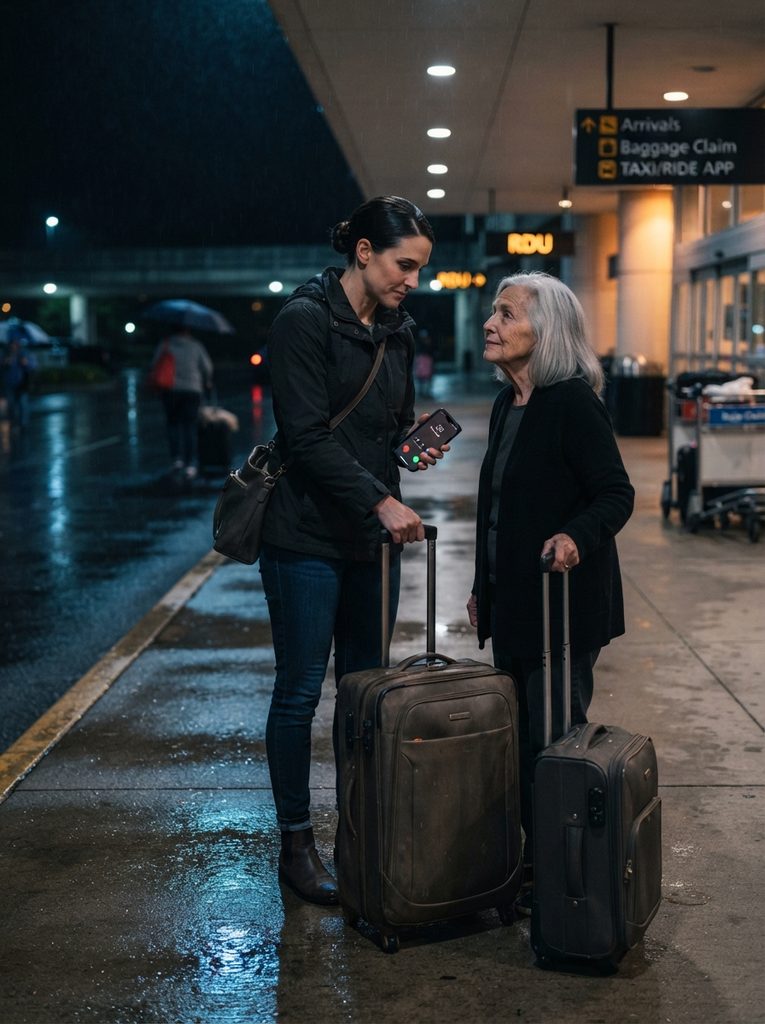
Her name was Judith Hale, and she was eighty-one years old. She had flown to Florida to visit a college friend she had known for nearly sixty years, but severe thunderstorms grounded flights across the Southeast on her return trip, and the airline couldn’t get her onto another flight until the following afternoon. Every reasonably priced hotel near the airport was full, the remaining rooms cost ridiculous amounts, and Mom had already spent two hours walking between service counters with two suitcases and a cardigan tied around her shoulders. When she finally called me, she said quietly, “Honey, I’m sorry. I don’t know where I’m supposed to sleep tonight.”
My mother hated asking anyone for help. She was the woman who would carry six grocery bags in both hands rather than make two trips, who still kept a step stool in her kitchen even though I had begged her to stop climbing on things, and who mailed birthday cards three weeks early because being late would have embarrassed her. So when I heard that small tremor in her voice, I was already reaching for my keys. “Stay exactly where you are,” I told her. “I’m coming.”
Our house was less than an hour from the airport. We had a clean guest room upstairs, fresh sheets in the linen closet, two spare blankets, a private bathroom, and enough food in the refrigerator to feed six people for three days. There was no decision to make as far as I was concerned. I would pick Mom up, bring her home, make her tea, let her sleep, and drive her back the next morning.
I called Nathan from the road. He answered after three rings, sounding distracted. “Hey. What’s going on?”
“Mom’s flight got canceled,” I said. “She’s stranded at the airport, so I’m picking her up.”
“Okay.”
“I’ll bring her home tonight and take her back tomorrow afternoon.”
There was a pause long enough for me to glance at the phone mounted on my dashboard. “No.”
At first I genuinely thought I had misunderstood him. “What?”
“She can’t stay here.”
I tightened my hands around the steering wheel. “Nathan, it’s one night.”
“I know.”
“She’s eighty-one.”
“I know how old she is.”
His voice wasn’t worried, apologetic, or hesitant. It was irritated. I pulled into a brightly lit gas station and parked near the edge of the lot because suddenly I didn’t want to have this conversation while driving. “She has nowhere else to go.”
“That’s not my problem.”
For several seconds I heard nothing but the hum of the engine and the distant hiss of tires on wet pavement. Behind the windshield, water slid in silver trails beneath the white gas-station lights, and I found myself staring at the empty passenger seat as if my mother were already sitting there. “Excuse me?”
Nathan sighed. “Rachel, your mom isn’t my responsibility. If she needs somewhere to stay, figure it out.”
I could have reminded him about the winter his mother, Carol, needed outpatient surgery and I rearranged my duty schedule, drove two hours after a twelve-hour day, slept four hours, then drove her to the clinic the next morning. I could have reminded him about the roof repair at Carol’s house that I quietly helped pay for when Nathan said she was embarrassed to ask. I could have listed the holidays I had spent making sure his family felt included even when mine had to celebrate without me. Instead, something inside me became completely still.
“Okay,” I said.
He sounded surprised. “Okay?”
“Okay.”
“Good. I have an early meeting tomorrow.”
Then he hung up.
I remained in the parking lot for another minute while strangers moved around me carrying drinks, pumping gas, laughing beneath umbrellas. Nothing about the world had changed, but my marriage suddenly looked different, as though someone had switched on a light in a room I had spent years keeping deliberately dim. I had always believed marriage meant compromise, loyalty, and sacrifice. That night, for the first time, I wondered how many sacrifices Nathan had made for me compared with how many he had simply expected from me.
.
I found Mom sitting beside two suitcases near baggage claim. Her silver hair was flattened slightly on one side, exhaustion showed around her eyes, and the moment she saw me she gave me the relieved smile she had used since I was a child whenever I walked through a door safely. “You came.”
“Of course I came.”
She studied my face while I reached for her larger suitcase. “Did Nathan mind?”
The question hurt more than I expected. “He has an early morning. We’re getting a hotel.”
Her smile faded. “Rachel, I can pay for it.”
“I know.”
“I don’t want to cause trouble.”
I stopped and looked directly at her. “Mom, you are not trouble.”
The hotel I found was farther from the airport and more expensive than it should have been, but it was clean and safe. I carried her bags upstairs, checked the lock, found extra water, arranged her medication beside the bed, and called the airline to confirm her flight before I finally sat beside her. Mom touched the back of my hand and whispered, “I’m sorry.”
“For what?”
“For needing you.”
That sentence almost broke something in me. “Never apologize for that.”
She went to sleep around midnight, but I stayed awake in the chair beside the window, listening to rain strike the glass. I thought about every time Nathan’s problems had become “our” problems while mine somehow remained mine, every time I had mistaken being dependable for being loved, and every occasion when I had protected him from discomfort because I thought that was what a good wife did. Around four in the morning, I finally understood the distinction I had spent years avoiding: sacrifice wasn’t destroying my marriage. One-sided sacrifice was.
My phone started vibrating at 7:12 a.m.
Nathan.
.
I ignored it.
He called again.
And again.
By the time Mom woke, stretched slowly, and began making coffee with the tiny hotel machine, the number on my screen had reached thirty-eight. Then a text appeared.
“Rachel, please call me. I need you.”
I read those six words twice.
The same man who had told me twelve hours earlier to solve my mother’s emergency alone was suddenly desperate for his wife.
And I was about to learn exactly why.
### Part 2
I let Nathan’s thirty-ninth call ring twice before answering. “Hello.”
“Rachel, where are you?”
No hello. No apology. Just panic.
I looked across the hotel room at Mom, who was stirring sugar into her coffee near the window. “I’m with Mom.”
“I know that. Where exactly?”
“Why?”
He exhaled hard enough for me to hear it through the phone. “Because I need you to come home.”
The words were so perfectly timed that I almost laughed, but nothing about the previous night felt funny. “What happened?”
“My mom has a problem.”
“Carol?”
“Yes. A pipe burst sometime overnight. Water got into the downstairs ceiling, the plumber shut everything off, and she can’t stay there.”
I sat straighter. Whatever I felt toward Nathan, Carol was nearly eighty and had always treated me kindly. “Is she safe?”
“She’s at a neighbor’s house right now.”
“Good.”
“I need her to stay with us.”
I said nothing.
“Rachel?”
“How long?”
“I don’t know. A few days. Maybe a week.”
The irony hung between us so clearly that he must have heard it too. Less than half a day earlier, my mother had been standing in an airport without a bed, yet suddenly the guest room Nathan had guarded like restricted territory was available for his own mother indefinitely. “Didn’t you tell me yesterday that my mother wasn’t your responsibility?”
“This is different.”
“How?”
“My mom’s house is damaged.”
“My mom had nowhere to sleep.”
“That isn’t the same thing.”
“No,” I said. “One happened to your family.”
He became defensive immediately. “You’re twisting this.”
“I’m repeating what you said.”
“I was stressed yesterday.”
“So was Mom.”
“I didn’t mean I don’t care about her.”
“She spent the night in a hotel because you refused to let her use an empty bedroom.”
Mom had stopped stirring her coffee. She was looking at me now, and even from across the room I could see concern in her eyes.
Nathan lowered his voice. “I’m sorry, okay?”
It was the fastest apology I had ever heard from him, which made it the least convincing. “You’re sorry because you need something.”
“That’s not fair.”
“Then tell me what you need.”
“I just told you. I need help with Mom.”
“What does ‘help’ mean?”
He hesitated.
That hesitation interested me more than everything else he had said.
“Nathan?”
“I need you to come home so we can figure this out.”
There it was. For nearly our entire marriage, “we need to figure this out” usually meant Rachel would organize it. Rachel would make the calls, adjust the schedule, find the money, remember the deadlines, calm the relatives, compare the options, and carry the emotional weight until everyone else could breathe normally again. Nathan contributed, but when life became complicated, I became the family emergency system.
“I’ll come home after Mom gets to the airport,” I said.
His relief was immediate. “Thank God.”
“But Carol isn’t moving into the house until we talk.”
Silence.
“What?”
“You heard me.”
“Rachel, she’s my mother.”
“I know.”
“She’s almost eighty.”
“I know.”
“So what exactly are you trying to prove?”
“Nothing. I’m trying to understand the rule.”
“What rule?”
“The one where your mother’s emergency automatically belongs to both of us, but my mother’s emergency belongs only to me.”
“You’re punishing me.”
“No. I’m asking you to hear yourself.”
Nathan muttered something under his breath. I waited until he finally said, “Fine. We’ll talk.”
After I ended the call, Mom looked at me over the rim of her coffee cup. “You don’t have to go home because he calls thirty-eight times.”
“I know.”
“Then why are you going?”
I looked toward the rain-smeared window. “Because something about this doesn’t make sense.”
Mom was quiet for a moment. “He sounded scared.”
“He is.”
“About his mother?”
“That’s what he says.”
She took a small sip. “Find out what he isn’t saying.”
I drove Mom to the airport later that morning, waited until the airline confirmed her new boarding pass, and refused to leave until she had cleared security. She hugged me tightly before walking away and whispered, “Don’t make any big decision because you’re angry.” Then she pulled back and added, “But don’t ignore what you learned just because you love him.”
That was my mother: compassionate without being naïve.
When I reached home, everything looked exactly as it had the day before. Our porch chairs were straight, the flowerpot beside the entrance still leaned slightly toward the sun, and our wedding photograph remained on the entry table, Nathan smiling at me as though nothing bad could ever reach us. I stood there with my keys in my hand and had the strange sensation of entering someone else’s house.
Nathan was waiting in the kitchen. His shirt was wrinkled, he hadn’t shaved, and dark shadows sat beneath his eyes.
“Where have you been?”
I stared at him.
He corrected himself immediately. “Sorry. I mean, how’s your mom?”
“Boarded safely.”
“Good.”
I set my keys on the counter. “How bad is Carol’s house?”
“Bad.”
“How bad?”
“They need to remove some drywall. Maybe flooring.”
“Insurance?”
“Probably.”
I frowned. “Probably?”
He looked away.
That was when I saw the envelopes beside the coffee maker.
There were at least seven of them, several already opened. One came from a major credit-card company, another from a lender whose name I vaguely recognized, and two had bright reminder notices visible through their plastic windows. Nathan noticed where I was looking and stepped slightly to the side as though his body could hide them.
“What are those?”
“Nothing important.”
“Then why do you look terrified that I noticed them?”
“I don’t.”
I reached toward the nearest envelope. Nathan grabbed it first.
My hand stopped in midair.
“Nathan.”
“I can handle this.”
“Handle what?”
“Our bills.”
“Our bills?”
“My bills.”
I stared at him. “How much do you owe?”
His jaw tightened. “That’s not what we need to talk about right now.”
“My husband’s debt isn’t what we need to talk about?”
“You’re making this bigger than it is.”
“No. I don’t know how big it is. That’s the problem.”
He rubbed his forehead, suddenly looking older than forty. “Rachel, can we please focus on my mom?”
I looked again at the stack of envelopes. Thirty-eight calls. Carol’s damaged house. Nathan’s sudden desperation. The way his voice changed when I asked about insurance.
For the first time, I realized he might not have been calling because he needed permission for his mother to use our guest room.
He might have been calling because he needed something far more valuable from me.
“Sit down,” I said.
His face changed.
“How much money do you owe?”
He didn’t answer.
And that silence told me the number was going to change everything.
### Part 3
Nathan spent nearly five minutes insisting the situation was “complicated” before finally sitting across from me at the kitchen table. I remained standing because sitting felt too much like agreeing we were having a normal conversation, and nothing about that morning felt normal anymore. The unopened envelopes between us looked harmless enough—white paper, printed addresses, ordinary windows—but I had spent enough of my career around risk assessments to know that dangerous problems often looked boring from the outside. “Give me the number,” I said.
He stared at the table. “Around forty-eight thousand.”
I thought I had misheard him. “Forty-eight hundred?”
“No.”
My mouth went dry. “Forty-eight thousand dollars?”
“Maybe a little more.”
I lowered myself into the chair.
Nathan began talking quickly. Some of it was credit cards. Some was a personal loan. Some came from purchases he had planned to pay off before interest accumulated, except then other expenses appeared, and he moved balances around, and one problem became three. His explanation sounded less like a financial plan and more like someone describing how a small kitchen fire had somehow reached the roof.
“How long?”
“What?”
“How long have you been hiding this?”
He winced at the word hiding. “I wasn’t hiding it.”
“Did I know?”
“No.”
“Then you were hiding it.”
“I was trying to fix it before it affected you.”
I stared at him. “We’re married. It already affected me.”
He looked toward the window.
“What did you spend forty-eight thousand dollars on?”
“It wasn’t one thing.”
“Then give me several things.”
His expression became defensive. “Living expenses. Some repairs. Stuff for the house.”
“The mortgage is current.”
“Yes.”
“The utilities are current.”
“Yes.”
“Our insurance is current. Groceries haven’t suddenly doubled. What expenses?”
He said nothing.
That was the moment fear replaced anger.
I went upstairs, got my laptop, returned to the kitchen, and logged into the accounts I could access. Nathan hovered nearby while I downloaded statements, and after a few minutes he said, “You really don’t trust me.”
I looked up at him. “At this exact moment? No.”
His face tightened as though my answer had injured him.
The first surprise came from our joint checking account. Over the previous eleven months, transfers totaling more than twelve thousand dollars had gone toward payments I didn’t recognize. They were small enough individually that I hadn’t noticed them amid mortgage deductions, utilities, insurance, groceries, and deposits from both of our salaries. Together they formed a pattern that made my stomach turn.
“Twelve thousand dollars,” I said.
Nathan rubbed the back of his neck. “I put some back.”
“That isn’t an answer.”
“I was going to replace it.”
“With what?”
He didn’t reply.
I continued through the statements.
Expensive restaurant charges appeared on evenings when Nathan had told me he was networking with coworkers. There were concert tickets, electronic purchases, recurring charges from a private golf club, weekend hotel bills from trips he described as professional events, and hundreds of dollars in online purchases that had never entered our home. None of those expenses proved some dramatic secret affair or criminal double life; in a way, the truth was more disappointing. Nathan had simply been living beyond what he earned while trusting that my steadier income and disciplined savings would keep our household stable.
“You’ve been using our money to support spending you never discussed with me.”
“I know it looks bad.”
“It looks exactly like what it is.”
“You’re acting like I stole from you.”
“You moved twelve thousand dollars from an account we share without telling me.”
“It’s our money.”
“Then why was the decision only yours?”
He had no answer.
I kept looking.
Near the bottom of one monthly statement, I found a recurring payment to an account number I didn’t recognize. The amount varied, but it appeared every month. I wrote down the lender’s name and called the bank while Nathan watched me.
The account was a personal line of credit under his name.
The mailing address was ours.
I hung up slowly. “How much is on that?”
He looked exhausted. “About twenty-one thousand.”
“Is that included in the forty-eight?”
“Yes.”
“What was it for?”
“To consolidate other balances.”
“So you borrowed money to pay borrowed money.”
“I was trying to get ahead.”
“You were building a circle.”
“I know that now.”
I stood and walked to the kitchen sink because I needed physical distance from him. Outside, sunlight had replaced the previous night’s storm, and water still clung to the leaves along our fence. Everything looked washed clean while my marriage felt dirtier by the minute.
Then I remembered Carol.
“What does your mother’s house have to do with this?”
Nathan went still.
I turned around.
“The pipe. The repairs. What does that have to do with your debt?”
He sat down. “The insurance deductible is higher than Mom expected.”
“How much?”
“Eight thousand.”
There it was.
I felt almost nothing at first. The realization was too clean, too precise. Nathan hadn’t called thirty-eight times because his mother desperately needed a bedroom. Carol was safe with a neighbor, and there were hotels near her house. What Nathan desperately needed was access to the person in our marriage who still had cash reserves.
Me.
“You wanted me to pay it.”
“I wanted us to help my mother.”
“No. Say it accurately.”
His face flushed. “What difference does it make?”
“It makes every difference.”
“She needs us.”
“My mother needed us twelve hours ago.”
“I told you I was wrong.”
“You told me you were stressed.”
“I said I was sorry.”
“After you needed eight thousand dollars.”
He pushed his chair backward. “You think this is some kind of scheme?”
“I think you decided my family was my responsibility right up until your family’s emergency required my bank account.”
“That’s not fair.”
“The word ‘fair’ has had an exhausting twenty-four hours.”
He paced toward the living room, then back. “So what? You’re going to let my mother’s house fall apart just to make a point?”
His accusation landed exactly where he intended it to land. Nathan knew I cared about Carol. He knew I had spent years solving problems because I couldn’t tolerate watching someone vulnerable suffer. He was counting on that instinct now.
I recognized it, and for the first time, I didn’t obey it.
“Carol will be helped,” I said. “But you’re not getting eight thousand dollars from me today.”
His face changed. “Rachel.”
“We will speak to the insurance company. We’ll confirm the deductible. We’ll get the contractor’s estimate. We’ll determine what Carol can afford and what temporary housing she actually needs.”
“You have the money.”
“That isn’t the point.”
“Then what is?”
“The point is that you hid nearly fifty thousand dollars in debt and took twelve thousand from our joint account. Until I know everything, my savings are not available to you.”
He stared at me as though I had suddenly started speaking another language. “We’re married.”
“Yes.”
“What’s yours is mine.”
The anger I had been controlling finally hardened into something colder. “Interesting. Because yesterday, my mother was apparently mine.”
He looked away.
I closed the laptop.
“I’m separating our finances.”
Nathan’s head snapped back toward me. “What?”
“My paycheck goes into an account only I control starting now. Household bills will still be paid. My share of our legitimate obligations will be covered. But you will not have unrestricted access to my money while I’m discovering debts you intentionally kept from me.”
“You’re punishing me.”
“No. I’m removing the cushion that allowed you to pretend your choices didn’t have consequences.”
He ran both hands through his hair. “You can’t just do this.”
“I can protect myself.”
“You’re my wife.”
“And you’re my husband. That title didn’t stop you from lying.”
The word lying finally silenced him.
That afternoon I contacted a financial counselor through a military family support program, changed the account where my future deposits would go, and began documenting every shared obligation. I wasn’t planning revenge in the dramatic sense. I didn’t want to destroy Nathan, embarrass him publicly, or leave Carol without help.
I simply stopped rescuing him.
That frightened him far more than shouting would have.
The next morning, I opened our shared desktop computer to print several bank statements. An email notification appeared before I could close the browser.
It was from Nathan to his younger brother, Colin.
The subject line was simple.
“Don’t worry. Rachel won’t leave.”
I stared at those four words for several seconds before opening the message.
And by the time I finished reading it, I understood that Nathan’s debt wasn’t the most painful secret in my house.
### Part 4
I read Nathan’s email three times. Not because the words were difficult to understand, but because I needed to make sure anger wasn’t altering what was actually on the screen. He had written Colin two weeks earlier about his credit cards, the personal loan, and the growing pressure of keeping everything hidden from me. Then he had added, “Rachel might be angry if she finds out, but don’t worry. She won’t leave. She’d never do that to me.”
There were other lines.
“She always handles things.”
“She gets mad, then she figures out a solution.”
“She won’t let the family fall apart over money.”
Family.
The same word Nathan had apparently trusted when he needed me and rejected when my mother needed him.
I closed the computer without replying, forwarding, or confronting him. Years in uniform had taught me something that marriage had apparently made me forget: information was useful only if you didn’t let emotion force you into acting before you understood the whole situation. So I showered, put on my uniform, tied my hair back, and went to work.
For four hours I focused on schedules, reports, training requirements, and people who expected me to make decisions based on facts rather than feelings. It felt almost peaceful. At noon, I sat in my car and called the financial counselor whose number I had received the day before.
Her name was Denise Parker. She listened while I described the debt, the transfers, the hidden line of credit, Nathan’s request for money, and the email. She did not tell me whether to stay married or file for divorce.
Instead, she asked, “What are you trying to protect right now?”
I almost answered my marriage.
Then I realized I wasn’t sure.
“My mother,” I said first. “My financial security. My career. Maybe my marriage.”
“That order sounds different from the one you might have given a week ago.”
I looked through the windshield at soldiers crossing the parking lot. “Yes.”
“Then don’t reverse it out of guilt.”
I wrote those words on the back of an old receipt.
That evening Nathan was waiting at the kitchen table when I returned. “You saw the email.”
It wasn’t a question.
“I did.”
“I can explain.”
“I’d love to hear how.”
He stared down at his hands. “I was venting to Colin.”
“You told him I wouldn’t leave.”
“I didn’t mean you couldn’t.”
“Then what did you mean?”
“That you’re loyal.”
I almost smiled. “You sound proud of that.”
“I am.”
“No. You counted on it.”
He looked up.
“There’s a difference between believing your wife is loyal and believing your wife will absorb whatever you do because she doesn’t have the courage to leave.”
“I never said you didn’t have courage.”
“You didn’t have to.”
His eyes filled with frustration. “Rachel, I was scared.”
“So was Mom.”
He closed his eyes.
“You keep explaining your behavior by describing your feelings,” I continued. “You were stressed. You were scared. You were embarrassed. You felt behind. But every explanation still ends with someone else paying for how you felt.”
“That’s not fair.”
“Then tell me what I’m missing.”
He pushed away from the table and walked toward the window. For several seconds he said nothing.
Finally, he whispered, “I resent you.”
That answer stopped me.
He turned around immediately. “Not because you did something wrong.”
“What does that even mean?”
“It means everything seems easier for you.”
For a second, I actually laughed. It came out sharp enough that he flinched. “Easier?”
“You know what I mean.”
“No. Explain it.”
“You have your career. Your benefits. Your retirement plan. People respect what you do.”
“You’ve watched me leave this house before sunrise for years.”
“I know.”
“You’ve watched me miss birthdays and holidays.”
“I know.”
“You’ve watched me come home after twelve-hour days and still deal with the mortgage, groceries, repairs, and family schedules.”
“I know.”
“Then which part looked easy?”
His eyes reddened. “The part where you always knew who you were.”
That quieted me.
Nathan sat down again. He told me the insecurity had started several years earlier when I received a promotion after he had been passed over for one at his company. He had been proud of me, genuinely proud, but that pride became tangled with embarrassment. Whenever someone thanked me for my service, whenever my mother talked about me with admiration, whenever a crisis happened and I moved calmly toward the solution, Nathan compared himself to me.
“I started feeling like the weak person in our marriage,” he said.
“So you hid debt.”
“I thought if I fixed it alone, I could prove I wasn’t.”
“And when you couldn’t?”
“I kept borrowing.”
I studied him. “What does my mother have to do with any of that?”
His jaw tightened.
“Nathan.”
“When you helped her, it bothered me.”
“Why?”
“Because you never hesitated.”
“She’s my mother.”
“I know.”
“When Carol needed surgery, I didn’t hesitate either.”
“I know.”
“When did compassion become a competition?”
His eyes filled. “I don’t know.”
For the first time, I believed him.
But understanding him did something unexpected. It didn’t erase my anger. It sharpened it, because this was no longer a story about a stressed husband blurting out one cruel sentence during a bad evening.
Nathan had spent years quietly punishing me for qualities he claimed to love.
My stability made him insecure.
My loyalty made him careless.
My compassion made me easy to exploit.
And my independence had somehow become evidence that I needed less consideration.
“I need you to understand something,” I said. “My career is not competing with you. My mother is not competing with you. My ability to handle a crisis is not an insult to you.”
“I know.”
“No. You know now because everything collapsed.”
He lowered his head.
“If you felt inadequate, you could have told me.”
“I was ashamed.”
“You could have gone to counseling.”
“I know.”
“You could have said, ‘Rachel, I’m struggling.’”
“I know.”
“Instead, you decided making me feel unsupported would make you feel stronger.”
He covered his face with both hands.
When he looked up again, tears were running down his cheeks. “I think I did.”
I didn’t comfort him.
That was another habit I was learning to break.
I placed a folder on the table containing copies of the accounts and a preliminary debt plan. “My personal income is separated. The household account will cover agreed expenses only. You will give me a complete disclosure of every debt, loan, card, account, and recurring charge.”
“You really don’t trust me.”
“Correct.”
His face tightened.
“Trust is not something you get to demand because the truth hurts.”
He nodded slowly.
Then he asked the question I knew was coming.
“What about Mom?”
“Carol?”
“She still needs help.”
“Yes.”
“Will you help her?”
I thought about it carefully. “I’ll help Carol. I will not rescue you.”
He looked confused.
So I explained the difference.
We would review the insurance coverage. We would speak directly with the adjuster. We would verify repair costs and temporary-housing options. If Carol legitimately needed money after every available resource was considered, I would decide what I could contribute transparently.
No secret credit cards.
No emotional blackmail.
No pretending eight thousand dollars had materialized because Rachel always fixed things.
For the first time since the airport call, Nathan looked less angry than frightened.
Because he finally understood what had changed.
I wasn’t leaving yet.
But I had stopped being predictable.
And the next person who spoke to me would make staying much harder.
That person was my mother.
### Part 5
Mom called the next morning before six. I knew something was wrong because Judith Hale considered any telephone call before seven an act of aggression unless somebody was sick, stranded, or dead. I answered quietly from the guest room, where I had started sleeping after discovering Nathan’s debt. “Mom?”
“Rachel, there’s something I should have told you.”
I sat up immediately. “What happened?”
“Nothing happened today.”
The distinction made my stomach tighten. “Then what are you talking about?”
She was silent for several seconds.
“I knew something was wrong with Nathan long before you did.”
Morning light was beginning to turn the bedroom curtains pale gray. “You knew about the debt?”
“No. Not that.”
“Then what?”
“His attitude toward me.”
I stared at the wall.
Mom explained that Nathan’s behavior had changed gradually over the previous year. At first it was almost invisible: a sigh when I mentioned helping her with something, a change in his expression when she asked whether I could drive her to an appointment, a silence after family dinners when I spent too much time talking with her. Nothing openly cruel happened while I was present.
“He was polite,” Mom said. “That almost made me think I imagined it.”
“What changed your mind?”
“Your roof.”
I remembered immediately. A storm had damaged part of Mom’s roof eleven months earlier, and although insurance covered most of the repair, I gave her money toward the deductible. Nathan knew about it.
“What did he say?”
“I offered to repay you. Nathan told me it wasn’t necessary.”
“That sounds normal.”
“Yes. Then you went outside to take a call.”
My hand tightened around the phone.
Mom continued. “He said you already had enough responsibilities.”
I waited.
“That’s all?”
“Not exactly.”
“What else?”
“He said, ‘Rachel can’t keep taking care of everyone forever.’”
The words were not monstrous. In another context they might even have sounded protective. But after everything Nathan had admitted, they felt like a window opening onto a room I hadn’t known existed.
“Why didn’t you tell me?”
“Because I thought it would create a problem between you.”
“There already was a problem.”
“I know that now.”
“Mom.”
“I was afraid you would think I was trying to turn you against your husband.”
I closed my eyes.
Judith had spent months swallowing discomfort because she loved me enough to fear becoming an obstacle in my marriage. Nathan, meanwhile, had interpreted my loyalty as proof that he could keep testing the limits without losing me. Both of them had been making decisions about my life without trusting me with the truth, but only one had benefited from my ignorance.
“I’m sorry,” Mom said.
“No.”
“I should have told you.”
“Maybe. But you aren’t responsible for what he did.”
She became quiet.
Then she said something I wrote down later because I knew I would need to remember it. “Rachel, you have always believed protecting people means carrying the painful thing for them. Sometimes protecting them means handing it back.”
That afternoon I asked Nathan to meet me at a diner near the base.
He was already sitting in a booth when I arrived, turning a coffee mug between his hands. Without his defensive posture, he looked tired rather than angry. I slid into the seat across from him.
“Mom told me what you said after her roof repair.”
His eyes changed immediately. “Rachel—”
“Don’t deny it.”
“I wasn’t going to.”
“Good.”
He looked down. “I was frustrated.”
“Because I helped her?”
“Because you always helped everyone.”
“That still makes no sense.”
“I know.”
“No. Explain it anyway.”
He rubbed one thumb along the handle of his mug. “Every time you solved another problem, I felt more useless.”
I stared at him.
“You understand how insane that sounds, right?”
“Yes.”
“Then why didn’t you stop?”
“Because insecurity is embarrassing. Resentment feels easier.”
That answer was disturbingly honest.
He told me he had started rewriting our marriage in his own head. Instead of admitting that he envied my discipline, he told himself I was controlling. Instead of admitting he admired my independence, he told himself I didn’t need him. Instead of confronting his reckless spending, he blamed the pressure he felt standing beside someone who appeared financially secure.
“I made you smaller in my mind so I wouldn’t have to admit I felt small,” he said.
The waitress set water on our table and walked away.
For a long time, I didn’t speak.
Then I asked, “Do you know what the worst part is?”
“The debt?”
“No.”
“My mother?”
“No.”
He looked confused.
“The worst part is that if your mother’s pipe hadn’t burst, I might still know nothing.”
His expression collapsed.
“You weren’t preparing to tell me because honesty became important. You were preparing to tell me because you ran out of room to hide.”
“I was going to tell you eventually.”
“That sentence means nothing.”
“I know.”
“And if Carol’s house hadn’t been damaged?”
He couldn’t answer.
There it was.
I had spent several days wondering whether the crisis had exposed a broken marriage that could be repaired. Sitting in that diner, I began wondering whether it had merely interrupted a betrayal that would otherwise have continued.
Nathan reached across the table. I moved my hand before he could touch it.
His face fell.
“What happens now?”
“Financial counseling continues.”
He nodded.
“You close the golf membership.”
“Yes.”
“No new debt.”
“Yes.”
“You give me every account.”
“Yes.”
“And we start marriage counseling.”
His shoulders relaxed slightly. “Okay.”
“That isn’t a promise that I’m staying.”
The relief disappeared.
“Rachel.”
“I’m willing to see whether you change when there’s no immediate reward.”
“What does that mean?”
“It means you’ve spent years knowing that I eventually solve the problem. Now you don’t know what I’m going to do.”
“I love you.”
“I believe you.”
His eyes filled. “Then why isn’t that enough?”
Because I had been asking myself the same question, I already knew the answer.
“Because someone can love you and still be destructive to your life.”
He looked away.
“Love is a feeling, Nathan. Marriage is behavior.”
Outside, afternoon sunlight flashed across passing windshields. Inside, coffee cups clinked, silverware scraped plates, and an old man at the counter complained cheerfully about baseball. It was strange how ordinary the world remained while mine was being dismantled sentence by sentence.
Before we left, Nathan asked, “Can I apologize to Judith?”
“You can ask her.”
“I want to tell her I was wrong.”
“Then do it because she deserves the apology, not because you think it earns points with me.”
He nodded.
Two days later, he called Mom.
She later told me exactly what happened.
Nathan said, “Judith, when you needed help, I acted as though your presence was a burden. You didn’t deserve that.”
Mom replied, “No, I didn’t.”
He apologized again.
She accepted the apology.
She did not tell him everything was fine.
That distinction mattered to me.
For the next month, Nathan did almost everything he said he would. He attended counseling, opened every account, canceled memberships, sold expensive equipment he didn’t need, and began confronting the debt instead of hiding it. He also helped Carol navigate her insurance claim instead of reaching immediately for my savings.
I watched all of it.
Part of me wanted to believe that this was the beginning of the man I had married returning.
Then Denise, the financial counselor, called.
“Rachel,” she said, “I need you to look at one more account.”
My stomach dropped.
“What account?”
There was a pause.
“One Nathan didn’t disclose.”
### Part 6
The undisclosed account held just over eleven thousand dollars in debt. It was a credit card Nathan had opened eighteen months earlier and sent to electronic billing, which explained why no paper statements had ever reached our kitchen. Denise discovered it because one of the transfers from his personal checking account didn’t match the balances he had given us. The moment she told me, every fragile piece of trust built during the previous month cracked at once.
I didn’t call Nathan from work.
I finished my day.
That choice surprised even me.
A month earlier, I would have demanded an explanation immediately because uncertainty made me anxious. Now I had learned that urgency often benefited the person who wanted me reacting instead of thinking.
I printed the account information, drove home, changed out of my uniform, made tea, and waited.
Nathan came through the front door at 6:17.
He saw the papers on the kitchen table.
His face answered my question before I asked it.
“You knew.”
He closed the door slowly. “Rachel.”
“You knew about this account when you gave Denise your disclosures.”
“Yes.”
“And you left it out.”
He put his keys on the counter. “I was going to handle that one myself.”
I almost admired the consistency.
After every apology, every tear, every counseling session, every promise about transparency, he had still believed concealment was acceptable if he intended to clean it up before discovery.
“You still don’t understand what you did.”
“I do.”
“No. You understand that I’m angry.”
“That’s not fair.”
“Stop using that sentence.”
He went quiet.
I pushed the statement across the table. “When did you open it?”
“Eighteen months ago.”
“What did you use it for?”
“Mostly balance transfers.”
“Anything else?”
“A trip.”
“What trip?”
He looked toward the floor.
“Nathan.”
“The Asheville weekend.”
I remembered it.
He had gone to Asheville with three friends from work for what he described as a leadership retreat organized by colleagues. I had been scheduled for duty that weekend, and when he came home he told me the trip had been mostly meetings, cheap beer, and bad hotel coffee.
“How much?”
“About thirty-two hundred.”
“For one weekend?”
“There were dinners. Golf. The hotel.”
“You told me your company covered most of it.”
“I know.”
Something inside me became quiet again, just as it had at the gas station the night Mom called.
But this time the quiet felt final.
Nathan stepped closer. “Rachel, please. I know this looks terrible.”
“It doesn’t look terrible. It is terrible.”
“I panicked.”
“For eighteen months?”
“No. When Denise asked for everything. I knew if you saw another account, you’d leave.”
I stared at him.
He had finally said it plainly.
“You lied because you were afraid lying would make me leave.”
He closed his eyes.
“And somehow you thought more lying was the solution.”
“I thought if I could pay it down—”
“Stop.”
He did.
I stood and walked into the living room. Our wedding photograph was still on the entry table. Nine years earlier, Nathan had looked at me with such warmth that I had believed no hardship could make us opponents.
The photograph wasn’t fake.
Neither were the years we had loved each other.
But good memories did not cancel current reality.
Nathan followed me. “What are you thinking?”
“That I kept waiting for the real problem to end.”
“What do you mean?”
“First I thought the problem was what you said about Mom. Then I thought it was the debt. Then I thought it was your insecurity. Then I thought it was the secrecy.”
I turned toward him.
“But the real problem is that whenever honesty threatens your comfort, you choose comfort.”
His face drained.
“That’s not who I want to be.”
“I believe you.”
“Then give me a chance.”
“I already did.”
“One mistake—”
I actually laughed. “One?”
He stopped.
“You denied my mother a bed because helping her irritated you. You hid almost fifty thousand dollars in debt. You took money from our joint account. You expected me to pay your mother’s deductible. You told your brother I would never leave. Then after I discovered all of that, after counseling started, after you promised complete transparency, you deliberately hid another eleven thousand dollars.”
Tears filled his eyes.
I felt sadness, but not confusion.
That was new.
“I’m filing for a legal separation.”
Nathan’s face crumpled. “Rachel.”
“I need distance.”
“You said we were trying.”
“I was.”
“So was I.”
“No. You were trying to keep me.”
“That’s the same thing.”
“No, it isn’t.”
I went upstairs and packed enough clothing for several weeks.
Nathan followed me into the bedroom but stayed near the doorway. “Where will you go?”
“Mom’s tonight. Then I’ll arrange something closer to base.”
“You’re leaving our house?”
“For now.”
He looked stunned. “Your mother is going to think I’m some monster.”
“This isn’t about what Mom thinks.”
“I love you.”
I folded another uniform into the bag. “I know.”
“Doesn’t that matter?”
“Yes.”
He stepped forward hopefully.
I looked at him. “It just doesn’t matter more than everything else.”
That stopped him.
When I arrived at Mom’s house, she opened the door before I reached the porch. She looked at my suitcase, then at my face.
She didn’t ask what happened.
She simply stepped aside.
The guest room smelled faintly of lavender detergent. Mom had placed clean towels on the bed and a glass of water on the nightstand, and the sight of those small preparations almost destroyed me. A month earlier, Nathan had denied this woman one night in our empty guest room.
Now she was giving me hers without requiring an explanation.
At breakfast the next morning, I told her about the second account.
Mom listened until I finished.
“Are you divorcing him?” she asked.
“I don’t know yet.”
She nodded.
“I still love him.”
“I know.”
“I hate that I still love him.”
“Why?”
“Because it makes leaving harder.”
Mom spread jam across a piece of toast. “Love can tell you what you feel. It can’t always tell you what to do.”
I looked at her.
She shrugged. “I’m eighty-one, Rachel. I’ve had time to learn a few things.”
Over the next several weeks, Nathan sent apologies, attended counseling without me, and made steady payments toward his debt. He never threatened me, never insulted Mom, and never demanded that I return.
That almost made things harder.
If he had become cruel, leaving would have been simple.
Instead, he finally began becoming the man I had begged him to be—after I stopped being his wife in every practical sense.
Three months into our separation, he asked me to meet him at the same diner where we had discussed counseling.
He looked healthier when he arrived. Tired, but steadier.
“I paid off one card,” he told me.
“That’s good.”
“I sold the golf equipment.”
“I heard.”
“I’m seeing a therapist.”
“I’m glad.”
He looked down at his coffee.
Then he said, “I’m not asking you to come home.”
I hadn’t expected that.
“I used to think everything I did was about keeping you,” he continued. “Now I think I need to fix myself even if you never come back.”
Something tightened painfully in my chest.
That was the first sentence he had spoken in months that sounded like genuine change.
And it came too late.
### Part 7
Six months after Mom’s canceled flight, Nathan had reduced his debt substantially, Carol’s house was repaired, and I had moved into a small townhouse fifteen minutes from base. The townhouse wasn’t impressive. It had beige walls, a narrow kitchen, a stubborn bathroom drawer, and a tiny back patio that looked directly at a wooden fence.
I loved it.
Every bill arriving there belonged to me. Every purchase was mine to approve. Every room felt peaceful in a way our old house had stopped feeling long before I recognized it.
Mom visited on Sundays.
She complained that my kitchen chairs were uncomfortable, brought containers of food I hadn’t requested, and inspected my refrigerator as though I might suddenly forget how grocery stores worked. I pretended to be annoyed.
Nathan and I continued communicating about the house, the remaining shared accounts, and the legal separation.
He never stopped wearing his wedding ring.
I stopped wearing mine after the fourth month.
That decision took me nearly an hour.
I sat at my bedroom dresser turning the ring beneath the lamp, remembering our wedding, our first apartment, Christmas mornings, hospital visits, long drives, terrible restaurants, private jokes, and all the ordinary moments that make a marriage difficult to summarize as either good or bad. Then I placed the ring inside a small wooden box.
Taking it off didn’t erase those years.
It simply meant I would no longer use them as collateral against my future.
Nathan noticed during our next meeting.
His eyes went directly to my hand.
“You took it off.”
“Yes.”
He swallowed. “Is that your answer?”
“Part of it.”
We were sitting on a bench outside a financial counselor’s office after completing paperwork that formally separated several remaining obligations. Nathan looked older than he had at the beginning of the year, but also calmer.
“I’ve been trying not to ask,” he said.
“Ask what?”
“Whether there’s still a chance.”
I watched a family cross the parking lot. A little girl was skipping between her parents, pulling on both their hands.
“There’s always a chance people change,” I said. “You already have.”
Hope appeared on his face.
“But that doesn’t mean I want to restart our marriage.”
The hope disappeared just as quickly.
“Why?”
The question wasn’t angry.
That made answering harder.
“Because every time I imagine coming home, I don’t feel relief.”
“What do you feel?”
“Responsible.”
He looked down.
“I picture watching accounts. Checking statements. Wondering whether every silence means something is hidden. Wondering whether every apology is real or just the beginning of another cycle.”
“I wouldn’t do it again.”
“I believe you believe that.”
“That isn’t enough?”
“No.”
He rubbed his hands together.
“I don’t understand how you can say I’ve changed and still leave.”
“Because your change isn’t a debt I have to repay.”
He looked at me.
“You’re doing good work. Keep doing it. But I don’t owe you reconciliation because you finally became honest.”
His eyes filled.
I hated hurting him.
But hurting someone and wronging someone were not always the same thing.
“I thought forgiveness meant another chance,” he whispered.
“I forgive you.”
He looked up.
“I mean that. I don’t want revenge. I don’t want your life ruined. I don’t want you carrying shame forever.”
“Then why divorce me?”
“Because forgiveness means I’m not carrying hatred. It doesn’t mean I’m volunteering for the same marriage again.”
For several seconds, he said nothing.
Then he nodded.
It was the saddest, most respectful thing he had done since the beginning.
We filed for divorce the following month.
There was no dramatic courtroom battle. No screaming over furniture. No attempt to destroy each other financially.
We divided what we could, sold the house, paid legitimate joint obligations, and kept Nathan’s undisclosed personal debt assigned to him.
Mom asked me one evening whether I was sure.
“Yes.”
“You still love him?”
“In a way.”
She nodded. “That doesn’t surprise me.”
“I thought you’d tell me I was foolish.”
“Why?”
“Because of what he did.”
She looked toward her porch. “A person doesn’t become entirely worthless because they failed you. But you don’t have to build your future around their potential.”
I smiled.
“You’ve been saving that sentence, haven’t you?”
“For eighty-one years.”
The divorce became final almost eleven months after the airport incident.
Nathan and I met afterward in the courthouse parking lot.
He handed me an envelope containing one final document we both needed.
Then he stood there with his hands in his coat pockets.
“So this is it.”
“Yes.”
He looked down.
“I’m sorry, Rachel.”
“I know.”
“For all of it.”
“I know.”
“I wish I had understood sooner.”
“So do I.”
He nodded.
Then, after a long silence, he said, “Your mom really was never the problem.”
“No.”
“I was.”
“You were part of it.”
He gave a sad smile. “Still protecting me from myself?”
“No. Just being accurate.”
That made him laugh quietly.
Before leaving, Nathan said something I carried with me afterward.
“When you said ‘okay’ that night, I thought I had won the argument.”
I looked at him.
“I didn’t realize you had stopped arguing because something in you had changed.”
He was right.
For years, I had believed silence meant surrender.
Now I understood that sometimes silence was the moment you stopped begging someone to understand what they had already chosen not to value.
Nathan walked toward his car.
I watched him go.
And I felt grief.
But underneath it was something stronger.
Relief.
Then my phone rang.
Mom.
“Are you finished?” she asked.
“Yes.”
“How do you feel?”
I looked at the courthouse behind me.
“Like I finally stopped carrying something that wasn’t mine.”
She was quiet.
Then she laughed softly.
“Good,” she said. “Now come get lunch. I’m starving.”
I smiled for what felt like the first time all day.
“I’m coming.”
But the final surprise came several weeks later, when Nathan sent me one last message about that night at the airport—and it changed the way I remembered those thirty-eight calls forever.
### Part 8
Nathan’s message arrived on a Sunday afternoon while Mom and I were sitting on my small back patio drinking coffee. I had spent most of the morning repotting plants I would probably forget to water, and Mom had spent most of the morning explaining why I was doing it incorrectly. My phone buzzed on the table between us.
It was Nathan.
I almost ignored it.
We had been divorced for several weeks, and our practical obligations were nearly finished. But the message contained only one sentence.
“I finally understand why the thirty-eight calls matter.”
Mom saw my expression. “Nathan?”
“Yes.”
“You going to answer?”
“I don’t know.”
She lifted her coffee. “Then don’t decide because I’m sitting here.”
I opened the message.
Nathan had written more beneath the first line.
He said he had recently discussed the airport incident with his therapist. For months he had remembered those thirty-eight calls as the moment he became terrified I might leave him.
Now he remembered them differently.
“You weren’t ignoring me to punish me,” he wrote. “You were taking care of your mother while I was panicking because I suddenly needed the exact kind of help I had refused to give you. I thought I was scared about Mom’s house. I think I was really scared because, for the first time, I could feel what our marriage looked like when you stopped carrying everything.”
I read that paragraph twice.
Then I handed the phone to Mom.
She adjusted her glasses and read it.
“Well,” she said.
“That’s all you have?”
“What do you want me to say?”
“I don’t know.”
She returned the phone. “He finally understood.”
“Yes.”
“That’s good.”
“You don’t think I should have stayed?”
Mom gave me the kind of expression only mothers can give adult children when they ask deliberately foolish questions.
“Rachel, his understanding belongs to him. Your decision belongs to you.”
I smiled.
“Right.”
“Besides, if someone finally learns not to burn the kitchen down, that doesn’t mean you have to move back into the house.”
I laughed so loudly that the woman next door looked over the fence.
I didn’t respond to Nathan immediately.
Instead, I thought about the previous year.
I remembered Mom sitting at the airport with her cardigan, trying to make herself smaller because she hated inconveniencing anyone. I remembered Nathan’s flat voice saying, “Your mom isn’t my responsibility.” I remembered the hotel room, the thirty-eight calls, the envelopes by the coffee maker, the hidden accounts, the diner conversations, the tears, the counseling sessions, and the moment I placed my wedding ring inside a wooden box.
The strangest part was that I no longer felt furious.
For months I had imagined healing would feel like winning.
It didn’t.
It felt like not needing the other person to lose.
Eventually, I typed back.
“I’m glad you understand now. Keep doing the work.”
Nathan replied several minutes later.
“I will.”
That was all.
No declaration of love.
No invitation to start again.
No promise that we were somehow destined to find our way back to each other.
For once, neither of us tried to turn growth into another negotiation.
Life continued.
I remained in the Army and eventually moved into a role with more responsibility. Mom continued living independently, although after the airport incident she finally allowed me to add my number to several of her travel accounts so I could receive automatic alerts when flights changed.
She complained about that arrangement for approximately two months.
Then one evening her flight from Chicago was delayed three hours and she texted, “Fine. This system is useful. Don’t become arrogant.”
I laughed for ten minutes.
Carol and I stayed in occasional contact too.
That surprised people.
But Carol had never been the one who betrayed me.
She sent me a Christmas card that first winter after the divorce, and inside she wrote, “Thank you for helping me when you had every reason to walk away.”
I called her.
“You never had to thank me.”
“Yes, I did.”
“No. Helping you was my choice.”
There was a pause.
Then she said, “I wish Nathan had understood that sooner.”
“So does he.”
She sighed.
“He misses you.”
I looked out my townhouse window.
“I miss parts of him too.”
Carol didn’t tell me to take him back.
I appreciated her for that.
Nathan eventually paid off the final personal loan. I learned because he sent Denise a brief update and copied me only because one remaining administrative document required confirmation.
I wrote, “Congratulations. I’m glad you finished it.”
He replied, “Thank you.”
That exchange made me unexpectedly emotional.
Not because I regretted leaving.
Because I realized Nathan had finally learned to solve a problem without assuming I would catch him.
And I had learned to care about someone’s progress without making myself responsible for it.
A year after our divorce, Mom came to stay with me for a long weekend.
I had moved into a slightly larger place by then, and there was an actual guest room.
She walked inside, looked around dramatically, and said, “So am I allowed to stay here, or am I not your responsibility?”
I stared at her.
She tried to keep a straight face.
She failed first.
We laughed until both of us had tears in our eyes.
That evening I cooked roast chicken, mashed potatoes, and green beans. The meal reminded me of the dinners Nathan, Mom, and I had once shared, but the memory no longer felt like an open wound.
It felt like history.
After dinner, Mom sat at the kitchen table while I washed dishes.
“Are you happy?” she asked.
I dried my hands and thought about it.
“Yes.”
“Really?”
“Really.”
She nodded.
Then she asked, “Do you ever think about forgiving him completely?”
“I already did.”
She looked surprised.
“I just didn’t go back.”
Mom smiled.
“That’s the part people misunderstand.”
I sat across from her.
For most of my life, I had thought forgiveness meant restoring a person to their previous position in your heart. Maybe sometimes it did.
But sometimes forgiveness simply meant accepting that the past happened without allowing it to dictate your next decision.
Nathan and I had loved each other.
He had also betrayed my trust.
He had changed.
I had changed too.
His growth didn’t require me to rewind mine.
A few weeks later, my phone resurfaced an old photograph automatically.
It was Mom asleep in the hotel room the night her flight was canceled.
She was curled beneath a white blanket, one suitcase near the wall, a glass of water beside her medication, her face finally relaxed after hours of uncertainty.
I remembered standing near that hotel window while Nathan called again and again.
At the time, I believed those thirty-eight missed calls were proof that he had finally discovered how much he needed me.
Later, I thought they represented hypocrisy.
Now I understood something deeper.
Being needed and being respected were completely different things.
A person can depend on you while taking you for granted.
A person can love you while still behaving selfishly.
A person can apologize sincerely and still be someone you choose not to trust with your future.
And boundaries are not punishments.
They are instructions about what access to your life requires.
I once believed being a good wife meant absorbing problems, preventing arguments, keeping everyone comfortable, and proving my loyalty by staying through almost anything. I thought strength meant carrying more.
Now I know strength sometimes means putting something down.
It means saying, “I love you, but I will not finance your deception.”
It means saying, “I forgive you, but I will not pretend trust returned overnight.”
It means saying, “I’m glad you changed, but I’m still allowed to leave.”
And sometimes it means saying one small word when someone reveals exactly how they see your needs.
“Okay.”
Not because you surrender.
Not because they won.
But because you finally understand there is no reason to keep arguing with someone who has already given you the information you needed.
Nathan thought my “okay” meant I accepted his rule.
In reality, it was the moment I began questioning the entire system our marriage had become.
The guest room had never really been about one night.
The broken pipe had never really been about eight thousand dollars.
The debt had never really been about numbers.
All of it came down to responsibility.
Nathan believed my loyalty made his choices my responsibility.
I believed marriage made his pain my responsibility.
Mom believed protecting me required hiding her discomfort.
For years, everyone carried the wrong things.
The healthiest decision I ever made was learning to hand them back.
Mom never again apologized for needing me.
Nathan learned to handle consequences without expecting rescue.
And I learned that loving people did not require disappearing inside their problems.
Sometimes I still think about the woman I was in that gas-station parking lot, gripping the steering wheel while rain streaked across the windshield and my husband told me my eighty-one-year-old mother was not his responsibility.
I wish I could tell her what happens next.
I would tell her she is going to cry.
She is going to discover truths she wishes she didn’t know.
She is going to watch a marriage she spent nine years protecting come apart.
She is also going to discover that losing a marriage is not the same as losing herself.
Most importantly, I would tell her not to underestimate the word she is about to say.
Because sometimes the quietest answer is the beginning of the biggest change.
Nathan said, “Your mom isn’t my responsibility. Figure it out.”
I looked at the man I loved and simply said, “Okay.”
And then, for the first time in years, I did exactly that.
I figured out what was mine to carry.
And what never should have been.
THE END!