My six-year-old nephew dragged his injured leg seven sidewalk blocks to my house while carrying his three-year-old sister against his chest. When he finally collapsed on the grass, he looked up at me and whispered, “She locked us in there again.”
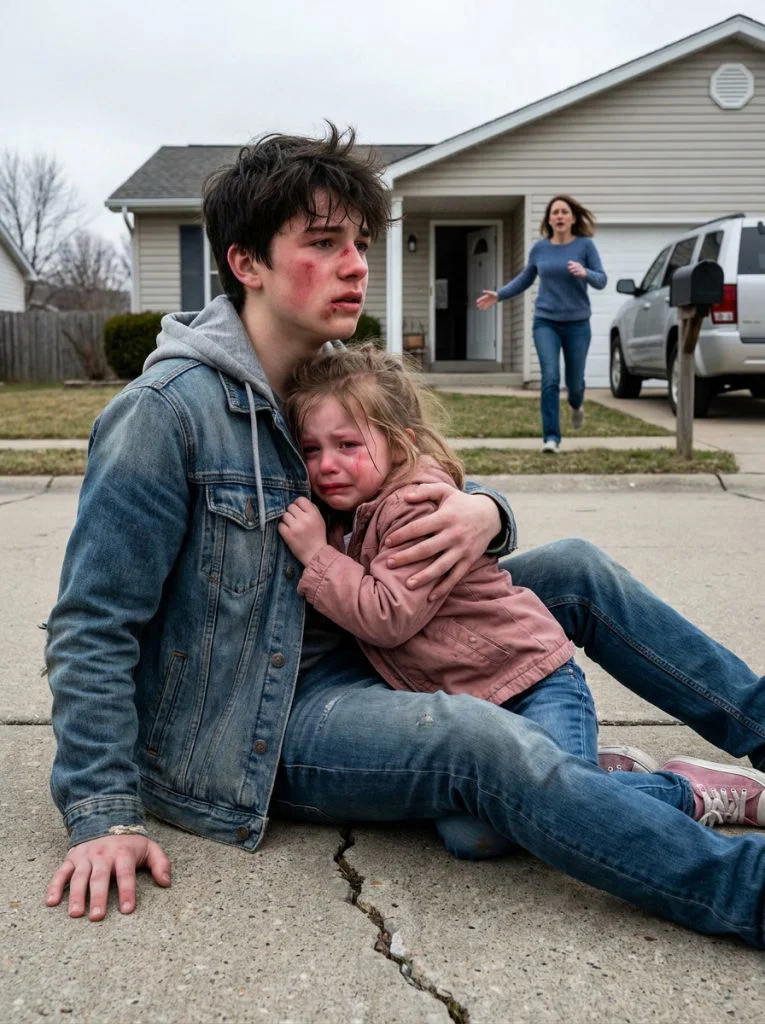
I called emergency services before I even understood the whole story. Little Toby came across my yard pulling himself forward with both hands. His blond hair was stuck to his forehead, his face looked gray beneath the dirt, and one leg dragged behind him in a way that made my stomach drop. His little sister, Daisy, clung to the front of his shirt while crying so hard she could barely breathe.
For one frozen second, I simply stared at them in utter disbelief. Then instinct took over, and I ran outside shouting, “Toby! Oh my god, Toby!”
He tried to answer, but his voice came out as almost nothing. “Aunt Claire, please help Daisy first,” he whimpered softly.
That sentence completely destroyed me inside. He was only six years old, his leg was clearly badly injured, and somehow his first concern was still his little sister. I lifted Daisy from his arms, and she wrapped herself around my neck immediately while her small body trembled uncontrollably.
Toby tried to sit up on the lawn, but he fell back down with a quiet groan. That was the moment I pulled out my phone and dialed 911.
“911, what is your emergency?” the dispatcher asked calmly.
“I need an ambulance right away,” I blurted out while kneeling next to my nephew. “My nephew is badly hurt, and he just crawled to my house.”
The dispatcher started asking systematic questions to assess the situation. “Is he conscious?”
“Yes, he is awake,” I replied.
“Is he breathing normally?”
“Mostly, but he is panting heavily.”
“Is there any severe bleeding?”
“Not much blood, but his leg looks terribly wrong,” I answered.
“Is the leg bent or swollen?”
“Yes, it is very swollen around the shin.”
“Can he move his toes?”
“I don’t know, I’m too afraid to touch it,” I admitted while watching Toby’s pale face.
Toby kept trying to speak through his tears. “She locked us in, Aunt Claire.”
“Who locked you in, sweetie?” I asked softly, rubbing his shoulder.
He looked terrified as he whispered, “Mom.”
My sister, Brenda, was their mother. For a moment, I thought he must be confused or delirious from the pain. Maybe there had been some kind of terrible accident at home, maybe Brenda had gone to find help, or maybe a door had jammed shut.
“Are you sure, Toby?” I asked gently. “Where is your mother now?”
Then Toby said it again, staring right into my eyes. “She locked us in there again.”
That word changed everything instantly. The realization that this was not a one-time accident hit me like a cold wave.
Part 2
The ambulance arrived within minutes, its sirens echoing through our quiet neighborhood in Springfield. Two paramedics rushed across my yard with medical equipment in their hands. One paramedic immediately knelt beside Toby while the other checked Daisy, who was still clutching my shirt.
I kept asking questions to figure out what had happened. Neither child had shoes on their feet, Daisy was still wearing her flannel pajama pants, and Toby had one sock on and one bare foot. His shirt was torn near the shoulder, covered in mud and street grit.
The paramedic touched Toby’s swollen leg carefully to check his pulse. Toby let out a piercing scream that rang across the yard. That sound is something I will never forget for the rest of my life.
The paramedic stopped immediately and looked at his colleague. “We need to immobilize this leg right now before moving him.”
“Is it broken?” I asked with a trembling voice.
The paramedic looked up at me with a solemn expression. “It is very likely fractured, ma’am.”
The police arrived almost simultaneously, parking behind the ambulance. An officer named Detective Miller pulled me aside on the driveway while the paramedics stabilized Toby.
“Who are these children?” Officer Miller asked while taking out a notepad.
“They are my sister’s kids,” I answered, trying to keep my voice steady.
“Where is your sister right now?” he asked.
“I don’t know,” I admitted. “I haven’t talked to her since yesterday.”
“Where do they live?”
“They live on Oak Street, just seven blocks away,” I replied.
Seven blocks was close enough that I had driven past Brenda’s house hundreds of times, but it was far enough that Toby had somehow dragged himself all the way to me on elbow and knee. The officers immediately dispatched a police unit toward Brenda’s house to investigate the situation.
I rode in the front of the ambulance while the paramedics monitored the children in the back. Daisy would not let go of my hand through the partition window, and Toby kept drifting between total exhaustion and sheer panic. Every few minutes, he asked the same heartbreaking question.
“Is Daisy okay?” Toby murmured from the stretcher.
“Yes, Toby, she is right here beside me,” I told him gently. “She is safe.”
He visibly relaxed every time he heard my reassurance, closing his eyes until the panic returned a few minutes later.
Part 3
At Saint Jude Medical Center, diagnostic imaging confirmed what everyone already feared. Toby’s lower leg had a severe bone fracture that required a fiberglass cast. Doctors also found clear physical signs that he had been dehydrated for quite some time, and Daisy was equally dehydrated. Both children were starving, their small stomachs making loud noises during the examination.
A pediatric nurse brought Daisy a small tray of crackers and apple juice. Daisy ate the crackers so quickly that the nurse gently put a hand over the package to slow her down.
“You can have more in a few minutes, sweetheart,” the nurse promised with a kind smile.
Daisy looked at her suspiciously with wide eyes. “Really? You won’t take it away?”
“Yes, I promise,” the nurse replied softly.
The nurse brought another packet a moment later, and Daisy immediately broke the crackers in half. She walked across the room on her small bare feet and carried half of the food straight to Toby’s hospital bed. I turned away toward the window because I couldn’t let the children see me crying.
Officer Miller returned to the pediatric ward about an hour later. He looked entirely different than he had at my house, carrying an extremely serious expression.
“Ms. Claire, can we speak privately in the hallway?” Officer Miller asked softly.
I followed him out into the quiet corridor, my stomach tightening with dread. “What did you find at the house?”
He hesitated for a moment, adjusting his belt. “The children were telling the truth about everything.”
“Oh god, no,” I whispered, leaning against the wall.
“There has to be another explanation, Detective,” I repeated, trying to process the horrifying reality.
Officer Miller spoke carefully to explain the crime scene. “Our officers forced entry into your sister’s house after getting no response. The front door was locked, her car was gone, and neighbors said they hadn’t seen her since yesterday afternoon.”
“Where were the kids kept?” I asked, wiping my tears.
“Inside a converted utility room near the back of the house,” he explained. “The police found blankets on the hardwood floor, empty snack wrappers, a single plastic cup, and a heavy childproof lock installed on the outside of the door.”
I stared at him in complete horror as he continued describing the room. “There was also fresh damage to a small high window inside that storage space.”
Toby had apparently climbed onto a wooden shelf inside the room and tried to force the window frame open with his small hands. He fell off the shelf during the attempt, which was how he broke his leg, but he somehow still managed to get himself and Daisy outside through the narrow opening.
“How did he get Daisy through that small window?” I asked, completely shocked by his resilience.
“The wire screen was torn loose from the frame,” Officer Miller said. “He must have pushed her through first and then dragged himself out behind her.”
I pictured a six-year-old child with a broken leg forcing himself through a tight window, helping his toddler sister down, and then dragging his body seven blocks along the pavement. I felt physically sick right there in the hospital hallway.
“Where is Brenda now?” I asked.
“We have issued a warrant and our officers are actively searching for her,” he replied.
Part 4
My sister Brenda had always been a complicated person to deal with. That was the polite word our family used when we did not want to admit she was deeply unstable. Growing up, Brenda was impulsive, emotional, and completely unpredictable in her behavior. However, she was also funny, charismatic, and fiercely affectionate when she wanted to be.
When she became a mother, I genuinely thought something in her temperament had settled down. For the first few years after Toby was born, that statement seemed entirely true because she adored him. Then Daisy was born, and life became much harder for everyone.
Brenda separated from the children’s father, Patrick, after a bitter relationship breakdown filled with endless arguments. Money became tight, she changed retail jobs repeatedly, and she stopped answering my phone calls for days at a time. Sometimes she would disappear from family dinners for weeks without explanation.
Every time I expressed worry, she always had a plausible explanation ready. She would tell me she was tired, she was overwhelmed by bills, the children had been sick with the flu, her cell phone screen had broken, or her store manager had suddenly changed her work schedule. Because I loved my sister and wanted to support her, I kept accepting those excuses without asking harder questions.
Now I stood in a hospital hallway wondering how many obvious warning signs I had carelessly explained away over the years.
Child protective services arrived at the hospital that afternoon. A senior caseworker named Denise spoke with Toby gently inside his room while I waited outside. I was not allowed in the room during the official record interview, but later Denise asked to speak with me privately in the consultation room.
“Toby told me that this has happened multiple times before,” Denise said while reviewing her notes.
“How many times has she locked them in there?” I asked, my voice cracking.
“He doesn’t know exact numbers,” Denise replied solemnly.
“What do you mean he doesn’t know?”
“He has difficulty understanding the concept of time, like most six-year-old children,” Denise explained. “He described sleeping in that locked utility room overnight more than once.”
I could barely breathe as the reality settled in. “Why would she do that to her own children?”
“He says his mother told them they were safer inside that room while she was away,” Denise said gently.
According to Toby, Brenda locked them inside whenever she wanted to leave the house without arranging proper childcare. Sometimes she came back after dark, and sometimes Toby woke up in the morning and realized she still had not returned.
He had learned where she kept extra crackers in the kitchen and saved them in his pockets. He always shared those saved crackers with Daisy when they were locked away. There was a single plastic cup they filled from the bathroom sink before the door was locked, but if they forgot to fill it, they had no water until Brenda returned home.
“This simply can’t be real,” I said, shaking my head in denial.
Denise looked at me with deep sympathy. “Children often normalize terrible neglect when it happens repeatedly within their daily routine.”
Part 5
Two days later, the local police located Brenda at a highway motel about forty minutes outside the city. She was staying there with an acquaintance nobody in our family had ever met before.
When detectives questioned her at the police station, she initially claimed she had left the children with an hired babysitter. When the police asked for the sitter’s contact information, she changed her story and claimed she only intended to be gone for two hours to run errands.
“My car had unexpected engine trouble on the highway,” Brenda lied to the detectives during interrogation.
Vehicle registration records and security footage contradicted her statement entirely. Finally, when confronted with the evidence from the house, she insisted the storage space was not a punishment or a cage.
“It is a safe room,” Brenda claimed during her interview. “It’s a controlled space where my children cannot hurt themselves while I am away.”
I remember hearing that absurd explanation from Detective Miller and feeling something cold settle deep inside my chest. Toby had broken his leg attempting to escape her twisted version of safety.
Brenda called me from the county jail detention center late that evening. At first, I let the phone ring on the kitchen counter, but she called a second time and then a third time until I finally picked up the receiver.
“Claire?” Brenda sobbed into the phone line. “You have to help me get bail.”
I stood silently in my kitchen, refusing to say a word.
“This whole thing is being blown out of proportion by the police,” she claimed hysterically.
“Is that really what you think, Brenda?” I asked, my voice completely devoid of emotion.
“I made a simple mistake, Claire,” she argued.
“A mistake?” I asked, holding the phone tightly. “You locked your small children in a windowless room and abandoned them to go to a motel.”
“They were completely safe in that room!” she yelled through the phone.
“No, Brenda, they were not safe at all,” I said firmly.
“They had food in there!” she insisted.
“They had leftover crackers,” I corrected her.
“They had fresh water!”
“They had one dirty plastic cup, Brenda.”
She started crying harder into the receiver. “You don’t understand how stressful my life has been lately!”
I thought about Toby pulling his broken body across my green grass. I thought about his swollen, discolored leg. I thought about Daisy carefully breaking a hospital cracker in half to feed her big brother.
“No, Brenda, you are completely right,” I said quietly. “I don’t understand you at all.”
Brenda immediately became furious on the phone, accusing me of turning the rest of the family against her. She claimed our parents had always loved me more than her, that motherhood was harder for her than anyone else could comprehend, and that Patrick had abandoned her without support.
“Nobody ever helped me when I was drowning!” she screamed into the phone.
That last statement hurt deeply because it was an absolute lie. Our mother had offered free childcare dozens of times, I had offered to babysit every weekend, and Patrick’s parents had constantly offered to take the kids. Brenda had refused our offers repeatedly, claiming people were judging her parenting style and insisting she needed complete personal freedom.
“Why didn’t you just call me that afternoon?” I asked her directly. “You live seven blocks away, Brenda. Why didn’t you just call me?”
There was complete silence on the other end of the phone line. She had no answer to give me, so I hung up the phone.
Part 6
The next few weeks became a chaotic blur of legal court hearings, medical follow-ups, social worker interviews, and endless custody paperwork. Toby needed regular therapy sessions for his leg, and both children were thoroughly evaluated by child psychologists.
Their father, Patrick, worked out of state on long-term industrial construction projects. He immediately flew back to the city the moment he received the emergency call from the police department. I had never seen a full-grown man cry the way Patrick did when Toby innocently explained the utility room to him.
“I should have known something was wrong,” Patrick kept repeating while sitting in my living room, burying his face in his hands.
I understood that crushing guilt completely because I thought the exact same thing every single day. My mother thought it, Brenda’s neighbors thought it, and even Toby’s kindergarten teacher admitted that the boy had occasionally come to school looking unusually tired and hungry. Everyone had seen tiny, isolated pieces of the puzzle, but nobody had put the whole picture together until Toby crawled to my porch.
Eventually, temporary joint custody was arranged between Patrick and me while the family court evaluated a long-term plan. For several months, Toby and Daisy lived full-time at my house.
The very first night they stayed with me was the hardest experience of all. I prepared the guest room upstairs, placing two comfortable beds side by side, plug-in night-lights, clean cotton pajamas, stuffed bears, and fresh glasses of water on the nightstands.
“You can leave this room whenever you want during the night,” I told them gently as I tucked them in.
Toby stared at me with wide, cautious eyes. “Even in the middle of the night, Aunt Claire?”
“Yes, sweetie, anytime you want,” I answered with a warm smile.
“To get a glass of water from the kitchen?” he asked softly.
“Yes, absolutely.”
“To come find you in your bedroom?”
“Yes, whenever you feel scared,” I assured him.
He pondered my words for a long moment before asking a question that broke my heart into pieces. “You won’t lock the door from the outside?”
“No, Toby,” I said, looking straight into his eyes. “I will never lock your door.”
“Do you promise?”
“I promise you with all my heart,” I declared softly.
He slept with the bedroom door completely open that night, and Daisy did the exact same thing. For weeks afterward, Toby panicked whenever any interior door clicked shut around the house. If he could not immediately turn the knob and open it, his breathing would become shallow and frantic. Daisy began crying uncontrollably whenever I grabbed my handbag from the counter, assuming I was going to abandon them forever.
Therapy helped them process the trauma, structured daily routines provided stability, and time allowed their small bodies to heal.
One evening, several months after the incident, I was sitting on the rug helping Toby finish a wooden floor puzzle. His leg had healed remarkably well, and the doctors had finally removed his leg brace.
“Aunt Claire, I really thought Daisy was going to die in that room,” Toby said out of nowhere, his eyes fixed on a puzzle piece.
My hands froze mid-air. “Why did you think that, Toby?”
“She was so thirsty, and her lips were dry,” he swallowed hard before continuing. “Mom said she would come back super fast, but she didn’t come back at all.”
“How long were you inside before you decided to break the window?” I asked gently.
“I don’t know,” he shrugged his shoulders casually, as if he were describing a simple school game. “So I climbed up the wooden shelves to reach the latch.”
“You were hurt really badly when you fell, Toby,” I pointed out softly.
“I know my leg made a loud pop,” he said, fitting two puzzle pieces together.
“Why didn’t you stay inside the room and wait for help to arrive?”
His answer came without a single moment of hesitation. “Because Daisy was crying so hard, Aunt Claire.”
That was the entire explanation for his extraordinary courage. A six-year-old boy had scaled a wall and squeezed through a broken window on a fractured bone simply because his baby sister was crying in the dark.
He carried her for as much of the journey as he physically could. Sometimes she walked slowly beside him holding his hand, sometimes he dragged his body forward across the concrete, and sometimes he held her tightly against his chest because she was too terrified to move.
They had stopped several times along the sidewalk. Toby remembered resting against a yellow fire hydrant on Elm Street, he remembered a silver car driving past them without stopping, and he remembered Daisy asking repeatedly if they were almost at my house. He kept telling her yes, even when his vision was going dark from the agonizing pain.
Seven sidewalk blocks seems like nothing to an adult taking a quick walk, but to a six-year-old child with a broken shin carrying a toddler, it was an impossible mountain to climb.
Part 7
The criminal court case dragged on for almost a year. Brenda eventually accepted a prosecution plea agreement involving felony child endangerment and criminal neglect charges. She was sentenced to mandatory treatment programs, parenting classes, and long-term supervised visitation requirements.
Some extended relatives thought I should have defended my sister more aggressively during the legal proceedings.
“She is your biological sister, Claire,” an aunt told me over the phone one afternoon.
My answer to them remained absolute and simple. “And Toby and Daisy are helpless children.”
Family loyalty does not mean shielding adults from the legal consequences of harming innocent children. Sometimes real loyalty means refusing to help someone cover up the terrible things they have done.
I still loved Brenda somewhere deep inside my heart, and that was the complicated truth I had to live with every day. I hated what she had done to her kids, I was utterly furious with her reckless choices, and I knew I could never trust her again, but she was still my sister. Those conflicting emotions existed side by side inside me.
People often want stories like this to be simple, with a clear villain, a heroic rescue, and a quick happy ending, but real life is rarely that clean or easy.
Toby still wakes up from sudden nightmares occasionally, and Daisy still gets anxious when adults leave the room unexpectedly. Patrick permanently changed his job to a local building company so he could live in town full-time and raise his children safely. I became an active part of their daily lives in a way I had never anticipated, picking them up from school every afternoon.
Slowly but surely, the children learned to be children again. They learned that food would always be in the pantry tomorrow, that adults always return when they say they will, that bedroom doors stay unlocked, and that asking for help never makes anyone angry.
Nearly a year after that terrible day, we were all outside in my front garden planting colorful summer flowers. Toby was running naturally across the green grass without any limp, while Daisy chased him around the oak tree with a bright yellow watering can.
At one point, Toby tripped over a garden hose and fell onto the grass with a loud thud. I froze instinctively, my heart jumping into my throat.
He immediately jumped back up onto his feet, laughing out loud. “I’m totally fine, Aunt Claire!” he shouted before running off again.
I stood there on the lawn watching him play freely under the afternoon sun. Suddenly, I remembered the exhausted, gray-faced child I had found crawling across that exact same patch of grass months earlier, dragging his broken leg while holding his baby sister tight.
People always call Toby a hero when they hear the story of what happened that day. He was remarkably brave, but I constantly wish he had never needed to be brave in the first place.
Children should never have to become heroes because the adults in their lives failed to protect them. They should not have to plan dangerous escapes, they should not have to ration stale crackers, and they should not have to save their younger siblings while their mother disappears.
Safety is not a locked storage room with a plastic cup of water. Safety is knowing that the adults who love you will always protect you and always come back home.
And if Toby remembers nothing else about that horrific afternoon, I hope he always remembers this foundational truth: he never should have had to rescue his sister alone, but once he reached my yard, he would never have to be alone again.