“That walk is for real dads, Kay.”
Travis said it with his fork resting on the edge of his plate. The way he sets it down when he’s about to say something he practiced in the truck on the way home.
It was a Tuesday supper in the middle of October. Two days before senior night.
I’d made tater tot hotdish. It’s the one thing all four of us will eat without a discussion.
Kaylee had asked him the way she asks everything. Straight out and a little too fast. Like she wanted the question over with before she lost her nerve.
“Will you walk me out Thursday?”
And then Travis said the rest of it.
“I don’t want to take something that isn’t mine. That’s for your dad. If he ever shows up. It wouldn’t be right for me to stand in his spot.”
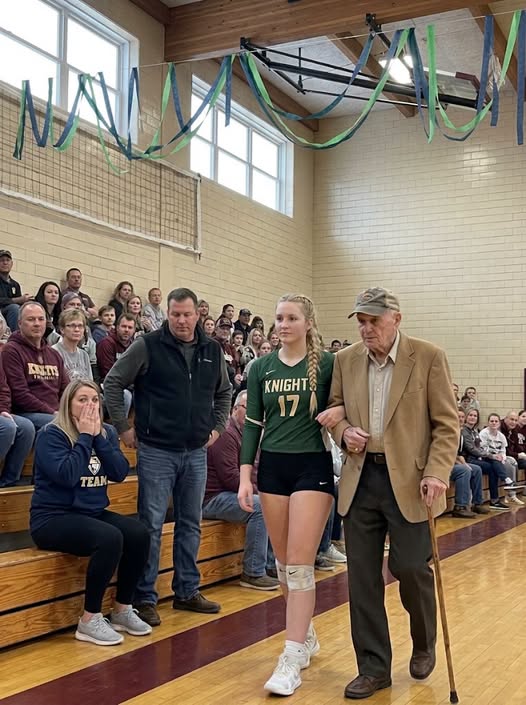
Kaylee is seventeen. She’s a senior. A middle hitter on the volleyball team. She’s worn the same long blond braid since the fourth grade, when she decided bangs were for babies.
She looked at him for maybe three seconds.
I watched her decide something behind her eyes.
Then she said, “Fine.”
Flat. Like the noon farm report on the radio.
She stood up. She rinsed her plate. She put it in the dishwasher the right way for once. And she went upstairs.
Her door didn’t slam.
I almost wished it had. You can argue with a slammed door.
Mason is eight. He’s Travis’s boy and mine. Kaylee’s half brother. Though nobody in our house has ever once used the word half about anything.
He had ketchup on his chin. And his eyes on me.
He was waiting for me to fix it.
That’s what I do in our family. I’m the one who calls the coach. Finds the permission slip. Knows where the good scissors are hiding.
I didn’t say a word.
I picked up the hotdish pan. I scraped the corner pieces into a Tupperware. I snapped the lid on.
And I did not say one single word to my husband.
I’ve gone over that silence a hundred times since then. And I want to tell it honestly. Because the easy version of this story makes me look a lot better than I was that night.
The easy version is that I was too stunned to speak.
I wasn’t stunned.
I knew exactly what I could say. And I knew that if I said it hard enough, Travis would walk her out.
He’s a man who does what he’s asked.
If I’d looked at him across that table and said, “You’re walking her out, and that’s the end of it,” he’d have nodded. And he’d have done it.
And then my daughter would have walked onto that gym floor on the arm of a man who was only there because his wife made him.
She’d have known it.
Every picture on the refrigerator would have known it.
I didn’t want that for her.
I wanted him to choose her.
Nine years in, I wanted just one time where nobody had to ask him. Where he just stood up and took the spot. Because it was his.
So I scraped the pan. And I waited.
I’m not sure that was right. It might’ve been a kind of pride.
But that’s the truth of why I kept my mouth shut.
My name is Jodi Brandt. I’m forty-one years old. I’m a dental hygienist in a little town in southern Minnesota, about forty minutes from Mankato.
And I need to tell you about Kaylee’s father. Because Travis wasn’t wrong that there was one.
His name is Ryan. We got married young. Twenty-two. In the Lutheran church I grew up in.
Ryan took a job in the North Dakota oil fields when Kaylee was four.
The money was good. And the distance turned out to be even better. For him.
He came home less. Then not at all.
For a while, he called on her birthdays. Then he called on some of them.
The last call came when she turned eleven. He promised he’d drive down for her confirmation.
He didn’t come.
That was six years ago.
She still has a phone number for him. She hasn’t dialed it since seventh grade. She keeps it in her contacts under his first name. Ryan. Not Dad.
Travis came along when Kaylee was seven.
He sells seed corn and soybeans out of a pole shed north of town. He came into the dental clinic where I work with a cracked molar.
I cleaned his teeth for two whole years before he asked me to supper.
He told me later that he’d been scheduling his six-month cleanings at five months. So he could see me sooner.
On our second date, he asked if he could meet Kaylee.
Not to impress me.
He said he wouldn’t keep seeing a woman with a little girl unless the little girl was all right with him being around.
Kaylee interviewed him at the kitchen table like a county commissioner.
Did he have a dog? Did he know how to braid hair? Did he like the Twins?
He said yes, no, and only when they win.
He learned to braid hair that summer.
He practiced on a length of orange baler twine tied to a cabinet knob out in the seed shed.
I know, because I walked in on him doing it once. He turned red all the way to his ears.
We got married when she was eight. She called him Travis then. She calls him Travis now.
Neither one of them ever made a big thing of it. And I never pushed.
I thought it was working.
He drove her to every single practice since seventh grade. An hour each way, when her club team practiced in Mankato.
He built her a hitting net out of old fence posts and cargo netting behind the shed.
He sat through every match. He kept stats on a clipboard nobody asked him to keep.
He knows her kill percentage better than her coach does.
And he’d never once called himself her dad.
That last part, I took for respect. I thought he was being careful with her. Giving her room.
I didn’t understand, until that Thursday, that a man can be careful for so long it turns into fear.
After supper that Tuesday, Travis went out to the shed.
He does that when something’s on his mind. He says he’s checking inventory. But there isn’t much inventory to check in October.
I went upstairs and knocked on Kaylee’s door.
“Come in.”
She was lying on her bed with her shoes still on, which she knows I hate. Staring up at the ceiling fan.
“You don’t have to talk about it,” I said.
“Good,” she said. “Because I don’t want to.”
I sat down on the edge of her bed.
Her room smells like the vanilla body spray every girl in her class wears. And like the knee pads she keeps forgetting to air out.
I didn’t mention the knee pads.
After a while, she said, “He’s not wrong, you know. He’s not my real dad.”
She stared at the fan going around.
“I just thought, I don’t know. I thought it didn’t matter anymore.”
“It doesn’t,” I said.
“Apparently it does to him.”
I put my hand on her ankle.
She let me leave it there.
She’s seventeen. The moments when she lets me leave my hand anywhere are fewer than they used to be.
“Who do you want to walk you out?” I asked. “Not who you’re supposed to want. Who.”
She thought about it longer than I expected.
Then she said, “Can Grandpa do it?”
My father is Duane Ostrem. He’s seventy-nine years old.
He milked Holsteins on the same quarter section east of town for fifty-one years. Twice a day. Three hundred and sixty-five days a year.
He sold the herd in 2011. The spring after my mother died.
He said the cows didn’t need a man who talked to them that much.
He still lives on the place. He still gets up at 4:30 every morning.
He had his left hip replaced two winters ago. He’s walked with a cane ever since. A plain wooden hickory cane, with a rubber tip he replaces from the farm store when it wears through.
Kaylee spent every summer of her childhood following him around that farm.
She learned to drive in his old Ford pickup out in the hayfield when she was eleven.
The same summer her father stopped calling.
“Grandpa walks really slow now, honey,” I said.
“I know,” she said. “I don’t care. I want it to be him.”
She turned her head and looked at me.
“And Mom? I want it to be just him. Is that okay? I want him to have it all by himself.”
That stung a little. I’ll admit it.
But I understood.
I’d be in the bleachers. I’d see it. And I wouldn’t have to be the one holding her together on the walk across that floor.
“I’ll call him tomorrow,” I said.
The next morning, between my eight o’clock and my nine o’clock patients, I called the activities director at the high school. Mrs. Larson.
Every senior turns in a form with the names of whoever’s walking her out.
Kaylee’s form said Jodi and Travis. I’d filled it out myself the week before. Without even thinking about it.
Mrs. Larson asked what name she should put instead.
“Duane Ostrem,” I said. “Her grandfather.”
There was a pause on the line.
“Oh, that’ll be nice,” she said.
And then, carefully, because it’s a small town and she wasn’t born yesterday: “Is everything all right at home, Jodi?”
“Everything’s fine,” I said. “Kaylee asked for her grandpa.”
That was true.
It just wasn’t all of it.
Wednesday night after supper, I called Dad.
He picks up on the fourth ring. Every single time. The phone hangs on the wall in the kitchen, and his recliner is in the front room.
I told him all of it. Travis. Tuesday’s supper. Those words. Real dads.
He didn’t interrupt once.
He listened the way he used to listen to a cow that was off her feed. Quiet. Patient.
When I was done, he didn’t say a word about Travis.
He didn’t ask what was wrong with that man, the way some fathers would’ve.
He just asked one question.
“Does Travis know you’re asking me?”
“No,” I said.
He was quiet for a long time. I could hear the clock over his stove ticking. That clock’s been ticking in that kitchen since before I was born.
“Well,” he finally said. “What time do I need to be there?”
I told him JV played at five-thirty. Senior night would be right after. Around a quarter to seven.
He said he’d be there by six.
My father has never been late to anything in his life.
“Dad,” I said. “You’d have to walk all the way across the gym floor. It’s a long way. With the cane.”
“I walked a lot farther than that in a snowstorm to get to the barn,” he said. “I suppose I can make it across a gymnasium for my granddaughter.”
I didn’t tell Travis that night.
I want to be honest about that too.
I could have told him.
He’d have known what it meant. Maybe he’d have changed his mind before the game.
But then it would’ve been the same thing as making him. A man changing his mind because his father-in-law was about to show him up.
I didn’t want that either.
So I let him go to bed not knowing.
He kissed me goodnight, like always. He set his alarm for 5:15, like always. He didn’t say anything about Kaylee. And neither did I.
I lay awake in the dark listening to him breathe. And I wondered what kind of woman sets up her own husband to be embarrassed in front of the whole school.
I didn’t have a good answer.
I still don’t. Not entirely.
On Thursday, I cleaned teeth from eight to four.
Mrs. Bauer, who’s eighty-four and has had the same partial plate since the Carter administration, told me she’d be at the game.
“I wouldn’t miss senior night,” she said, around my mirror and my scaler. “I haven’t missed one since my Jim’s sister played. That was 1974. They played in bloomers back then. Or near enough.”
Everybody goes to senior night in our town.
Our school’s a consolidated district. Three little towns that merged back in the nineties when none of them could field a football team alone anymore.
About four hundred kids in the whole building. Kindergarten through twelfth grade.
There were six seniors on the volleyball team that year. When you’ve only got six, everybody in town knows every one of them by name.
I picked Mason up from his after-school program at four-thirty.
He’d made a poster in art class. GO KAYLEE, with a picture of a volleyball. It looked a lot like a pumpkin.
“It’s a volleyball,” he told me, before I could say anything. “I ran out of white.”
We got to the gym at five-fifteen. I was wearing my maroon booster club sweatshirt, the one with the volleyball on the sleeve.
Travis came straight from the shed in his fleece vest with the seed company logo on the chest. He sat down next to me in the front row of the bleachers without saying much.
The gym smelled like popcorn and floor wax. And that hot electrical smell the old scoreboard makes when it’s been on for an hour.
The booster club had hung maroon and gold streamers along every railing.
Each of the six seniors had a big poster on an easel by the scorer’s table. Her number. Her picture.
Kaylee’s showed her in midair at a home game last fall. Her braid flying out behind her like a rope.
On the scorer’s table was a bucket of red roses from the flower shop on Main Street.
Each senior carries one out and hands it to whoever walks her. That’s how it’s been done here as long as anybody can remember.
Travis looked at those roses. Then he looked away.
I saw him do it.
He had his hands clasped between his knees. He kept rubbing his thumb over the side of his first finger. A thing he does when he’s nervous.
“You okay?” I asked him.
“Fine,” he said.
The exact same flat voice Kaylee had used on Tuesday.
For one second, they sounded so much alike I almost laughed. Except nothing about it was funny.
The JV girls played the visitors from two towns over. They lost the first set. Then won the next two.
Mason cheered for both teams. He didn’t entirely understand which side was ours.
At six o’clock, I watched the side door.
At six-oh-five, I watched it harder.
Dad has never been late. But he’s also never been seventy-nine with a new hip on a cold October night before.
Travis noticed me watching.
“Who are you looking for?”
“Nobody,” I said.
That was a lie. It sat in my mouth like a sour mint.
At twelve minutes after six, the side door swung open.
And my father walked through it.
My whole chest let go of something I’d been holding since Tuesday supper.
He was wearing his tan Sunday sport coat. The one he wore to my mother’s funeral. And to Mason’s baptism. And to nothing in between.
Under it, a white shirt buttoned all the way to the top.
And on his head, his seed corn cap. The good one. The green one he keeps on the hook by the back door and only wears to town.
His cane was in his right hand. His shoes were shined.
He didn’t climb up into the bleachers.
He went straight down to the end of the gym where the seniors were lining up. And he stood right next to Kaylee. Like he’d been assigned there by the governor.
Travis saw him.
I watched it land on his face.
First confusion. The plain kind. Like a man who sees his own truck parked somewhere he didn’t leave it.
Then understanding.
Then something else. Something I didn’t have a word for.
He turned and looked at me.
I looked back at him.
I didn’t explain. He didn’t ask.
“Jodi,” he said quietly.
“She asked for him,” I said. “Tuesday night. After you went out to the shed.”
He nodded. Slowly.
He looked back down at the floor. Kaylee had taken her grandfather’s free arm, and she was laughing at something he’d said. Her laugh carried all the way across the gym.
Travis didn’t say anything else.
He put his hands back between his knees.
But he stopped rubbing his thumb.
He went very still. The way a man goes still up in a deer stand.
The JV girls cleared the floor. The varsity girls from both teams lined up along the far sideline for the ceremony. Our girls in maroon. The visitors in white. Everybody with their hands clasped behind their backs.
Mr. Halvorson does the announcing at every home game.
He taught shop at our school for thirty years. He has a voice like a man calling hogs who’s been to a little bit of college.
He tapped the microphone twice.
“Ladies and gentlemen. Please welcome our senior volleyball players and their families, as we honor them on their final regular-season home game.”
The first girl was announced with her mother and father. They walked out to center court together. She handed her mother the rose. They turned for a picture. Everybody clapped.
The second girl walked out with her mother and her stepfather.
I noticed that. Of course I noticed that.
I didn’t look at Travis. But I felt him notice it too.
The rose went to the mother. The stepfather put his arm around both of them.
The third girl had both parents and a grandmother in a wheelchair, pushed out by an uncle. The grandmother got the loudest cheer so far.
Then Mr. Halvorson looked down at his index card.
And I saw him pause. Just slightly. The same way Mrs. Larson had paused on the phone.
Then he read it.
“Number seventeen. A middle hitter and four-year letter winner. Kaylee Brandt. Escorted tonight by her grandfather, Mr. Duane Ostrem.”
A murmur went through the bleachers.
Half the people in that gym had bought milk off my father at one time or another. Or ridden the school bus with him in the seventies. Or sat on a church council with him.
Kaylee moved the rose to her left hand. She slid her right arm through his left.
He planted the cane.
And they started across the floor.
They walked slow. Because he walks slow now.
Cane, step, step.
Cane, step, step.
That rubber tip squeaked on the varnished floor every single time it came down. You could hear it all the way up in the top row.
Mr. Halvorson kept reading. There’s a list for every senior, and he reads all of it.
“Kaylee has been on the honor roll all four years. She is a member of the National Honor Society, and has shown dairy heifers in 4-H for eight years…”
Then somebody in the top row stood up.
I don’t know who. I’ve asked around since. Nobody will claim it.
It might have been Mrs. Bauer. But I doubt she can stand up that fast.
Then the row under that one stood up.
Then the whole top section.
It went down the bleachers like water running down a hill. Row after row after row. Until the entire home side of that gym was on its feet.
Old men who’d hauled milk with my father stood up. Women from his church circle stood up. Little kids who had no idea who he was stood up because everybody else was standing.
And then the girls on the visiting team, in their white jerseys over on the far sideline, started clapping.
And then their parents, on the other side of the gym, stood up too.
I had both hands over my mouth.
I didn’t decide to put them there. They just went there. And stayed. And I could feel my face getting wet against my palms.
My father didn’t look up at any of it.
He kept his eyes on the floor in front of his cane. The same way he always watched his footing in the barn.
Kaylee had her head turned toward him. Saying something low.
And next to me, Travis stood up.
At first I thought he was just standing because everybody else was standing.
But he wasn’t clapping.
His hands were down at his sides. He was looking at the bleacher steps at the end of our row.
His jaw was working. Side to side.
I’ve seen him do that exactly twice in nine years. Once when he asked me to marry him. Once at his mother’s funeral.
He put his hand on the metal rail.
And he took the first step down.
Mr. Halvorson was still reading.
“After graduation, Kaylee plans to attend Minnesota State University in Mankato, to study nursing…”
Travis took the next step. And the next.
There are four steps from the front row of our bleachers down to the gym floor.
I counted every one of them. Because I couldn’t breathe.
He walked out onto that varnished floor in his work boots and his fleece vest.
Kaylee and Dad were maybe ten feet from center court.
Travis lengthened his stride. And he caught up to them.
He didn’t say anything to them.
He didn’t ask.
He just came up on Kaylee’s other side. Her left. The side away from the cane.
And he offered her his arm. The way you would at a wedding.
Kaylee stopped walking.
She looked at his arm.
She looked up at his face.
I couldn’t see her expression from where I was. But I could see her shoulders.
They went up.
And then they came down.
And she put her hand through his arm.
And the three of them walked the last ten feet together.
Cane, step, step.
Cane, step, step.
Travis matched my father’s pace exactly.
The noise in that gym. I can’t describe it.
It had been loud before. Now it was something else entirely.
Mason was jumping up and down on the bleacher seat next to me, yelling at the top of his lungs.
“That’s my dad! That’s my dad!”
Mr. Halvorson had run out of things on his index card.
He stood there at the scorer’s table with the microphone in his hand, looking at the three of them standing at center court.
And I watched him make a decision.
He walked the microphone out onto the floor.
And he handed it to Travis.
Because it’s a small town, and everybody in that gym knew him, nobody thought it was strange.
And nobody sat down.
Travis looked at that microphone like it was a live wire.
He’s not a talker. He sells seed to farmers who don’t like salesmen. And he does it by saying as little as possible and always showing up.
The gym got quiet.
Not all at once. In waves. From the floor up. Until the only sound left was the hum of the old scoreboard and somebody’s baby fussing up in the corner.
Travis lifted the microphone to his mouth.
His hand was shaking. I could see it from the front row.
“I’m Travis,” he said. “I’m Kaylee’s stepdad. I’ve been her stepdad for nine years.”
He stopped.
He looked down at the floor.
My father didn’t move. Kaylee didn’t move.
“Tuesday night at supper,” Travis said, “she asked me to walk her out tonight. And I told her no. I told her this walk was for real dads.”
There was a sound from the bleachers. Not quite a gasp. More like four hundred people letting out their breath at the same time.
“I said it because I thought I didn’t have the right,” Travis said. “I thought I’d be taking something that belonged to somebody else. I’ve thought that for nine years.”
Then he turned and looked at Kaylee.
Right at her. In front of four hundred people, my husband looked at my daughter.
“I was wrong,” he said. “I’ve been your dad for nine years, Kay. I just never had the guts to say it out loud.”
His voice cracked.
“I’m saying it now. And I’m sorry.”
He handed the microphone back to Mr. Halvorson, who took it like it was made of glass.
Travis looked like he wanted to sink straight down through that varnish into the crawl space.
Kaylee didn’t say anything.
She just turned and pressed her face into the front of his fleece vest.
And he put both his arms around her.
And her long blond braid hung down his back.And that’s when my father did the thing I’ll think about for the rest of my life.
Kaylee had given him the rose. She’d put it in his hand the second they stopped at center court. The same way the other girls had given theirs to their parents.
He’d been holding it against his cane.
He waited until Kaylee stepped back from Travis.
Then he held the rose out. Stem first. To my husband.
Travis looked at it.
He didn’t take it.
He shook his head a little. Like he was telling Dad no. That’s yours. You earned it. You walked the whole way.
My father didn’t lower his arm.
He just kept holding it out. Patient. The same way he used to hold out a bottle to a stubborn calf until it decided on its own.
The gym had gone so quiet, I was close enough to hear what he said.
“I already raised mine, son,” my father said. “This one’s yours.”
Travis took the rose.
My father touched the brim of his seed corn cap to Kaylee. Like a man saying good morning at the co-op.
Then he turned around. He planted the cane. And he started back across that floor by himself.
Somebody went out to help him. One of the JV girls. A sophomore I didn’t know.
He let her walk beside him. But he didn’t take her arm.
He made it all the way to the end of the bleachers on his own.
Then he climbed the four steps. One at a time. Hand on the rail.
And he sat down in the front row right next to me.
He was breathing hard.
He reached over and patted my knee. Twice.
“Well,” he said. “That went all right.”
I couldn’t answer him.
I just put my head down on his shoulder, on that tan Sunday sport coat that still smelled a little like cedar from his closet.
And I cried like I hadn’t cried since my mother died.
Down on the floor, the coach had come out with her phone to take the picture.
Travis and Kaylee stood in front of her poster. Him holding the rose. Her holding his arm. Both of them red in the face.
Then Kaylee looked up at the bleachers.
She waved at Mason and me and her grandpa to come down.
Mr. Halvorson leaned into the microphone.
“Come on, Jodi. Bring ’em down here.”
And everybody laughed.
So we went down. Dad, Mason, and me.
Dad took those stairs a second time without one word of complaint.
That picture, the five of us at center court under the maroon and gold streamers, is the one on our refrigerator now.
Mason’s holding his pumpkin volleyball poster upside down in it.
Nobody noticed until we got it printed.
We left it.
We didn’t talk about it in the truck on the way home.
Mason fell asleep against the window before we even got to the edge of town. Kaylee rode with her friends to the team’s pizza party at Casey’s.
Travis drove with both hands on the wheel. The rose lay on the dashboard, rolling a little on the curves.
He didn’t say a word for eleven miles.
Neither did I.
When we got home, I carried Mason up to bed and came back down.
Travis was sitting at the kitchen table. In the same chair he’d been sitting in on Tuesday.
The rose was lying in front of him on the oilcloth.
I put on a pot of decaf.
I didn’t ask him anything.
I sat down across from him, and I waited. The same way I’d waited all week.
Only this time, it didn’t feel like a test.
“I’m sorry I didn’t tell you Dad was coming,” I finally said. “I should have. I wanted you to decide on your own. But that wasn’t fair to you.”
He shook his head.
“You were right not to,” he said. “If you’d told me, I’d have done it for you. I needed to do it for her.”
And then he told me something he’d never told me in nine years of marriage.
And it explained the whole thing.
I had to set my coffee cup down.
When Travis was twelve years old, his mother remarried.
The man’s name was Dale.
He wasn’t a bad man, Travis said. He worked hard. Paid the bills. Never raised a hand to anybody.
That spring, Travis played Little League.
At the end of the season, there was a banquet at the American Legion. The boys’ fathers were supposed to stand up behind them when they got their trophies.
Travis asked Dale to come.
And Dale said, right there in front of Travis’s mother, at their own kitchen table:
“You’re not mine to raise. That’s your dad’s job. I’m not going to stand up there and pretend.”
“My dad wasn’t coming either,” Travis said. “So I walked up there alone. I got my trophy. I walked back to my seat. And I never asked Dale for anything ever again.”
He turned the rose a quarter turn on the oilcloth.
“I swore I’d never do that to a kid. I’d never make a kid feel like that.”
He looked up at me.
“And Tuesday night, I sat right here in this chair and I said almost the exact same words.”
“Why?” I asked him.
Not mean. I just needed to understand.
“Because I’ve been scared for nine years that I was overstepping,” Travis said.
“Every time I wanted to call her mine, I’d think about her real dad. What if he shows up someday. What if she resents me for it. What if I take something that was never mine to take.”
He rubbed his face with both hands.
“When I said real dads, Jodi, I wasn’t talking about her. I was talking about me. I didn’t think I counted. I didn’t think I was allowed to count.”
He was quiet for a long time.
“Then I watched your dad walk her out on that cane,” he said. “A seventy-nine-year-old man. Walking the whole length of that gym. And I thought, what in the world am I doing up here?”
He looked down at the rose.
“He showed up. That’s all a real dad is. The one who shows up. And I’ve been showing up for nine years, and telling myself it didn’t count.”
I reached across the table and put my hand over his.
His hands are rough. From the shed. From loading seed bags and fixing augers.
He turned his hand over. And he held on.
We sat there like that until Kaylee came home at eleven.
She came in through the back door in her warmup jacket. Her braid half undone. Smelling like pepperoni and the gym.
She stopped when she saw us at the table.
She looked at the rose.
Then she walked over and did something she hadn’t done since she was ten years old.
She sat down on Travis’s knee.
Like a little girl.
She’s five foot ten. She’s a middle hitter. She didn’t fit on his knee at all.
It didn’t matter even a little bit.
“I put my phone away during the party,” she said. “Everybody kept showing me the video. Somebody already put it on Facebook. Grandpa has four hundred likes.”
Travis laughed. It came out wet.
“Your grandpa doesn’t even know what Facebook is.”
“I know,” she said. “That’s the best part.”
Then she was quiet for a minute.
And she said, to the side of his head, “I wasn’t mad that you said no, Travis. I was mad because I thought you didn’t want to.”
“I always wanted to,” he said. “Every single day. I was just scared.”
“Scared of what?”
He thought about it.
“Of you telling me I wasn’t your dad.”
Kaylee pulled back and looked at him. Like he’d just said something in a foreign language.
“Travis,” she said. “Who do you think taught me how to braid my own hair?”
That’s when I had to get up and go stand at the kitchen sink for a while.