I kept my shoulders square and my expression composed.
Twenty years in uniform had taught me how to remain calm under pressure. I had stood in rooms where a single decision could determine whether soldiers returned home safely. I had delivered difficult briefings to commanders who expected answers, not excuses. I had watched young officers struggle with decisions that would follow them for the rest of their lives.
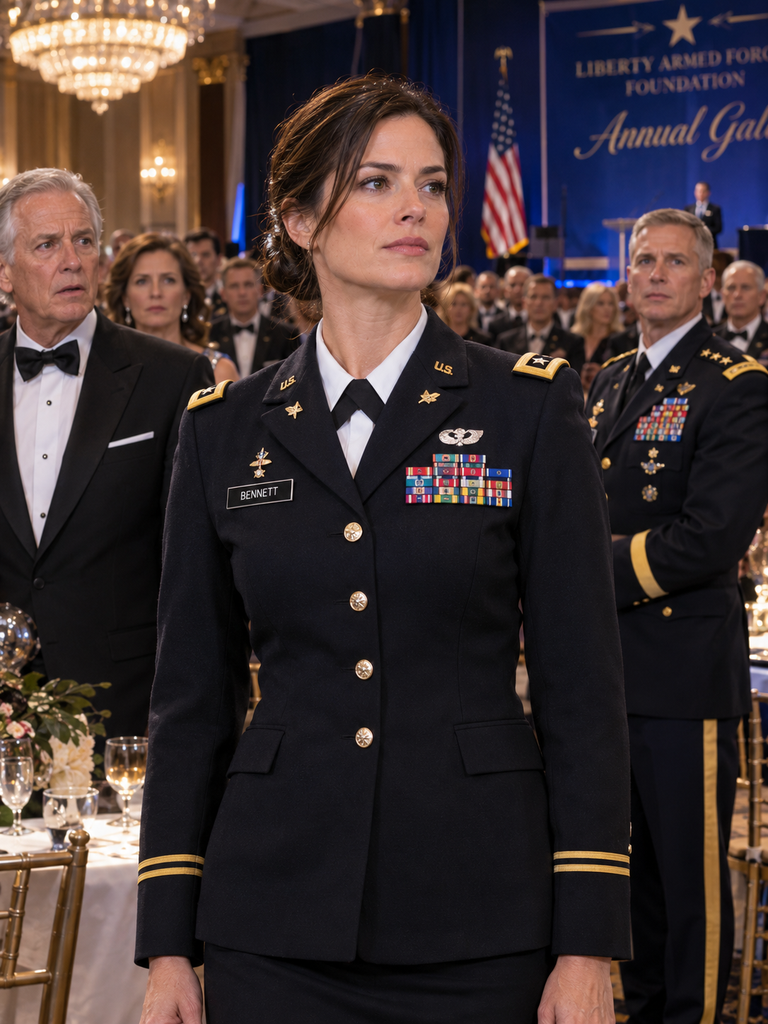
Yet somehow, standing in that ballroom with my family watching, I felt more exposed than I had in any of those moments.
Because this time, the people judging me weren’t strangers.
They were the people whose approval I had once desperately wanted.
My father finally turned toward Ethan.
“What is going on?” he whispered.
Ethan didn’t answer.
He was staring at my shoulders, studying the silver eagle insignia of a full colonel. His eyes moved across my ribbons, pausing at decorations he recognized from his own years in uniform.
Then he looked at the general standing beside the stage.
“Dad,” he murmured, “I think we need to listen.”
For once, Richard Bennett had nothing to say.
The master of ceremonies resumed.
“Colonel Bennett’s career has included operational planning, joint-force coordination, and assignments involving some of the Army’s most demanding missions. Her work has been instrumental in protecting American personnel and strengthening the ability of our forces to operate under extraordinary circumstances.”
Polite applause filled the ballroom.
Then the master of ceremonies paused.
“But tonight, we are not simply recognizing twenty years of service. We are honoring one particular mission, the details of which remained restricted for years after its completion.”
The applause stopped.
My father’s head snapped toward me.
Restricted.
That word had always irritated him.
Whenever he asked what I did, I gave him the answers I was permitted to give. When he complained that I never told him anything interesting, I reminded him that some details of my work weren’t mine to share.
He always assumed I was hiding an unremarkable career behind official language.
Now, for the first time, he seemed to wonder whether he had been wrong.
General Harrington stepped toward the microphone.
“I’ve had the privilege of serving with outstanding officers throughout my career,” he began. “Some distinguish themselves through their command presence. Others through their technical expertise. And a rare few demonstrate the ability to make the right decision when every available option carries a cost.”
He looked directly at me.
“Colonel Bennett is one of those officers.”
I felt my throat tighten.
I knew what was coming.
I had reviewed the ceremony program two weeks earlier. I had approved the wording, corrected an error in the description of my assignment, and asked that the presentation avoid unnecessary operational details.
But reading words on a page was different from hearing them spoken aloud.
Especially when the people who had dismissed you were finally listening.
“Several years ago,” the general continued, “a joint operation encountered circumstances that threatened the safety of American personnel and endangered the success of a much larger mission. Communications were disrupted. Information arriving from the field was incomplete. Commanders faced competing demands, and time was running out.”
A photograph appeared on the enormous screen behind him.
It showed a military operations center, rows of monitors illuminating the faces of tired personnel. The image was several years old, and the quality was poor.
I recognized the room immediately.
I had spent countless hours there.
“Colonel Bennett was responsible for coordinating a critical part of the operation,” General Harrington said. “When the original plan became unworkable, she identified an alternative that allowed our forces to adapt without abandoning personnel who could not safely be left behind.”
A murmur traveled through the audience.
My father leaned forward.
The general continued.
“She brought together intelligence assessments, logistical requirements, and the capabilities of multiple units. She challenged assumptions that others had accepted. And when the situation changed again, she revised the plan before a narrow window of opportunity closed.”
My hands remained still at my sides.
I remembered the sleepless nights.
The unanswered calls.
The maps covered in markings.
Most of all, I remembered the voices of people who had been waiting for someone to make a decision.
There had been no applause then.
No chandeliers.
No audience.
Just a clock, a series of uncertain reports, and the knowledge that the consequences would belong to real people.
General Harrington turned slightly toward me.
“Her contribution helped bring American personnel home safely and prevented a difficult situation from becoming a far greater tragedy.”
This time, the applause was louder.
I heard someone near the front say, “Outstanding.”
My father didn’t join in.
He was staring at the screen.
A second image appeared.
It showed a younger version of me, standing beside a table crowded with maps and briefing folders. My hair was shorter. My face was thinner. I looked exhausted.
But I was unmistakably myself.
The image had been taken shortly after the operation.
Madison’s hand rose to her mouth.
Ethan took a step closer to the stage.
And my father whispered something I could barely hear.
“That can’t be her.”
Unfortunately for him, it was.
The general continued speaking, but I barely heard the next few sentences. My attention had shifted to a memory I had spent years trying to leave behind.
A young soldier named Daniel Mercer.
He had been twenty-four when I first met him.
He was the sort of person who made everyone around him feel a little less afraid. He joked when he was tired, volunteered for difficult assignments, and called home whenever he could.
During the operation General Harrington was describing, Daniel and several other soldiers had become separated from the larger force.
The situation deteriorated faster than anyone expected.
For a period of time, their location could not be confirmed. The information reaching our command post contradicted itself. The original plan no longer provided a safe path forward.
Every option carried risk.
And while commanders debated what could reasonably be done, families back home continued their ordinary evenings without knowing that the lives of their sons and daughters were hanging in the balance.
I remembered Daniel’s mother’s name because I had seen it on a letter he carried in his personal effects.
Margaret.
He had shown me the letter during an earlier briefing, laughing at how his mother still reminded him to eat properly despite the fact that he was a grown man in uniform.
“If anything happens to me, ma’am,” he had joked, “please tell her I wasn’t skipping meals.”
I had told him not to talk like that.
He had grinned.
“Yes, ma’am.”
Then he had gone back to work.
During the operation, when the information began arriving in fragments, I had found myself thinking about that conversation.
Not because I believed I could save everyone.
I knew better than that.
But because every name on the situation board represented someone who had once been a child, someone who had a family, someone whose absence would leave an empty chair at a dinner table.
I refused to let uncertainty become an excuse for inaction.
I worked with the relevant commanders and staff, challenged an assumption about the available route, and coordinated a revised plan that gave the rescue effort a viable path forward.
We did not know whether it would succeed.
We only knew that doing nothing was not an acceptable answer.
When confirmation finally arrived that the isolated personnel had been recovered, nobody in the operations center cheered immediately.
We waited for the names.
One by one, they were accounted for.
Then Daniel’s name appeared.
Alive.
I had closed my eyes for three seconds.
Three seconds.
Then I opened them and asked for the next report.
That was what the Army had been recognizing tonight.
Not a dramatic speech.
Not a photograph of me standing in a heroic pose.
A decision made under pressure, followed by the responsibility to keep making decisions until the danger had passed.
And now, years later, my father was finally hearing about it.
Except he still didn’t understand the most important part.
General Harrington moved away from the podium and approached me.
“Colonel, would you join me on stage?”
“Yes, General.”
As I stepped forward, I caught sight of my family.
Madison looked pale.
Ethan appeared stunned.
My father looked angry, but beneath his anger was something unfamiliar.
Fear.
Not fear of me.
Fear of what this moment meant for everything he had believed about his own daughter.
I climbed the steps and stood beside the general.
He shook my hand firmly before turning back toward the audience.
“There is one other thing I want everyone here to understand,” he said.
The ballroom fell silent again.
“People sometimes imagine that the most consequential work in the military is always performed by the person giving the order or standing at the front of a formation. But complex operations succeed because people throughout the chain of command do their jobs with judgment, integrity, and courage.”
He paused.
“Colonel Bennett did not ask for recognition when this operation concluded. In fact, she requested that attention remain focused on the personnel who carried out the mission and the soldiers whose lives had been at risk.”
That was true.
When the operation ended, I had returned to work.
There were reports to complete, lessons to document, and people who needed follow-up support. There were also losses elsewhere during that deployment that made celebration feel complicated.
The men and women involved had never forgotten what happened.
But I had never expected a ballroom full of strangers to stand for me.
Nor had I expected my father to witness it.
The general held out a dark presentation case.
“On behalf of the Liberty Armed Forces Foundation, and in recognition of your service, leadership, and enduring commitment to the soldiers entrusted to your care, it is my privilege to present this award.”
I accepted it with both hands.
The applause rose around us.
And then I saw my father lower his eyes.
For a brief moment, I thought he might finally understand.
But when the ceremony ended and the guests began gathering for dinner, he approached me with an expression I knew all too well.
He wasn’t ready to apologize.
He wanted an explanation.
“Claire,” he said quietly, “we need to talk.”
I looked at the award in my hands.
Then I looked at him.
“Yes, Dad.”
His jaw tightened.
“Not here.”
I almost smiled.
For twenty years, he had insisted that my career wasn’t worth discussing.
Now, suddenly, he was concerned about where we discussed it.
“All right,” I replied. “Not here.”
He glanced toward the general, who was speaking with several senior officers nearby.
Then he lowered his voice.
“Tell me exactly what happened on that mission.”
I met his eyes.
“I can’t tell you everything.”
His face hardened.
“After tonight, you’re still going to hide things from your own family?”
“No,” I said. “I’m going to respect the people who trusted me with information that wasn’t mine to share.”
For the first time in my life, my father had no immediate answer.
Then Ethan appeared beside us.
“Dad,” he said, “leave her alone for a minute.”
Richard turned sharply.
“Excuse me?”
“I said leave her alone.”
My brother had rarely challenged our father in public. In our family, Richard spoke and everyone else adjusted. Even as adults, we had learned to anticipate his moods and avoid giving him reasons to turn a conversation into a contest.
But Ethan was looking at me differently now.
Not with envy.
Not with pity.
With the recognition of one soldier looking at another and realizing he had never truly understood the work that person had done.
“Claire,” he said, “can I ask you something?”
“Of course.”
He hesitated.
“Why didn’t you ever tell us you were a colonel?”
I looked at him for a long moment.
Then I answered with the truth.
“I did.”
Ethan blinked.
“What?”
“I told you about my promotion. I told Dad when I made lieutenant colonel. I told Madison when I took command of my last assignment.”
I paused.
“You all thought I was exaggerating.”
Ethan’s face changed.
He remembered.
I could see it happening.
The family dinner where I had mentioned my promotion and Dad had interrupted me to ask whether I had heard about Ethan’s new civilian job.
The holiday when Madison had joked that my title sounded impressive but probably involved paperwork.
The phone call when I had explained that I would be unavailable for several weeks, only to hear Dad complain that I never made time for family.
They hadn’t lacked information.
They had lacked interest.
And now that the truth was standing in front of them, dressed in uniform, they had no idea what to do with it.
Before Ethan could respond, a young officer approached me.
“Colonel Bennett? General Harrington would like you to join the receiving line. The foundation chair is ready.”
“Thank you. I’ll be there shortly.”
The officer nodded and walked away.
Ethan watched him go.
Then he turned back to me.
“I owe you an apology.”
I wasn’t prepared for that.
Not because I didn’t think he owed me one.
Because I had spent so many years waiting for someone in my family to say those words that I had eventually convinced myself I didn’t need to hear them.
“You do,” I said.
He nodded slowly.
“I know.”
Dad made a dismissive sound.
“This is getting ridiculous. She’s still my daughter. We don’t need to turn an award into a national event.”
I looked at him.
“Then don’t.”
I walked away before he could answer.
For the next hour, I spoke with foundation members, retired officers, active-duty commanders, and people who had served alongside me during different stages of my career.
Some congratulated me.
Others shared memories of the operation.
A retired sergeant major gripped my hand and told me that one of the soldiers involved had named his daughter Claire.
I had to turn away for a moment after hearing that.
I had never known.
The man smiled gently.
“He said he wanted her to grow up knowing what it meant to stand up when things got difficult.”
I swallowed.
“Thank you for telling me.”
When I finally returned to the main ballroom, my family was waiting near a tall arrangement of white flowers.
Madison approached first.
“I didn’t know,” she said.
I took a slow breath.
“You didn’t ask.”
Her eyes filled with tears.
For once, she didn’t defend herself.
Dad stood behind her, his hands clasped in front of him.
He looked as if he had rehearsed several different speeches and rejected every one.
Then he said something I had never expected to hear.
“Claire, I think I’ve made a mistake.”
I waited.
He looked down at the floor, then back at me.
“But there’s something I need to understand before we go any further.”
My stomach tightened.
“What is it?”
His voice dropped.
“The general mentioned that you protected people during an operation. Ethan says you were a full colonel. And the foundation has been treating you like someone extraordinarily important.”
He paused.
“Why didn’t you tell me that you were involved in something so significant?”
I stared at him.
Even now, even after everything, he was asking why I hadn’t given him a story he could be proud of.
Not why I had been forced to endure years of humiliation.
Not why he had laughed when I told him about my promotions.
Not why he had assumed that the daughter who chose a difficult career was somehow less valuable than the son who had left it.
He wanted to know why I hadn’t told him something he could use to impress other people.
I felt the old disappointment rise in my chest.
Then, slowly, it settled.
“Because, Dad,” I said, “I never knew whether you wanted to know me or simply wanted to be proud of me.”
His expression crumpled.
For a moment, the noise of the ballroom seemed to disappear.
Then a voice came from behind us.
“Colonel Bennett?”
I turned.
General Harrington was standing there, accompanied by the foundation chair.
“I’m sorry to interrupt,” he said, “but there’s one final matter we need to discuss before the evening concludes.”
He looked toward my father, then back at me.
“It’s regarding the second phase of the recognition.”
The second phase?
I had not been told there would be one.
The general’s expression grew serious.
“Your former commanding officer has arrived. He asked that we wait until the presentation was complete before introducing him.”
My breath caught.
I knew exactly who he meant.
And when the doors at the far end of the ballroom opened, I saw a familiar figure enter.
A man whose name had not appeared in the ceremony program.
A man who had been there on the night Daniel Mercer and the other soldiers were brought home.
A man who knew the part of the story that had never been told publicly.
My father followed my gaze.
“Who is that?”
I couldn’t answer immediately.
Because the man crossing the ballroom was carrying a small, framed photograph.
And the moment he reached me, I recognized the face in it.
Daniel Mercer.
But the photograph wasn’t the one I remembered.
It showed Daniel standing beside a woman and a little girl.
On the back, written in careful handwriting, were six words:
For Colonel Bennett, who brought him home.
I looked up at the man holding it.
“Sir,” I whispered.
He smiled sadly.
“Claire, there’s something you need to hear.”
Then he glanced toward my father.
“And I believe your family needs to hear it, too.”
PART 3: THE TRUTH MY FATHER NEVER EXPECTED
The man standing before me was Lieutenant General Thomas Walker, my former commanding officer.
He had retired two years earlier, after a career spanning more than three decades. He was one of the few people who had seen me at my lowest point during the operation, when exhaustion had blurred the difference between what was possible and what I desperately wanted to be possible.
He had also been the person who signed the recommendation that eventually helped me advance to colonel.
I had not seen him in nearly eighteen months.
“General Walker,” I said, recovering my composure. “I didn’t know you were coming.”
“That’s because I asked them to keep it quiet.”
He held out the framed photograph.
“There’s someone who wanted you to have this.”
I accepted it carefully.
The little girl in the photograph had dark hair and a wide, mischievous smile. She was standing between Daniel and a woman who looked at him as if he were the most precious person in the world.
I turned the frame over.
Beneath the six words was a name.
Margaret Mercer.
Daniel’s mother.
My fingers tightened around the frame.
“Is Daniel all right?”
General Walker studied my face.
“Yes, Colonel. He’s doing well. He’s no longer on active duty, but he’s built a good life. He’s married, and the little girl in that photograph is his daughter.”
I closed my eyes briefly.
Relief moved through me so sharply that I had to steady my breathing.
For years, I had wondered how the people from that operation were doing. Military service has a way of bringing people into your life at moments of extraordinary intensity, then sending them in different directions.
Sometimes you hear about them again.
Sometimes you don’t.
And sometimes you remember their voices long after you have forgotten the details of the room where you last heard them.
“Why didn’t he come tonight?” I asked.
“He wanted to,” Walker replied. “But his daughter has been unwell, and he didn’t want to risk bringing her into a crowded event. He sent the photograph and a letter instead.”
He handed me a sealed envelope.
My name was written across the front.
For a moment, I could not open it.
The ballroom continued around us. Waiters moved between tables. Guests talked in low voices. Somewhere near the stage, a microphone squealed briefly before being adjusted.
But I was back in that operations center, watching a list of names appear on a screen and waiting for confirmation that Daniel had made it home.
I finally opened the envelope.
The letter was handwritten.
Colonel Bennett,
I don’t know if you remember the joke I made about my mother reminding me to eat. I remember it because I thought I had all the time in the world to make fun of her.
After we came home, I learned how close we had come to not coming home at all.
I didn’t understand everything that happened during that operation. I still don’t. I know there were people making decisions in rooms we couldn’t see, people working through the night to find a way to get us out.
Years later, when I was finally able to talk about some of it, I learned how much you had done.
I also learned that you never asked for anything in return.
My mother kept the letter I sent her after I came home. I told her that if I ever had a daughter, I wanted her to grow up understanding that courage isn’t always loud. Sometimes it’s a tired person sitting in a room full of maps, refusing to stop looking for an answer.
My daughter is six now. Her name is Claire.
My wife and I chose it because we wanted to remember the officer who helped give me the chance to become a husband and a father.
Thank you for bringing me home.
Respectfully,
I read the letter once.
Then again.
By the time I reached the signature, my vision had blurred.
I turned my face slightly, trying to regain control.
I had spent years learning how to manage emotion in front of other people. I could deliver a briefing while carrying the weight of a difficult decision. I could speak calmly after a mission had gone wrong. I could comfort a young soldier whose hands were shaking while my own heart raced.
But this letter reached a place that no medal, promotion, or commendation could touch.
Because it wasn’t about my rank.
It wasn’t about recognition.
It was about a little girl who had been given the chance to grow up because her father had survived.
General Walker waited patiently.
Then he placed a hand on my shoulder.
“You did good work, Claire.”
“Thank you, sir.”
“No,” he said gently. “I mean you did good work when nobody was watching. That’s the part that matters.”
I nodded, unable to speak.
Beside us, my father had gone completely silent.
I hadn’t forgotten he was there.
I had simply stopped organizing my life around his reaction.
Now, however, I could feel his eyes on the letter in my hands.
He looked at the photograph again.
Then at me.
“His daughter is named Claire?”
“Yes.”
My father swallowed.
“Because of you?”
“That’s what he wrote.”
He seemed unable to decide where to look.
For decades, he had measured success by what could be displayed. A framed commissioning photograph. A set of medals. A title spoken at a dinner party. A connection to someone important.
Now, standing before a photograph of a child he had never met, he was confronted with a different kind of achievement.
One that could not be placed in a glass case.
One that had nothing to do with how impressive a career sounded when described to strangers.
General Walker glanced at him.
“Are you Colonel Bennett’s father?”
Richard straightened automatically.
“Yes. Richard Bennett.”
Walker extended his hand.
“It’s a pleasure to meet you. You must be very proud of your daughter.”
My father shook his hand.
For years, I had imagined hearing those words.
I had imagined my father smiling, putting an arm around me, and telling everyone how proud he was.
But when the moment finally arrived, the expression on his face was complicated.
Because he knew what the general didn’t.
He knew that he had spent years doing the opposite.
“Of course,” my father replied. “Of course I’m proud.”
The words came out too quickly.
General Walker nodded politely, then turned to greet another guest.
The moment passed.
But my father remained where he was.
He looked at me as though he were trying to reconcile two different people: the daughter he believed he knew and the officer standing in front of him.
Finally, he said, “I didn’t realize.”
I tucked Daniel’s letter carefully back into its envelope.
“No,” I answered. “You didn’t.”
“I thought you were doing administrative work.”
“I was doing operational planning.”
“But you said you couldn’t tell us much.”
“I couldn’t tell you everything.”
He rubbed his forehead.
“I thought that meant there wasn’t much to tell.”
I held his gaze.
“That’s because you decided what my work was worth before you bothered to understand it.”
He flinched.
It was a small movement, almost imperceptible.
But I saw it.
And for the first time, I didn’t feel guilty about telling him the truth.
My father had taught me that difficult conversations were disrespectful, that disagreement was ingratitude, and that a daughter’s job was to make the family look good.
It had taken me twenty years in the Army to understand that respect and obedience were not the same thing.
A person could love her family without accepting every judgment they made about her.
She could forgive without pretending nothing had happened.
And she could stand in front of her father, wearing the uniform he had mocked, without needing him to approve of it.
“I need to ask you something,” he said.
I waited.
“Were you ever going to tell us about the operation?”
“I would have told you what I was allowed to tell you.”
“Even if we had asked?”
“Yes.”
He looked down.
“Why didn’t you tell me about the promotion? The awards?”
I could have laughed.
I could have reminded him of every conversation in which he had interrupted me, every dinner in which Ethan’s career had occupied the entire evening, every time Madison had mocked my work while he laughed along.
Instead, I chose a simpler answer.
“I did tell you, Dad. You just weren’t listening.”
His eyes reddened.
For a moment, he looked older than I had ever seen him.
Then he turned toward the ballroom, where guests were still talking about the ceremony.
“I wanted you to be successful,” he said.
I believed that he believed it.
That was the difficult part.
My father had not necessarily set out to hurt me. He had inherited his own ideas about achievement, status, and what a successful family was supposed to look like. He had learned to admire visible accomplishments and dismiss anything he couldn’t easily explain.
But intentions did not erase consequences.
“You wanted me to be successful in a way you understood,” I replied. “And when I wasn’t, you treated me like I had failed.”
He shook his head.
“I never thought you were a failure.”
“Then why did you keep calling me one?”
He opened his mouth.
Nothing came out.
I had spent years imagining that question.
I had prepared speeches in my head during long flights, late nights, and quiet moments when I was too tired to sleep.
I had pictured myself listing every insult, every comparison, every moment when I had felt invisible.
But standing there, I realized I didn’t need to deliver a courtroom argument.
The evidence had been there for years.
He simply hadn’t wanted to see it.
My sister Madison approached us, her eyes swollen from crying.
“Claire?”
I turned.
She held a folded napkin in her hand, twisting it nervously.
“Can we talk?”
“Of course.”
She glanced at Dad, then back at me.
“I owe you an apology, too.”
I said nothing.
She took a breath.
“I used to make fun of your job because I thought you were embarrassed by it. I thought you kept things vague because there wasn’t anything impressive to tell.”
She looked at my uniform.
“I never considered that maybe you were protecting information you weren’t allowed to share.”
“That’s part of it,” I said.
“And I think…” She hesitated. “I think I liked being the person who understood everything about the family. Ethan was the successful military one. I was the one who knew what was happening. And you were the one we joked about.”
Her voice broke.
“I didn’t realize how cruel that was.”
I watched her carefully.
An apology could be sincere and still arrive too late to undo the damage.
But it could also be the beginning of something different.
“Why did you keep doing it?” I asked.
Madison wiped her cheek.
“Because you never fought back.”
That answer hurt more than I expected.
Not because she was blaming me entirely, but because it revealed how easily silence could be mistaken for permission.
“I wasn’t trying to win an argument,” I said. “I was trying to keep my family.”
She began to cry again.
I reached for her hand.
She gripped mine.
“I am sorry,” she whispered.
This time, I believed her.
Ethan joined us a few minutes later. He had been speaking with General Harrington and looked as though he had spent the last hour reconsidering his entire understanding of our family.
“I talked to the general,” he said.
I raised an eyebrow.
“What did you ask him?”
“Mostly about your career. He couldn’t tell me much about the operation, obviously.” Ethan gave a short, embarrassed laugh. “But he told me something else.”
“What?”
“He said that when your promotion to colonel was being considered, your commanders spoke about your judgment under pressure, your ability to take responsibility, and the way you treated the people who worked for you.”
He paused.
“He said that people trusted you.”
I looked away.
Ethan’s voice softened.
“I always thought being a good officer meant being the person everyone could see. Leading from the front. Having the medals. Being the one people congratulated.”
He glanced at his own hands.
“When I left the Army, Dad kept telling everyone I had been a captain, as if the rank itself was the whole story. I let him do it because I liked being the person he was proud of.”
He looked at me.
“I didn’t realize how much that came at your expense.”
I thought about the commissioning photograph in our parents’ living room.
Ethan had earned his commission. He had served honorably. His decision to leave the Army didn’t diminish those years.
Neither did mine.
Our careers had simply taken different paths.
“You don’t have to feel guilty for what you accomplished,” I told him. “You just have to stop pretending my accomplishments didn’t exist.”
He nodded.
“I can do that.”
“Good.”
For the first time that evening, I felt something loosen inside me.
Not because my family had suddenly become different people.
Because I was finally speaking to them without trying to make myself smaller.
The gala continued around us.
At dinner, the foundation chair gave a short additional speech about the importance of recognizing service that often went unseen. General Harrington invited me to sit with several senior officers, and I spent most of the meal discussing leadership, the challenges of developing young officers, and the responsibility that came with command.
My father watched from across the room.
Occasionally, I caught him looking at me.
He didn’t interrupt.
He didn’t tell me to sit up straighter, speak less, or avoid making the family look bad.
For once, he let me be.
Near the end of the evening, General Walker returned to our table.
“Colonel, I hope you don’t mind my saying this,” he began, “but there’s something I wanted to tell your family.”
I looked at him cautiously.
“Of course, sir.”
He turned toward my father, Ethan, and Madison.
“Your daughter was never the loudest person in the room. She wasn’t interested in making herself look important. She asked difficult questions, listened to people who disagreed with her, and accepted responsibility when the answers weren’t obvious.”
He paused.
“Those qualities matter in any profession. In ours, they can make a difference between a plan that looks good on paper and one that brings people home.”
My father listened without moving.
General Walker continued.
“I’ve commanded many talented officers. What I remember most about Claire is that she never confused recognition with responsibility. Even after difficult operations, she was more concerned about whether her people were all right than whether anyone noticed what she had done.”
He smiled at me.
“She was the kind of officer I would trust with my own soldiers.”
My father lowered his head.
This time, he didn’t try to turn the compliment into a story about himself.
He simply listened.
When General Walker left, Dad remained quiet for a long time.
Finally, he said, “I don’t know how to fix this.”
I studied his face.
It was the first honest thing he had said to me all evening.
“You can’t fix twenty years in one night.”
“I know.”
“And an apology doesn’t mean everything goes back to the way it was.”
He nodded.
“I understand.”
I wasn’t sure he did.
But at least he was beginning to listen.
He took a slow breath.
“I am sorry, Claire.”
The words were awkward. His voice was unsteady. He looked as though the apology itself had cost him something.
Perhaps it had.
“I was wrong to belittle your work. I was wrong to compare you to your brother. I was wrong to make you feel as if you had to prove your worth to me.”
He swallowed.
“I told myself I was pushing you to do better. The truth is, I didn’t understand what you were doing, and instead of admitting that, I made jokes about it.”
He looked directly at me.
“You deserved better from your father.”
For years, I had wanted to hear those words.
Now that they had arrived, they did not erase the past.
They did, however, give me something I had never had before: a chance to decide what happened next without pretending the hurt had never existed.
“Thank you for saying that,” I replied.
He looked hopeful.
“Can you forgive me?”
I took a moment before answering.
“I can work toward forgiving you. But I need you to understand something first.”
“Anything.”
“I am not going to spend the rest of my life trying to earn your respect. I have a life, a career, and people who depend on me. I need you to respect me even when you don’t understand every detail of what I do.”
He nodded slowly.
“And I need you to stop treating Ethan’s accomplishments as the standard against which everyone else in this family is measured.”
Ethan stepped closer.
“I agree.”
Dad looked at him.
For the first time, my brother wasn’t standing beside him as the favored son.
He was standing beside me as an adult who had finally recognized the harm our family had done.
“I don’t want to be the reason you two resent each other,” Dad said.
“You aren’t the only reason,” I replied. “But you can help change what happens from here.”
He took that in.
Then he nodded.
“I’ll try.”
It wasn’t a perfect ending.
There were no sudden embraces, no magical transformation, no promise that every family dinner from that day forward would be filled with understanding.
Real change rarely works that way.
But when the gala ended, my father asked whether he could walk me to the entrance.
I agreed.
We moved through the lobby together, past the registration desk where the two young soldiers who had greeted me earlier were now preparing to close out the evening.
One of them recognized me.
“Good night, Colonel. Congratulations again, ma’am.”
“Thank you,” I said. “You both did a great job tonight.”
They smiled.
My father watched the exchange.
Outside, the night air was cool, and the lights from the ballroom spilled across the pavement.
He stood beside me for a moment before speaking.
“I used to think the most important thing a person could do was become someone other people admired.”
I waited.
“I think I confused being admired with being worth something.”
It was an unexpected confession.
He looked toward the entrance.
“When you were young, I wanted you to have a life you could be proud of. Somewhere along the way, I started measuring your life by whether I could explain it to other people.”
He turned back to me.
“I am sorry I made you pay for that.”
I felt the ache of old memories, but it no longer felt like an open wound.
“I wanted you to be proud of me,” I admitted. “I really did.”
His eyes filled.
“I know.”
“No,” I said gently. “I don’t think you did. I wanted you to ask about my work. I wanted you to remember my promotions. I wanted you to understand that when I said I couldn’t talk about something, it didn’t mean there was nothing worth knowing.”
He nodded.
“I wish I had.”
“So do I.”
We stood quietly beneath the entrance lights.
Then he asked, “Will you come to dinner next Sunday?”
I almost said yes automatically.
It was what I had done for years: agree, accommodate, smooth things over, and hope the next gathering would be better.
Instead, I gave him an honest answer.
“I’ll think about it. But if I come, we’re not going to spend the evening talking about tonight as if it’s a story you can tell your friends. I don’t want to become the family’s new trophy.”
He looked startled.
Then, slowly, he nodded.
“That’s fair.”
I studied him for a moment.
“Good night, Dad.”
He reached for me, hesitated, and then gave me an awkward hug.
I returned it.
Not because everything was forgiven.
Because I was willing to leave the door open.
As I walked toward my car, I heard him call my name.
“Claire?”
I turned.
He was holding himself unusually still, as though he were afraid that one wrong word might undo the little progress we had made.
“I am proud of you,” he said.
I looked at him beneath the lights.
For years, those words had been the destination I imagined every difficult conversation would lead to.
But they weren’t the destination anymore.
They were simply words.
Meaningful ones, perhaps. A beginning, if he proved willing to make them so.
I smiled faintly.
“Thank you, Dad.”
Then I got into my car and drove away.
On the passenger seat lay the award case and Daniel Mercer’s letter.
At a red light, I opened the letter one more time.
I read the final lines, then carefully folded the paper and placed it back in the envelope.
I thought about Daniel’s daughter.
About the life she was growing into.
About the years her father had been given, the ordinary mornings and family dinners that had once seemed uncertain, and the small moments that would never make it into a military report.
I thought about all the people whose work would never be recognized at a gala.
The planners who stayed late.
The junior officers who asked uncomfortable questions.
The soldiers who carried out difficult orders.
The people who took responsibility when a plan failed and kept looking for another way.
For most of my career, I had believed that if I worked hard enough, remained disciplined enough, and did the right thing often enough, my family would eventually understand.
I had been wrong about that.
My work had never needed their understanding to matter.
My service had never needed my father’s approval to be real.
And my worth had never depended on whether the people who knew me best could explain what I did.
I had spent twenty years serving my country.
But that night, I finally understood another truth.
I could love my family without begging them to recognize me.
I could accept an apology without surrendering my boundaries.
And I could walk away from the need to prove myself to people who had already decided who I was.
The next morning, I returned to my office.
There were reports waiting, emails to answer, and a meeting scheduled with a group of younger officers who needed guidance on an upcoming planning assignment.
Life had not stopped because my family had finally discovered my rank.
I placed the award on a shelf, put Daniel’s letter in a secure drawer, and opened the first briefing document.
A few minutes later, my phone buzzed.
It was a message from Ethan.
I talked to Dad this morning. He wants to know if he can visit you sometime—not to ask about your job, but just to see you.
I read it twice.
Then I replied:
He can ask me himself. And when he does, I’ll decide.
Ethan responded with a simple thumbs-up.
It wasn’t dramatic.
It wasn’t the kind of ending people tell stories about at dinner parties.
But it felt honest.
Later that afternoon, another message arrived.
This one was from my father.
Claire, I have spent a long time thinking about last night. I know I cannot make up for the way I treated you simply by saying I am sorry. I would like to learn how to do better, if you are willing to let me try. You don’t have to answer today.
I stared at the screen for a long time.
Then I put the phone down and returned to work.
I didn’t need to decide everything immediately.
For the first time, the decision belonged entirely to me.
Months later, my father would begin asking different questions.
Not questions about my medals or the names of generals I knew.
Questions about whether I enjoyed my work.
Whether I was sleeping enough.
Whether the younger officers I mentored were doing well.
He would still make mistakes. Sometimes he would drift back into old habits, measuring achievement by the title attached to someone’s name. And sometimes I would remind him that I was his daughter, not a résumé he could present to other people.
The difference was that I no longer swallowed those words to keep the peace.
Ethan and I would grow closer, too. We would talk more honestly about our years in uniform, about why he had left the Army, and about why I had stayed. We would discover that neither of us had been living the story Dad had told about us.
Madison would apologize again, privately this time, without an audience to witness it.
And I would learn that rebuilding trust was not a single emotional moment.
It was a series of ordinary choices.
Showing up.
Listening.
Telling the truth.
Respecting a boundary even when it was inconvenient.
None of those things would change what had happened during the years when my family treated my career as a disappointment.
But they would help determine what happened next.
And that was enough.
I still keep Daniel’s letter.
Not because I need a reminder of my rank.
Not because I want to remember the night three hundred people stood when my name was announced.
I keep it because it reminds me of the reason I chose this life in the first place.
The people.
The responsibility.
The knowledge that sometimes the most important thing you do is something almost nobody will ever know about.
My father once believed that the most disappointing thing about me was that I had failed to become the kind of daughter he could proudly describe to a room full of important people.
At the gala, he finally discovered that he had been wrong about my career.
But the greater truth was this:
I had never been a disappointment. I had simply spent too many years trying to earn approval from someone who had mistaken his own limited understanding for the measure of my worth.
I am Colonel Claire Bennett.
I have served in the United States Army for twenty years.
I have made difficult decisions, carried responsibilities I could not always explain, and worked alongside people whose courage I will remember for the rest of my life.
Some of those people know what I did.
Some never will.
And that is all right.
Because the greatest honor of my career was never the moment a four-star general addressed me by my rank.
It was knowing that somewhere, a little girl named Claire was growing up with her father beside her.
A father who had come home.
A father who would see her first day of school, hear her laugh at the dinner table, teach her to ride a bicycle, and hold her hand when she was afraid.
A father who had been given the chance to live an ordinary life because a group of people refused to stop searching for a way to bring him home.
That was what mattered.
Not the applause.
Not the medals.
Not my father’s opinion.
The lives that continued after the operation was over.
And the quiet knowledge that I had done my part.
Because sometimes, the people who underestimate you will eventually learn your title.
But the people whose lives you change will remember something far more important.
They will remember that when it mattered most, you showed up.