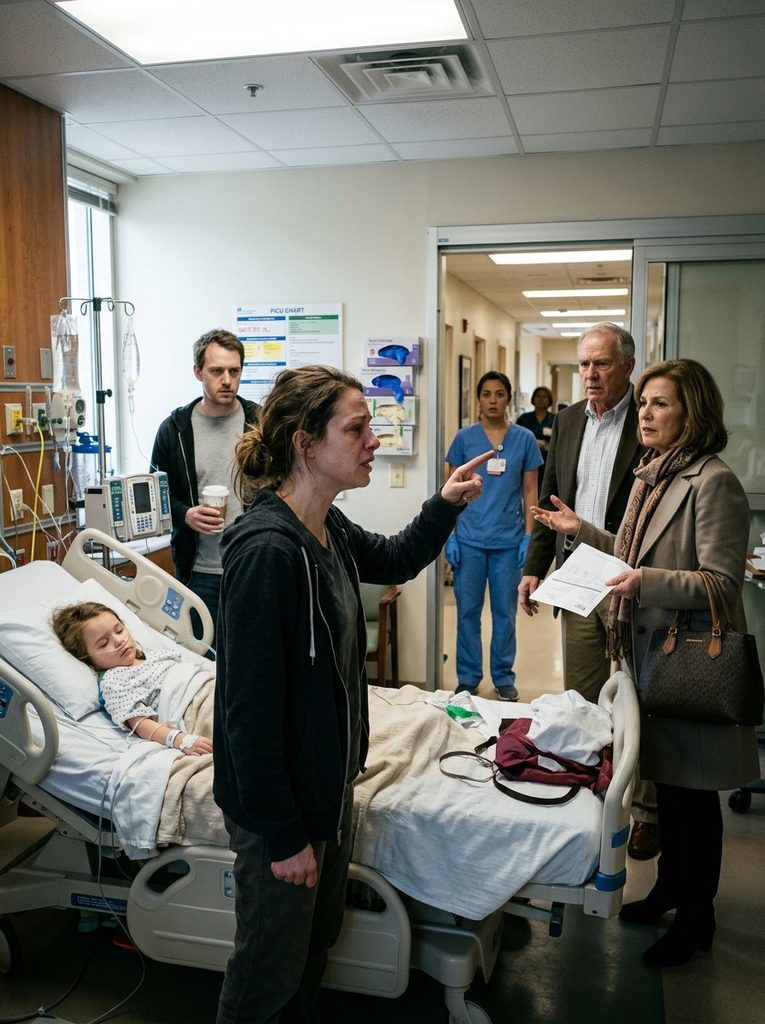
What’s the hold up?” When I refused, my mother suddenly interfered with my little girl’s oxygen mask and tossed it aside, saying, “Well, she’s gone now. You can come with us.” I still remember the alarms that followed.
The mask slipped free with a faint plastic snap.
It hit the cabinet and landed beside the trash bin.
“Well, she’s gone now,” my mother said. “You can come with us.”
The monitor reacted before my brain did.
One alarm became three.
The gentle movement beneath Emma’s blanket weakened.
The nurse pushed past my mother, grabbed the mask from the floor, and reached for the emergency controls while Marcus seized my mother by the shoulders and dragged her away from the bed.
I pressed myself beside Emma, helpless and trembling, repeating her name even though she could not respond to me.
My father did not rush toward his granddaughter.
He moved toward Marcus.
“Take your hands off my wife,” he said, as though that were the emergency.
Josh stepped between them.
His phone remained in his hand, but he was no longer sending updates to his wife.
He watched my parents with an expression I had never seen on his face before.
The nurse secured the mask back into position and shouted for help.
Footsteps thundered through the corridor.
My mother adjusted her blouse.
“This is what Rebecca does,” she announced. “She creates scenes when she doesn’t get her way.”
I stared at the invoice protruding from her open purse—the $2,300 demand that had followed us into intensive care—and realized she still believed everyone inside that room would defend her version of events.
Then the nurse turned away from Emma, pointed straight at my mother, and said, “Do not let either of them leave.”
My father moved in front of the doorway.
To understand how my family reached a place where a birthday invoice mattered more than a child’s oxygen, you need to understand what those first twenty-four hours inside that hospital did to us.
The first thing I remember clearly was not the equipment.
It was Emma’s hair.
One side remained curled against the pillow, soft and blonde beneath the bright hospital lights.
The other side had been shaved short beside a thick bandage.
That narrow missing strip seemed impossibly small, yet every time I noticed it, I felt as though someone had drawn a line between the life we had on Wednesday and the life that existed after Thursday afternoon.
Emma was four years old.
Four meant stickers placed crookedly across the refrigerator door because she insisted she could handle it herself.
Four meant grilled cheese sliced into triangles, never squares.
Four meant tiny sneakers abandoned underneath the coffee table even after I had reminded her twice to put them away.
Four meant her voice calling from the backyard—“Mommy, look!”—with the certainty of a child who believed every adult she loved would always remain close enough to catch her.
The accident happened at 4:18 p.m. on a Thursday.
A plank on the treehouse railing broke.
Marcus had gone inside to prepare lunch.
I heard Emma scre:am.
Then I heard the impact.
There are sounds your mind shields you from, and there are sounds it preserves with horrifying precision.
I remember the patio underneath my bare feet.
I remember Marcus rushing toward her and then carrying her back with all the color gone from his face.
I remember one of Emma’s arms hanging unnaturally still against his chest.
I remember trying to call 911 while my fingers kept sliding across the screen.
By 5:06, a hospital wristband wrapped around her tiny wrist.
By 5:41, a surgeon stood before us speaking rapidly and carefully about a fractured skull, swelling in her brain, internal bl33ding, and emergency surgery.
Marcus gripped a paper coffee cup so tightly that its cardboard collapsed inward.
“I should’ve seen her climb back up,” he whispered.
“This is not your fault,” I told him.
He nodded because he loved me and understood that I needed him to nod.
But the guilt had already rooted itself inside him.
It remained in his shoulders, in the way he stared at the double doors, and in the way he apologized whenever a nurse asked him something he could not answer.
I called my parents three times.
That is still one of the most difficult details for me to admit.
I knew exactly who they were.
I knew how often their concern came attached to some kind of favor.
I knew they might go weeks without speaking to me and then abruptly remember I existed whenever Charlotte needed assistance, my father needed a check paid, or my mother decided family loyalty meant I had to solve something she had promised without consulting me.
Still, while Emma lay beneath surgical lights and I could hardly remain standing, I reached out to them.
Some part of me remained their daughter.
Some part of me believed terror this enormous would finally make them become the parents I had spent years convincing myself they could be.
When my father eventually called back, I walked into the hallway and answered on the first ring.
“Dad, thank God,” I said. “Emma’s in surgery. It’s bad. I don’t know what’s happening.”
He did not ask what had happened.
He did not ask if she was conscious.
He did not ask whether Marcus and I were by ourselves.
He asked why I had not paid for Madison’s birthday party.
Madison was Charlotte’s daughter.
Her party was planned for Saturday.
Charlotte had reserved a venue, entertainment, a custom cake, a balloon arch, favors, and decorations designed around a unicorn theme.
My mother had forwarded me the bill as though it were neither an invitation nor request but some kind of family assessment.
The total was $2,300.
“Dad,” I said, clutching the metal rail along the hallway wall, “Emma might not make it through tonight. Did you listen to my messages?”
“Children bounce back,” he said.
A nurse hurried through the double doors behind me with a chart held against her chest.
Somewhere farther along the hallway, another monitor continued beeping.
My father kept talking about em.bar.rass.ment.
He said Madison was devastated.
He said Charlotte should not have to explain why her own sister was acting difficult.
He said I had obligations to the family, although I had never agreed to contribute a single dollar toward the party.
I ended the call while he was still speaking.
The phone stayed warm against my cheek for several seconds.
Fifteen minutes later, my mother sent the invoice again.
At the bottom, she had included one line.
Payment required by Friday at 6 p.m. Madison is counting on you.
That was how affection worked inside my family.
Not through a container of soup brought into a hospital waiting room.
Not through someone volunteering to sleep in a plastic chair so you would not have to wake up by yourself.
Not through a gentle hand resting on your shoulder while your child underwent surgery.
Love came as a deadline.
Love came as guilt.
Love came as a bill they labeled loyalty.
Charlotte began texting after nightfall.
You always make everything about you.
Madison is crying.
Do you know how selfish this is?
I responded once.
Emma is in critical condition.
Charlotte answered that children fall all the time.
Then she sent one more message.
Madison asked why Aunt Becca hates her.
What’s the hold up?” When I refused, my mother suddenly interfered with my little girl’s oxygen mask and tossed it aside, saying, “Well, she’s gone now. You can come with us.” I still remember the alarms that followed.
Marcus noticed my expression, reached across, and removed the phone from my hand.
He did not read the message out loud.
He did not have to.
He placed the phone facedown on the chair between us and sat near enough that our shoulders touched.
Neither of us said anything for several minutes.
Before sunrise, Josh showed up.
He was Marcus’s older brother, and he walked through the waiting room doors carrying hoodies, phone chargers, granola bars, and two fresh paper cups filled with coffee.
He had the same exhausted eyes as Marcus, but his anger felt different.
It was restrained.
He stared through the glass at Emma.
He looked toward his brother.
Then he turned toward me.
“This isn’t normal,” he said. “None of this is normal.”
No one from my family had ever spoken those words to me.
People had described my parents as demanding, complicated, traditional, dramatic, sensitive, and difficult.
People had encouraged me to maintain the peace.
They had told me my mother took everything personally and my father could not tolerate disrespect.
They had told me Charlotte relied on everyone more because she had always been emotional.
But no one had ever stared directly at the pattern and called it abnormal.
Josh did.
The words did not solve anything, but they gave me somewhere solid to stand.
The following afternoon, my father called again.
“That bill still isn’t paid,” he snapped. “What exactly is the hold up?”
For a moment, the hospital hallway seemed to tighten around me.
“My daughter is in intensive care,” I said. “If you ask me for one more cent while she is lying here, do not ever contact me again.”
He let out a quiet, offended laugh.
“You don’t get to talk to us that way.”
I ended the call.
For an hour, I believed that was the end of it.
Then I heard my mother at the nurses’ station.
Her voice traveled through the glass before I even saw her.
Sharp.
Polished.
Irritated that anyone had made her wait in a place where parents spoke softly and strangers learned to recognize fear on one another’s faces.
My parents walked into Emma’s room dressed as though they were running late for lunch.
My mother had her oversized purse hanging over one arm.
My father glanced around once.
His gaze moved across the machines, the chair where Marcus had slept, the folded hoodie Josh had brought, and the untouched coffee sitting on the counter.
He did not look at Emma first.
He looked at me.
“That bill wasn’t paid,” my mother said. “What’s the hold up?”
The nurse standing in the doorway froze with her fingers resting on the chart.
Marcus’s paper cup crumpled in his hand.
Josh lowered the phone he had been using to keep his wife updated.
Emma’s monitor continued its quiet, steady beeping.
It was the only reliable thing in the room.
“Get out,” I said.
My voice came out softer than I expected.
My father folded his arms.
“We drove all this way,” he said. “The least you can do is stop acting hysterical and explain yourself.”
I pointed toward the bed.
I pointed at the bandage beside Emma’s shaved hair.
I pointed toward the clear tubing and the oxygen mask rising gently over her mouth.
“Look at her,” I said. “She almost d!ed. She still might. Leave.”
My mother barely glanced toward the bed.
“She is asleep,” she said. “Enough with the theatrics. Charlotte needs that money today.”
Something shifted across Marcus’s face.
He rose slowly, still gripping the crushed coffee cup.
Josh moved closer toward the foot of the bed.
The nurse stepped deeper into the room.
I reached toward the call button.
My mother noticed my hand moving.
Her expression shifted.
Not into fear.
Not into regret.
Not even into ordinary anger.
It became calculating.
“You would not dare hum!liate us,” she said.
Then she moved.
Her purse struck against the bed rail.
The nurse yelled at her to stop.
Marcus sprang from the chair.
My mother reached over the bed, wrapped her fingers around Emma’s oxygen mask, and yanked it free.
The alarms exploded.
She hurled the mask across the room.
“Well, she’s gone now,” she said. “You can come with us.”
The nurse was already in motion.
Marcus seized my mother and dragged her away from the bed.
Josh positioned himself between my father and the doorway.
I leaned over Emma and repeated her name again and again as the nurse pressed the mask firmly back into place.
My mother adjusted her clothes as though the room had somehow become chaotic through no fault of hers.
My father ordered Marcus to let her go.
Neither one of them asked whether Emma was breathing.
That was the moment when the final illusion I still held about my parents finally shattered.
Not because they demanded money.
Not because they insulted me.
Not even because they entered the ICU without first asking how Emma was doing.
It shattered because the alarms were blaring, my daughter’s oxygen mask lay on the floor, and they were still talking as though they were the ones who had been wronged.
The nurse called out for help.
Footsteps raced toward the room.
My father stepped in front of the doorway.
My mother pointed toward me and started telling everyone that I had caused the scene.
But for the first time in my life, other people were inside the room who had witnessed the entire thing unfold.
And not one of them looked away.
Part 2
The nurse’s command hung in the sterilized air of the intensive care unit like an electric charge.
“Do not let either of them leave.”
Footsteps slammed against the linoleum corridor outside. Within seconds, a security guard in a dark navy uniform and a secondary resident physician pushed past my father, their eyes darting quickly from the chaotic tangle of monitors to the flushed, indignant faces of my parents.
My father stood tall, his chin raised in that familiar posture of unassailable righteousness that he had used my entire life to dismiss teachers, mechanics, neighbors, and anyone else who dared question his judgment. He planted his heels firmly against the doorway, effectively blocking the exit.
“This is an overreaction,” my father announced, his voice carrying the deep, authoritative timber he reserved for board meetings and family lectures. He didn’t look at the nurse, nor did he look at the security guard. His gaze locked onto Marcus, who was still breathing heavily after hauling my mother away from the bedside. “Take your hands off my wife right now, young man, or you will regret this.”
Marcus didn’t move. He stood shoulder-to-shoulder with Josh, his knuckles white where he still gripped the crushed paper coffee cup. His eyes were wide, bloodshot from lack of sleep and raw with a terrifying, coiled fury that I had never seen in him before. Marcus was a gentle man; he built wooden furniture for local clients, spent his weekends gardening with Emma, and apologized when someone else bumped into him at the grocery store. But watching him stare at my father, I realized the quiet man I loved had crossed an invisible line.
“Get out of the doorway,” Marcus said. His voice wasn’t loud. It was terrifyingly flat.
“Excuse me?” my father scoffed, looking around the room as if seeking an invisible jury to witness our collective insanity. “We came here out of concern for our granddaughter, and this is how we are treated? By a pack of ungrateful—economic illiterates who can’t even manage a simple family obligation?”
My mother, meanwhile, was busy fixing the cuffs of her silk blouse. She cast a dismissive glance toward the security guard, treating him like an annoying waiter at an upscale restaurant. “My daughter has always been prone to histrionics,” she said smoothly, pitching her voice to sound reasonable, long-suffering, and entirely victimized. “She staged an incident because we asked her to take responsibility for a family debt. If you security officers have any sense, you’ll escort her out so we can discuss this in private.”
“Ma’am,” the security guard said, stepping forward. He was a broad-shouldered man in his late forties with a laminated badge swinging from his belt. He didn’t smile. He didn’t nod. He had spent enough years in a hospital ICU to recognize the specific flavor of wealthy entitlement that believed rules applied only to everyone else. “Step away from the door, please.”
“Do you know who I am?” my father asked, taking half a step forward. It was his signature move—asserting space, overwhelming opponents with sheer, unearned gravity.
“I know you’re blocking an exit in an intensive care unit where a four-year-old child just had her oxygen mask ripped off her face,” the guard replied, his voice dropping into a register that brook no argument. “Move. Now.”
The nurse who had secured the mask back onto Emma’s face turned around. Her hands were shaking slightly—not from fear, but from a rage so pure it seemed to vibrate off her skin. She walked past my mother, stopped directly in front of the security guard, and pointed a finger straight at my father’s chest.
“They were told to leave,” the nurse said, her voice sharp and ringing. “They refused. Then her mother—that woman right there—reached across a critical patient and disconnected her life support equipment because she was angry about a phone call. I want them detained. I am filing an incident report for endangerment.”
“Endangerment?” My mother let out a sharp, incredulous laugh that sounded like glass breaking on tile. “She is our granddaughter! We bought her clothes! We paid for her first preschool tuition when these two couldn’t afford it! How dare you use words like that?”
“Mom, shut up,” I said.
The words didn’t rumble; they tore out of my throat, raw and jagged. I hadn’t raised my voice to my mother in twenty years. Growing up, shouting meant punishment, silence, or a three-day freeze out where my father would pretend I didn’t exist while my mother sighed heavily around the kitchen, letting everyone know what a burden my existence was. But standing there with Emma’s tiny chest rising and falling beneath the clear plastic mask, the fear vanished, replaced by an ash-gray clarity.
My mother stopped mid-sentence. She blinked, her mouth slightly open, staring at me as if I had suddenly grown a second head.
“What did you say to me?” she whispered, genuinely shocked.
“I said shut up,” I repeated, stepping away from Emma’s bedside and walking toward them. The linoleum felt cold beneath my socks. “You didn’t come here to see your granddaughter. You didn’t come here to ask how she was doing. You walked into an intensive care unit, ignored her monitors, ignored her bandages, and demanded money for Charlotte’s party. And when I told you to leave, you tried to suffocate my child to prove a point.”
“That is a monstrous distortion!” my father thundered, stepping in to shield my mother’s flank. “We are trying to instill values! You have always been irresponsible, Rebecca—ever since you chose this man, ever since you decided to live in this cramped house, ever since you isolated yourself from the family safety net! We are trying to teach you accountability!”
“Accountability?” Josh stepped forward. He didn’t yell; he didn’t gesture. He simply stood beside his brother, towering over my father by several inches. Josh was a corporate compliance officer; his entire professional existence was built around catching people violating rules they thought they were clever enough to bypass. He looked at my father with a cold, professional detachment that was far more devastating than any punch. “You’re standing in an ICU talking about account management while a child with a fractured skull fights for air. You don’t even know what accountability means. You think it means other people doing what you want so you never have to feel inconvenienced.”
My father’s face flushed a deep, mottled purple. “This is a family matter. Stay out of it, Josh. This is between us and our ungrateful daughter.”
“It’s not a family matter anymore,” the security guard said, gesturing toward the hallway. “Step back from that door or I will cuff you both and call the local precinct. You’re trespassing in a restricted medical wing after being asked to leave.”
For a second—just one fleeting, agonizing second—I saw doubt flicker in my father’s eyes. He looked at the security guard’s uniform. He looked at the nurse’s rigid posture. He looked at Marcus and Josh, two men who looked ready to dismantle him piece by piece if he took another breath. He realized, perhaps for the first time in his life, that his last name, his country club membership, his donations to the local symphony, and his intimidating scowl carried zero currency inside the walls of a public hospital.
He didn’t apologize. People like my father do not possess the internal architecture required for genuine contrition. Instead, he retreated into wounded dignity.
He grabbed my mother’s elbow.
“This is disgraceful,” my father muttered, glaring at me as though I were personally responsible for the humiliation of being held accountable. “You are cutting yourself off from every source of support you have. When you come crawling back, don’t expect us to answer the phone.”
“I won’t,” I said.
They turned. The security guard escorted them down the hallway, their footsteps fading past the nurses’ station, past the waiting room where Josh’s discarded coffee cups still sat, and out through the automatic glass doors into the humid Thursday evening.
As the doors hissed shut, the silence in the room returned. It was heavy, ringing, and profound.
I turned back to the bed.
Emma hadn’t stirred during the shouting. Her eyelashes lay dark and still against her pale cheeks. The monitor kept up its steady, rhythmic chime—beep, beep, beep—each one a heartbeat, each one a second we had managed to keep her here with us.
Marcus dropped into the chair beside the bed, burying his face in his hands. His shoulders shook—not with anger now, but with the delayed, crushing wave of everything we had barely survived. Josh placed a heavy hand on his brother’s neck, squeezing gently before walking over to the door to pull the privacy curtain halfway across the glass.
The nurse lingered for a moment, adjusting the IV drip. She looked at me, her expression softened by a tired, sorrowful empathy.
“I’ve seen a lot of families in this room,” she said quietly. “Some of them fall apart under the pressure. But some of them… some of them finally figure out who they’re supposed to protect.”
She gave my shoulder a brief, warm squeeze and walked out, leaving us alone with our daughter.
Part 3
The sun came up on Friday morning like an uninvited guest, spilling pale, cold light across the linoleum floor of Room 412.
I hadn’t slept. None of us had. Marcus dozed upright in the uncomfortable plastic chair, his head tilted back against the wall, his breathing deep and ragged. Josh had gone home around 3 a.m. to check on his wife and children, promising to return with fresh clothes, coffee, and a phone charger that actually worked.
I sat on the edge of the narrow visitor’s cot, my fingers intertwined with Emma’s small, limp hand. Her skin was warm, but her fingers felt fragile—like porcelain that might shatter if squeezed too hard. Every time the monitor beeped, my chest tightened in an involuntary spasm.
At 7:30 a.m., the door swung open without a knock.
It wasn’t a nurse. It wasn’t Josh.
Charlotte stood in the doorway, wearing a designer trench coat and oversized sunglasses pushed up into her perfectly styled hair. She carried a leather tote bag under one arm and held a steaming venti cup of caramel macchiato in her hand. Her expression was a masterclass in righteous martyrdom.
She stopped dead when she saw me sitting by the bed, looking like a ghost who had forgotten how to fade away.
“Well,” Charlotte said, her voice dropping into that familiar, saccharine cadence she used whenever she wanted everyone in a room to know she was the adult in charge. “Mom and Dad told me what happened. Becca, honestly? Have you completely lost your mind?”
Marcus stirred in his chair, groaning as his neck popped. He rubbed his eyes with the heels of his hands, squinting against the harsh morning light until his gaze landed on his sister-in-law.
“Charlotte,” Marcus said, his voice gravelly and low. “Get out.”
“Excuse me?” Charlotte arched a perfectly sculpted eyebrow, taking two steps into the room as if inspecting a poorly decorated hotel suite. “You people create a hysterical scene, you assault our parents—yes, Mom told me everything, don’t bother lying—and now you’re going to sit there and act like I’m the intruder? Madison’s party is tomorrow. The deposit was non-refundable. The bakery is already icing the cake. Do you have any idea how humiliating this is for me?”
I looked at her. I looked at the golden straw protruding from her coffee cup. I looked at the manicured nails, the subtle designer logo on her handbag, and the blank, glassy selfishness that radiated from her like heat off asphalt.
This was the girl who, at age twelve, had thrown a full-blown tantrum because our parents bought me a used bicycle in blue instead of the pink one she had demanded for herself. This was the woman who had expected our parents to pay for half her destination wedding in Cabo while Marcus and I were eating canned soup to save up for a down payment on our starter home.
“Charlotte,” I said, my voice surprisingly steady. “Emma was in surgery for four hours yesterday. She almost died. She still might.”
Charlotte rolled her eyes with an exaggerated, theatrical sigh. She adjusted her trench coat, letting out a sharp huff of air.
“Oh, stop it with the melodrama,” she snapped. “Kids get hurt. Madison fell off the jungle gym last year and scraped her knee, and I didn’t hold the entire family hostage. You’ve always been jealous of me, Becca. Ever since we were kids, you couldn’t stand the idea of anyone else having attention. So you staged this whole crisis—or blew a minor accident completely out of proportion—just so you wouldn’t have to contribute to Madison’s party.”
Marcus stood up so fast his chair screeched loudly against the floor.
“A minor accident?” Marcus’s voice cracked, rising in volume until the monitor beside Emma seemed to jitter in response. He pointed a shaking finger at the shaved patch of blonde hair near the white bandage. “Her skull is fractured, Charlotte! There’s internal bleeding! She stopped breathing twice yesterday because our mother walked in here and ripped her oxygen mask off the wall like it was a scarf!”
Charlotte flinched slightly, but her stubbornness—that impenetrable armor forged by thirty years of unconditional parental indulgence—quickly reasserted itself.
“Mom said you were all screaming and she tripped,” Charlotte said, crossing her arms defensively. “She didn’t mean to touch the mask. But you were attacking them! You and your loser brother-in-law threatened my elderly parents and had them thrown out by security like common criminals!”
“They were trespassing,” Marcus snarled, taking a step toward her. “And if you don’t walk out those double doors right now, I’m going to have security escort you out, too.”
Charlotte gasped, stepping back as if Marcus had physically struck her. Her face flushed bright red.
“You wouldn’t dare,” she hissed. “You’re trash, Marcus. Both of you. You’ve always dragged our family down. When Mom and Dad cut you out of the will—and trust me, I’m making sure they do it today—don’t come crying to us when you can’t pay your mortgage.”
Before Marcus could answer, the door opened again.
This time, it was Dr. Evelyn Vance, the pediatric neurosurgeon who had led Emma’s surgical team yesterday. She wore her white coat over blue scrubs, her dark hair pulled back in a practical ponytail, and carried a thick manila folder under her arm. She stopped when she saw Charlotte standing in the center of the room like an uninvited storm cloud.
Dr. Vance looked from Charlotte to me, her eyes sharp and assessing.
“Are you family?” Dr. Vance asked, her tone professional and cool.
“I’m her aunt,” Charlotte said, smoothing down her coat with a swift, defensive motion, instantly pivoting into the persona of the grieving, supportive relative. “I’m Madison’s mother. We’re just trying to figure out why my sister is being so difficult about a family emergency—”
“This is an intensive care unit,” Dr. Vance interrupted, her voice cutting through Charlotte’s monologue like a scalpel. “We don’t discuss family emergencies here. We discuss medical stability. If you are not immediate parents or legal guardians, I must ask you to step out into the waiting area immediately.”
Charlotte’s mouth dropped open. “I have a right to know—!”
“You have no legal right to confidential patient information,” Dr. Vance said flatly, pointing toward the door. “Now. Out.”
Humiliated, cornered, and entirely unaccustomed to being ordered around by professionals who didn’t care about her social standing, Charlotte glared at me with pure venom.
“You’ll regret this,” she whispered, turning on her heel and marching out of the room, her designer boots clicking sharply against the floor.
Dr. Vance watched the door close, locked it with a swift turn of the thumb-latch, and then turned back to us, letting out a long, exhausted sigh.
“Morning,” she said quietly, pulling out a chart. “Let’s talk about Emma’s scan from six o’clock.”
Part 4
By Saturday afternoon, the hospital waiting room had transformed into an outpost of quiet endurance.
Josh had returned with clean clothes for Marcus, a bag of groceries, and a laminated copy of a local real estate attorney’s business card tucked inside his wallet. He hadn’t said much when he handed it to me, but the message was clear: We are done playing by their rules.
Emma’s condition had stabilized, though she remained heavily sedated. The swelling in her brain had plateaued overnight, which Dr. Vance described as cautious good news, but she warned us that the road ahead would be long—weeks of monitoring, potential physical therapy, and endless vigilance.
At 2:15 p.m., my phone buzzed on the small laminate table beside the sofa.
It wasn’t a call. It was a group chat notification.
The chat was titled The Family, created by my mother two years ago for organizing Sunday dinners that I rarely attended.
Mother: [Photo attached]Mother: Madison’s party is underway. Everyone is having a wonderful time. It’s such a shame that some people choose drama over family unity.
I tapped the photo.
It showed Charlotte kneeling beside Madison, who was wearing a pink unicorn crown and blowing out candles on a three-tier frosted cake. In the background, dozens of balloons arched gracefully over a rented party space in an upscale country club. My father stood behind them, holding a glass of sparkling cider, smiling for the camera as though nothing in the world had ever gone wrong.
Beneath the photo, another message popped up. This one was from my father.
Father: Your mother and I have decided to give you until Monday morning to apologize to us, apologize to Charlotte, and pay the $2,300 invoice for the party deposit. If you fail to do so, we are officially removing you from the family trust and revoking any future assistance. Consider this your final chance to act like an adult.
I stared at the screen.
The words didn’t hurt anymore. That was the strangest part. There was no hot spike of grief, no desperate urge to reply, no frantic desire to explain myself so they would finally understand how terrifying it was to watch your four-year-old child stop breathing.
There was only a vast, clean emptiness.
Marcus leaned over my shoulder, his eyes scanning the messages. He didn’t curse. He didn’t punch the wall. He simply reached out, took the phone gently from my hand, and tapped three icons: Block contact. Delete conversation. Leave group.
“Done?” he asked quietly.
“Done,” I said.
Josh walked into the waiting room a minute later, holding two paper cups of terrible hospital coffee. He handed one to Marcus and sat down across from us.
“My wife talked to our aunt in Florida,” Josh said, staring down into his coffee. “And she talked to our uncle in Chicago. They both heard about what happened yesterday.”
I looked up. “What did they say?”
Josh offered a grim, humorless smile. “They said it’s about thirty years overdue. Apparently, your parents tried the exact same stunt at our wedding ten years ago—demanding that Marcus pay for extra catering seats for their friends from the country club, or else they wouldn’t show up.”
Marcus blinked, looking surprised. “I thought they paid for those seats themselves.”
“They didn’t,” Josh said. “Mom paid for them out of her own grocery budget and lied to you about it so you wouldn’t feel bad. She’s been covering for their emotional blackmail her entire life.”
Silence settled over the room, interrupted only by the distant hum of the hospital ventilation system.
For thirty-four years, I had believed that my family’s dysfunction was unique to me—that if I tried harder, smiled brighter, anticipated their demands more skillfully, and swallowed my own pain more quietly, I would eventually earn the kind of unconditional love that other people seemed to take for granted.
I finally understood the terrifying truth: unconditional love didn’t exist in their world. Everything was a ledger. Everything was a transaction. Affection was an advance payment; loyalty was an interest-bearing loan; and grief was just an inconvenient distraction from their social calendar.
And the moment you stopped paying their price, they didn’t try to negotiate. They simply cancelled your subscription to their lives.
Part 5
By Monday morning, the hospital had settled into the dreary, predictable rhythm of a new week.
Emma opened her eyes around 8:00 a.m.
It wasn’t a dramatic Hollywood awakening. She simply blinked twice, her eyelids fluttering against the bright fluorescent lights, and turned her head toward the window.
“Mommy?” she whispered.
My heart leaped into my throat. I dropped to my knees beside the bed, pressing my face gently against the edge of her blanket so I wouldn’t startle her.
“I’m right here, sweet girl,” I choked out, tears finally breaking free and spilling down my cheeks. “I’m right here.”
Emma reached out a tiny, unsteady hand, her fingers brushing against my cheek. “My head hurts,” she murmured.
“I know, baby. I know. You’re safe. You’re going to be okay.”
Marcus was already out of his chair, pressing the nurse call button while wiping his own eyes with the sleeve of his hoodie. Within thirty seconds, Dr. Vance and two nurses rushed into the room.
For the next hour, the room was a blur of penlights, neurological tests, reflex checks, and quiet murmurs of relief. Emma could squeeze our fingers. She recognized her name. She knew what day of the week it was—or at least guessed close enough.
By the time Dr. Vance stepped back from the bed, her expression was one of genuine, cautious optimism.
“She’s out of the immediate danger zone,” Dr. Vance said, smiling softly as she looked down at Emma, who had already drifted back into a light, exhausted sleep. “The swelling is receding. We’ll keep her under observation for another forty-eight hours, but barring any setbacks, she’s going to make a full recovery.”
Marcus let out a ragged sob and pulled me into his arms, burying his face in my hair. We held onto each other right there beside the bed, shaking with the overwhelming, seismic relief of parents who had just stared into the abyss and been granted a second chance.
When the door opened a few minutes later, I expected Josh.
Instead, a young courier in a gray uniform stepped into the room, holding a clipboard and a heavy manila envelope.
“Delivery for Rebecca Lawson,” the courier said, looking around awkwardly at the medical equipment.
“That’s me,” I said, stepping away from Marcus.
I signed the electronic pad. The courier handed me the envelope, muttered a quick apology for interrupting, and hurried out.
I broke the paper seal and pulled out three sheets of thick legal paper.
It wasn’t a birthday invoice.
It was a formal letter from my father’s corporate attorney, written on expensive letterhead with embossed gold lettering.
Dear Rebecca,
Please be advised that pursuant to your hostile and inappropriate behavior on Thursday, October 29, at St. Jude’s Memorial Hospital, as well as your ongoing refusal to meet familial financial obligations, your father, Arthur Vance, has instructed this office to draft formal codicils removing you and your dependents from all current and future distributions under the Vance Family Trust, effective immediately.
Furthermore, your parents request that you cease and desist all direct or indirect contact with members of the Vance family, effective upon receipt of this notice.
Sincerely,Harrison Vance, Esq.Vance & Associates Law Firm
I read the letter twice.
Then I folded it neatly in half, walked over to the small metal waste bin beside the sink, and dropped it inside.
Marcus watched me from the bedside, his eyebrows raised in quiet inquiry.
“What was it?” he asked.
“A divorce decree,” I said, walking back to take Emma’s small, warm hand in mine. “From my parents.”
Marcus didn’t ask to read it. He didn’t look upset. He simply walked over, wrapped his arm around my shoulders, and kissed the top of my head.
“Good,” he whispered.
Part 6
Two weeks later, we brought Emma home.
The treehouse in the backyard was gone. Marcus had hired a demolition crew the day after we returned from the hospital, and by the time Emma looked out her bedroom window, all that remained of it was a smooth, clean patch of grass where the old oak tree stood tall and unburdened.
The house felt quieter than it used to—not with the heavy, suffocating silence of fear, but with the quiet of a space that had been scrubbed clean of old ghosts.
We didn’t hear from my parents on Monday. We didn’t hear from them on Thanksgiving, which we spent quietly at home eating takeout pizza on the living room floor while Emma built elaborate castles out of plastic blocks. We didn’t hear from them at Christmas, when a package arrived from Josh’s aunt in Florida containing hand-knitted sweaters for Emma and a handwritten card that simply said: Welcome to the real family.
My mother tried one last maneuver in mid-December.
An unknown number called my cell phone while I was sitting at the kitchen table helping Emma color inside the lines of a new unicorn coloring book—one I had bought her myself, without anyone’s permission or invoice.
I let it ring to voicemail.
The transcription popped up a minute later:“Becca, it’s your mother. Your grandmother’s estate disbursement is being finalized next week, and there are papers you need to sign. If you continue this ridiculous silent treatment, you’ll forfeit your share of the inheritance. Call me back immediately.”
I stared at the screen for three seconds.
Then I blocked the number.
I didn’t need their inheritance. I didn’t need their conditional generosity, their emergency loans disguised as favors, or their endless, exhausting ledger of emotional debts.
Emma looked up from her coloring book, her blonde hair falling softly across her forehead, perfectly intact on both sides, the shaved strip beneath her bandage already starting to sprout fuzzy new curls.
“Mommy?” she asked, tilting her head.
“Yes, sweet girl?”
“Can we have grilled cheese for lunch?” she asked seriously. “In triangles. Not squares.”
I smiled, feeling a lightness in my chest that I hadn’t known was missing for thirty-four years.
“Triangles,” I promised, picking up a yellow crayon and sitting down beside her on the floor. “Only triangles.”
THE END..!