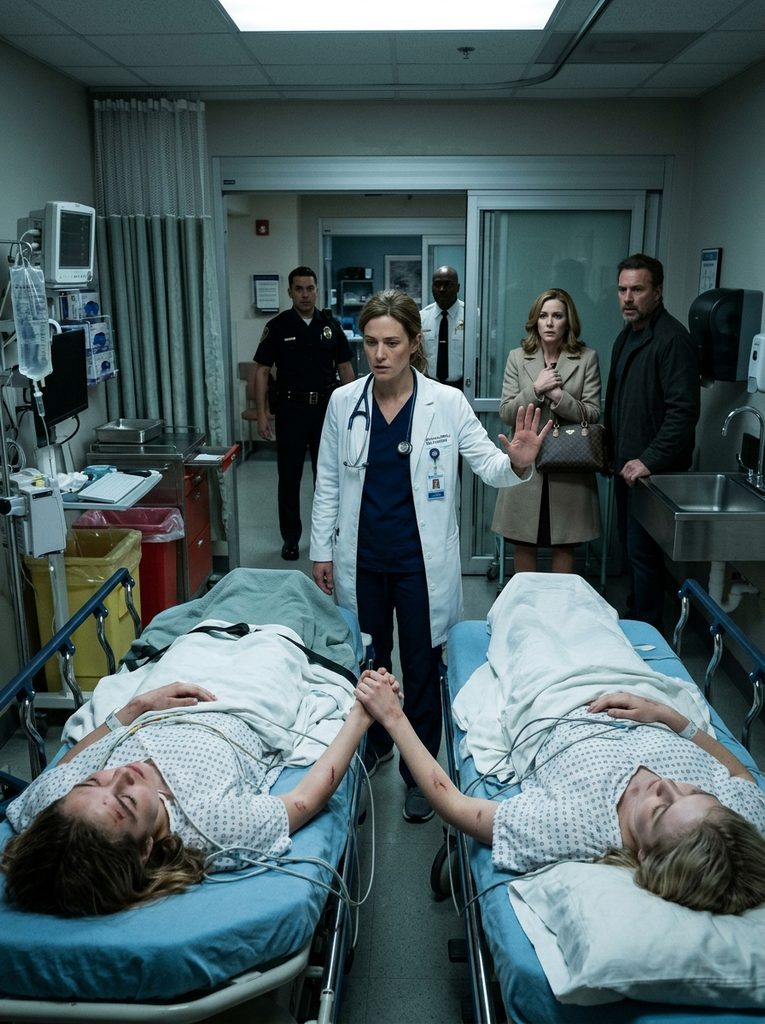
My stepfather hurt my twin sister and me every day because he enjoyed watching us live in fear. One night, after brutally hurting us until we passed out, he dragged us into the emergency room while my mother calmly told everyone, “They fell down the stairs.”
The night my stepfather knocked my twin sister unconscious, my mother dragged us to the emergency room and swore under oath that we had fallen down the stairs.
I was seventeen years old, and I could barely keep my eyes open. Every shallow breath burned against my ribs like cracked glass. Beside me on an adjoining stretcher, Clara lay motionless, her dark hair matted with dried blood.
Edward Vance, our stepfather, stood over by the stainless-steel sink calmly washing his hands, looking as though he had just fixed a leaky pipe rather than brutally beaten two teenage girls.
The attending physician, Dr. Rachel Miller, carefully examined the deep purple welts running down my forearms before turning to inspect the near-identical contusions covering Clara’s skin. Her expression shifted instantly. The confusion vanished, replaced by a cold, sharp fury.
“Did they both tumble down the stairs in the exact same physical pattern?” Dr. Miller asked, her voice dangerously quiet.
My mother, Patricia, clutched her designer handbag against her chest, her knuckles white. “They’re identical twins, Doctor. They even imitate each other when they’re being clumsy.”
Edward let out a dry, dismissive chuckle. “Just patch them up and let us go. They have school in the morning.”
Dr. Miller didn’t answer. She turned on her heel and stepped out of the examination room. A second later, the sharp click of a lock echoed from the outside.
“Call 911 and alert the county prosecutor’s office,” Dr. Miller’s voice boomed through the door to a nurse outside. “Lock down this corridor. Nobody enters or leaves this room.”
Edward’s arrogant smile vanished.
He had never beaten us out of a sudden loss of control. His true satisfaction came from absolute, calculated dominance. He chose the hour, closed the heavy curtains, removed his watch, and ordered my mother to turn up the television volume. Then he forced Clara and me to stand side by side so he could decide who would suffer first.
Clara begged because she foolishly believed pleading might soften him. I kept dead silent because I knew seeing the sheer terror in my eyes was his ultimate reward.
That night, after slamming Clara against the drywall, he had turned toward me. “Still playing the brave one, Phoebe?”
I tasted copper in my mouth. “I’m not playing brave. I’m memorizing.”
His expression flickered with slight hesitation for a fraction of a second.
What Edward didn’t know was that three months earlier, I had found an old smartphone hidden inside my late father’s Christmas decoration box in the attic. The screen was shattered, but the internal microphone worked perfectly. I had concealed it beneath a loose floorboard in our bedroom, keeping it continuously powered via a thin charging cable routed behind the heavy oak wardrobe. Every recorded audio file was automatically uploaded to an encrypted cloud drive my father had set up for us before he died.
Our father, Daniel Sterling, had been a senior forensic accountant. He passed away from a sudden illness when we were fourteen. Before his death, he placed his life insurance payout and primary corporate shares into an irrevocable trust, designed to unlock exclusively on our eighteenth birthday.
Edward believed my mother possessed full administrative control over that fortune. She allowed him to believe it because she was terrified he would abandon her if he discovered the truth.
Our uncle, Dr. Marcus Sterling—Dad’s brother and a former military surgeon—had warned us from a overseas deployment that a vast fortune would inevitably attract predators. Shortly after, Patricia severed all contact with him: changing our phone numbers, blocking his emails, and claiming he was trying to steal our inheritance. Meanwhile, Edward systematically told neighbors, teachers, and school counselors that Clara and I were deeply troubled, manipulative teenagers who self-harmed to gain attention.
He had built a prison without iron bars: locked doors, confiscated devices, and plausible lies.
That night, when Edward moved toward me, Clara threw herself between us. He hurled her across the room into the wall. I lunged to protect her, but a heavy blow to my temple made the room spin into darkness.
I woke up on the cold vinyl of the hospital stretcher.
Hearing the doctor order a police lockdown, Edward frantically rattled the brass door handle. A heavy-set security guard held it firmly shut from the hallway. My mother began to weep loudly, though she never once leaned over to check if Clara was breathing.
Within fifteen minutes, local officers and a detective from the Special Victims Unit arrived. Detective Rachel Vance sat down on a stool beside my stretcher while two uniformed officers escorted Edward to the far side of the room.
“Phoebe,” Detective Vance said softly, opening a notepad. “I need you to tell me exactly what happened in that house.”
From the hallway, Edward was already shouting that he was a prominent land developer, a friend of the mayor, and a major donor to local political campaigns, demanding his high-priced attorney.
I reached out and took Clara’s cold, trembling hand. Her fingers closed weakly around mine.
“I don’t need to tell you,” I whispered, looking the detective dead in the eye. “I can let you hear it.”
I gave Detective Vance the login credentials to the encrypted drive. Eighty-seven audio files sat in the queue. She opened the most recent recording, and the color drained completely from my mother’s face.
The recording opened with Patricia’s clear, unprompted voice giving an order no child should ever hear:
“Strike Phoebe first. She’s the one who watches too closely.”
Edward backed away into the wall. Beside me, Clara opened her eyes and whispered something that made the detective immediately call for a forensic crime scene unit:
“The audio isn’t the worst part, Detective. Phoebe found the legal documents for our eighteenth birthday.”
PART 2
Detective Vance paused the recording and signaled an officer to remove my mother from the room. Patricia tried to reach out and touch my arm as she was led past, but I pulled away. For years she had claimed her silence was borne of fear; her own recorded voice proved she was an active accomplice.
Crime scene technicians bagged the old smartphone as primary evidence while Detective Vance notified the state child protective agency and the district attorney’s financial crimes unit. Meanwhile, Dr. Miller meticulously documented every injury across our bodies—some fresh and raw, others in various stages of healing beneath the skin.
“This is not consistent with a fall down a staircase,” Dr. Miller noted for the official record. “This shows a prolonged, systematic pattern of physical abuse.”
From the hallway, Edward continued yelling threats through the reinforced glass. “Phoebe! Tell these officers that Clara started the fight! If you cooperate with me right now, I’ll forget your disrespect!”
Detective Vance looked at me. “Do you want to say something to him?”
“Only if Clara can hear it too,” I replied.
The heavy door was opened a crack. Edward stood flanked by two uniformed officers, still convinced his status could intimidate us into compliance.
“Do the sensible thing, Phoebe,” he ordered, adjusting his cuffs.
“I’ve been doing the sensible thing for three months,” I said, my voice echoing clearly down the corridor. “Every single word you’ve spoken in that house is already in the hands of the prosecutor.”
For the very first time in my life, I saw sheer, unadulterated terror flicker in his eyes.
Patricia wailed from a nearby bench. “You recorded us inside our own home?!”
Clara pushed herself up onto her elbow despite the pain in her ribs. “You taught us to keep quiet, Mom. You never taught us to give up.”
Edward’s defense attorney arrived twenty minutes later, but neither his tailored suit nor his loud legal threats could halt the protocol. Detective Vance reviewed the digital files alongside a prosecutor. Audio file #7 recorded Edward cursing at us after a family dinner. File #32 captured Clara screaming for help while Patricia warned her not to upset the man paying the mortgage. File #61 contained a detailed conversation about bribing a private psychiatrist to declare us legally incompetent.
Then I produced the photographs I had taken of his desk drawers.
Weeks earlier, searching for my birth certificate, I had discovered medical evaluations containing fabricated psychiatric diagnoses, draft applications for adult guardianship, and forged copies of our signatures. Their plan was to have us declared mentally incompetent five days before our eighteenth birthday. As our court-appointed guardian, Edward would gain full legal control over our father’s $42 million estate trust.
“I also photographed an insurance policy,” I added, looking at the detective. “A dual term-life policy taken out on both of us six months ago.”
The primary beneficiary was a holding company controlled exclusively by Edward.
Clara gripped my hand tighter. “Why didn’t you tell me about the policy, Phoebe?”
“Because you were barely sleeping as it was,” I whispered. “If he realized we knew about the insurance, he would have accelerated his timeline.”
“Don’t ever carry something like that alone again,” she said.
We looked at each other the way we used to when we were small girls hiding beneath a fort of blankets during thunderstorms. We were identical on the outside, but Clara had always been the visible heart, and I was the quiet vault of memory. We had survived because each held what the other lacked.
By sunrise, a superior court judge issued emergency search warrants for our family residence, Edward’s corporate offices, and a self-storage unit rented under my mother’s maiden name. Forensic teams recovered forged medical stamps, unprescribed sedatives, burner phones, and correspondence with the estate trust’s probate attorney.
State forensic specialists managed to recover deleted text threads from Edward’s primary phone. One exchange with a local mechanic discussed the sedan Clara and I were scheduled to drive to college in the fall. It detailed cutting a brake line and choosing a steep mountain road.
The final text read: Two girls, one mechanical failure, zero questions after.
Detective Vance read the text aloud in the holding room.
Patricia went completely rigid, spinning to face her husband. “You wrote that?! You told me they were only going to be declared incompetent!”
Edward turned on her like a cornered animal. “You paid the psychiatrist! You forged their signatures on the guardianship forms!”
“Because you swore no one was going to die!” she shrieked.
Their unified front disintegrated entirely in front of police officers, medical staff, and security cameras. Patricia admitted to transferring funds to the corrupt doctor, though she frantically claimed she had no knowledge of the staged car crash. Edward countered that she had orchestrated the entire financial scheme.
Both were formally arrested and processed. As Edward was led past my stretcher in handcuffs, he leaned in toward me. “You think you’ve won, but I still control the people who hold your money.”
“Not anymore,” I said softly. “Now they’re listening to the tapes.”
I thought the immediate danger was over, until Detective Vance received an urgent call from the trust’s corporate executor. She hung up with a dark expression.
“Phoebe, someone submitted a formal wire authorization this morning to liquidate the entire trust account. The document carries both your signature and Clara’s.”
The request had been transmitted forty minutes after our arrival at the hospital. And the destination account listed on the wire belonged to the only relative we had left: our uncle, Dr. Marcus Sterling.
PART 3
The air seemed to leave the examination room. Clara instantly shook her head before the detective could finish explaining.
“Uncle Marcus would never do that,” Clara insisted.
I wanted to believe her, but for three years Edward had repeatedly claimed Marcus was waiting for a chance to steal our inheritance. I also remembered that my mother had severed his calls right after he began asking detailed questions about the trust provisions.
Detective Vance urged us to stay calm. She immediately contacted the military base where Marcus was stationed. It turned out he had returned to the states two days earlier and was currently driving toward the hospital after receiving an anonymous email claiming Clara had been critically injured in an accident.
Officers intercepted him in the hospital lobby.
Hours later, Uncle Marcus entered the private room accompanied by detectives. He was wearing his uniform, carrying a small duffel bag, and his face was utterly distraught. The moment he saw our bruises and bandages, he stopped dead in his tracks as if the physical blows had struck him instead.
“Forgive me,” he choked out, his voice cracking. “I should have come back sooner.”
Clara burst into tears. I remained guarded, sitting upright. “Did you attempt to liquidate our trust this morning, Uncle Marcus?”
He looked at me in absolute bewilderment. “I can’t liquidate your trust, Phoebe. I’m listed as a secondary contingent advisor, not a beneficiary. My address is on the original file because your father wanted you to be able to live with me if anything ever happened to him.”
Without being asked, he handed over his phone, military ID, and personal banking records. Forensic analysts confirmed he had never transmitted the wire request. The digital footprint traced directly back to an encrypted terminal seized from Edward’s corporate office.
Investigators uncovered another glaring discrepancy: on the fraudulent wire document, Marcus’s middle name was misspelled—the exact same misspelling found in an old address book belonging to my mother. Patricia had used his military address to frame him as a suspect, systematically isolating us from the one person capable of protecting us.
Uncle Marcus walked over to our stretchers, waiting for our nod before pulling both of us into a warm, protective embrace.
“I called every month,” he whispered against my hair. “Patricia told me you girls wanted nothing to do with me.”
“She told us you were trying to take Dad’s money,” I said.
“Your father made me swear I would never touch a single cent of your inheritance,” he said, pulling out his phone. “I kept every email, every call log, and every returned letter.”
Those records became crucial prosecution evidence. They documented forty-six separate attempts to reach us, blocked messages, and emails sent from Patricia’s account posing as us—including one claiming we were terrified of him and threatening legal action if he tried to make contact.
Child protective services granted an emergency custody transfer to Uncle Marcus. When the hospital discharged us three days later, we didn’t return to Edward’s house. We moved into a secure temporary apartment with him under full police protection.
For the first few weeks, we woke up at the slightest sound. Clara needed to know where I was at every second, and I checked the door locks three times every hour. Uncle Marcus didn’t force us to adjust quickly or demand that we treat him like a parent. He cooked meals, drove us to physical therapy, and sat quietly outside our bedroom door so we knew we were safe.
The preliminary trial began three weeks later. Edward arrived in a tailored suit, surrounded by high-priced defense attorneys. Patricia sat behind him with her head lowered. His legal team argued that the audio files were edited fabrications created by two rebellious teenagers seeking early access to a multi-million-dollar trust.
Edward’s lead attorney approached the witness stand during my cross-examination. “Miss Sterling, do you consider it normal behavior to secretly record your family inside your own home?”
“No,” I replied clearly into the microphone. “Nor is it normal behavior to need forensic evidence to survive living with your stepfather.”
The courtroom went dead silent.
A court-appointed digital expert testified that the eighty-seven audio files retained their original timestamps, GPS metadata, and unedited wave files. Every automated upload matched our home Wi-Fi network. Dr. Miller testified regarding our physical injuries, demonstrating that the contusions were consistent with repeated, deliberate blunt-force trauma rather than a fall.
“The deep bruising showed distinct, overlapping stages of healing,” Dr. Miller explained to the jury. “These girls were being systematically assaulted over a period of months.”
When the defense attempted to suggest that Clara and I had inflicted the injuries on each other, the prosecutor played Audio File #87.
Edward’s booming voice echoed through the courtroom speakers, demanding we stand side by side, followed by Patricia suggesting he strike me first because I watched too much. The terror, the heavy thuds, and our muffled pleas filled the room.
My mother began to sob uncontrollably.
Edward leaned over toward her, forgetting his desk microphone was live: “Shut up, or you’ll end up worse off than those bratty girls.”
The judge immediately ordered the jury out and reprimanded the defense. That single unscripted whisper utterly destroyed the image of the respectable land developer his legal team had spent days constructing.
Clara took the stand next. Her voice trembled as she recalled waking up on the floor that night. “When I opened my eyes, I thought Phoebe was dead. My mother was standing less than six feet away, and she didn’t even drop to her knees to check if my sister was breathing.”
Patricia lifted her tear-streaked face. “I was terrified of him too, Clara!”
Clara looked straight at her. “We were terrified too, Mom. The difference is we chose to protect each other. You chose to sacrifice us so he wouldn’t walk away.”
The court denied bail for both defendants. Over the next eleven months, further evidence mounted. The corrupt psychiatrist admitted to accepting bribes and handed over ledger entries of wire transfers from Patricia’s private account. The mechanic subpoenaed by the prosecution confirmed he had received detailed inquiries from Edward regarding how to alter a brake line to look like a wear-and-tear failure.
Bank audits revealed Edward was over $19 million in personal and corporate debt. His real estate developments were on the verge of foreclosure. He desperately needed our $42 million trust to liquidate his liabilities and maintain his public image.
At the final trial, the jury deliberated for less than three hours.
Edward Vance was convicted of multiple counts of aggravated child abuse, felony assault, corporate fraud, attempted grand larceny, and attempted first-degree murder. He was sentenced to forty-eight years in a maximum-security state penitentiary.
Patricia Sterling was convicted of child endangerment, conspiracy to commit fraud, and accessory to aggravated assault. She received a twelve-year sentence.
Before her sentencing, Patricia asked to address us in court. “I’m still your mother.”
I looked at Clara, then turned to face Patricia. “You were our very first betrayal. Being our mother didn’t give you the right to turn us into bargaining chips.”
The trust was fully restored under Uncle Marcus’s court-monitored stewardship until our eighteenth birthday. Upon turning eighteen, Clara and I established a non-profit foundation utilizing a portion of the trust’s annual dividend yield. The foundation funds specialized training for emergency room staff to identify subtle patterns of domestic abuse, preserve digital evidence, and safely interview victims away from their abusers.
Dr. Rachel Miller accepted the position as the foundation’s advisory director.
“I only locked an examination room door,” Dr. Miller told us during the foundation’s opening ceremony.
“No, Doctor,” Clara replied gently. “You opened the first door that actually mattered.”
With time and intensive therapy, we stopped propping a chair against our bedroom door at night. Clara enrolled in a university nursing program, determined to become the person who listens when a patient is too terrified to speak. I chose forensic accounting, following in our father’s footsteps, learning how numbers tell unassailable truths and how a paper trail can defend those who have been forced into silence.
Patricia wrote several letters from prison over the years. We never opened them. It wasn’t done out of spite, but out of a firm, healthy boundary she had spent our childhood destroying. Edward’s legal team attempted two appeals, but the digital and medical evidence held firm against every challenge.
A year after the trial, Clara and I walked through the doors of that same hospital emergency department as guest speakers for a training seminar. Outside, the morning sun was bright, and families walked through the sliding doors, unaware of the quiet work taking place inside.
Clara looked over at me as we stood in the hallway. “Do you still hear him in your dreams?”
“Sometimes,” I admitted softly.
“And what do you do?”
I looked at our shared reflection in the glass wall. We still carried the exact same face, but we no longer looked like two terrified girls standing side by side waiting to see who would suffer first.
“I wake up,” I told her, taking her hand. “And then I remember that he can never touch us again.”
We walked down the bright corridor together, side by side. For years, quietness in a room had meant danger was hiding around the corner. Now, listening to our matching footsteps against the clean floor, the silence didn’t announce fear.
It meant peace.
PART 2: The Fracture of Silence
The sterile smell of floor wax and disinfectant in Emergency Room 4 did not hide the copper tang of blood. Outside the heavy reinforced door, heavy footsteps echoed back and forth across the polished vinyl floor.
Detective Rachel Vance remained seated on her small steel stool, her posture rigid, her pen frozen two inches above her legal pad. The audio file playing from her department-issued tablet had reached a stretch of terrible, rhythmic thuds, accompanied by the distinct sound of drywall cracking under impact.
Patricia’s recorded voice cut through the background noise with terrifying clarity: “Strike Phoebe first. She’s the one who watches too closely.”
Inside the room, the silence was absolute. Even Edward, who had spent the last twenty minutes pacing behind the two uniformed officers like a caged predatory cat, seemed to lose his breath. The arrogant tilt of his chin collapsed into a slack, pale grimace.
“Turn that off,” Edward commanded, his voice pitching higher than before. “That is illegal. You cannot record individuals inside a private residence without mutual consent! State law requires—”
“State law makes an explicit exception for the recording of active violent felonies,” Detective Vance interrupted, her tone devoid of emotion. She tapped the screen to pause the file, then raised her eyes to Edward. “And what I am listening to right now, Mr. Vance, is a primary record of felony assault, child abuse, and attempted murder.”
“She edited it!” Patricia shrieked from the corner, clutching her leather purse so tightly the seams groaned. “She’s a sick, disturbed girl! She used software—she put those words in my mouth! Edward, tell them! Tell them she bought programs on the internet!”
“Quiet, Patricia!” Edward barked, his eyes darting frantically toward the door.
Dr. Rachel Miller stepped back into the room holding a digital SLR camera equipped with a macro lens. She didn’t speak to either parent. She walked straight to Clara’s stretcher, adjusted the overhead surgical lamp, and began photographing the deep, targeted bruising across Clara’s ribs, wrists, and collarbone. Every camera flash illuminated the absolute brutal reality of what had taken place inside the mansion on Willow Creek Lane.
“Standard accidental falls down wooden stairs yield diffuse, randomized abrasions, typically concentrated on bony prominences like elbows, knees, and shin bones,” Dr. Miller said for the camera’s internal audio record. “These marks are uniform, parallel, and show clear evidence of repeated impact from a thick, flexible object—most likely a heavy leather belt—along with direct manual strangulation marks on the anterior neck.”
“I fell!” Clara suddenly whispered from her pillow, her voice raw.
Dr. Miller paused, her camera lowering slightly. “What did you say, sweetie?”
Clara turned her face toward the wall, tears slipping quietly into her matted hair. “That’s what we were supposed to say. If we said anything else, he said he’d put our dog in the incinerator.”
Phoebe’s jaw tightened. “Our dog died two years ago, Clara. He lied to us about that, too.”
Detective Vance turned to the uniformed officers. “Escort the suspects to separate holding units in the precinct. Do not allow them to speak to each other, do not allow them access to mobile devices, and place a mandatory hold on all financial transfers associated with their names.”
As the officers grabbed Edward’s arms, he shoved back violently. “Do you have any idea who I am? I am the managing partner of Vance Development Holdings! I have dinner with the District Attorney twice a year! If you put handcuffs on me in this public hallway, I will destroy your career!”
“You can discuss your dinner calendar with the booking sergeant, Mr. Vance,” Detective Vance replied calmly. “Walk, or we will carry you out in leg restraints.”
Two hours after Edward and Patricia were dragged down the emergency corridor, the hospital room became a operations hub for the county’s crime scene investigation unit. A forensic technician named Officer Torres sat beside Phoebe’s bed with a high-speed data transfer array, cloning the contents of the shattered smartphone Phoebe had retrieved from under the floorboards.
“How did you keep this powered?” Torres asked, looking up from his monitor in genuine surprise. “The battery housing is cracked down the center.”
“I spliced a five-volt micro-USB cable into the junction box behind the master wardrobe,” Phoebe explained, her voice low and even, despite the throbbing headache behind her eyes. “My dad taught me basic circuitry when I was eleven. I ran the line through the baseboard gap. Edward never checked behind the furniture because he assumed we were too stupid to know how electricity works.”
“And the cloud server?”
“It’s a remote Linux server Dad set up before he got sick,” Phoebe said. “It syncs every night at 2:00 AM via an encrypted FTP script. Edward installed a network filter on the router to block social media, but he didn’t block non-standard port traffic.”
Torres shook his head in silent disbelief. “You’ve got three gigabytes of raw audio here, kid. Timestamped, geotagged, and uncompressed. This isn’t just evidence. This is an entire history of that house.”
While the technicians worked, Dr. Miller completed her physical evaluation. The medical report was devastating:
- Phoebe Sterling: Hairline fracture of the left zygomatic arch (cheekbone), three cracked ribs on the left side, severe soft-tissue trauma to both forearms (defensive wounds), and chronic nutritional deficiencies.
- Clara Sterling: Grade 2 concussion, acute laceration to the scalp requiring eight sutures, multiple contusions along the lumbar spine, and a displaced fracture of the right ulna.
As the physical exams wrapped up, the door swung open and a tall, broad-shouldered man in an olive-drab military uniform burst into the room. His uniform bore the insignia of a Lieutenant Colonel in the United States Army Medical Corps. His face was weathered, his eyes bloodshot from lack of sleep.
“Phoebe! Clara!”
Clara flinched instinctively at the sudden movement, flinging her arm over her face.
Uncle Marcus Sterling stopped instantly in the center of the room. He raised both hands slowly, dropping his heavy canvas duffel bag to the floor with a thud. His voice trembled with a profound, terrifying grief. “It’s me. It’s Uncle Marcus. I’m sorry… God, I’m so sorry.”
PART 3: The Architecture of Greed
For three years, Edward and Patricia had painted Marcus as a monster—a disinherited, bitter brother who wanted to strip the girls of their rightful legacy. But as Marcus stood in the harsh fluorescent lighting of the hospital room, his hands trembling as he looked at his nieces, the illusion dissolved completely.
“Where have you been?” Phoebe asked, her voice steady, though her hands clutched the hospital blanket like a shield. “Mom told us you signed a waiver waiving your right to see us.”
“I never signed a damned thing,” Marcus said, taking a slow step forward only after Phoebe nodded. He sank into the chair beside Clara’s bed, resting his elbows on his knees and burying his face in his hands. “After your father died, I tried to take custody of you girls. Patricia threatened to take you out of the country if I pursued a court order. Then the legal letters started coming—letters signed by an attorney claiming to represent both of you, stating that my presence caused you severe emotional distress.”
Detective Vance stepped into the room, holding a printed paper document that had just arrived via fax from the district attorney’s office.
“Dr. Sterling,” Vance said, watching him carefully. “At 6:15 this morning—roughly forty-five minutes after your nieces were admitted to this facility—a wire transfer authorization for the sum of $41,850,000 was submitted to the First National Trust Corporation. The document bore the names of Phoebe and Clara Sterling, and listed an offshore commercial account in the Cayman Islands under your name as the sole destination.”
Marcus looked up, his eyes widening in pure shock. “What? That’s impossible. I don’t have an offshore account. I’ve been on a transport plane coming out of Ramstein Air Base for the last fourteen hours!”
“We know,” Vance said softly, leaning against the wall. “We checked the flight manifest. You were at thirty thousand feet over the Atlantic when that wire was initiated.”
“Then who sent it?” Clara asked.
“Edward,” Phoebe said flatly. “He had a scheduled script.”
Detective Vance nodded. “Our cyber-forensics unit just pulled the hard drives from Edward’s private office down at Vance Development Holdings. He didn’t just beat you girls tonight because he was angry. He beat you because he needed you hospitalized or dead before sunrise.”
The full blueprint of Edward Vance’s corporate predator scheme began to take shape over the next forty-eight hours.
When Daniel Sterling died, he had left his entire wealth—derived from early technology investments and forensic auditing patents—in an irrevocable trust managed by First National. The terms were absolute: neither Patricia nor any future spouse could access the principal. The funds were locked tight until the twins turned eighteen, at which point the assets would transfer directly into their names, managed by an independent board of trustees.
However, Edward had found two lethal loopholes in the trust’s structural documents:
- Incapacitation Clause: If both beneficiaries were declared legally incompetent or permanently incapacitated by two board-certified psychiatrists prior to their eighteenth birthday, administrative control of the trust would revert to the surviving legal guardian—Patricia—with Edward holding full power of attorney.
- Survivorship and Term-Life Provisions: Six months prior, Edward had surreptitiously taken out dual $10 million key-person term-life insurance policies on both girls through a shell holding company named Vance Capital Investments LLC. To pull this off, he had paid off a corrupt medical examiner to forge their physical fitness records and sign off on the policy applications.
Edward was underwater. His grand commercial real estate project, the Vance Plaza Tower, was a financial black hole. He had embezzled over $14 million from his business partners, used corporate loans to pay off personal gambling debts in Macao, and was facing imminent federal indictments for bank fraud. He needed $40 million, and he needed it before the quarterly audits hit at the end of the month.
“The plan wasn’t just to abuse you,” Detective Vance explained during a formal briefing at the precinct three days later, as Marcus, Phoebe, and Clara sat across from her. “The plan was to stage a catastrophic vehicular accident on the State Route 9 mountain pass next month. The wire transfer this morning was his backup plan—an automated attempt to drain the trust liquid assets using forged digital keys in case things blew up early.”
“And my mother?” Clara asked, her eyes hollow. “Did she know about the car?”
Detective Vance pressed a button on her desk recorder. An audio excerpt from Patricia’s interrogation room filled the air.
Prosecutor: “Mrs. Vance, did you sign these consent forms for the psychiatric commitment of your daughters?” Patricia: (Sobbing) “Edward said they were unstable! He said if we put them in a private facility for two years, we could use the interest from the trust to save the company! He promised we would get them back!” Prosecutor: “And this text message from Mr. Vance, dated Tuesday, where he mentions ‘cutting the brake lines on the sedan’? You replied to that message with the words: ‘Just make sure it looks clean.’” Patricia: (Silence, followed by heavy breathing) “I… I thought he meant selling the car to a scrap yard. I didn’t think… I didn’t want them to die!”
Phoebe didn’t drop a tear. She sat perfectly still, her hands resting in her lap, her broken cheekbone aching beneath her bandages.
“She knew,” Phoebe said quietly. “She just wanted the money more than she wanted us.”
PART 4: The Courtroom Crucible
The trial of State v. Edward Vance and Patricia Vance began eight months later in the State Superior District Court. Because of the overwhelming public interest, the court assigned Judge Masterson, a veteran jurist known for his zero-tolerance policy regarding domestic violence and white-collar fraud.
The courtroom was packed every day with local reporters, national news crews, and members of the legal community. Edward sat at the defense table dressed in a bespoke charcoal suit, flanked by three of the state’s most expensive defense attorneys. He looked composed, clean-shaven, and utterly convinced that his wealth and influence would save him.
Patricia sat two chairs away from him, looking broken, her hair silvering at the roots, wearing a plain gray prison jumpsuit. The unity between the couple had dissolved entirely; their respective legal teams were actively trying to pin the mastermind role on each other.
On the fifth day of the trial, the prosecution called Phoebe Sterling to the stand.
She walked up to the witness box slowly, holding herself upright despite the faint stiffness in her shoulder. She wore a simple navy-blue dress. She didn’t look at Edward as she took the oath, but when she turned to face the jury, her gaze was clear and unwavering.
The lead prosecutor, Assistant District Attorney Thomas Coleman, stepped forward.
“Miss Sterling, the defense has argued throughout this trial that the eighty-seven audio files recovered from your hidden phone were selectively edited, staged, or generated using artificial voice synthesis tools. Can you describe for the jury how those files were created?”
“I hid an old Android phone inside the floorboard beneath my bedroom closet on November 14th,” Phoebe said, her voice carrying easily through the silent courtroom. “The phone was programmed to record continuously whenever the ambient sound rose above forty decibels. It automatically saved those files into an encrypted cloud server every morning at 2:00 AM. I never edited a single second of those recordings. I couldn’t have, even if I wanted to—I didn’t have access to the server’s administrative interface once the script was initiated.”
Edward’s chief defense attorney, Arthur Pendelton, stood up for cross-examination. He buttoned his jacket and walked toward the witness box with a patronizing smile.
“Miss Sterling,” Pendelton began, his voice dripping with faux-empathy. “You were seventeen years old at the time of these events, correct?”
“Yes.”
“A difficult age. An age of emotional volatility. Isn’t it true that you and your sister had repeatedly expressed resentment toward Mr. Vance for imposing basic house rules—such as curfews, digital device restrictions, and chores?”
“Mr. Pendelton,” Phoebe replied smoothly, “locking two teenage girls in an unheated basement for thirty-six hours without food is not a ‘house rule.’ It is a felony.”
A murmur rippled through the gallery. Judge Masterson rapped his gavel once. “Counsel will refrain from characterizing systemic torture as ‘house rules.’ Proceed with your question.”
Pendelton flushed slightly, adjusting his glasses. “Is it not true, Miss Sterling, that your father’s estate was worth over $40 million, and that you were aware that upon your eighteenth birthday, you would gain complete independence from your mother and stepfather?”
“I was aware of the trust, yes.”
“And isn’t it true that you stood to profit enormously by removing your stepfather from the legal picture before that birthday?”
“I didn’t need to remove him to get the money,” Phoebe said, looking Pendelton directly in the eye. “The money was already ours. All Edward had to do to leave us alone was wait until our birthday. But he couldn’t wait, because he had spent $19 million of money he didn’t own, and he needed our bodies broken or dead so his creditors wouldn’t send him to prison.”
Pendelton gripped the wooden railing. “That is an unproven financial assertion!”
“It’s not unproven,” Phoebe countered, reaching into her small folder on the witness stand. “It’s documented in Exhibit 42B—the forensic audit performed by the State Department of Revenue on Vance Development Holdings.”
Pendelton looked toward the defense table, where his co-counsel was frantically shuffling papers. He tried to pivot.
“Let us speak about the night of October 12th. You claim your stepfather struck your sister until she lost consciousness. Yet, when you arrived at the hospital, your mother explicitly stated that you had fallen down the stairs. Why should this jury believe your recorded phone files over the immediate eyewitness testimony of your own mother?”
Phoebe turned her eyes to the jury box.
“Because my mother was standing in the kitchen when Edward hit Clara with a brass lamp,” Phoebe said, her voice dropping to a low, intense hush. “And instead of reaching down to wipe the blood from my sister’s face, my mother picked up her purse, checked her lipstick in the hallway mirror, and said: ‘Make sure you hit Phoebe hard enough that she doesn’t try to call the police on the way to the car.’”
In the second row of the gallery, Clara began to cry quietly. Uncle Marcus put his arm around her shoulders.
The prosecutor then recalled Dr. Rachel Miller to the stand. Dr. Miller brought out full-scale, high-resolution anatomical charts mapping every injury on both girls.
“I have worked in emergency medicine for twenty-two years,” Dr. Miller testified, pointing her laser pointer at the detailed scans of Clara’s skull. “I have seen victims of high-speed rollover collisions, industrial explosions, and structural collapses. The injuries sustained by Clara and Phoebe Sterling were not caused by gravity, timber, or accidental missteps on a flight of stairs. They were caused by targeted, repetitive, maximum-force impacts delivered by an adult male using blunt instruments and bare fists.”
Dr. Miller turned to face Edward directly.
“The physical evidence does not lie, Mr. Vance. You tried to murder those girls in slow motion over three years.”
The defense’s case collapsed entirely when the prosecution called Dr. Harold Vance—no relation to Edward—a corrupt private psychiatrist who broke down on the stand under immunity. He confessed that Edward had paid him $250,000 in cash over eighteen months to draft fraudulent medical reports certifying that both Phoebe and Clara suffered from severe schizophrenia and self-harming delusions.
“He told me they were out of control,” the psychiatrist sobbed into a tissue. “He told me he just needed the paperwork to keep them safe in a private clinic!”
“And the $250,000?” the prosecutor asked.
“It… it went to pay off my gambling debts,” the doctor admitted.
The jury deliberated for precisely two hours and forty minutes.
When they returned to the courtroom, the foreman read the verdict in a flat, stern voice:
- Edward Vance: GUILTY on all twenty-four counts, including attempted first-degree murder, aggravated child abuse, corporate fraud, grand larceny, wire fraud, and witness tampering.
- Patricia Sterling Vance: GUILTY on fourteen counts, including child endangerment, conspiracy to commit attempted murder, fraud, and perjury.
At the sentencing hearing two weeks later, Judge Masterson showed zero leniency.
“Edward Vance,” Judge Masterson said, looking down from the bench with utter disdain. “You are a predator in every sense of the word. You took the innocence of two young women, exploited the weakness of a weak-willed mother, and tried to turn human lives into a ledger balancing act for your own greed. I sentence you to sixty-five years in the State Maximum Security Penitentiary without the possibility of parole for forty years.”
Edward’s face turned gray. He was handcuffed immediately and led through the side door. He never looked back.
“Patricia Vance,” Judge Masterson continued, his tone laced with deep disappointment. “A mother’s primary duty in this life is the protection of her children. You failed that duty in the most monstrous way imaginable. You sold your daughters’ safety for comfort and luxury. I sentence you to fifteen years in the State Correctional Facility for Women.”
As Patricia was led away in tears, she cried out, “Phoebe! Clara! Please! I loved you!”
Neither sister answered. They stood shoulder-to-shoulder beside Uncle Marcus, watching the heavy metal door swing shut behind her.
PART 5: Unraveling the Empire
The criminal trial was over, but the financial and legal fallout took years to settle.
When Phoebe and Clara turned eighteen three months after the sentencing, they took full possession of their father’s estate, which had grown under Marcus’s prudent temporary management to $44 million. But Phoebe was not content simply taking her money and walking away. She wanted every trace of Edward’s corrupt legacy erased.
Utilizing her dad’s old professional contacts and working alongside forensic accountants hired by the estate, Phoebe launched a series of civil suits against Vance Development Holdings, the banks that had facilitated Edward’s fraudulent loans, and the insurance companies that had issued the illegal term-life policies.
Over eighteen months of intense civil litigation, Phoebe personally uncovered a network of offshore shell companies Edward had set up to hide stolen assets.
“Look at this,” Phoebe said one evening, spreading financial spreadsheets across the kitchen table of Uncle Marcus’s suburban home. Clara sat across from her, studying for her nursing exams.
“What is it?” Clara asked, leaning over her textbook.
“Edward didn’t just steal from us,” Phoebe said, highlighting a series of wire transfers. “He was laundering money for a shell corporation registered in Panama that was buying up low-income residential housing complexes and deliberately letting them deteriorate to force the tenants out for redevelopment.”
“Can we stop it?” Clara asked.
Phoebe smiled—a sharp, brilliant smile that looked just like their father’s. “We don’t just stop it, Clara. We buy the mortgages.”
Using a portion of their trust funds, Phoebe and Clara established Sterling Holdings LLC. They executed a hostile takeover of Edward’s remaining real estate assets during the corporate bankruptcy auction. They acquired:
- The half-completed Vance Plaza Tower in down-town.
- Sixteen residential properties across the tri-county area.
- The intellectual property and land deeds of Vance Development Holdings.
They immediately rebranded the corporate entity as The Sterling Foundation.
The half-finished Vance Plaza Tower was completely redesigned. Instead of luxury corporate suites and high-end penthouses for wealthy developers, the sisters funded its transformation into a state-of-the-art facility: The Daniel Sterling Community & Recovery Center.
The complex included:
- A 24-hour emergency crisis shelter for victims of domestic abuse.
- A legal defense clinic providing free representation to abused spouses and children.
- A specialized trauma therapy wing staffed by top child psychologists.
- A forensic accounting research lab dedicated to tracking financial fraud in domestic violence cases.
When the building officially opened on a crisp autumn morning two years after the trial, over five hundred people gathered in the plaza outside. Dr. Rachel Miller stood at the podium beside Clara and Phoebe.
“Three years ago,” Dr. Miller told the crowd, “two young women entered my emergency room bruised, broken, and systemically betrayed by the people who were supposed to love them. Today, they have turned the very weapons used against them into a shield for an entire city.”
The ribbon was cut not with silver shears, but with a pair of practical steel scissors held by both sisters together.
PART 6: Rebuilding from the Ashes
Physical wounds heal far faster than psychological ones. The years following the trial were defined not by court battles or financial victories, but by the quiet, painful, and beautiful process of daily recovery.
For the first two years after moving into Uncle Marcus’s home, neither sister could sleep through the night without a nightlight. If a door slammed unexpectedly, Clara’s heart rate would spike, and she would lock herself in the bathroom for twenty minutes. Phoebe continued her habit of double-checking door locks, windows, and security camera feeds every night at 11:00 PM.
They spent three years in intensive trauma therapy with Dr. Evelyn Carter, a specialist in post-traumatic stress disorder resulting from severe family abuse.
In one session, Dr. Carter asked Phoebe to bring an object that represented her childhood. Phoebe brought the broken, taped-up smartphone that had saved their lives.
“Why this, Phoebe?” Dr. Carter asked gently.
“Because this was my weapon,” Phoebe said, touching the spiderweb cracks on the glass screen. “It was the only thing in that house that told the truth.”
“And what does it represent to you now?”
Phoebe thought about it for a long moment. She looked at Clara, who was sitting beside her holding a mug of warm tea.
“It represents the end of my silence,” Phoebe said. “For three years, I thought surviving meant keeping secrets. Now I know surviving means putting the truth where everyone can see it.”
Clara pursued her degree in nursing with relentless dedication. She excelled in emergency medicine and pediatric care, specializing in recognizing non-accidental trauma in pediatric patients. Her personal experience gave her an almost supernatural instinct for detecting when a child’s injuries did not match the parents’ stories.
During her residency at the county hospital—the very facility where Dr. Miller had locked the door three years prior—Clara identified a subtle pattern of spiral fractures in a five-year-old boy whose parents claimed he had fallen off a couch. Because of Clara’s quick action and detailed documentation, the child was removed from the home safely before severe harm occurred.
“You saved him, Clara,” Dr. Miller said to her in the breakroom that afternoon.
Clara looked out the window at the parking lot below. “No, Dr. Miller. We just opened the door for him, the way you did for us.”
Phoebe, meanwhile, completed her degree in Forensic Accounting and Business Law, graduating summa cum laude. She was recruited by the Federal Bureau of Investigation’s Financial Crimes Division, but she turned down their offer to work full-time as the Managing Director of the Sterling Foundation’s Financial Investigation Unit.
Phoebe’s unit worked directly with law enforcement agencies across the country, specializing in high-net-worth domestic abuse cases where abusers used complex corporate structures, trusts, and hidden offshore accounts to financially entrap their victims. Over the next decade, Phoebe’s team helped liberate over three hundred women and children from financially coercive domestic environments, recovering tens of millions of dollars in stolen assets.
PART 7: The Unbroken Horizon
Ten years after that fateful night in Emergency Room 4, life had moved forward in ways the twin sisters could never have imagined while sitting on those cold vinyl stretchers.
Uncle Marcus retired from the military as a full Colonel and settled into a quiet life running a veteran healthcare program funded in part by the Sterling Foundation. He remained the solid anchor of their lives—the father figure who showed up for birthdays, graduations, and quiet Sunday dinners.
Clara married a kind, soft-spoken pediatric cardiologist named David, whom she met while working in the emergency department. Their wedding was held on a quiet estate overlooking the ocean. Marcus walked Clara down the aisle, while Phoebe stood beside her as maid of honor. Two years later, Clara gave birth to twin girls—Elena and Maya.
Phoebe chose a different path. She lived in a light-filled loft in the heart of the city, devoting her energy to her work, her research, and her role as the fiercely protective aunt who spoiled her nieces endlessly. She authored a ground-breaking textbook on digital forensic preservation in domestic abuse cases, which became standard curriculum at police academies nationwide.
In the autumn of their thirty-second year, a heavy envelope arrived at the Sterling Foundation offices. It was an official notification from the State Department of Corrections.
Patricia Vance was up for early parole after serving fourteen years of her fifteen-year sentence. As the primary victims, Phoebe and Clara were invited to submit victim impact statements or appear in person before the parole board.
They drove to the state correctional facility together on a rainy Tuesday morning.
The parole hearing room was small, concrete, and cold. Patricia was brought in wearing an orange prison jumpsuit, her hair completely white, her frame frail and stooped. When she saw her daughters sitting across the table, her eyes filled with tears.
“Phoebe… Clara…” Patricia whispered, her hands shaking in her handcuffs. “You came.”
The chairperson of the parole board rapped his pen on the table. “Miss Phoebe Sterling, Miss Clara Sterling. You have the floor. Do you oppose the release of the inmate?”
Clara looked at her mother for a long time. There was no anger left in Clara’s eyes—only a quiet, profound sadness for a woman who had traded everything of real value for absolute dust.
Clara spoke first.
“Fourteen years ago, I thought my mother’s betrayal would define the rest of my life,” Clara said calmly. “I thought I would always be the girl who was beaten on a living room floor while her mother watched. But my sister and I rebuilt our lives. We built a home, a family, and a legacy that protects thousands of people every year.”
Clara leaned forward slightly.
“I do not hate you, Patricia,” Clara continued, using her mother’s first name for the first time. “Hate requires energy, and you are no longer worth my energy. I do not oppose your parole. You are an old woman now. You can live out the rest of your days with the choices you made. But you will never see my children. You will never have our address. And you will never hear our voices again.”
Phoebe did not offer a spoken statement. She simply handed the board a single sheet of paper—a signed court order establishing a permanent, lifelong order of protection barring Patricia from coming within five hundred yards of any member of the Sterling family or their foundation facilities.
The parole board granted Patricia’s release under strict supervision. As the officers led Patricia away, she turned around one last time.
“Phoebe! Please… just tell me you forgive me!” Patricia pleaded.
Phoebe stood up, buttoned her coat, and looked at her mother with complete, peaceful clarity.
“Forgiveness isn’t something you get because you served time, Patricia,” Phoebe said softly. “Forgiveness is what Clara and I gave to ourselves when we stopped waiting for you to become a mother.”
They walked out of the prison doors into the cool, rain-washed air.
The rain was easing up, breaking apart into streams of gold as the morning sun began to cut through the clouds. They walked down the long concrete path toward their car, side by side, their coats brushing against each other in the gentle wind.
Clara reached out and took Phoebe’s hand, just as she had done on the cold vinyl stretchers fourteen years ago. Their hands locked together—strong, unyielding, and whole.
“Where to now?” Clara asked with a soft smile.
Phoebe looked out toward the open highway stretching toward the city, where their home, their work, and their family were waiting.
“Home, Clara,” Phoebe said, her voice steady and full of life. “Let’s go home.”
THE END..!