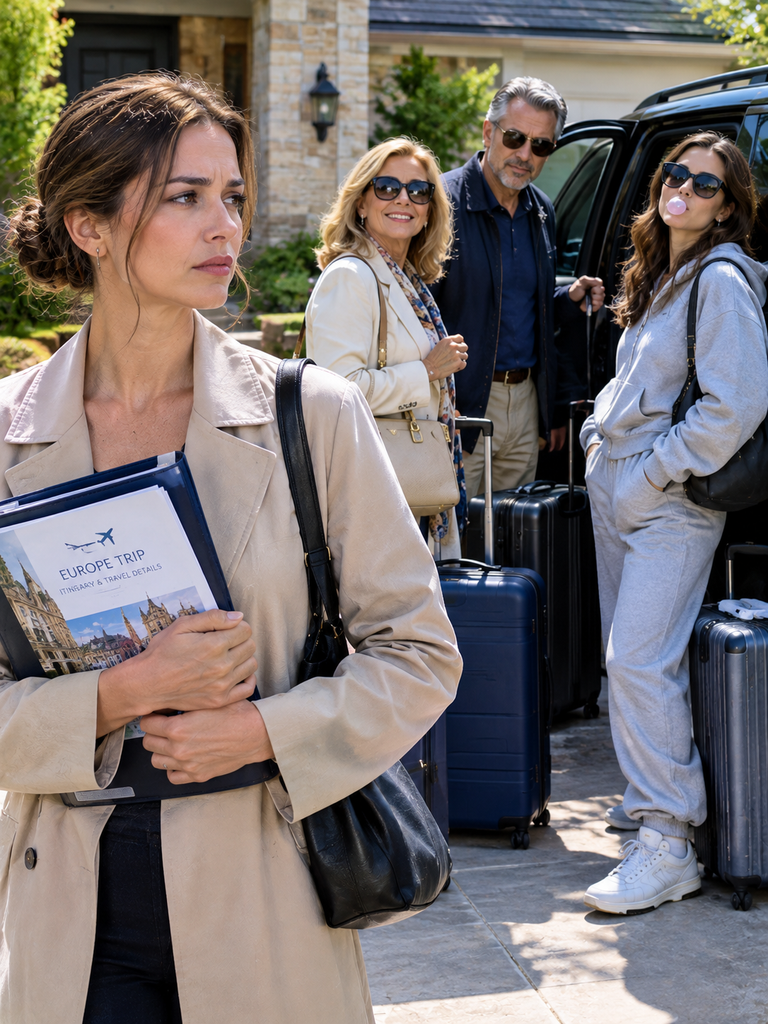
“We’ve decided to take Talia instead.”
My mother said it before I had even gotten the trunk open. She said it the way people say the weather is turning, or that the store is out of milk. Like it was a small change of plans. Like it was nothing.
I was standing in my parents’ driveway at five-forty in the morning with my keys still in my hand. The sky over the rooftops was that thin gray color it gets before sunrise in late October. My breath was coming out in little white clouds. Three coffees sat in the cupholders of my car, one black for Dad, one with oat milk for Mom, one with two sugars for me.
“What do you mean, instead?” I asked.
Dad came down the front steps with his rolling suitcase. Behind him, my sister Talia was dragging a second one, a bright red one I had never seen before. She was wearing sunglasses even though the sun wasn’t up.
“Your sister needs this more than you do, Nina,” Dad said. “She’s been having a hard time.”
“I’ve been planning this for five months.”
“And it’s a beautiful plan,” Mom said. She reached out and patted my arm. “You did such a wonderful job. Talia’s going to love it.”
I looked at Talia. She didn’t look at me. She was looking at her phone.
“Dad, my name is on the reservation. I took the week off work. My suitcase is in the car.”
“We already took care of the ticket,” Dad said. “Talia’s flying in your seat. It’s done.”
“You changed my ticket? Without asking me?”
“You’d have made it into a whole thing,” he said. “Like you’re doing right now.”
I stood there. Nobody said anything for a few seconds. A neighbor’s dog started barking somewhere down the block.
Then Talia finally looked up. “Can we go? We’re going to miss the flight.”
That was the part I couldn’t get over later. Not the words. The fact that she wanted me to drive them. She wanted me to load her new red suitcase into my trunk and drive her to the airport so she could take my seat on the trip I had paid for.
“Take a cab,” I said.
Mom’s face went tight. “Nina, don’t be petty. It’s our fortieth anniversary.”
“I know what it is, Mom. I’m the one who booked it.”
Dad already had his phone out, calling a ride. He didn’t argue. He didn’t apologize. He just turned his back and stood at the end of the driveway, waiting.
I got back in my car. I didn’t drive away right away. I sat there and watched the three of them through the windshield. Talia was laughing at something on her phone. Mom was fixing the collar of the cream wool coat we had picked out together at Nordstrom three weeks earlier. Dad was checking his watch.
None of them looked back at me.
When the cab pulled up, they loaded their bags and climbed in, and it turned at the corner, and they were gone.
I sat in the driveway with three coffees going cold. Then I pulled up the hotel reservation on my phone.
My name was still on the hotel reservation.
I checked it twice, standing beside my car while the morning cold worked through my coat.
Three guests. Two rooms. Seven nights. A small, elegant hotel in the Saint-Germain neighborhood of Paris, two blocks from the river. Under special requests, I had written that my parents were celebrating their fortieth wedding anniversary and that my father preferred a quiet room away from the elevator.
I had spent longer choosing those rooms than my parents had spent deciding whether I should come.
The whole trip had cost me $14,860. I knew the number exactly because I had moved it out of my savings account in three transfers over the summer, and every time I did it, I told myself it was worth it. Mom had never been to Paris. Dad had talked about seeing the Normandy beaches since I was a little girl. Forty years of marriage. Forty years of them working, raising two daughters, paying off a house in Naperville. I wanted them to have one perfect week.
I had wanted to be there to see it.
My finger hovered over the cancellation button.
Then I called the hotel instead.
A woman named Camille answered in careful English. I explained that I was the lead guest on the reservation and that I would not be traveling. I asked what could still be canceled.
She didn’t ask why. She just pulled up the booking and read me the terms.
“The first night is non-refundable, madame. Six hundred and twenty euros for both rooms. The remaining six nights can be released if you confirm before noon, Paris time.”
It was already past noon in Paris. My heart sank.
“Let me check,” she said. A pause. Keys clicking. “Ah. You booked with the flexible rate. The deadline is end of day for the arrival date. You are still within the window.”
“Then I confirm. Please cancel the remaining nights.”
“Of course. You will receive the confirmation by email.”
After that, I sat in my car and went down the list. The private airport transfer, already booked for that afternoon. Canceled. The full-day countryside excursion to Giverny and Normandy, with a private driver. Canceled, with a twenty percent fee. The river dinner cruise. The anniversary dinner at a restaurant where I had spent days emailing the chef to make sure Dad’s low-sodium diet could be accommodated. Canceled, both of them.
Some money came back. Some didn’t. By the time I was done, I figured I’d lost a little over $2,300 in fees and non-refundable deposits. The rest, about $9,100, would go back on my credit card in five to ten business days.
I left the flights alone.
My parents had their passports. They had their bank cards. They had their return tickets home. They were adults with a paid-off house and two retirement accounts. They would not be stranded.
What they no longer had was a week of my work, dressed up as something they could hand to somebody else.
I sent one message to the family chat, where my parents and Talia would all see it.
Since I am no longer included, I have canceled the arrangements booked under my name. Your return flights remain unchanged. You will need to arrange your own accommodation and activities.
Their plane had already taken off. I watched the message sit there, delivered, unread.
For the next eight hours, nobody could tell me I was overreacting.
I drove home with three coffees cooling in the cupholders.
At my apartment, I carried my suitcase back up the stairs and set it by the door. I didn’t unpack it. I put the itinerary folder on the kitchen counter and sat down on a stool beside it.
I had made that folder by hand. Printed every confirmation, every map, every restaurant menu translated into English. I’d bought a nice leather cover from a stationery shop downtown. On the front, in gold lettering I’d paid an extra eleven dollars for, it said Our Week Away.
I turned it facedown.
I had taken seven days of vacation from work. I’m a compliance manager at a mid-sized financial services firm in the Loop. I spend my days reading other people’s paperwork, finding the numbers that don’t match, asking the questions nobody wants to answer. It’s not glamorous. But I’m good at it. I hadn’t taken a full week off in almost three years.
For the first time in a long time, there was nothing on my calendar that somebody else needed from me.
I had no idea what to do with that.
I made a sandwich and didn’t eat it. I turned on the television and didn’t watch it. I sat on the couch and looked at the suitcase by the door.
My mother’s first call came about an hour after their flight landed in Paris.
I watched her name light up on the screen. Mom, with a little heart emoji next to it that Talia had added years ago as a joke. I watched it ring until it stopped.
Then Dad called. Marek Volkov, the contact said. I’d never changed it to Dad.
Then Talia.
Then the messages started coming in bursts.
Where is the driver?
Answer your phone.
The hotel says there’s a problem with the booking.
NINA.
Then, finally, a photograph.
My parents standing next to their luggage under the brass ceiling lights of the hotel lobby. Talia in the front of the picture, one arm stretched out toward the reception desk like a game show host showing off a prize.
Under it, two words.
Fix this.
I looked at the picture for a long time.
My mother was wearing the cream coat. I remembered standing outside the fitting room while she turned in front of the mirror. She asked me if it looked elegant enough for Europe. She sounded nervous, like a girl going to her first dance.
“You look beautiful, Mom,” I told her.
She smiled at me in the mirror. It was the happiest I’d seen her look in a long time.
That memory hurt worse than anything Talia had typed.
I called Dad back.
He answered on the first ring.
“What have you done?”
“I told you what I did. It’s in the message.”
“They don’t have rooms for us, Nina. They say the reservation was canceled.”
“The reservation was in my name. I canceled it.”
“Your mother is exhausted. We’ve been traveling for eleven hours.”
“So am I, Dad.”
“Don’t be like that.”
Behind him, I heard Talia say something sharp in a voice I couldn’t make out.
Then there was a rustle, and my mother came on the line.
“How could you humiliate us like this? In front of all these people?”
I pulled out a kitchen chair and sat down.
“Did you really think I would keep paying after you replaced me?”
“We didn’t replace you. Your sister needed—”
“My place,” I said. “She needed my place.”
Silence.
Then my mother said, very quietly, “You can travel whenever you want, Nina. You have a good job. You have money.”
“Apparently I can pay whenever you want too.”
“You’re punishing us over a vacation.”
I looked over at my packed suitcase by the door.
“No, Mom. I’m declining to pay for one I was kicked off of.”
She hung up.
For the next hour, the larger family group chat lit up. Somebody, I assumed Talia, had told the rest of the family what was happening.
My Aunt Irina, Dad’s older sister, asked whether my parents were safe. Were they on the street? Did they need help?
A cousin I hadn’t spoken to in two years wrote that money should never matter more than family.
Then Talia posted the lobby photograph to the group.
Imagine doing this to your own parents on their anniversary.
My hands were shaking. I typed a reply. I deleted it. I typed another one, longer, angrier. I deleted that too.
In the end, I took a screenshot of my original message, the one showing that it had been delivered before their plane even landed. I posted it to the group.
I added only one line.
They have their return flights and their own credit cards.
Aunt Irina wrote back within a minute.
Then book yourselves a room, Marek.
Nobody else said anything.
Ten minutes later, Talia deleted the lobby photograph.
I set the phone face-down on the table and let out a breath I’d been holding for hours. I thought that was going to be the worst of it. A few angry calls. Some family drama. Maybe a cold Thanksgiving.
I was wrong.
At three-seventeen that afternoon, an email arrived from the travel agency I had used to book the hotel package. Lumière Travel Partners, a boutique agency with an office in Paris and another in New York.
The subject line said Payment Authorization Required.
The amount was €8,640.
I sat up straight and opened the attachment.
It was an invoice. Eight rooms. Four nights each. The same hotel in Saint-Germain.
Under the booking reference, there was a line I read four times before it made sense.
Volkov Group. Organizer: Nina Volkov.
I had booked two rooms.
I read the whole document again, slower this time, line by line, the way I would at work. Room types. Rates. Taxes. City tourism fees. Arrival date.
The arrival date was today.
I called the agency using the phone number from my original confirmation email. A woman with a pleasant voice answered and asked me three security questions. My date of birth. The last four digits of the card on file. The name of my first pet.
Then she put me on hold.
When she came back, she said, “Thank you for waiting, Ms. Volkov. Are you calling about the additional room allocation?”
“I’m calling because I don’t know what it is.”
A pause.
“I’m sorry. Was this not arranged through your representative?”
My stomach went cold.
“I don’t have a representative.”
She transferred me to a supervisor. While the hold music played, I opened my laptop and started a new document. At the top, I typed the date. Then I started making notes the way I do at work.
Time. Name. Question. Answer.
The familiar motions steadied my hands.
The supervisor’s name was Philippe Moreau. He spoke slowly and carefully, like a man who knew he was walking into something.
“Ms. Volkov, three weeks ago someone contacted our office using your original booking reference. They requested additional rooms for a group of guests arriving on the same date as your party.”
“Who contacted you?”
“The sender described herself as your assistant.”
“Her name?”
He paused.
“Talia Volkov.”
I set my pen down on the table.
Philippe kept talking. The hotel had agreed to hold the eight rooms pending a signed group agreement and a final payment. A deposit had been promised. Some of the guests had already arrived this afternoon and were waiting in the lobby.
“Do not charge my card,” I said. “I want that on the record. And please record that Talia Volkov is not authorized to act for me in any way.”
“We will need that in writing, madame.”
“You’ll have it within the hour. And please preserve every single communication that refers to me. Every email, every phone note, everything.”
“I understand.”
I wrote the email before I hung up. I sent it from my personal account and copied myself.
Then I logged in to my travel account and changed the password. I turned on two-factor authentication. I called my credit card company, the number on the back of my card, and sat on hold for twenty-two minutes.
When I finally got a person, I explained what had happened. She checked my account.
“The €8,640 charge has not been processed, ma’am. It’s showing as a pending authorization request only.”
“I want to dispute it. I didn’t authorize it.”
“I’ll flag it now. I’m also going to recommend a new card number. We’ll mail it to you in three to five business days.”
“Do it.”
Only after all of that did I call Talia.
She rejected the call on the second ring.
A message came instead.
Busy dealing with what YOU caused.
I typed back.
Who are the other guests?
Three dots appeared. Then disappeared. Then appeared again.
Stay out of things you don’t understand.
I sat back in the chair.
For thirty-four years, that sentence had meant the same thing in my family. Somebody wanted me to stop asking questions. Stay out of it, Nina. Don’t make it bigger than it is. Just let it go.
This time, it made me open another page in my notes.
The agency sent the copies that evening, around eight. Philippe had attached a short cover note apologizing for the confusion and saying the matter was under internal review.
The first thing I found made my face go hot.
My airline ticket hadn’t just been handed to Talia. Dad had called the airline’s partner desk and instructed them to cancel my booking entirely and issue a brand-new ticket in Talia’s name. He paid the change fee and the fare difference himself, $680. He’d used the confirmation numbers from the itinerary I had emailed to him so he could check the dates.
I had sent him that itinerary because I wanted him to be excited.
But it was Talia’s email signature that stopped me cold.
Talia Volkov
Guest Relations
Volkov Escapes
Underneath it was a website address.
I clicked on it.
And there it was. Everything.
The hotel I had chosen after reading two hundred reviews. The private museum visits I’d arranged at the Musée d’Orsay. The countryside excursion to Giverny and the Normandy beaches. Even the anniversary restaurant, the one where I had spent days going back and forth with the chef about salt.
All of it was laid out on a slick, beautiful website with soft photographs and gold lettering. The trip was advertised as “A Premium Parisian Experience, Hosted by the Volkov Family.” Eight days, seven nights. Starting at €4,900 per couple.
At the bottom of the page was a section called Meet Our Team.
There was my face.
Beside it, in elegant script:
Nina Volkov, Finance and Compliance Director.
My hands went cold. I actually felt the blood leave my fingers.
I had never heard of Volkov Escapes. Not once. Not a mention at Sunday dinner, not a text, not a joke.
I recognized the photograph immediately. It was from a financial compliance conference in Denver last spring. They’d taken headshots of all the panelists for the program. I remembered standing against the photographer’s gray backdrop, trying to look friendly without looking too young.
Talia had taken that face and put it underneath promises I had never read.
There were testimonials. Five stars. “The Volkovs made us feel like family!” There was a contact form. There was a whole paragraph about how customer funds were “held under careful financial oversight by our compliance director, ensuring every payment is protected until your journey is complete.”
That was me. That was supposed to be me.
I took screenshots of every page. Then I saved the full website as a PDF. Then I did it again on my phone, just in case.
Then I called an attorney.
Leena Shah had helped my friend Sasha with a nasty contract dispute the year before. Sasha always said Leena was the calmest person she’d ever met. She had an office on LaSalle Street and a voice like cool water.
She picked up on the third ring, even though it was after nine.
I explained everything. The trip. The pickup. The canceled reservation. The eight rooms. The website. My photograph.
She listened without interrupting. When I finished, she asked three questions.
“Have you received any money from any customer of this business?”
“No.”
“Have you signed anything connected to this business?”
“No.”
“Have you given anyone permission to use your name, your title, or your image?”
“No. Never.”
“Then let’s make those facts very clear, in writing, right now,” she said, “before anyone tries to turn your concern into your responsibility.”
I sent her everything that night. The invoice, the website PDF, the screenshots, my notes.
An hour later, around ten-thirty, Mom called again.
This time I answered.
“Who are the people at the hotel, Mom?”
She let out a long breath. I could hear a television in the background, French voices, and the hum of an air conditioner.
“Talia is trying to do something with her life, Nina.”
“Using my photograph?”
“She needed credibility. People trust you. You have that kind of face.”
I closed my eyes.
“You knew.”
“She was going to explain it to you.”
“When?”
“Nina, please. There are people standing here.”
“How many people?”
“I don’t know.”
“Mom. Did you know before you left?”
For several long seconds, I heard voices in the background. A man asking something in an American accent. Talia answering him, bright and fake.
Then Mom said, “Your sister needed support.”
I looked at the leather folder lying face-down on my counter.
“And I needed to stay home,” I said. “That’s what this was. I needed to stay home so I wouldn’t see.”
She didn’t deny it.
She just didn’t say anything at all.
That silence would stay with me for a very long time.
Dad called ten minutes after she hung up.
“Your sister made some mistakes.”
“What mistakes?”
“She expected the arrangements to work out.”
“Whose arrangements?”
“The rooms. The activities. The excursion.”
“My arrangements, Dad. She sold my arrangements.”
He didn’t answer that.
“Who took the customers’ money?”
“Talia.”
“Where is it?”
“We’re trying to establish that.”
I reached for my notebook.
We. My whole life, we had been my father’s favorite word when the work was eventually going to land on me.
We need to help your sister with her rent.
We need to be reasonable about the car.
We can’t let your sister fail.
When Talia dropped out of community college, we paid back the loan. Except I paid it, $6,200, because Dad’s back was bad that year and he was on disability. When Talia’s car got repossessed, we helped her get a new one. I co-signed. When she missed four payments, the collections calls came to me, and my credit score dropped forty-one points.
“I’m getting independent legal advice,” I said.
“You’d bring lawyers into this? Against your own family?”
“My name is on invoices I’ve never seen, Dad.”
“You’ll ruin her.”
“Then tell her to stop using my name.”
He hung up.
Leena called back close to midnight. She had already drafted and sent formal notices to the travel agency, the hotel, and the email address listed on the Volkov Escapes website. The notices said I had not authorized any additional bookings, had no role in the business, and had not agreed to act for it in any capacity.
Then she asked me a question I hadn’t thought about.
“Does your employer know?”
I looked at my conference photograph on the laptop screen. The one with my real job title in the program underneath it.
“No.”
“It’s better coming from you,” she said. “With the records. Before anyone else tells them a different version.”
I didn’t sleep much. At seven the next morning, I called my director, Helen Brandt, at home.
Helen has been my boss for six years. She’s sharp and fair and doesn’t waste words. I explained everything. I didn’t make it sound smaller than it was. I told her about the website, the title, the photograph, the invoice.
When I finished, she was quiet for a moment.
“Send the documents to legal and to our chief compliance officer,” she said. “I’ll let them know they’re coming.”
“Okay.”
“Have you used any company resources in connection with this? Email, phones, systems?”
“No.”
“Have you taken any money from anyone?”
“No.”
“Then keep those answers clear and simple. Don’t let anybody make them complicated.”
“I’m so embarrassed, Helen.”
“I understand,” she said. “We’ll separate that from the evidence.”
I had said almost those exact words to colleagues over the years. People who had been caught up in something they didn’t cause. Hearing them said to me made my throat close up.
The next morning, a woman named Ruth Bell emailed me.
She was seventy-three years old and lived in Scottsdale, Arizona. She’d found my email address through my professional profile. She attached an invoice for two travelers.
€4,900.
It listed accommodation for seven nights, airport transfers, guided activities, and a farewell dinner. It looked professional. It had a logo.
At the bottom was a signature that looked like mine.
Her message was so polite it made my chest ache.
Dear Ms. Volkov, we were told by your sister that you would resolve the accommodation issue at the hotel. My husband Walter had hip surgery in March and cannot stand for long periods. We have been sitting in the lobby since yesterday afternoon. We paid the full amount from our retirement savings in August. Could you please advise us what to do? Thank you so much. Ruth.
I read it three times.
Then I forwarded it to Leena.
With her help, I wrote back. I said that I had not approved the invoice, had no role in the business, and had reported the unauthorized use of my identity. I gave her the name of the hotel’s manager. I told her I was very sorry she and Walter had been put in this position.
I did not promise to pay.
My thumb hovered over the screen after I hit send.
One night. I could pay for one night. Just get Ruth and Walter into a decent room somewhere. Untangle everything afterward. It was only a few hundred euros.
The instinct felt like kindness.
It also felt very, very familiar.
I put the phone down and called Leena.
She listened while I explained what I wanted to do.
“Nina,” she said gently, “if you pay for their room, what does that look like on paper? It looks like the organizer stepping in to cover the business’s obligations. It looks like you were responsible all along.”
“I just feel so terrible for them.”
“You can care about them,” she said, “without confirming a promise you never made.”
After we hung up, I wrote that sentence on a sheet of paper and taped it to my refrigerator. I knew I was going to need to see it when the next invoice showed up.
That afternoon, I heard from Aunt Irina that my parents had booked a cheaper hotel near the Gare du Nord. Dad paid with his own Visa. Three nights.
They had not been stranded. They had been inconvenienced.
That difference never seemed to make it into the messages they’d sent to the rest of the family.
Talia took my photograph off the website sometime that afternoon. The Meet Our Team section just disappeared. But Leena had already saved everything, with timestamps.
By evening, three more travelers had contacted me.
A retired couple from Ohio. A widow from Tampa traveling with her sister. A man from San Diego who had booked the trip as a surprise for his wife’s sixtieth birthday.
Their invoices were all different. One included flights. Another included airport transportation but not airfare. One had a different hotel listed than the one they’d actually been sent to.
All of them named me.
One of them had also received a separate document, a sort of terms-and-conditions page. It said in bold letters that all customer deposits were held in a separate protected account and would not be touched until suppliers had been paid in full.
I forwarded all of it to Leena.
Then I built a timeline. Every email, every invoice, every phone call. Dates down the left side. Names in the middle. Amounts on the right.
I worked until midnight.
At twelve-fifteen, I realized something. I had just spent the first full day of my vacation doing exactly what I do at work. Following money. Testing accounts. Looking for the place where the story didn’t match the paperwork.
Except this time, the account under review belonged to my little sister.
I closed the laptop.
Then I went into the bathroom, turned the shower on as hot as it would go, and cried, because the water was loud enough that I didn’t have to hear myself.
On the third day, Dad sent a text asking for a video call.
Leena told me not to make any commitments, not to agree to anything, and to save every message. She suggested I take notes during the call.
I sat at my kitchen table with my notebook open and a pen in my hand.
My parents appeared on the screen in front of beige hotel curtains. The lighting was bad. Dad looked tired. Mom looked like she’d been crying. Talia sat behind them, on the edge of one of the beds. Her sunglasses were lying on the bedspread beside her.
For one second, I saw the little girl who used to sneak into my room during thunderstorms. She’d crawl under my blanket, all cold feet and bony elbows, and whisper, “Nina, are you awake?” I always said yes, even when I wasn’t.
Then she opened her mouth.
“You’ve made everyone think I’m a criminal.”
“What did you tell them about me, Talia?”
“That you handled the financial side.”
“Why would you say that?”
“Because you know about those things. Numbers and compliance and all of that.”
“That isn’t permission.”
“I was going to ask you.”
“Before or after you took their money?”
She looked over at Mom.
Dad leaned closer to the camera, so his face filled half the screen.
“This isn’t productive, Nina.”
I ignored him.
“Why did I have to stay home?”
Nobody answered.
“Why?” I said again, louder. “Why did I have to stay home?”
Talia pushed her hair behind her ears. She does that when she’s about to say something true. She’s done it since she was five.
“Because you would have stopped it.”
The kitchen around me went very, very still. I could hear the refrigerator humming. I could hear a car door slam somewhere outside.
She kept talking, fast, like she couldn’t stop now that she’d started.
She had suppliers waiting to be paid. A guide service. A bus company. A restaurant. There was another group booked for the spring, a bigger one. Once this week went well, once people posted good reviews, the spring deposits would come in and cover the shortfall. Everybody would get what they paid for. It would all work out.
“What spring deposits?” I asked.
She stopped.
Dad said, “Don’t twist her words.”
“How many people have paid you, Talia?”
Mom started crying. Big, heaving sobs, her hand over her mouth.
I waited.
For once in my life, her tears didn’t become the only thing in the room. For once, I didn’t rush to comfort her so everybody could stop feeling uncomfortable.
“How many?” I said.
Talia stood up and walked out of the frame.
A second later, the call ended.
I sat there until my screen went black. Then I wrote down everything that had been said, word for word, as close as I could remember. I dated it and signed my name at the bottom.
That afternoon, Philippe from the travel agency sent another attachment.
A supplier agreement with a Paris-based tour company. Six pages. On the last page, Talia had signed as Guest Relations Director.
Beneath her name, there was a second signature. Mine. Or something pretending to be mine. It sat under a paragraph that said I personally guaranteed payment of all outstanding balances owed by Volkov Escapes, up to €60,000.
A financial guarantee. With my name on it.
Leena called me as soon as she saw it.
“Nina, I need you to think. Does your family have access to anything with your actual signature on it? Anything recent?”
I spent an hour going through my files. Old tax documents where I’d signed an authorization for Dad’s accountant. A delivery form. An insurance letter from when I’d helped Mom with a Medicare claim after her knee surgery.
Then I found it.
The payment authorization I had signed for the original vacation package. Back in June. I’d signed it, scanned it, and emailed it to the agency. And I had copied Dad on the email, because I wanted him to be able to check the travel dates and hotel details.
I put the two pages side by side on my screen.
The same slant. The same loop on the V. The same tiny mark I always make under the last letter, a habit I picked up in high school and never broke.
It was the same signature. Lifted straight off the page.
I had signed a gift for my parents’ anniversary. They had used it to back a business.
I sent both versions to Leena.
Then I turned off the laptop, turned off the lights, and sat in my dark living room for a long time.
On the fourth evening, I asked Sasha to come over.
Sasha and I met in our first week of college, in a dorm laundry room where we both put red socks in with white sheets. We’ve been best friends for fifteen years. She works as an ER nurse at Northwestern and has seen everything at least twice.
She showed up with two containers of pad see ew from the Thai place on Clark Street and two oranges in her coat pocket.
She didn’t ask me to tell her the story from the beginning. She didn’t ask me anything at all. We just sat on the sofa and ate noodles out of the containers.
After a while, she looked over at my suitcase, still sitting by the door where I’d left it four days ago.
“Have you unpacked?”
“No.”
“Do you want help?”
I thought about it for a long time.
Then I shook my head.
“I still want to go somewhere,” I said. “Someday. Somewhere.”
“Then leave it packed,” she said.
It was the first thing anybody had said to me in four days that didn’t need me to fix something.
I slept almost seven hours that night. The first real sleep since the driveway.
In the morning, Sasha was still there, curled up on the other end of the sofa. She made coffee while I took a shower. When I came out, she was sitting at my kitchen table peeling one of the oranges.
She broke it in half and put one half beside my plate.
I stared at it.
“What?” she asked.
“Nothing.”
But it wasn’t nothing. She had just given me something without first explaining why somebody else deserved it more.
I couldn’t remember the last time that had happened in my own family.
At eight o’clock, my phone rang. Leena.
“Are you alone?”
“Sasha’s here.”
“Good,” she said. “That’s good. There’s another record I need to discuss with you.”
I set down my coffee.
“What kind of record?”
“A merchant-account application.”
“What does that mean?”
“The business used a payment processor to accept credit card payments from customers. Before a processor approves an account like that, the business has to submit an application. That application lists the owners of the business.”
Sasha was watching my face.
“And?”
“It identifies you as an owner, Nina. Fifty percent.”
“I’m not an owner.”
“I know you’re not. We’re establishing how that representation was made.”
I pressed my hand flat against the table to keep it from shaking.
“What did they give the processor? To prove it was me?”
“Your professional details. Your employer. Your date of birth. And a copy of your passport.”
The vacation folder.
Three passports. Three itineraries. I had scanned all three passports in July so I could fill out the forms for the private museum visits and the Normandy excursion. I’d emailed the scans to Dad so he’d have a backup in case anything got lost on the trip.
Every single document. Handed over because I wanted the trip to be easy for the people I loved.
“There’s more,” Leena said.
Sasha pulled her chair closer to mine. She didn’t say anything. She just sat there, close enough that our shoulders touched.
“The account was approved about seven weeks ago,” Leena said. “We’ve requested the full records, including the identity verification history. But I have the initial summary.”
“How much money, Leena?”
She paused.
“The records currently available show roughly one hundred and seventy-six thousand euros processed through that account.”
I said the number out loud. “One hundred and seventy-six thousand.”
It sounded even less possible spoken.
“That doesn’t mean all of it is still there,” Leena said carefully. “We need the full accounting. Where it came from, where it went.”
Outside my window, a garbage truck stopped at the curb. Glass bottles rattled into the back. One of the workers shouted something to another and laughed.
The ordinary noise made my kitchen feel strange and far away, like I was watching it on television.
Leena kept going.
“Nina, I need to ask you something specific. The application lists a bank account where the funds were withdrawn. A checking account. Do you recognize it?”
She read me the last four digits.
I stopped breathing.
“Nina?”
I didn’t answer.
“Nina, do you recognize it?”
I did.
It was an account my parents opened for me when I was sixteen years old. A joint student checking account at Fifth Third Bank, the branch on Ogden Avenue in Naperville. Mom and Dad were listed as co-owners because I was a minor.
My first paychecks went into that account. Saturday shifts at the Jewel-Osco, bagging groceries and stocking shelves. Holiday work at the mall. Babysitting money. Every dollar I could scrape together, because I wanted to leave home for college and I knew nobody else was going to pay for it.
I had $3,412 in that account the summer before I left for the University of Illinois. I remembered the exact number because I had checked it every day.
When I opened an adult account at a bank near campus, Dad told me he’d moved my money over and closed the old one. He said there was no reason to keep it open. He said it would just cost fees.
I believed him. I never thought about it again.
“Are you certain?” Leena asked.
I gave her the bank’s name. Then the branch. Then I tried to say what the account was and how old I was when it was opened, and I started crying so suddenly I couldn’t finish the sentence.
Sasha took my hand and held it.
Leena didn’t rush me. She just waited on the line, quiet, while I cried.
Finally I said, “He told me it was closed. He told me he closed it fifteen years ago.”
“All right,” Leena said softly. “That’s something we can verify directly with the bank. You’re still listed on it, which means you have the right to request the statements.”
My phone buzzed against the table.
Dad.
A message appeared under his name.
Before you listen to anyone else, we need to explain what we did.
I read it once. Twice.
Then another message came in right below it.
Do not contact the bank yet.
Sasha saw my face change.
“What is it?”
I turned the phone around so she could read it.
Neither of us said a word.
For four days, I thought I was refusing to pay for a vacation.
I thought this was about a hotel room and a plane ticket and a mother who didn’t want me around. I thought it was about a little sister who had always gotten whatever she wanted, and parents who had always let her.
Now there were strangers sitting in a Paris hotel lobby holding invoices with my name on them. An old man with a bad hip who had paid €4,900 from his retirement savings. A business I had never heard of had used my passport to open an account. A financial guarantee for €60,000 carried a signature copied off my parents’ anniversary gift.
And all of that money, a hundred and seventy-six thousand euros of other people’s savings, had passed through an account I believed had been closed since I was nineteen years old.
Leena was still talking. I made myself listen.
“We’re going to handle this in order, Nina. Step by step. Don’t move any funds. Don’t log into that account. Don’t accept any explanations over the phone, from anyone. We need the actual records first. Then we’ll know what we’re dealing with.”
“Okay,” I said. “Okay.”
“I’m going to draft a records request to the bank today. And Nina, I think it’s time we talk about filing an identity theft report. And placing a fraud alert with all three credit bureaus. Today, not tomorrow.”
“I understand.”
“I’ll call you this afternoon.”
After she hung up, I sat very still.
Sasha got up and refilled my coffee without asking. She put it in front of me and sat back down.
I reached for my notebook.
The page under my hand was my original vacation budget. I’d made it in May, sitting at this same kitchen table, with a glass of wine and a lot of hope. Museum tickets, €34 each. The anniversary dinner, €410 with wine. Three breakfasts at a café by the river that I’d found on a travel blog, because I wanted Mom to see the Seine in the morning light.
I’d drawn a little heart next to the anniversary dinner.
I turned to a clean page.
At the very top, I wrote the old account number. The one from when I was sixteen. I still knew it by heart.
Then I looked at Dad’s message again.
What we did.
Not what Talia did. Not what your sister did.
We.
I read the word over and over until it stopped looking like a word.
And for the first time, sitting at my kitchen table with half an orange beside my plate, I finally understood the look on my parents’ faces that morning in the driveway. The way Dad turned his back so fast. The way Mom patted my arm. The way nobody looked back when the cab turned the corner.
I had thought it was guilt.
It wasn’t.
It was relief.
They were relieved that I let them go without a fight. Relieved I didn’t ask more questions. Relieved I wasn’t going to be standing in that hotel lobby when the eight rooms didn’t exist and the money was gone.
They hadn’t just expected me to fix things once they landed.
They had already arranged for the damage to carry my name.
THE END..!