Our elderly neighbor invited us to dinner, but minutes after we arrived, my husband rushed into the kitchen and insisted we leave. Then he showed me a wedding photograph on her wall. The groom looked exactly like him, but I wasn’t the bride. What was going on?
“We have to leave. Right now.”
My husband, Johnny, appeared in our elderly neighbor’s kitchen with a look I’d never seen.
I was arranging plates for dinner.
Margaret, our hostess, was checking something in the oven.
“What’s wrong?” I whispered.
“Please, just come with me.”
He caught my hand and led me into the living room. His fingers were trembling.
He stopped in front of a photograph hanging beside the fireplace.
It showed a bride and groom standing under a flower-covered arch.
The groom was my husband.
Except I had never seen that wedding, and the woman beside him wasn’t me.
I turned toward Johnny.
“What is this?”
“That’s what I want to know.”
Before I could ask another question, Margaret appeared in the doorway.
She followed our gaze to the photograph, and her expression changed.
“Oh, Johnny,” she said quietly. “I hoped we’d have dinner first.”
Three weeks earlier, Johnny and I had moved into a neighborhood filled with old houses and enormous trees.
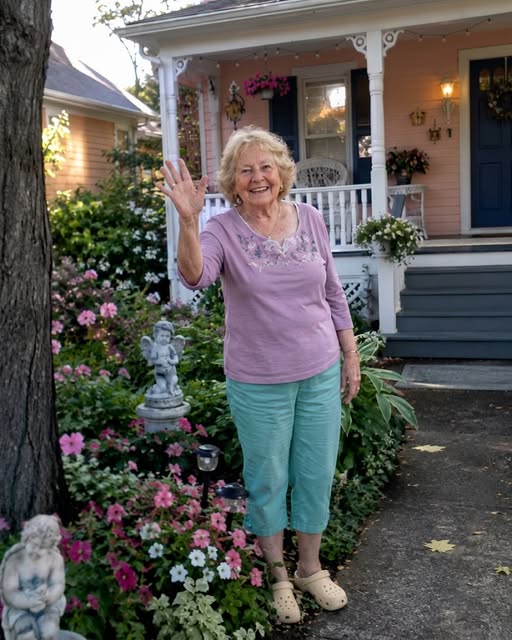
Margaret lived across the street in the prettiest house of all.
It was painted pale pink, with a carefully tended garden and little stone statues between the flowers.
Everyone called her the Pink Lady.
She was 75, widowed, and apparently comfortable enough to spend her days gardening, reading, and cooking.
She was also one of the few neighbors who welcomed us personally.
The afternoon after we moved in, she appeared with homemade cookies.
“Welcome to the neighborhood,” she said.
Then she glanced behind me.
“Is your husband around?”
“Oh, Johnny? He’s at work.”
“No need to bother him. I’m just glad Johnny will get some cookies too.”
I briefly wondered how she knew his name.
But we had introduced ourselves to several neighbors, and I assumed someone had mentioned him.
A few weeks later, Margaret left a handwritten dinner invitation.
Johnny immediately refused.
“We’ll eat weird old-people food and listen to stories about how everything was better in 1974.”
“She’s lonely,” I argued. “It’s one evening.”
Eventually, he agreed.
Margaret greeted us at the door, hugged me, and shook Johnny’s hand.
She held his hand slightly longer than necessary.
“You look so much like…” she began.
Then she stopped.
“Come inside. Dinner’s almost ready.”
Her house was beautiful, filled with polished wooden furniture, embroidered cushions, and fresh flowers.
But something seemed missing.
There were almost no family photographs downstairs.
Margaret invited me into the kitchen while Johnny wandered toward the living room.
Five minutes later, he came to look for me.
And now we were standing under a photograph that seemed impossible.
Johnny stepped toward Margaret.
“Who is that man?”
She clasped her hands.
“His name is Daniel.”
“Why does he look exactly like me?”
Margaret glanced at me, then back at him.
“Because he’s your brother.”
Johnny stared.
“I don’t have a brother.”
Margaret’s eyes filled with tears.
“You have a twin.”
For several seconds, nobody spoke.
Then Johnny shook his head.
“No. My parents would have told me.”
“I wish they had.”
He looked at the photograph again.
The groom had Johnny’s dark hair, narrow nose, and slightly crooked smile.
Even the small crease beside his left eye was familiar.
“That’s not possible,” Johnny whispered.
Margaret pulled out a chair.
“Please sit down. There’s something I should have told you when you moved here.”
Johnny remained standing. “Start talking.”
Margaret explained that she and her late husband had known Johnny’s parents when they were young.
His mother had given birth to identical twins during a difficult period.
His father was struggling to find steady work, and his mother needed time to recover from the delivery.
Margaret and her husband had wanted children for years but couldn’t have any.
“They asked us to look after Daniel for a little while,” she said. “Just until things improved.”
“How long was a little while?” Johnny asked.
“At first, a few months.”
“And then?”
Margaret looked down.
“Then it became longer.”
She explained that Daniel had remained with them as a toddler. By the time he was three, he called Margaret and her husband Mom and Dad.
Eventually, the adults agreed that Daniel would stay permanently.
Johnny stared at her.
“My parents gave away my brother?”
“It wasn’t that simple.”
“Then make it simple.”
Margaret struggled to answer.
Finally, she said, “We loved him. And your parents believed he was happy with us.”
Johnny walked toward the window.
Across the street, our house stood behind its newly planted shrubs.
“We’ve lived there three weeks,” he said. “You knew who I was?”
“I recognized you the first day.”
“How?”
“Daniel showed me pictures of you online after you moved in. I’d already noticed how much you looked like him, and he wanted to know whether you were the brother he’d been searching for.”
Johnny turned sharply.
“He knows about me?”
Margaret nodded.
“He’s known since he was 18.”
Johnny’s hand tightened around mine.
“Then why hasn’t he contacted me?”
Margaret’s answer came slowly.
“He believed you didn’t want contact.”
Johnny looked as though she’d struck him.
“I didn’t even know he existed.”
Margaret began crying.
“I know.”
The oven timer sounded.
Nobody moved.
Finally, I switched it off.
Johnny asked whether Daniel was alive, where he lived, and whether he was happy.
Margaret answered carefully.
Daniel was 38, the same age as Johnny.
He lived two hours away with his wife, Claire. They had married four years earlier.
The photograph was from their wedding.
Johnny studied it again.
“He’s been married four years,” he murmured. “And I didn’t even know his name.”
Margaret approached him.
“I never meant to hurt you.”
“Then why invite us here?”
She took a deep breath.
“I wanted you to know him. I thought if you came inside, I might find the courage.”
Johnny looked at the photograph.
“You could’ve knocked on our door and told me.”
“You’re right.”
He shook his head.
“I need to go.”
This time, I didn’t argue.
We walked home without speaking.
Inside, Johnny sat at the kitchen table, staring at nothing.
I made tea, but he didn’t touch it.
“Do you believe her?” I asked.
“I don’t know.”
He rubbed his face.
“My mother used to say she was grateful she’d only had one child. She said she couldn’t imagine managing two.”
I sat beside him.
“Maybe she was trying to convince herself.”
“Or maybe she meant it.”
He stood and went upstairs.
An hour later, I found him sitting on the edge of our bed with an old family album.
He’d brought it from his parents’ house after his father died six years earlier.
Every childhood photograph showed Johnny alone.
His first birthday. His first bicycle. His first day of school.
He turned to a photograph of himself at two.
“Somewhere, there’s another picture of this same face,” he said.
I sat beside him.
“Do you want to call your mother?”
He shook his head.
“Not tonight.”
The next morning, he changed his mind.
His mother, Linda, lived about an hour away.
Johnny called and asked whether we could visit.
She sounded delighted.
When we arrived, she had coffee and muffins waiting.
But her smile faded when Johnny placed his phone on the table.
The wedding photograph was on the screen.
“Mom,” he said, “who is this?”
Linda went completely still.
She stared at the photograph for several seconds.
Then she sat down.
“Where did you find that?”
“At Margaret’s house.”
Linda closed her eyes.
Johnny leaned forward.
“Is he my brother?”
She nodded.
“Yes.”
Johnny looked away.
I could see him struggling to remain calm.
“Why didn’t you tell me?”
Linda began crying.
“Your father and I thought we were protecting you.”
“From what?”
“From feeling like something was missing.”
Johnny laughed bitterly.
“Something was missing. My entire brother.”
Linda wiped her face.
She confirmed that she and Johnny’s father had asked Margaret and her husband to care for Daniel temporarily.
But then she revealed something Margaret hadn’t mentioned.
“When you boys were almost three, we asked for Daniel to come home.”
Johnny looked up.
“You wanted him back?”
“Of course we did.”
Linda explained that their finances had improved. They had a larger apartment, and she was working again.
But Daniel had become deeply attached to Margaret and her husband.
“He called them his parents,” Linda said. “He cried whenever we tried to take him away.”
Johnny frowned.
“Did you visit him?”
“Yes. For a while.”
“Then why did you stop?”
Linda stared at her hands.
“Margaret believed moving him would hurt him. Your father agreed that we shouldn’t force it.”
“And you?”
“I wanted my son.”
Her voice broke.
“But I was afraid of taking him from the only home he remembered.”
Johnny was silent.
Linda continued, “Eventually, we agreed that Daniel would stay. We arranged for Margaret and her husband to become his legal parents.”
“Why didn’t you tell me I had a twin?”
“At first, we thought you were too young. Later, every year made it harder.”
Johnny stood.
“You could’ve told me when I turned 18.”
“I know.”
“When I got married?”
She nodded through tears.
“When Dad died?”
Linda covered her mouth.
Johnny stepped back.
“You let me bury my father without knowing he had another son.”
Linda began sobbing.
I reached for Johnny’s hand.
He didn’t pull away.
After a while, he asked, “Did Daniel know about us?”
Linda nodded.
“Margaret told him when he became an adult.”
“Did he ever ask to meet me?”
Linda hesitated.
“Margaret called us once, years ago. She said Daniel wanted to know whether you were interested.”
“What did you say?”
“Your father told her not to disturb your life.”
Johnny stared at his mother.
“And you agreed?”
“I was afraid you’d hate us.”
He looked toward the door.
“I need some time.”
Linda reached for him.
“Johnny, please.”
He stepped away.
“I love you, Mom. But I don’t know what to do with this.”
We drove home quietly.
Halfway there, Johnny pulled into a parking lot.
He rested his forehead against the steering wheel.
“She wanted him back,” he whispered.
“Yes.”
“And Margaret didn’t want to give him up.”
“It sounds like all of them were afraid of losing something.”
Johnny sat upright.
“But Daniel and I lost each other.”
I couldn’t argue.
That evening, Johnny walked across the street.
I went with him.
Margaret opened the door, looking nervous.
“Johnny. I’m glad you came.”
“I spoke to my mother.”
Margaret’s expression fell.
He stepped inside.
“She said she wanted Daniel back.”
Margaret nodded slowly.
“She did.”
“Why didn’t you tell me that?”
“Because I was ashamed.”
Johnny waited.
Margaret sat in the same chair she’d offered him the night before.
“When Daniel was little, he followed me everywhere. He’d wait by the window for my husband to come home. He was our whole world.”
Her voice trembled.
“When Linda asked for him back, I was terrified.”
“So you convinced her to leave him with you.”
“I told her he would be frightened and confused. I believed that was true.”
“But you also wanted to keep him.”
Margaret nodded.
“More than anything.”
Johnny looked toward the wedding photograph.
“Did you ever think about me?”
“Every birthday.”
“Then why didn’t you come?”
“Your parents asked us not to.”
Johnny shook his head.
“Everyone keeps telling me what someone else wanted.”
Margaret looked down.
“You’re right.”
I finally asked the question that had been bothering me.
“Why did Daniel think Johnny didn’t want to meet him?”
Margaret took a long breath.
“When Daniel turned 18, I told him about his birth family. He wanted to find you immediately.”
“Did you contact Johnny’s parents?” I asked.
“Yes. His father said Johnny had a good life and didn’t need complications.”
Johnny clenched his jaw.
“And you told Daniel I rejected him?”
“I told him his brother’s family didn’t want contact.”
“That’s not the same thing.”
“I know. But Daniel believed you knew.”
Margaret began crying again.
“I should’ve explained that I hadn’t spoken to you directly. I was afraid he’d be hurt if he kept hoping.”
Johnny stood quietly for a moment.
“Can I have his number?”
Margaret looked up.
“Of course.”
She wrote it on a piece of paper.
Johnny folded it carefully.
“Does he know we’re here?”
“Not yet.”
“Then please don’t call him. I want to do that myself.”
Margaret agreed.
Back home, Johnny placed the paper beside his phone.
He stared at it throughout dinner.
Finally, he picked up the phone.
I went into the kitchen to give him privacy.
A minute later, I heard him speak.
“Hi. Is this Daniel?”
There was a pause.
“My name is Johnny.”
Another pause.
“I think I’m your brother.”
His voice broke on the last word.
I heard him laugh softly.
Then he began crying.
They talked for almost two hours.
When Johnny finally came into the kitchen, his eyes were red.
“He thought I hated him,” he said.
“What did you tell him?”
“That I only found out last night.”
He sat beside me.
“He said he used to imagine what I looked like. After hearing we’d moved here, he found an old photograph of me online and couldn’t believe how much we looked alike.”
“Did he know you moved here?”
“He saw an announcement about our move through a mutual acquaintance. He mentioned it to Margaret, and she recognized the address.”
That explained why Margaret had known Johnny’s name.
“Are you going to meet him?” I asked.
Johnny nodded and said, “Saturday.”
Saturday arrived with rain.
We met Daniel and Claire at a quiet restaurant halfway between our homes.
Johnny was so nervous that he barely spoke during the drive.
Then we walked inside.
A man near the window stood up.
For a moment, I felt as though I was seeing two versions of my husband.
Daniel had the same eyes, the same smile, and almost identical features.
But his hair was shorter, and he carried himself differently.
Johnny stopped.
Daniel smiled uncertainly.
“Well,” he said, “this is strange.”
Johnny laughed.
“Very.”
They shook hands.
Then Daniel pulled him into a hug.
Johnny hugged him back.
Neither spoke for several seconds.
Claire and I exchanged tearful smiles.
Lunch began awkwardly.
They asked about work, hobbies, and where they’d grown up.
Daniel was a teacher. Johnny worked in construction management.
Daniel loved fishing. Johnny hated it.
Both disliked olives.
Both had broken their left wrists as teenagers.
They laughed at the coincidence.
Then Daniel grew serious.
“I spent years thinking you didn’t want me around.”
Johnny shook his head.
“I didn’t know you were there.”
Daniel looked down.
“I wish someone had told us.”
“Me too.”
They talked about their parents, childhood birthdays, and the different lives they’d lived.
Daniel described Margaret’s husband teaching him to ride a bicycle.
Johnny remembered his father doing the same.
For the first time, they could compare memories instead of imagining them.
Before leaving, Daniel asked whether they could meet again.
Johnny smiled.
“I was hoping you’d say that.”
Over the following weeks, the brothers began calling regularly.
They didn’t suddenly become inseparable.
Sometimes their conversations were awkward. Sometimes they disagreed.
But they kept trying.
Johnny also continued speaking with Linda.
Their relationship was strained, and he wasn’t ready to forgive her completely.
Still, he asked questions she’d avoided for decades.
For once, she answered them.
Margaret apologized to both brothers separately.
Daniel told her he loved her but wished she’d trusted him with the whole truth.
Johnny said he appreciated her invitation, even though he hated how she’d handled it.
A month after that first dinner, Margaret invited us back.
This time, Daniel and Claire came too.
Johnny hesitated before accepting.
Then he said, “I think we should go.”
Margaret had cooked enough food for twice as many guests.
The table was crowded with dishes, and the house smelled wonderful.
During dinner, Daniel told a ridiculous childhood story about one of Margaret’s garden statues.
Johnny laughed so hard he nearly spilled his drink.
Margaret watched them with tears in her eyes.
Afterward, Johnny and I wandered into the living room.
The wedding photograph still hung beside the fireplace.
He stood in front of it for a moment.
“The first time I saw this, I thought I was losing my mind,” he said.
I slipped my hand into his.
“You looked ready to run out the door.”
“I was.”
“And now?”
He glanced toward the dining room, where Daniel was helping Margaret clear the table.
“Now I know who he is.”
He smiled faintly.
“I just wish we’d had more time.”
I squeezed his hand.
“You have time now.”
Johnny looked at the photograph once more.
Then he turned away from it and went to join his brother.
So here’s the real question: If you discovered your parents had hidden the existence of your twin brother for your entire life, would you eventually forgive them, or would that betrayal permanently change your relationship?
The Architecture of Silence
Forgiveness isn’t a simple light switch you flick on; it’s a slow restoration project on a building whose foundations were laid wrong from the start. For Johnny, the weeks following that second dinner weren’t marked by sudden epiphanies, but by a quiet, persistent accounting of his past. Every childhood memory felt as though it needed to be re-examined through a new lens. The lonely summer afternoons, the unsaid words during family arguments, the strange moments when his mother, Linda, would look at him with an intensity that felt heavier than simple maternal affection—all of it had to be rebuilt from scratch.
Johnny began meeting Daniel on Thursday evenings at a quiet diner midway between their towns. It was a neutral ground with cracked vinyl booths, bad drip coffee, and no family history hanging on the walls.
“I found old report cards last night,” Daniel said during one of their early meetings, sliding an apple pie toward the center of the table. “My adoptive mother saved everything. Standardized test scores, art projects, even little disciplinary slips.”
Johnny picked up a fork, tracing the crust. “What did they say?”
“Average math skills. Highly easily distracted,” Daniel chuckled, a small, wry sound. “And a tendency to day-dream during reading hour.”
Johnny looked up, staring into eyes that were identical to his own. “My third-grade teacher wrote the exact same sentence on my report card. ‘Johnny wanders mentally.’”
They sat with that small, shared fragment of shared DNA. It was fascinating, but it was also haunting. For every shared trait, there was an accompanying void—a realization of thirty years lived in parallel isolation.
“Do you ever get angry?” Johnny asked, his voice dropping low enough that the waitress passing by wouldn’t hear.
Daniel paused, his hands resting flat on the laminate table. “I used to be angry at the universe when I found out I was adopted. Then I was angry at Margaret for keeping quiet when she knew where I was. But with Linda…” He looked out the rain-streaked window toward the highway. “I don’t know her, Johnny. You do. She’s your mother. To me, she’s a line on a birth certificate that got blacked out. It’s easier for me to be detached. But for you, it’s a total rewrite of your history.”
Johnny didn’t answer right away. He thought of his mother’s apartment—the smell of lavender and stale tea, the dozens of framed photos of him lining her hallway, and the total, calculated absence of Daniel. He wondered how many times she had looked at those photos, held that secret under her tongue, and simply chosen not to speak.
The Weight of Unspoken Truths
Two months after the revelation, Johnny finally agreed to sit down with Linda alone. They met at her house, a place Johnny had known every corner of since he was five years old. Walking through the front door felt different now; the walls seemed thinner, the air heavier with the weight of what had been hidden.
Linda set down a pot of chamomile tea, her hands trembling slightly as the porcelain clinked against the saucer. She looked older, worn down by the quiet storm that had swept through their family.
“You don’t have to look at me like I’m a stranger, Johnny,” she said softly, taking the chair across from him.
“You made yourself one,” Johnny said, keeping his tone measured, though his chest felt tight. “You let me grow up an only child. You let Daniel grow up down the road without a brother. How do you explain that away?”
Linda looked down at her hands, her knuckles white. “It wasn’t a cold decision, Johnny. It was a desperate one. Your father and I… we were nineteen. We were broke, living in a trailer, and we could barely feed ourselves, let alone two newborn babies. When the state came in, when my mother stepped in… it felt like the only way to save half the family was to let half of it go to someone who could afford a life.”
“And when things got better?” Johnny pressed, leaning forward. “When Dad got the job at the plant? When we moved here? When Margaret offered to help? Why keep lying?”
“Because the lie gets bigger every year,” Linda murmured, a single tear cutting a track down her cheek. “When you’re five, you think, ‘I’ll tell him when he’s ten.’ At ten, you think, ‘He’s too sensitive, it’ll ruin his middle school years.’ At eighteen, you think, ‘He’s starting his life, why break his heart now?’ And then you wake up and thirty years have passed, and the truth feels like a bomb that will blow up everything you built.”
Johnny listened, feeling a complex mix of sympathy and profound anger. He understood the fear of an overwhelmed nineteen-year-old girl, but he couldn’t reconcile it with the thirty years of deliberate deceit that followed.
“You didn’t just protect us from pain, Mom,” he said quietly. “You stole thirty years of brotherhood from us. We don’t get those back. We don’t get the shared childhood, the high school graduation photos together, the feeling of having someone who truly shares your blood in the world.”
He stood up, leaving the tea untouched.
“I don’t hate you,” he said from the doorway. “But I don’t know how to trust you right now. And I don’t know if that’s something we can ever fix.”
Building from the Rubble
Forgiveness, as Johnny learned over the next six months, is not a grand gesture or a single emotional conversation. It is a slow, tedious practice of choosing forward movement over past resentment.
He and Daniel began working on a shared project: restoring an old 1978 Chevy truck that Daniel had bought years ago but never had the time or skill to fix. Johnny brought his construction management mindset—tools, timelines, and practical problem-solving—while Daniel brought endless patience and an eye for detail.
Saturdays were spent in Daniel’s garage, knee-deep in engine grease and radio rock.
“Hand me the 3/8 socket,” Daniel requested from beneath the chassis.
Johnny reached into the tool chest, handing it down. “You know, Margaret came by my place yesterday.”
The sound of metal clinking paused. Daniel slid out from beneath the truck, wiping his forehead with a grease-stained rag. “And?”
“She gave me an old photo album,” Johnny said, leaning against the workbench. “Pictures of your adoptive parents. Pictures of you when you were seven, eight years old. She said she kept them in a lockbox for twenty-five years because she couldn’t bear to throw them out, but couldn’t show them to me either.”
Daniel looked at him thoughtfully. “How did that make you feel?”
“Angry at first,” Johnny admitted. “Then sad. Then… tired. I realize everyone in this story was terrified. Margaret was scared of ruining her relationship with my mom. My mom was scared of losing me. My dad was scared of facing his own failures. Everyone was acting out of fear.”
“Fear makes people do terrible things to the people they love,” Daniel said quietly. He sat up, resting his elbows on his knees. “My adoptive dad used to say that holding onto anger is like drinking poison and waiting for the other person to die. I don’t want to spend the next thirty years feeling robbed. I just want to spend them being your brother.”
Johnny looked at Daniel—really looked at him. They were identical in face, but their lives had sculpted them differently. Daniel had a softer posture, a gentler way of speaking. Johnny was squarer, more rigid, hardened by a life of believing he had to stand alone against the world. But here they were, rebuilding an engine together, carving out a joint future from a fractured past.
“Yeah,” Johnny said, a small grin breaking through his serious expression. “Me too. Now get back under there, we’ve still got the transmission to drop.”
The Gathering
A year after the truth exploded into their lives, the family gathered once more. It wasn’t at Margaret’s house this time, nor was it at Linda’s. It was on neutral territory: a rented pavilion at a state park overlooking a calm lake on a warm September afternoon.
The air smelled of cedar, charcoal, and roasting corn. Children—Daniel’s two young daughters—were chasing dragonflies along the shoreline, their laughter ringing across the water.
Linda sat on a bench near the perimeter, watching them with a quiet, hesitant expression. She had stayed on the fringes of the family dynamics for months, respecting Johnny’s boundaries while trying, step by small step, to reach out to Daniel.
Daniel walked over to her, carrying two paper plates loaded with food. He handed one to her without a word and sat on the far end of the wooden bench.
“Thank you, Daniel,” she whispered, her voice fragile.
“It’s good food,” Daniel said simply. He looked out at his daughters playing by the water. “They look a lot like Johnny did at that age, don’t they? In the photos Margaret gave us.”
Linda’s eyes filled with tears, but she managed a small, tentative smile. “They do. They have the exact same smile.”
Johnny watched them from across the lawn, standing next to Claire. He took a slow sip of his lemonade, feeling a strange, unfamiliar sensation settling in his chest. The sharp, jagged edge of betrayal hadn’t completely disappeared, but it had dulled into a quiet acceptance of human imperfection.
“You’re okay,” Claire observed softly, slinging an arm through his.
“I am,” Johnny said. “It’s strange. A year ago, I felt like my whole life was a lie. Like everything I built was based on a fake story.”
“And now?”
“Now I realize the story wasn’t fake—it was just incomplete,” he said, turning to look at her. “The betrayal changed the past, but it doesn’t have to define the future. I can’t undo what my parents did. I can’t get back the thirty years Daniel and I missed. But I can choose what the next thirty years look like.”
He walked over to the bench where Linda and Daniel were sitting. He didn’t say anything grand. He just sat down on the grass across from them, stretched his legs out toward the lake, and pointed toward the kids.
“Look at that,” Johnny chuckled. “She’s about to fall right into the mud.”
Linda let out a soft, genuine laugh—the first real laugh Johnny had heard from her in over a year. Daniel smiled, reaching out to pat his mother’s shoulder gently.
The Measure of Forgiveness
So, returning to that final question: If you discovered your parents had hidden the existence of your twin brother for your entire life, would you eventually forgive them, or would that betrayal permanently change your relationship?
The truth is, both things happen at once.
The relationship is permanently changed. You cannot un-know a secret of that magnitude. The trust you once had in your parents as absolute, infallible authorities is shattered. You see them no longer just as “Mom” and “Dad,” but as flawed, frightened human beings who made profound, devastating mistakes under the pressure of their own lives and limitations. The blind obedience of childhood is gone forever; in its place is a more complicated, adult reality where love and disappointment exist side by side.
But forgiveness is not the absence of change—it is the decision to keep going despite it.
Forgiveness doesn’t mean pretending the lie never happened, nor does it mean immediately restoring things to the way they were before. It means refusing to let the anger become the main character of your life. It means choosing to build a new foundation, however imperfect, out of the broken pieces left behind.
For Johnny and Daniel, the betrayal changed their relationship with their mother, but it also opened the door to the greatest gift of their adult lives: each other. In learning to forgive the people who kept them apart, they finally found the freedom to stand together.
THE END…!