After nearly forty years of blindness, my husband developed a surgery that could restore my vision. But as the operation approached, he repeatedly begged me to reconsider. “You don’t understand what you might lose,” he whispered. I thought he was afraid the surgery would fail. Then, when the bandages finally came off, I saw the scar above his left eyebrow—and recognized the boy who had pushed me off a swing when I was eight years old.
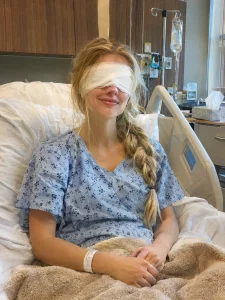
My name is Tessa Reeves, and I lost my sight during a summer afternoon that began like any other.
I was playing at our neighborhood park in Pennsylvania when a boy who lived three houses away challenged me to swing higher. His nickname was Gordy, and we’d been friends since preschool.
“Bet you can’t go any higher!” he shouted.
“Watch me!”
As I leaned backward, he gave the swing a sudden push. My hands slipped from the chains, and I fell onto a rock near the playground.
The last thing I remembered seeing was the blue sky above the oak trees.
Doctors performed two operations, but the injuries permanently damaged my vision. I spent months hoping the darkness would disappear, until my mother gently explained that I might never see again.
Gordy never visited me.
His mother came to the hospital several times, bringing coffee for my mother and sitting quietly beside my bed. But shortly after the accident, their family moved to another state, and I never heard from him again.
I grew up learning Braille, memorizing rooms, and recognizing people by their voices. Eventually, I graduated from college and became a social worker, determined to help children facing difficulties of their own.
Still, I never stopped dreaming of seeing again.
When I was twenty-four, I met a young ophthalmologist named Dr. Gordon Pruitt during a routine appointment.
The moment he spoke, something about his voice seemed strangely familiar.
“Have we met before?” I asked.
He hesitated.
“No. I don’t believe so.”
Gordon was patient and thoughtful, explaining medical developments without treating me like someone who couldn’t understand. Over time, we became friends, and after he transferred my care to another doctor, we began dating.
Two years later, we married.
We had two beautiful children, Owen and Rose. I learned their faces through touch, recognizing Owen’s crooked nose and Rose’s tiny dimple long before I could imagine what either of them looked like.
Gordon became a respected eye surgeon, spending countless nights studying experimental treatments for damaged optic nerves.
Sometimes I woke at three in the morning and found him crying quietly in his office.
“A research trial failed,” he’d explain. “I thought we were finally close.”
I believed he was working for his patients.
I never realized how personal his research was.
Then, one evening, Gordon came home with extraordinary news.
“Tessa, I think I’ve found a way to restore your sight.”
I could barely speak.
He explained that an experimental procedure had produced promising results and that I might qualify. After consultations, testing, and careful consideration of the risks, I agreed to proceed.
But instead of celebrating, Gordon became increasingly anxious.
He repeatedly asked whether I was certain.
“Think about our children,” he said one evening. “Think about everything we have.”
“I am thinking about them,” I replied. “I want to see their faces.”
The night before surgery, I held his trembling hands.
“Are you afraid the operation won’t work?”
“No,” he whispered.
“Then what are you afraid of?”
He pulled me close.
“That when you finally see me, I’ll lose you.”
I thought he was simply overwhelmed.
The following morning, before the anesthesia took effect, I smiled toward his voice.
“If this works, I want you to be the first person I see.”
Gordon kissed my forehead, but his breathing suddenly changed.
“I love you, Tessa,” he whispered.
When I woke after surgery, my eyes were covered with bandages. Gordon assured me the procedure had succeeded, yet his voice sounded almost grief-stricken.
Two days later, he sat beside my bed to remove the coverings.
As the final layer loosened, his hands began shaking.
“Don’t hate me,” he whispered. “There’s something about me you don’t know.”
Before I could ask what he meant, the last bandage fell away.
Light flooded my eyes.
For the first time in decades, shapes and colors began emerging from the darkness.
And as the face of my husband slowly came into focus, I noticed something above his left eyebrow.
A thin, familiar scar.
Suddenly, I remembered a little boy standing behind a playground swing, laughing beneath the summer sun.
The boy everyone had called Gordy.
I stared at Gordon, unable to breathe.
Because the man who had just restored my sight was the same boy who had taken it away.
PART 2
I couldn’t stop staring at my husband, struggling to take in a face I was seeing for the very first time. The slightly crooked nose, the warm brown eyes, the narrow scar above his left eyebrow. Together they pulled up a memory I had spent decades trying to bury.
“Gordy?” I whispered.
Gordon went pale.
“Tessa, please. Let me explain.”
I shifted away from his outstretched hand.
“You were the boy at the playground that day?”
He lowered his eyes.
“Yes.”
The steady beeping of the heart monitor seemed to grow louder as the memories rushed in. I was eight years old again, standing by the swings on a summer afternoon, seconds before a push from behind and a fall that took my sight.
“You pushed me off that swing,” I said.
Gordon nodded, tears pooling in his eyes.
“I did. But I was nine, Tessa. I never meant for any of this to happen.”
“And afterward, you disappeared.”
“I know.”
I searched his face for any sign that I had gotten it wrong. I hadn’t.
“When we met all those years ago, you already knew who I was.”
He hesitated.
“Yes.”
My stomach clenched.
“I asked you if we’d met before. You looked right at me and said no.”
“I was terrified you’d hate me.”
“So you lied. You married me, built a family with me, and let me believe you were a stranger who just happened to fall in love with me.”
Gordon wiped his face with the back of his hand.
“I tried to tell you so many times. I kept waiting for the right moment.”
“Twenty years, Gordon. You had twenty years.”
He reached for me again, and again I pulled away.
Dr. Whitfield, who had assisted with my surgery, stepped closer and quietly warned that the stress could interfere with my recovery. My new vision was still fragile, and I needed rest.
But rest was impossible beside the man who had hidden the truth about my blindness.
“I want to be moved to another room,” I told her.
Gordon took a step forward.
“Tessa, please don’t leave before you’ve heard everything.”
I looked at the husband I had trusted for more than two decades.
“You had our entire marriage to tell me the truth.”
Then I turned to the doctor and left him standing alone beside the empty bed.
PART 3 (FINAL)
They moved me to a quiet room on the fourth floor, with a window facing the parking lot and a strip of gray Pennsylvania sky above it. I sat on the edge of the bed for hours, looking at things I had only ever touched: the rail, the blanket, my own hands. They were older than I’d imagined, with veins and small freckles. Even in the middle of the worst day of my adult life, I couldn’t stop looking.
Around dusk, a nurse knocked and said my children were outside.
I hadn’t asked for them. Gordon must have called.
Rose came in first. I knew her at once, because she had the dimple, tiny and exactly where my fingertips had always found it. She stopped in the doorway with her hand over her mouth.
“Mom?”
“Come here,” I said, and my voice broke. “Let me look at you.”
She crossed the room and knelt beside the bed. I held her face in both hands, the way I had a thousand times, only now I could see her eyes fill. Owen stood behind her, tall and awkward, with the crooked nose I had traced since he was a baby. It was far more charming than I had ever imagined.
“You’re even better than I pictured,” I told him, and he laughed and cried at the same time.
For a few minutes, nothing else existed. Then Rose looked up at me carefully.
“Dad told us,” she said. “In the hallway. He told us everything.”
“What did he say?”
“That he pushed you when he was nine. That he’s spent his whole life trying to make up for it.” She swallowed. “Mom, we’re not asking you to forgive him. We just thought you should know he’s not hiding anymore.”
Gordon didn’t come in that night, and I was grateful. I needed to be angry without watching him break.
But I couldn’t sleep, so the next morning, I asked Dr. Whitfield for a favor. She wheeled me down to the hospital’s small chapel, where I sat alone and finally let myself think.
I thought about the voice I’d heard in that exam room at twenty-four. I thought about how it had felt familiar, and about how, even then, some part of me had wondered. I thought about Gordon at three in the morning, crying in his office over failed trials. I’d believed he was grieving for strangers.
He had been grieving for me, for twenty years. He had spent his whole career trying to undo one afternoon.
None of that erased the lie. Both things were true, and I had no idea how to hold them at once.
When I came back to my room, there was a woman sitting in the chair by the window. She was small and white-haired, and she clutched her purse in both hands.
“Tessa,” she said. “I don’t know if you remember me. I’m Ruth Pruitt.”
I did. She was the woman who had brought coffee to my mother, who had sat by my bed when I was eight and said nothing, because there was nothing to say.
“Gordon’s mother,” I said.
“Yes.” Her eyes were wet. “I came because there’s something you should know, and I’ve waited far too long to say it.”
She told me that on the night of the accident, her nine-year-old son had sat on the stairs and refused to eat. He had begged to go to the hospital and confess to my parents, to anyone. But Ruth, frightened and ashamed, had told him they would only make things worse. A few weeks later, her husband took a job in Ohio, and the family left.
“I made him run away,” she said. “He was a child, and I taught him that the way to survive guilt was to hide from it. He’s been trying to unlearn that his whole life.”
“He’s forty-four years old,” I said. “He chose to lie to me.”
“He did. And that’s his to answer for.” She stood slowly. “But I wanted you to know the boy wanted to tell the truth. It was the grown-ups who took that from him.”
She left a folded paper on the nightstand. Inside were twenty-six years of birthday cards Gordon had written to me and never mailed, one for every year since the accident. The handwriting grew from a child’s scrawl to a surgeon’s neat script. Each said the same thing in a slightly different way.
I’m sorry, Tessa. I’m so sorry. I hope you’re happy.
I read all of them. It took a long time.
Gordon came to my room that evening. He didn’t knock, only stood in the doorway and waited.
“I’m not asking you to say anything,” he said. His voice was ragged. “I just want to answer every question you have, for as long as you want. And then I’ll go wherever you tell me to.”
I studied him. The crooked nose, the scar, the gray at his temples. It was so strange to know a man by touch for twenty years and meet him again as a stranger.
“Why did you beg me not to have the surgery?”
He closed his eyes. “Because I knew that the moment you could see me, you’d know. I’d rather have kept you blind and kept you than given you the world and lost you.” He opened his eyes. “That’s the worst thing I’ve ever admitted. It was selfish. You deserved your sight more than I deserved your love.”
“Then why did you build it for me anyway?”
“Because you deserved it.” He said it simply. “I decided somewhere around the third failed trial that I’d rather lose you than keep you in the dark because of me.”
The room was very quiet. I looked at my husband for a long time.
“I’m not ready to forgive you,” I said.
“I know.”
“I may not be for a long time.”
“I know.”
“But sit down, Gordon. And tell me what the sky looked like that day. I’ve wondered for thirty-six years whether I remembered it right.”
He sat. His hands shook, and he told me.
It has been a year.
We went to counseling, the first few months separately and then together. Gordon moved to the guest room, and then back out to an apartment for a while. I made him wait. There were nights I wanted nothing more than to slam every door he’d ever walked through, and mornings I found myself watching him make coffee and wondering how a person could be both the wound and the cure.
Last month, he came home. Not all at once, and not with promises. He just started coming to dinner, then staying for movie nights, then sitting beside me on the porch.
Yesterday, I asked him to take me to the park.
It’s smaller than I remembered. The oaks are taller, and the swing set was replaced years ago with something plastic and bright. But the spot where the old swings stood is still there, and the sky above it was a deep, clear blue.
Gordon stood beside me, saying nothing, his hands in his pockets.
“It’s exactly the same,” I said.
“Is it?”
“It’s exactly the same blue.”
He wept quietly, and this time I put my hand in his. I didn’t say I forgave him, because I’m still learning how. But I didn’t let go.
Owen and Rose were waiting at the car. Rose had brought a camera. She wanted a picture, she said, of “the first time Mom saw the park again.”
We stood together under the oaks while she counted down. For the first time in my life, I looked straight into the lens and smiled at something I could actually see.
Forgiveness, I’ve learned, doesn’t arrive in a single moment. It comes slowly, like sight returning through bandages: first light, then shapes, then a face you thought you knew.
I’m still learning to look at his. Some days it’s easier than others. But I keep looking.
THE END