Cindy’s hands landed flat between my father’s shoulder blades.
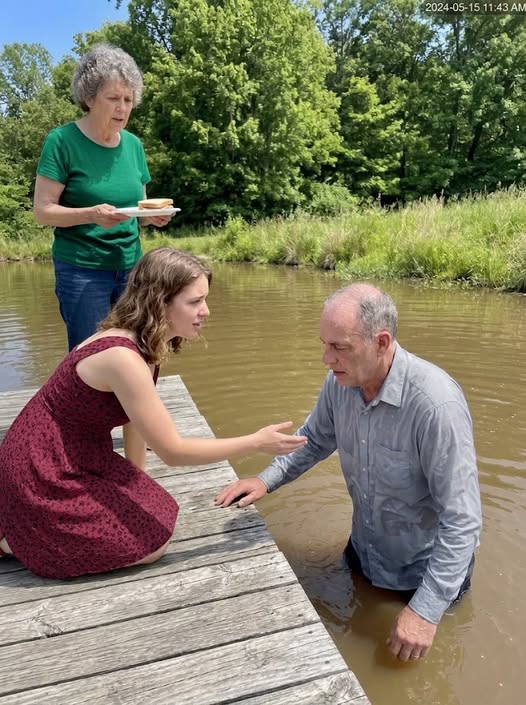
I saw it happen from six feet away. I was holding a paper plate of potato salad. Dad was standing at the end of the old wooden dock, looking out over the farm pond the way he looks at everything, quiet and patient, his good straw hat pushed back on his head.
Cindy came up behind him laughing and shoved.
Dad went in with a heavy, flat splash that sent brown water up over the dock boards. His hat landed upside down on the surface and turned in a slow circle.
He came up sputtering, waist-deep beside the dock. His light blue button-up shirt was soaked to the chest. The water came up past his belt buckle.
His hand went to his left ear. Then his right.
Nothing there.
Forty people at the reunion went quiet at once. Somebody’s radio kept playing an old George Strait song up by the barn. A kid on the tire swing stopped swinging.
Cindy stood on the dock behind me with her paper plate in one hand. She was smiling.
“Oh, Leon, lighten up,” she said. “You should’ve taken them out.”
He couldn’t hear a word she said.
I dropped my plate. Potato salad went across the dock boards. I got down on my knees in my yellow sundress and reached for my father’s hand.
“Daddy. Give me your hand.”
He looked up at me. His face was white under his tan, and his eyes were scared, really scared, in a way I’d never seen them. His mouth moved, but he was talking too loud, the way he does when he can’t hear himself.
“Kayla? Kayla, I can’t hear. They’re gone. Both of ’em.”
My father is sixty-eight years old. He climbed utility poles for the Ozark Rural Electric Cooperative for thirty-eight years, through ice storms and tornadoes and hundred-degree Augusts. When the big ice storm of 2007 took down half the lines in southwest Missouri, he worked nineteen days straight and slept in his truck.
He doesn’t fall in ponds.
I got both hands around his wrist and pulled. He found his footing in the mud and climbed out onto the bank, water pouring off him, his boots squelching. He stood there dripping, patting his ears over and over, like the hearing aids might come back if he just checked one more time.
My name is Kayla Brandt. I’m thirty-four, and I work as the billing coordinator at a dental office in Ozark, Missouri. I spend my days on the phone with insurance companies, explaining why a crown isn’t cosmetic and why a deep cleaning really is necessary. I know exactly what things cost. I know which insurance pays for what, and I know which ones pay for nothing at all.
And I know exactly what pond water does to anything with a battery in it.
That reunion was on the second Saturday in June, at the Brandt family farm outside Rogersville. It belongs to my husband Josh’s Uncle Gene. Every summer, the whole Brandt clan comes from all over Missouri and Arkansas: forty or fifty people, folding tables under the pecan trees, a smoker going since four in the morning, kids running wild in the hayfield, and the old men fishing off the dock.
It’s the kind of family event where everybody’s happy and nobody looks too closely at anything.
My father wasn’t a Brandt. He came because Josh invited him. Every year since my mother died, Josh has called him in May and said, “Leon, you’re coming to the reunion. Gene’s smoking a brisket, and I need somebody who can actually catch a fish.”
Dad always came. He always brought a pecan pie from the bakery in Ozark, because he never learned to bake after Mom passed, and he always stood a little off to the side, smiling, not quite part of it but glad to be asked.
I want you to understand that he was a guest. He was invited. And my mother-in-law pushed him into a pond.
Josh was up the hill helping Uncle Gene with the brisket when it happened. He heard the splash and the silence after it and came running down through the pecan trees with a pair of barbecue tongs still in his hand.
By the time he reached the dock, I already had Dad out of the water.
“What happened?” Josh said, breathing hard. “Leon, you okay?”
“He can’t hear you,” I said. “His hearing aids are gone.”
Josh looked at Dad, soaking wet and patting his ears. Then he looked at the dock.
His mother was still standing at the end of it with her paper plate, her coral lipstick perfect, her hair sprayed into its usual blond helmet.
“It was a joke, Joshie,” Cindy said, and laughed. “I didn’t push him that hard. How was I supposed to know he had those things in? Everybody takes their stuff out before they go near the water.”
“He wasn’t going near the water, Mom. He was standing on the dock.”
“Well, he should’ve been more careful.”
Josh’s face went tight. I watched him swallow whatever he wanted to say. Forty relatives were watching, and that’s a lot of eyes on a man about to yell at his mother at his own family reunion.
I knew what everybody was thinking, because I was thinking it too. Nobody calls the sheriff over a family reunion. Nobody calls a lawyer because somebody’s mother-in-law got silly on a dock. She was Josh’s mother. If this got fixed, it would have to be fixed by us.
“Let’s find them,” Josh said.
He kicked off his shoes, rolled up his jeans, and waded into the pond. Two of his cousins, Tyler and Brent, followed him in without being asked. All afternoon and into the evening, the three of them walked the bottom of that pond with their bare feet, shuffling slowly through the mud in a line, feeling for anything small and hard.
The water was murky and brown, about five feet deep at the end of the dock. Somebody brought a rake from the barn. Uncle Gene brought a big flashlight when the sun started going down.
They found a fishing lure, a beer can from probably 1985, and a kid’s flip-flop.
Not the hearing aids.
While they searched, I sat with Dad on a hay bale by the barn. Josh’s Aunt Peggy brought him a dry flannel shirt and a towel, and he changed behind the barn and came back with his wet shirt folded neatly over his arm, because that’s my father. Even in the worst moment, he folds his shirt.
He sat beside me and stared at the pond.
I knew those hearing aids. Dad had bought them three and a half years earlier at an audiology clinic in Springfield. They were good ones, rechargeable, with Bluetooth so he could hear phone calls right in his ears. He’d paid $4,100 for the pair, out of his savings, in cash.
I’d gone with him that day. I’d read the paperwork, because I read everyone’s paperwork. The price included a three-year loss and damage warranty: if they were lost, stolen, or damaged, the manufacturer would replace them once for a small deductible.
The warranty ran out at three years.
He’d had them three and a half.
And Medicare doesn’t pay for hearing aids. Not one dime. I deal with insurance every day, and that’s the rule that makes my patients the angriest. Original Medicare covers a hearing test if your doctor orders it, but not the hearing aids themselves. Dad has Original Medicare and a supplement plan, and none of it would help him.
So my father, a widower living on his co-op pension and Social Security, had just lost $4,100 he couldn’t get back, because my mother-in-law thought it would be funny.
The sun went down. Josh came out of the pond shaking his head, mud up to his knees.
Dad leaned close to me on the hay bale and spoke too loud, the way he does now when he can’t hear.
“Don’t make trouble with her on my account, sis.”
He’s called me sis since I was little. I don’t know where it came from. My mother used to say it was because he’d wanted a boy and settled for calling me something that sounded like one.
“Daddy…”
“I mean it.” He gripped my hand. His fingers were still cold from the pond. “She’s Josh’s mama. You got to live with these people. I’m just an old man at somebody else’s picnic.”
“You’re not just an old man. You’re my dad.”
He couldn’t hear me. He just patted my hand and nodded, like he understood anyway.
I didn’t say one word to Cindy that day.
I want to be honest about why. It wasn’t because I wasn’t angry. I was so angry my hands were shaking. It was because I knew if I opened my mouth in front of forty Brandts, I wouldn’t be able to stop. And Josh would be the one standing in the middle of it, and Dad would be the reason, and he would hate that more than losing the hearing aids.
So I helped my father to my car. I drove him home to his little house in Ozark with the windows down, because he likes the night air. At every stoplight I wrote notes on the back of a receipt and held them up so he could read them.
Are you cold?
He shook his head.
Do you want me to stay tonight?
He shook his head again. “I’ll be fine, sis. I got Duke.”
Duke is his old beagle. He’s fourteen, half blind, and as stubborn as Dad.
When we pulled into his driveway, I walked him to the door. Then he did something that made my throat close up.
He stopped on the porch, turned around, and said too loud, “I won’t hear the phone. If you call, I won’t hear it. You’ll have to text me.”
He’d had those hearing aids for three and a half years. Before them, he’d gone ten years pretending he could hear, nodding along at church and at the bank and at my wedding, missing half of every conversation. He told me once that buying them was like somebody turning the lights back on in a house he didn’t know had gone dark.
Now the lights were off again.
I drove home and found Josh sitting on our back steps in the dark, still muddy from the knees down, a beer in his hand that he wasn’t drinking.
I sat down beside him and didn’t say anything for a long time.
“She pushed him, Kayla,” he finally said. “I saw her hands on his back when I came down the hill. That wasn’t a little bump.”
“I know. I was standing right there.”
“And she laughed.”
“She laughed.”
He put his face in his hands.
I need to tell you about Cindy, because otherwise none of this makes sense.
Cindy Brandt is Josh’s mother. She’s fifty-nine, a few months short of sixty. She’s divorced from Josh’s father, Rick, who moved to Tulsa with a woman from his bowling league fifteen years ago and sends Josh a text on his birthday most years.
Cindy is the loudest person in every room. She has opinions about everything and announces all of them. She runs on attention the way a car runs on gas. When things are about her, she’s charming and funny and generous with compliments. When they aren’t, she finds a way to make them about her.
She’s not a monster. I want to be fair about that. She loves Josh in her own way. She’s good with our nephews. She’s the first one to bring a casserole when somebody’s sick.
But she’s careless with other people. With their feelings, their time, and their things. And when she breaks something, she laughs and tells you to lighten up.
At our wedding seven years ago, she gave a toast at the reception that lasted eleven minutes and was mostly about her own wedding. When Josh and I bought our house, she showed up on moving day, criticized the kitchen cabinets, and left before anything got carried in.
Two years ago, Josh co-signed a loan for her car, a white Buick Enclave, because her credit wasn’t good enough after the divorce. She missed three payments. Each time, the credit union called Josh, and Josh paid it so his own credit wouldn’t take the hit. That was $1,467 she never paid back. She never mentioned it, and Josh never asked.
And she’d never been kind to my father. Not mean, exactly. Just dismissive. At Christmas she talked over him. At the reunions she called him “Josh’s wife’s daddy” instead of his name. At Thanksgiving she once asked him, loudly, in front of everybody, whether he could even hear what she was saying, and then laughed when he said “What?”
My father has never said one unkind word about her. Not one.
So here’s what I hadn’t told anybody.
For eighteen months, Josh and I had been putting back $250 a month into a savings account at our credit union. The account was labeled MOM’S 60TH on our banking app.
We were going to send Cindy on a cruise for her sixtieth birthday next spring: four nights out of Galveston to Cozumel, an ocean-view cabin, with a little extra for her shore excursions and souvenirs. It was Josh’s idea. His mother had always wanted to go on a cruise. She’d talked about it his whole life. She’d never been anywhere farther than Branson.
By June, the account held $4,500.
And Cindy knew. Josh had made the mistake of mentioning it at Christmas, with the details still fuzzy, and she had grabbed onto it with both hands. She’d been telling the whole beauty shop about it ever since.
Every Friday morning, Cindy got her hair done at Darlene’s Shear Elegance on Main Street. Every Friday since Christmas, according to everyone in town, she’d told the ladies under the dryers about her cruise. “My son is sending me on a cruise for my sixtieth. Out of Galveston. Ocean view. He’s such a good boy.”
She’d already bought cruise clothes. She’d shown me a new swimsuit cover-up and three sundresses from Dillard’s, charged to her store card. She’d bought a waterproof phone case and a sun hat with a brim the size of a hubcap.
The cruise wasn’t booked yet. We were waiting for the spring prices to drop. The money was still sitting in our account.
That Sunday evening, the day after the reunion, I sat with Josh on our back steps again. The cicadas were loud in the oak trees. The light was going gold over the neighbor’s soybean field.
I’d been thinking about it all day.
“I want to spend it on Dad,” I said.
Josh didn’t answer right away. He looked out at the yard for a long time, at the clothesline, the swing set we’d put up for the nephews, the garden with its rows of green beans.
I’d spent the morning doing what I do at work. I’d made phone calls and gotten the facts.
First I called Dad’s homeowner’s insurance agent, a nice man named Mr. Kessler at the Farm Bureau office in Ozark. I asked whether Dad’s policy would cover the hearing aids.
“I’m sorry, Kayla,” he said. “Unless he’d added them to his policy as scheduled personal property, a standard homeowner’s policy generally doesn’t cover something just being lost in a pond. It covers things like fire and theft. Dropping something in the water isn’t one of the covered causes. I wish I had better news.”
Then I called the audiology clinic in Springfield. The office manager confirmed that the loss and damage warranty on Dad’s pair had expired six months earlier. A new comparable pair would run between $4,000 and $4,500, depending on the model. They offered financing through a medical credit card, at zero interest for twelve months but twenty-six percent after that.
I knew all about those medical credit cards from work. I’ve seen them swallow older patients whole.
Then, God help me, I looked up the small claims court rules in Missouri. You can sue someone in small claims for up to $5,000 without a lawyer. The filing fee in Greene County is around forty dollars. I could have filed against Cindy for the full $4,100, and I had forty witnesses.
I sat at my kitchen table and imagined it. Me and Dad on one side of a courtroom. Cindy on the other, in her coral lipstick. Josh in the middle, having to testify about his own mother.
I closed the laptop.
“I’m not suing your mother,” I told Josh on the steps. “I thought about it. I looked it up. But I’m not putting you through that. And Dad would never forgive me.”
“I know you wouldn’t.”
“But I’m not letting him go deaf again either. He can’t afford it, Josh. He’s on a fixed income. His pension from the co-op is eighteen hundred a month, and his Social Security is about fourteen hundred. His property taxes and his supplement premium alone eat up a big chunk of that. He’d put it on one of those twenty-six percent cards before he’d ask me for help. Or he’d just go without. He went without for ten years before.”
Josh still didn’t say anything.
“The cruise money is ours,” I said. “We saved it. We earned it. And your mother is the reason my dad can’t hear the phone ring.”
Josh set down his beer.
“It was ours to give,” he said finally, still looking at the yard. “Do it.”
I let out a breath I hadn’t known I was holding.
Then he said something that made me love him more than I already did.
“And I’ll tell Mom myself.”
“Josh, you don’t have to…”
“Yes, I do.” He turned and looked at me. His eyes were wet. “She pushed your father into a pond, Kayla. Then she laughed at him. And I stood there with a pair of barbecue tongs and didn’t say a single word to her because forty people were watching.” He shook his head. “I’m thirty-six years old. I’m done being scared of my mother.”
I put my head on his shoulder. We sat there until the fireflies came out over the soybeans.
On Monday morning I called the dental office and took a personal day. Dr. Halverson, my boss, didn’t even ask why. He just said, “Take care of whatever it is, Kayla.”
I picked Dad up at eight. He was waiting on his porch in his church clothes, a pressed white shirt and his good khakis, his hair combed with water. He’d dressed up for the audiologist the way men of his generation dress up for the bank or the doctor.
He climbed into my car. “Where are we going, sis?”
I’d written it out on a yellow legal pad the night before. I held it up.
Springfield. Audiologist. New hearing aids. My treat.
He read it twice, and his face changed.
“No, ma’am,” he said too loud. “No. I’ll figure something out.”
I flipped the page. I’d written the next part ahead of time, because I knew exactly what he’d say.
Already made the appointment. 9:30. Don’t argue with me. You taught me not to quit.
He looked at that for a long time. Then he looked out the windshield, and his jaw worked.
“Your mama would’ve done the same thing,” he finally said. “Stubborn as a mule. Just like you.”
We drove the forty minutes to Springfield in silence. He couldn’t hear the radio, so I left it off. He watched the cattle fields and the cell towers go by, and every so often he’d point at something, a hawk on a fence post, a new subdivision going in, and I’d nod.
The audiology clinic was in a brick building off South National Avenue. The audiologist was a calm young woman named Dr. Nguyen with gentle hands and a soft voice. She’d fitted Dad’s original pair and remembered him.
“Mr. Lowery! How are those hearing aids treating you?”
Dad looked at me helplessly. I wrote on my pad: She asked about your hearing aids.
“They’re at the bottom of a pond,” he said loudly.
Dr. Nguyen’s eyebrows went up.
I explained the rest in a low voice while Dad sat in the chair.
Dr. Nguyen listened. When I finished, she was quiet for a moment.
“I’m so sorry,” she said. “Losing them is hard on anybody. For someone his age, it can be really isolating. People stop going out. They stop talking on the phone. It happens faster than you’d think.”
“I know,” I said. “That’s why we’re here.”
She ran a new hearing test. Dad’s hearing had gotten a little worse in three and a half years, which is normal. She recommended the newest version of the same model, slightly stronger, rechargeable, with the same Bluetooth connection to his phone.
Then she printed the quote and slid it across the desk.
The new pair came to $4,300. That included the fitting, follow-up adjustments for a year, and a new three-year loss and damage warranty.
“We have financing options,” Dr. Nguyen said gently.
“No, thank you,” I said. “I’ll pay today.”
I took out my debit card for our joint savings account, the one labeled MOM’S 60TH.
Dad saw the number on the quote and grabbed my arm.
“Kayla. That’s too much. That’s your money.”
I didn’t argue. I wrote on my legal pad in big block letters and held it up so he could read it.
IT’S FAMILY MONEY. YOU’RE FAMILY.
He read it. His chin trembled. He looked down at his big, scarred hands, the hands that had climbed poles for thirty-eight years, and didn’t say anything.
I handed the card to the receptionist. She ran it, and the machine beeped. Approved.
There was $200 left in the account labeled MOM’S 60TH.
Out in the parking lot, Dad stopped beside my car and kept shaking his head.
“That’s your money, Kayla,” he said again, too loud. “Your and Josh’s money. You been saving it for something.”
I didn’t tell him what for. I’ve never told him. He doesn’t know to this day that the money was meant for Cindy’s cruise. I think it would break his heart, and I think he’d try to pay it back, a hundred dollars at a time out of his pension, for the rest of his life.
So I just wrote: We were saving it for something important. This is important.
He folded the page carefully, tore it off the pad, and put it in his shirt pocket.
The new hearing aids had to be ordered from the manufacturer. Dr. Nguyen said it would take three days.
Those three days were hard. I called Dad every morning and every evening by FaceTime, so he could see my face and read my lips. On Tuesday, he didn’t answer. I drove over on my lunch break, my heart in my throat, and found him in the backyard pulling weeds. He hadn’t heard the phone.
On Wednesday, the pharmacy in Ozark called his house phone to say his blood pressure prescription was ready. He didn’t hear that either. I found out because the pharmacist, a sweet woman named Gloria who’s known Dad for twenty years, called me instead.
“Kayla, honey, is your daddy okay? He didn’t pick up, and he always picks up.”
“He’s okay, Gloria. He just can’t hear right now. It’s a long story.”
That night, Josh came home from work at the John Deere dealership and found me crying at the kitchen table.
“He’s going to be okay,” Josh said, putting his arms around me. “Thursday. Just one more day.”
“It’s not just the hearing aids,” I said into his shirt. “It’s that she did this to him, and she doesn’t even care. She hasn’t called. She hasn’t texted. Nothing. She doesn’t even know if he’s okay.”
Josh held me tighter. “She called me,” he said quietly.
I pulled back. “When?”
“Yesterday. She wanted to know if we’d booked the cruise yet. Said the spring prices were dropping, and Darlene at the beauty shop had a cousin who works for a travel agency.”
“What did you say?”
“I said we’d talk Saturday. In person.” He wiped my face with his thumb. “I’m not doing it on the phone, Kayla. She’s going to look at me when I tell her.”
On Thursday, they fitted the new hearing aids.
Dr. Nguyen put them in Dad’s ears in her little exam room with the pictures of mountains on the walls. She plugged them into her computer and adjusted the settings while Dad sat very still in the chair, hands folded in his lap.
“Mr. Lowery,” she said in her normal voice. “Can you hear me?”
Dad’s whole face changed.
“Yes, ma’am,” he said. And for the first time in five days, he said it at a normal volume. He didn’t have to shout.
“How does my voice sound?”
“Sounds like you.” He laughed, and his voice cracked. “Sounds just like you.”
Dr. Nguyen spent half an hour showing him how to charge them, how to clean them, and how to connect them to his phone. Then she showed him something new.
“These have a ‘find my hearing aid’ feature on your phone,” she said. “If you ever lose one, the app can show you the last place it was connected.”
“Wouldn’t have helped in the pond,” Dad said dryly.
Dr. Nguyen laughed. “No. But you might want to keep them out of ponds from now on.”
“Wasn’t my idea to go in,” he said.
At the front desk, I asked about one more thing. I’d called Mr. Kessler at Farm Bureau again on Wednesday.
“You can add the new hearing aids to your dad’s homeowner’s policy as scheduled personal property,” he’d told me. “Then they’re covered for loss, even if they get dropped in a pond. It’ll cost him about forty dollars a year. All I need is the receipt.”
I got a copy of the receipt from the clinic, and that afternoon I emailed it to Mr. Kessler. By Friday the hearing aids were listed by serial number on Dad’s policy, covered for $4,300 against any kind of loss.
I’ll tell you, I’ve never been so happy to pay forty dollars in my life.
When we walked out of the clinic into the parking lot, Dad stopped under the oak trees along the sidewalk.
He tilted his head.
“What kind of bird is that?”
I listened. Up in the oak tree, a mockingbird was going through every song it knew: a cardinal, a blue jay, a robin, the squeak of a gate, something that sounded almost like a car alarm. Over and over, running through its whole list, one song after another.
“It’s a mockingbird, Daddy.”
“A mockingbird,” he repeated softly.
He stood there in the parking lot of a medical building on South National Avenue, in his pressed white shirt and his good khakis, with his head tilted back and his eyes closed, listening like it was the first bird God ever made.
I had to look at the pavement for a minute.
Mom used to love mockingbirds. She kept a bird feeder outside the kitchen window of their house on Elm Street for thirty years, and she could name every bird that came to it. When she was dying, in the hospice room at Mercy Hospital, a mockingbird sat outside her window every morning for a week and sang. She said it was the prettiest sound she’d ever heard.
Dad hadn’t been able to hear it. That was before he got his first hearing aids.
He told me once, after she passed, that he’d sat by her bed every morning and watched her smile at that bird, and he couldn’t hear a single note.
Now he stood under the oak tree and listened to the mockingbird for a long, long time.
“Your mama would’ve known what all those songs were,” he said quietly. “Every one of ’em.”
“I know, Daddy.”
He opened his eyes and looked at me. He’d heard me. He’d heard me say it in a normal voice, standing three feet away.
He put his arms around me right there in the parking lot and held on.
On Saturday morning, Josh drove out to his mother’s place, and I rode along.
Cindy lives in a tan double-wide on two acres outside Rogersville, about three miles from Uncle Gene’s farm. The yard is full of ceramic geese, wind chimes, and a sign by the porch that says THIS IS MY HAPPY PLACE. Her white Buick Enclave, the one Josh co-signed for, was parked in the gravel drive.
Josh didn’t say much on the drive. His hands were tight on the steering wheel of his truck. At a stop sign on Highway 125, he looked over at me.
“If I start backing down,” he said, “you squeeze my hand.”
“You won’t back down.”
“I’ve been backing down from her my whole life, Kayla.”
“Not today.”
When we pulled into the gravel drive, Cindy came down her porch steps to meet us in the front yard. She was wearing one of the new Dillard’s sundresses, a turquoise one with big white hibiscus flowers, and her hair was freshly done. Friday had been beauty shop day.
“There’s my boy,” she said, holding her arms out.
Josh didn’t hug her.
He stood in the gravel with his hands in his jacket pockets, and he looked straight at his mother.
“Mom, there’s no cruise.”
She laughed. It was the same laugh from the dock, high and bright and careless.
“Very funny.”
“It’s not a joke,” he said. “Kayla spent it Monday. On Leon’s ears.”
Cindy looked at me. Then at her son. Then she opened her mouth.
What came out was a sound I’d never heard from her before. It wasn’t a word. It was a kind of strangled gasp, like somebody had knocked the wind out of her.
“You spent my cruise money,” she said finally, very slowly, “on that old man’s hearing aids?”
“It wasn’t your money, Mom. It was ours. We saved it. And yes, we spent it on Leon’s hearing aids. The ones you knocked into the pond.”
“I did not knock them into the pond! He fell!”
“You pushed him.” Josh’s voice was steady. “I saw your hands on his back when I came down the hill. Kayla was standing right there. So were forty other people.”
“It was a joke! Everybody was laughing!”
“Nobody was laughing, Mom. Except you.”
Cindy’s face went red under her makeup. She looked at me, and her eyes narrowed.
“This is your doing,” she said. “You put him up to this.”
“No, ma’am,” I said quietly. “I didn’t.”
“She didn’t,” Josh said. “It was my decision too. And I’m the one telling you.”
“I’ve told everybody about that cruise! The whole beauty shop! Darlene! Carol! The ladies from church! What am I supposed to tell them now?”
“Tell them the truth,” Josh said. “Tell them you pushed a sixty-eight-year-old man into a pond, his hearing aids cost forty-one hundred dollars, and your son paid to replace them.”
Cindy stared at him.
“I bought clothes,” she said, and her voice cracked. “I bought three sundresses and a cover-up and a hat. On my Dillard’s card. Six hundred dollars.”
“Then you can return them,” Josh said. “Or you can keep them and pay for them yourself, Mom. Like the rest of us do.”
For a long moment, nobody said anything. The wind chimes on the porch tinkled in the breeze. One of the ceramic geese had fallen over in the flower bed.
Then Cindy did what she always does when she’s losing. She cried.
It wasn’t quiet crying. It was big, loud, heaving sobs, standing in her gravel driveway in a turquoise sundress.
“I can’t believe this,” she wailed. “My own son. On my sixtieth birthday. Choosing her family over his own mother. After everything I’ve done for you, Josh. After I raised you all by myself after your daddy left!”
I felt Josh’s hand twitch. I reached over and squeezed it.
He didn’t back down.
“Mom. I love you,” he said. “But you need to hear this. Two years ago, I co-signed your car loan. You missed three payments, and I paid them. Fourteen hundred and sixty-seven dollars. I never said a word about it. At my wedding, you gave an eleven-minute toast about yourself. At Thanksgiving, you made fun of Leon for not hearing you. And last Saturday, you pushed him into a pond and laughed while he stood there in the water, scared to death, patting his ears.”
Cindy stopped crying. She stared at him with her mouth open.
“I’ve been making excuses for you my whole life,” Josh said, and his voice finally shook. “Dad left, and you were hurting, and I understood that. But Leon has never done one unkind thing to you. Not one. He comes to our reunions because I invite him. He brings pie. He stands in the back. And you treated him like he was nothing.”
“I didn’t…”
“You did, Mom. And you didn’t even call to see if he was okay. Not once. All week. You called me to ask about the cruise.”
Cindy opened her mouth again. This time, nothing came out.
“I’m not cutting you off,” Josh said. “You’re still my mother. You’re still coming to Thanksgiving. But there’s no cruise. And I want you to think about what you did.”
He turned and walked back to the truck.
I stood in the gravel a moment longer, looking at my mother-in-law. She looked small all of a sudden, standing in front of her THIS IS MY HAPPY PLACE sign in a sundress she couldn’t afford.
“He can hear the birds again,” I said quietly. “My dad. On Thursday, in the parking lot, he heard a mockingbird. He just stood there and listened to it.”
Cindy looked at me. Something flickered across her face. I couldn’t tell what.
Then I got in the truck, and Josh drove us home.
Neither of us said anything for the first five miles. Then, at the stop sign on Highway 125, Josh pulled over onto the shoulder, put the truck in park, and put his forehead against the steering wheel.
He was shaking.
“I did it,” he said into the steering wheel. “I actually did it.”
“You did it.”
“I’ve never talked to her like that in my life.”
“I know.”
He lifted his head and looked at me. His eyes were red. “Did I go too far?”
I thought about my father in the pond, waist-deep in the brown water, patting his ears.
“No, baby,” I said. “You went exactly far enough.”
The next two weeks were quiet. Cindy didn’t call. She didn’t text. She skipped Sunday dinner at Uncle Gene’s, which she’d never done in thirty years.
But she did go to the beauty shop.
On the Friday after we told her, Cindy went to Darlene’s Shear Elegance for her standing ten o’clock appointment. Josh’s Aunt Peggy, who also gets her hair done there, told us what happened.
Cindy sat in Darlene’s chair and announced to the whole shop that her daughter-in-law had “stolen her cruise money” and spent it on “her daddy,” and that her own son had “turned against her.”
She expected sympathy.
What she didn’t know was that Darlene’s brother is Tyler’s father-in-law. Tyler was one of the cousins who walked the pond bottom until dark looking for the hearing aids. And Tyler had told his wife, and his wife had told her mother, and her mother had told Darlene, and by that Friday, every single woman in that beauty shop already knew exactly what had happened on that dock.
According to Aunt Peggy, Darlene stopped cutting Cindy’s hair. She set her scissors down on the counter. She looked at Cindy in the mirror.
“Cindy,” Darlene said, in front of the whole shop, “I heard you pushed Leon Lowery off Gene’s dock and his hearing aids sank. Is that true?”
The shop went dead quiet.
Cindy started to say it was a joke.
“Leon Lowery restored power to my mama’s house in the ice storm of ’07,” Darlene said. “She was on oxygen. He climbed that pole at two in the morning, in sleet, so her machine would keep running. I’ve never forgotten it.” She picked up her scissors again. “Those kids didn’t steal anything from you, Cindy. They paid for what you broke.”
According to Peggy, Cindy didn’t say another word for the rest of the appointment. She paid, left a smaller tip than usual, and walked out with her hair half done.
I’ll admit I felt a little sorry for her when I heard that. Just a little.
Peggy also told us something else.
“She came to my house after,” Peggy said. Peggy is Cindy’s older sister. “She sat at my kitchen table and cried for an hour. And I told her the same thing Darlene did. I said, Cindy, you’ve been careless with people your whole life, and everybody’s always cleaned up after you. This time your boy made you look at it.”
“What did she say?”
Peggy sighed. “She said, ‘I didn’t think it would hurt him that bad.’ And I said, ‘You never think, Cindy. That’s the problem.’”
On the first Saturday in July, three weeks after the reunion, I drove over to Dad’s house to help him clean out his gutters. He insists on doing it himself every summer, and I insist on holding the ladder.
When I pulled into his driveway, there was a white Buick Enclave parked out front.
My stomach dropped.
I parked behind it and walked around to the backyard. Dad was sitting in one of his old green metal lawn chairs on the patio, wearing his new hearing aids, with Duke asleep at his feet.
Across from him, in the other lawn chair, sat Cindy.
She wasn’t wearing the turquoise sundress. She was wearing jeans and an old Rogersville Wildcats sweatshirt, with hardly any makeup on. Her hair wasn’t done. There was a pecan pie on the little patio table between them, in a store container from the same bakery in Ozark where Dad buys his.
They both looked up when I came around the corner.
“Hey, sis,” Dad said, at a perfectly normal volume.
“Hi, Daddy.” I looked at Cindy. “Cindy.”
“Kayla.” She looked down at her hands.
“Pull up a chair,” Dad said. “Cindy was just telling me something.”
I sat down slowly on the edge of the brick planter. Duke lifted his head, sniffed my shoe, and went back to sleep.
Cindy didn’t look at me. She looked at Dad.
“I was telling him,” she said, in a small voice I’d never heard from her, “that I’m sorry. For pushing him. And for laughing. And for not calling to see if he was okay.”
Dad nodded slowly.
“And I brought this.” She reached into the pocket of her sweatshirt and pulled out a white envelope. She set it on the table beside the pie and pushed it toward Dad with one finger. “It’s eight hundred dollars. It’s not the whole thing. I know it’s not. It’s what I got back when I returned the sundresses and the hat, plus what I had in my savings. I’ll send more when I can.”
Dad looked at the envelope. He didn’t pick it up.
“Cindy,” he said gently, “I don’t want your money.”
“I know you don’t,” she said, and her eyes filled up. “But I want to give it to you. Josh said something to me in my front yard. He said I’ve been careless with people my whole life and everybody always cleaned up after me.” She wiped her eyes with the sleeve of her sweatshirt. “He’s right. I have been. And I don’t want my son to be ashamed of me.”
Nobody said anything for a while. A mockingbird started singing somewhere in Dad’s pecan tree. Dad tilted his head toward it, just a little, and smiled.
Then he picked up the envelope, turned in his chair, and held it out to me.
“Sis,” he said. “This is family money. You know where it goes.”
I looked at him. Then at Cindy.
Then I took the envelope.
That night, I deposited Cindy’s $800 into the account at the credit union labeled MOM’S 60TH. It had $200 left in it after we paid for Dad’s hearing aids. Now it had $1,000.
Then I renamed the account.
I sat at the kitchen table with Josh and showed him on my phone. The old name, MOM’S 60TH, was gone. The new one said FAMILY MONEY.
Josh looked at it a long time.
“We keep putting in two-fifty a month,” I said. “Same as before. But it’s not for one person anymore. It’s for whoever in this family needs it. Your mom, my dad, the nephews. Whoever.”
Josh nodded slowly. “What about Mom’s cruise?”
“Maybe someday,” I said. “If she earns it.”
He laughed, a real one, and kissed the top of my head.
I’m not going to pretend everything was fixed after that, because it wasn’t. Cindy is still Cindy. She’s still loud. She still has opinions about my kitchen cabinets. At Thanksgiving she talked through the blessing and dominated the conversation for most of the meal.
But something had changed.
At Thanksgiving, when my father said something quietly at the end of the table, a story about the ice storm of ’07 that nobody had heard, Cindy did something I’d never seen her do.
She stopped talking.
“Leon, say that again?” she said. “I didn’t catch it.”
Dad looked surprised. Then he told the story again, louder, to the whole table. Cindy listened all the way through without interrupting once.
For Cindy, that’s practically a miracle.
On her sixtieth birthday in March, there was no cruise. Josh and I took her to dinner at a steakhouse in Springfield and gave her a card with a framed photo inside: the whole family on Uncle Gene’s dock at the reunion two summers before, everyone squinting into the sun, Dad standing at the end in his straw hat.
She looked at that picture for a long time. Then she said quietly, “I’ll keep my hands to myself on that dock from now on.”
“Good,” Josh said.
She laughed. But it wasn’t the dock laugh. It was softer.
In April, she sent Dad another envelope, a hundred dollars and a note in her loopy handwriting: For the family money. —C.
In May, she sent another hundred.
Dad gave each one to me without a word, and I deposited them all in the account.
The next June, on the second Saturday, the Brandt family reunion was held at Uncle Gene’s farm again, the way it always is.
Josh called Dad in May, the way he always does.
“Leon, you’re coming to the reunion. Gene’s smoking a brisket, and I need somebody who can actually catch a fish.”
Dad came. He brought a pecan pie from the bakery in Ozark.
But this year he didn’t stand off to the side. Uncle Gene put him on the smoker. Cousin Tyler, the one who walked the pond bottom until dark, brought him a lawn chair and a cold Dr Pepper and sat with him for an hour talking about the co-op. A couple of the little kids followed him down to the dock and asked him to teach them to fish.
He did. He baited their hooks and showed them how to cast. When one of them, a six-year-old named Maddie, caught a bluegill the size of her hand, he laughed so loud you could hear him all the way up at the barn.
Somewhere in the middle of the afternoon, I saw Cindy walking down toward the dock with a paper plate in her hand.
My whole body went tight.
She stopped at the edge of the dock, about ten feet from where Dad was sitting with the kids. She stood there for a moment.
Then she called out, “Leon? You want some potato salad?”
Dad turned around. He’d heard her clearly, from ten feet away.
“I’d love some, Cindy. Thank you.”
She walked the plate out to him, handed it over very carefully with both hands, and then walked back to the bank, well away from the edge.
When she passed me on her way back up the hill, she gave me a small, embarrassed smile.
“I’m staying off that dock,” she said. “Permanently.”
I laughed. I couldn’t help it.
Late in the afternoon, when the sun was going gold over the hayfield and the old men were packing up their fishing poles, I walked down to the dock and sat beside my father at the end of it, my feet dangling over the brown water.
He was quiet, listening. Somewhere up in the pecan trees, a mockingbird was singing, running through its whole list: cardinal, blue jay, robin, gate squeak. Over and over.
“Your mama would’ve known every one of those songs,” he said quietly.
“I know, Daddy.”
He reached over and patted my hand, the way he always does.
“Thank you, sis,” he said. “For my ears.”
I didn’t answer. I just leaned my head against his shoulder, and we sat there together at the end of the dock in the evening light, listening to the mockingbird sing every song it knew.
He heard every single one.
THE END..!