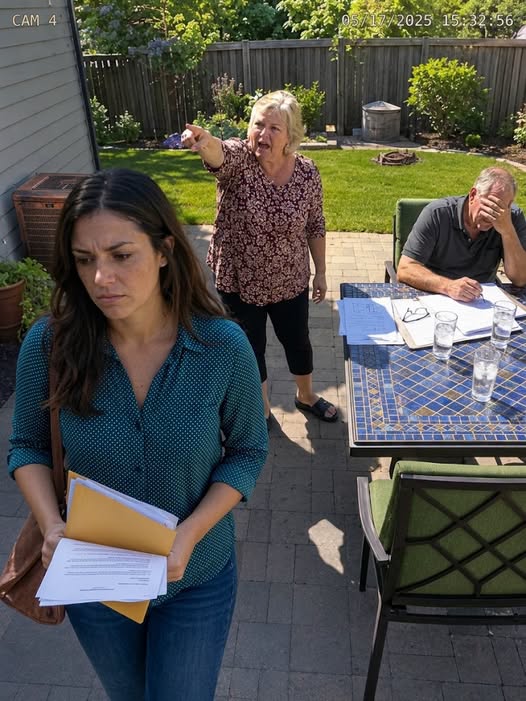
My name is Natalie Mercer. I’m thirty-one years old, and three weeks ago my mother pointed at the front door and screamed at me to get out and never come back.
Her voice cracked when she said it, like I’d committed some unforgivable sin, like I was a burden she’d finally decided to throw away.
So I left. I didn’t beg. I didn’t argue. I didn’t remind her that I’d spent years quietly holding her whole life together. I just picked up my bag and walked out the door.
What she didn’t know was that some doors don’t just close emotionally. They close financially too.
I hadn’t gone there looking for a fight that day. I went the way I always did—trying to keep the peace, ignoring the little digs and the cold tone. But that afternoon, something got exposed, and suddenly I wasn’t family anymore. I was an outsider. A problem.
For days I kept waiting for my phone to ring with an apology, or even just a “are you okay?”
That call never came.
What came instead, weeks later, was my father standing in front of me with a face I’d never seen before, asking why the mortgage payments had stopped.
I looked at him and said the only thing that made sense.
“I’m not your child.”
Not in the way that mattered to them, anyway.
I grew up in Matthews, just outside Charlotte, in a neighborhood where every house looked stable from the street even when the people inside were barely holding it together. Trim lawn. Decent porch. A little American flag out front every Fourth of July. Church on holidays. From the outside, we looked fine.
But money had always been a quiet emergency in our house—the kind nobody named out loud until things got bad enough to turn into blame. My dad worked warehouse operations, always promising the next promotion would fix everything. My mom worked the front desk at a pediatric clinic and treated appearances like a second job. We could be behind on bills, but the curtains still had to be pressed and the porch swept, because the neighbors needed to think we were doing just fine.
I was the kid who studied hard, stayed out of trouble, got scholarships, worked extra shifts. By my late twenties I had a solid job in health compliance, a nice apartment in Charlotte, enough stability to breathe without checking my bank account three times a day.
Then my dad got downsized, and whatever fragile balance my parents had been faking collapsed fast. They fell behind on the mortgage. Then behind again. By the time my mom finally called me crying, the bank was already sending letters with language serious enough to make my stomach drop.
“We’re going to lose the house,” she kept saying. “Everything we worked for is going to disappear.”
I remember standing in my kitchen, phone pressed to my ear, staring at the Charlotte skyline while she cried. That old reflex kicked in. Fix it. Don’t ask who created the mess. Just fix it.
So I did. I covered the overdue amount. I called the mortgage servicer myself and asked questions my parents had never bothered to ask. Turned out it was worse than they’d admitted. There was no backup plan. No relative stepping in. No retirement fund. Just me.
I set up recurring payments from my own account and told myself it was temporary. Just until they got back on their feet.
Temporary turned into four years.
Four years of monthly withdrawals so consistent they became part of my life the way rent or groceries were. Except these payments weren’t keeping a roof over my head. They were keeping one over people who never stopped acting like I was the difficult one.
My mother never knew the full mechanics of it. Honestly, she didn’t want to know. She preferred the version where the bank had “worked something out” so she could keep performing respectability. My father asked even fewer questions than she did, which was its own kind of answer.
Meanwhile I became the invisible support beam holding the whole place up. I drove out most Sundays, brought groceries, fixed things around the house when they broke—and listened to my mother complain about people who were, depending on the day, selfish, entitled, or ungrateful.
She loved reminding me I “lived in the city now” and didn’t understand real pressure. She rolled her eyes at my job, then acted offended if I missed a weekend. If I bought something nice for myself, she’d say it must be easy to waste money when you had nobody else to think about. If I dated someone, she found a flaw. If I stayed single, that was a flaw too. Nothing about me was ever simply enough.
My dad would sit through all of it, stirring his coffee, giving me that tired look men like him give when they want credit for not being the one doing the damage.
My younger brother had already figured out what it took me years to admit. He moved to Denver and kept his distance. I used to think that meant he was checked out. Later I realized it meant he was healthy enough to leave.
I stayed because I thought loyalty meant endurance. I put off buying my own place because I was paying theirs. I turned down trips because there was always some expense at the house. I told myself I didn’t resent it, then wondered why I was exhausted all the time.
The truth was ugly and simple. I was financing the stability of a family that still treated me like I was failing some impossible test. And because nobody knew the full truth, nobody had to feel grateful. They got to keep their house and their pride. I got to keep writing checks and calling it love.
Everything blew up on a Sunday that started so normally it should have warned me.
I drove out around noon, picked up drinks on the way, walked into the backyard to find my mother already performing happiness. She’d set the patio furniture just so, marinated way too much food, and kept dropping hints about “big plans.” I should’ve known that meant she was trying to prove something.
Halfway through lunch, she brought it up. She’d been talking to someone about refinancing, maybe pulling cash out of the house. Maybe getting a new SUV. Maybe finally taking a cruise like other people their age.
She said it loud enough that the message underneath was clear. We’re fine. We’re more than fine.
Then her phone rang. She glanced at the screen, smiled like she was about to close some big deal, and answered on speaker without even leaving the table.
At first it sounded routine—identity verification, property address, a few polite questions. Then the loan officer said there was an issue with the file. He said the payment history showed a consistent outside funding source over the last forty-eight months, and they needed clarification, because the account making the mortgage payments didn’t belong to either borrower on the loan.
The silence that hit that yard after those words is something I’ll never forget.
My mother’s face changed so fast it was hard to process. One second confident, the next exposed, then furious. She grabbed the phone off speaker, but it was too late. Everyone at the table had heard enough.
She hung up. Turned to me slowly.
“What was that woman talking about?”
When I didn’t answer fast enough, she stood up. “Natalie. What was she talking about?”
I kept my voice steady. “I’ve been making sure the mortgage got paid.”
I told her why. That the house was weeks from disaster the first time, and nobody in it had ever gotten stable enough to keep it afloat since. I thought maybe the truth would land with shock first, gratitude later.
What I got instead was rage.
She accused me of humiliating her. Sneaking behind their backs. Acting like I owned them. She said I did it to feel superior, that this was what happened when kids made money and forgot where they came from.
I told her nobody had forgotten where they came from more than the people sitting in a house they hadn’t been paying for.
That’s when it snapped. She started shouting loud enough for the neighbors to hear through the fences. Ungrateful. Manipulative. Arrogant. No right to interfere. No right to turn their home into a charity project.
I looked at my father, some part of me still hoping he’d do something if it got bad enough.
He didn’t. He just sat there stunned—not stunned enough to speak, not stunned enough to defend me, not stunned enough to point out that the woman who’d paid the mortgage for four years didn’t deserve to be screamed at in her own childhood backyard.
Then my mother pointed at the gate.
“Get out and never come back.”
I stood there for a second, waiting for her to pull it back. Waiting for my father to step in. Neither happened.
So I went inside, grabbed the overnight bag I still kept in my old room, and walked out without another word. Because I finally understood something I should’ve understood years earlier. If I had to defend my right to basic dignity in a house I was helping keep standing, then whatever I was doing there wasn’t love anymore.
By the time I got back to my apartment, I was still shaking. I opened my laptop, pulled up the recurring payment, and stared at the screen for maybe ten seconds before I canceled it. No speech. No drama. Just one click.
Then I left the family group chat, put my phone on silent, and let them live inside the consequences of my absence for the first time in years.
The first week felt muffled, like the world had gone quiet. I went to work, answered emails, sat in meetings, acted normal while my whole family had just detonated over barbecue and buried finances.
At night I kept circling the same questions. Had she really meant it? Had my father really let me walk out like that? Had I actually just stopped paying the mortgage on the house I’d protected for years?
Yes to all three. My nervous system just hadn’t caught up yet. I still caught myself reaching for my phone on Sundays out of habit.
My best friend Erica was the first person who didn’t let me romanticize any of it. She came over with takeout, listened to everything, and then said the sentence that made me go quiet.
“Natalie, the only time they treated you like family was when you were useful.”
I wanted to argue. I wanted to say it was more complicated. But a clean sentence like that cuts straight through years of loyalty-fog.
I started therapy that same week, because I knew if I didn’t, I’d eventually talk myself back into the same arrangement just to relieve the guilt.
Meanwhile, the messages started. First from my dad, pretending nothing had happened. How’s work? Give us a call. Then the tone shifted. Have you spoken to the bank lately? There’s an issue with the portal. A notice came in the mail.
Then, once they connected the dots, my mother started messaging through other people, since she’d blocked me herself in a fit of pride and apparently hadn’t thought that part through. My aunt texted that Mom was “very upset about some banking confusion.” A cousin asked if I knew why my parents got a default notice.
Erica read one message and laughed. “Your mother really said ‘get out and never come back,’ then acted shocked when your money left too.”
Weeks passed. I held the line. Late fees stacked up. Letters got sharper. My father finally stopped pretending this was some technical glitch and started reaching out with real urgency.
I still didn’t answer. Not because I was cruel, but because I knew how the cycle worked. If I let them skip the part where they acknowledged what happened, they’d go straight back to the part where I fixed everything, and nothing would change.
My therapist helped me put language to something I’d never let myself say out loud: I wasn’t abandoning my family. I was stepping out of a role they’d assigned me without ever asking, and then punished me for playing too well.
Around week three, my brother called. He said Dad had reached out, said the bank was moving faster than expected, and Mom was in full panic mode. Then he said something that stuck with me. “Dad only notices a fire when the smoke reaches him.”
A few days later, my building’s front desk called up to say a man was downstairs asking for me. It was my father. He’d never come to my apartment before. Not when I moved in, not on a single birthday. But now that the money had stopped, he’d found my address and made the drive.
I met him in the lobby. I wasn’t ready to let that conversation into my actual home.
He looked older than he had a month earlier. Shoulders bent forward. Eyes tired in that way that comes from fear, not age. We sat near the windows. He didn’t waste time on small talk.
“Why did you stop paying the mortgage?”
The question that had traveled all the way from their house to mine. Not “how are you.” Not “did you eat.” Just that.
I looked at him. “I’m not your child.”
He blinked like he’d misheard me, so I said it again, slower. “I’m not your child. Not in the way that seems to matter to either of you.”
He asked what that meant. And for the first time in my life, I didn’t soften it for him.
I told him that the moment my mother screamed at me to get out and he sat there and let her, I stopped being their daughter in every practical way they valued. I told him that when bills were due, I was family. When groceries showed up, when repairs got handled, when money quietly flowed in so they could keep pretending they were stable—I was absolutely family. But the second the truth came out, the second my mother felt embarrassed, I became an outsider to throw out.
I told him I wasn’t going to keep paying for the privilege of being disrespected.
He tried, at first, to explain my mother away like he always did. She was upset. She felt humiliated. She didn’t mean it.
I asked which part she didn’t mean. The part where she pointed at the gate? The part where she said never come back? The part where she blocked my number and told relatives her own version of what happened?
He had no answer for that.
So I kept going. I told him silence isn’t neutrality when one person keeps getting hurt. That sitting there saying nothing every time my mother took a shot at me hadn’t made him peaceful—it had made him safe at my expense. That he’d taken my support for years without ever asking what it cost me, because it was easier than facing his own dependence.
He looked down at his hands, and for the first time I saw something real in his face. Not defensive shame. Actual recognition.
He admitted they couldn’t afford the house without me. He admitted he’d suspected more than he’d ever asked. He admitted he’d let my mother’s pride steer the whole family because challenging her felt harder than watching me absorb the damage.
Then he said he was sorry. And because I’d waited so long to hear anything honest from him, it actually landed. Not enough to undo anything. Not enough to bring the payments back. But enough to crack something open.
He asked what it would take for us to talk as a family without it turning into another disaster. I told him I’d agree to one conversation, under strict conditions. No yelling. No revisionist history. No expectation that I’d resume paying just because they were finally scared.
He nodded and said he understood. And I believed he actually meant it, which was new.
Before he left, he stood there awkwardly like he wanted to hug me and wasn’t sure he’d earned it. He hadn’t, not really. But I let him anyway, because sometimes people don’t get access to forgiveness and comfort at the same speed.
Watching him walk out of my building, I stood in the lobby for a long time. I wasn’t proud of the pain. I wasn’t enjoying their fear. But for the first time, the weight of that house was off my chest, and I could finally tell the difference between guilt and grief.
The family meeting happened the following Sunday, four weeks to the day after my mother threw me out. I sat in my car outside the house for a full minute before going in, because some places remember your old self too well.
I rang the doorbell instead of using my key. That small choice mattered more than I expected.
My mother was already in the living room, sitting stiff on the couch like she was bracing to defend herself before anyone had even spoken. I stayed standing until my father asked me to sit, and even then I chose the chair across from them instead of my usual spot.
At first, my mother tried the same routine. Talked about the bank, the notices, the stress, like a crisis had just descended on them out of nowhere. Finally, I asked one question.
“Is there anything you want to say to me before you talk about what you need from me?”
That’s when the room shifted. She looked at me, then away, then back. She said maybe she overreacted.
I told her telling your daughter to get out and never come back wasn’t an overreaction. It was a decision.
My father surprised me then. “No, Sharon,” he said. “You threw her out. You don’t get to shrink that now just because the consequences showed up.” He kept going. “We took her help and turned it into something shameful, because facing our own reality felt harder than saying thank you.”
I reached into my bag and pulled out the payment records. Four years, every transfer documented, printed neat. I set them on the table and slid them forward. My father flipped through and went pale halfway. My mother stared at the total like it had personally insulted her.
Maybe it had. There it was in black and white—proof that the daughter she’d called selfish had been quietly carrying their household from a distance the entire time she was criticizing me for how I loved them.
When my mother finally spoke, her voice was quieter than I’d ever heard. She said thank you first. Then she said she was sorry. Not perfect, not graceful, not free of pride. But real enough that I could tell fear had finally dragged some honesty into the room.
She admitted finding out I’d been paying the mortgage made her feel small and exposed—like every harsh thing she’d ever said about my life had just been revealed for what it actually was. Jealousy. Deflection. Resentment toward the daughter who left and actually made something of herself.
Hearing her say it didn’t heal me. But it clarified everything. Some people don’t hate your strength because it hurts them. They hate it because it exposes everything they’ve refused to build in themselves.
Then we got to the part that mattered. I told them I wasn’t resuming the mortgage payments. Not for a month. Not while they “got organized.” I was done being the silent safety net that let everyone avoid adulthood. What I was willing to do was help them build a real plan. Budget. Sell if they had to. Downsize. Stabilize for real this time. But I wasn’t financing a fantasy anymore.
My father agreed immediately. My mother cried—not the theatrical crying I grew up around, but the quieter kind that comes when pride actually breaks instead of performs.
The bank’s timeline didn’t give them much room. Once we laid out the real numbers, even my mother could see it. They couldn’t keep that house. Not without me. And I wasn’t available for that role anymore.
The next month was brutal. They listed the house fast and accepted less than they once would have, watching the future they’d pretended was secure shrink down to something much smaller. They ended up in a two-bedroom condo outside their old neighborhood—manageable, practical, and nothing like the house my mother had spent years using as proof she was doing fine.
She picked up evening shifts at the clinic twice a week just to help cover the new budget. The SUV disappeared from conversation. So did the cruise.
Worse than the financial fall, for her, was the social one. A few relatives pieced enough of it together to know the truth. The daughter she’d painted as cold and self-centered had actually been the one keeping the roof over their heads. She never used the word humiliated to me, but she didn’t need to. I watched her stop telling the polished version of our family story once reality had actual names and numbers attached to it.
My father changed in smaller but more meaningful ways. He started handling bills himself. Started speaking up. Started calling me not to ask for money, but to tell me what steps he’d taken on his own.
My relationship with them didn’t turn magically warm. That would’ve been dishonest. But it got clearer, and clear is better than fake.
Six months later, I got promoted. I started sleeping through the night. I stopped checking my phone with dread every Sunday morning. I let myself build a life that didn’t revolve around rescuing people who only loved me most when I was useful to them.
My mother and I still have distance between us. But now it’s honest distance, not the old kind where I pretended not to feel what she kept doing to me.
If there’s one thing I took away from all of it, it’s this: family isn’t a free pass to use someone until they disappear inside your needs. Love without boundaries isn’t noble when it destroys the person giving it. Sometimes the most important thing you can do for yourself—and even for the people who raised you—is stop protecting them from the consequences of who they’ve become. That’s where accountability starts. That’s where self-respect finally comes back.
And that’s where real change, if it ever comes at all, actually has a chance to begin.
The Echo of Broken Contracts
The transition from the family estate to the two-bedroom condo on the eastern fringe of town didn’t happen in a vacuum. It reverberated across the network of relatives, family friends, and decades-old acquaintances who had long consumed my mother’s polished narratives.
For thirty years, Sharon had operated as the family standard-bearer. Her social currency was constructed from visible markers: the manicured lawn of the suburban house, the periodic updates about home renovations, and the subtle, passive-aggressive comparisons between her children and those of her sisters. I was the child who had “distanced herself,” the daughter who prioritized a corporate career over filial devotion, the one whose lifestyle was quietly scrutinized for lacking warmth.
When the moving vans arrived, the narrative began to fracture.
The initial story my mother attempted to circulate was one of downsizing for convenience—a modern, streamlined lifestyle choice for two people entering a quieter phase of life. But real estate transfers are public records, and moving from a four-bedroom colonial with a swimming pool to an eighty-year-old mid-rise complex near the industrial belt leaves a trace that no amount of spin can fully cover.
The first major rupture occurred three months after the move, during the annual family gathering for my aunt Clara’s silver wedding anniversary.
I arrived late, straight from the airport after a high-stakes client pitch in Chicago. The hotel ballroom was filled with familiar faces—uncles who smelled of expensive cigars, cousins who had seamlessly inherited family businesses, and my mother, wearing a dress I recognized from five seasons ago, standing near the punch bowl with her shoulders held unnaturally rigid.
I watched her from across the room before she saw me. For the first time in my life, Sharon looked reduced. It wasn’t just the absence of her usual jewelry or the modest cut of her outfit; it was the way she held her body. She no longer commanded the center of the room. She stood at the periphery, nodding along to conversations rather than directing them.
When Aunt Clara approached me near the bar, her tone carried the sharp, investigative edge of someone who had suspected a flaw in a pristine surface for years.
“Sharon tells everyone the staircase at the old house was getting too difficult for your father’s knees,” Clara said, taking a slow sip of her white wine. Her eyes scanned my face for cracks. “Though Arthur looks fine to me. He was just lifting heavy folding tables in the lobby.”
I looked at my aunt. Four years ago, I might have felt the instinct to protect my mother’s pride—to lie, to corroborate the story about my father’s knees, to absorb the burden of her shame just to keep the peace. That instinct had been forged early, cultivated through hundreds of quiet rescues.
“The old house was no longer practical for their finances,” I said evenly. “The condo is the right size for what they can actually afford.”
Clara’s glass paused mid-air. “Afford? But I thought… Sharon always said you were doing so well, but that the family properties were fully secured.”
“They weren’t,” I replied. “And now they are facing reality.”
I didn’t offer details. I didn’t hand over the ledger or detail the four years of quiet wire transfers that had preserved their illusion of prosperity. But I refused to participate in the performance any longer. The truth didn’t need to be weaponized to be absolute; it simply needed to exist without my intervention to cover it up.
Later that evening, my father found me on the balcony overlooking the hotel courtyard. The night air was brisk, carrying the scent of autumn leaf-fall and wet pavement.
“She heard what you said to Clara,” my father said quietly, leaning his forearms against the iron railing.
“I didn’t lie for her, Dad.”
“I know,” he said. He didn’t sound angry. In fact, there was a strange, worn exhaustion in his voice that sounded almost like relief. “You shouldn’t have to. We built that house out of pride, Elena. We paid for it with money we didn’t have, and then we paid for it with your peace of mind. Clara can think whatever she wants.”
I looked at him side-profile. My father had aged significantly over the past six months, but the soft, passive sag in his posture was gone. In its place was a quiet, sober presence. Since taking over the household accounts, he had discovered the actual depth of their indebtedness—not just to the bank, but to credit companies, local service providers, and high-interest store cards my mother had hidden under piles of unread mail.
“How is the budget holding up?” I asked.
“We’re clear on the utility bills,” he said, pulling a small pocket ledger from his coat—a cheap, spiral-bound notebook where he meticulously tracked every expense by hand. “The clinic shifts give your mother about eight hundred a month after taxes. I took a part-time consultation gig with the old engineering firm three mornings a week. It’s not much, but between that and my reduced pension, we aren’t slipping backward.”
“And Mom?”
He paused, looking out over the dark parking lot. “She’s learning what things actually cost. Not just in dollars, Elena. In dignity.”
The Architecture of Boundaries
By the winter of that year, my own life had transformed into something structural and quiet.
The promotion at work brought an expanded team, an office with floor-to-ceiling windows overlooking the skyline, and a salary that finally felt like it belonged entirely to me. For years, every bonus check, every merit raise had been privately earmarked: How much of this do I hold back in case the house goes into default? How much do I need to cover their property taxes this spring?
Without that invisible tax on my labor, my financial reality opened up. I hired a financial planner. I set up long-term investments. I bought a home of my own—a modest, light-filled brownstone flat with high ceilings, original hardwood floors, and space for a proper drawing room.
When I moved in, I didn’t invite my parents to help, nor did I host a grand housewarming party. I moved slowly, curating each room with items I loved, unhurried by the need to prove anything to anyone.
My mother called on a Tuesday evening in January. It was the first time she had initiated a call without an immediate logistical request or an underlying crisis.
“Your father said your new apartment is near the botanical park,” she began. Her voice was careful, measured, stripped of the old grandiosity that used to define her speech.
“It is,” I said, balancing the phone between my shoulder and ear while organizing my desk. “About three blocks away.”
“That’s nice,” she said. A long silence followed. In the past, silence from Sharon was a weapon—a calculated pause designed to provoke an apology or an offer of help. Now, it was just the awkward space of two people learning how to speak without a pre-written script.
“Elena?”
“Yes?”
“The clinic… they offered me a full-time administrative position. Desk work, intake files, scheduling.” She cleared her throat. “It comes with basic health coverage. I… I told them I would take it.”
I stopped writing. Sharon had not held a full-time job since 1988. For thirty-five years, she had viewed traditional employment as something beneath her social standing, a concession reserved for households that couldn’t manage on a single high income.
“That’s a big step, Mom,” I said carefully. “How do you feel about it?”
“My back aches at the end of the day,” she admitted. There was no theatrical pity in her tone—just a factual assessment of physical fatigue. “And some of the younger nurses are sharp with their tongue when I make mistakes on the computer system. But… your father looked at the figures. With my salary, we can start putting five hundred dollars a month into a small savings account. We haven’t had a savings account since you were twelve.”
“I’m glad to hear that,” I said. And I was. Not because it relieved me of a financial obligation—that boundary had already been set in stone—but because for the first time, I was listening to an adult taking responsibility for her own existence.
“I went to see a counselor,” she added suddenly. The words were quiet, almost lost beneath the hum of the landline connection. “At the community center. Dr. Vance.”
I sat back in my chair. “You’re in therapy?”
“Your father insisted. He said if we were going to stay in the same room together for the rest of our lives, we couldn’t keep living on lies.” She paused, and I could hear her deep, unsteady breathing. “The doctor asked me why I hated your success so much.”
The directness of the statement hung in the cold air of my study.
“What did you tell her?” I asked.
“I told her I didn’t hate your success,” Sharon said, her voice cracking slightly before steadying itself. “I told her I hated that your success was proof that my choices were unnecessary. I thought… I thought if I kept up the house, if I kept up the appearance, it meant I hadn’t wasted thirty years playing a character. But every time you wrote a check to fix my mistakes, it felt like you were buying the right to see right through me.”
“I wasn’t trying to see through you, Mom. I was just trying to keep you from drowning.”
“I know,” she whispered. “And that was the hardest part to forgive you for.”
The Legacy of Accountability
Two years after the sale of the suburban house, my parents celebrated their forty-fifth wedding anniversary.
There was no catered hall, no fifty-person guest list, no announcement in the local paper. Instead, my father booked a private corner table at a small Italian bistro three blocks from their condo. The attendees were simple: my parents, my brother David—who had finally re-emerged after years of staying clear of the family drama—and me.
David sat next to me, looking remarkably relaxed. For years, he had coped with our family’s chaos by withdrawing entirely, building a quiet life three states away and rarely coming home for holidays. With the toxic dynamics dismantled, he had slowly begun to re-engage.
My mother looked different. Her hair was cut shorter, unstyled by expensive salons, and she wore minimal jewelry. But the tight, panicked strain around her mouth had dissolved. Working forty hours a week at the clinic had given her something she had never possessed in all her decades as a suburban matriarch: an identity grounded in real, practical competence.
During dinner, my father raised his glass.
“I want to make a toast,” he said, his voice firm and clear. “To stability. To simple truths. And to our children, who were patient enough to let us grow up, even when we made it as difficult as possible.”
We clinked glasses. My mother met my gaze over the table. She didn’t offer a dramatic speech, nor did she break into tears. Instead, she raised her glass to me with a brief, quiet nod—a silent acknowledgment of the debt that could never be repaid with money, only with living differently.
After dinner, as we walked out into the cool evening air, my mother stopped me near my car.
“Elena,” she said, holding her handbag tightly against her side. “I found some old boxes in the condo storage unit last week. School reports, your early drawings from middle school, the trophies from the debate team.”
“Did you keep them?”
“I organized them,” she said. “They’re neatly labeled now. I put them in the spare closet. Next time you come over… if you want to look through them, they’re there.”
“I’d like that,” I said.
I opened my car door, unlocked the engine, and pulled out into the evening traffic.
The roads were clear, stretching out under a deep, quiet night sky. The dread that used to settle in my chest whenever I spent time with my family had completely evaporated, replaced by a clean, unimpeded clarity.
Accountability had not rewritten our history. It hadn’t erased the four years of silent sacrifice, the bitter insults, or the painful afternoon when I was told to leave a home I was secretly funding. But accountability had cleared away the rot. It had forced everyone to stand on their own ground, however small that ground might be.
I drove home to my own space, surrounded by the life I had chosen, built, and paid for with my own hands—fully aware that love, when stripped of sacrifice and performance, finally had room to grow.
THE END..!