The Ledger of Larkin Street: A Chronicle of Betrayal and Receipts
My mother-in-law decided, with the casual entitlement of a monarch levying a tax, that she was owed exactly fifty percent of my monthly earnings. Her rationale? I was supposedly living rent-free in her son’s house.
I had looked my husband dead in the eye and delivered a calm, ironclad promise: “If your mother utters one more syllable about my finances, I am going to handle her myself.”
Apparently, he didn’t pass along the warning. That following Sunday, she arrived at dinner armed with a freshly printed financial extortion ledger. So, I arrived armed with the official deed to the property.
It was the second Sunday of October. The setting was her suffocatingly pristine dining room in Centreville, unfolding the exact way it always did. We were served an overcooked pot roast, metallic-tasting green beans scraped straight from an aluminum can, and the table was draped in her good tablecloth—the one laced with ostentatious gold thread where placing a water glass without a coaster was a cardinal sin.
My father-in-law, Ogden, sat at the far end of the mahogany table, methodically sawing his gray meat into microscopic cubes, lost in his own quiet world. My husband, Gervase, sat pressed to my left, his smartphone flipped face-down beside his porcelain plate, radiating a cowardly silence.
His mother, Lindsey, orchestrated the meal with agonizing slowness. She waited until every single person had been served before reaching beneath her upholstered dining chair. From the shadows, she retrieved a rigid, clear plastic folder. With the theatrical flair of a sommelier presenting a vintage wine list, she slid it across the gold-threaded linen using just two manicured fingers.
“I had Stacy’s printer run this off,” Lindsey announced, her voice dripping with artificial sweetness. “I wanted it to look nice and official.”
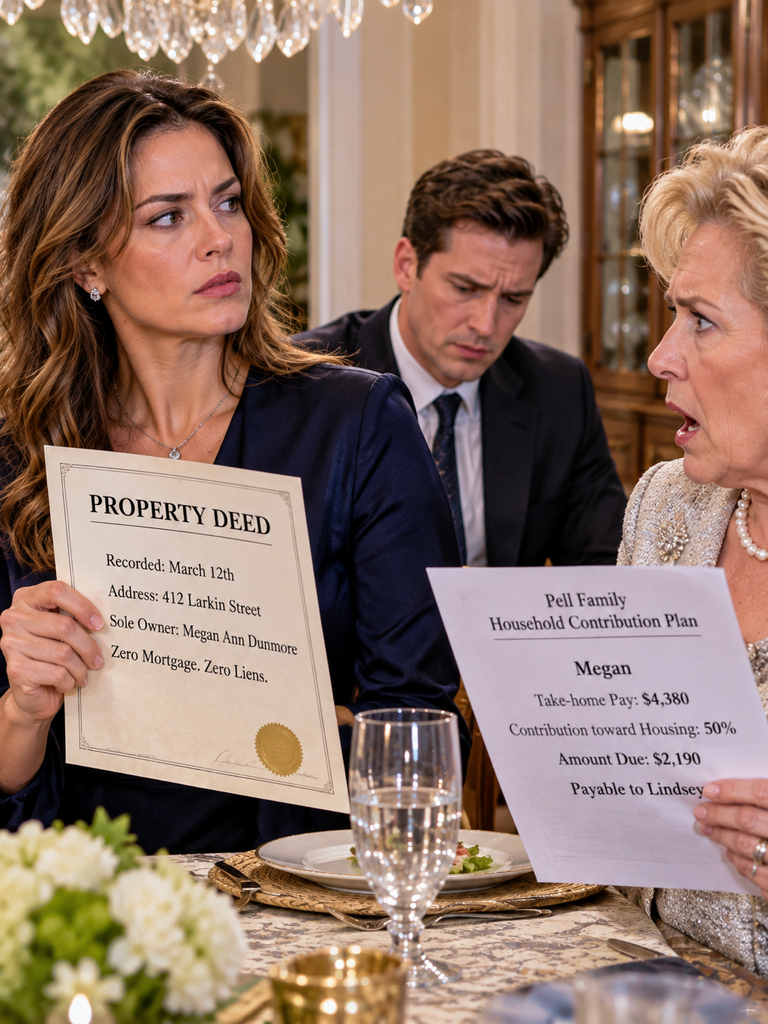
I stared down at the document. The cover page proclaimed, in a domineering, bold blue typeface: Pell Family Household Contribution Plan. Just beneath that, in a slightly smaller, more insidious font: Prepared by Lindsey Pell.
There were three crisp pages. The second page had my name stamped at the top like a target.
Megan. Take-home pay: Approximately $4,380 per month. Contribution toward housing and family support: 50%. Amount due: $2,190. Due on the first of each month. Payable to Lindsey.
At the very bottom of the page, there was a neat little box hovering above a solid black line, waiting for my signature.
“Now, I want you to look at this through the lens of fairness,” Lindsey said, folding her hands beneath her chin like a benevolent priest delivering a sermon. “You have been occupying Gervase’s beautiful home for well over two years. You avoid paying a mortgage. You avoid paying rent. Gervase carries the crushing weight of all that responsibility, while you just hoard your little paycheck for yourself. That is simply not how a family operates, Megan. In this family, we contribute.”
I slowly turned my head to look at my husband. He was currently dedicating all his cognitive function to slicing a limp green bean perfectly in half. He refused to lift his eyes.
“Gervase,” I whispered, the air in my lungs growing ice-cold. “Let’s just hear her logic out.”
Without glancing up from his plate, he mumbled, “She’s… she’s not wrong that the current setup isn’t exactly fair.”
Something deep inside my chest went perfectly, terrifyingly still. It wasn’t a hot, blinding rage. It was a glacial, suffocating stillness. It felt like sitting in a windowless room the exact second the humming air conditioner abruptly shuts off, leaving you acutely aware of the deafening silence.
I didn’t scream. I didn’t cry. Instead, I reached down into my structured brown leather tote bag—the oversized one I had brought on purpose—and retrieved a heavy Manila envelope. Inside was a freshly printed, certified copy obtained directly from the Montgomery County Recorder’s Office. The raised, embossed seal at the bottom corner was still sharp enough to cut a finger on.
I deliberately placed the heavy parchment directly on top of her ridiculous contribution plan and rotated it 180 degrees so she could read the legal jargon right side up.
“Transfer on Death Designation Affidavit,” I recited, my voice stripped of all emotion. “Officially recorded on March 12th, 2021. Property address: 412 Larkin Street, Kettering, Ohio. Grantee: Megan Ann Dunmore. Sole owner. Zero mortgage. Zero liens.”
I tapped the date printed at the top with my index finger. “I didn’t even meet your son until six months after this document was filed.”
The silence that blanketed that dining room stretched for so long that the rhythmic ticking of the analog clock over the kitchen stove sounded like a sledgehammer. Ogden carefully set his silverware down. Lindsey snatched the heavy paper off the table, pulling it inches from her nose, then thrusting it to arm’s length, performing the desperate optical dance people do when they hope the words will magically rearrange themselves.
“This… this isn’t right,” she stammered, the manufactured sweetness evaporating. “Gervase explicitly told me he paid this property off.”
She snapped her gaze toward her son. I mirrored her movement. Gervase, trapped between his mother’s wrath and his wife’s receipts, remained paralyzed, staring at his mutilated green beans.
I pushed my chair back, stood to my full height, and smoothly plucked the certified deed right out of my mother-in-law’s trembling hands. I slid it back into my Manila envelope, draped my wool coat over my arm, and walked out. Nobody said a word to stop me.
I navigated the drive home down Far Hills Avenue with both hands gripping the steering wheel in a white-knuckle hold, the radio completely silenced. When I finally pulled into the concrete driveway of the property on Larkin Street—my property—I sat in the idling car for exactly eleven minutes before turning the key.
I did not shed a single tear. I want to make that unequivocally clear, because society always conditions us to expect the wife to break down sobbing over the steering wheel at this juncture. I didn’t have time for tears. I had an audit to conduct.
At 11:40 PM, while my husband was presumably still cowering at his mother’s house, I sat at my butcher-block kitchen table bathed in the blue light of my laptop. I logged into my corporate payroll portal and immediately rerouted my direct deposits, yanking them out of our shared marital account and funneling them into a private, individual checking account I had maintained since I was a teenager.
Next, I registered for the Montgomery County Recorder’s complimentary property fraud alert system—a digital tripwire that dispatches an immediate email the moment any legal document is filed under your name.
At 8:05 the following morning, before stepping foot into my office, I marched into the local Fifth Third Bank branch. I carried the original deed affidavit and a fragile, handwritten letter from a woman named Theodora Abernathy. I locked both items inside a steel safe deposit box, ensuring only my signature could grant access. The entire errand consumed twenty-five minutes. Looking back, they were the most vital twenty-five minutes of my entire existence.
I was entirely ignorant of the fact that a mere eleven days later, at 6:52 in the morning, that digital fraud tripwire would jolt me out of my sleep. I had no idea a stranger wielding a laser measure would appear on my porch demanding to appraise a kitchen for a bank loan I never applied for. And I certainly didn’t know that by Thanksgiving, a squad car would be parked on Lindsey’s pristine driveway, or that Ogden would be the one holding the door open for the police.
But I am getting ahead of the ledger.
Chapter 2: The Architecture of Deceit
My name is Megan Dunmore. I am thirty-six years old. By trade, I am the Business Office Manager at Willow Bend Care Center, a sprawling 120-bed nursing facility anchoring the south side of Kettering. My daily existence revolves around processing complex Medicaid applications, auditing resident trust accounts, untangling payroll discrepancies, and meticulously tracking every single piece of paper that dictates how currency flows from one entity to another.
Before taking the desk, I spent six grueling years walking those exact same hallways as a Certified Nursing Assistant. I don’t just look at numbers; I interrogate them. I know how to read a balance sheet the way a poker player reads a nervous twitch. When a financial equation fails to balance, I am usually the first person in the room to smell the smoke.
I need to explain the foundation of my life so you can grasp how blind the woman sitting in that driveway had been to the avalanche building above her.
I was raised in the Dayton foster care system. I was shuttled through four different temporary houses before my ninth birthday. Eventually, I was placed with a fiercely stubborn woman named Daisy Ostrowski. Daisy operated a chaotic daycare out of her cramped living room and fostered children to make ends meet. She kept me until I officially aged out of the system, at which point she simply refused to resign from the role of my mother.
To this day, Daisy mails me a crumpled twenty-dollar bill and a greeting card every single birthday, always accompanied by a post-it note that reads, “Buy yourself something frivolous.” She has never, not once in my entire life, asked me for a dime or a favor. I share this detail because it forged my definition of what a family was supposed to be: unconditional support, free of invoices.
Theodora Abernathy was a permanent resident on the East Hall of Willow Bend back when I was still wearing scrubs. She was eighty-four, her mind as sharp as broken glass, and she affectionately dubbed me ‘The Quick One’ because I always managed to answer her call button before the echo faded. I started bringing her chamomile tea after my grueling twelve-hour shifts.
Over steaming mugs, she spun tales about her late husband and the charming brick bungalow on Larkin Street they had purchased back in 1966 for a modest nineteen thousand dollars. Over the course of three years, she received exactly zero visitors.
It wasn’t until after her passing that her estate attorney, a meticulously careful, soft-spoken gentleman named Rufus Okafor, summoned me to his oak-paneled office on Wilmington Pike to unravel the mystery.
Theodora, he explained, had surrendered an infant boy for closed adoption when she was a terrified seventeen-year-old. She spent her twilight years burning through her savings trying to track him down. By the time the private investigators breached the sealed records, her biological son was already deceased. However, he had left behind a daughter who was swallowed by the state foster system at age three.
I was that daughter.
Theodora had known my true identity for nearly two years before she drew her final breath. She took the secret to her grave because, as she eloquently penned in a letter left in Mr. Okafor’s custody, she wanted me to visit her room out of genuine affection, not biological obligation. Shortly before she died, she executed a Transfer on Death affidavit for the bungalow, legally naming me the sole beneficiary. Mr. Okafor officially recorded it with the county the week the dirt settled on her casket.
When I refer to the property on Larkin Street as my house, you must understand the gravity of that statement. It was not a real estate portfolio addition. It was not a flip project. It was the singular, tangible artifact any blood relative had ever bothered to leave me. The wooden doorframe in the pantry still bore Theodora’s faded pencil slashes, marking the heights of her nephews in the late 1960s. When I moved in, I scrubbed, sanded, and repainted every square inch of that house—except for that sacred pantry doorframe.
I met Gervase Pell six months into homeownership at a mundane backyard barbecue in Oakwood. He was thirty-three, boasting broad shoulders, a booming, infectious laugh, and the aggressive confidence unique to men who sell commercial HVAC components on commission. He had an intoxicating way of making you feel like you were the only fascinating creature in the room.
In the honeymoon phase, he was incredibly easy to love. He replaced the grinding garbage disposal without me having to nag. He memorized my convoluted coffee order by our second date. When I finally confessed the profound saga of Theodora, his boisterous demeanor softened. He interlaced his fingers with mine and murmured, “It sounds like she spent her whole life waiting for you to walk through her door.”
We dated for eighteen months. He relocated his belongings into the Larkin Street bungalow roughly eight months prior to our wedding, citing an expiring lease and the financial redundancy of maintaining two residences. We struck a verbal contract: he would deposit $600 a month into a newly minted joint account to cover his share of groceries and utilities. I would deposit $1,500. Furthermore, I absorbed the crushing $3,840 annual property tax bill entirely from my personal funds, because the deed bore only my name, and that was the logical arithmetic of the situation.
Gervase never uttered a single complaint about this financial architecture. I now recognize that it suited his parasitic needs flawlessly.
Looking back, the breadcrumbs of their delusion were scattered everywhere. The inaugural red flag was hoisted at our wedding reception in June 2023. We rented a rustic venue near Yellow Springs. Halfway through the catered chicken, Lindsey stood up, clinking a butter knife against a crystal wine glass, commanding a room that hadn’t asked for her opinion.
She delivered a rambling monologue about Gervase’s childhood athletic triumphs. Then, she pivoted toward me, raised her Chardonnay, and broadcasted to the crowd, “And a warm welcome to Megan, who is so incredibly blessed to be moving into Gervase’s stunning home.”
A ripple of polite, confused laughter washed over the tables. From Table Four, Daisy slowly lowered her water glass, her eyes locking onto mine with feral intensity. I offered a microscopic shake of my head. Let it slide, I rationalized internally. It’s a wedding. She’s drunk on attention. She just misspoke.
If I possessed a time machine, I would materialize at that exact moment, rip the microphone from her manicured grip, and correct the public record in front of all eighty-two guests.
The second omen manifested as a mailbox. A mere two months post-honeymoon, I returned from a grueling shift to discover our standard issue, unassuming black mailbox had been vandalized. Plastered across its side in sprawling, white vinyl cursive was a custom decal: The Pell Residence.
Lindsey had supposedly dropped it off as a ‘thoughtful surprise,’ and Gervase had eagerly assisted her in applying it. When I gently pointed out that I had legally retained my maiden name and perhaps a monolithic family crest wasn’t factually accurate, Gervase chuckled, waved his hand dismissively, and said, “Babe, relax. It’s just a sticker.”
I let it fester for a year before I took a razor blade and peeled it off myself on a sweltering July afternoon. No one dared mention its absence.
The third omen cost me one thousand, eight hundred dollars in liquid cash. In the damp spring of 2024, Lindsey circumvented her son and called my cell phone directly—an unprecedented event. She was weeping hysterically. Her roof had supposedly sprung a catastrophic leak over the guest suite. The roofing contractor was demanding an extortionate upfront deposit. Ogden’s meager pension check wasn’t clearing for a fortnight, and she simply couldn’t bear to burden poor Gervase because he was under immense stress hitting his HVAC sales quotas. Could I, out of the goodness of my heart, float her a tiny loan just until the first of the month?
I authored a check for $1,800 that very afternoon. Being a creature of habit, I deliberately wrote “Roof Loan” on the memo line.
She never repaid a single cent. Forty-five days later, she uploaded an album of forty-one photographs to Facebook documenting her lavish, five-day Carnival Cruise to Cozumel, complete with umbrella drinks. To my knowledge, the roof remained untouched.
When I carefully broached the topic of the missing funds with Gervase, his demeanor soured. He accused me of being painfully petty over “family money,” insisting his mother had endured a tough year. I dropped the argument, but I kept the canceled check in a digital file. Keeping receipts isn’t just a habit for me; it’s a religion.
The fourth omen was a literal brass key. Completely bypassing my consent, Gervase marched to a hardware store and cut a duplicate house key for his mother, citing ‘potential emergencies.’ The betrayal was unveiled on a random Tuesday in early 2025. I walked through my front door to find Lindsey comfortably seated at my butcher-block table, casually thumbing through a stack of my incoming mail.
She had ripped open an official envelope dispatched by the Montgomery County Treasurer. It was my property tax assessment.
“Oh, hello dear, I was just making absolutely certain Gervase wasn’t getting price-gouged by the city,” she announced, flashing a predatory smile as she shoved the paper back into the envelope, acting as though she had performed a noble service.
I remember staring at the document in her clawed hands, my eyes burning holes into the ink printed at the top: Megan A. Dunmore. Sole Owner. I watched her eyes dart across those letters. She had to have read it. But to Lindsey Pell, legal documents were merely rough drafts waiting to be aggressively edited by her delusions.
The fifth omen was the one that should have triggered alarms, but the sound was muffled until much later. Gervase was actively parading around his social circles claiming he was the sole proprietor of the real estate. He lied to his regional manager. He lied to the men in his Thursday golf league. He even lied to an independent contractor who serviced our furnace; the man tipped his cap, called me ‘Mrs. Pell,’ and remarked, “Your husband sure played it smart, locking this place down before the market went insane.”
I forced a tight smile and swallowed the correction. I absorbed countless indignities during those years under the tragically misguided belief that accommodating a spouse’s fragile ego was synonymous with being a good wife.
Meanwhile, Lindsey maintained a steady drumbeat of condescension regarding my career. At Easter dinner, she loudly inquired if I was “still doing that little secretary thing at the old folks’ home.” At Ogden’s birthday, she bragged to her sister that while I handled some minor nursing home paperwork, Gervase was the “actual breadwinner.”
Fact check: Gervase’s base salary was $68,000 before his unpredictable commissions. My salary was exactly the same. I never vocalized this truth. I simply smiled, passed the potato salad, and let them live in their fictional tax bracket.
Therefore, by the time that second Sunday in October rolled around, the physical appearance of the ‘Household Contribution Plan’ wasn’t a shock. It was simply the first time her audacity had been committed to paper.
The true genesis of the budget war had ignited three weeks prior, during a Wednesday evening dishwashing session. Lindsey had called Gervase on speakerphone. She proclaimed she had been “crunching some numbers” and decided it was high time Megan started pulling her dead weight. She weaponized the word half—as if demanding fifty percent of a woman’s livelihood was akin to splitting a slice of cheesecake.
When he finally disconnected, I turned off the faucet, meticulously dried my hands on a dish towel, and delivered the ultimatum. “One more word from your mother about my money, and I will handle her myself.”
He chuckled, a nervous, patronizing sound, assuming I was being hyperbolic. Then his eyes met mine, and the laughter died in his throat.
“She doesn’t mean anything malicious by it,” he pleaded, deploying his favorite shield. “She just worries. You know how she gets.”
I knew exactly how she got. That was a Wednesday. Her response was the plastic folder.
Which brings the timeline hurtling back to the Monday immediately following the disastrous Sunday dinner. The uneasy truce lasted a mere twenty-four hours.
Gervase had slinked into the house around midnight on Sunday, collapsed onto the living room sofa without a word, and vanished for work before I descended the stairs Monday morning.
At 12:15 PM, as I sat at my office desk eating a grim cup of yogurt and aggressively auditing a Medicaid pending list, my cell phone vibrated. A text from Lindsey illuminated the screen.
I owe you a sincere apology for the misunderstanding regarding the paperwork yesterday. However, regardless of whose name is scribbled on a piece of paper, Gervase has been pouring his resources into that house for over two years, and that grants him equitable rights. I’ve taken the liberty of revising the plan. $1,900 a month, effective November 1st. I think that is an exceedingly generous compromise. Please confirm receipt.
Sixty seconds later, a digital photograph materialized. It was a fresh iteration of her extortion ledger. The domineering blue heading remained. The monetary demand had shrunk slightly. But it was the handwritten addendum at the bottom, penned in her unmistakable, loopy blue cursive, that made my blood run cold:
Out of respect for Gervase’s investment.
I took a screenshot, forwarded both the message and the image to my secure personal email, deposited them into a freshly minted folder labeled The Pell File, and offered zero response.
At 5:47 PM, Gervase fired off a panicked text from his car.
Babe, can we please just pay her something to make this nightmare stop? Even like 500 bucks a month? It would mean the world to her. Please don’t turn this into a massive war.
I stood in the asphalt parking lot of Willow Bend and read his pathetic plea four times. He wanted me to pay a $500 monthly ransom to prevent his mother from illegally charging me rent to exist inside my own dead grandmother’s sanctuary.
I ghosted him, too.
That evening, he pivoted to romance as a weapon. He boiled spaghetti—a culinary feat he hadn’t attempted in six months. He struck a match and lit a vanilla candle on the butcher-block table. As we pushed pasta around our plates, he reached across the wood, enveloping my hand in his.
“Look, I know Mom executed this terribly,” he began, his voice dripping with faux-sympathy. “But try to view it through her lens. She has always been deeply uncomfortable with the concept of a woman holding the title to the primary residence. It’s a generational quirk. If you could just funnel her a little stipend every month, it would soothe her anxieties and make her feel like her son was being taken care of.”
“Taken care of?” I echoed, the words tasting like acid on my tongue. “Gervase, look at me. Did you actively tell your mother you paid off the mortgage on this house?”
He flinched, withdrawing his hand as if I had burned it. He stared into the flickering candle flame for an agonizing eternity.
“I… I might have let her draw that conclusion,” he finally confessed, his voice barely a whisper. “It just streamlined the conversation! She was constantly riding my case about not building equity. I honestly didn’t think a white lie would mutate into this.”
“It matters now,” I said.
“It’s just words, Megan! It doesn’t mean anything real!”
That Wednesday night, watching the wax drip onto the table, was the exact moment the foundation of my marriage crumbled into dust. It wasn’t merely the lie that broke me; it was his chilling inability to comprehend why the lie was abhorrent.
Week two of the siege commenced. Thursday afternoon, at precisely 2:14 PM, the telephone on my desk chirped. It was Jessica Haynes, our veteran receptionist who had guarded the Willow Bend front lobby for nineteen years.
“Megan, honey,” Jessica whispered, her voice laced with maternal concern. “There’s a rather intense woman out here claiming to be your mother-in-law. She’s aggressively demanding to speak with someone in the Human Resources department.”
By the time my sensible heels clicked onto the lobby tile, Lindsey had already been stonewalled and dismissed by our razor-sharp HR Coordinator, a young man named Parker.
Jessica silently slid the leather-bound visitor log across the counter. Lindsey had arrogantly scrawled her name in cursive. In the column designated ‘Reason for Visit,’ she had written: Family matter. Salary verification.
Parker later debriefed me in private. He revealed that Lindsey had marched up to his desk, demanded to know my exact gross annual income, and brazenly inquired if there was a mechanism to legally garnish my wages and redirect a percentage directly to a ‘concerned family member.’
When Parker informed her that employee compensation was strictly confidential and ordered her to vacate the premises, she scoffed, claiming she was merely trying to ‘rescue her son’s deteriorating marriage.’
I asked Jessica to meticulously photocopy that page of the logbook. I retreated to the suffocating heat of my parked car for my fifteen-minute break. For the first time since that fateful Sunday dinner, I looked down at my hands and realized they were violently shaking.
It wasn’t terror. It was the sheer, unadulterated audacity of the invasion. This was my sanctuary. I had residents in this building whose trust I had cultivated for twelve years. I managed the life savings of vulnerable families.
I dialed Gervase’s number. He picked up on the second ring.
“Your mother physically trespassed at my place of employment today,” I stated, my voice a lethal monotone.
A heavy, guilty silence flooded the line. “She… she mentioned she might pop by,” he finally muttered.
“She told you she was coming to my job to interrogate my HR department?”
“She just wanted to verify the math on the plan!” he pleaded, his voice cracking. “She didn’t want to accidentally overcharge you, Megan! She’s trying to be equitable!”
I severed the connection. If I had spoken another syllable, it would have been a feral scream.
But week two was far from over. Saturday morning, my phone vibrated at 9:20 AM. The caller ID read Daisy. My foster mother categorically refuses to operate a telephone before noon on a Saturday unless the world is ending, because Saturday mornings are fiercely reserved for her beloved garden club.
“Megan, sweetheart,” Daisy said, skipping the pleasantries. “I just endured the most bizarre phone call of my life, and I need your version of reality before I detonate.”
Lindsey had somehow excavated Daisy’s private phone number—likely by plundering our wedding vendor files—and dialed her at the crack of dawn. She introduced herself with venomous warmth, speaking ‘mother to mother.’ She then launched into a soliloquy about how deeply concerned she was for Megan’s moral compass. She informed Daisy that I was a financial parasite draining her son’s resources, that I spitefully refused to contribute to the marital household, and requested that Daisy ‘talk some sense into the girl.’
“She actually had the nerve to ask me,” Daisy said, her voice dropping an octave into a register that used to terrify me when I was a teenager breaking curfew, “if I had ever bothered to teach you the concept of paying your own way.”
I closed my eyes. “What did you say to her, Daisy?”
“I told her that I taught you to pay in cash for every single crumb you’ve ever consumed, because you grew up in a world where nobody ever handed you a damn thing for free. And then I informed her I was late for garden club, and I slammed the receiver down.” Daisy paused, the silence heavy with suspicion. “Megan, honey… whose name is on the deed to that house?”
“It’s mine, Daisy. It’s Theodora’s house. It has always been solely mine.”
“Then why in God’s name does that delusional woman believe her son owns the bricks?”
I didn’t have the complete puzzle yet, but I was about to unearth the missing pieces.
That Sunday night, after Gervase had medicated himself to sleep with bourbon, I fired up the laptop and logged into our joint checking account.
Historically, I never scrutinized the joint ledger. It was the mundane utility-and-grocery account. My $1,500 deposited on the first of the month; his $600 trickled in on the fifteenth. The water, power, and internet automatically debited. I trusted its rhythm the same way you trust gravity.
But I am an auditor by blood, and once my eyes focused on the spreadsheet, I couldn’t tear them away.
The anomaly glared at me from the screen. A recurring, automated electronic transfer scheduled for the third day of every single month. $350.00.
Gervase had utilized the online banking nickname feature. The transfers were boldly labeled: PP House Fund.
The destination was an external routing number belonging to Wright-Patt Credit Union, an account ending in 4471.
I scrolled backward. The hemorrhaging began in September of 2023—exactly three months after we stood at an altar and vowed to honor each other. It had been siphoned out every single month like clockwork.
Twenty-six transfers. Nine thousand, one hundred dollars.
I cross-referenced the debit dates against our deposit history, and a more sinister truth emerged. In a majority of those twenty-six months, Gervase’s meager $600 deposit hadn’t possessed the volume to cover both his half of the utility bills and the $350 siphon.
My $1,500 had been subsidizing the deficit.
Without uttering a single syllable, my husband had been silently embezzling my hard-earned salary to pay his mother a ‘house fund’ stipend for a piece of real estate she falsely believed he owned. He had been doing this for over two years.
At 1:30 in the morning, listening to the rhythmic snoring of the thief in my bed, I powered up the dusty inkjet printer in the spare bedroom. I printed all twenty-six transactional receipts. I laid them out across the butcher-block table in meticulous rows, organizing them with the same chilling precision I would use to lay out evidence for a state Medicaid auditor.
I slumped back in my chair, staring at the constellation of financial betrayal.
The printed budget from Sunday dinner was never the opening salvo. The budget was simply Lindsey Pell growing impatient. For two solid years, she had already been extracting her tribute. She just decided she was entitled to a raise.
I didn’t know yet what demonic lengths she was willing to traverse to secure that raise.
Chapter 3: The Trap is Set
I didn’t confront Gervase with the printed bank statements that Monday. I need to explain the methodology behind that silence, because human nature screams for immediate, fiery confrontation.
When you navigate the treacherous waters of nursing home administration, you learn a cardinal rule of investigations: The absolute worst tactical error you can commit is confronting a suspect before you fully comprehend the scope of their crime. If a resident’s trust account is bleeding funds, you don’t sprint down the hallway and scream at the overnight nurse. You pull the ledgers. You cross-reference the shift schedules. You identify every soul who possessed a key. Then, and only then, do you initiate the interrogation.
Because the second you ask the question, the guilty party begins incinerating the evidence and rewriting the narrative.
So, I strapped on my armor and went to work. I processed payroll. I facilitated a care conference for a declining dementia patient. And during my unpaid thirty-minute lunch break, I locked my office door and dialed Rufus Okafor.
The attorney remembered me instantly. He politely inquired about the upkeep of the house. I informed him the house was physically intact, and then I unleashed the avalanche. I detailed the Sunday dinner budget, the extortionate text messages, the HR invasion, Daisy’s furious phone call, and finally, the twenty-six transfers labeled ‘PP House Fund.’
When my monologue concluded, the silence on the other end of the line was absolute.
“Mrs. Dunmore,” Mr. Okafor finally murmured, utilizing the formal title I had repeatedly asked him to drop. “Theodora often remarked that you were the most fiercely cautious individual she had ever encountered. I implore you to marshal every ounce of that caution right now.”
He cleared his throat, shifting into legal gear. “Ohio statutes are brutally clear. Property inherited prior to the execution of a marriage is legally classified as separate property. Your husband possesses zero ownership interest in that home, regardless of the fictions he has spun for his mother. However… individuals who convince themselves they are owed a debt often resort to staggeringly foolish actions.”
“What do I do, Rufus?”
“You do not sign anything,” he commanded, his voice gaining velocity. “You do not allow anyone to remove a single scrap of paper from that premises. And if anyone places a document in front of you that even tangentially references the title of that property, you call my cell phone before you uncap a pen.”
I transcribed his exact words onto a neon yellow sticky note and adhered it to my computer monitor: DO NOT SIGN ANYTHING.
I couldn’t have fathomed how rapidly that advice would be tested.
On Tuesday evening, Gervase arrived home uncharacteristically early, bearing plastic bags dripping with grease from the Thai restaurant on Stroop Road. He arranged the porcelain plates, poured the water, and genially asked about my day. It was the first facsimile of a normal marital conversation we had engaged in for nine agonizing days. Against my better judgment, I allowed my shoulders to drop an inch. I allowed myself to relax.
It was a catastrophic miscalculation, but a fundamentally human one.
As the empty takeout containers were being cleared, Gervase casually retrieved a manila folder he had smuggled in from his car.
“So, I was chatting with one of the senior guys at work,” he began, adopting an air of casual nonchalance as he slid the folder across the butcher block. The gesture—two fingers pushing the cardboard—was a terrifying mirror image of his mother’s Sunday dinner presentation. “He pointed out that our tax situation is an absolute nightmare because the deed is solely in your name. If we simply add me to the title, we can both leverage the property tax deductions, and it gives us the power to refinance at a killer rate if we ever hit a financial pothole. It’s literally just a bureaucratic formality, babe. It builds a safety net for both of us.”
I flipped open the folder. Resting inside was a single, meticulously typed sheet of paper. It was a draft Quitclaim Deed.
My full legal name was already populated in the ‘Grantor’ field. His name and my name were typed into the ‘Grantees’ section, legally bound as Joint Tenants with Right of Survivorship.
At the bottom of the page, a blank line hovered, waiting to harvest my signature, flanked by an empty Notary Public seal block.
“Who drafted this legal instrument, Gervase?” I asked, my voice terrifyingly calm.
“Oh, I just pulled a standard template off the internet,” he lied smoothly. “Mom came over and helped me format it. It took ten minutes.”
“There is no mortgage on this house, Gervase. There is no loan. There is nothing to refinance.”
“I said if we ever need to leverage the equity!” he shot back, a defensive spike entering his tone.
Without breaking eye contact, I retrieved my smartphone, activated the camera, and snapped a crystal-clear photograph of the fraudulent document. I then closed the folder and slid it back across the wood.
“I am not signing this.”
He recoiled as if I had physically struck him across the jaw. “Wow,” he exhaled, letting out a toxic, bitter laugh. “Okay. So, after two years of building a life together, after everything I do for us, you don’t trust me enough to put my name on a meaningless piece of paper.”
I leaned forward, resting my elbows on the table. “After two years of building a life together, I discovered you’ve been secretly wiring your mother three hundred and fifty dollars a month out of our joint account to pay for a house you never owned.”
The remaining color drained from his face with horrifying speed. He looked like a corpse. “You… you went digging through my bank account?”
“It is our bank account, Gervase. My salary is deposited into it. In fact, mathematically, it’s primarily my money.” I didn’t raise my voice. I had rehearsed this execution in the shower. “Twenty-six separate transfers since September of 2023. Nine thousand, one hundred dollars. Labeled House Fund. What house, Gervase? Did you build her a house out of my paychecks?”
He pushed his chair back so violently it crashed to the floor. He began pacing the kitchen tiles like a caged animal. For a suffocating two minutes, the only sound was his heavy breathing.
And then the dam broke.
He vomited the entire, pathetic truth, the words laced with the acidic anger that always accompanies a long-held lie finally seeing the sun. He shrieked that his mother had brainwashed him since childhood into believing a man who didn’t possess a deed wasn’t a real man. He confessed that when he moved his boxes into my home, she had demanded to know the mortgage rate, and he had cowardly claimed it was ‘handled.’ She assumed he was paying the bank; he gleefully allowed the assumption to root.
He confessed that shortly after our wedding, Lindsey had cornered him, crying about drowning in credit card debt. The monthly transfers were disguised as her ‘investment stake’ in the imaginary equity he was supposedly building. She called it a ‘family portfolio.’ She genuinely believed that when Gervase eventually sold my grandmother’s house, she would recoup her seed money with massive interest.
“So, you allowed your mother to believe she was aggressively investing in my inherited property,” I summarized, my voice dropping to a deadly whisper. “Using my money.”
“It wasn’t framed like that in my head!” he screamed.
“Then how was it framed in your head, Gervase?”
“It was family survival!” he roared, louder than I had ever heard him scream. “She is my mother, Megan! She has absolutely nothing! Dad’s pension is a joke! You have this massive, paid-off house that just miraculously fell into your lap from some ghost, and you guard it like it’s a sacred temple nobody else is allowed to touch!”
There it was. The venomous truth. Fell into my lap.
My mind flashed to Theodora’s faded pencil marks etched into the pantry doorframe. I thought about the agonizing decades she spent hunting for a biological son she would never get to hold. I thought about the four chaotic foster homes I bounced between before I was tall enough to reach the kitchen sink.
“Pack your bags,” I commanded, the stillness returning. “You can go reside in your mother’s temple for a while. I need oxygen to think.”
He didn’t put up a fight. I genuinely believe he was relieved to escape the cross-examination. He hastily stuffed a canvas duffel bag, grabbed his corporate laptop and his golf clubs, and fled into the night at 9:15 PM without uttering a single goodbye.
Crucially, he took the manila folder containing the Quitclaim deed with him.
The very next morning, acting on Mr. Okafor’s explicit instructions, I summoned Kettering Lock & Key. The technician replaced every deadbolt on the property, invoicing me $189.00. I mandated Mr. Okafor hold a sealed copy of the new master key at his law office, notifying Gervase via certified mail that he could request access through legal counsel at any time. That was the equitable, legally sound protocol.
But Lindsey’s stolen key no longer turned the tumblers, and that was the tactical objective.
Thursday dawned as the most high-stakes, blood-pressure-spiking day of my professional calendar. Every operational nursing facility in the state of Ohio is subjected to an unannounced, brutal annual audit by the State Department of Health. At 7:00 AM sharp, a squad of government surveyors breaches the front lobby and camps out for days, forensically dissecting every medical chart, every operational policy, and every single dime flowing through the resident trust accounts.
That specific October, the state descended upon Willow Bend on Thursday the 23rd.
I was the executive who greeted the grim-faced inspectors in the lobby at 7:04 AM. From 9:00 AM until 12:15 PM, I was physically barricaded inside our windowless corporate conference room alongside two senior surveyors. I spent three hours walking them, line-by-agonizing-line, through complex trust fund reconciliations.
There was a mandatory, state-issued sign-in sheet dominating the center of the table. There were four credentialed witnesses present. The electronic security system registered my ID badge swiping into that conference room at 8:56 AM, and swiping out for lunch at 12:17 PM.
I am documenting this microscopic timeline because of the catastrophic crime that was being committed at exactly 10:30 that morning, eleven miles away, while I was trapped in that room.
I wouldn’t discover the crime until Friday.
At 6:52 AM on Friday, October 24th, my smartphone vibrated violently against the nightstand. I squinted through sleep-crusted eyes. It was an automated email from the Montgomery County Recorder’s Office.
The subject line glowed like a radioactive warning: PROPERTY FRAUD ALERT: DOCUMENT RECORDED.
I bolted upright, the sleep vaporizing from my brain. A Quitclaim Deed had been officially filed and recorded against 412 Larkin Street at 3:48 PM the previous afternoon.
Grantor: Megan A. Dunmore.
Grantees: Megan A. Dunmore and Gervase M. Pell as Joint Tenants with Right of Survivorship.
With hands shaking so violently I could barely operate the trackpad, I booted up my laptop and downloaded the scanned image of the official filing.
It was the identical sheet of paper Gervase had slid across my kitchen table on Tuesday. The exact same typography. The exact same formatting.
Except this version possessed a signature bleeding blue ink across the bottom line.
It was a terrifyingly accurate forgery of my signature. It featured my signature looping ‘C’, the sharp ‘I’, the U’s, and the distinctive way the ‘D’ aggressively smashed into the ‘U’. It was a masterclass in mimicry. But it was not my hand.
Directly below the forgery was the fatal blow: a legitimate Notary Public stamp.
Kendra J. Kowalski, Notary Public, State of Ohio. Signed and acknowledged before me on the 23rd day of October, 2025, at 10:30 a.m.
I knew that name. Kendra Kowalski was a fixture in Lindsey’s social orbit. She occupied the pew two rows behind my mother-in-law at St. Leonard’s every Sunday. She had attended our wedding reception. She had gifted us a hideous crystal candy dish swathed in silver wrapping paper.
According to this legal document, at 10:30 AM on Thursday, I had miraculously teleported into Kendra Kowalski’s presence and willingly signed away half of my grandmother’s legacy.
According to the State of Ohio Department of Health, a physical sign-in sheet, a digital badge log, and two highly trained government auditors, I had been sitting in a conference room eleven miles away defending a spreadsheet.
I want to attempt to articulate the exact emotion that flooded my veins in that moment, because I have dissected it endlessly.
I didn’t feel panic. I didn’t feel despair. I felt the exact same hyper-focused, cold-blooded tranquility I experience when I uncover a malicious billing discrepancy someone attempted to bury in the margins. Because a hidden error is still an error. And this particular error was now stamped with a timestamp, a date, and a co-conspirator’s name.
I dialed Rufus Okafor at 7:10 AM. He answered on the second ring.
I read the document aloud. He didn’t interrupt.
“Do not respond to a single soul,” Mr. Okafor commanded, his voice vibrating with lethal authority. “Do not dial your husband. Do not dial his mother. I am drafting an Affidavit of Fraud at this very second. You will report to my office immediately to sign it in front of my notary—a legitimate one. We will file it with the county recorder before noon and demand a hard freeze on the title. Following that, you will march directly into the Kettering Police Department and file a felony report. Bring every piece of paper you possess.”
“I possess a formidable amount of paper, Rufus,” I replied, grabbing my tote bag. “Theodora would have expected nothing less.”
I called the nursing home administrator and invoked a family emergency. She didn’t interrogate me; I hadn’t utilized a sick day in three years.
By 9:30 AM, my signature was drying on the fraud affidavit in Mr. Okafor’s suite. By 11:00 AM, I was seated across a scarred metal desk from a seasoned detective named Sergeant Francis Reyes at the precinct on Smithville Road.
Reyes was a burly man in his late fifties, sporting reading glasses perpetually shoved onto his forehead. He absorbed my entire saga in absolute silence. When I finished, he picked up the printed scan of the forged deed and scrutinized the notary block for an uncomfortable duration.
“You’d be horrified by the frequency with which this exact scenario lands on my desk,” Sergeant Reyes sighed, leaning back in his chair. “A desperate family member convinces themselves that a signature is just a trivial bureaucratic hurdle. They always operate under the delusion that securing a notary stamp magically launders the crime into legitimacy.”
He tapped a thick finger against Kendra Kowalski’s seal. “Notaries operating in Ohio are bound by law to maintain a chronological journal. Every single signing requires a date, a time, the signer’s physical signature in the book, and documentation of the specific government ID presented. If Ms. Kowalski stamped this document, she documented what ID you allegedly handed her. I am going to procure a warrant for that journal.”
“What happens when the ink in the journal doesn’t align with reality?” I asked.
“Then Ms. Kowalski is staring down the barrel of a significantly more devastating problem than your mother-in-law is,” Reyes stated bluntly.
He handed me a business card with a case number scribbled on the back. My hands were so loaded with evidence folders I had to write the digits on the back of my hand in ballpoint pen. I didn’t scrub it off until midnight.
At 9:40 that evening, my phone screen illuminated. The caller ID flashed Stacy Pell.
Stacy was Gervase’s younger sister. She was thirty-four, pulling grueling shifts as a labor and delivery nurse at Miami Valley Hospital. In two years of marriage, I had perhaps accumulated a grand total of sixty minutes of private conversation with her. She was always perfectly polite during holiday gatherings, but she constantly maintained the posture of someone bracing for a physical blow whenever Lindsey entered the room.
I had never understood the psychology behind her flinching until that phone call.
“Megan,” Stacy whispered, her voice trembling with adrenaline. “I need to confess something, and I am begging you not to hang up on me, because I know my family has treated you like absolute garbage.”
“I’m listening, Stacy.”
“Mom came over and borrowed my laser printer on Wednesday afternoon,” she began, the words tumbling out in a rush. “She claimed her ink cartridges dried up, so she swung by my apartment to run off some documents. After she left, I went to print my upcoming nursing schedule, and I found pages she had accidentally abandoned in the output tray. I swear to God I wasn’t trying to snoop, Megan, but I saw your home address.”
My phone chimed simultaneously. She was transmitting digital photographs while we spoke.
There were four images.
The first photograph was a formal pre-approval letter dispatched by a predatory institution named Vantage Point Home Lending. It was authorization for a Home Equity Line of Credit. The approved amount was $60,000. The target property was 412 Larkin Street. The listed applicants were Gervase M. Pell and Megan A. Dunmore.
The letter was dated October 20th—a full three days before my signature was allegedly witnessed by Kendra Kowalski.
The second photograph was a lined piece of notebook paper. The heading, penned in Lindsey’s loopy cursive, read: Pay Off First. Beneath the title was a meticulous inventory of six maxed-out credit cards and a high-interest store card from Elder-Beerman. Each entry featured an exorbitant balance. The grand total at the bottom, violently circled twice in blue ink, was $47,200.
The third photograph was a printed Vantage Point underwriting checklist. Item number four read: Proof of Title – Gervase on Deed. Someone had aggressively slashed a blue checkmark next to the requirement.
The fourth photograph made my lungs seize. It was a blank sheet of printer paper covered in practice signatures. Megan A. Dunmore. Written over and over again. Eleven distinct times in blue ballpoint pen, the loops and angles growing progressively more confident, more fluid, more me, with every repetition.
Someone had sat at a kitchen table and methodically rehearsed stealing my identity.
“Stacy,” I whispered, the horror crystallizing into absolute clarity. “Why are you handing me the murder weapon?”
She fell silent for a long moment. When she finally spoke, her voice was choked with unshed tears.
“Because she executed the exact same playbook on me first,” Stacy confessed. “Not real estate. But the day I landed my first RN job out of nursing school, she sat me down and explained that I owed the family an immense debt for the privilege of being raised. She manufactured a printed budget for me, too. I was forced to pay her three hundred dollars a month for three solid years, Megan. It cost me almost eleven thousand dollars. I only escaped the extortion because I fled to Columbus for a year and changed my phone number. When I finally moved back, she gaslit me into acting like the debt never existed. And Gervase knew. Gervase watched the whole thing happen. He just never got billed because he was the golden son.”
She inhaled a shaky, ragged breath. “When I saw your address on those loan documents, my blood ran cold. I realized she had simply found a new victim to finance her delusions, and I refused to let her destroy another woman.”
I asked if she would be willing to repeat this testimony to a Kettering police detective. She said yes before I even finished the sentence.
I didn’t sleep that night. I occupied the butcher-block table—the one bearing the scorch mark from Theodora’s ancient casserole dish—and constructed a lethal, undeniable timeline.
October 12th: The initial budget ambush.
October 13th: The revised extortion text ($1,900).
October 16th: The corporate HR invasion.
October 18th: The harassment of my foster mother.
October 19th: The discovery of the $9,100 embezzlement.
October 20th: The $60k loan pre-approval.
October 21st: Gervase presents the un-signed deed.
October 23rd: The forgery is executed and notarized.
October 24th: The fraud alert triggers.
When laid out chronologically on the wood, the narrative ceased to be a misunderstanding. It was a calculated, criminal conspiracy.
Chapter 4: The Appraiser and the Ultimatum
Saturday morning at exactly 10:05 AM, a heavy fist pounded on my front door.
I opened it to find a middle-aged man in a navy blue polo shirt, a laminated corporate ID badge clipped to his collar. He was armed with a clipboard and a digital laser measuring tool.
“Morning, ma’am,” he chirped with practiced cheer. “I’m with Buckeye Valuation Services. I’ve been dispatched to conduct the interior appraisal on behalf of Vantage Point Home Lending. Is Mr. Pell available?”
I stared at him, letting the silence stretch. He nervously checked his clipboard.
“I have the appointment locked in for ten o’clock,” he muttered. “Mr. Pell explicitly scheduled it this past Thursday.”
“Mr. Pell does not reside at this address,” I stated, projecting my voice so it echoed off the porch. “Furthermore, Mr. Pell holds zero ownership stake in this property. I am the sole owner. There is currently an active, felony police investigation regarding a fraudulent deed recorded against this address. May I please have a carbon copy of your dispatch order?”
To the man’s immense credit, he didn’t argue. He looked utterly terrified. He hastily tore off the yellow carbon slip from his clipboard and surrendered it.
The paperwork listed the requesting party as Gervase M. Pell. The primary contact number was Gervase’s cell. The secondary contact number was Lindsey’s landline.
But it was the ‘Special Instructions’ box at the bottom that made my jaw clench. Someone at the lending firm had explicitly typed:
Borrower advises spouse may be difficult. Schedule weekend. Spouse may be difficult.
I politely thanked the appraiser and secured the deadbolt. I snapped a high-resolution photograph of the work order and immediately emailed it to both Sergeant Reyes and Rufus Okafor.
Then, I walked into the kitchen pantry—the sole room I had refused to repaint—and I pressed my palm flat against Theodora’s faded pencil marks. I stood there, drawing strength from the ghosts of my bloodline, until my heart rate returned to normal.
I received zero communication from Gervase the entire weekend. Not a phone call, not a text message, not an email.
I understand now that he was operating in a state of blissful ignorance. He genuinely believed the forged deed had sailed through the county recorder’s office undetected. He assumed the appraisal had merely been postponed due to a scheduling glitch. He believed that he and his mother were merely weeks away from an injection of sixty thousand dollars.
On Monday afternoon, a physical letter materialized inside my mailbox. It lacked a postage stamp; it had been hand-delivered. It was a pristine white envelope with a single word slashed across the front in blue ink: Megan.
I ripped it open in the driveway. It contained a single, typewritten page bearing a hostile legal heading: NOTICE TO OCCUPANT.
The document aggressively decreed that as of October 23rd, Gervase M. Pell was a legal, fifty-percent co-owner of the estate at 412 Larkin Street. It stated that as a displaced co-owner, he was legally entitled to ‘fair market compensation’ for my continued, exclusive occupation of the premises.
The document dictated an ‘occupancy fee’ of $1,900 per month, made payable directly to Gervase Pell. It concluded with a threat: If I failed to submit written agreement within thirty days, Gervase would initiate hostile legal remedies, including forcing a partition and public auction of the home.
Gervase’s signature scrawled across the bottom was authentic. I had witnessed him sign it a thousand times.
But hiding beneath his signature was a tiny, handwritten postscript, penned in that unmistakable, loopy blue ink.
We can still do this the nice way, honey. – P.
I stood in the freezing driveway, the paper trembling in my hands, and I experienced the most bizarre reaction. A sharp, humorless laugh burst from my chest.
It wasn’t amusing. It was simply the most spectacular, unforced confession I had ever witnessed. She had weaponized the exact monetary figure—$1,900—from her revised text message. She had utilized the exact phrasing. Her narcissism was so overpowering she couldn’t even resist the urge to leave her literal handwriting on the ransom note.
I marched inside, photographed the ultimatum, and added it to the groaning weight of the Pell File.
On Tuesday, Sergeant Reyes called.
“I paid a visit to Ms. Kowalski yesterday afternoon,” Reyes reported, his voice grim. “She became incredibly cooperative the second I explained the felony implications of her situation. She surrendered her official notary journal.”
“And?”
“The entry logged for October 23rd at 10:30 AM lists the signer as Megan A. Dunmore. The identification presented was recorded as an Ohio Driver’s License. She transcribed the license number perfectly.”
“Is it my actual license number?” I asked, a cold sweat breaking out.
“It is. Which immediately provoked my next question: How exactly did she visually verify your identification if you weren’t physically standing in her living room?”
Reyes cleared his throat. “She broke down. She confessed that Mrs. Pell arrived with a high-quality photocopy of your license, claiming you were violently ill and bedridden, but that you had allegedly signed the deed at home and were begging for it to be notarized as a personal favor. Ms. Kowalski admits she never laid eyes on you. She wept and claimed she had trusted Lindsey for thirty years.”
“Where did Lindsey procure a photocopy of my driver’s license?” I asked, though I already knew the answer.
When Gervase and I applied for our marriage certificate at the probate court, he had diligently made photocopies of our vital documents for his ‘records.’ He stored them in a fireproof lockbox shoved in the back of the spare bedroom closet. He had carried that exact lockbox out to his car the night I evicted him. I had watched him load the ammunition, completely oblivious to the threat.
“What is the next tactical move, Detective?”
“I am currently drafting the charging documents for the prosecutor’s desk,” Reyes said. “We are looking at Forgery, Tampering with Government Records, and potentially Attempted Theft by Deception, considering the active loan application. Ms. Kowalski will be stripped of her commission and likely face charges. As for your husband… his fate hinges entirely on what he knew, and the exact timestamp of when he knew it.”
Reyes paused. “I intend to haul him in for an interview. But Mrs. Dunmore? Between you and me? The mastermind who practiced forging your name eleven times on a sheet of loose-leaf is the primary target in my crosshairs.”
That night, I sat at Theodora’s table one final time, arranging the arsenal. The 2021 deed. The two budgets. The text logs. The visitor logs. Daisy’s testimony. The twenty-six bank transfers. Gervase’s draft deed. The forged deed. The alibi logs. Stacy’s photographs. The appraiser’s work order. The ransom note.
I arranged them in perfect chronological sequence. I picked up my phone, created a group chat containing Gervase, Lindsey, and Ogden, and typed the final invitation.
I would like to convene a mandatory family meeting. Sunday, November 2nd, 2:00 PM at my property. My legal counsel will be present. It is time we all reviewed the identical paperwork.
Gervase replied within sixty seconds: What legal counsel?
Lindsey replied four minutes later: We will be there. I’ll bring the updated budget.
Ogden remained silent.
But on Thursday afternoon, my phone pinged with a direct message from a number I had saved but never utilized.
I will be there Sunday. I need to see what evidence you hold. – Ogden.
I had absolutely no idea that Ogden Pell was bringing a thirty-year-old folder of his own.
Chapter 5: The Reckoning
On Sunday, November 2nd, I transformed my dining room into a tribunal. I set the table exactly the way Theodora used to prepare for esteemed guests. A stark white linen cloth. A sweating crystal pitcher of ice water. Six gleaming glasses.
I did not prepare a meal. We were not gathering to break bread.
Mr. Okafor arrived at precisely 1:30 PM, clad in a razor-sharp charcoal suit, clutching a worn leather briefcase. He took his seat at the far end of the table, methodically aligning his fountain pens in a perfectly straight row.
Stacy slipped through the door at 1:45 PM. She looked ghastly pale, her knuckles white as she relentlessly twisted the leather strap of her purse. I placed a reassuring hand on her shoulder; she reached up, squeezing my fingers without making eye contact. She took the chair next to the lawyer.
At 2:00 PM on the dot, Lindsey’s hulking silver Buick drifted into my driveway. Gervase slinked out of the passenger side, looking like a man walking to the gallows. Ogden emerged slowly from the rear door, clutching a swollen, brown accordion folder tightly against his ribs.
Lindsey breached the threshold first, draped in her finest Sunday church coat, brandishing her clear plastic folder like a shield. She froze the second she locked eyes with her daughter.
“What on earth are you doing here?” Lindsey snapped.
“Megan invited me,” Stacy replied, her voice trembling but unbroken.
Lindsey’s gaze violently ping-ponged from Stacy, to Mr. Okafor, and finally to me. For the first time in our entire history, a crack appeared in her armor. A flicker of genuine uncertainty danced across her eyes before being rapidly buried under bravado.
She marched to the head of the table, commandeering the chair I had deliberately left vacant, and slammed her folder down. I allowed her the illusion of power. The seating arrangement was irrelevant; the only thing that mattered was the paper about to hit the wood.
Gervase collapsed into the chair beside her, his eyes glued to his lap. Ogden slowly lowered himself into the corner seat adjacent to Stacy, resting his mysterious accordion folder on his knees.
“Well,” Lindsey announced, intertwining her fingers, attempting to project authority. “I assume we are finally convening to discuss the financial arrangement like mature adults.”
“We are convening to discuss the paper trail,” I corrected, my voice ringing clear and cold. “Mr. Okafor is my retained attorney. He was also my grandmother’s legal counsel. His presence ensures that every person in this room digests the exact same facts, simultaneously.”
I opened the Pell File.
“October 12th,” I announced, dropping her printed budget dead center onto the white linen. “A household extortion plan, demanding half my net income, payable directly to you, for residing in what you delusionally labeled ‘Gervase’s house.’”
I slapped the certified deed down next to it.
“March 12th, 2021. Transfer on Death Affidavit cementing me as the sole, unencumbered owner of 412 Larkin Street. This was recorded six months before I even learned your son’s name. Under the laws of this state, inherited property is untouchable. Gervase has never possessed a shred of equity in this estate.”
Mr. Okafor nodded once, a sharp, validating motion. “That is the legal reality.”
“October 13th,” I continued, maintaining a relentless rhythm. “Your revised budget demand of nineteen hundred dollars. Accompanied by the text message citing ‘respect for Gervase’s investment.’” I dropped the screenshot.
“October 16th. The Willow Bend visitor logs.” I slapped the photocopy down. “The day you ambushed my HR department, demanding access to my salary and inquiring if my wages could be forcibly garnished.”
“I was merely acting out of deep concern—” Lindsey sputtered.
“I am not finished,” I cut her off, my voice slicing through her defense like a scalpel.
I produced the banking ledgers. “Twenty-six unauthorized transfers. September 2023 through October 2025. Three hundred and fifty dollars a month siphoned from my marital account into your Wright-Patt Credit Union account, terminating in 4471. Labeled ‘PP House Fund.’ Nine thousand, one hundred dollars.”
Ogden’s head swiveled with agonizing slowness. He stared at his wife as if she were an alien species. “What account ends in 4471?” he rasped.
Lindsey clamped her jaw shut.
I dropped the photograph of the draft Quitclaim deed. “October 21st. Gervase attempts to coerce me into signing away my home. He admits his mother coached him. I explicitly refused.”
I reached into the folder and pulled out the kill shot. The forged deed.
“October 23rd, 10:30 AM. A Quitclaim deed officially recorded with the county, bearing my signature. A signature I never wrote.”
I threw the Willow Bend security logs on top of it. “Because at 10:30 that morning, I was locked inside a conference room with two State Department of Health auditors. Four witnesses. Electronic timestamps. Kendra Kowalski has already confessed to the Kettering Police that you presented her with a stolen photocopy of my ID and demanded she notarize a forged document.”
The room plunged into a terrifying silence. Stacy was staring blankly at the ice water. Gervase’s skin had turned the color of wet ash.
“October 20th,” I said, producing the color photographs. “A Vantage Point pre-approval for a sixty-thousand-dollar home equity loan against my property. A target hit-list of your credit card debt totaling forty-seven thousand dollars. And a page of practice signatures. My name, forged eleven times.”
Lindsey whipped her head toward Stacy, her eyes burning with pure malice. “You filthy traitor… you went digging through my private property?”
“You left the evidence sitting in my printer tray, Mom,” Stacy fired back, tears finally spilling over her lashes, yet she refused to break eye contact. “Just like you carelessly left the extortion budget you forced me to sign when I was twenty-three.”
I delivered the final blow. “October 25th. An appraiser arrives at my door. October 27th, an eviction notice demanding rent.” I rotated the paper to face her. “Complete with a handwritten note in your loopy blue ink.”
I sat back, folding my hands exactly as she had done. “That is the complete ledger. That is the truth.”
For what felt like an eternity, nobody breathed. The furnace roared to life in the basement. A lone vehicle hissed past on Larkin Street.
Then, in a display of staggering, sociopathic defiance, Lindsey lifted her chin. She decided to double down on the delusion she had rehearsed in the Buick.
“None of this pageantry alters the fundamental reality, Megan,” she sneered. “You have been squatting in my son’s house for two years, and you have never once contributed your fair financial share.”
I didn’t scream. I didn’t cry.
“You are absolutely correct that a parasite in this family has been living in someone else’s house without paying their share,” I replied softly. “But that parasite was never me. Your son has occupied my home for two years, rent-free, and every single month, he paid you rent using my money.”
Lindsey opened her mouth to strike, but the words died in her throat.
I picked up her original printed budget, uncapped a black pen, and slid it back across the linen toward her. Beneath her absurd $2,190 demand, I had written a new equation.
Amount embezzled: $9,100.
Fraudulent roof loan (Check #147): $1,800.
Total owed to Megan Dunmore: $10,900. Payable immediately.
“Since you have a fetish for printed invoices,” I said, “I felt it was only right to provide the corrected balance.”
She stared at my handwriting. Her right hand, heavy with gaudy gold rings, began to violently tremor against the tablecloth.
And that was the moment Ogden Pell unsealed his accordion folder.
He moved with tectonic slowness. He extracted a thick stack of aggressively yellowed, brittle documents, bound by a rusted black binder clip. He gently placed them on the table, right next to my pristine evidence.
“1998,” Ogden rasped. His voice sounded like dry leaves scraping across pavement. “A second mortgage executed on our property on Bigger Road. Twenty-two thousand dollars. My signature was on the dotted line.” He paused, looking at his wife. “But I never signed it.”
He tapped the fragile paper. “Lindsey forged it. I only discovered the fraud when the bank mailed a default notice. I quietly paid off the debt over fourteen agonizing years. I never breathed a word to the children. I never told a soul. I foolishly believed if I just absorbed the financial blows, the bleeding would stop.”
Stacy clamped both hands over her mouth, a muffled sob escaping.
“Then the credit cards started arriving,” Ogden continued, his voice devoid of emotion. “Accounts opened in my name that I never authorized. I paid those off, too.”
He turned his head and looked at Lindsey. He truly looked at her, and the absolute, crushing exhaustion in his eyes was so profound I had to look away.
“Twenty-seven years, Lindsey,” Ogden whispered. “I swallowed the poison and covered your crimes for twenty-seven years. And now you’ve deployed the exact same weapon against this innocent girl, inside Theodora Abernathy’s home.”
“Ogden,” Lindsey gasped, genuine panic finally shattering her mask. “Ogden, please, you don’t understand the pressures—”
“I understand perfectly,” he silenced her. “I have always understood. I just lacked the spine to say it aloud.”
Gervase finally shattered his silence. His voice cracked like a brittle twig. “I didn’t know she was going to forge the deed,” he pleaded, locking his terrified eyes onto mine. “Megan, I swear to God. I handed her the photocopies of your license because she convinced me the loan officer just needed proof of marriage. I assumed you would eventually come around and sign it willingly! I didn’t know she would—”
“You scheduled the appraiser on Thursday morning,” I interrupted, my voice devoid of mercy. “The exact day she executed the forgery. You signed the eviction notice. You explicitly warned a loan officer that your wife ‘might be difficult.’”
He had no defense. He buried his face in his trembling hands and began to weep.
Mr. Okafor gracefully cleared his throat, commanding the room. “For the absolute clarity of all present parties,” the attorney announced, “my firm filed an aggressive action to Quiet Title in the Montgomery County Court of Common Pleas on Friday morning. The forged instrument will be legally obliterated. We have alerted the fraud division at Vantage Point Home Lending, and the credit application has been nuked. The Kettering Police Department has formally transferred their investigation to the district prosecutor’s desk.”
Mr. Okafor adjusted his glasses. “Furthermore, Mrs. Dunmore has instructed me to inform Mr. Pell that she intends to file a petition for absolute divorce within forty-eight hours.”
Lindsey violently shoved her chair back. It shrieked across the hardwood floor.
“This is my family!” she shrieked, pointing a manicured talon at my face. “You crawled into my family with absolutely nothing! No parents, no pedigree, no people! And you think you can just orchestrate this—”
“Lindsey,” Mr. Okafor warned, his voice dangerously low. “As an officer of the court, I strongly advise you to swallow the rest of that sentence in front of four hostile witnesses.”
She stood panting, her chest heaving as she scanned the ruins of her empire. She looked at Stacy, who was weeping silently into her hands. She looked at Ogden, who was staring blankly at his twenty-seven-year-old secrets. She looked at the crown prince, sobbing into his palms.
Then, she snatched her leather purse, abandoned the corrected budget on the table, and stormed out the front door.
A moment later, the heavy engine of the Buick roared to life and backed out of the driveway. She left alone.
Ogden did not stand up to chase her. Gervase did not run to the door. They sat frozen in my dining room as the engine noise faded down Larkin Street, swallowed by the autumn wind. I realized, with a profound sense of awe, that for the first time in three decades, nobody in that family was sprinting after Lindsey Pell to clean up her mess.
Chapter 6: The Final Balance
Ogden rode home in the passenger seat of Stacy’s car that afternoon.
Before fleeing the premises, Gervase quietly asked if he could retrieve the master key from Mr. Okafor’s office to collect the remainder of his belongings. I granted permission. He arrived the following Saturday flanked by a cousin and a borrowed pickup truck. He packed in agonizing silence for three hours. The only words he spoke to me were a hollow “Thank you” as he walked out the door for the final time. He delivered the gratitude to the floorboards.
The justice, when it finally arrived, was administered exactly how I preferred it: methodically, on paper, and in chronological order.
On Monday, November 24th—three days before the Thanksgiving holiday—a Kettering Police cruiser rolled into Lindsey’s Centerville driveway at 8:15 AM. Sergeant Reyes informed me later that Ogden was the one who calmly opened the front door. He politely invited the armed officers inside, offered them fresh coffee, and slowly walked upstairs to retrieve his wife.
Lindsey Pell was formally indicted for Felony Forgery and Felony Tampering with Government Records. She was photographed, fingerprinted, and booked into the Montgomery County Jail. She was released on her own recognizance later that afternoon.
Ogden refused to drive to the precinct to collect her. Stacy assumed the burden, later recounting that her mother stared blankly out the passenger window, refusing to utter a single syllable during the entire commute.
I spent Thanksgiving that year crammed into Daisy’s modest ranch house in Huber Heights—the exact same structure where I had slept under a faded pink comforter from age nine until nursing school. She overcooked the turkey into a dry husk, exactly as tradition demanded, and she suffocated the sweet potatoes beneath a lethal dose of marshmallows. Two of her other former foster placements attended, now grown adults, one trailing a chaotic toddler who made a game of stealing black olives off our plates.
Nobody interrogated anyone about their gross income. Nobody brought a plastic folder.
Halfway through the dry turkey, my phone vibrated. A text from Stacy.
Dad is here with me at my apartment. We are eating lukewarm Chinese takeout straight from the cartons. He asked me to wish you a Happy Thanksgiving. He told me to tell you he is profoundly sorry it took him this long to stand up.
I slid the phone across the table to Daisy. She adjusted her reading glasses, absorbed the message twice, and gently patted the back of my hand.
“Some folks require a lifetime to unearth their voice,” Daisy noted softly. “The crucial victory is that he found it before the clock ran out on that girl. For Stacy, and for you, sweetheart.”
After dinner, I stood at the porcelain sink, meticulously drying the plates while Daisy washed, seamlessly falling into the rhythm of my teenage years. Gazing out the window at the skeletal maple tree in the backyard, a profound realization washed over me. I had squandered my entire marriage desperately attempting to purchase a seat at a table where the admission price increased every month. Meanwhile, there had always been a chaotic, imperfect table in Huber Heights that never once handed me an invoice.
The legal dominoes continued to fall. Kendra Kowalski’s notary commission was permanently revoked by the Ohio Secretary of State in late December. She mailed me a handwritten letter, the penmanship shaky and frail, begging for forgiveness. She swore she had trusted Lindsey for thirty years and never imagined she was participating in a felony. I genuinely believed her. I authored a brief reply, accepting her apology and advising her to guard her stamp with her life moving forward.
In January, a judge presiding in the Court of Common Pleas officially executed the order rendering the forged Quitclaim deed null and void, legally cementing 412 Larkin Street as the sole property of Megan A. Dunmore. Mr. Okafor minted a fresh certified copy. I locked it inside the safe deposit box, resting it gently atop Theodora’s letter.
Lindsey’s public unraveling was spectacular. She attempted to launch a smear campaign on Facebook in early December, posting vague, venomous diatribes about ‘women who marry into families just to extract wealth’ and how ‘a mother’s intuition never fails.’ Her defense attorney forced her to scrub the profile within twenty-four hours. Daisy, naturally, had screenshotted every post and forwarded them to Mr. Okafor before I even woke up.
In February, Lindsey attempted one final, desperate ambush. She materialized in the Willow Bend lobby, demanding Jessica allow her to speak with me ‘woman to woman.’ Jessica didn’t even bother calling my office line. She immediately summoned our Facilities Director, a towering former Marine named Bernard, who silently escorted Lindsey to the parking lot and stood dead-eyed by her bumper until she drove away. Jessica documented the entire encounter in the visitor log with a triumphant smirk.
By March, Lindsey’s legal counsel capitulated. She accepted a plea deal, pleading guilty to Attempted Tampering with Records, a lesser felony charge that kept her out of a concrete cell. She was sentenced to thirty-six months of strict community control and ordered to pay financial restitution.
The presiding judge ruthlessly included the $1,800 for the ‘roof loan,’ citing the canceled check as evidence, alongside the $9,100 embezzled from the joint account, ruling it was obtained via malicious deception.
The final judgment: $10,900. The exact mathematical sum I had scrawled onto her extortion budget.
At the sentencing hearing, the judge peered over her spectacles at a weeping Lindsey Pell and delivered a statement I immediately transcribed into my notepad.
“A family is not a corporate enterprise, Mrs. Pell. And a mother who possesses the audacity to issue an invoice to her daughter-in-law should not feign shock when that daughter-in-law meticulously retains the receipts.”
The restitution trickles into my bank account every month: $303, processed directly through the county clerk of courts. I divert every penny into a designated high-yield savings account. I haven’t decided how to deploy the funds yet. Perhaps I will buy something incredibly frivolous, exactly as Daisy mandates.
Gervase evaded criminal prosecution. Sergeant Reyes conceded that the district attorney felt they lacked the concrete evidence to prove he had premeditated knowledge of the physical forgery, and Gervase had instantly fully cooperated with investigators once he retained counsel. I have made my peace with that reality. The justice system is constructed upon what can be proven, not upon the moral failings of a coward who weaponized his own ignorance.
Our divorce was mercifully finalized in May. Because the Larkin Street estate was ironclad separate property, it never even entered the battlefield. The family court judge logged a formal finding of ‘financial misconduct’ regarding the joint account embezzlement. As the criminal court had already mandated restitution, the judge aggressively partitioned the remainder of our shared assets in my favor to absorb my exorbitant legal fees. Gervase lacked the spine to contest a single clause.
Ogden called me the afternoon the decree was signed, just to verify I was breathing okay.
A week post-divorce, Gervase transmitted an email spanning over two thousand words. He waxed poetic about our inaugural date, his heroics with the garbage disposal, and how my laughter used to cure his bad days. He confessed he had been poisoned by a toxic upbringing that equated a man’s worth with real estate deeds, and the suffocating shame of living in a home he didn’t own had caused a tiny lie to mutate into a monster that devoured his life.
He revealed he was attending intensive therapy. He confessed he was currently residing in the damp basement of his mother’s Centerville home, describing the environment as a ‘highly specific ring of hell.’ He apologized a hundred different ways in a hundred different fonts.
But not once, in two thousand words of prose, did he ever admit that stealing my money was fundamentally wrong.
I read the manifesto twice. I dragged the digital file into the Pell Folder, and I closed the application forever.
Ogden officially vacated the toxic house on Bigger Road in April. He currently leases a modest one-bedroom apartment in Miamisburg, overlooking the river. Stacy reports he has developed a passion for fly-fishing. He mailed me a Christmas card containing a crisp twenty-dollar bill folded into a perfect square. I have no earthly idea how he learned about the tradition, but I suspect Daisy’s espionage skills.
Stacy attends Sunday dinner at my house on the first weekend of every month. Daisy is a permanent fixture. Occasionally, Mr. Okafor graces us with his presence, provided his wife grants him a pass. We gather around Theodora’s butcher-block table, the one with the scorch mark, and we consume food prepared with genuine affection. Not a single soul in that room is keeping a ledger.
During Stacy’s inaugural visit, she lingered in the pantry doorway for a long time, tracing the faded pencil slashes etched into the wood.
“Who were they?” she whispered. “Theodora’s nephews?”
“From the late sixties,” I confirmed. “I couldn’t bring myself to paint over them.”
She reached up, her fingertips grazing the lowest, faintest line, bearing the inscription Cedric, Age 4.
“I am so incredibly glad you didn’t,” she smiled.
It has been nearly a year since the implosion. I still reside at 412 Larkin Street. My name is the sole entity printed on the deed, the municipal tax bill, and the unassuming black mailbox at the end of the driveway. In the spring, I cultivated a vibrant row of yellow roses flanking the front walkway—the exact species immortalized in a faded photograph on Theodora’s nightstand at Willow Bend. They bloomed with a ferocity that surprised me.
I still commute to the nursing home every morning. I still reconcile the complex trust accounts, I still interrogate the Medicaid rejections, and I still hoard every vital piece of paper that crosses my desk.
Just last month, a weeping woman collapsed into the chair opposite my desk. She had just discovered her older brother had been methodically draining their mother’s life savings for two years.
I locked my office door. I sat with her for an hour. I taught her how to pull the banking ledgers. I taught her how to arrange them chronologically on the desk.
“Keep every single receipt,” I instructed her.
I won’t fabricate a lie and claim this war didn’t extract a heavy toll. I truly loved Gervase in the beginning. I mourn the fictional version of my life where Sunday dinners in Centerville were merely aggravating, rather than a covert criminal conspiracy. On quiet nights, I still occasionally grieve for the marriage I believed I inhabited—the one illuminated by vanilla candles, anchored by the man who held my hand when I spoke of a grandmother I never knew.
That specific marriage felt entirely real to me. I simply wasn’t the only person living in it.
But whenever the grief threatens to take hold, I replay the memory of that Wednesday night. Standing at the kitchen sink, the water dripping from my hands, delivering a prophecy to a man who thought it was a joke.
One more word from your mother about my money, and I will handle her myself.
He laughed because he assumed handling her meant screaming, or throwing a tantrum, or crying in the bathroom.
I never raised my voice. Not at the Sunday ambush. Not in the interrogation room. Not at my own dining room table.
I handled her myself. I just executed the task the exact same way I handle every discrepancy in my life.
I handled it on paper.