PART 3 — THE SECRET ON EMILY’S PHONE: THE NIGHT HER MOTHER DISCOVERED THE TRUTH
The doctor stood beside Emily’s hospital bed, waiting for an answer to a question no mother should ever have to hear.
“Emily, has your father been hurting you?”
My fifteen-year-old daughter stared at the blanket covering her knees.
Her fingers twisted the fabric until her knuckles turned white.
I wanted to tell her she didn’t have to answer, that everything would somehow be all right, that the man waiting outside couldn’t hurt her anymore.
But I knew promises meant nothing unless I could keep them.
So I sat beside her, held her trembling hand, and waited.
Finally, Emily nodded.
“Yes.”
One word.
That was all it took to destroy the life I thought we had.
The doctor remained calm.
“Can you tell me what happened?”
Emily looked toward the door.
“Is he still here?”
The nurse answered gently.
“He’s outside the treatment area. He isn’t allowed in without your permission.”
Emily swallowed.
“Then lock the door.”
The nurse quietly checked the door and assured her that no one would enter without the medical team’s approval.
Only then did my daughter begin speaking.
“Three nights ago, Dad got angry because I told him I wanted to stay with Grandma for the weekend.”
I felt something tighten inside my chest.
Emily’s grandmother was my mother, Margaret, who lived forty minutes away.
Emily had always loved visiting her.
But recently, my husband had started finding excuses to prevent those visits.
He said Grandma was interfering with our parenting.
He said Emily needed discipline.
He said I was making our daughter weak by constantly defending her.
I had believed we were having ordinary disagreements about raising a teenager.
Now I realized something much darker had been happening inside my own home.
Emily continued.
“He grabbed me when I tried to leave the kitchen. I fell against the counter, and then he hurt me again when I tried to get away.”
Her voice broke.
“He told me nobody would believe me because I was always arguing with him.”
My eyes filled with tears.
But Emily wasn’t finished.
“He said if I told you, he’d make sure you hated me.”
The doctor leaned forward slightly.
“Emily, did he threaten you more than once?”
She nodded.
“He kept coming into my room afterward. He wanted to know whether I’d told anybody. He checked my phone. He said I was ruining our family.”
I suddenly remembered the way Emily had stopped eating dinner with us.
The way she startled whenever her father entered a room.
The way she had begun locking her bedroom door.
And the way my husband always seemed to have an explanation.
“Teenage hormones.”
“Attention seeking.”
“She’s testing boundaries.”
Every explanation had pushed me farther away from the truth.
I squeezed Emily’s hand.
“Sweetheart, I’m so sorry.”
She shook her head.
“Mom, I tried to tell you.”
Those words hurt more than anything else she could have said.
“Last Tuesday,” she whispered. “I told you Dad scared me.”
I remembered.
We had been folding laundry in the living room.
Emily had asked whether fathers were supposed to make their children afraid.
I had answered that parents sometimes became frustrated, but that her father loved her.
I had meant to comfort her.
Instead, I had unknowingly given her another reason to stay silent.
“I should have listened,” I whispered.
Emily began crying.
“I thought you would choose him.”
I wrapped my arms around her as carefully as I could.
“Never again,” I said. “You will never have to face him alone again.”
The doctor gave us a moment before explaining that Emily needed imaging, blood tests, and a careful examination.
Her abdominal pain was serious.
And they needed to understand exactly what had caused it.
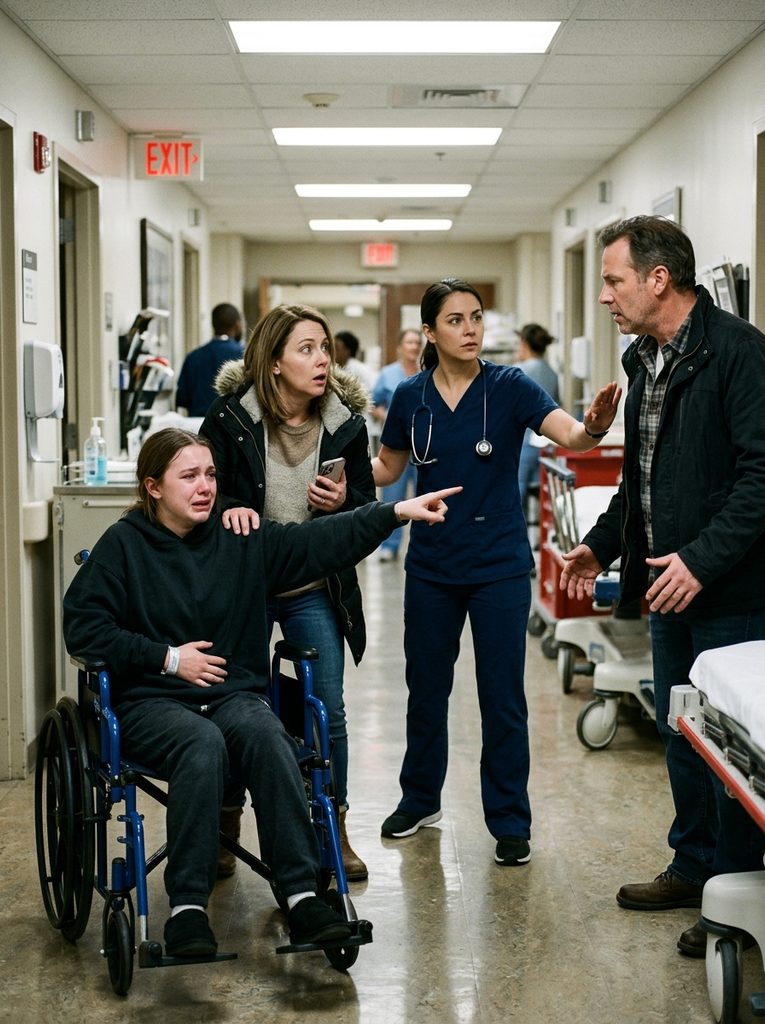
But before anyone could move her, shouting erupted outside.
My husband’s voice.
“I HAVE A RIGHT TO SEE MY DAUGHTER!”
A second voice answered.
“Sir, you need to lower your voice.”
Then came a heavy bang against something metal.
Emily immediately grabbed my wrist.
“Mom, please.”
I stood.
“I’m not leaving you.”
A hospital security officer appeared in the doorway.
He spoke quietly to the nurse, who stepped outside with him.
Seconds later, another woman entered.
She wore a navy cardigan and carried a small notebook.
“My name is Sarah,” she said. “I’m a hospital social worker.”
She pulled a chair beside Emily’s bed.
“Your doctor asked me to come because we want to make sure you’re safe.”
Emily looked suspicious.
“Are you going to make me talk to him?”
“No.”
“Are you going to send me home?”
“Not while we have serious concerns about your safety. We’ll work with the people responsible for protecting you.”
For the first time that night, Emily’s shoulders relaxed.
Then Sarah said something that changed everything.
“Emily, has anyone else seen what happened?”
My daughter hesitated.
Then she looked directly at me.
“Grandma.”
I stared at her.
“What?”
Emily swallowed.
“Grandma knows something.”
PART 4 — THE WOMAN WHO HAD BEEN TRYING TO WARN ME
At 4:46 a.m., I called my mother.
She answered on the second ring.
“Claire? What’s wrong?”
Her voice changed immediately when I told her we were at the emergency room.
“Is Emily alive?”
The question startled me.
“Of course she’s alive. Mom, why would you ask that?”
Silence.
Then I heard her begin to cry.
“Oh, thank God.”
I pressed the phone tighter against my ear.
“Mom. What do you know?”
She didn’t answer immediately.
Instead, she asked whether my husband was with us.
“No,” I said. “Hospital security is keeping him away.”
My mother exhaled shakily.
“Then listen carefully. I need to tell you something I should have told you weeks ago.”
Three weeks earlier, Emily had visited Grandma while I was working.
She had arrived unusually quiet.
When my mother offered to help her change into clean clothes after she spilled juice, Emily had panicked.
My mother hadn’t forced her.
But later, Emily had shown her bruises on her upper arm.
She said her father had grabbed her during an argument.
My mother wanted to call me immediately.
Emily begged her not to.
“She told me he would punish her if you found out,” my mother whispered.
I closed my eyes.
“Why didn’t you tell me?”
“I tried, Claire.”
She reminded me of a conversation we’d had two weeks earlier.
She had said that my husband seemed increasingly controlling.
She had asked whether Emily was happy at home.
I had become defensive.
I told my mother she didn’t understand our marriage.
Then I had ended the call.
I remembered every word.
My mother started crying harder.
“I should have insisted. I should have done something more.”
Neither of us spoke for several seconds.
Then she said, “There’s something else.”
My stomach tightened.
“What?”
“Emily left an envelope here.”
“An envelope?”
“She told me to keep it somewhere safe. She said if anything happened to her, I should give it to you.”
My knees nearly buckled.
“What is inside?”
“Photographs. Some handwritten notes. And a small memory card.”
I looked through the hospital doorway at my daughter, lying beneath a white blanket while a nurse adjusted her IV.
She was fifteen.
Fifteen years old.
And she had been preparing evidence in case something happened to her.
“Bring it,” I said.
My mother didn’t hesitate.
“I’m coming now.”
When I ended the call, Sarah was waiting beside me.
I told her everything.
She documented what I said and explained that the hospital would make the required child-protection report and coordinate with law enforcement.
Then she asked whether Emily had a safe adult she trusted besides me.
“My mother,” I answered.
“Good. We’ll include her in the safety planning if Emily wants that.”
A doctor appeared.
“We have some preliminary results.”
My heart stopped.
“Is she going to be okay?”
“She’s dehydrated, and we’re concerned about an abdominal injury. The imaging shows something that needs a surgical specialist’s evaluation.”
I covered my mouth.
“From what her father did?”
“We can’t determine the cause from imaging alone,” he said carefully. “But her symptoms and what she’s told us make the injury especially concerning.”
He paused.
“The important thing is that you brought her here.”
I thought about my husband standing in the bathroom doorway.
She’s being dramatic.
For three days, he’d watched his daughter suffer.
For three days, he’d told me she was pretending.
And now doctors were discussing whether she needed surgery.
Something inside me hardened.
I no longer cared about preserving my marriage.
I cared about getting my daughter through the night.
PART 5 — THE MESSAGE HE FORGOT TO DELETE
At 5:27 a.m., two detectives arrived.
One was a woman named Detective Elena Brooks.
She spoke to me first, then explained that a specialist trained to interview children would speak with Emily when she was medically stable.
They wanted to avoid making her repeat painful details unnecessarily.
I handed over the information about the messages and explained that Emily wanted the evidence preserved.
Detective Brooks asked us not to alter the phone.
Then she asked a question I hadn’t expected.
“Does your husband know you have access to these messages?”
“I don’t think so.”
“Has he contacted you?”
I looked down.
My phone showed eleven missed calls.
Six text messages.
All from him.
The latest read:
“Don’t let her tell them stories. You know how she gets. We need to handle this as a family.”
A second message arrived while we were looking.
“If you destroy this family over her lies, that’s on you.”
Detective Brooks read the messages.
“Please preserve these too.”
Then my phone rang again.
His name flashed across the screen.
I looked at the detective.
She advised me not to engage in an argument and to let the investigators handle contact with him.
I declined the call.
For fifteen years, I had built my life around keeping our home peaceful.
I had learned to apologize first.
To explain his anger.
To calm Emily before he became irritated.
To make excuses when he snapped at people.
I had called it compromise.
Now I wondered how much fear I’d mistaken for peace.
At 6:03 a.m., my mother arrived carrying a brown envelope.
Her hair was tangled.
She wore slippers and an old winter coat over her pajamas.
The moment she saw me, she pulled me into her arms.
“Where is my girl?”
“She’s being examined.”
My mother looked at the detectives.
“Please tell me you’re going to protect her.”
Detective Brooks answered without making promises she couldn’t guarantee.
“We’re taking her report seriously, and we’re working to establish what happened.”
My mother handed over the envelope.
Inside were photographs of bruises, dated handwritten notes, and a memory card.
The notes were written in Emily’s careful handwriting.
Some described arguments.
Others recorded dates when her father had threatened her.
One page contained only three sentences.
“Mom thinks Dad is strict because he loves me.”
“I don’t think love is supposed to feel like this.”
“If I disappear, please don’t believe him.”
My mother broke down when she saw me reading it.
I couldn’t cry.
Not yet.
I was too frightened by the thought that my daughter had genuinely believed she might disappear.
Detective Brooks carefully placed the materials into evidence packaging.
Then my mother spoke.
“There’s something on the memory card.”
The detective looked up.
“What kind of recording?”
“I haven’t watched all of it. Emily told me it was from the kitchen camera.”
Our kitchen had a small security camera mounted above the back door.
My husband installed it the previous year after someone stole a package from our porch.
He controlled the system through his phone.
I barely thought about it.
But Emily had apparently discovered that older footage could be downloaded before it was overwritten.
My mother explained that she’d helped Emily save a copy after the girl told her she was afraid the recording would disappear.
The detectives arranged to review the file through their evidence procedures.
I didn’t know what it would show.
But I remembered something my husband had said months earlier.
“That camera sees everything.”
He had meant it as a warning to Emily.
He never imagined she might use it to protect herself.
PART 6 — THE TRUTH NO ONE COULD TALK AWAY
By sunrise, Emily had been admitted for observation and treatment.
A surgical specialist explained that her abdominal injury was serious but that her condition was stable.
She would need close monitoring and might require a procedure if her condition worsened.
I sat beside her bed as the morning light crept through the blinds.
She looked smaller than I remembered.
“Mom?”
“I’m here.”
“Is Dad angry?”
I felt tears gathering.
“That’s not something you need to worry about.”
“But what if he comes home?”
I took her hand.
“We’re not going back there with him.”
She stared at me.
“You mean it?”
“Yes.”
She looked away.
Then she asked the question that nearly broke me.
“Even if he says he’s sorry?”
I leaned closer.
“Being sorry doesn’t erase what someone has done. And you don’t have to put yourself in danger to make someone else feel forgiven.”
Emily was quiet for a long moment.
Then she began crying.
Not the terrified, silent crying I’d seen in the emergency room.
This was different.
She cried openly, like a child who had finally been given permission to stop pretending everything was fine.
I held her until she fell asleep.
Later that morning, Detective Brooks returned.
She told me investigators had reviewed footage relevant to Emily’s account.
The recording showed a confrontation in the kitchen.
It also showed physical violence consistent with parts of what Emily had described.
The detective didn’t show me the footage.
I didn’t ask her to.
I had already seen enough in my daughter’s eyes.
“We’re pursuing this through the appropriate legal process,” she explained. “We also need to discuss where you and Emily can safely stay.”
I told her about my mother’s house.
She asked about spare keys, shared accounts, location tracking, and whether my husband had access to our phones.
I suddenly remembered the family location app.
He had insisted we all install it.
He said it was for emergencies.
Detective Brooks helped us identify the information relevant to a safety plan.
For the first time, I understood that leaving wasn’t as simple as walking through a door.
It meant protecting our location, our documents, our communications, and the people helping us.
That afternoon, a child-protection worker met with us.
A hospital advocate explained the available support services.
And when Emily woke up, the first thing she asked was whether Grandma had arrived.
My mother came into the room carrying Emily’s favorite stuffed rabbit.
Emily hadn’t slept with that rabbit in years.
But when she saw it, she reached out immediately.
Grandma sat beside her.
“I’m sorry I couldn’t stop this sooner,” she whispered.
Emily shook her head.
“You believed me.”
My mother kissed her forehead.
“Always.”
At that moment, I realized something important.
My daughter had spent weeks searching for adults who would believe her.
Now she had three sitting beside her bed.
And none of us intended to abandon her.
PART 7 — THE LAST THING HER FATHER EXPECTED
Two days later, Emily was well enough to leave the hospital with a carefully arranged follow-up plan.
We didn’t return to our house.
We went to my mother’s.
The detectives were continuing their investigation, and protective measures were being pursued through the appropriate authorities.
My husband had been questioned.
He had denied intentionally harming Emily.
He claimed the confrontation had been exaggerated.
He said he had only been trying to discipline a disrespectful teenager.
But there were the messages.
The photographs.
The medical findings.
And the recording.
His explanations were no longer the only version anyone heard.
That evening, I received a message from his sister, Rebecca.
“You are destroying his life. Emily needs to stop making accusations.”
I stared at the screen.
For years, Rebecca had defended her brother whenever he lost his temper.
She called him passionate.
Misunderstood.
A man who expected respect.
I started typing an angry response.
Then I stopped.
I saved the message and shared it with our advocate.
Emily didn’t need another family argument.
She needed safety.
Over the following weeks, we met with legal professionals, investigators, doctors, and a trauma-informed counselor.
Some days Emily seemed almost like herself.
She watched movies with Grandma.
She laughed at silly videos.
She asked for pancakes.
Other days, she couldn’t sleep.
A slammed cabinet made her jump.
A man’s raised voice on television made her leave the room.
Once, she cried because she’d accidentally dropped a glass and expected someone to shout at her.
I knelt beside the broken pieces and told her I wasn’t angry.
“It’s just a glass,” I said.
She looked at me as though I’d spoken a language she was still learning.
Then she whispered, “Dad would’ve yelled.”
“I know.”
“I’m sorry.”
“You don’t have to apologize for accidents.”
She nodded.
But I knew it would take time before she truly believed that.
A month later, the investigators informed us that criminal charges had been filed against my husband in connection with the assault.
The case was not finished.
There would be hearings.
There would be difficult questions.
And there would be no quick way to undo what Emily had endured.
But he could no longer insist the entire matter had been invented without facing the evidence.
I had also begun divorce proceedings.
When my attorney asked whether I wanted to attempt reconciliation, my answer was immediate.
“No.”
I didn’t hate the fifteen years I’d spent married to him.
There had been birthdays.
Vacations.
Ordinary mornings.
Moments I once believed were happy.
But none of those memories changed what he’d done to our daughter.
And none of them required us to return.
PART 8 — THE LETTER EMILY LEFT ON MY PILLOW
Three months after that night in the emergency room, I came home from work and found an envelope on my pillow.
My name was written across the front.
MOM.
Inside was a letter.
I sat on the edge of my bed and unfolded it.
Dear Mom,
I need to tell you something I couldn’t say in the hospital.
When I gave you my phone, I thought you might hand it to Dad.
I thought you might tell me I was making things worse.
I thought you might be angry because I saved the messages instead of deleting them like he told me to.
But you didn’t.
You held my hand.
You told me you believed me.
I know you wish you’d noticed sooner.
Sometimes I wish that too.
But I don’t want you to spend the rest of your life blaming yourself.
I want us to have a different life now.
I want to go to school without worrying about what will happen when I get home.
I want to laugh loudly.
I want to make mistakes.
I want to invite friends over.
And I want to stop being scared when someone says my name.
I don’t know how long that will take.
But I think I’m getting better.
Yesterday, Grandma dropped a plate.
It made a really loud noise.
And for the first time, I didn’t think someone was going to get hurt.
I just helped her clean it up.
That probably sounds small.
But it felt huge to me.
I love you, Mom.
Thank you for choosing me.
Love, Emily.
I read the letter three times.
Then I walked into the living room.
Emily was sitting on the floor with Grandma, working on a puzzle.
She looked up.
“Did you read it?”
I nodded.
Her expression became nervous.
“Was it okay?”
I sat beside her.
“It was more than okay.”
Then I hugged her.
And for the first time since the hospital, I cried without trying to hide it.
Emily held me.
After a moment, she whispered, “Mom, you don’t have to be strong every second.”
I laughed through my tears.
“Neither do you.”
We stayed like that for a long time.
No shouting.
No threats.
No footsteps making us tense.
Just three generations of women sitting together in a small living room, slowly learning what peace felt like.
PART 9 — ONE YEAR LATER: THE MOMENT I KNEW SHE WAS HEALING
A year after the emergency-room visit, Emily turned sixteen.
We celebrated at Grandma’s house.
There were pink balloons, homemade cupcakes, and six of Emily’s closest friends.
She wore a blue dress she’d picked out herself.
Her hair was curled.
And she laughed so loudly that my mother had to remind everyone to lower the music.
I watched her from the kitchen.
She looked happy.
Not completely healed.
Not untouched by everything that had happened.
But happy.
The criminal proceedings had continued, and my former husband’s case had resulted in a conviction.
Protective restrictions remained in place.
Our divorce was finalized.
Emily continued attending counseling, and her doctors were pleased with her physical recovery.
There were still difficult days.
Sometimes she asked questions I couldn’t answer.
Sometimes she became angry about what had happened.
Sometimes she worried that trusting people would always be difficult.
I learned not to rush her.
Healing wasn’t a straight road.
And it wasn’t something I could demand just because I wanted her suffering to end.
That afternoon, Emily carried a cupcake into the kitchen.
“Mom?”
“Yes, sweetheart?”
“Can I ask you something?”
“Anything.”
She leaned against the counter.
“Do you remember what I said at the hospital?”
My chest tightened.
“Of course.”
She looked down.
“He knows why it hurts.”
I nodded.
She was quiet for a moment.
“That was the scariest thing I’ve ever said.”
I reached for her hand.
“I know.”
“But it was also the first time I stopped protecting him.”
I swallowed.
She continued.
“I used to think being brave meant not being scared.”
“And now?”
She smiled faintly.
“Now I think it means saying something even when you’re terrified.”
I kissed her forehead.
“I think you’re right.”
Outside, her friends began singing.
Emily laughed and hurried toward the living room.
I followed.
As she stood in front of her birthday cake, surrounded by people who loved her, I noticed something I hadn’t seen in years.
She wasn’t watching the doorway.
She wasn’t checking anyone’s expression before speaking.
She wasn’t waiting for permission to enjoy herself.
She simply closed her eyes and made a wish.
Then she blew out sixteen candles.
Everyone cheered.
And I understood that the greatest gift I could give my daughter was not a perfect family, a beautiful house, or a life without hardship.
It was a home where she could feel safe.
A home where telling the truth didn’t lead to punishment.
A home where love didn’t have to be earned through fear.
That night, after the guests had gone, Emily helped me gather the wrapping paper.
She picked up the old stuffed rabbit Grandma had brought to the hospital and placed it carefully on her bookshelf.
“Keeping that?” I asked.
She smiled.
“Of course.”
“Even though you’re sixteen?”
“Mom, some things are worth keeping.”
I looked at her.
And suddenly I understood that she wasn’t only talking about the rabbit.
She was talking about the people who stayed.
The people who listened.
The people who believed her when telling the truth was the hardest thing she had ever done.
Later, when I turned off her bedroom light, Emily called out.
“Mom?”
I stopped in the doorway.
“Yes?”
“Thank you for taking me to the hospital that night.”
My throat tightened.
“I would do it a thousand times.”
She smiled.
“I know.”
Then she rolled onto her side and closed her eyes.
I stood there for another moment, listening to her breathe.
A year earlier, I’d stood outside a bathroom door listening to my daughter cry, unaware that everything we believed about our family was about to collapse.
Now I stood outside her bedroom knowing something far more important.
We had survived the truth.
And the truth had finally given us the chance to live without fear.
THE END.