“Please don’t tell your son you found me,” she whispered. “He’ll destroy both of us.” I thought she was frightened of losing her baby. But when she noticed my trembling hands, she revealed something terrifying about the coffee my son brought me every morning.
My name is Raymond Callahan. I’m fifty-nine years old, and I’ve spent more than thirty years building a construction company in Dallas, Texas.
I thought I knew my only son, Garrett, better than anyone.
I was wrong.
That evening, I was having dinner with my longtime business partner, Frank Doyle, at a restaurant in Highland Park. We were supposed to discuss a contract worth twelve million dollars.
But I could barely concentrate.
For six months, I’d suffered unexplained dizziness, weakness in my legs, and a strange metallic taste in my mouth. My doctors suspected exhaustion, but the symptoms kept getting worse.
“Ray, are you feeling all right?” Frank asked.
“Just tired. I’ll be fine.”
Then a young waitress approached our table.
“Good evening, gentlemen. Can I get you anything?”
I looked up and froze.
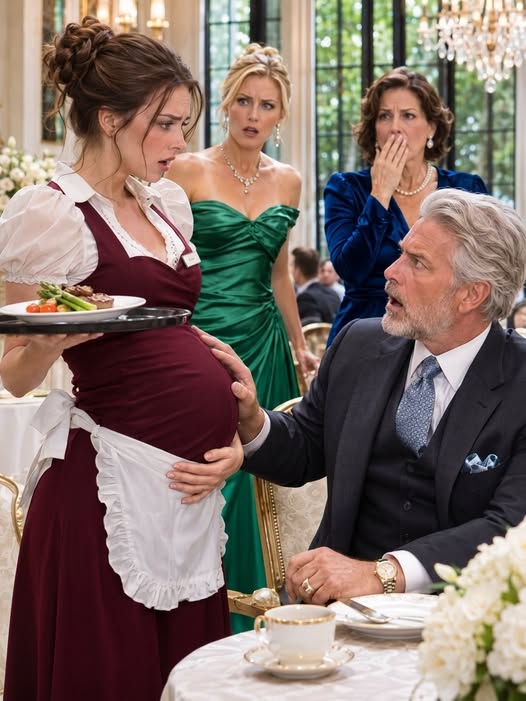
Standing in front of me was Rebecca Sullivan, my twenty-seven-year-old daughter-in-law.
Her hair was tied back, her shoes were worn, and her face looked exhausted. Beneath her black uniform, her pregnant belly was unmistakable.
Eight months earlier, Garrett had told me she’d disappeared with another man.
He’d also claimed she’d stolen money from our company.
“Rebecca?” I whispered.
Her serving tray trembled.
“I’m sorry, sir. You must have mistaken me for someone else.”
“Rebecca, it’s Ray.”
She glanced nervously toward the entrance before disappearing through the kitchen doors.
I immediately stood up.
“Ray, what about the contract?” Frank called.
“Something more important has come up.”
I followed her through the kitchen and found her leaning against a wall in the service alley, one hand resting protectively on her stomach.
“Rebecca, please. Tell me what’s happening.”
She began crying.
“You shouldn’t have followed me.”
“Garrett said you left him. He told me you ran away with another man and stole from the company.”
She stared at me.
“That’s what he told you?”
I nodded.
Rebecca wiped her cheeks.
“I never stole anything. Garrett threw me out. He canceled my cards, changed the locks, and threatened to ruin my life if I told anyone what happened.”
I struggled to understand what I was hearing.
“And the baby?”
She lowered her eyes.
“He’s Garrett’s son.”
I took an involuntary step forward, but she backed away.
“He doesn’t know I’m pregnant,” she explained. “If he finds out, he’ll try to take my baby. He already threatened to make everyone believe I’m mentally unstable.”
“Rebecca, Garrett would never do something like that.”
Her expression changed.
“You don’t know the man your son has become.”
I wanted to argue.
Instead, I remembered how quickly Garrett had convinced me that Rebecca was dishonest. I’d accepted his explanation without ever hearing her side.
“Why didn’t you contact me?” I asked.
“I tried.”
She looked toward the restaurant door again.
“Your son made sure I couldn’t reach you. And there’s something else you need to know.”
I waited.
Rebecca gripped my arm.
“Mr. Callahan, Garrett has been waiting for you to die.”
My stomach tightened.
“What are you talking about?”
She hesitated, then glanced at the trembling hand I’d been trying to hide all evening.
“I know you’ve been sick. I know about the dizziness and the weakness.”
“How?”
Her voice dropped almost to a whisper.
“Because I saw Garrett and another woman preparing something they were putting in your morning coffee.”
For a moment, I couldn’t speak.
Every morning for months, my son had brought me coffee at the office, insisting that I was working too hard and needed someone to look after me.
I’d always thought it was a small act of love.
Standing in that alley, looking at my frightened, pregnant daughter-in-law, I began to wonder whether I’d misunderstood everything…
PART 3: THE LAST CUP
I didn’t confront my son that night.
Every instinct I had as a father told me to drive to Garrett’s penthouse and demand the truth. But Rebecca was gripping my sleeve, shaking so hard I could feel it through the fabric.
“If you go to him now, he’ll know I talked,” she whispered. “And he’ll make sure nobody ever believes me.”
I looked at her swollen belly, her cracked hands, her worn-out shoes. Then I made the most important decision of my life.
“Pack your things,” I said. “You’re not staying another night in this place.”
She lived in a rented room above a laundromat in East Dallas. It had a mattress on the floor, a hot plate, and a folder hidden inside a torn pillowcase. She handed it to me with trembling fingers.
“I should have gone to the police,” she said. “But Garrett told me they’d never believe a woman he’d already painted as a thief.”
Inside the folder were photographs taken from a hallway, slightly blurred. In them, my son stood in the kitchen of his penthouse beside a slim blonde woman in a gray blazer. She was holding a small brown bottle. Garrett was stirring a coffee cup.
There was also a phone with a cracked screen, holding a forty-second video.
I watched it twice.
On the screen, Garrett’s voice was calm and almost cheerful. “Half a dose in the morning. The doctors will keep calling it burnout. Another few months and the board will vote me in as acting president.”
The woman laughed. “And the old man never suspects?”
“My father trusts anything I put in his hand.”
I set the phone down very carefully, because I didn’t trust myself not to throw it across the room.
Thirty-one years of building a company. Thirty-one years of believing I was building it for him.
“Who is she?” I asked, my voice barely working.
“Tessa Marlowe,” Rebecca said. “She was Garrett’s financial consultant. After I noticed money missing from the company accounts, I asked questions. Two days later, I was out of the house, and the missing money had become my crime.”
I closed my eyes.
“I’m so sorry, Rebecca.”
“You didn’t know.”
“I should have.”
She didn’t argue. She just placed her hand over mine, and we sat there in that cramped little room, two people who had both been lied to by the same man.
By midnight, Rebecca was asleep in the guest room of my house in Preston Hollow, with a security guard parked outside. By 1:00 a.m., I was sitting in Frank Doyle’s kitchen.
Frank had been my partner for twenty-six years. He listened to the entire story without interrupting. When I finished, his face had gone gray.
“Ray, I’ve been noticing things in the books for almost a year,” he said quietly. “Payments to vendors I’d never heard of. I brought it up with Garrett twice. He said it was a bookkeeping transition.”
“Why didn’t you tell me?”
“Because he’s your son.” Frank rubbed his eyes. “And because I didn’t want to be the man who accused him without proof.”
“Now we have proof.”
“Then we do this right,” Frank said. “Lawyers. Doctors. The police. No heroics.”
That was how I met Detective Angela Ruiz.
She was in her forties, sharp-eyed, with a voice that never rose and never needed to. She watched the video, reviewed the photographs, and asked Rebecca questions for nearly two hours. Then she turned to me.
“Mr. Callahan, have you had any medical testing for toxic exposure?”
“No. My doctors thought it was stress.”
“We’ll fix that today.”
By afternoon, I was at a hospital across town, far from my usual physicians, sitting across from a toxicologist named Dr. Patricia Wynn. She took blood, urine, and a hair sample, and asked me to describe every symptom in detail.
Three days later, she called me back to her office.
She didn’t waste any time.
“Mr. Callahan, your results show a significant level of a toxic heavy metal in your system. It’s consistent with repeated low-dose exposure over many months.”
I had known. Somewhere inside, I had known since the courtyard. Still, hearing it said aloud by a stranger in a white coat made the room tilt.
“Will I recover?” I asked.
“If the exposure stops now, most of the damage should be treatable. You may have lost more than a few months if this had continued.”
I thought of Rebecca, working a double shift while heavily pregnant, carrying a secret that could have cost her everything.
She hadn’t just saved my life.
She’d done it while terrified for her own.
Detective Ruiz laid out the plan in a quiet conference room the next morning.
“We have a video, but we need a confession or physical evidence tied directly to Garrett. If we move too early, his attorneys will argue the video is out of context.”
“What do you need from me?” I asked.
“Business as usual,” she said. “Tomorrow morning, Garrett will bring you coffee like he always does. You’ll take it, thank him, and set it aside. We’ll have officers and recording equipment in place. The cup will be collected.”
“And if he suspects?”
“He won’t. He believes you’re a tired old man who trusts his son.”
It was the most painful sentence anyone had ever said to me, because it was true.
That night, I didn’t sleep. I walked the halls of my own house like a stranger. In the guest room, Rebecca sat on the edge of the bed, one hand on her stomach.
“He kicked tonight,” she said, almost shyly. “For the first time in days.”
“Strong like his mother,” I said.
She smiled, then her eyes filled.
“Mr. Callahan, whatever happens tomorrow, he’s still your son.”
“I know.”
“It’s going to hurt.”
“I know that too.”
She was quiet for a moment. “I used to love him. I really did. I keep trying to find the exact moment he turned into someone else.”
“Maybe he didn’t turn into anyone,” I said. “Maybe I just never looked closely enough at who he was.”
She reached for my hand.
“Then look closely now.”
At 8:15 the next morning, I sat behind my desk on the twelfth floor of Callahan Construction.
Two plainclothes officers sat in an empty office down the hall. A small microphone was clipped inside my jacket. Detective Ruiz waited in a van in the parking garage, watching every second.
At 8:20, Garrett walked in.
He wore a navy suit, the same confident smile, and a paper cup from my favorite café in each hand.
“Morning, Dad.”
My heart pounded so hard I thought he’d hear it.
“Good morning, son.”
He set one cup in front of me, as he had done on hundreds of mornings, and sat down across from me. His eyes moved over my face the way a doctor’s might, studying, measuring.
“You look tired,” he said gently. “You’re pushing yourself too hard. Drink your coffee.”
For one long second, I looked at the cup.
Then I looked at my son.
“Garrett,” I said, “why did Rebecca leave?”
His smile didn’t flicker.
“We’ve been over this, Dad. She stole from us and ran off. I don’t like talking about it.”
“I saw her last week.”
The air in the office changed.
Garrett’s fingers tightened around his own cup.
“Saw her where?”
“Working in a restaurant. Pregnant.”
For the first time in my life, I watched my son’s face go completely empty. No shock, no concern, no joy at the news of a child. Only calculation, quick and cold.
“She’s lying to you,” he said softly. “She’s unstable, Dad. I didn’t want to tell you everything because I was protecting you.”
“Protecting me?”
“From the truth about her.”
“Then protect me from this one.”
I pushed the cup an inch toward him.
“Drink my coffee.”
Silence.
Garrett stared at the cup. A muscle in his jaw moved.
“Dad, that’s ridiculous.”
“Is it?”
“I made sure it was just how you like it.”
“Then you won’t mind having some.”
He stood up slowly. “I think you’re confused. The medication the doctors have you on—”
“I’m not on any medication, Garrett.”
That was when he made his mistake.
He glanced at the door.
It was a tiny movement, no more than a half-second. But it told me everything. He was measuring the distance to the exit.
“What did you put in it?” I asked.
“Nothing.”
“What did you and Tessa put in it?”
His face hardened. The mask finally slipped away, and the man underneath looked nothing like the boy I had taught to ride a bike in the cul-de-sac behind our first house.
“You were never going to retire,” he said.
“There it is.”
“You’re sixty years old and still sitting in that chair like you’ll live forever. Do you know how many years I’ve waited? How many times I’ve had to listen to you tell the board that I’m ‘not ready’?”
“So you decided to speed things up.”
“I decided to take what I earned!” His voice cracked through the room. “I worked for you my whole life, and you never once looked at me like I was enough.”
I stared at him.
“You were my son,” I said. “That was always enough.”
“Don’t.”
“I would have given you everything.”
“You gave me a title and a leash.”
Behind him, the office door opened.
Detective Ruiz stepped in with two uniformed officers.
“Garrett Callahan,” she said evenly, “you’re under arrest for attempted murder, fraud, and conspiracy.”
He spun toward her, then back toward me, and for a moment he looked like a frightened child.
“Dad. Dad, tell them this is a mistake.”
I couldn’t speak.
When the handcuffs closed around his wrists, I finally understood that some things cannot be undone, only survived.
Tessa Marlowe was arrested at the airport that same afternoon, a one-way ticket to Miami in her purse and a duffel bag containing nearly four hundred thousand dollars in cash.
Garrett’s attorneys fought for months. They argued the video was edited, the coffee had been tampered with by someone else, and the missing funds were poor accounting. But the prosecution had the recording from my office, the lab results from Dr. Wynn, the bank records Frank had quietly pulled together, and Tessa’s cooperation once she realized Garrett would let her take the fall.
In the end, Garrett accepted a plea deal.
Twenty-two years.
I sat in the second row of the courtroom as the judge read the sentence. Garrett never looked at me.
Rebecca sat beside me, holding my hand.
I didn’t cry until I got to my car.
Then I cried for a long time.
Our grandson was born on a snowy morning in February.
I was in the hospital waiting room when the nurse came out smiling. “Mr. Callahan? Your daughter-in-law is asking for you.”
Rebecca lay propped against pillows, exhausted and radiant, a tiny bundle wrapped in a blue blanket against her chest.
“Meet Henry,” she whispered.
I stepped closer.
He had dark, wrinkled little fists and a face scrunched in protest at the whole world. When I touched his hand, his fingers curled around my thumb with astonishing strength.
“Henry Raymond Sullivan-Callahan,” Rebecca said. “If that’s all right with you.”
I couldn’t answer. My throat had closed completely.
“Ray?”
“It’s more than all right.”
She smiled. “He’s going to know the truth someday. Not all at once. But I won’t build his life on a lie.”
“No,” I said softly. “Neither will I.”
She looked at me, her eyes steady.
“I’m not going to teach him to hate his father. But I’m not going to pretend, either.”
“That’s the right way.”
We sat in the quiet of that hospital room as snow drifted past the window, a broken family trying carefully to become something new.
Months passed.
I sold my controlling shares in Callahan Construction and moved the company into the hands of Frank and a new leadership team, with Rebecca as a voting board member. She had a head for numbers and a spine of steel, and she’d already caught two errors in the quarterly reports that would have taken Frank a week to find.
My health recovered slowly. The dizziness faded. The tremor in my hands eased. By summer, I could walk the length of White Rock Lake without stopping to rest.
One evening, I sat on the back porch with Henry asleep in my arms.
Rebecca came out with two mugs and handed one to me.
I looked down.
Coffee.
She saw my face and laughed softly. “Relax. I made it myself.”
I laughed too, and the sound surprised me. It was the first real laugh I’d had in over a year.
“Thank you,” I said.
“For the coffee?”
“For everything. For not walking away when you could have. For warning me when you had every reason to stay silent.”
Rebecca looked at the sleeping baby.
“You followed me into that alley,” she said. “You could have called Garrett. You could have walked away. You didn’t.”
“I almost did.”
“But you didn’t.”
I took a slow sip. It tasted like nothing but coffee, warm and bitter and honest.
“My father used to say that trust is the foundation of every structure worth building,” I said. “I spent thirty years pouring concrete and never once checked what was cracking underneath my own house.”
She leaned her head against my shoulder.
“Then we’ll rebuild it,” she said.
And as the Texas sun sank behind the trees and Henry stirred peacefully in my arms, I realized she was right.
Some foundations collapse.
But the people who survive them can build again, slower and wiser, with open eyes, and with truth poured into every corner.
The rain in Dallas always felt heavy, but on the morning of Garrett’s first parole hearing three years later, it felt like lead.
I sat in the small room across from Frank, sipping lukewarm tea. The lake house was quiet—a retreat I had built to escape the echoes of the city and the corporation that bore my name. Every corner of Callahan Construction carried a shadow, but out here, watching the grey ripples on White Rock Lake, I could breathe.
“The board approved the expansion into affordable housing,” Frank said, setting down a thick blue folder. “Rebecca pushed it through. She didn’t let the legacy committee bully her for a second.”
I smiled, though my heart wasn’t entirely in it. “She’s stronger than I ever was at her age, Frank.”
“She had a good teacher,” Frank replied gently. He hesitated, rubbing his thumb against the edge of his mug. “The hearing is at two. Are you going?”
I looked at my hands. The tremor was long gone, but the ghost of the poison still felt embedded in my joints whenever the weather turned cold. “If I go, Frank, am I going as a father who wants to forgive, or as the man he tried to kill?”
“Maybe you’re just going as a man who needs to see the door closed,” Frank said.
When I arrived at the Huntsville Unit, the damp air inside smelled of bleach and old cement. The parole room was stark: fluorescent lights hummed above a long oak table.
Garrett was brought in five minutes later.
He wore orange scrubs that hung loosely on his shoulders. He had lost weight, and his posture—once defined by the arrogant posture of a young executive who owned every room he walked into—was stooped. The sharp hair cuts were replaced by an uneven buzz. But it was his eyes that caught me: cold, hollowed, and defensive.
He sat down, refusing to look directly at me.
“Garrett,” I said. My voice was lower than I intended.
“You came to watch?” he snapped, his voice rough from lack of use. “Check on your investment?”
“I came because your mother would have wanted someone here,” I said. “And because Henry asks questions.”
At the mention of his son’s name, Garrett’s jaw tightened. “Don’t say his name. You stole him from me. You and Rebecca. You took my company, you took my son, and you threw me in a cage.”
“You built the cage, Garrett,” I answered quietly. “I just locked the door after you tried to put me under the earth.”
The parole commissioner entered before Garrett could respond. The proceeding was brief. Garrett’s conduct record was marred by two altercations in the yard, and he showed zero contrition. When the commissioner asked if he had anything to say to the victim, Garrett simply looked out the narrow window.
Parole denied. Minimum three more years.
As the guards stepped forward to handcuff him, Garrett turned to me, his eyes burning with a sudden, desperate fury. “You think you won, Ray? Callahan Construction is built on my sweat too. Tessa didn’t act alone. You think she gave up everything?”
“What are you talking about?” I asked.
“Ask Frank,” Garrett whispered bitterly as he was dragged toward the steel door. “Ask Frank about the offshore accounts in the Cayman Islands from four years ago. You thought I was the only one who wanted you gone?”
The heavy door slammed shut.
The drive back to Dallas felt longer than usual. Garrett’s parting words hung in the car like toxic fumes. Ask Frank.
Frank had been my right hand for thirty-five years. He had helped me build Callahan Construction from a two-man framing outfit into a regional powerhouse. He was the one who pulled the bank records that put Garrett away.
When I reached the corporate offices downtown, the building felt different. The high-gloss marble floors and polished brass detailing no longer represented achievement; they looked like monuments to vanity.
I didn’t take the executive elevator. I took the stairs up to the legal and finance department on the fourth floor.
Rebecca was in her office, framed blueprints of our new sustainable housing project spread across her desk. Henry, now three years old, was sitting in the corner with a set of wooden building blocks, methodically stacking them before knocking them down with a soft laugh.
“Ray,” Rebecca said, looking up with a warm smile. “How was… how did it go?”
“Denied,” I said. I walked over and knelt beside Henry, letting him hand me a yellow block. “He’ll serve at least three more years.”
Rebecca let out a slow breath, settling back into her chair. “Is he… is he okay?”
“He’s angry. He’s consumed by it.” I stood up, dusting off my trousers. “Rebecca, where is Frank?”
“He went to the city planning committee meeting twenty minutes ago. Why?”
I walked over to her desk and looked at the ledger entries she was auditing. “Garrett said something at the prison. It might just be the rambling of a bitter man trying to tear down whatever is left. But he mentioned offshore transfers from four years ago. Before the poisoning started.”
Rebecca’s face lost its color. She pulled up a secure folder on her laptop. “Ray, when I was reviewing the accounts last month, I found three wire transfers marked as sub-contractor fees for a firm called Vane Logistics. They were authorized by Frank’s key. I assumed they were legitimate shell entities for land acquisition.”
“Vane,” I repeated. “That was Tessa Marlowe’s mother’s maiden name.”
The floor beneath me felt like it was dissolving. Frank hadn’t just uncovered the fraud—he had managed it. He had played both sides, steering Garrett into a desperate move so that when Garrett fell, Frank would be left running the empire while I faded away from ‘natural’ health complications.
“Ray,” Rebecca whispered, reaching for my arm. “Don’t go after him alone.”
“I spent thirty years trusting the wrong people because it was convenient,” I said softly, looking at Henry, who was carefully balancing a red block on top of a tower. “I’m not doing it anymore.”
The planning committee meeting took place in the basement of City Hall. The room was cold, lit by dim overhead lights, with the smell of stale coffee lingering in the air.
I waited in the corridor outside until the double doors swung open and the members filed out. Frank was among the last, laughing with a city commissioner, a leather portfolio tucked under his arm.
When he saw me standing by the marble pillar, his smile flickered, then smoothed out into his familiar, comfortable warmth.
“Ray! I thought you were at Huntsville,” he said, stepping toward me.
“I was,” I said. “Garrett sends his regards.”
Frank stopped. The commissioner nodded to us both and walked away down the hall, leaving us alone in the cavernous hallway.
“How is he?” Frank asked, his voice cautious.
“He’s bitter. But he has a very good memory,” I said, stepping closer. “He remembered Vane Logistics. He remembered who suggested the Cayman structure to him when he was struggling to hide his gambling debts.”
Frank didn’t flinch. He slowly lowered his portfolio. The warmth in his eyes died, replaced by the cool, calculating distance of an accountant looking at a bad line item.
“Garrett was weak, Ray,” Frank said smoothly, his tone conversational. “He lacked vision. He wanted money for cars and women. I wanted this company to survive.”
“By helping my son poison me?” My voice shook, a low rumble of rage.
“I didn’t know about the poison until it was already happening,” Frank said calmly. “Tessa came to him on her own. But when I saw what Garrett was doing, I realized it was an opportunity. You were old-fashioned, Ray. You were stopping us from bidding on the high-density projects. You were holding Callahan back.”
“I was keeping Callahan honest!”
“Honest doesn’t pay twelve hundred payrolls every Friday!” Frank snapped, his composure breaking for a fraction of a second. “I saved this company three times while you were out playing master builder. You gave your worthless son everything, and you treated me like a clerk.”
“You were my friend, Frank.”
“I was your employee,” Frank corrected softly. “And I’ve taken measures to ensure my retirement is secure.”
He turned to walk away, but two men in grey suits stepped out from the stairwell behind him.
Detective Ruiz stepped out from the main entrance hall, her quiet footsteps echoing off the stone floor.
“Frank Vance,” Ruiz said, pulling a document from her coat. “We have a warrant for your personal bank records and a freeze order on all accounts associated with Vane Logistics.”
Frank looked at Ruiz, then back at me. He didn’t scream or fight like Garrett had. He simply adjusted his tie, handed his leather portfolio to the nearest officer, and looked me dead in the eye.
“You’re going to watch everything you built rot, Ray,” he whispered. “You don’t have the stomach for what it takes to keep it alive.”
“Then let it rot,” I said. “We’ll build something better on the dirt.”
The fallout was immediate and devastating.
When news broke that both the CEO’s son and the chief financial officer were tied to systemic embezzlement and attempted murder, Callahan Construction’s stock plummeted sixty percent in forty-eight hours. Banks froze our credit lines. Subcontractors pulled off job sites, fearing they wouldn’t get paid.
I called an emergency board meeting on a rainy Thursday morning.
The conference room was full of frightened faces—investors, senior partners, department heads who had spent decades building their quiet, comfortable lives on Callahan paychecks.
“We have two options,” I said, standing at the head of the table where I had sat for thirty years. “We can file for Chapter 11, liquidate our assets, and walk away with whatever scrap value is left.”
A murmur of panic went through the room.
“Or,” I continued, leaning forward on my hands, “we restructure completely. We strip the executive bonuses, we sell the high-rise division, and we pivot ninety percent of our resources into municipal affordable housing and public infrastructure.”
“Ray, that’s high risk and low margin,” one of the senior investors argued. “We won’t see profits for three years.”
“We’ll see honest work tomorrow,” Rebecca spoke up from the middle of the table. She stood, pulling up a detailed financial model on the main screen. “I’ve recalculated our debt service. If we sell the downtown corporate tower and move operations to the West Dallas site, we cut overhead by seventy percent. We retain ninety percent of our field workers.”
The room went quiet. They looked at Rebecca, then at me.
“Callahan Construction was built on a lie for the last five years,” I told them. “If we carry on business as usual, we deserve to fail. I’m putting up my personal real estate portfolio as collateral to secure the worker pension fund. Who is staying?”
One by one, the hands went up.
That afternoon, we packed up thirty years of history from the executive suite. I took down the framed photos of Garrett breaking ground on his first project, the shovel shiny and unused in his young hands. I didn’t burn them or throw them away. I put them in a box to give to Henry when he was old enough to understand that good people can make monstrous choices.
Six months later, the sun was shining bright over the West Dallas build site.
The air was filled with the familiar smell of fresh-cut pine, damp earth, and hot asphalt—the smells of my youth. There were no glass skyscrapers here. Just thirty units of energy-efficient, low-income family housing designed to stand for a hundred years.
I wore my old yellow hard hat, the paint chipped and faded at the crown.
Rebecca was standing near the foundation of unit four, talking animatedly with a master carpenter about the roof trusses. She wore her own hard hat, her notebook tucked under her arm, completely at home among the dust and the noise.
Henry was sitting on a pile of smooth cedar planks nearby under the watchful eye of our site manager, playing with a toy bulldozer.
I walked over and sat down beside my grandson on the lumber stack.
“Grandpa,” Henry said, holding up the yellow truck. “We’re making houses?”
“We sure are, Henry,” I said, picking up a piece of timber and checking it for grain alignment. “Straight and true.”
“Is daddy coming to help?”
The question hung in the warm summer air, simple and heavy.
I looked across the dusty site toward the horizon where the Dallas skyline glinted like chrome in the distance.
“Not today, Henry,” I said gently, laying a hand on his small shoulder. “Your dad is somewhere far away right now, learning how to fix things he broke.”
“Will he fix them?”
“I hope so,” I said, looking over at Rebecca as she laughed at something the carpenter said, her face bright with purpose. “I hope so. But until he does, we’re going to build this place real sturdy. So when he’s ready, there’s something good waiting for him.”
Henry nodded, satisfied with the answer, and pushed his toy truck into the dirt, clearing a small path.
I leaned back against the stack of cedar, taking a deep breath of the clear air. The company was smaller now, the bank accounts were modest, and the prestige was gone. But as I watched the foundation being poured—honest concrete settling into deep, strong earth—I knew the house would stand.
THE END..!