Tamara stood in her kitchen doorway with Jodie’s cubby bag already zipped.
It was 6:40 on a Monday morning. I still had my scrubs bag on my shoulder, the one with the new stethoscope Austin bought me when I passed my boards. The coffee in my travel mug was still too hot to drink.
“I can’t keep her, Holly,” she said.
I didn’t understand at first. I thought she meant today. Maybe she was sick. Maybe one of her own kids was home with a fever.
Jodie waved from my hip with all five fingers spread wide, the way she does.
“Bye bye, Aunt Tamara,” she said, like it was any other day.
Tamara didn’t wave back.
That’s when I understood.
Jodie had gone to Tamara’s three mornings a week since June. Little Sprouts Home Daycare, the only licensed childcare in Pruitt County, run out of the converted garage behind my sister-in-law’s house on Second Street. Jodie loved it. She came home every Tuesday, Thursday, and Friday with paint on her elbows and stories I could only understand half of, about the goldfish named Biscuit and the boy who cried when the rain came.
The full-time spot was supposed to start in two weeks. My first shift at Mercy Regional was the same day. Four years of nursing school at night, two years of saving, and a signed offer letter for $31.40 an hour on the day shift in medical-surgical.
I’d signed the enrollment contract for that full-time spot in August. I’d paid the $150 registration fee. I still had the receipt in the glovebox.
“Is this about her heart?” I asked.
Jodie was born with a hole between the chambers of her heart. Lots of babies with Down syndrome are. It was repaired when she was five months old, at Children’s in Omaha, by a surgeon with gray eyebrows and the gentlest hands I had ever seen. He’d cleared her at her three-year checkup. Run, climb, fall down, get back up. “She’s a regular kid,” he’d said. “Treat her like one.”
“It’s the insurance,” Tamara said.
She didn’t look at me. She looked at a spot somewhere over my left shoulder.
“The renewal came in. It’s a hundred and forty dollars a month higher.”
I waited.
“The agent says a child with needs does that.”
She had practiced it. I could tell. The words came out too smooth, too even, like she’d said them to the bathroom mirror. But her hands shook anyway. She was holding the strap of Jodie’s bag so tight her knuckles had gone white.
“Tamara,” I said. “She’s your niece.”
“I know who she is.”
“She’s been here five months. Has she ever once needed anything different from the other kids?”
Tamara’s jaw tightened. She didn’t answer.
I knew the law said she couldn’t do this. I’d read enough during Jodie’s first year, sitting up nights in the NICU parent lounge, to know that a licensed daycare can’t just turn away a child because she has Down syndrome. Not without a real reason. Not because of a rumor about an insurance rate.
But I also knew a complaint takes months. Investigators. Letters. Phone calls nobody returns. And I started work in fourteen days.
And I would not leave my daughter all day with a woman who had to be made to take her.
So I reached past my sister-in-law and took the cubby bag off the bench myself.
“Come on, baby,” I said to Jodie. “We’re going to Grandma’s.”
“Grandma Dot?” Jodie’s whole face lit up.
“Grandma Dot.”
I didn’t look back when I walked out. But I heard the kitchen door close behind me, softly, like Tamara was ashamed of the sound.
I buckled Jodie into her car seat and sat behind the wheel of the Silverado without starting it. My hands were shaking now too.
Austin was ninety miles away on a ladder truck. He’s a lineman for the rural power co-op, and a windstorm had dropped forty poles overnight across three counties. He’d left at two in the morning. When the lines go down, he doesn’t come home until the lights come back on.
I called him anyway. It went straight to voicemail. I didn’t leave a message. What would I even say? Your sister kicked our daughter out of daycare. Please climb down off that pole and fix it.
So I called his mother instead.
Dot answered on the first ring. She always does. She’s seventy-one and keeps her phone in her apron pocket like a pistol in a holster.
“Holly? Everything all right?”
I tried to say it calmly. It came out in pieces.
There was a long silence on the line.
“Bring that baby here,” Dot said finally. Her voice was very quiet, the way it gets when she’s angrier than she wants anybody to know. “I’ll make pancakes.”
“Dot, you don’t have to…”
“I said bring her here.”
I drove the eleven miles out to her place with Jodie singing in the back seat. Some song she’d learned at Tamara’s, about five little ducks. She sang it over and over. Every time she got to the part where the mother duck says quack, quack, quack, she laughed so hard she couldn’t finish.
I cried the whole way. Quietly, so she wouldn’t see.
Dot met us on the porch in her flannel robe. She took Jodie from me, settled her on one hip like she weighed nothing, and looked me up and down.
“Did Tamara say why?”
“Insurance. She said the agent told her a child with needs raises the rate a hundred and forty a month.”
Dot’s mouth went thin. “Gary Pruett said that?”
“She didn’t say which agent.”
“There’s only one agent in this town who writes daycare policies, and it’s Gary.” Dot shook her head slowly. “I’ve known Gary since he was in diapers. I don’t believe he said any such thing.”
“Then why would she…”
“I don’t know, honey.” Dot looked down at Jodie, who was patting her cheek with a sticky hand. “But I raised that girl. And I know when she’s lying. She does it with her shoulders.”
Inside, the kitchen smelled like coffee and bacon grease. Dot set Jodie on the counter and handed her a whisk, and Jodie started stirring an empty bowl very seriously.
“You go on to your orientation,” Dot told me. “I’ve got her today.”
“And tomorrow?”
“Tomorrow, too.”
“Dot, I start full-time in two weeks. Twelve-hour shifts. Five days a week, some weeks. You can’t do that. Your knees…”
“My knees are my business.” She cracked an egg one-handed. “We’ll figure it out.”
I kissed my daughter on the top of her head and walked back out to the truck.
But I knew Dot couldn’t do it forever. Nobody could. And there was nowhere else to go. The next closest licensed daycare was forty-one miles away in Hartley, and they had a waiting list until next August.
I drove to the hospital for orientation and sat through four hours of slides about electronic charting and fall prevention. I didn’t hear a word.
All I could see was Tamara’s knuckles on that bag.
On Wednesday, I stood in line at Kessler’s Hardware with a box of cabinet latches and a baby gate I’d already decided we needed, even though I didn’t know yet for what.
Chelsea Hahn was ahead of me with her four-year-old, Declan.
I knew Chelsea a little. Everybody knows everybody a little in a town of eleven hundred people. She’d been two years behind me at Pruitt County High, and she worked at the bank now, First Farmers State Bank on Main, in the loan department. Or she used to.
Declan stood beside her, holding the hem of her coat. He doesn’t talk. He hums one low note, steady as a tractor engine, and he holds a little green plastic tractor in his right hand and never lets go of it.
Chelsea saw me and nodded. Then she saw Jodie’s cubby bag sticking out of my purse, the one with her name in puffy paint on the side, and her face changed.
“Tamara?” she asked quietly.
I stared at her. “How did you know?”
“Because she told us in March.” Chelsea’s voice was flat, like she’d said it so many times it had worn smooth. “Said she couldn’t be responsible for him. Said he needed more than she could give.”
“What did you do?”
“I went part-time at the bank. Lost my benefits. Then I quit altogether in July.” She paid for her box of screws and took the receipt from Mr. Kessler. “Now I drive him fifty-two miles a day to my mother’s in Hartley and back. Twenty-six miles each way. I’m putting gas on a credit card most weeks.”
I felt sick. “Chelsea, I had no idea.”
“Nobody does. That’s how she does it.” She looked down at Declan, who was humming at the gumball machine. “Quiet. One at a time. Nice as pie about it.”
“Are there others?”
She counted on her fingers without looking up.
“Waylon Pruett. He’s two. Has asthma bad, uses a nebulizer three times a day. Tamara told his mom in May she wasn’t trained for breathing treatments.”
Pruett. The insurance agent’s grandson. I filed that away.
“Tess Lindqvist. She’s four. Has cerebral palsy, wears braces on both legs. Tamara said her setup wasn’t accessible.”
“The garage has one step,” I said. “One.”
“I know.” Chelsea folded a third finger. “And the Tilley baby. Rose. Fourteen months. Had surgery for her cleft lip and palate in August. Tamara told Kayla Tilley she couldn’t handle the special bottles.”
Four kids. Four families.
Every one of them told no, quietly, one at a time. Nobody comparing notes. Nobody making a fuss. Every mother thinking it was just her child, just her bad luck.
“Did anybody report it?” I asked.
Chelsea was quiet for a moment. Then she said, “I did. In March. To the state. The civil rights office in Lincoln.”
“What happened?”
“An investigator called me once. A woman named Ms. Okafor. She said these things take time.” Chelsea picked up her bag. “That was seven months ago.”
Declan hummed his one low note. He turned the little green tractor over in his hands, wheels up, and spun them with one finger.
“I gotta go,” Chelsea said. “Mom’s expecting us.”
I watched her walk out to her car. An old Malibu with a cracked windshield and a donut spare on the back left wheel.
Fifty-two miles a day.
I drove home instead of back to Dot’s. I needed to think.
Our farmhouse sits on a quarter section four miles north of town, at the end of a gravel lane lined with cedars. Austin’s grandfather built it in 1951, with his own hands and his brother’s help, the year he came home from Korea. White clapboard. A big kitchen with a pantry. A porch that wraps around two sides. The deed has been in Austin’s family for seventy-five years. When his dad died, Dot signed it over to us and moved into the little house in town, because she said a farmhouse needed children in it.
We’d only ever had one. We’d hoped for more. After Jodie’s heart surgery, after the bills started coming, after the night in the NICU when they told us she might not make it, we’d sort of stopped talking about it.
I sat in our yard on an overturned bucket until the sun went down behind the cedars.
I thought about Declan humming at the gumball machine. About a two-year-old with a nebulizer. About a four-year-old in leg braces and a fourteen-month-old with a healing lip, and four mothers sitting in four different kitchens thinking they were the only ones.
I thought about the big empty farmhouse behind me. The pantry. The porch. The fenceless yard that ran out to the pasture and the machine shed and the old stock tank.
Then I went inside and opened the laptop.
The state licensing website was slow and confusing and made me want to throw the computer across the room. But I found it. Family Child Care Home, Type One. A licensed home provider. Up to eight children, including your own. A pre-licensing class. Background checks and fingerprints for every adult in the home. A fire inspection. A health and safety inspection of the house and yard. CPR and first aid certification, which I already had through nursing school.
I wrote down every fee in a notebook. The application. The class. The fingerprinting for me and for Austin. The fire marshal’s inspection.
I added it up twice.
Two hundred and fifty dollars.
That was it. Two hundred and fifty dollars stood between those five kids and a safe place to go every day.
I sat there staring at that number for a long time.
Then I looked at our checking account at First Farmers. $3,612.88. We’d been saving for my first two months of work, because the hospital paid every two weeks and my first check wouldn’t come for almost a month. We still owed $14,200 on Jodie’s medical bills from Omaha, even after insurance. We paid $220 a month on that, every month, like clockwork.
Two hundred and fifty dollars wouldn’t break us.
But the rest of it might. Because if I ran a daycare during the week, I couldn’t work day shifts at the hospital. And without the hospital job, there was no health insurance for Jodie. Austin’s co-op plan had a $6,000 deductible, and Jodie’s cardiology follow-ups alone ran through that by March most years.
I closed the laptop and put my face in my hands.
I needed both. The hospital and the daycare.
And I had no idea how to do both.
Austin got home Thursday afternoon with grease up to his elbows and a sunburn on the back of his neck, even though it was the end of October.
He’d been awake for thirty-one hours. He came in through the mudroom, saw Jodie at the kitchen table eating applesauce with Dot, and his whole face changed. He scooped her up, applesauce and all, and held her against his chest for a long time.
Dot had told him. I could tell by the way he didn’t look at me right away. Like he was afraid of what he’d see.
He set Jodie back down. He washed his hands at the kitchen sink for a long time, scrubbing at the grease with the orange soap, not saying anything.
He didn’t say one word about his sister.
Not then. Not that whole night. Austin is the quietest man I’ve ever known. When something hurts him bad, he goes silent and does something with his hands. After Jodie’s surgery, he rebuilt the entire back porch railing in one weekend without being asked.
Instead, he dried his hands on a dish towel, turned around, and looked at the notebook I’d left open on the counter. The page with the licensing fees. The page where I’d written the names of four children in a column. Declan. Waylon. Tess. Rose.
He read it for a long time.
Then he asked, “How many kids does the state let you have?”
I stared at him. “Eight. With the small license. Counting Jodie.”
He nodded slowly, like he was measuring something in his head.
“Then we’ll need a fence,” he said.
I burst into tears. Dot pretended to be very busy with the dishes.
Austin came over and put his arms around me, and he smelled like sweat and diesel and burned wire, and I didn’t care at all.
“Austin,” I said into his shirt. “The hospital. If I do this, I can’t work days.”
“Then work nights.”
“Twelve-hour nights? Three in a row? Who watches the kids during the day when I’m sleeping?”
“Nobody,” he said. “You don’t run the daycare on the days you work. You work weekends.”
I pulled back and looked at him. “Weekends?”
“Friday, Saturday, Sunday nights. Seven at night to seven in the morning. Three twelves is full-time at Mercy. I checked with Kenny’s wife last month. She works med-surg there.”
“You checked last month?”
He shrugged, embarrassed. “You were stressing about the schedule. I asked around.”
“And who takes care of Jodie on the weekend nights?”
“I do,” Austin said. “I’m off weekends unless there’s a storm.”
“And if there’s a storm?”
From the sink, without turning around, Dot said, “Then she sleeps at Grandma’s. Like she’s been begging to do since she could talk.”
I looked from my husband to his mother and back again.
“Monday through Thursday, you run the daycare,” Austin said. “Fridays you rest. Friday night through Sunday night, you’re at the hospital. You still get your benefits. Jodie still gets her insurance. And those four kids get somewhere to go.”
“When do I sleep?”
He kissed the top of my head. “We’ll figure it out.”
On Friday morning, I called Denise Albrecht, the nurse manager at Mercy who had hired me.
I’d met her exactly twice. Once for my interview and once at orientation. She was a tall woman with reading glasses on a beaded chain and a voice like gravel. I was terrified of her.
“You want what?” she said.
“Weekend nights. Three twelves, Friday through Sunday. I know it’s not what I applied for. I know you already have me on the day schedule. I’ll understand if you need to rescind the offer.”
There was a long silence on the line.
“Do you know how many nurses I’ve begged to work weekend nights in the last two years?” Denise said finally.
“No, ma’am.”
“Neither do I. I lost count.” I heard papers rustling. “Weekend nights carry a differential. Four dollars and fifty cents an hour on top of base. You’d be at thirty-five ninety. Same benefits. Medical, dental, and the 403(b) with the four percent match.”
I almost dropped the phone. “Are you serious?”
“I’m always serious. Ask anybody.” She paused. “Can I ask why?”
I told her. All of it. Tamara. Jodie. The four kids. The fence.
Denise Albrecht didn’t say anything for a long time.
“My grandson has autism,” she said finally. Her gravel voice had gone very quiet. “He’s eleven now. When he was three, we went through four daycares in eight months. Every one of them found a reason.” She cleared her throat. “You’ll start weekend nights on the eighteenth. I’ll have HR send the updated offer letter this afternoon.”
“Thank you,” I said. “Thank you so much.”
“Don’t thank me. Just show up on time. And Holly?”
“Yes, ma’am?”
“Give that sister-in-law of yours hell.”
The updated offer letter came at 3:15 that afternoon. I printed it out and read it standing at the kitchen counter. Registered Nurse, Medical-Surgical, 0.9 FTE, Weekend Night Rotation. Base rate $31.40. Shift differential $4.50. Benefits effective the first of the month following start date.
Jodie’s insurance. Locked in.
That afternoon, I drove to the sheriff’s office in town for fingerprints. Austin met me there on his lunch break, still in his co-op jacket. We stood side by side at the counter while a deputy named Brady rolled our fingers across the scanner one at a time.
“What’s this for?” Brady asked.
“Daycare license,” I said.
Brady looked up. He had a little girl in Tamara’s program. I’d seen her there. “Out at your place? You opening a daycare?”
“Trying to.”
He looked at me for a second. Then at Austin. Then he went back to rolling Austin’s thumb.
“Huh,” he said.
That was all. But by suppertime, half of Pruitt County knew.
Then came everything else.
The pre-licensing class was a Saturday in Grand Island, eight hours in a community college classroom with folding chairs and bad coffee. Twenty-three women and one man, all of us wanting to take care of other people’s children. The instructor, a woman named Lorraine with bright red reading glasses, walked us through ratios and record-keeping, emergency plans and medication logs, nutrition standards and reporting requirements.
When we got to the section on children with disabilities, Lorraine took off her glasses.
“I want to be very clear about something,” she said. “A licensed provider can’t turn a child away just because of a disability. You look at the actual child. What does she actually need? Can it be reasonably done? Most of the time, the answer is yes. A nebulizer is a machine with a button. A feeding bottle is a bottle.” She looked around the room. “If you’re in this room because you only want easy kids, there’s the door.”
Nobody moved. I wrote down every word.
The fire inspection was the following Tuesday. The county fire marshal, an older man named Hal Brenner who’d been a volunteer firefighter with Austin’s father, walked through every room of the farmhouse with a clipboard. He tested the smoke detectors. He checked the fire extinguisher in the kitchen and the one Austin had just mounted in the mudroom. He opened every window on the first floor to make sure it would open all the way.
“Two exits from every room the kids use,” he said. “Front door, back door. That’s fine. Emergency plan posted where?”
“On the fridge,” I said. “And by both doors.”
He checked. He nodded. He signed.
“Your father-in-law was a good man,” Hal said at the door. “He’d be glad there’s going to be kids in this house again.”
That left the health and safety inspection.
The licensing specialist for our region came on a Thursday. Her name was Marsha Quint, and she drove a white state car with a seal on the door. She was maybe sixty, with a gray bob and sensible shoes and a measuring tape on her belt like a carpenter.
She measured my kitchen. She measured the living room where the children would play, and the spare bedroom where the cribs and nap mats would go. Thirty-five square feet of usable space per child, she told me, not counting furniture.
She checked every cabinet latch. Every single one. She tugged on each of them, hard, and nodded when they held. She checked that the cleaning supplies were up high and locked. She looked at the water heater temperature. She looked at our medications cabinet, which Austin had installed with a keyed lock the night before.
She asked about our insurance.
“I called Gary Pruett yesterday,” I told her. “He’s writing a home daycare liability endorsement on our homeowners policy. He said it would be about forty dollars a month.”
Marsha raised an eyebrow. “Forty? For eight kids?”
“That’s what he said.”
“That’s about right.” She wrote something on her clipboard. “Funny. I hear rates are going up all over.”
I didn’t say anything. But I thought about Tamara’s practiced words. A hundred and forty dollars a month. A child with needs does that.
Then Marsha went outside.
She walked the yard slowly, her sensible shoes crunching on the dry grass. She walked out past the swing set Austin had built for Jodie’s second birthday, past the garden, past the machine shed.
And she stopped at the old stock tank behind the machine shed.
It was a big round galvanized tank, eight feet across, that Austin’s grandfather had used for cattle back when this was a working farm. It still held about two feet of rainwater and a scum of leaves.
Marsha looked at it for a long moment.
“That has to go,” she said.
Austin drained the stock tank that night.
He didn’t argue. He didn’t sigh. He came home from work, ate supper standing up at the counter, kissed Jodie goodnight, and went out to the machine shed with a work light and a pump.
I stood at the kitchen window and watched him in the dark. The work light threw his shadow huge across the side of the shed. He pumped out every gallon. Then he and his cousin Kenny tipped the tank on its side and rolled it into the shed, and Austin locked the shed door with a new padlock.
He came back inside at eleven-thirty, his jeans soaked to the knees.
“Done,” he said.
“Austin,” I said. “That tank was your grandpa’s.”
“It’s still my grandpa’s.” He pulled off his wet boots. “It’s just in the shed now.”
Marsha came back out the next week to check. She walked straight to where the tank had been. A circle of dead grass was all that was left.
She made a mark on her clipboard.
“Now,” she said, “about that fence.”
“We’re putting it in,” I said. “Austin’s ordering the posts.”
“You’ll need it finished and latched before I can issue the license. Forty-eight inches minimum. Nothing a child can climb through, over, or under. A gate latch at least fifty-four inches high on the outside, or a latch a small child can’t operate.”
“How long do I have?”
“I can issue the license as soon as I see it done.” She looked at me over her glasses. “You’ve got the paperwork. You’ve got the class, the background checks, the fire inspection. You’ve got the insurance endorsement. The fence is all that’s left.”
The posts and wire came on a flatbed from the farm supply store in Hartley. Thirty-eight treated wood posts. Four rolls of woven wire fencing, forty-eight inches high. Two gates. A bag of concrete mix for the corners. The receipt said $1,486.20.
I looked at that number and felt my stomach drop. It wasn’t part of the $250. It wasn’t part of anything I’d planned.
Austin took the receipt out of my hand and folded it into his wallet.
“I picked up the overtime from the windstorm,” he said. “Forty-one hours of it. Time and a half. That’s what that money was for.”
“You were going to put that toward Jodie’s hospital bills.”
“I was going to put it toward Jodie,” he said. “This is Jodie.”
That night, after Jodie was asleep, I sat at the kitchen table with my phone and a list of four names.
I’d gotten the numbers from Chelsea. I called them one at a time.
Chelsea first. Then Megan Pruett, Waylon’s mom. Then Annie Lindqvist, Tess’s mom. Then Kayla Tilley, the baby’s mom, who answered on the sixth ring sounding like she hadn’t slept in a month.
To every one of them, I said the same thing.
“We’re putting in a fence on Saturday. It’s the last thing I need for my license. When it’s done, I’ll have room for your child, Monday through Thursday. Bring gloves. I’ll feed you.”
Megan Pruett cried. Annie Lindqvist was quiet for so long I thought the call had dropped. Kayla Tilley said, “Are you serious? Are you actually serious?” four times in a row.
And Chelsea Hahn just said, “I’ll bring my dad’s post-hole digger.”
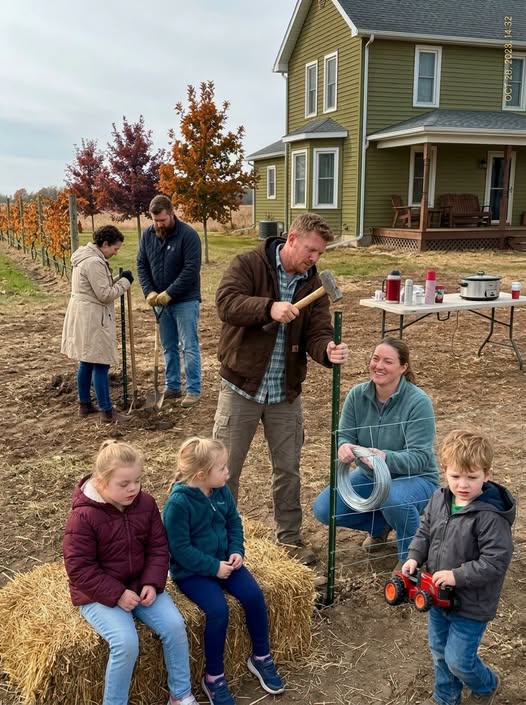
We set the fence on the first Saturday in November.
The morning came up cold and clear, frost silver on the pasture grass and our breath hanging in the air. Austin was out at six with string lines and stakes, marking the corners. Dot came at seven with three dozen cinnamon rolls and a coffee urn she’d borrowed from the Lutheran church.
By eight, all four pickups were in the lane.
Chelsea came first in her dad’s old Ford, with the post-hole digger in the bed and Declan in his car seat, humming, holding his green tractor. Then Megan Pruett and her husband, Cody, with Waylon in a puffy red snowsuit, the nebulizer bag slung over Megan’s shoulder. Then Annie Lindqvist with Tess, who climbed down out of the truck on her own in her little leg braces, refusing all help, and stood at the edge of the yard with her hands on her hips like she owned the place. Then Kayla Tilley and her husband, Jake, with baby Rose bundled in a carrier, a healing pink line on her upper lip.
They all stood in the yard for a minute, awkward, looking at each other.
Four families who had been told no, quietly, one at a time. Who had never once been in the same place together.
“So,” Cody Pruett said finally. “Which end do we start on?”
Austin handed him a tamping bar. “North corner.”
We worked all morning. The men dug and set the posts. The women held them plumb while the concrete set at the corners. Annie Lindqvist turned out to be a math teacher and measured every gap between posts with a tape, calling out numbers like a drill sergeant. Kayla Tilley, who hadn’t slept in a month, laughed so hard at something Jake said that she had to sit down on the tailgate.
Dot set up camp on the porch with the coffee and the kids. Waylon got his breathing treatment at nine-thirty, sitting on Dot’s lap, watching the fence go up through the clear plastic mask. Rose slept in the carrier by the porch rail. Tess stomped back and forth across the yard in her braces, supervising.
Declan stood off by himself, near the cedars, rocking from foot to foot. Humming. Holding his tractor.
He doesn’t let strangers near him. Chelsea had told me that. He doesn’t like loud voices or sudden movements or people reaching for him. Most adults try too hard, and he shuts down.
Jodie was sitting on a straw bale by the porch steps, where Dot had put her with a sippy cup of cocoa.
I saw her see him.
She set down her cup. She climbed down off the straw bale, carefully, the way she does everything, one foot and then the other. And she walked straight across the yard to him.
I stopped working. So did Chelsea. She was holding a post upright, and she went completely still.
Jodie walked right up to Declan. She didn’t say anything. She didn’t reach for him. She just stood next to him, close but not touching, and looked out at the pasture where he was looking.
Then she started to hum.
Not his note. Her own. Higher, a little wobbly, the five little ducks song, over and over.
Declan stopped rocking.
He turned his head and looked at her. For a long moment, neither of them moved.
Then he held out the green plastic tractor. Wheels up. And Jodie spun the wheels with one finger.
Beside me, Chelsea let go of the post. It tipped and Austin caught it. Chelsea didn’t even notice. She had both hands pressed over her mouth.
“He’s never,” she whispered. “Not once. Not with anybody.”
Around ten-thirty, a truck I knew turned in at the mailbox.
It was not one of the four.
A blue Dodge with a dented tailgate and a Little Sprouts Home Daycare magnet on the driver’s door, the one with a cartoon sunflower that Jodie used to point at and say “Flower! Flower!”
Every shovel in the yard stopped moving.
Austin straightened up slowly from the corner post, the tamping bar in his hands. Dot set down her coffee cup on the porch rail. Chelsea pulled Declan a little closer. Megan Pruett put a hand on Cody’s arm.
The truck came up the gravel lane slow, the way you drive when you’re not sure you want to arrive. It stopped at the edge of the yard, behind Kayla Tilley’s pickup.
For a long time, nobody got out.
Then the door opened, and Tamara stepped down.
She was wearing work jeans and an old Carhartt jacket and leather gloves. She had a long manila envelope in one hand. In the bed of the truck behind her, I saw a second post-hole digger and a bundle of steel T-posts.
She stood there at the edge of the yard. She looked at all of us. At the fence posts standing in a line across the frosted grass. At Waylon on Dot’s lap with his mask. At Tess in her braces. At baby Rose in her carrier.
At Declan and Jodie standing side by side under the cedars, spinning the wheels of a little green tractor.
Her face crumpled.
Austin set down the tamping bar and walked across the yard toward his sister. I followed. I didn’t know what he was going to say. I’d never seen him look like that, his jaw so tight I could see the muscle jump.
He stopped three feet from her.
“What are you doing here, Tam?” he said quietly.
Tamara held out the manila envelope. Her hand was shaking so badly the paper rattled.
“I came to tell the truth,” she said. “And then to dig. If you’ll let me.”
Austin didn’t take the envelope.
So I did.
Inside the envelope were three things.
The first was a letter from Gary Pruett’s insurance agency. Little Sprouts Home Daycare, commercial liability renewal. The premium had gone up $140 a month, exactly like she’d said. But there was a note at the bottom, typed by the agent himself, explaining why. A daycare in another county had a large claim last spring, and every home daycare policy in the region had gone up the same amount at renewal.
There was nothing in it about children with needs. Not one word.
The second was a letter on state letterhead from the civil rights office in Lincoln, dated the previous Tuesday. It was addressed to Tamara Kessler, owner, Little Sprouts Home Daycare. It said the office had completed its preliminary investigation into a complaint filed in March regarding the refusal of care to a child with a disability. It said the investigator, a Ms. Adaeze Okafor, had identified three additional families with similar experiences. It requested Tamara’s records and a written response within thirty days.
I looked up. Chelsea was standing at my elbow now, reading over my shoulder. When she saw her own complaint described on state letterhead, she made a small sound in her throat.
The third thing was a letter from First Farmers State Bank. A notice of default on a second mortgage. Tamara’s house on Second Street. The one with the converted garage.
$61,000 borrowed three years ago to build the daycare addition. Four payments behind. A total of $3,180 past due.
I looked at Tamara. She was staring at the frosted grass.
“Tamara,” I said. “What is this?”
“It’s why,” she said. Her voice was raw. “That’s the real reason. Not the insurance. Not Gary. I lied about Gary. He never said anything about Jodie. I made that up in my head because it sounded better than the truth.”
Austin’s voice was very quiet. “Which is what?”
Tamara took a breath. It shook all the way in.
“I borrowed against the house to build the addition. I thought I’d fill every spot with full-time families paying full price. But half the families in this county are on the state childcare subsidy, and the subsidy pays slower and pays less. And the kids who needed more of me, more time, more training, more hands, I’d have to cut my numbers to keep the ratios right. And I couldn’t afford to cut my numbers. I was already behind.”
“So you cut the kids instead,” Chelsea said.
Tamara flinched like she’d been slapped. But she didn’t look away.
“Yes,” she said. “I did. One at a time. Quietly. So nobody would put it together. I told myself it was business. I told myself the mortgage was more important. I told myself somebody else would take them.” She looked at Declan, still under the cedars with Jodie. “Nobody else did.”
Nobody in that yard said a word. The only sound was Waylon’s nebulizer hissing on Dot’s lap.
“And Jodie?” I asked. My voice broke on her name. “You did it to Jodie too. Your own niece.”
Tamara’s eyes filled.
“When I got the letter from the state,” she said, “I panicked. I thought if anybody looked at my records, they’d see I’d taken a child with Down syndrome and said yes to her, and then they’d ask why I said no to all the others. So I…” She stopped. She pressed the back of her glove against her mouth. “I pushed her out too. So it would look like a policy. So it would look like I was being consistent.”
Austin turned around and walked away.
He walked all the way to the end of the half-built fence line, to the last post, and stood there with his back to us, his hands on top of the post, his head down.
Tamara watched him go. Tears were running down her face now, freely.
“I’m not asking you to forgive me,” she said to me. “I don’t deserve that. I came to tell you before the state does. Before anybody else does. I wanted you to hear it from me.”
I looked down at the letters in my hand. The insurance renewal. The civil rights notice. The bank default. Three years of my sister-in-law’s life, falling apart one letter at a time.
“What are you going to do?” I asked.
“I’m closing Little Sprouts,” she said. “End of the month. I already called Gary to cancel the policy. I called Mrs. Okafor at the state yesterday and told her everything. Every family. Every date. The truth.” Her voice cracked. “She said she appreciated my cooperation. She said it might change things. Or it might not.”
“And the house?”
“I met with Chelsea’s old boss at the bank on Thursday. Mr. Henning.” She glanced at Chelsea. “I’m going to sell the daycare equipment. Cribs, cots, the tables, all of it. That covers the past-due. Then I’m going back to work at the elevator office, full-time, so I can keep up the payments. He said if I’m current by the fifteenth, the default notice goes away.”
Chelsea crossed her arms. “And all those families you had paying you full-time? Where are their kids going?”
Tamara turned toward the fence. Toward the thirty-eight posts standing in a line across the frozen grass.
“That’s the other reason I came,” she said. “I have eleven families on my list. Most of them don’t have anywhere else. The nearest place is Hartley, and they’re full until August.” She looked back at me. “I know you can only take eight. I know you’ve already got five. But I thought you should have the list. I thought maybe, between you and the state, somebody could figure something out.”
She pulled a folded sheet of notebook paper from her jacket pocket and held it out.
I didn’t take it right away.
“You brought a post-hole digger,” I said.
“I didn’t know what else to bring.” She laughed, wet and broken. “I didn’t know if you’d let me past the mailbox. I figured if you didn’t, at least the digger could stay.”
From the end of the fence line, Austin turned around.
He walked back slowly across the yard. Everybody watched him. Megan Pruett put her hand on Waylon’s back. Kayla Tilley held Rose closer.
Austin stopped in front of his sister. He looked at her for a very long time.
“You know what Jodie did this morning?” he said quietly. “She walked over to a kid who doesn’t let anybody near him. And she just stood there with him. She didn’t need anything from him. She just stood there.”
Tamara nodded. She couldn’t speak.
“She’d have done that for you too, Tam,” Austin said. “Every day. If you’d let her.”
Then my husband picked up the second post-hole digger out of the bed of his sister’s truck and held it out to her.
“North side,” he said. “We’re four posts short.”
Tamara dug for six hours.
She didn’t talk much. Nobody talked to her much, either. The other mothers gave her a wide berth at first, working at the opposite end of the fence line, glancing over now and then like she might bite.
But she worked harder than anybody. She dug every hole on the north side by herself, chopping through the frozen top layer of soil with the bar, then twisting the digger down through the clay underneath. She set the posts. She held them while Annie Lindqvist checked them with a level. When Annie said one was a quarter inch off, Tamara pulled it out and set it again without a word.
At noon, Dot brought out a huge pot of chili and a pan of cornbread, and everybody sat on the porch steps and tailgates to eat. Tamara sat by herself on the bumper of her truck.
I took two bowls of chili over and sat down beside her.
She looked at me, surprised.
“Eat,” I said, handing her one. “Dot’ll be offended if you don’t.”
She took it. Her hands were blistered right through the gloves.
We ate in silence for a while, watching the kids on the porch. Waylon was asleep on Dot’s lap. Tess had decided she was in charge of Rose and was telling Kayla Tilley very sternly how to hold her own baby. Declan sat on the bottom step with Jodie, and they were taking turns pushing the green tractor back and forth between them.
“Did you know he hums?” Tamara said quietly. “Declan. When he’s happy, the note goes up. I never noticed until he wasn’t there anymore.”
I didn’t say anything.
“I’m a good daycare teacher, Holly. I used to be. I don’t know when I stopped.” She stared into her chili. “Somewhere between the second mortgage and the subsidy paperwork, I started looking at kids and seeing dollar signs. And I hated myself for it. And I did it anyway.”
“You could’ve told somebody,” I said. “Austin. Dot. Me.”
“And admit I was failing? In this town?” She laughed bitterly. “Austin climbs power poles in ice storms. Dot raised three kids alone after Dad died. And you, you went to nursing school at night with a baby who’d had heart surgery. Everybody in this family is so strong. I was the only one who couldn’t hold it together.”
I put my bowl down.
“Tamara,” I said. “Two weeks ago, I sat in this yard on an upside-down bucket and cried until the sun went down. Last week, I added up our checking account and realized we can’t pay Jodie’s hospital bills and buy a fence in the same month. Austin hasn’t slept a full night since the windstorm. Dot’s knees are so bad she can’t kneel in church anymore.” I looked at her. “Nobody in this family is holding it together. We’re just holding it together with each other.”
Tamara’s chin trembled.
“I’m still so angry at you,” I said. “I don’t know when that’s going to stop. Maybe it won’t, for a long time.”
“I know.”
“But I’ll take the list.”
She looked at me. Slowly, she pulled the folded notebook paper out of her pocket again.
This time, I took it.
We finished the fence at 4:40 that afternoon, just as the sun was going down behind the cedars.
Thirty-eight posts. Woven wire, forty-eight inches high. Two gates, each with a heavy steel latch mounted fifty-six inches off the ground on the outside, which Austin tested over and over until he was satisfied that nobody under four feet tall could ever work it.
Austin made Jodie try. She stood on her tiptoes and reached with both hands and couldn’t get anywhere close.
“Locked,” she announced proudly.
“Locked,” Austin agreed.
Everybody stood around in the cold yard, tired and dirty, looking at it. Annie Lindqvist walked the whole perimeter with her tape measure one last time. Cody Pruett leaned on his shovel. Chelsea’s dad’s post-hole digger lay in the grass beside Tamara’s.
Kayla Tilley started crying again. Then Megan Pruett did. Then, for no reason I could explain, so did I.
“It’s a fence,” Austin said, bewildered. “Why is everybody crying about a fence?”
“Because it’s not a fence,” Chelsea said, wiping her face. “It’s a yes.”
Marsha Quint came back out on Tuesday. She walked the entire fence line twice. She tried both gates. She tugged on the wire. She reached for the latch and nodded when it sat well above where any child could reach.
She made a final mark on her clipboard. Then she went out to her white state car and came back with a single sheet of paper.
State of Nebraska. Department of Health and Human Services. Family Child Care Home I License. Licensee: Holly Kessler. Address: our farmhouse on Route 4. Capacity: eight children.
“Congratulations,” Marsha said. “You’re a daycare.”
I held that piece of paper in both hands and read every single word of it.
“I should tell you something,” Marsha said quietly. “I’ve read the state file on Little Sprouts. Everybody in my office has. What you did out here was the fastest response to a gap in care I’ve seen in twenty-two years in this job.”
“It was just a fence,” I said.
“It’s never just a fence,” she said. Then she got in her car and drove away.
We opened the following Monday.
Jodie. Declan. Waylon. Tess. Rose.
Five kids at my kitchen table on the first morning, eating oatmeal with blueberries, which is the only breakfast I could get all five of them to agree on. Waylon’s nebulizer sat on the counter next to the coffee maker, with his treatment schedule taped above it. Rose’s special bottles lined up in a row in the refrigerator, labeled in my handwriting. Tess’s leg braces stood by the door, because she refused to wear them during circle time and insisted on putting them back on herself before outside play.
Declan sat next to Jodie. He held his green tractor in his left hand so he could eat with his right.
And right in the middle of breakfast, I heard it. His one low humming note slid up. Just a little. Just a half step higher.
Happy.
Chelsea went back to work at First Farmers the second week of November. Mr. Henning gave her back her job in the loan department, full-time with benefits, and she stopped putting gas on her credit card. She told me she’d been driving 1,144 miles a month to her mother’s and back, and now she drove four miles a day.
“I did the math,” she said, standing in my mudroom at 7:15 one morning, handing Declan’s backpack to me. “I’m saving almost three hundred dollars a month on gas alone. And that’s before my paycheck.”
The state childcare subsidy started paying for three of the five kids in December. It paid slowly, just like Tamara had said. The first reimbursement took forty-one days to arrive. But it arrived. And between that, the private tuition from the Pruetts and the Hahns, and my weekend night shifts at Mercy, we were okay.
Not rich. Okay.
I worked my first weekend-night rotation on the eighteenth. Denise Albrecht met me at the nurses’ station at 6:45 p.m. with a cup of coffee and a printout of my patient assignments.
“Well?” she asked. “How’s the daycare?”
“Five kids. Three on subsidy, two private pay. A waiting list of eleven.”
She raised her eyebrows over her reading glasses. “Eleven?”
I told her about Tamara’s list. About the families with nowhere to go. About Hartley being full until August.
Denise was quiet for a moment. Then she said, “You know, Mercy has been talking about an on-site childcare center for staff for five years. The board keeps saying there’s no demand.” She tapped her pen on the counter. “Maybe somebody should show the board a list.”
I gave her a copy that night.
In January, Ms. Okafor from the state civil rights office closed her investigation into Little Sprouts. Because Tamara had come forward on her own, admitted everything, and closed her business, the state entered into what Ms. Okafor called a resolution agreement. Tamara had to complete a disability inclusion training course. She had to write a letter of apology to each of the four families, which the state would deliver. And if she ever applied for a childcare license again, the state would review her application with the findings in her file.
No fines. No court. No lawsuit, though Chelsea told me later she’d thought about it, long and hard, sitting in her mother’s kitchen in Hartley at five in the morning with a sleeping boy in her lap.
“Why didn’t you?” I asked her.
Chelsea looked out my kitchen window, at the fence line, at the place by the cedars where Declan always stood.
“Because she dug the north side by herself,” she said. “And because Declan’s happy. And because I’d rather be done with being angry.”
Tamara caught up her mortgage on the fourteenth of December. One day early. She sold the daycare cribs and cots and tables to a church preschool in Grand Island for $3,400 and walked the cashier’s check into First Farmers herself. Chelsea was the one who processed the payment. They didn’t say much to each other. But Chelsea told me Tamara thanked her, and Chelsea said, “You’re welcome,” and meant it.
In February, Tamara came to the farmhouse on a Saturday morning while I was sleeping off a night shift.
Austin let her in. I came downstairs in my robe to find my sister-in-law sitting at my kitchen table with a cup of coffee, a notebook, and a small pile of library books about childcare for children with disabilities.
“I finished the state course,” she said. “The inclusion training. Twelve hours.”
“Okay,” I said carefully.
“I learned a lot. Things I should have known years ago.” She pushed the notebook across the table. “And I was wondering if I could come help. On Thursdays. My day off at the elevator. Not paid. Not as anything. Just as an extra set of hands.”
I looked at her for a long time.
“Why?” I asked.
She looked out the window. Jodie and Austin were in the yard inside the fence, building a lopsided snowman. Jodie was putting the carrot nose on upside down, and Austin was letting her.
“Because I want to remember why I started,” Tamara said. “Before the mortgage. Before the subsidy paperwork. Before I started seeing kids as numbers. I want to be the person Jodie waves at again.”
I didn’t answer right away. I poured myself a cup of coffee. I sat down across from her.
“Thursdays,” I said finally. “You’ll sign in on the visitor log like everybody else. You’ll complete the background check, which Marsha requires for any regular volunteer. And you’ll follow my rules. My kitchen. My daycare.”
“Your kitchen,” Tamara said. “Your daycare.”
“And Tamara?”
“Yeah?”
“You do Waylon’s breathing treatments. You learn the bottles for Rose. You get down on the floor with Tess and do her stretches. You don’t get the easy jobs.”
Tamara smiled. It was small and wobbly and real. “I don’t want the easy jobs.”
The first Thursday she came, Jodie was sitting at the kitchen table with her crayons when Tamara walked in through the mudroom.
Jodie looked up. She looked at her aunt for a long moment, her head tilted to one side, the way she does when she’s thinking about something very carefully.
Then she raised her hand and waved, all five fingers spread wide.
“Hi, Aunt Tamara,” she said, like it was any other day.
Tamara stood frozen in the doorway. Then she raised her own hand and waved back.
She waved back.
In April, the board of Mercy Regional voted to fund a feasibility study for an on-site staff childcare center. Denise Albrecht presented Tamara’s list at the meeting, along with a petition signed by forty-seven nurses, techs, and respiratory therapists. She told me afterward that when she got to the part about a nurse who had to switch to weekend nights to open a daycare in her own farmhouse, the hospital president put down his pen.
“Is that true?” he’d asked.
“Every word,” Denise said. “She’s in her third month of weekend nights. Hasn’t missed a shift.”
The study would take a year. The center, if it happened, would take two more. But it was a start.
By spring, our waiting list was nineteen names long. I couldn’t take any of them. Eight is eight. But Marsha Quint called me in May with news. Two women in the county had enrolled in the pre-licensing class, one in Pruitt and one out by the lake, after hearing about our fence at church.
“They both asked about you by name,” Marsha said. “They wanted to know how you did it.”
“What did you tell them?”
“I told them two hundred and fifty dollars and a lot of stubbornness.” She paused. “And a good fence.”
On the first warm Saturday in May, all four families came back out to the farmhouse. Not to work this time. Just to have a picnic.
Dot made fried chicken and potato salad. Cody Pruett brought a cooler of root beer. Annie Lindqvist brought a sheet cake with “Happy Six Months” written on it in purple frosting, because she is the kind of person who counts. Kayla and Jake Tilley brought Rose, who was walking now, wobbly and fearless, her lip healed to a faint pale line.
Tamara came too. She brought lemonade and sat on the porch steps next to Dot, and nobody minded.
Austin had built a sandbox in the corner of the yard where the stock tank used to be. The circle of dead grass had grown back green.
I sat on the porch with a plate of chicken and watched the kids.
Tess was racing Waylon across the yard in her braces and winning. Rose was toddling after both of them, falling down, getting up, falling down again. And in the sandbox, Declan and Jodie sat side by side, pushing the little green tractor through the sand, back and forth between them.
Declan was humming. His note had climbed so high I could hardly believe it was the same boy.
And Jodie was humming with him, wobbly and off-key, the five little ducks song.
Chelsea came and sat beside me on the steps. She didn’t say anything for a long time.
“Six months ago,” she finally said, “I was driving fifty-two miles a day and putting gas on a credit card and wondering if anybody in this world was ever going to say yes to my son.”
“And now?”
She looked at the fence. Thirty-eight posts. Woven wire. A latch no toddler could work.
“Now he has a best friend,” she said.
I leaned my head against the porch post and closed my eyes in the warm sun.
Austin’s grandfather built this farmhouse in 1951, with his own hands, for the children he hoped would someday fill it. For a long time, there had only been one.
Now there were five. Sometimes six, when Tamara’s boys came on Thursdays after school.
Our fence keeps them in. But that was never really what it was for.
It was for everyone who’d been told no, quietly, one at a time. It was for the yes that comes after.
THE END..!