My father ordered me to leave Boston before Thanksgiving.
Not asked. Ordered.
“You’re the embarrassment, not family,” he told me. “If you show up, Vivian could lose Derek’s defense deal.”
I didn’t argue with him. I didn’t tell him that the official Silver Star citation sitting in a folder on my dresser already carried General Thomas Vance’s signature. I didn’t tell him that the citation named me as the officer who had helped bring four soldiers out alive.
And I definitely didn’t tell him what would happen when General Vance saw me standing across that ballroom.
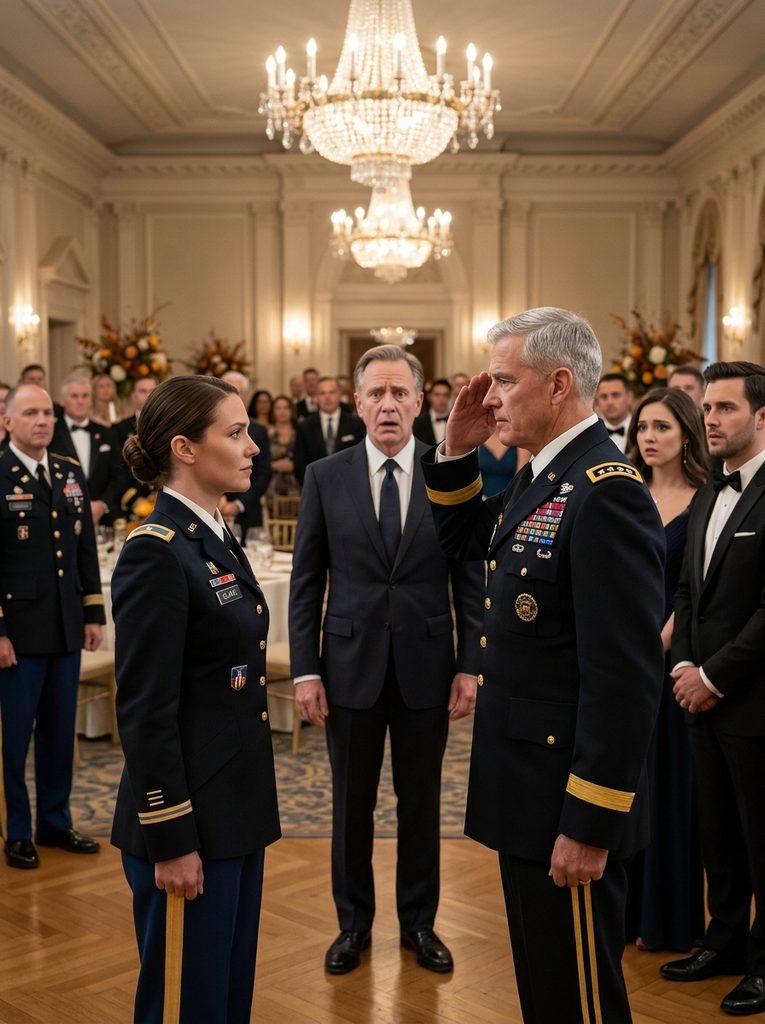
Because when the general finally walked past Derek Hartwell’s outstretched hand, stopped directly in front of me, snapped to attention, and raised his hand in salute, every trace of color drained out of my father’s face.
But that moment started days earlier. And it started with a phone call I should never have answered.
I had been home from deployment for less than forty-eight hours. My bags were still half unpacked. My boots sat beside the bed in my small Boston apartment, dust packed so deep into the seams that I doubted I’d ever get them fully clean.
There was a bruise spreading beneath my ribs. Whenever I twisted too fast, pain shot through my side and reminded me of concrete collapsing on top of us during the extraction. The doctor at the base had told me to rest. My body agreed. My head didn’t.
Sleep came in pieces. Twenty minutes. Forty minutes. Sometimes an hour. Then I’d jerk awake, sure I could still hear somebody shouting through the smoke.
That afternoon, when my phone rang and Dad’s name lit up the screen, something inside me softened. For one stupid second, I let myself hope.
I hoped he was calling to ask what parents are supposed to ask. Are you okay? Did you get hurt? Do you need food? Do you want me to come over?
I picked up. “Hi, Dad.”
“You’re not planning to wear your uniform on Thanksgiving, are you?”
I stared at the wall. “What?”
“You heard me.” His voice already had that familiar edge, the one I’d been hearing since I was twelve. “Vivian is bringing Derek. This weekend matters to her.”
I looked down at my side. A strip of medical tape peeked out from under my shirt.
“Dad, I just got back.”
“I know when you got back.”
No welcome home. No relief in his voice. Nothing.
“Derek Hartwell is hosting the Thanksgiving gala at the Ardmore,” he went on. “His investment group is putting together a major defense venture. He’s trying to get time with General Thomas Vance, and if that happens, this could be enormous for Vivian.”
I almost laughed. Not because anything was funny. Because the name Thomas Vance was printed on a document six feet away from me.
General Thomas Vance had personally reviewed the report from our operation. His signature sat beneath the recommendation that had become my Silver Star citation. I had stood in front of him in a plywood briefing room with a cracked rib and smoke still in my hair, and he had shaken my hand.
Dad kept talking. “Derek has serious people around him. Investors. Contractors. Political contacts. Vivian finally has a chance to build the kind of future she deserves.”
I closed my eyes.
There it was. The kind of future she deserves.
Vivian had always deserved things.
The bigger bedroom. The newer car. The better graduation party, with a tent in the backyard and a string quartet Dad couldn’t really afford. When Mom died four years ago and her life insurance paid out, a big piece of that money went toward the down payment on Vivian’s condo in the Seaport. “She’s starting her career,” Dad had said. “She needs stability.”
I enlisted that same year. Dad called it running away.
When Vivian changed majors three times, she was finding herself. When I went to Officer Candidate School, I was being dramatic. When she quit her marketing job after eight months, she was too talented for that company. When I deployed, I was making life unnecessarily hard for everyone.
Apparently, nothing had changed.
“What exactly are you asking me?” I said.
Dad let out a long breath, like I was the one exhausting him. “I’m asking you not to turn Thanksgiving into some kind of military performance.”
“My uniform isn’t a performance.”
“You know what I mean.”
“No. I really don’t.”
His voice went hard. “Derek comes from a different world, Emily.”
I looked around my apartment. A secondhand couch. A small dining table with one wobbly leg. My duffel bag still slumped against the wall. My dress uniform hanging on the closet door, pressed and waiting, because the Army had asked me to attend a ceremony I hadn’t told him about.
Apparently, my world embarrassed him.
“Vivian needs this weekend to go smoothly,” he said. “Derek doesn’t need to hear deployment stories. He doesn’t need to see medals. And frankly, neither do the rest of us.”
That hurt more than it should have.
Not because I wanted praise. I had stopped expecting that from him years ago. But there was something especially cruel about coming home from a place where men almost died beside me, and being treated like an ugly lamp that needed to be moved into the garage before company arrived.
Then he said it. Slowly. Clearly. Like he wanted to make sure I couldn’t misunderstand a single word.
“You’re the embarrassment, not family. Vivian will lose Derek’s defense deal if you show up.”
The silence after that felt heavier than the pain in my ribs. I waited for him to take it back. To laugh it off. To say he was stressed.
Instead, he said, “Pack a bag and go somewhere else for the holiday. Go see one of your Army friends. Leave town for the weekend.”
I swallowed. “You want me to leave Boston because Vivian’s boyfriend has important guests?”
“I want you to stop making everything about yourself.”
Then he hung up.
I sat on the edge of my bed for a long time. I had faced gunfire. I had watched a building fold in on itself. I had carried a wounded sergeant through smoke so thick I couldn’t see my own hands, knowing the next blast might take all of us.
Somehow, my father found a place inside me that the battlefield never reached.
My phone buzzed. This time it was Vivian.
“Please don’t make this difficult,” she wrote. “Derek’s partners are very traditional and your military stuff makes people uncomfortable.”
I read it twice. I wondered when serving my country had become something my own family needed to hide, like a stain on a tablecloth.
Another message came in. “Just stay away until after the gala, okay? You can come by another time. Dad’s really stressed. There’s a lot of money riding on this.”
A lot of money riding on this.
I didn’t know yet how true that was.
I couldn’t sleep that night, so I did something I’d been putting off. I went through the mail.
My neighbor, Mrs. Delgado, had been collecting it for me for nine months. She’d handed it over in two grocery bags when I got back, along with a foil-covered plate of empanadas and a hug that made my ribs scream. “You’re too thin,” she’d said. “And you have a lot of letters from people who want money.”
She wasn’t wrong. Credit card offers. A renewal notice for my renter’s insurance. A statement from my bank showing my savings account sitting at $41,700, every dollar of combat pay I hadn’t spent because there was nothing to spend it on out there.
Then I found an envelope that didn’t look like junk.
Heavy cream paper. A return address in Newton. Brennan & Cole, Attorneys at Law.
I knew that name. Harold Brennan had been my mother’s lawyer. He had sat at our kitchen table two weeks after her funeral, reading her will in that slow, careful voice while Dad stared out the window and Vivian scrolled on her phone.
I tore it open.
“Dear Captain Parker,” it began. “I am writing regarding the Margaret A. Parker Family Trust and the property at 14 Linden Street, Newton, Massachusetts.”
My childhood home. The white colonial with the blue shutters my mother had painted herself one summer, standing on a ladder while I held the paint can.
I kept reading.
“Our office has received a beneficiary consent form, dated August 14th, authorizing the trustee to encumber the trust property with a home equity line of credit in the amount of $300,000 through Bay Colony Savings Bank. The form bears your signature, executed by your father, Richard Parker, under a power of attorney dated February 2nd of this year.”
My hands started to shake.
“Upon review, I note that the power of attorney appears to be limited in scope to matters concerning your vehicle and your residential lease. Before this office can approve any disbursement under the trust, I must confirm your consent directly. The bank has scheduled closing for the Friday following Thanksgiving. Please contact me at your earliest opportunity.”
It was signed in blue ink. Harold J. Brennan.
I read it three times. Then I got up, went to the closet, and pulled out the folder where I kept my deployment paperwork.
The power of attorney was right there. I’d signed it at the legal office on base before I left, a sergeant with reading glasses walking me through it line by line. I’d given Dad a limited power of attorney so he could handle my car payment if something went wrong with autopay, and so he could talk to my landlord if a pipe burst.
That was it. That was all I’d given him.
I looked at the date again. August 14th.
On August 14th, I was sitting in a forward operating base with no cell service, eating cold rations and sleeping in my boots. Ten days later, a building came down on top of my team.
And on August 14th, back home in Massachusetts, my father had used my name to borrow $300,000 against my mother’s house.
I sat down on the floor of my closet because my legs wouldn’t hold me.
Three hundred thousand dollars. Against a house he didn’t own outright. A house my mother had put in trust for both her daughters, so that no matter what happened, we would always have a home.
I thought about Vivian’s text. There’s a lot of money riding on this.
I thought about Derek Hartwell’s investment group.
And suddenly I understood exactly why my father wanted me as far away from Boston as possible.
My mother set up the trust eight months before she died.
I remember the day because she called me into the kitchen and made me sit down. She was already thin by then, the chemo hollowing out her cheeks, a scarf wrapped around her head in the green she knew I liked.
“I need you to understand something, Em,” she’d said. “This house is going to you and your sister. Equally.”
“Mom, don’t talk like that.”
“I’m going to talk like that because somebody has to.” She reached across the table and squeezed my hand. “Your father can live here as long as he wants. That’s in the papers. But he can’t sell it, and he can’t borrow against it, unless both of you agree. In writing.”
I didn’t understand then why she’d been so specific about that last part. I was twenty-three and stupid with grief I hadn’t even started feeling yet.
“Why would he borrow against it?” I asked.
My mother looked out the window at the backyard, where Dad was on the phone, pacing, talking about some business opportunity with his hands.
“Your father loves big ideas,” she said quietly. “He loves them more than he loves being careful. I just want to make sure there’s always something left for you girls.”
Sitting on my closet floor four years later, I finally understood what she’d been protecting us from.
It was almost one in the morning, but I found Harold Brennan’s office number and left a message anyway. I kept my voice steady. “Mr. Brennan, this is Emily Parker. I received your letter. I did not sign that consent. I did not authorize anyone to sign it. I was deployed overseas on August 14th, and I can prove it. Please call me back.”
He called at 8:02 the next morning.
“Captain Parker,” he said. His voice was older than I remembered, but just as careful. “Thank you for calling. I was hoping you would.”
“Mr. Brennan, I never agreed to any loan.”
“I suspected as much.” I heard papers shuffle. “Your mother was very clear about the consent requirement when she drafted the trust. When the bank sent over the closing documents and I saw the power of attorney attached, something didn’t sit right. A limited power of attorney for a car and an apartment lease doesn’t stretch to a $300,000 lien on a trust property.”
“Has any money gone out?”
“Not yet. The bank’s attorney needs my sign-off as counsel to the trust before closing. I haven’t given it.”
I let out a breath I didn’t know I’d been holding. “Can you hold it?”
“I can do more than that,” he said. “But I’d like you to come in. I need to see you in person, and I need you to bring proof of where you were on August 14th. Can you be here Tuesday at ten?”
“I’ll be there.”
There was a pause. Then he said, more gently, “Emily, I’m sorry. Your mother would be heartbroken.”
“She saw it coming,” I said. “She just hoped she was wrong.”
After I hung up, I went to the kitchen to make coffee. My hands still weren’t quite steady. The empanada plate from Mrs. Delgado sat on the counter, half empty.
That’s when I saw the email notification on my phone. The subject line read: “Invitation – Recognition Presentation, Ardmore Hotel, Boston.”
I opened it.
“Captain Parker,” it said. “On behalf of General Thomas Vance, your attendance is requested at a private presentation recognizing service members involved in Operation Iron Gate. The presentation will take place during the Thanksgiving Defense Leadership Gala at the Ardmore Hotel. General Vance has asked specifically that you be present. Respectfully, Major Dana Ruiz, Office of the Commanding General.”
The Ardmore. Thanksgiving night.
The same ballroom where my father wanted to show Derek Hartwell a family without me in it.
I read Major Ruiz’s email standing at the kitchen counter, coffee going cold in my hand, and the memories came back the way they always did. All at once, with no warning.
The building had been a four-story concrete shell on the edge of a town whose name I still couldn’t say out loud without my throat tightening. Four of our soldiers had taken cover inside during a firefight. Then a blast hit the east wall, and the top two floors started coming down.
Sergeant Marcus Webb. Corporal Jess Lindqvist. Specialist Tyler Okafor. Private First Class Danny Reyes.
Danny was nineteen. He had a picture of his baby nephew taped inside his helmet.
I was the ranking officer close enough to reach them. The order came over the radio to hold position until engineers could assess the structure. I could hear Webb on the net, his voice calm in a way that scared me more than screaming would have. “Captain, Reyes is pinned. Okafor’s bleeding bad. We’ve got maybe ten minutes before the next floor goes.”
Engineers were forty minutes out.
I remember turning to my staff sergeant, a big quiet man named Coleman. “We’re going in.”
“Ma’am, that thing’s coming down.”
“I know. That’s why we’re going now.”
We went in through a gap in the south wall. Dust so thick it felt like breathing sand. Rebar sticking out of the ceiling like broken fingers. Somewhere behind us, the enemy was still shooting, rounds cracking off the concrete.
We got Lindqvist and Webb out first. Then Okafor, Coleman carrying him over his shoulder while I held pressure on the wound in his thigh. Then I went back for Reyes alone, because there wasn’t room for two people in the space where he was trapped.
A slab of ceiling had pinned his leg. I braced my shoulder under it and pushed. Something in my side cracked. I didn’t care. I pushed again, and the slab shifted enough for him to drag his leg free.
“Captain,” he said, crying, gray with dust. “Captain, I thought nobody was coming.”
“Somebody always comes,” I told him. “Now move.”
We were twenty feet clear when the third floor collapsed into the space where he’d been lying.
All four of them lived.
Two days later, General Vance walked into the briefing room at the base. He wasn’t supposed to be there. He’d flown in to review the incident report personally. He listened to every word, asked hard questions, and when it was over, he stood up and shook my hand.
“What you did out there saved lives, Captain Parker,” he said, looking me straight in the eye. “Make sure you never let anyone convince you otherwise.”
I hadn’t thought about those words since I’d landed in Boston. Now they were the only thing I could hear.
I set the coffee down and typed my reply to Major Ruiz. One sentence.
“Captain Emily Parker confirms her attendance.”
I hit send before I could think about it too long. Then I stood there in my small kitchen, heart pounding, and wondered what my father’s face would look like when he found out.
I didn’t have to wonder long about Vivian.
That afternoon, someone knocked on my door. I opened it to find my sister standing in the hallway in a camel coat and expensive boots, a coffee in each hand.
“Peace offering,” she said, holding one out.
I stared at her. She hadn’t been to my apartment once in four years.
“Can I come in?” she asked.
I stepped aside. She walked in, looked around at my secondhand couch and my duffel bag and the dress uniform hanging on the closet door, and I watched her face do something complicated.
“You’re really going to wear that, aren’t you,” she said quietly.
“I haven’t decided what I’m doing,” I said, which was only half a lie.
Vivian sat down on the edge of my couch like she was afraid it might stain her coat. She looked tired. Under the makeup, there were shadows beneath her eyes I’d never seen before.
“Em, I know Dad was harsh on the phone.”
“He called me an embarrassment.”
She winced. “He didn’t mean it like that.”
“How else could he mean it, Viv?”
She didn’t answer. She turned the coffee cup in her hands, around and around.
“Derek’s really important to me,” she finally said. “And this deal is important to Derek. His firm, Hartwell Strategic, they’re trying to land a contract for logistics software. Supply tracking for bases overseas. If he gets in front of General Vance, it could change everything.”
“For Derek.”
“For us.” She looked up. “Derek’s bringing me in as a founding partner. Dad’s investing so I can have a real stake. Not just be the girlfriend. An actual equity position.”
I set my coffee down very carefully. “Dad’s investing?”
“Yeah.” She shrugged like it was nothing. “Three hundred thousand. He’s getting a loan or something. He said he had it handled.”
My heart was pounding so hard I was sure she could hear it.
“A loan against what, Viv?”
She frowned, confused by my tone. “I don’t know. The house, I think? He said it was basically free money because the house is paid off. Why does it matter?”
I looked at my little sister. The girl who used to crawl into my bed during thunderstorms. The girl who cried for three days when our dog died. She genuinely didn’t know.
“Did Dad tell you the house is in Mom’s trust?” I asked. “That it belongs to both of us?”
“Sort of. But he’s the trustee. He makes the decisions.”
“Not about this. He needs both of us to sign off.”
Vivian blinked. “I signed something. In August. He brought it over to the condo with a bunch of other papers.”
“Did you read it?”
Her face went pink. “Em, come on. Nobody reads that stuff.”
“Did he ask you where I was? Whether I’d signed?”
“He said he’d take care of your part. He said you gave him power of attorney before you left.” She tilted her head. “Didn’t you?”
I stood up and walked to the window because I didn’t trust what my face was doing.
Outside, a garbage truck was backing down the alley, beeping. Normal Boston. Normal Tuesday afternoon. And my father had used my name to put my mother’s house on the line for a man none of us really knew.
“I gave him power of attorney for my car,” I said, still facing the window. “And my lease. That’s it. I never agreed to borrow money against Mom’s house. I was in a combat zone on August 14th, Viv. I didn’t even have cell service.”
Behind me, it was very quiet.
“That can’t be right,” Vivian said.
I turned around. “I have a letter from Mr. Brennan. Do you want to read it?”
She didn’t move. Then, slowly, she held out her hand.
I gave her the letter. I watched her read it. I watched the color leave her face, the same way it would leave our father’s face three days later, though neither of us knew that yet.
“He told me it was fine,” she whispered. “He told me everyone had signed.”
“I know.”
“Em, Derek’s expecting that money Friday. The papers for my partnership are already drawn up. If it doesn’t come through…” She stopped. Her eyes filled. “Oh my God. What did he do?”
I sat back down beside her. For a while neither of us said anything.
“I’m not trying to wreck your thing with Derek,” I said finally. “I swear I’m not. But I can’t let Dad borrow $300,000 against Mom’s house using a signature I never gave him.”
“He’ll be so angry.”
“He’s already angry. He’s been angry at me since I was twelve.”
Vivian wiped her eyes with the back of her hand, smearing her mascara. “He’s not like that with me.”
“I know,” I said. “That’s sort of the problem, Viv.”
She laughed, a wet, broken sound. Then she looked at the uniform hanging on the closet door. “Why did he even care so much about you wearing it? I mean, I asked you not to, but that was because he made such a big thing of it. It’s just clothes.”
I hesitated. Then I went to my dresser and took out the protective folder.
“Because it’s not just clothes,” I said, and handed it to her.
She opened it. I watched her read the citation. Her lips moved slightly on some of the words. For gallantry in action. Under direct enemy fire. With complete disregard for her own safety. Saving the lives of four fellow soldiers.
Then she reached the signature at the bottom.
“Thomas Vance,” she said. She looked up at me, eyes huge. “Emily. That’s him. That’s the general Derek’s been trying to meet for six months.”
“I know.”
“You know him?”
“I’ve met him. He reviewed our operation.”
“And Dad doesn’t know.”
“Dad never asked.”
Vivian closed the folder very slowly. She looked at me like she was seeing me for the first time, and I didn’t know whether that made me feel better or worse.
“He’s going to be at the gala,” she said. “Vance.”
“So am I. I got an invitation from his office this morning.”
My sister stared at me. Then, to my complete shock, she started laughing. Really laughing, her hand over her mouth, tears still on her cheeks.
“Dad told you to leave town,” she gasped. “He told you to leave town so you wouldn’t embarrass him in front of a general who signed your medal.”
“Pretty much.”
She laughed harder. Then, just as suddenly, she stopped, and her face crumpled.
“I texted you that your military stuff makes people uncomfortable,” she said. “I actually typed that. I’m so sorry, Em.”
I didn’t say it was okay. It wasn’t. But I put my hand on her shoulder, and she leaned into me, and for a minute we were just two sisters on a cheap couch.
“What are you going to do about the money?” she asked.
“I’m meeting Mr. Brennan on Tuesday. I’m going to tell him the truth. That I never signed.”
“Will Dad get in trouble?”
I thought about that. About the word fraud. About Mom on the ladder with the blue paint.
“I don’t know yet,” I said honestly. “That depends a lot on what he does next.”
Vivian stood and picked up her purse. At the door she turned back. “Are you going to tell Dad before the gala?”
I looked at the citation folder in her hands. “Are you?”
She was quiet for a long moment. Then she handed the folder back to me.
“No,” she said. “I think he needs to see it for himself.”
Brennan & Cole occupied the second floor of an old brick building near Newton Centre, above a bakery that made the whole staircase smell like cinnamon. I wore my civilian clothes, jeans and a navy sweater, but I brought everything.
Harold Brennan met me at the top of the stairs. He was smaller than I remembered, his hair completely white now, but he took my hand in both of his.
“Look at you,” he said. “Your mother would be so proud.”
I didn’t trust myself to answer, so I just nodded.
His office was full of books and dark wood, with a window overlooking the street. He sat across from me and opened a thick file.
“Let’s start with what we have,” he said. He slid a photocopy across the desk. “This is the beneficiary consent form submitted to the bank.”
I looked at it. My name, typed at the top. Emily R. Parker. Then a signature line, and there was my father’s handwriting. Emily R. Parker, by Richard J. Parker, Attorney-in-Fact.
A notary’s stamp sat at the bottom. Commonwealth of Massachusetts. Notary Public, Linda Farrow. Commission expires 2029. Dated August 14th.
“The notary witnessed your father signing,” Brennan said. “Not you. She would have checked his identification and looked at the power of attorney he presented. Notaries don’t usually examine how far the authority goes. That’s not their job.”
“But it’s yours.”
“It’s mine.” He slid over another document. “This is the power of attorney he attached.”
I recognized it immediately. Two pages. My own signature at the bottom, and the base legal office’s stamp. And there, in section two, in plain language: “The agent’s authority is limited to matters concerning the principal’s 2021 Toyota RAV4, including loan payments, registration, and insurance, and the principal’s residential lease at the address listed above.”
“He couldn’t have thought this covered the trust,” I said.
Brennan folded his hands. “I’ve practiced law for forty-one years, Emily. People believe what they need to believe when they want something badly enough.”
I took out my own folder. “You asked for proof of where I was.”
I handed him a copy of my deployment orders, with the dates highlighted. Then a memorandum from my battalion’s personnel office confirming my location at a forward operating base from August 1st through August 30th, with no leave and no travel. I’d requested it on Monday, and the S1 had emailed it to me within hours with a note that said, “Hope everything’s okay, ma’am.”
Brennan read every page. Then he took off his glasses and rubbed his eyes.
“Well,” he said. “That settles that.”
“What happens now?”
“Several things. First, I’ll notify Bay Colony Savings in writing that the consent is defective and that counsel to the trust does not approve the line of credit. The bank won’t close without my sign-off. Their attorney already flagged the issue with me informally.”
I nodded.
“Second, you should consider revoking the power of attorney entirely. You can do that in writing, and I can help you prepare it today if you’d like.”
“Yes,” I said, faster than I expected.
“Third.” He paused. “You have the right to report this. Using a power of attorney beyond its scope to encumber property can be very serious. Some people go to the police. Some people go to the district attorney. Some people decide to handle it within the family. That decision is entirely yours, and I won’t push you either way.”
I looked down at my father’s handwriting on the consent form. My name, written in the same blocky letters he’d used on my birthday cards when I was a kid. Happy birthday, Emmy. Love, Dad.
“Can I think about that part?” I asked.
“Of course.” He reached into the file and took out one more sheet of paper. “There’s something else you should see before you decide.”
It was a bank statement. Bay Colony Savings, checking account ending in 4471, Richard J. Parker.
“Your father provided this to the bank with his loan application,” Brennan said. “The bank shared it with me as part of the closing package.”
I scanned it. The balance on November 1st was $2,316.48.
Then I saw the column of withdrawals. A $1,900 payment to a Mercedes-Benz financial services company. A $640 charge at a restaurant downtown. A $4,200 transfer labeled “Hartwell Strategic – Deposit.”
“He’s already given Derek money,” I said.
“It appears so. Four thousand two hundred, at least. There may be more elsewhere.”
I scanned further down. Credit card payments. Minimum amounts only. A notice that an overdraft fee of $35 had been charged twice in October.
“He’s broke,” I whispered.
“I wouldn’t put it quite that way,” Brennan said carefully. “But he’s stretched. His pension from the utility company covers his basic expenses, but not much more. Your mother’s life insurance is gone. Much of it went to your sister’s condo, as I understand it, and some to paying off the remaining mortgage on Linden Street.”
“So the house is the only thing he has left.”
“The house,” Brennan said, “is the only thing your mother left you. That’s exactly why she wrote the trust the way she did.”
I sat back in the leather chair. Through the window, I watched a woman walk her dog past the bakery, completely unaware that a small, ordinary-looking office upstairs held the wreckage of my family.
“Was the appraisal done?” I asked.
“It was. One million, one hundred eighty thousand.” He tapped the file. “Plenty of equity to borrow against, from the bank’s point of view. And with $300,000 owed on a line of credit and a man living on a fixed pension, if the investment failed…”
He didn’t finish. He didn’t have to.
If Derek’s venture collapsed, Dad couldn’t make the payments. The bank could come after the house. Mom’s house. The house with the blue shutters.
“Draft the revocation,” I said. “Please.”
He did. It took twenty minutes. I signed it in front of his paralegal, a young woman named Priya who also served as a notary, and she stamped it with a satisfying thunk.
“I’ll send a copy to your father by certified mail,” Brennan said. “And another to the bank.”
“When will he get it?”
“Probably Friday or Saturday. After Thanksgiving.”
After the gala.
I stood up and shook his hand. At the door, he said, “Emily. One more thing.”
I turned.
“Your mother told me something the day she signed the trust. She said, ‘Harold, if this ever comes up, it’ll be Emily who catches it. Vivian trusts him too much. Emily never stopped watching.’”
My eyes stung. “She said that?”
“Word for word. I wrote it in my notes.” He smiled sadly. “She knew you, Captain.”
I made it all the way down the stairs and out past the bakery before I started crying. I stood on the sidewalk in Newton Centre with the cold wind in my face and cried for my mother, for the house, for the father I’d wanted my whole life and never had.
Then I wiped my face, got in my RAV4, the car my father was supposedly managing, and drove home to press my uniform.
The night before Thanksgiving, Dad called one more time.
I was sitting at my small dining table, polishing my boots with an old T-shirt, the way a drill sergeant had taught me years ago. Small circles. Patient. The leather slowly coming back to life under my hands.
I answered on the fourth ring.
“I assume you’ve made the right decision,” he said. No hello.
I set down the boot. “What decision is that, Dad?”
“Don’t play games, Emily. Are you leaving town or not?”
I looked at the invitation from Major Ruiz, printed out and propped against the salt shaker. At the uniform hanging on the closet door. At the folder with the citation inside.
“I’ve decided,” I said.
He let out a breath of relief so loud I could hear it through the phone. “Good. Good. That’s the mature thing to do. I’m glad you finally understand what’s at stake here.”
“I understand a lot more than you think.”
He didn’t catch it. He never caught anything I said. “Derek’s people have a table right up front. Vivian’s going to look beautiful. Everything’s going to be perfect.”
“Dad,” I said. “Can I ask you something?”
“Make it quick. I have to pick up my tux.”
“Is there anything you want to tell me? About Mom’s house?”
The silence on the line lasted three full seconds. I counted.
“What are you talking about?” he said. His voice had changed. Sharper. Careful.
“I’m asking if there’s anything you want to tell me. Before this weekend.”
“I don’t know what you’re getting at, but I don’t have time for it. The house is fine. Everything’s fine.”
I closed my eyes. I had given him a chance. One clean chance to tell me the truth.
“Okay, Dad,” I said quietly. “I’ll see you at the gala.”
“What? No, you just said…”
But I’d already hung up.
My phone rang twice more. I let it go to voicemail both times. The first message was him yelling. The second message was him almost pleading, saying I didn’t understand how important this was, that if I cared about my sister at all, I’d stay home.
I deleted them both.
Then I texted Vivian. “I talked to Brennan. The loan won’t go through. He’s sending Dad a letter. I’m still coming tomorrow.”
Three dots appeared. Disappeared. Appeared again.
“Okay,” she wrote. Then: “Derek asked me today why Dad’s money hasn’t cleared yet. I told him I didn’t know. Em, he got really weird about it.”
“Weird how?”
“Like angry. He said Dad promised. He said he already told his partners the founding round was closed.”
I stared at the screen. A man who would get angry at his girlfriend over her father’s money. I filed that away.
“Are you okay?” I asked.
“I don’t know,” she wrote. “Ask me tomorrow.”
I set the phone face down and picked up the boot again. Small circles. Patient. I worked until I could see my reflection in the toe, a tired woman with short hair and dark circles and a face that looked a lot like our mother’s.
Then I went to bed, and for the first time since coming home, I slept six hours straight.
Thanksgiving evening arrived with cold rain sweeping sideways across Boston.
I took a cab to the Ardmore, a grand old hotel on the edge of the Back Bay with brass doors and a doorman in a long gray coat. I stood under the awning for a moment, adjusting the collar of my dress uniform. The fabric pressed against the bruise on my ribs, and every breath reminded me it was still there.
I didn’t let it show.
The doorman looked at my uniform, then at my face. He straightened up. “Evening, Captain. Welcome.”
“Thank you.”
“My son’s at Fort Drum,” he said, almost shyly. “Tenth Mountain.”
“Then he’s in good company,” I told him, and he smiled so wide it made my chest ache.
Inside, the ballroom looked like something out of a movie. Crystal chandeliers. Round tables draped in gold linen. Centerpieces of white roses and little pumpkins painted silver. A string quartet in the corner playing something soft. Waiters carrying trays of champagne and tiny plates of turkey with cranberry glaze.
The room was full of money. Defense executives in tailored suits. Investors with the kind of watches that cost more than my car. A scattering of officers in dress uniforms, a few colonels, a Navy captain, a retired Marine general with a chest full of ribbons. Families dressed to impress one another.
I spotted my father in about four seconds.
He stood near the front, beside Vivian and a tall man with perfect teeth and perfect hair who could only be Derek Hartwell. Dad had his hand on Derek’s shoulder. He was laughing at something Derek said, head thrown back, the way he used to laugh at Vivian’s school plays.
He had never laughed like that around me.
Vivian wore a silver dress that caught the light every time she moved. She looked beautiful. She also looked like she hadn’t slept. When she saw me across the room, her eyes widened, and she gave me the smallest nod.
Then Dad turned. And he saw me.
His smile didn’t fade. It vanished. One second it was there, and the next it was just gone, like someone had flipped a switch.
He excused himself from Derek and crossed the room toward me so fast he almost knocked over a waiter. He grabbed my elbow, hard, right above my wrist, and steered me toward a quiet corner near the coat check.
“What are you doing here?” he hissed. His breath smelled like scotch. “I told you not to come. And in that uniform.”
I looked down at his hand on my arm. Then I calmly took it off and straightened my sleeve.
“You invited me to Thanksgiving, Dad,” I said. “This is Thanksgiving.”
“Don’t be smart with me.”
“I’m not being anything. I’m standing here.”
His face went red, then a darker red. “Do you have any idea what you’re doing to your sister? Derek has people here tonight. Important people. Board members. Investors who were about to commit.”
“I haven’t done anything to Vivian’s future.”
“You’re standing in a ballroom full of defense executives dressed like a recruitment poster!” he whispered, furious. “Derek’s partners are going to think we’re some kind of…”
“Some kind of what, Dad?”
He didn’t finish. He looked over his shoulder at Derek’s table, then back at me.
“Please,” he said, and his voice cracked in a way I’d never heard before. “Please, Emily. Just leave. I’m begging you. You don’t understand how much is riding on tonight.”
I looked at him for a long moment.
“Three hundred thousand dollars,” I said quietly. “That’s how much is riding on tonight. Isn’t it?”
My father’s face went completely still.
“What did you say?”
“You heard me.”
He opened his mouth. Closed it. His eyes darted around the room, like he was checking whether anyone had overheard. When he spoke again, his voice was barely a whisper.
“Who told you that?”
“Mr. Brennan sent me a letter,” I said. “About a beneficiary consent form with my name on it. Dated August 14th.”
“That’s… that was a formality. I had power of attorney.”
“For my car, Dad. For my lease. I was sitting in a combat zone on August 14th, and you signed my name to a $300,000 loan against Mom’s house.”
“It’s not a loan against… it’s a line of credit, it’s completely different, and it’s my house…”
“It’s Mom’s trust. It belongs to me and Vivian. You can live there. You can’t borrow against it without both of us. Mom wrote that in on purpose. You know she did.”
He grabbed my arm again. “Keep your voice down.”
“I am keeping my voice down.”
“You don’t understand,” he said desperately. “Derek’s fund is going to triple that money in eighteen months. Triple it. Vivian gets a partnership. I pay off the line, everybody wins, and nobody ever has to know. Do you understand? Nobody gets hurt.”
“And if it fails?”
“It won’t fail.”
“If it fails, Dad, you’re a retired man on a utility company pension with $2,316 in checking. The bank takes the house.”
He let go of my arm like it had burned him. “How do you know what’s in my checking account?”
“You gave your bank statement to the lender. The lender gave it to the trust’s lawyer. That’s what happens when you put somebody else’s name on a loan.”
For a second, I thought he might actually hit me. His hand came up. Then he looked around the crowded ballroom and lowered it.
“You’re ruining this,” he said through his teeth. “You’ve always ruined everything. Your mother spoiled you, and you’ve been punishing me for it ever since.”
That one landed. Right under the bruised rib.
I didn’t let it show.
Before I could answer, a voice rang out over the speakers. “Ladies and gentlemen, please welcome General Thomas Vance.”
The whole room shifted. Conversations died mid-sentence. The quartet stopped. Every head turned toward the main entrance.
My father’s anger evaporated instantly. I watched it happen. His shoulders went back. He smoothed his jacket. He wiped his face with his palm, and when he lowered his hand, there was a big, warm, welcoming smile there, the smile of a man who had never done anything wrong in his life.
He turned his back on me without another word and hurried toward Derek’s table.
General Vance walked in with two senior officers flanking him, a colonel and a woman with major’s oak leaves I guessed was Dana Ruiz. Vance was exactly as I remembered him. Not especially tall. Gray hair cut close. A face like weathered granite. He moved through the room slowly, shaking hands with a congressman, nodding to the retired Marine general, saying a few words to a defense company CEO.
Derek Hartwell stepped forward as the general got close. He’d clearly rehearsed this. He buttoned his jacket, put on his best smile, and extended his hand.
“General Vance,” he said. “Derek Hartwell, Hartwell Strategic. It’s a tremendous honor, sir. We’ve been hoping to discuss how our logistics platform could support…”
But General Vance barely glanced at the hand.
His eyes had gone past Derek, past my father, past Vivian in her silver dress. They had settled on me, standing alone near the coat check in my dress uniform.
I watched recognition cross his face.
And then General Thomas Vance walked right past Derek Hartwell’s outstretched hand.
He crossed the ballroom without hesitating. The crowd parted for him without being asked. I heard someone whisper, “Who is that?” I heard a glass clink against a table.
Behind him, Derek stood frozen with his hand still in the air. My father stood beside him, the smile slowly sliding off his face like wet paint.
General Vance stopped directly in front of me.
Then, in front of every investor, executive, officer, and politician in that ballroom, he snapped to attention.
“Captain Parker,” he said, his voice carrying clearly across the silent room. He raised his hand in a sharp, formal salute. “It’s an honor to see you home safely.”
For one breathtaking moment, nobody moved. Nobody breathed.
A general saluting a captain. Some people in that room didn’t know what it meant. But the officers did. I saw the retired Marine general set down his drink. I saw the Navy captain straighten in his chair.
I returned the salute. My arm was steady. My voice was steady too, even though something was tightening in my chest so hard I could barely speak.
“Thank you, sir. It’s good to be home.”
He lowered his hand and then, to my surprise, reached out and gripped my shoulder. Gently. Like he knew about the ribs.
“How’s the side?” he asked quietly, just for me.
“Healing, sir.”
“And Reyes?”
“Walter Reed. He’s walking with a cane. He sent me a picture yesterday. He’s going to be fine.”
General Vance nodded once, slowly. Something moved behind his eyes. “Good,” he said. “That’s good.”
Then he turned to face the room.
Across the ballroom, my father had gone completely pale. Not red. Not pink. White, like someone had drained every drop of blood out of him. Vivian stood beside him with her hand pressed over her mouth. And Derek slowly, slowly lowered his empty hand to his side.
“Ladies and gentlemen,” General Vance said. He didn’t need a microphone. “Most of you came here tonight to talk about contracts and partnerships. That’s fine. That’s part of how we keep this country safe. But I want to take a moment to tell you why I came.”
The room was silent.
“In August, during an operation I can’t describe in detail, four American soldiers were trapped inside a collapsing building under enemy fire. Engineers were forty minutes away. The building had about ten.”
He looked at me. I looked at the floor.
“Captain Emily Parker went in anyway. She led her team through the only opening left. She carried out a wounded specialist while holding pressure on an arterial bleed. Then she went back alone for a nineteen-year-old private pinned under a concrete slab, and she lifted it with a cracked rib. They were twenty feet clear when the floor came down.”
Someone near the front made a small sound. A woman in a blue dress had her hand on her chest.
“All four of those soldiers are alive tonight,” Vance said. “They’re with their families. Because of her.”
He didn’t exaggerate. He didn’t make me into a legend. He just told them what happened, plainly, the way it happened. Somehow that was worse. I had to bite the inside of my cheek to keep my face still.
“I reviewed that operation personally,” he continued. “I recommended Captain Parker for the Silver Star. The citation carries my signature. And I’ll tell you, in thirty-four years of service, I’ve signed very few documents I’m prouder of.”
Several guests turned to look at one another. Then they turned to look at me. Then, one by one, I noticed people looking across the room at my father, because Vivian was standing next to him, and Vivian looked like me, and people were starting to put it together.
My father looked like he had forgotten how to breathe.
Then General Vance asked a question that changed the entire evening.
“Captain,” he said, turning back to me. “Major Ruiz tells me your family is here tonight. Would you introduce me?”
I hesitated. Just for a second.
Then I nodded and walked across the ballroom with the general beside me. Every eye in the room followed us. My boots, the ones I’d polished in small patient circles the night before, clicked on the marble floor.
My father watched us come. I saw him make a decision. I saw him force a smile back onto his face, grab hold of it with both hands, and step forward, suddenly desperate to reclaim the daughter he had spent a week trying to send away.
“General,” he said, extending his hand. “Richard Parker. Emily’s father. We’re so proud of her. So very proud.”
General Vance shook his hand. Briefly. Then he let go and looked at my father for a long moment with those granite eyes.
“Mr. Parker,” he said. “Were you aware of what your daughter accomplished during that operation?”
My father opened his mouth.
Nothing came out.
I watched him try. I watched him search for the words a proud father would say. She called us right away. We were worried sick. We knew all about it. But he couldn’t say any of that, because none of it was true, and somehow even he seemed to understand that a lie wouldn’t survive under that stare.
The silence stretched. Five seconds. Ten. It was the longest silence of my life.
And for the first time in my life, I didn’t rush in to rescue him from it.
I didn’t say, “I didn’t tell him, sir.” I didn’t say, “My dad’s not a military person.” I didn’t smooth it over or make it easier or take the blame, the way I’d done since I was a little girl.
I just stood there at parade rest and let him feel it.
Finally, Vivian spoke. Her voice shook. “He wasn’t, sir,” she said. “None of us were. We never asked.”
General Vance turned and looked at her. Then he nodded slowly, like he respected the honesty, even if he didn’t like what it said.
“Well,” he said. “Now you know.”
He shook Vivian’s hand. He didn’t shake Derek’s. Derek tried again, stepping forward with his card in his fingers. “Sir, if I could just have two minutes of your time regarding…”
“Mr. Hartwell,” Vance said, without turning his head. “Major Ruiz handles my schedule. I’m sure she’ll be in touch if there’s a fit.”
Major Ruiz gave Derek a smile that could have frozen the Charles River. “We’ll be in touch,” she said. Everyone in the room heard the word never at the end of that sentence, even though she didn’t say it.
The general turned back to me. “Captain, the presentation is at nine in the Wellington Room. I’d like you there ten minutes early. Sergeant Webb’s family drove up from Virginia. They want to meet you.”
My throat closed. “Yes, sir.”
He saluted me one more time. I returned it. Then he walked away toward the head table, and the room slowly, awkwardly, came back to life. The quartet started playing again. Someone laughed too loudly. Waiters began moving with their trays.
But nobody near our table moved.
Derek Hartwell turned to my father, and his perfect smile was gone. In its place was something cold and hungry.
“Richard,” he said quietly. “Outside. Now.”
They went out onto the covered terrace overlooking the street. I followed. So did Vivian, her silver dress whispering against the marble.
The rain was still coming down hard beyond the canopy. Derek didn’t even wait for the door to close.
“You told me she was a nobody,” he said to my father. “You told me she was a clerk. A paper pusher who couldn’t hold a real job.”
“I didn’t know…” Dad started.
“You didn’t know your own daughter was decorated by the man I’ve been trying to reach for six months?” Derek laughed, an ugly sound. “Do you have any idea how stupid I just looked in there? In front of my board?”
“Derek, please…”
“And where’s my money, Richard?”
The question hung in the cold air.
“It’s coming,” my father said. “There was a delay with the bank. It’ll close Friday.”
“It won’t,” I said.
Both men turned to look at me.
“The trust’s attorney isn’t approving the line of credit,” I said. “The consent form was signed under a power of attorney that didn’t cover it. I’ve revoked that power of attorney. The bank has been notified. There won’t be a closing Friday. There won’t be a closing ever.”
Derek stared at my father. “You told me the house was yours.”
“It is mine. I live there. I’ve lived there for thirty years…”
“It’s in a trust,” Vivian said quietly. “Mom left it to me and Emily. Dad’s allowed to live there. That’s all.”
Derek’s jaw worked. He took a step toward my father, and for a moment I thought I might actually need to step between them. I shifted my weight without thinking about it, the way I’d been trained.
Derek noticed. He stopped.
“I told my partners the founding round was closed,” he said, voice low and furious. “I told them Parker money was in. I’ve already spent against that commitment, Richard. I’m out four hundred thousand in commitments on the strength of your word.”
“You took four thousand two hundred dollars from him already,” I said. “In October. As a deposit.”
Derek looked at me sharply. “That’s between me and your father.”
“It was,” I said. “Until he tried to cover the rest with my mother’s house.”
Vivian took a step toward Derek. “Is that all I was?” she asked him. Her voice was trembling, but she held his gaze. “A founding round? Parker money?”
“Viv, come on. That’s not fair. You know how I feel about you.”
“Then say it,” she said. “Right now. Say you want to be with me even if there’s no money.”
Derek looked at her. Then he looked at my father. Then he looked back inside the ballroom, where his board members were standing in a cluster near the bar, glancing toward the terrace doors.
He didn’t say it.
He didn’t have to. All of us heard the silence.
“Okay,” Vivian whispered. She pulled a ring off her right hand, a thin gold band with a small diamond, and held it out. “I think this is yours.”
Derek took it without a word. He shoved it in his pocket, straightened his jacket, and walked back into the ballroom without looking at any of us.
Vivian watched him go. Then she started to cry. Not loudly. Just quietly, her shoulders shaking, mascara running down her cheeks onto the silver dress.
I put my arm around her. She turned and buried her face in my shoulder, right against my bad ribs, and I didn’t care at all.
My father stood alone at the edge of the terrace, staring out at the rain. He looked smaller than I’d ever seen him. Older. Like a man who’d been holding his breath for years and had finally run out of air.
“I was trying to help her,” he said to nobody. “I just wanted her to have something.”
“She already had something, Dad,” I said quietly. “Mom made sure of that. You almost gave it away.”
I went to the presentation in the Wellington Room at nine o’clock. I was ten minutes early.
Sergeant Marcus Webb’s wife was there, a small woman named Denise with tired eyes and a church hat. She had their two boys with her, maybe eight and ten, both in little clip-on ties. Marcus himself was still at a medical center in Virginia doing rehab on his shoulder, but he’d sent them anyway.
“He said I had to hug you,” Denise told me. “He said it was an order.”
She hugged me. I let her. The older boy shook my hand very seriously and said, “Thank you for bringing my dad back.” I had to look at the ceiling for a while after that.
There were six of us being recognized that night. Coleman, my staff sergeant, was there with his wife. Two engineers. A medic named Torres who had kept Okafor alive on the helicopter. General Vance read each citation himself, and pinned each medal himself, and when he got to mine, he leaned in close and said, “Your mother would have been proud of you, Captain.”
I stared at him. “How did you know about my mother?”
“Major Ruiz does her homework,” he said, with the faintest ghost of a smile. “And so do I.”
When I turned around after he pinned the Silver Star to my chest, I saw two people standing at the very back of the room near the door.
Vivian, her face washed clean of makeup, her silver dress wrinkled, clapping so hard her palms must have hurt.
And my father, standing a few feet behind her. Not clapping. Just watching. His hands hanging at his sides.
I didn’t know what he was thinking. For once in my life, I didn’t try to guess.
After the presentation, Vivian found me in the hallway. She threw her arms around me. “That was the most amazing thing I’ve ever seen,” she whispered. “Em, I’m so sorry. I’m so, so sorry. For everything. For the texts. For not asking. For believing him.”
“I know, Viv.”
“Can I come over tomorrow? I’ll bring real coffee. And maybe pie. Mrs. Delgado’s not the only one who can feed you.”
I laughed for the first time all night. “Yeah. Come over.”
Dad was waiting by the coat check when I went to get my things. He held my coat out to me, the way he used to hold my winter jacket when I was small.
I took it.
“Can we talk?” he said quietly. “Not tonight. I know not tonight. But soon?”
I looked at him for a long time.
“Mr. Brennan’s office,” I said. “Monday at ten. You, me, Vivian, and him. Bring every piece of paper you have from Hartwell Strategic and from Bay Colony Savings.”
He flinched. “Emily, I’m your father. We don’t need lawyers.”
“You put my name on a loan, Dad. We needed a lawyer the second you did that.”
He opened his mouth to argue. Then something in his face gave way, and he just nodded.
“Monday at ten,” he said.
I put on my coat and walked out past the doorman into the cold Boston rain. The doorman saw the Silver Star on my chest and stood a little straighter.
“Captain,” he said.
“Tell your son to stay safe up at Drum,” I said.
“Yes, ma’am.”
I got in a cab and gave the driver my address. As the Ardmore disappeared behind us in the rain, I leaned my head against the window and closed my eyes, and I thought about Danny Reyes saying, I thought nobody was coming.
Somebody always comes, I’d told him.
Tonight, for the first time in years, somebody had come for me.
Monday morning, the stairs above the bakery in Newton Centre smelled like apples instead of cinnamon.
Dad was already in Harold Brennan’s office when Vivian and I arrived. He sat stiffly in a chair by the window, a manila folder on his knees, wearing the same gray suit he wore to Mom’s funeral. He stood when we walked in, then didn’t seem to know what to do with his hands, so he sat back down.
Mr. Brennan didn’t waste time. He laid everything out on the desk. The consent form. The limited power of attorney. My deployment orders and the memo from my battalion. The appraisal for 14 Linden Street at $1,180,000. The bank’s letter confirming that the application for the $300,000 home equity line had been withdrawn, and that no lien had been recorded against the property.
“The house is safe,” Brennan said. “Nothing was ever filed with the registry of deeds. As of this morning, the title is exactly as your mother left it.”
Vivian let out a long, shaky breath. I squeezed her hand under the table.
Then Brennan turned to my father. “Richard. Emily has the right to report what happened. I’ve explained that to her. I’d like to hear from you before she decides anything.”
My father looked at the folder on his knees for a long time.
“I signed her name,” he finally said. “I knew the power of attorney was for the car. I told myself it didn’t matter. I told myself it was just paperwork, that she was overseas and wouldn’t care, that by the time she got back I’d have paid it off and she’d never even know.”
He looked up at me. His eyes were wet.
“I did it because I wanted Vivian to have the life I never gave either of you. And I did it behind your back because I knew you’d say no. You always see things clearly. You always have. Just like your mother.”
Nobody said anything.
“I was wrong,” he said. His voice broke on the word. “About the house. About Derek. About you. I was wrong about you most of all.”
He opened the folder and pushed it across the desk. Inside was a signed letter to Hartwell Strategic formally withdrawing any investment commitment and demanding return of the $4,200 deposit. A copy of a new checking account statement, with his pension direct deposit and nothing else. A brochure from a nonprofit credit counseling service in Waltham, with an appointment card stapled to it for Thursday.
“I sold the Mercedes,” he said. “Saturday. Paid off what was left on the loan. I’m driving your mother’s old Buick now.”
Vivian laughed through her tears. “The Buick? Dad, it smells like dog.”
“It smells like Rufus,” he corrected her, and for a second, he almost smiled.
Mr. Brennan looked at me. “Emily?”
I thought about it. I had thought about it all weekend. About the word fraud. About my mother on the ladder with the blue paint. About my father holding out my coat at the Ardmore.
“I’m not going to report it,” I said. “Not this time.”
Dad closed his eyes.
“But I want some things in writing,” I continued. “I want the trust amended so that any future action on the house requires both beneficiaries in person, in this office, with Mr. Brennan present. No more forms brought to anybody’s condo. No more powers of attorney.”
“That’s very sensible,” Brennan said, already writing.
“And I want you to start coming to dinner, Dad. Real dinners. At my apartment. Once a month. Where you ask me questions and listen to the answers.”
My father stared at me. Then he nodded, slowly, again and again, like he couldn’t stop.
“Yes,” he said. “Yes. I’d like that. I’d like that very much.”
The first dinner was in December.
He arrived twenty minutes early, carrying a store-bought pie and a bag of groceries he insisted on unloading himself. He stood in my small kitchen and looked around at the secondhand couch and the wobbly table and the duffel bag I’d finally unpacked and stowed in the closet.
“It’s nice,” he said. “It’s small, but it’s nice.”
“It’s mine,” I said.
“Yeah.” He nodded. “Yeah, it is.”
Vivian came too. She had moved out of the Seaport condo and listed it for sale. She’d taken a job at a nonprofit that helped veterans find housing, which she said was the most boring and the most satisfying work she’d ever done. She brought a casserole that was mostly cheese and nobody complained.
Halfway through dinner, Dad put down his fork.
“Emily,” he said. “Can I ask you about it? About the building?”
Vivian went very still.
I looked at my father across the wobbly table. He had never once asked me about anything I’d done in the Army. Not basic training. Not OCS. Not my first deployment or my second.
“Are you sure you want to hear it?” I asked.
“No,” he admitted. “But I think I need to.”
So I told him. Not all of it. Not the parts I still couldn’t say out loud. But I told him about Webb’s calm voice on the radio. About going in through the gap in the south wall. About Okafor’s blood soaking through my gloves. About Danny Reyes and the picture of his nephew and the slab and the crack in my side.
Somebody always comes, I’d told him.
When I finished, my father was crying. Really crying, his shoulders shaking, the way I had cried on the sidewalk in Newton Centre.
“I called you an embarrassment,” he said. “You were doing that, and I called you an embarrassment.”
“Yeah, Dad. You did.”
“I’m so sorry, Emmy.”
Nobody had called me Emmy since Mom died.
I didn’t say it was okay. It wasn’t okay, not yet, maybe not for a long time. But I reached across the table and put my hand on his, and he turned his hand over and held on.
In January, Hartwell Strategic quietly closed its Boston office. Vivian read about it online and showed me. A short article said two investors had filed a lawsuit claiming the firm misrepresented its relationships with military leadership. The $4,200 deposit came back to Dad in a cashier’s check with no note attached.
In February, I received a letter from Walter Reed. Inside was a photograph of Danny Reyes standing without a cane, holding his baby nephew, both of them grinning. On the back he’d written, “Told you somebody always comes. Thanks for coming, Captain.”
I framed it and hung it beside my citation.
And in the spring, on a bright Saturday in April, Dad, Vivian, and I stood in the backyard on Linden Street with three cans of paint and a borrowed ladder. The blue shutters had faded over the years, peeling at the corners, the way things fade when nobody’s paying attention.
I climbed the ladder. Vivian held the paint can. Dad stood at the bottom, steadying the legs with both hands, looking up at me.
“Be careful up there,” he said.
“I’m always careful, Dad.”
“I know,” he said. “I know you are. I’m just finally paying attention.”
I dipped the brush and started painting, small careful strokes, the way my mother taught me. The color went on bright and new. Below me, my sister was laughing at something, and my father was holding the ladder steady, and the house my mother had saved for us stood solid and safe in the April sun.
It had taken a war, a salute, and a forged signature to bring us here.
But we were here. All of us. Finally home.
THE END…!