“Daniel, could you grab that sock for me?”
It had fallen behind the dryer, one of his gray work socks, lying in the dust just out of reach. I was thirty-six weeks pregnant. My belly was so big I couldn’t see my own feet anymore, let alone bend down far enough to reach behind a washing machine.
My husband didn’t even look up from his phone.
“You’re pregnant, Maren,” he said. “You haven’t lost your arms.”
I stood there holding the edge of the dryer, waiting for him to laugh and say he was kidding. He didn’t.
“I can’t bend that far,” I said.
“Then leave it until later.”
“Daniel, you’re standing right there.”
“And I’ve been working all day.”
“So have I.”
He rolled his eyes. “Are we seriously arguing about a sock? Just leave it.”
“Fine,” I said. “Forget it.”
I used to believe that having a big family meant never feeling alone. I grew up without parents. My mother died when I was four, and I never knew my father. I lived with my grandmother until I was nine, and when she passed, there was no will, no named guardian, nothing on paper that said where I should go. A social worker named Mrs. Ortiz picked me up from school with a garbage bag full of my clothes. Her house went to a cousin in Ohio I’d never met. I went into foster care.
I spent the rest of my childhood in other people’s homes, sleeping in other people’s spare rooms, always the girl at the edge of the family photo. So I dreamed about having my own. A husband. Babies. Sunday dinners with too many people at the table.
By thirty, I had almost all of it. A husband, Daniel. A baby girl on the way. A mother-in-law named Della who hugged me the first time we met and said, “Finally, a daughter.”
I thought I’d gotten everything I wanted.
But at thirty-six weeks pregnant, standing in our laundry room staring at a sock I couldn’t reach, I felt more alone than I’d ever felt in foster care.
My back ached all the time. My ankles swelled so badly by evening that I had to sleep with my feet propped on two pillows. And even though we both worked full-time, me as an accounts coordinator at a medical supply company and Daniel as a freelance project manager, every single household chore fell to me.
Cooking. Dishes. Laundry. Grocery shopping. Bills, actually, though Daniel liked to say he handled those. Cleaning the bathroom on my knees with my belly pressed against the tub.
I’d been going to prenatal classes alone, too. Six Tuesday evenings at the hospital. The other women sat with their husbands on yoga mats, practicing breathing together, and I sat with a pillow.
Daniel never asked what we’d learned. When I tried to tell him, he’d say, “You handle the baby stuff. I’ll handle the bills.”
Now he sighed and scrolled his phone. “Besides, I’m already having a lousy day. Michael just got another promotion.”
I tried to sound kind. “That’s great, isn’t it?”
“Sure. Great. Regional director now. Meanwhile, I’m still trying to land one decent project.”
“I’m sorry you’re having a rough day,” I said. “But I’m exhausted too.”
He tossed his phone onto the couch. “And instead of supporting me, you’re making a big deal out of a stupid sock.”
“I just asked you for a little help.”
“Well, I have bigger things to worry about.”
That’s when I started crying.
He stared at me like I’d grown a second head. “Wow. Hormones really are something.”
But it wasn’t the hormones. It was realizing I felt completely alone while standing three feet from my husband.
That night I couldn’t sleep. The baby was kicking hard against my ribs, and Daniel was snoring beside me like a man who had nothing in the world to worry about.
I got up, waddled to the kitchen, and made a cup of decaf tea. Then I did what I always do when I can’t sleep. I opened the laptop and looked at our accounts.
It’s a habit from foster care, I think. When you grow up never knowing what’s going to happen next, you learn to count things. Count your clothes. Count your money. Count the days until the next placement.
Our joint checking account at Lakeshore Credit Union had $2,140 in it. The baby fund, a savings account I’d opened the day we found out I was pregnant, had $8,400. I’d been putting $300 from every paycheck into it for seven months.
Then I opened the credit card statement.
There was a charge I didn’t recognize. $1,189 at a baby boutique downtown. I clicked on it. A stroller. A Bugaboo Fox, the exact same one Michael and Rachel had bought for their youngest.
We already had a stroller. I’d found it secondhand on a parents’ group online for $140, barely used, and Daniel had said it looked fine.
Below that was another charge. $2,050 to a furniture store. A nursery glider and matching dresser. The same brand Nathan and Claire had in their house.
I sat back in the kitchen chair, my tea going cold.
Three thousand two hundred and thirty-nine dollars. On a credit card with nineteen percent interest. Charged without a single word to me.
I wasn’t angry about the stroller, exactly. I was scared. Because I knew why he’d bought it. It wasn’t for our daughter. It was so that when his brothers came over, they’d see the same things they had.
The next morning, I put the statement on the kitchen counter next to his coffee.
He glanced at it. “What’s this?”
“You tell me.”
He picked it up. “Oh. The stroller. I was going to tell you.”
“We already have a stroller, Daniel.”
“A used one. From some stranger.” He set the paper down. “Our daughter isn’t going to be riding around in somebody else’s junk while Michael’s kids get the best of everything.”
“That ‘junk’ was in perfect condition. And we can’t afford $3,200 on a credit card right now. I’m going on maternity leave in four weeks. My short-term disability only pays sixty percent.”
“I told you, I’ll handle the bills.”
“You’re putting the bills on a credit card.”
“Because I’m going to land the Hendricks project and pay it off.” He grabbed his keys. “Why can’t you just trust me for once?”
He was gone before I could answer. The front door slammed hard enough to rattle the wedding photo on the hallway wall.
I stood in the kitchen with my hands on my belly.
“It’s okay, baby girl,” I whispered. “Mommy’s got you.”
But I didn’t feel like anybody had me.
On Saturday, his mother finally saw what I’d been dealing with.
Della arrived around eleven, just as I was trying to carry a laundry basket from the dryer to the stairs. She came in without knocking, the way she always did, carrying a tin of her lemon cookies.
“Hello, my darlings,” she sang. Then she saw me holding the basket against my belly, breathing like I’d just run a mile. “Oh, honey.”
I turned toward the living room. “Daniel, can you carry this upstairs?”
He looked over from the couch, where he’d been watching a basketball game since nine. “What exactly have you done all morning?”
I blinked. “Breakfast. Dishes. Changed the towels. Two loads of laundry.”
“Then why isn’t anything finished?”
Before I could answer, Della set down her cookies and took the basket out of my hands.
“Why are you making her prove she’s tired?” she asked her son.
Daniel laughed. “Mom, come on. You raised three kids. You never acted this helpless.”
Della’s face changed. I had never seen it look like that. Hard, and very old, and very tired all at once.
“You remember being taken care of,” she said quietly. “You don’t remember what it cost me.”
“Come on,” Daniel said, turning back to the game. “Pregnancy isn’t a disability.”
Della looked at him for a long moment. Then she put down the laundry basket, picked up her purse, and walked out the front door without a word.
Daniel shrugged. “She’ll be back. She always gets dramatic.”
I picked up the basket myself and started up the stairs, one step at a time, gripping the railing.
Fifteen minutes later, the front door opened again.
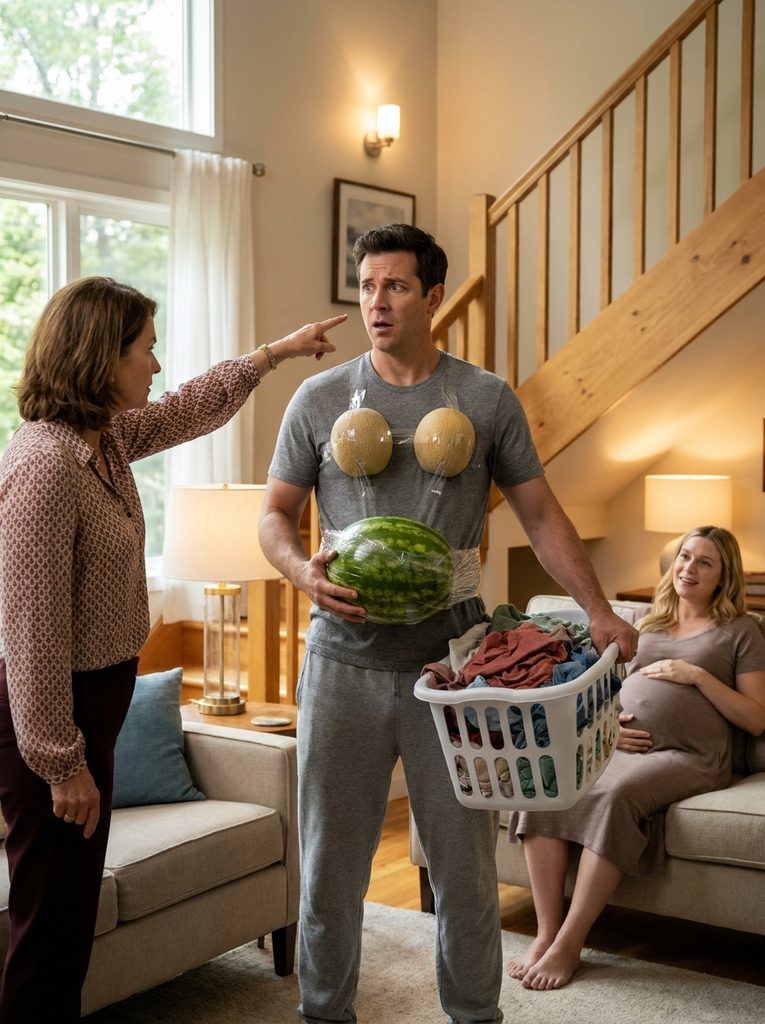
Della walked in carrying a huge watermelon in her arms and two cantaloupes in a grocery bag hanging from her wrist. A roll of medical tape and a long elastic back brace stuck out of her purse.
Daniel blinked. “Are we having a barbecue?”
“No,” Della said. “You’re having a baby.”
“What?”
She held up the watermelon. It had to weigh at least twenty-five pounds. “You think carrying extra weight is easy? Let’s find out.”
Daniel laughed, sure she was joking. She wasn’t. She made him stand up, wrapped the back brace around his middle, and strapped that watermelon to his stomach with the elastic and half a roll of tape. Then she put the two cantaloupes in a canvas bag, slung it across his chest, and taped that down too.
Daniel looked down at himself. Then he looked at me and struck a pose, one hand on his hip, belly pushed forward.
“Still think you’re special?” he asked me, grinning.
Della handed him the laundry basket. “Upstairs.”
For two hours, my mother-in-law ran my husband like a drill sergeant.
She made him carry the laundry up the stairs. She made him strip our bed and put on fresh sheets, which meant bending over the mattress and tucking in the corners with a watermelon hanging off his front. She made him unload the dishwasher.
“Mom, I can’t reach the bottom rack!” he called from the kitchen.
Della sipped her coffee at the table. “Interesting.”
I sat on the couch with my feet up, eating one of her lemon cookies. I’m not proud of it, but I was smiling.
He tried to vacuum the living room and kept bumping the watermelon into the furniture. He tried to put on his own shoes and gave up after the second attempt, sitting on the bottom stair with his laces dangling.
“How do you do this?” he muttered.
“Slowly,” I said.
Then he went into the laundry room to move a load from the washer to the dryer. I heard something drop. I got up and looked through the doorway.
One of his socks had fallen behind the dryer. Right in the same spot as before.
Daniel stood there staring at it. He tried to bend. The watermelon stopped him. He tried to crouch. The cantaloupes swung forward and nearly knocked him off balance. He grabbed the edge of the dryer, breathing hard.
I waited for the joke. I waited for him to say something clever.
None came.
He just stood there, looking at that sock for a long time.
By lunchtime, his shirt was soaked through with sweat. He came into the kitchen, where Della had made sandwiches, and dropped into a chair with a groan.
“I’m taking this off,” he said. “I need a break.”
“So did she,” Della replied, not looking up from her plate.
Daniel looked at me. I could see he wanted me to say something. To tell him it was okay, he’d learned his lesson, he could stop.
I took another bite of my sandwich and kept eating.
That evening, after Della had gone home, Daniel barely spoke. He sat on the edge of the bed rubbing his lower back. There was a red mark across his stomach where the brace had pressed in.
“Two hours,” he said finally. “Just two hours.”
“I know.”
“You’ve been doing it for months.”
“Eight and a half,” I said.
He looked at me. Something moved in his face, and for a moment I let myself believe it had finally gotten through. That tomorrow would be different.
I went to sleep with my hand on my belly, hopeful for the first time in weeks.
The next morning proved how wrong I was.
A zipper woke me.
I opened my eyes to gray light coming through the blinds. Daniel’s side of the bed was empty. Through the open bedroom door, I could see him in the hallway, kneeling on the carpet beside two open suitcases.
My heart stopped.
I sat up too fast, and the baby kicked in protest. I swung my legs off the bed and gasped, gripping the mattress.
The suitcases were full of clothes. But they weren’t his. Floral blouses. Cardigans. A stack of framed photographs, one of them a picture of Daniel and his brothers as little boys on a beach, squinting into the sun.
“You’re leaving?” I asked. My voice came out thin.
Daniel looked up, startled. “What? No!”
“Then why are your mother’s things here?”
He stood up and smiled at me. Proud. Actually proud, like a kid bringing home a good report card.
“I figured everything out,” he said. “Mom’s moving in for a few months.”
I stared at him. “You did what?”
“Yesterday made me realize how much you have on your plate. So I called her last night after you fell asleep. She’s going to stay in the guest room until the baby’s a few months old.”
“And she’ll do what, exactly?”
“Cooking. Cleaning. She’ll help you with the baby. She raised three of us. She’s a pro.”
“And you?”
“I’ll focus on earning money.” He spread his hands. “Everybody wins.”
I felt something cold settle in my stomach, right next to the baby.
He hadn’t learned a thing. He’d spent two hours carrying a watermelon, stared at a sock he couldn’t reach, and his solution was to hire his sixty-three-year-old mother as an unpaid maid.
Then the guest bathroom door opened, and Della stepped out in her robe, her gray hair wrapped in a towel.
“Good morning, sweetheart,” she said.
“Della,” I said slowly. “You’re actually moving in?”
“That’s what Daniel asked me to do.”
“See?” Daniel said, beaming. “Problem solved.”
I looked at my husband. Then I looked at his mother. Della’s face was completely calm. Too calm.
“Daniel,” I said. “Could you give us a minute?”
“Sure. I’ll go check my emails.”
He kissed my cheek on his way past, like he’d just handed me a present. I listened to his footsteps go down the stairs and into the little office off the kitchen. I heard the door close.
Then I turned to Della.
“Yesterday meant nothing to him,” I said. My voice cracked.
Della took the towel off her head and smiled at me. Not a sad smile. A sly one.
“Oh, honey,” she said. “That’s exactly why I agreed to come.”
I blinked at her. “What?”
Della sat down on the edge of the guest bed and patted the spot beside her. I lowered myself down carefully.
“Did you really think I came here to be his housekeeper?” she asked.
“That’s what he expects.”
“I know what he expects.” She sighed. “He expects what his father expected. What I gave his father for thirty-one years.”
She was quiet for a moment, looking at the stack of photographs in the suitcase. She picked up one of them. A tall man with Daniel’s jaw, standing in front of a brick office building, wearing a suit.
“Frank thought earning money was enough,” she said. “He worked sixty-hour weeks. Missed birthdays. Missed school plays. Missed Nathan’s first steps because he was in Denver closing a deal. And I let him, because I thought that was what a good wife did.”
“I’m sorry, Della.”
“That’s not even the worst part.” She set the photo down. “Frank handled all the money. Every account. Every bill. I didn’t even know the password to our bank. When he had his heart attack, I was fifty-four years old, and I didn’t know how much was in our checking account.”
I didn’t say anything. I just took her hand.
“I found out afterward that he’d let his life insurance policy lapse,” she said. “Two years before he died. A $250,000 policy, gone, because he missed three payments during a bad stretch and was too proud to tell me. The mortgage was four months behind. There were letters from the bank in his desk drawer that he’d never opened.”
“Oh my God.”
“I nearly lost the house. I sat in a lawyer’s office for a year going through probate, because Frank never updated his will after the boys were born. I had to sell his car and cash out my own little 401(k) from the library to catch up the mortgage.” She squeezed my hand. “The boys never knew. I made sure of it. I told them Daddy took care of everything, because I wanted them to remember him well.”
“That’s why Daniel thinks providing is enough,” I said quietly.
“That’s why.” Della looked at me. “I wish I’d challenged Frank sooner. I won’t let Daniel make the same mistake.”
I felt tears burning. “Della, I already feel like a single mother. And this week I found out he put $3,200 on our credit card for a stroller and nursery furniture, just because Michael and Nathan have the same ones. What if he never changes?”
Della’s mouth tightened at the mention of the credit card. Then she pulled me into a hug.
“Then you’ll have a place with me,” she said. “With or without my son.”
“You’d really do that?”
“Of course. You’re family.” She leaned back and looked at me fiercely. “My house is paid off. The deed is in my name alone. I made sure of that after Frank. There are three bedrooms and nobody in them but me. You and that baby will always have a home.”
I thought about the garbage bag full of clothes. About Mrs. Ortiz’s car. About my grandmother’s house going to a cousin I’d never met because nobody had written anything down.
Nobody had ever said those words to me before. You’ll always have a home.
I wiped my face. Then I looked toward the hallway, toward the stairs, toward the little office where my husband was checking his emails, completely sure he’d solved everything.
And something occurred to me.
“Della,” I said slowly. “I think I have an idea.”
Her eyes brightened. “Will we need another watermelon?”
I laughed for the first time in weeks.
“No,” I said. “This time, I have something much better.”
By Monday, Della had settled into the guest room, and Daniel had settled into acting like a man on vacation.
He came home from work and sat on the couch while Della cooked. He left his plate on the table and Della cleared it. He said, “Thanks, Mom,” and went back to his phone. Every time, Della smiled sweetly and said, “Of course, sweetheart,” and every time, she looked at me over his head and winked.
Meanwhile, I spent my evenings in the guest room with the door closed, arranging supplies.
Della sat on the bed watching me unpack shopping bags. A portable crib still in its box. A life-size baby doll from a medical training supply company my office worked with, the kind nursing students practiced on. Newborn diapers. A mountain of tiny clothes. Two laundry baskets. A bottle-warmer. A clipboard.
“What should I tell my sons?” Della asked. “Michael and Nathan?”
“Family dinner Saturday,” I said. “Tell them to bring Rachel and Claire.”
“You’re frighteningly organized.”
I smiled. “Before I married Daniel, I used to plan parties for all my friends. Birthdays. Baby showers. Surprise anniversaries. They called me the queen of surprises.”
“What happened?”
I thought about it. “I just got tired.”
Della sighed. “Daniel wasn’t always like this, you know.”
“No,” I said. “He used to notice when I needed help. When we were dating, he used to drive across town at midnight if I had a flat tire. Then he started comparing himself to his brothers.”
Michael was a regional director at a logistics company. Nathan was a partner at an architecture firm. They both had big houses in the suburbs, kids in good schools, wives who smiled in every family photo. Daniel was the youngest, the one who’d bounced between jobs, the one who’d gone freelance two years ago because his last company downsized.
“When I got pregnant,” I said, “he started taking every extra project he could find. He started bragging to everyone about providing for me. As if that was the only thing that mattered.”
“Neither of his brothers ever asked him to compete,” Della said.
“I know. But I don’t think he knows that.”
I pulled out the last item from the bag. A blue folder. I opened it and showed her what was inside.
The hospital pre-registration form, half filled out, waiting for Daniel’s signature. Our health insurance card, with a sticky note on it that said “Add baby within 30 days of birth.” Daniel’s employer-sponsored life insurance enrollment form from his freelance agency’s benefits portal, printed out, with the beneficiary section completely blank.
“He enrolled in a $500,000 policy last spring,” I said quietly. “He told everyone at Easter that he’d taken care of us. But I checked the portal last week. He never named a beneficiary. If something happened to him, it would go to his estate. Into probate. Just like Frank.”
Della put her hand over her mouth.
“And we don’t have wills,” I said. “Either of us. If something happened to both of us, there’s no paper anywhere that says who would raise our daughter.”
Della looked at me for a long moment. She knew where I’d grown up. She knew about my grandmother.
“Oh, honey,” she whispered.
“I’m not going to lecture him,” I said, closing the folder. “I’m just going to put it on a chair. And let him look at it.”
That evening, I brought up Saturday at dinner. Della had made pot roast. Daniel was on his second helping.
“Your mom invited Michael and Nathan for dinner this Saturday,” I said. “With Rachel and Claire.”
Daniel immediately brightened. “Seriously? Both of them?”
“Both of them.”
“Great!” He put down his fork. “I can tell them how we solved the whole baby situation. Mom moving in, everything running smoothly. Michael’s always going on about how hard it was when their first was born. I’ll show him how it’s done.”
I smiled. “Oh, you’ll definitely have something to tell them.”
He didn’t notice anything in my voice. He went back to his pot roast.
Across the table, Della dabbed her mouth with her napkin to hide her smile.
The rest of the week passed slowly. On Wednesday, I went to my last prenatal class alone. The instructor, a cheerful nurse named Bev, asked where my husband was. I said he was working. She gave me the same look she’d given me for six weeks, sympathetic and a little sad.
“He’s missing the infant CPR module,” she said. “That’s the most important one.”
“I’ll teach him,” I said.
On Thursday, I met with Hannah, the HR coordinator at my office, to sign the last of my maternity leave paperwork. Twelve weeks of job-protected leave. Six weeks of short-term disability at sixty percent of my salary. After that, unpaid.
“Do you have enough saved to cover the gap?” Hannah asked kindly, sliding the forms across her desk.
I thought about the $8,400 in the baby fund. About the $3,239 on the credit card at nineteen percent. About Daniel’s freelance income, which came in big chunks some months and nothing at all in others.
“We’ll be fine,” I said. I wasn’t sure it was true.
On Friday night, Daniel came home excited. “I think I’m getting the Hendricks project,” he said. “It’s a big one, Maren. Six months. Twenty-two thousand dollars.”
“That’s wonderful,” I said, and I meant it.
“It’s a lot of hours, though. Evenings. Probably some weekends.”
“When does it start?”
“Probably right around your due date.”
I looked at him. He was already pulling out his phone, already texting someone about it.
He didn’t even realize what he’d just said.
Della, standing at the sink, set down the dish she was drying very carefully.
“Saturday,” she murmured to me later, as we turned out the kitchen lights. “Tomorrow, honey.”
“Tomorrow,” I said.
Saturday arrived cold and bright.
Della and I spent the afternoon cooking together, roast chicken, mashed potatoes, green beans with almonds, and her famous apple crumble. Daniel spent the afternoon watching football. Twice he wandered into the kitchen to steal a piece of chicken skin, and twice Della slapped his hand.
At six o’clock, the doorbell rang.
Michael and Rachel came first, carrying a bottle of wine and a bouquet of sunflowers. Michael was the oldest, tall and broad-shouldered like Frank in the photograph, with gray creeping into his hair. Rachel was small and warm, with a laugh you could hear across a room.
Nathan and Claire arrived ten minutes later. Nathan was the middle brother, quieter, with glasses and an architect’s careful hands. Claire hugged me hard and put her hand on my belly.
“Look at you,” she said. “Any day now.”
“Twenty-six days,” I said. “But who’s counting.”
Daniel was delighted to have an audience. He poured the wine. He told everybody about the Hendricks project before they’d even sat down. He showed off the new Bugaboo stroller standing in the hallway.
“Same as yours, Mike,” he said proudly.
Michael glanced at it. “Nice. Honestly, we barely used ours. Rachel liked the cheap umbrella one better.”
Daniel’s smile flickered just slightly.
Halfway through dinner, Daniel raised his glass and tapped it with his fork.
“So,” he said. “I wanted to share something. I’ve finally figured out how to balance everything.”
Michael smiled. “Yeah? How?”
“Mom’s moving in.” Daniel gestured toward Della with his glass like he was presenting a prize. “She’ll manage the house. Maren will handle the baby. And I can concentrate on providing. It’s the perfect system.”
There was a short silence.
Rachel frowned. “Does Maren get any time off?”
“Mom’s helping.”
“Helping whom?” Claire asked.
Daniel opened his mouth.
Before he could answer, I put my napkin down and stood up, one hand pressed to the small of my back.
“Actually,” I said, “I prepared something special for tonight.”
Daniel grinned. “There’s my old Maren! I was wondering when you’d start being fun again.”
“You’re right,” I said. “I’m finally becoming myself again.”
I met his eyes across the table.
“Now it’s your turn to become the man I married.”
His smile faded.
I walked down the hallway and opened the guest-room door.
Everyone at the table turned to look. Della stood and followed me, and after a moment, so did the others, wine glasses in hand, curious. Daniel came last.
The guest room looked like a baby store had exploded in it. The portable crib, assembled. The life-size baby doll lying on the changing pad. A stack of newborn diapers. A mountain of tiny folded and unfolded clothes. Two overflowing laundry baskets. A bottle, a can of formula, and a bottle-warmer on the dresser. And two chairs, side by side, with a sheet draped over them.
I picked up my clipboard.
“Welcome, everyone,” I said, “to our family competition. Welcome to Fatherhood!”
Nathan laughed. “Are we playing?”
“Only Daniel.”
My husband stared at the room. Then he stared at me. His face went red.
“You want to embarrass me in front of my brothers?”
“No,” I said. “You’ve spent months proving to everyone how successful you are. Tonight, I’d like you to prove something to me.”
“Which is?”
“That I can depend on you as our child’s father.”
“This is ridiculous.”
“Then don’t participate.”
“Good,” he snapped. He turned toward the door.
“But understand something,” I said.
He stopped. The room went completely silent.
“If you can’t show me you’re willing to take responsibility,” I said, “I’ll pack my things and stay with Della. I’m not raising our baby alone while pretending I have a partner.”
Daniel turned around slowly. His face had changed. The red was gone. He looked pale.
“You’re threatening to leave me?”
“I’m telling you what I can no longer live with.”
Della stepped up beside me. “My door is open to her,” she said quietly. “And to my granddaughter.”
Michael set his wine glass down on the dresser. “Daniel. What’s going on?”
“She’s exaggerating!”
“Am I?” I asked. “Tell them, Daniel. Tell them who cooks. Who cleans. Who goes to the prenatal classes. Who set up the nursery. Who prepares everything for the baby.”
Daniel looked at his brothers. Then at their wives. Then at the floor.
He said nothing.
Della folded her arms. “You told us household work was easy, son. Surely a little competition won’t frighten you.”
For a long moment, Daniel didn’t move. I could see him weighing it. His pride on one side. Me, his mother, and his unborn daughter on the other.
Finally, he exhaled.
“Fine,” he said. “Let’s get this over with.”
I looked down at my clipboard and smiled.
“Wonderful,” I said. “Round one.”
I picked up the doll and placed her in Daniel’s arms. She was surprisingly heavy, weighted to feel like a real seven-pound newborn. Daniel held her out from his body like she was a bag of groceries.
“Congratulations,” I said. “Your baby needs a diaper change.”
He looked at the doll. Then at the changing pad. “Seriously? That’s it?”
“That’s it.”
He laid her down, grabbed a diaper, and started.
Thirty seconds later, Michael burst out laughing.
“Buddy,” he said. “That’s backward.”
Daniel glared at him. “I know!”
“Then why are the tabs underneath her?”
“I’M FIXING IT!”
Michael stepped forward. “Here, let me just…”
“Nope,” I said, holding up my hand. “He said he could handle everything himself.”
Michael raised his hands and stepped back. Rachel was biting her lip to keep from laughing.
Daniel flipped the diaper around. He got one tab fastened. The other one stuck to his thumb. He peeled it off, and it stuck to the doll’s leg. He peeled that off, and the whole tab tore.
“These things are defective,” he muttered.
“Grab another one,” Claire said helpfully.
On the third diaper, he finally got it on. Crooked, too loose on one side, but on.
“Done,” he said, stepping back and wiping his forehead.
“Excellent.” I checked something off my clipboard. “Now prepare a bottle, fold those baby clothes, and sort the laundry.”
He stared at me. “All at once?”
“You’re a capable man.”
He picked up the bottle and stared at the formula can. He set it down and grabbed a handful of tiny clothes from the basket. Onesies. Sleepers. Little knit hats. And socks. Dozens of tiny socks, each smaller than his thumb.
“Why are there so many socks?” he asked.
“Babies have feet,” I said.
Nathan nearly choked on his wine.
Daniel started trying to match the socks into pairs. White with white. Pink with pink. He held up a single blue one. “Where’s the other blue one?”
Claire pointed at him. “Your pocket.”
He looked down. A tiny blue sock was hanging out of the front pocket of his jeans. He pulled it out. Two more came with it, a white one and a yellow one.
“How did those get there?”
“Excellent question,” I said. “Now your bottle.”
He picked up the formula can again and turned it around, searching for instructions. “Can somebody help me with this?”
I tilted my head. I kept my voice soft.
“You’re not helpless, Daniel,” I said. “You haven’t lost your arms.”
Everyone laughed. Rachel laughed so hard she had to sit on the bed.
But I wasn’t laughing. I was watching my husband’s face.
And I saw it. Recognition. It crossed his face like a shadow. His hand froze on the formula can. His eyes came up and met mine, and for one second I saw him standing in the laundry room, staring at a sock he couldn’t reach with a watermelon strapped to his stomach.
He remembered.
He didn’t say anything. He looked back down at the can, found the instructions in tiny print on the side, and read them carefully. He measured the water. He scooped the powder, leveled it with his finger the way the instructions said. He screwed on the nipple and shook it.
He tested a drop on the inside of his wrist, the way I’d learned in prenatal class. Nobody had taught him that. He must have seen it in a movie.
“Done,” he said quietly.
“Good.” I checked the box. “Now comes round two.”
His shoulders dropped. “There’s MORE?”
I smiled. Changing a diaper was one thing. But Daniel still had no idea what I’d saved for the final round.
I led everyone into the kitchen. Della and I had set it up that afternoon. A pot of pasta sauce sat on the stove beside a pot of water. A pile of clean towels waited on the counter, unfolded. The doll sat in her bouncer on the floor. A stack of mail lay by the coffee maker.
“Here’s the situation,” I said. “You’ve just finished a nine-hour workday. The baby’s crying. Dinner isn’t ready. There’s laundry to fold. And the bills came today.”
Daniel surveyed the kitchen. “Easy.”
“Begin.”
He turned on the burner under the sauce and started folding a towel at the same time. Della pulled out her phone and started a timer.
Ten seconds in, I said, “Your baby’s crying.”
“Can she wait?”
“She’s a newborn.”
He set down the towel, grabbed the doll from the bouncer, and held her against his shoulder. “Okay, sweetheart. Daddy’s here. Daddy’s here.”
He bounced her, trying to stir the sauce with his free hand. Then I said, “The pasta water’s boiling over.”
He spun around. Foam was spilling down the side of the pot onto the burner, hissing.
“Can someone hold her?”
“Nope,” I said. “You’re doing this yourself.”
He shoved the doll under his arm like a football and turned down the burner. The sauce started spitting. He grabbed a towel to wipe it and knocked the mail onto the floor.
“How am I supposed to do everything at once?” he shouted.
“Good question,” I said.
Nathan leaned toward Claire and murmured, “Suddenly I understand why you ask me to watch the kids when I get home.”
“Only suddenly?” Claire replied.
Everyone laughed. Everyone except Daniel.
He stood in the middle of the kitchen holding a doll under one arm and a dish towel in the other hand. The sauce was scorching. The pasta water was everywhere. The mail lay scattered across the floor, and I watched him look down at it. One envelope had landed face up. It was from our credit card company. The statement.
Daniel stared at that envelope for a long moment.
Then he did something I didn’t expect. He reached over and turned off both burners. He set down the towel. He pulled out a kitchen chair, sat down, and cradled the doll properly in his arms, her head in the crook of his elbow, the way Bev had taught me in class.
“Okay,” he said quietly. “Baby first. Everything else can wait.”
The kitchen went still.
I nodded slowly. “Now imagine doing this every evening. After working all day. With no one coming to help.”
He looked down at the doll. He looked exhausted. Not physically. Something deeper.
“You’ve been doing it,” he said. “Even before. Even without the baby. You’ve been coming home and doing all of it.”
“Yes.”
He didn’t answer.
I picked up my clipboard. “Ready for the final round?”
Daniel groaned and closed his eyes. “There’s MORE?”
“Last one,” I said. “I promise.”
I led everyone back to the guest room. Daniel carried the doll without being asked.
The two chairs still sat side by side, covered with the sheet. I pulled the sheet off.
On the first chair sat Daniel’s work laptop, open, the Hendricks project proposal on the screen. Twenty-two thousand dollars.
On the second chair was a small pile of tiny baby clothes, our wedding photograph in its silver frame, and the blue folder.
Daniel looked from one chair to the other. “What am I choosing?”
“It’s not work versus family,” I said. “Nobody’s asking you to quit your job. It’s two different ideas of what a father is.”
I pointed at the laptop.
“This one says money makes you a good father. Even when you’re never home. Even when you’re never available.”
Then I pointed at the second chair.
“This one says providing matters. But so does showing up.”
Daniel rubbed his forehead with the hand that wasn’t holding the doll.
“Without my income,” he said, “we can’t give our child a good life.”
“I work too, Daniel,” I said. “I’ve worked full-time this entire pregnancy. Yet somehow, that doesn’t excuse me from everything else.”
He looked away.
“Remember the prenatal classes I kept asking you to come to?”
He shifted uncomfortably. “I was busy working.”
“Do you even know what we covered?”
He opened his mouth. Then he closed it.
“Breastfeeding. Labor positions. Car seat installation. What postpartum depression looks like and when to call the doctor. Infant CPR.” My voice cracked on the last one. “Infant CPR, Daniel. If our daughter stops breathing and I’m not in the room, would you know what to do?”
He didn’t answer. He looked down at the doll in his arms like he’d never seen it before.
“That’s what scares me,” I said. “Our baby is almost here, and you’ve left me to prepare for everything alone.”
Then I picked up the blue folder and held it out to him.
He took it with his free hand and opened it on top of the dresser. He looked at the hospital pre-registration form with his signature line still empty. The health insurance card with my sticky note. Then he turned to the last page, the life insurance enrollment form from his agency’s benefits portal.
The $500,000 policy he’d told everyone at Easter about. Coverage amount filled in. Policy number filled in.
Beneficiary: blank.
He stared at it for a long time.
“I enrolled,” he said. “I know I enrolled.”
“You enrolled,” I said. “You never named anyone. I checked the portal last week. If something happened to you tomorrow, that money wouldn’t come to me. It wouldn’t come to her. It would go to your estate. And we don’t have a will, Daniel. Either of us.”
Behind me, I heard Della take a sharp breath.
“And if something happened to both of us,” I said, “there’s no paper anywhere that says who would raise our daughter.”
Daniel looked up at me. He knew my story. He’d heard it on our third date, sitting in his car outside a diner while it rained. My grandmother. No will. Mrs. Ortiz and the garbage bag. He’d held my hand and said, “That’ll never happen to you again.”
I watched him remember that, too.
“You keep telling everyone you handle the bills,” I said softly. “But being a provider isn’t just a paycheck. It’s making sure that if the worst happens, she’s still safe. It’s putting your name on the forms. It’s showing up.”
“I thought I was doing my part,” he muttered.
“You’ve spent years trying to prove to your brothers that you’re successful,” I said. “But I’m the one having your baby. And I’m still waiting for you to prove I can count on you.”
Michael cleared his throat. “Daniel,” he said. “You never had to compete with us.”
Daniel shook his head without looking up from the folder.
“Easy for you to say,” he said. “You and Nathan have everything figured out. Great careers. Big houses. Happy families. You have no idea what it’s like trying to catch up.”
Michael exchanged a glance with Rachel. Something passed between them. Rachel gave him a tiny nod.
“Actually,” Michael said, “I do.”
Daniel frowned and looked up. “What?”
“After Lily was born,” Michael said, “Rachel nearly left me.”
The room fell completely silent.
Daniel stared at his brother. “You never told me that.”
“Because I was ashamed.” Michael put his hands in his pockets. “I worked late every night. I missed her pediatrician appointments. I missed her first bath. I took a promotion that had me traveling three weeks a month, and I convinced myself that paying the mortgage made me a good husband.”
Rachel looked at Daniel. Her voice was gentle but steady. “I spent months begging him to come home before our daughter was asleep. Just once a week. Just once.”
“And one night,” Michael said, “I came home from Chicago and found Rachel in our bedroom packing a suitcase. Lily was asleep in her car seat by the front door.”
Daniel’s mouth opened. “But you two always seemed so happy.”
“We are now,” Michael said. “Because I finally understood that my family needed more than my paycheck.”
“And because a lawyer named Gloria Haines scared the life out of him,” Rachel added, with a small smile.
Daniel blinked. “A lawyer?”
“Rachel made me go to an estate planning attorney before she’d unpack that suitcase,” Michael said. “Ms. Haines sat us down and asked who’d raise Lily if we both died in a car crash on the way home. I couldn’t answer. I had a fancy title and a 401(k) and I hadn’t even written down who I trusted with my own kid.” He shook his head. “We named you and Maren as guardians, by the way. Did you know that?”
Daniel looked like someone had hit him. “Us?”
“You,” Michael said. “Because you were the one who used to show up. Back before you started trying to be me.”
Daniel crossed his arms over the doll, almost defensive. “I’m not abandoning anyone. I’m working hard for my family.”
“When did you last ask Maren what she needed?” Michael asked.
Daniel opened his mouth. Then stopped.
Slowly, he turned and looked at me.
“Have I really made you feel that alone?” he asked.
“Most days,” I said. “Yes.”
Della stepped forward and spoke quietly.
“Your father worked constantly, too,” she said. “He missed so much of your childhood. You boys used to fall asleep on the couch waiting for him. And when he died, Daniel…” She stopped. She looked at Michael and Nathan, and I saw her decide.
“When your father died, he left me with a lapsed life insurance policy, a mortgage four months behind, and a will so old it didn’t even mention any of you. I spent a year in probate court. I cashed out my retirement savings to keep the house. I never told you boys because I wanted you to think he’d taken care of us.”
All three brothers stared at her.
“Mom,” Nathan said. “Why didn’t you ever say anything?”
“Because I was protecting him. The way I always did.” She looked at Daniel. “And I see you doing the same thing he did. Telling everyone you’ve got it handled, while the forms sit in a drawer.”
Daniel looked down at our wedding photograph on the chair. He stared at it for a long time. We were so young in that picture. He was laughing at something I’d said, his head thrown back, his arm around my waist.
“I thought I was doing the right thing,” he said.
“By leaving everything to me?” I asked.
He rubbed his face with his free hand. When he took it away, his eyes were wet.
“God, Maren,” he said. “I messed this up.”
“Then why did you keep doing it?”
He was quiet for a long time. The doll lay still in his arms. Finally, he said it.
“Because I’m scared.”
I lowered myself onto the edge of the bed, across from him. “Of what?”
“Of not being enough.” His voice broke. “You both had houses and kids before I even got married. Michael’s a director. Nathan’s a partner. I’m the guy who got laid off and went freelance and still can’t land a steady contract. I thought our baby deserved everything yours have. I thought if I bought the same stroller and the same furniture and worked twice as hard, nobody would notice I was behind.”
Nathan shook his head slowly. “Daniel. None of us had everything figured out. Claire and I spent two years in couples counseling after our second. We nearly lost the house when my firm froze bonuses. We just didn’t talk about it.”
Claire nodded. “Nobody posts that part.”
“I know that now,” Daniel said.
He turned toward Della.
“I’m sorry, Mom,” he said. “I called you to come live here like you were hired help. After everything you went through. After everything you did for us.”
Della’s chin trembled. She reached up and touched his cheek.
Then he faced me.
“And I’m sorry, Maren,” he said. “For all of it. For the classes. For the stroller and the credit card. For the forms.” He swallowed. “Especially for that stupid sock.”
I laughed through my tears. “It was never about the sock.”
“I know.” He sat down on the chair, the one with the laptop, and pushed the laptop aside onto the floor. Then he picked up the blue folder and set it on his knee. “I’ll rearrange my projects. I’ll tell Hendricks I can do it at three-quarter time or not at all. I’ll share the chores. Real sharing, not helping. And I’ll take a parenting class with you. Whatever class. CPR. All of it.”
“Promises aren’t enough anymore, Daniel.”
He nodded slowly. “Then I’ll prove it.”
He looked at the folder. Then he looked at Michael. “This lawyer. Gloria Haines. Is she any good?”
Michael smiled. “She’s terrifying. You’ll love her.”
Daniel pulled out his phone. Right there, in front of everyone, he opened the benefits portal for his agency. I watched him log in. I watched him find the life insurance section. I watched him type in my name, my date of birth, our address. Under contingent beneficiary, he wrote, “Our daughter, to be held in trust,” and added a note to update it with her legal name after birth.
He hit submit. A confirmation number popped up on the screen.
Then he held the phone out to me so I could see it.
I looked at the confirmation. Then at him.
I reached out and squeezed his hand. “Okay,” I said. “You have a chance.”
Rachel started clapping. Then Claire. Then Nathan, and Michael, and finally Della, who was crying openly now, her mascara running just like mine.
Daniel looked down at the doll still in his arms.
“So,” he said, a little shakily. “Do I win?”
I checked my clipboard. “You came in last.”
“Last? I was the only one competing!”
“Exactly,” I said. “And somehow, you still came in last.”
Everybody laughed, Daniel loudest of all.
On Monday morning, Daniel took a personal day.
He called Gloria Haines’s office at nine o’clock sharp. Her assistant said she had a cancellation on Wednesday at two. Daniel said we’d take it before she even finished the sentence.
Then he sat at the kitchen table with the blue folder and filled out the hospital pre-registration form himself. He called our health insurance company and spent forty minutes on hold to confirm exactly how to add the baby after birth. He wrote the phone number and the deadline on a sticky note and stuck it to the refrigerator, right next to mine.
Then he did something that made Della put down her coffee cup.
He called the furniture store and asked to return the nursery glider and dresser. They were still in their boxes in the garage. The manager charged a fifteen percent restocking fee, but Daniel paid it without arguing. He listed the Bugaboo stroller on the same parents’ group where I’d found our used one, and it sold by Tuesday night for $950.
When the credit card statement came the next month, the balance was down to $487.
“I’ll pay off the rest from my next invoice,” he said, showing me the statement. “And I set up a transfer. Two hundred dollars from every payment I get goes into the baby fund. Automatically. So I can’t forget.”
I didn’t say anything. I just hugged him, as well as I could with a basketball-sized belly between us.
On Wednesday at two o’clock, we sat in Gloria Haines’s office. She was a tall woman in her sixties with silver hair cut short and reading glasses on a beaded chain. Michael was right. She was terrifying.
She asked us questions for an hour and a half. What we owned. What we owed. Who we trusted. When she asked who we would want to raise our daughter if we both died, Daniel and I looked at each other.
“Della,” we said at the same time.
Gloria wrote it down. “And an alternate guardian, in case Mrs. Della Morrow is unable?”
Daniel didn’t hesitate. “Michael and Rachel.”
Two weeks later, we signed our wills in her conference room. A notary named Mr. Ferris stamped every page. Two of Gloria’s paralegals signed as witnesses. Daniel held my hand under the table the entire time.
When it was done, Gloria handed us each a folder with copies.
“Keep these somewhere safe,” she said. “Somewhere your mother-in-law knows about.”
“She already knows,” I said. “She’s the one who gave me the fireproof box.”
Driving home, I looked out the window at the bare November trees and thought about my grandmother. About a little girl with a garbage bag full of clothes. About how nobody had written anything down.
My daughter would never be that little girl.
“You’re quiet,” Daniel said.
“I’m happy,” I said. “That’s all.”
He reached over and took my hand. He didn’t let go until we pulled into the driveway.
The changes didn’t all happen at once. I won’t pretend they did.
Some nights, Daniel still came home tired and dropped onto the couch out of habit. But now, before I could say anything, he’d catch himself. He’d sit there for a second, and then he’d sigh, stand up, and say, “What needs doing?”
He called the Hendricks people and told them he could take the project at three-quarter time, with no weekends for the first three months after the baby came. He was sure they’d say no. They said yes. The project manager, a man named Phil, told him he had two kids himself and wished someone had made him do the same thing.
The contract came in at $16,500 instead of $22,000. Daniel signed it anyway.
“That’s five and a half thousand dollars less,” I said when he showed me.
“I know,” he said. “I did the math. It’s still more than enough with your disability pay and the baby fund. And it gets me home by six.” He looked at me. “I’d rather have less money and know how to bathe my own daughter.”
Four days after the dinner, he went with me to the hospital for the make-up session of the infant CPR class. Bev, the nurse, nearly dropped her clipboard when she saw him walk in.
“Well,” she said, giving me a look. “Look who finally showed up.”
“Better late than never?” Daniel offered.
“In my line of work,” Bev said, handing him a practice mannequin, “late can be never. So pay attention.”
He paid attention. He practiced the compressions on the tiny mannequin over and over, two fingers in the center of the chest, counting under his breath, until Bev said, “Okay, Dad. You’ve got it.”
He looked at me when she called him Dad. I saw his eyes go shiny.
Della moved back into her own house the following weekend.
“You don’t need me here,” she said, folding her blouses into the suitcase Daniel had packed for her. “Not as a maid, anyway. I’ll come for Sunday dinners like a normal grandmother.”
“You can stay as long as you want,” Daniel said. “Really, Mom.”
She smiled at him. “I know. That’s why I’m going.”
Before she left, she pulled me aside on the porch. She pressed something into my hand. It was a key.
“To my house,” she said. “Just in case. Not because I think you’ll need it. Because I want you to always know you have it.”
I looked at the key. A plain brass house key on a ring with a little enamel sunflower.
Nobody had ever given me a key to their home before. Not in all those years of foster care. Not once.
“Thank you, Della,” I whispered.
“Thank you, honey,” she said. “For giving me back my son.”
Our daughter was born nineteen days later, at 4:12 in the morning, after fourteen hours of labor.
Daniel was there for every one of them.
He held my hand. He did the breathing with me, the exact counting pattern Bev had taught, the one he’d learned from a printout I gave him because he’d missed the class. When the nurse asked who wanted to cut the cord, he looked at me, and I nodded, and his hands were shaking so badly the nurse had to help him.
Then they laid her on my chest, red and furious and perfect, and Daniel put his hand on her back, and she stopped crying.
“Hi,” he whispered to her. “Hi, baby girl. I’m your dad. I’m here.”
We named her Grace. After my grandmother.
The next morning, while I was nursing her, Daniel sat in the hospital chair with his laptop. Not working. He was on the phone with our health insurance company, adding Grace to our policy. Then he logged into his benefits portal and updated the contingent beneficiary on his life insurance. Grace Della Morrow, born November 28th.
He turned the laptop around to show me the confirmation screen.
“Done,” he said. “First thing.”
“First thing,” I agreed.
The whole family came that afternoon. Della cried the moment she held her granddaughter. Michael and Rachel brought a balloon so big it barely fit through the door. Nathan and Claire brought a tiny pair of knit socks, blue ones, and Claire made a show of handing them to Daniel.
“Try not to lose these in your pocket,” she said.
Daniel laughed and tucked them carefully into the diaper bag.
That night, after everyone had gone, I woke up at two in the morning to the sound of the baby fussing. I started to sit up, my whole body aching.
“I’ve got her,” Daniel said softly.
He was already standing by the bassinet. He picked her up the way Bev had taught him, one hand under her head, and walked her slowly back and forth across the dark hospital room, humming something off-key. Grace settled against his chest.
I lay back against the pillow and watched them.
Later that week, at home, I was folding laundry in our bedroom when I heard something drop in the laundry room. I waddled to the doorway, still sore, and looked in.
One of Grace’s tiny socks had fallen behind the dryer.
Before I could say a word, Daniel was there. He got down on his hands and knees, reached into the dust, and fished it out. He stood up, blew the lint off it, and handed it to me with a small, embarrassed smile.
“I’ve got arms,” he said.
I laughed so hard I had to hold my stitches.
All my life, I’d been afraid of losing the family I’d always dreamed of. I thought a real family meant a big table and a lot of people and never being alone.
But now I understood something different. A real family isn’t about being perfect. It isn’t about matching strollers or bigger houses or who got promoted first.
It’s about showing up. It’s about writing things down so nobody you love ever gets left behind. It’s about bending down to pick up the sock.
And every single day since then, my husband has shown up.
THE END..!