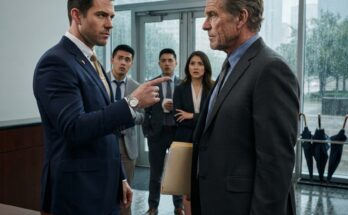
The kitchen inside my modest home on the outskirts of Fort Campbell smelled faintly of toasted sourdough and strong coffee while I packed three identical lunchboxes under the hum of the fluorescent lights. Precision had become second nature to me after working for years in military intelligence, a field where a single wrong coordinate could end lives just as easily as a forgotten sandwich crust could trigger a morning meltdown from my seven-year-old triplets.
Connor and Zoey were bickering loudly over a blue marker in the living room while Sam sat quietly at the kitchen island, watching me with that unsettling perception only certain children possess. He always noticed the things I tried hardest to hide, especially on mornings when the sheer weight of exhaustion pressed against the back of my smile.
My Major’s insignia gleamed against the crisp fabric of my Class A uniform as I adjusted the collar with a practiced hand. The uniform always felt like armor, specifically after seven years spent rebuilding my life from the wreckage left behind when my ex-husband, Caleb O’Connor, abandoned me and our newborn infants for a younger woman.
Just as I smoothed down Zoey’s hair clip, both my personal phone and my encrypted government device buzzed in unison on the granite countertop. The sharp, metallic ping from the classified tablet tightened a knot in my chest because simultaneous notifications like that never brought good news.
I glanced toward the television mounted in the corner and saw a bright red breaking news banner stretching across the screen. The anchor’s grave voice filled the quiet kitchen moments later as she announced that disgraced former officer Caleb O’Connor had reportedly perished during a high-stakes combat operation overseas.
According to the official Pentagon briefing, Caleb died heroically while shielding fellow soldiers during a brutal ambush. Hearing the word heroic attached to his name made a cold, heavy stone settle into my stomach.
Before the broadcast could continue, my personal phone lit up with a text message from a number I had blocked long ago, yet I recognized the cruelty behind the sender immediately. The message came from Diane O’Connor, my former mother-in-law, who had never missed a chance to remind me of my supposed failures.
“Caleb will be laid to rest at the National Cemetery this Friday,” the text read in her cold, clipped tone. “Do not bring those charity case children of yours anywhere near the family, as Monica is the only grieving widow the public needs to see.”
I stared at the glowing screen while the old, familiar sting of humiliation washed over me. Seven years earlier, Caleb had walked away from our marriage and our triplets without a backward glance, running off with Monica Frost, a twenty-five-year-old social climber obsessed with the O’Connor family fortune.
His parents, Diane and Frank, had bankrolled the divorce lawyers and cut off all contact, treating me like a smudge on their pristine public image. Meanwhile, I spent those seven years building a life from scratch, raising three kids through multiple deployments and endless nights of worry while Caleb lived a life of luxury, occasionally popping up in tabloid photos on yachts beside Monica.
Now he was dead, and the very people who had ignored my children’s existence for years wanted the world to remember him as a hero. The absolute audacity of it felt suffocating.
Sam pointed a small finger toward the television screen where Caleb’s old military photo was still being displayed. “Mom, is that the man on the TV our daddy?” he asked with that quiet, piercing curiosity.
I took a steady breath before nodding slowly, finding no tears in my heart, only a strange, hollow numbness. I was still trying to figure out how to explain betrayal and the complexity of death to children who were barely old enough to remember the man who had discarded them.
I deleted Diane’s message instantly because I refused to let her venom occupy any space in my life. However, before I put the phone away, my attention drifted back to the classified tablet sitting by the toaster.
The Department of Defense notification remained open on the screen, filled with redacted operational details and sterile condolences. As I scrolled through the report, one hidden section regarding the mission’s failure caught my eye because it felt deliberately, suspiciously incomplete.
At the time, I chose to ignore that nagging feeling because surviving the daily grind of motherhood and military service took every ounce of emotional energy I had. I had no idea that the classified secret buried inside that file would soon unravel everything the O’Connor family had fought so hard to keep hidden.
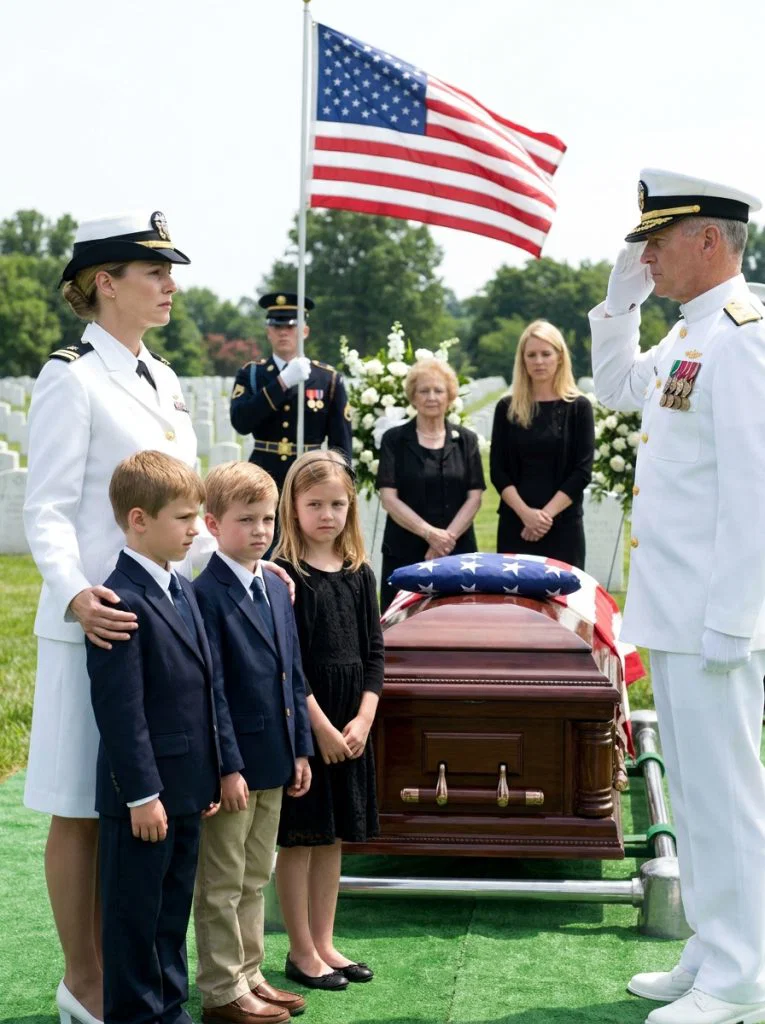
Friday arrived under a sky of heavy gray, wrapped in a biting, freezing rain that soaked the grounds of the cemetery. Rows of white marble gravestones stretched endlessly across the hills as icy water seeped through the shoulders of my dress uniform.
My triplets stood close to me under a large black umbrella while reporters crowded behind the front rows, their cameras clicking incessantly. We stayed in the back, exactly where Diane had demanded, because I refused to turn my children into a public spectacle for the sake of the O’Connor ego.
Fifty yards away under the covered pavilion, Monica Frost sat in the front row wearing an absurdly expensive black wool coat while dramatically sobbing into a lace handkerchief. One hand rested protectively against her rounded belly, a performance clearly intended for the news cameras aimed directly at her.
Diane sat beside her, stroking Monica’s hair like a grieving mother comforting a daughter. Frank O’Connor stood near the reporters, speaking loudly about Caleb’s patriotism and sacrifice, waiting for the nearby microphones to catch every word.
It was a piece of cheap theater masquerading as a funeral. They were using this hallowed ground to scrub Caleb’s tarnished reputation clean, pretending the family he had abandoned didn’t exist.
Then, Diane turned her head and spotted me standing silently in the rain with my children. Even from this distance, I saw the satisfaction twist across her face before she leaned over and whispered something to Monica that made both women sneer in my direction.
Monica touched her stomach and offered a smug, thin-lipped smile before burying her face back into the handkerchief. I kept my gaze fixed firmly forward, knowing my children deserved dignity even if the adults surrounding us had absolutely none.
Suddenly, the air in the cemetery shifted.
A black armored SUV with government plates rolled through the main gates while military personnel throughout the crowd snapped to attention. Conversations died instantly the moment General Robert Kingston stepped out into the storm, carrying a tightly folded ceremonial flag beneath his arm.
Rain lashed against the four-star general’s heavy coat, and the reporters immediately scrambled to get their lenses on him. What unsettled me most, however, was not the rows of medals on his chest or his intense, piercing gaze.
It was the fact that he didn’t look like a man here to honor a fallen soldier. He looked like a man here to finish a war.
CHAPTER 2: THE TRUTH COMES TO LIGHT
The sharp, rhythmic sound of General Robert Kingston’s boots against the wet pavement echoed through the silence of the cemetery. The reporters lowered their microphones, their movements frantic as they tried to capture the moment this legendary commander approached the pavilion.
I stood frozen in the back row, holding the umbrella high above my children while the cold rain turned my hair into a tangled mess. My pulse hammered against my ribs, a warning signal I had learned to trust over years of intelligence work.
At any standard military funeral, the flag presentation was the emotional anchor of the service, typically reserved for the immediate surviving next of kin. Diane clearly expected that moment to be the climax of her staged production, and she nudged Monica forward with a gloved hand.
Monica stood up, carefully arranging her face into a mask of fragile, heartbreaking grief. She reached out her hands to receive the flag, her voice trembling just enough for the audio equipment to pick it up.
“Thank you, General,” she whispered, her eyes wide and wet. “He died protecting us, and his memory will live on.”
I prepared myself for the sickening humiliation of watching Caleb honored as a hero while my children stood ignored in the puddles behind the crowd. But General Kingston never stopped walking.
He moved right past Monica, ignoring her outstretched hands completely, and she froze in the aisle, her face flickering with a mix of shock and confusion. A collective gasp rippled through the gathered crowd.
Diane lunged forward, her composure cracking, and shouted that the General was moving in the wrong direction. He didn’t even look her way.
Instead, General Kingston kept marching through the center aisle, the crowd parting before him as if he were a force of nature. My stomach turned over when I realized exactly where he was headed.
He was walking straight toward me.
He stopped only two feet away, rainwater streaming off the brim of his cap. My triplets instinctively pressed against my legs as he surveyed each of them with a stern, unreadable expression before locking eyes with me.
Then, to the complete shock of everyone present, he raised his hand in a slow, precise salute. “Major Katherine Hunt,” he announced in a voice that cut through the rain.
I returned the salute automatically, my military training overriding the utter confusion crashing through my brain. Every instinct I possessed screamed that something had gone terribly wrong in the world of high-level intelligence.
General Kingston lowered his hand but did not offer me the folded flag. Instead, he gripped it tightly under his arm and turned slightly so his voice carried across the entire assembly.
“I am not here to present a hero’s flag to a grieving widow,” he declared, his voice hard as iron. “I am here to deliver a classified briefing on why this man has been stripped of his honors.”
The cemetery fell so silent you could hear the rain hitting the marble headstones. Monica’s face drained of color, her performance of grief replaced by an immediate, visceral terror.
General Kingston’s eyes stayed fixed on mine, ignoring the reporters who were now sprinting toward us. “We recovered encrypted files from Caleb O’Connor’s final operation,” he continued. “He did not die protecting American soldiers.”
My muscles tightened until I felt like I might snap.
“He died during an illicit intelligence exchange inside a hostile compound after attempting to sell critical satellite coordinates to enemy combatants,” the General stated clearly. “He was trying to sell the real-time movement data of your own unit, Major Hunt.”
The world tilted on its axis, and for a moment, I felt like I couldn’t breathe. Caleb had not just abandoned us; he had actively tried to facilitate the slaughter of my entire tactical team.
My children would have been left without a mother because their father wanted a payday badly enough to commit high treason.
Behind the General, Diane started screaming that it was a fabrication and that her son was a patriot, but Frank looked as if he might collapse right there in the mud. The reporters turned their cameras toward the O’Connor family, capturing every second of their public disintegration.
General Kingston didn’t even look back at them. He reached into his coat and pulled out a thick, waterproof envelope stamped with red ‘TOP SECRET’ markings, handing it directly to me.
“The intelligence you recovered in your own unit’s firewall prevented the breach,” he said, his voice lowering so only I could hear. “Because of your actions, not a single member of your team was lost.”
Then, the General nodded to the military police who had been waiting at the perimeter. They surged forward, surrounding the pavilion as the media frenzy reached a deafening roar.
Frank tried to argue, his face turning a shade of purple, but an agent shoved him toward the transport van. Diane was still shrieking, her mascara running down her cheeks, as she blamed me for their downfall, calling me a traitor to their family.
I never uttered a single word to her. She was not worth my breath.
I pulled my children closer, shielding their eyes from the sight of their grandparents being handcuffed and led away. Monica sat motionless on the folding chair, her hands shaking as a federal agent read her her rights.
The Honor Guard suddenly descended upon the casket, their movements sharp and efficient. They ripped the American flag from the wooden box without a shred of ceremony and marched away, leaving the casket looking small, cheap, and entirely unremarkable in the pouring rain.
General Kingston stepped closer to create a wall between us and the chaos. “You are the only hero standing in this cemetery today, Major,” he said, and for the first time, I saw a flicker of genuine respect in his cold eyes.
CHAPTER 3: THE END OF THE LIE
The aftermath of the Arlington disaster was immediate and absolute. Federal agents swarmed the grounds, and the reporters—who had come for a tear-jerking story about a hero’s death—found themselves documenting a far grimmer tale of treason and corporate greed.
Frank and Diane were shoved into the back of government SUVs, their screams of denial echoing against the headstones. They had tried to paint me as the villain for years, but in the end, their own corruption had brought their world crashing down.
Monica remained glued to the seat, her face a mask of pure, unadulterated fear as an agent stood over her with a pair of silver handcuffs. All the expensive jewelry and the designer clothes couldn’t save her from the reality of what she had helped hide.
I didn’t watch as they dragged her away. I didn’t watch as they carted off the coffin that held the man who had tried to sell my life for a few million dollars.
Instead, I focused on the faces of my triplets. “It’s time to go home,” I said, my voice steady.
We walked away from the wreckage of the O’Connor family legacy, the mud clinging to our boots as we moved toward the exit. I could still hear the reporters shouting questions, but I felt a strange, profound sense of peace settling into my bones.
That night, after the children were finally tucked into bed, I drove to the secure intelligence facility where I spent my days. I needed to see for myself what was in those files.
The terminal glowed in the dark of the secure room, and as I input my credentials, the truth unspooled on the screen. There were bank records, encrypted text messages, and a final audio recording of Caleb discussing the ‘disposal’ of my unit with a foreign operative.
He hadn’t been an accidental casualty. He had been a predator.
Three years later, the sun was shining bright over the parade grounds at the military academy where I had been stationed as an instructor. My children were playing on the grass, chasing a ball while I sat on a bench with a cup of coffee.
I was now a Lieutenant Colonel, and the weight of the past had long since lifted. General Kingston, who had retired from active duty, walked up to the bench with a soft smile.
“They’re growing up fast, Katherine,” he said, nodding toward the kids.
“They are,” I replied, watching them run. “And they’re safe. That’s all that matters.”
“The firewall protocols you designed that day,” he continued, “are still protecting thousands of soldiers overseas. You saved more than just your unit.”
I looked at the children, remembering the day at the cemetery. The O’Connors had spent their remaining years in a federal prison, and the secrets they thought they could buy had only served to build their own cages.
My phone vibrated in my pocket with a notification from the justice department. The final co-conspirator had been extradited and was now in custody, closing the last chapter of that dark, painful history.
I didn’t answer the message. I just deleted it and looked back at my children.
I was finally breathing, and for the first time in my life, I felt like I was exactly where I was supposed to be.
THE END.