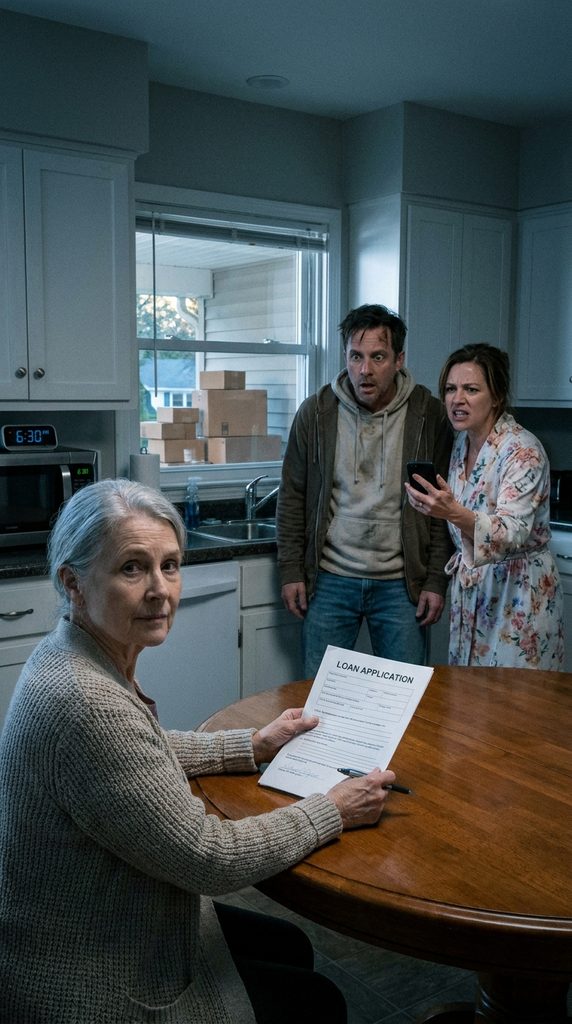
At 6:30 a.m., my daughter-in-law charged downstairs, yelling, “WHY DID YOU PUT MY BOXES ON THE PORCH?” My son ordered, “Mom, apologize right now!” Instead, I set a document on the kitchen table. “Before I apologize, Daniel, explain why your wife applied for a $180,000 loan using my signature.” His face drained of color. Then I played security footage that made them regret ever moving in.
My daughter-in-law first tried taking my bedroom. Next, she planned to take the entire house.
A week after Brooke and Daniel moved in, she appeared at my bedroom holding a tape measure.
“We’re taking the primary bedroom,” she announced.
I glanced up from cleaning a photograph of my late husband, Thomas, smiling crookedly beside me at our wedding, his hand enclosing mine.
“Are you?” I asked.
Brooke measured the doorway. “The guest room is too cramped. We need space for our furniture. You can use the small room downstairs.”
“The room beside the laundry?”
“It has a window,” she said, as if that settled everything.
Daniel stood behind her without meeting my gaze. At forty, he still rubbed his thumb against his wedding ring, just as he had at twelve when hoping someone else would handle his problems.
“Mom, just be flexible,” he muttered.
I’d offered them shelter after Daniel claimed their lease unexpectedly ended. He promised two months to save for another place. I bought towels, emptied closets, and stocked Brooke’s preferred oat milk.
They repaid me by reorganizing my kitchen, criticizing the neighborhood, and calling it “our house.” Brooke labeled pantry shelves without permission and told a neighbor I was growing forgetful.
Daniel laughed, which hurt more than her remark. I had given them a temporary refuge, not permission to take over the home Thomas and I built. Yet they behaved as though my generosity had transferred ownership to them.
Brooke approached Thomas’s picture.
“You probably don’t even use half this space. Tomorrow morning, please have everything moved out.”
“By what time?”
“Six thirty. The movers are coming at eight.”
Daniel flinched; he hadn’t mentioned movers.
I carefully lowered the picture. Thomas and I had spent thirty-six years paying for this house and repairing its floors and windows. He died holding my hand in that room. I never expected to defend it against our own son.
“All right,” I said.
Brooke beamed. “See? That wasn’t difficult.”
They left laughing, convinced I had surrendered. Instead, I locked my door and retrieved the PROPERTY folder from my desk cabinet. Alongside the deed and estate papers lay a copy Brooke had left in the printer: a $180,000 home-equity application bearing my forged signature.
I called for my phone. After thirty-one years investigating mortgage fraud, I knew exactly what that meant.
Before midnight, I called Margaret Shaw, my attorney.
“Do not confront them about the application yet,” she told me. “Send me photographs. Preserve the original. And do not lock them out or dispose of their property. We’ll handle the occupancy question properly.”
I sent photographs, then contacted the lender’s fraud department using its official website number. An officer confirmed an application in my name using an unfamiliar email.
“We flagged it because the identification verification failed,” she said. “No funds have been released.”
“Good,” I replied. “Please preserve every submission.”
I disputed it as instructed, saved the confirmation number, and arranged for Margaret to submit my signed statement that morning.
Next, I reviewed cameras Thomas had installed after nearby burglaries. At 2:14 the preceding afternoon, Brooke entered the study with my purse; Daniel followed carrying mail.
“What if she refuses?” he asked.
“She won’t,” Brooke replied. “Get her into the downstairs room first. Once the money clears, we tell her the house needs to be sold.”
“She’ll be furious.”
“She’ll get over it. She always forgives you.”
I replayed it, desperate for some indication my son wasn’t involved. There was none. The camera had captured not merely Brooke making threats, but Daniel standing beside her, aware of the scheme. I wished the footage showed anything else.
At 5:30, I brewed coffee and moved Brooke’s six sealed boxes from outside my bedroom onto the covered porch. I photographed them and left the porch light on. Their guest-room possessions and keys remained untouched.
By 6:15, three envelopes waited on the dining table: a demand to stop misusing my identity, Margaret’s formal occupancy notice outlining the required legal process, and a personal letter for Daniel.
At 6:20, Brooke appeared in silk pajamas.
“Did you clear the bedroom?”
“No,” I said.
Her expression tightened. “Excuse me?”
“Your movers aren’t bringing furniture into my bedroom.”
Daniel emerged, blinking. “Mom, please don’t start.”
Brooke strode down the hall, glanced out the window, and stopped. At precisely 6:30, she screamed.
“WHY IS ALL MY STUFF ON THE PORCH?”
I sipped coffee.
“Those are the boxes you put outside my bedroom,” I said. “The ones you planned to move into it.”
“You had no right!”
“Neither did you.”
She reached for my phone; I pocketed it.
“Daniel,” she snapped, “tell her whose house this is going to be.”
His silence answered enough. I laid down the application. I had spent the night preserving proof instead of arguing, and that quiet preparation was finally more useful than any confrontation.
“That’s an excellent question,” I said. “Because the bank would like to know, too.”
Daniel turned pale, but Brooke immediately protested.
“That’s a draft,” she said. “Nothing was finalized.”
“The lender received it Tuesday,” I replied. “The signatures were forged. And the verification attempt is already documented.”
Daniel grabbed the page. “Mom, we weren’t stealing. We were going to invest the money and pay it back.”
“With my house as collateral?”
He glanced at Brooke; she looked toward the exit.
I played the study footage on my phone.
“Get her into the downstairs room first,” Brooke’s voice said. “Once the money clears, we tell her the house needs to be sold.”
Silence settled over the kitchen.
“You recorded us?” Brooke whispered.
“My security system did. In my home.”
She attempted a conciliatory smile. “Evelyn, we’re family. Families make arrangements.”
“Families ask,” I said. “They don’t forge signatures.”
Brooke pushed her chair back. “Fine. We’re staying until you give us what Daniel deserves.”
I indicated the envelopes.
“You can remain only as long as the law permits. Margaret has prepared the proper notice, and I will follow the court process. Meanwhile, the lender has frozen the application and received my fraud report.”
Daniel’s eyes watered. “You reported your own son?”
“I reported what happened. You decided to be part of it.”
I gave him the third envelope, containing my existing trust, instructions for Margaret, and my letter.
“You were my beneficiary,” I told him. “That was a gift, not a down payment on my surrender.”
His hands trembled as he read.
“Margaret will amend the trust. When I die, the house will go to the community housing trust Thomas supported. You won’t inherit a key, a share, or another chance to use my name.”
Brooke grabbed her purse. “You’ll regret this.”
“No,” I said. “I’ve spent seven days regretting letting you in.”
At eight, I told their arriving movers that no indoor work was authorized. They departed without unloading. I neither changed locks nor illegally evicted anyone. Margaret filed the paperwork; weeks later, a deputy supervised their departure under a court order.
The boxes had never been destroyed, and their legal right to remain during the proceedings had been respected. I signed the trust amendment the following week.
Nine months afterward, both pleaded guilty over the forged application, receiving probation, restitution requirements, and criminal records. Brooke lost her real-estate-office job. Daniel’s creditors pursued him, and their marriage collapsed beneath concealed debt.
I grieved the son I’d believed I’d raised, without yielding my home. Forgiving someone, I now understood, was not the same as letting them continue to exploit you.
The next spring I planted white roses below my bedroom window. Thomas’s picture remained by my bed, and I slept with the door open.
At 6:30 one morning, sunlight crossed the floorboards. No shouting or demands disturbed me.
The house was mine again, filled with the sound of peace.
The Quiet Aftermath
The deputy’s patrol car rolled down the gravel driveway just past noon on a crisp Thursday in October, kicking up a faint plume of golden leaves. From the bay window in my study, I watched the taillights disappear around the bend of Oak Ridge Road. For twenty minutes after the engine faded, I simply stood there with my hands resting on the cool oak sill, listening to the house settle.
A house holds onto tension the way plaster holds onto dampness. For six weeks—from the morning I placed Brooke’s boxes on the porch until the judge signed the final writ of possession—every hallway had felt narrow, every creak of the floorboards like an approaching footstep. Now, the silence was vast and unfamiliar.
I walked upstairs first. The guest bedroom smelled faintly of Brooke’s vanilla perfume and cardboard. They had left behind a tangled phone charger, two mismatched hangers, and a scuff mark along the baseboards where they’d dragged a dresser out in spite. I opened the windows wide to let the autumn air sweep through, stripped the mattress, and carried the sheets down to the laundry room—the very room beside the tiny downstairs bedroom Brooke had tried to banish me to.
Standing by the washing machine, I looked at that small room. It held Thomas’s old drafting table, shelves of my retired case files, and a single twin bed for visiting nieces. It was a warm, useful space, not a cell. Yet knowing they had intended to tuck me away there while liquidating thirty-six years of my life left a coldness in my chest that hot coffee couldn’t touch.
Later that afternoon, I drove into town to meet Margaret Shaw at her office on Elm Street. Her desk was piled high with real estate closings and probate folders, yet she cleared a space immediately when I walked in.
“It’s done?” she asked, offering me a mug of tea.
“Done,” I said, sitting across from her. “The deputy was thorough. They didn’t take anything that wasn’t theirs, though Brooke made sure to slam the front door hard enough to rattle the transom.”
Margaret nodded, sliding a thick manila folder across the blotter. “I expected as much. Now, let’s talk about the two tracks moving forward. First, the civil protection—your amended trust is recorded, and I’ve placed a title lock and fraud alert with the county recorder’s office. Nobody can file a lien, deed, or equity line against this parcel without triple-factor verification directly through my firm and your personal appearance.”
“Good,” I replied. “And the second track?”
“The district attorney’s financial crimes unit,” Margaret said, folding her hands. “Because you worked three decades in mortgage fraud investigation, your documentation was airtight. The forged wet-ink signature, the IP logs from your home router showing the digital submission came from Brooke’s laptop, and the audio-video from your study—the prosecutor didn’t even need a grand jury to see the intent. They’re issuing warrants by Monday.”
I stared down at my tea. Knowing the law and watching it close around your own child are two entirely different experiences. “Did Daniel reach out to you at all during the eviction?”
“Once,” Margaret said gently. “Yesterday afternoon. He asked if you’d drop the bank complaint if they moved out quietly.”
“And what did you tell him?”
“The truth. That once a federally insured lender flags an attempted $180,000 fraud, it’s no longer a private family disagreement. You couldn’t stop it even if you wanted to.”
The Paper Trail
November brought early frost and the first pre-trial conference at the county courthouse. I wasn’t required to attend, as the state was the plaintiff, yet I sat on a wooden bench in the back row of Courtroom 4B anyway. I needed to see with my own eyes that the illusion I had carried for forty years—that Daniel was merely passive, soft-hearted, and easily led—was truly gone.
When the bailiff called their case, Daniel and Brooke entered from the side corridor. Without Brooke’s curated wardrobe and salon blowouts, she looked sharp-edged and hollow-eyed in a wrinkled gray blazer. Daniel wore the navy suit I had bought him for his promotion five years earlier. His shoulders were hunched, his eyes fixed on the scuffed linoleum floor. He didn’t look toward the gallery once.
Their court-appointed attorneys—because neither could afford private counsel anymore—spoke in low tones with the assistant district attorney. Afterward, I met with the prosecutor, a sharp-eyed woman named Elena Vance, in a witness conference room down the hall.
“Mrs. Mercer,” Vance said, opening a binder tabbed with red flags. “Before we finalize their plea offers, I wanted to walk you through what our forensic accountant uncovered. You ought to know the full scope, especially since you’re listed as a victim for restitution.”
She turned the binder toward me. Spread across the pages were credit card statements, payday loan notices, and defaulted business leases—all in Daniel and Brooke’s names, stretching back three years.
“Their lease didn’t ‘unexpectedly end’ in September,” Vance explained. “They were evicted from their townhouse for being four months behind on rent. Brooke had lost her previous position at a title agency after discrepancies in escrow reconciliations—though that firm declined to press charges to avoid bad publicity. Between luxury car leases, speculative crypto losses Daniel hid from his employer, and credit lines maxed out on vacations, they were $214,000 in the hole.”
I felt a strange numbness spread through my fingers. “The $180,000 loan wasn’t meant to ‘invest and pay me back,’ as Daniel claimed.”
“Not a dime of it,” Vance said firmly. “They had already drafted a quitclaim deed on Brooke’s laptop. Once the home equity line funded, they planned to wire the cash into an offshore trading account, convince you the house had structural issues requiring a quick sale, and vanish before the first payment defaulted.”
I closed my eyes briefly. Every excuse I had quietly invented for my son in the dark hours of the night—that he panicked, that he didn’t understand the paperwork, that he was trying to protect his marriage—evaporated on the spot. He had carried mail into my study so Brooke could copy my signature. He had watched me pack away thirty-six years of memories in preparation for moving beside the laundry room, all while knowing he intended to leave me homeless and saddled with debt.
“Proceed with the plea terms as written,” I told Vance, my voice steadier than I felt. “Full felony accountability, permanent records, and mandatory restitution for my legal fees.”
Unraveling
By January, the consequences of their choices began rippling outward in ways no courtroom could orchestrate.
News travels fast in a mid-sized county, especially within real estate and banking circles. Brooke’s brokerage terminated her immediately upon her arraignment, revoking her license pending the felony conviction. Without her commission checks, the fragile scaffolding holding their lifestyle together collapsed overnight.
I learned fragments not through gossip, but through formal notices that still arrived at my mailbox—collection letters addressed to Daniel, final notices from an auto finance company, and eventually, a subpoena for my records from a divorce attorney.
Daniel called me on a rainy Tuesday night in February. I almost didn’t answer, watching his name glow on my phone screen beside Thomas’s photograph on the nightstand. Finally, I pressed accept and put the call on speaker.
“Mom,” he said. His voice sounded thin, scraped raw. “Please don’t hang up.”
“I’m listening, Daniel.”
“Brooke moved out last week. She’s staying with her sister in Ohio. She filed for divorce and told the court the whole loan idea was mine—that I pressured her into forging your name because of my trading debts.”
I looked out the rain-streaked window toward the dark silhouette of the oak trees Thomas and I had planted the year Daniel was born. “And what did you tell the court?”
A long, ragged breath echoed over the line. “The truth. That we both did it. My lawyer showed them the study video you submitted in discovery. She couldn’t lie her way out of her own voice.”
“Good,” I said simply.
“I lost my job at the logistics firm yesterday,” he continued, his voice cracking. “When the background check flagged the pending felony plea, HR walked me out. I’m staying in a weekly motel off Route 9. Mom… I don’t know how to fix this. I keep thinking about that morning in the kitchen, and I wish I could go back and stop her when she pulled out that tape measure.”
Silence stretched between us, heavy with forty years of history. A younger version of me—the mother who had stayed up sewing Halloween costumes at midnight, who had bailed him out of fender-benders in college, who had excused every small selfishness because he was my only child—ached to tell him to come home, have a hot meal, and sleep in his old bed.
Instead, I remembered Thomas’s voice from the last winter of his life, when we spoke about how easily kindness turns into permission when there are no boundaries left.
“You can’t go back, Daniel,” I said quietly. “And the problem didn’t start with a tape measure. It started every time you let someone else carry the weight of your choices while you stood behind them rubbing your ring.”
He let out a choked sound—half laugh, half sob. “You saw that.”
“I’m your mother. I’ve seen it since you were twelve. I’m glad you finally told the truth in court. Pay your restitution, work whatever honest job takes you, and rebuild your life from the ground up. I won’t rescue you from the consequence of what you did, because rescuing you is how we ended up here.”
“Can I… can I call you once in a while? Just to talk?”
“In six months,” I said, “after your sentencing is complete and you’ve shown you can stand on your own two feet, you may send me a letter. Until then, focus on making things right.”
When I ended the call, my hands were shaking, yet my conscience was entirely clear. Love without truth isn’t mercy; it’s an accomplice.
Reclaiming the Rooms
Spring arrived early that March, softening the frozen ground and coaxing green shoots out of the perennial beds along the porch. With the legal proceedings winding down toward their formal guilty pleas in June, I turned my attention back to the house itself.
For months, I had avoided the guest room and the dining room—the places where Brooke’s loud voice and Daniel’s evasive silences still seemed to linger. One Saturday morning, I hired a local painter named Mateo to help me strip the guest bedroom down to bare plaster and repaint it a soft, sunlit sage.
While Mateo worked upstairs, I emptied the kitchen pantry. I peeled off every single plastic label Brooke had stuck onto my shelves during her week-long occupation—Organic Grains, Artisanal Oils, Brooke’s Snacks—and scrubbed the adhesive away with lemon oil until the cedar wood smelled clean again.
In the bottom drawer of the hutch, beneath a stack of linen napkins, I found a small velvet jewelry box I hadn’t noticed missing. Inside was my grandmother’s silver brooch, tucked inside a Ziploc bag alongside a pawn shop price tag from three towns over. Brooke had taken it, priced it, and apparently run out of time to cash it in before the morning I put her boxes on the porch.
I didn’t feel anger when I saw it. Just a quiet, profound relief that I had trusted my instincts instead of doubting my own memory when Brooke tried to convince the neighbors I was growing forgetful.
That afternoon, I invited Clara Jenkins, my next-door neighbor of twenty-two years, over for iced tea on the back deck. Clara was the woman Brooke had whispered to by the mailbox about my “declining faculties.”
Clara set a plate of lemon bars on the patio table and squeezed my shoulder. “I never believed a word of it, Evelyn. Anyone who knows you knows your mind is sharper than a tack. Still, I’m glad to see the color back in your cheeks.”
“It took a winter to thaw out,” I admitted, pouring the tea. “Tell me, Clara—your daughter still works for the county housing trust, doesn’t she?”
“Director of family placements,” Clara said proudly. “Why do you ask?”
“Because Thomas always believed a solid roof was the foundation of everything else,” I said, looking out over the yard. “And I’ve been thinking about how much space one woman actually needs—and how much good this property could do long after I’m gone.”
The White Roses
By June, the courtroom chapter closed for good. Both Daniel and Brooke stood before Judge Harrison and entered formal guilty pleas to attempted grand theft and forgery. Neither received prison time—first-time nonviolent offenders rarely do in crowded dockets—but both walked out with felony records, three years of supervised probation, community service hours, and strict court-ordered restitution schedules.
I didn’t go to the sentencing. Instead, I spent that morning at the nursery outside town, selecting six bare-root bushes of Winchester Cathedral white roses—Thomas’s favorite variety, prized for their fragrance and resilience through harsh winters.
With a spade, a bag of bone meal, and gardening gloves worn thin at the fingertips, I dug a neat trench directly beneath my primary bedroom window. The soil was rich and dark, smelling of earthworms and rain. As I pressed the roots firmly into the ground and watered them in, I thought about how close I had come to surrendering this patch of earth to people who saw it only as collateral.
Later that afternoon, Maya Jenkins—Clara’s daughter from the housing trust—stopped by with architectural sketches and program brochures. Together, we walked the perimeter of the two-acre lot.
“The main house has four bedrooms, wide hallways, and solid bones,” Maya noted, admiring the original oak banisters and sunroom. “Under your trust bequest, when the time comes, we can convert this into transitional housing for three single mothers and their children—giving them a safe, rent-free year to finish job training and save for permanent homes.”
“No temporary guests trying to change the locks,” I smiled faintly.
“Strictly vetted families who will treat this place like the blessing it is,” Maya assured me. “And we’ll dedicate the main hall in Thomas’s name.”
That evening, I carried Thomas’s wedding photograph from the dresser over to the windowsill overlooking the newly planted rose bed. In the silver frame, he was twenty-six again, grinning crookedly in a slightly oversized tuxedo, holding my hand as if he never intended to let go.
“We kept it safe, Tom,” I whispered to the quiet room.
The Letter in August
Summer settled into a gentle, predictable rhythm. I returned to consulting part-time for a regional bank’s fraud prevention unit—working remotely from my study two mornings a week, reviewing suspicious mortgage files with the same sharp eye that had caught Brooke’s forged signature in under thirty seconds. Having my mind engaged in purposeful work again swept away the last shadows of the autumn ordeal.
In mid-August, exactly six months and two weeks after his phone call from the motel, a plain white envelope arrived in my mailbox. There was no return address printed on the corner, only Daniel’s familiar, slightly slanted handwriting.
I took it to the back porch, sat in the wicker rocker, and opened it with a silver letter opener.
Inside were two pages of lined notebook paper.
Mom,
I waited until the six months were up, like you asked. I’m not writing to ask for anything, and I know you don’t owe me a reply.
The divorce was finalized in July. Looking back, I realize I spent ten years trying to buy love and status I hadn’t earned, and when the bills came due, I was coward enough to let someone else point the weapon at the only person who ever genuinely cared for me. Seeing the video in discovery was the worst moment of my life—not because I got caught, but because I saw myself clearly for the first time.
I took a night-shift warehouse supervisor job in April. It’s hard work, and the pay is half what I used to make, but I’ve made every single restitution payment on time and cleared two of my smaller debts. I’m renting a studio apartment ten miles south of town. It has one window and a hot plate, and honestly, it’s the first place I’ve lived in years where I don’t lie awake afraid of a knock on the door.
I’m still working with a counselor through probation to figure out why I spent forty years avoiding conflict until it turned into deceit. I’m deeply sorry, Mom. Not because I lost the house or the trust—you were completely right to take both away—but because I broke the trust of the woman who raised me.
If you ever feel ready to get a cup of coffee in a public diner, I’d be grateful. If not, I understand and I’ll keep praying you’re well.
Love,Daniel
I read the letter twice, folding it neatly along its creases. There were no excuses in it. No mention of Brooke leading him astray, no subtle hints about rent being tight, no pleas for forgiveness wrapped in guilt. For the first time in his adult life, Daniel had written down the unvarnished truth without asking someone else to clean up the mess.
I didn’t call him that day, nor the next. Trust, once shattered, isn’t rebuilt by a single well-written letter. Yet I placed the envelope inside my desk drawer—not in the PROPERTY folder, which remained locked and ironclad, but beside my personal stationery, where a mother keeps things worth watching over time.
Autumn Lessons
By October, the white roses beneath my window had produced a late flush of blooms, their ivory petals bright against the crimson maple leaves blanketing the lawn.
One crisp Saturday morning, I hosted a small workshop at the local senior center at Clara’s request. What started as an informal chat over coffee had turned into a packed community room of forty retirees eager to learn how to protect their homes and estates from deed theft, forged equity lines, and family financial coercion.
Standing at the podium with a projector displaying redacted examples of fraudulent loan applications, I felt completely in my element.
“The most dangerous myth about financial exploitation,” I told the room, “is that it always comes from a stranger on the phone or a scammer overseas. More than sixty percent of elder property fraud involves someone who already has a key to your front door—someone who knows where you keep your mail, knows your middle initial, and counts on your embarrassment or loyalty to keep you quiet.”
A retired schoolteacher in the second row raised her hand. “What if it’s your own family? How do you protect yourself without tearing everything apart?”
I paused, looking out over faces lined with decades of hard work, sacrifice, and love for their children and grandchildren.
“You love your family with an open heart,” I answered, “and you guard your paperwork with a locked cabinet. Clear boundaries don’t destroy healthy relationships—they only expose the ones that were built on taking advantage of you. Put a title lock on your deed, keep your sensitive mail off the kitchen counter, and never let anyone rush you out of a room you spent your life paying for.”
Afterward, three different women lingered by the door to thank me—one quietly admitting her nephew had been pressuring her to co-sign a commercial van loan that very week. Helping them spot the warning signs before their signatures hit paper felt like turning my own painful autumn into armor for others.
A Neutral Table
November returned, bringing the first light dusting of snow across the ridge just before Thanksgiving. For the first time in forty years, I wasn’t roasting a twenty-pound turkey or setting extra leaves into the dining room table. Instead, I was flying to Seattle on Friday morning to spend the holiday week with my younger sister, Helen, and her twin granddaughters.
Two days before my flight, I picked up my phone and dialed Daniel’s number.
He answered on the second ring, sounding slightly breathless, as if he had hurried across a room. “Mom?”
“Hello, Daniel. Are you working tonight?”
“No, I’m off until Thursday night. Is everything okay? Are you feeling alright?”
“I’m perfectly well,” I said, glancing out at the frost-rimmed rosebushes. “I’m flying to Seattle on Friday to visit Aunt Helen for Thanksgiving. Before I leave, I have an hour free tomorrow afternoon. If you’d like, we can meet at Miller’s Diner on Main Street at two o’clock.”
Silence hung on the line for a beat, followed by a quiet, steady exhale. “I’d really like that, Mom. I’ll be there.”
The next afternoon, I arrived at Miller’s Diner five minutes early and chose a booth near the front window. Daniel was already waiting outside in the cold, wearing a heavy canvas work jacket instead of his old tailored suits. His hands were calloused, his face leaner, and when he slid into the vinyl seat across from me, he didn’t reach for his ring finger—the gold band was gone, leaving only a faint pale line on his skin.
We ordered coffee and apple pie. For the first twenty minutes, we spoke carefully, like two travelers meeting at a crossroads after a long storm. He told me about the warehouse crew he supervised, the night classes he was taking in supply-chain logistics, and the probation officer who had commended his consistent restitution payments.
Not once did he mention the house. Not once did he ask about the trust.
“I heard you’ve been teaching classes at the senior center,” he said, wrapping both hands around his mug. “A guy at work mentioned his grandmother went to your talk on title fraud.”
“Someone has to teach them what to look for,” I replied evenly.
Daniel nodded slowly, meeting my eyes without flinching for the first time in years. “You saved my life by not letting us get away with it, Mom. If that loan had gone through, I would have buried myself so deep I never would have climbed out. Losing everything forced me to finally grow up.”
I looked at my son—not the idealized boy I had shielded for decades, and not the desperate stranger who had stood silently behind Brooke in my doorway, but a flawed, sobered man doing the slow, unglamorous work of accountability.
“I’m proud of the work you’re doing now, Daniel,” I said honestly. “Keep doing it. Not for me, and not to get back into a will—because the trust stays exactly as it is. Do it so you can look at yourself in the mirror.”
“I understand,” he said, a genuine, quiet smile touching the corners of his mouth. “Just sitting here with you is more than I earned.”
When we parted on the sidewalk outside the diner, I gave him a brief, firm hug. It wasn’t a return to the past—that door had closed forever—but it was an honest beginning on solid ground.
The Sound of Peace
Spring returned once more to Oak Ridge Road, warmer and brighter than the year before.
The Winchester Cathedral roses beneath my bedroom window had grown nearly four feet tall, bursting with dozens of creamy white blossoms that filled the upstairs hallway with a sweet, clean fragrance every time a breeze stirred the curtains.
At 6:30 on a clear May morning, golden sunlight spilled across the polished oak floorboards of my bedroom. I lay awake for a few quiet moments, listening to the cardinals calling from the maple trees and the distant hum of a delivery truck down on the main road.
No footsteps stomped down the hallway. No tape measure clicked against my doorframe. No voices demanded that I pack away my life to make room for someone else’s greed.
I swung my feet onto the warm rug, pulled on my robe, and walked over to the dresser. Thomas’s photograph stood right where it had always been, catching the morning light. I brushed a speck of dust from the silver frame, walked downstairs with my bedroom door left wide open behind me, and put the kettle on for coffee.
The house was mine—every beam, every window, every quiet corner—filled to the rafters with the unmistakable sound of peace.
THE END…!