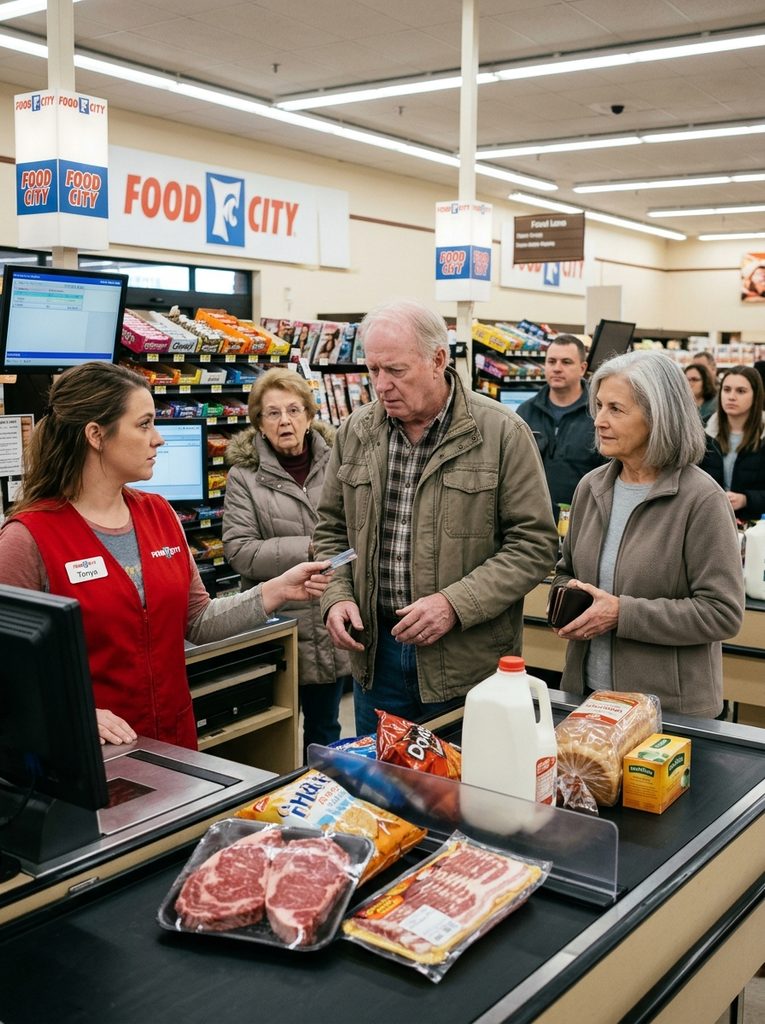
He frowned.
“What do you mean? There’s money in there.”
He slid the card through again.
Beep.
DECLINED.
The line behind us had grown to six people.
I could hear somebody’s little boy asking his mother why the machine didn’t like that man’s card.
Roger’s face started turning red.
“There’s something wrong with your machine,” he said.
Tonya kept her voice polite.
“I’m sorry, sir. It looks like the available balance isn’t enough to cover this purchase.”
Roger stared at her.
“That can’t be right. I get paid every Friday.”
Tonya glanced at the screen.
Then she looked at him.
“Sir, would you like me to tell you what the remaining balance is?”
“Yes, I would.”
She leaned forward slightly.
“Your account has $46.83 available.”
Roger looked at his cart.
Then he looked at me.
I didn’t say a word.
He turned toward Tonya.
“Well, just take the groceries off. I’ll pay for mine another way.”
Tonya started removing items.
The ribeyes.
The bacon.
The pop.
The ice.
The snack cakes.
One by one, she put them aside.
Then Roger pointed at my little basket.
“Go ahead and ring hers up.”
Tonya looked at me.
I reached into my purse and pulled out my debit card.
My own card.
The one attached to my own checking account.
“Mine is $19.64,” I said.
She ran it through.
APPROVED.
Roger stared at the little screen.
Then he stared at my card.
“Where’d you get that?”
“From my bank account.”
“What bank account?”
“The one I opened last month.”
His mouth opened, but nothing came out.
I picked up my groceries and placed them in the cart.
Rhoda was standing behind us, holding her purse against her chest.
She didn’t say anything either.
Roger lowered his voice.
“Sue, what in the world is going on?”
I looked at him.
“Nothing, honey. We’re just doing fifty-fifty.”
His face changed.
For the first time in forty-one years, he seemed to understand that those words could mean something besides what he wanted them to mean.
He grabbed his groceries and walked toward the customer service desk.
I followed Rhoda outside.
We loaded my groceries into her trunk.
She looked at me.
“You all right?”
I nodded.
Then I started laughing.
Not because it was funny.
Because if I didn’t laugh, I might have cried.
Inside the store, I could see Roger talking with the manager.
His arms were moving.
His face was red.
And for once, I wasn’t rushing back inside to rescue him.
I had paid my $19.64.
That was my responsibility.
His $46.83 was his.
And I had a feeling we were just getting started.
When Roger finally came out, he didn’t look like the man who had walked into that store bragging about his new boat.
He looked like a man who had just discovered that the ground beneath his feet wasn’t quite as solid as he thought.
He climbed into the passenger seat.
I was driving.
“Take me home,” he said.
“Of course.”
We drove three miles without speaking.
Then he asked the question I knew was coming.
“Sue, where’s the rest of the money?”
I kept my eyes on the road.
“What money?”
“Our money.”
I turned onto our road.
“Well, Roger, I thought we agreed. Fifty-fifty.”
He slapped his hand against his knee.
“Don’t get smart with me.”
I parked in the driveway.
Then I turned off the engine.
“Roger, I haven’t gotten smart. I’ve gotten organized.”
He stared at me.
And that was when I knew he was finally beginning to worry.
PART 3 — THE MAN WHO NEVER READ THE BANK STATEMENTS
Roger didn’t speak to me through supper.
He sat in his recliner with the television turned up so loud I could hear it from the kitchen.
I made myself a grilled cheese sandwich.
He usually liked two pieces of meatloaf, mashed potatoes, and green beans on Saturday night.
But I hadn’t made any meatloaf.
I wasn’t punishing him.
I was simply no longer cooking for two people who had decided they were living separate financial lives.
At eight-thirty, he came into the kitchen.
“Where’s supper?”
I looked up from my book.
“I had a sandwich.”
“Well, what about me?”
“You can make whatever you’d like.”
He looked at me as though I’d spoken a foreign language.
“Since when?”
“Since you put that paper on the refrigerator.”
He walked over and pulled it down.
HIS.
HERS.
He held it in his hand.
“That was just about groceries.”
I folded my book closed.
“No, Roger. You said everything was going to be fifty-fifty.”
“I meant the groceries.”
“You wrote the light bill, water, and phone under my name. You wrote your truck and boat money under yours.”
“Well, somebody has to pay the bills!”
I looked at him.
“Exactly.”
He went quiet.
Then he said something I hadn’t expected.
“How much money do you actually have?”
I took a breath.
“That’s not the right question.”
“Then what is?”
“How much money have I been putting into this marriage that you never bothered to count?”
He shook his head.
“Sue, don’t start.”
I stood up.
“I’ve been doing the bills since 1985. Your paycheck has gone into our joint account every Friday. My pension has gone into it since I retired. The hay money has gone into it since Daddy died. I’ve paid the mortgage, insurance, property taxes, car repairs, groceries, and every emergency we’ve had.”
“That’s what married people do.”
“Yes. It is.”
I paused.
“Until one of them decides the other one owes him thirty-eight dollars.”
He looked away.
I went to the filing cabinet and brought out the old checkbook registers.
I put them on the kitchen table.
“Here.”
He stared at them.
“What am I supposed to do with those?”
“Read them.”
“I don’t need to read all that.”
“Then don’t tell me your little paycheck has been keeping this house running.”
He pushed the books away.
“I’ve worked my whole life.”
“So have I, Roger.”
That sentence landed harder than anything else I had said.
He looked at me.
For the first time that evening, he seemed to remember that I had worked thirty-three years at the county clerk’s office.
I had driven to work through snowstorms.
I had stayed late during tax season.
I had taken vacation days to care for his mother after her surgery.
I had worked while raising our children.
And I had never once handed him a bill for half of any of it.
But Roger wasn’t ready to admit that.
Instead, he said, “I want to see the bank account.”
I nodded.
“Tomorrow, we’ll go to the bank.”
He looked surprised.
“You’ll show me?”
“Of course. I have nothing to hide.”
Then I added something I had been thinking about all week.
“But we’re going to look at all of it. Not just the account you want to see.”
He frowned.
“What does that mean?”
“It means we’re going to look at the pension deposits, the hay checks, the house payments, and everything else.”
He walked back toward the living room.
I heard him mutter something about women making things complicated.
I let him go.
The next morning, I got up early.
I made coffee.
I put the bank statements in a folder.
And I wrote down three numbers on a yellow notepad.
The first was my monthly pension.
The second was the annual income from the hay lease.
The third was Roger’s average monthly paycheck.
I didn’t write them down to embarrass him.
I wrote them down because facts had become necessary.
At ten, we drove to the bank.
Our banker, Mr. Collins, had known us for years.
He greeted us at the door.
“Morning, Roger. Morning, Sue.”
Roger sat down first.
“I need to find out where our money went.”
Mr. Collins looked at me.
I smiled politely.
“We’re reviewing our finances.”
Roger leaned forward.
“I’ve been working three days a week, and somehow there’s no money left.”
Mr. Collins opened the account records.
Then he turned the monitor slightly.
“Well, let’s go through the deposits.”
He showed us Roger’s paychecks.
Then my pension deposits.
Then the hay lease payments.
Roger stared.
“What’s that?”
“The hay lease,” I said.
“I know what the hay lease is. I mean, why is it going in here?”
“Because it’s income from my land.”
He looked at the screen again.
“How much?”
Mr. Collins gave him the annual total.
Roger leaned back.
He looked at me.
Then at Mr. Collins.
Then back at me.
“You never told me it was that much.”
I kept my voice calm.
“I’ve told you every year when the check came.”
He shook his head.
“I thought it was just a little extra.”
“It was enough to pay our property taxes, insurance, and several major repairs over the years.”
Mr. Collins continued showing us the records.
Mortgage.
Electricity.
Water.
Insurance.
Taxes.
Medical bills.
The roof repair.
The new furnace.
The truck repairs.
Roger’s face grew quieter with every line.
Finally, he asked:
“So what exactly have I been paying?”
Mr. Collins didn’t answer for me.
I did.
“Your paycheck has helped. It has paid for some of our expenses. But it has never been the whole story.”
Roger stared at the numbers.
Then he said something I will never forget.
“All these years, I thought I was the one taking care of us.”
I looked at him.
“You were part of taking care of us, Roger. So was I.”
He lowered his eyes.
And for the first time since that grocery store incident, he didn’t have an answer.
PART 4 — THE SECRET HE DIDN’T KNOW ABOUT THE LAND
We drove home in silence.
When we got there, Roger went straight to the barn.
I knew why.
He needed somewhere to think where he didn’t have to look at me.
I sat at the kitchen table and opened the little wooden box where I kept Daddy’s papers.
There was the original deed.
The hay lease agreement.
The property tax receipts.
And a letter Daddy had written me shortly before he died.
I hadn’t read it in years.
I opened it carefully.
His handwriting was shaky.
Susan,
Your mother and I worked hard for what little we had. Land is not just dirt. It’s security. It’s something nobody can take from you if you take care of it.
Don’t ever let anyone make you feel guilty for having something that belongs to you.
I folded the letter.
Daddy had been gone twenty-six years.
But somehow, sitting there at my kitchen table, I felt as though he had come back to remind me of something.
I wasn’t selfish for protecting what he had left me.
That afternoon, Rhoda came over.
She brought a pie.
She also brought the latest news from town.
“Your husband was at the diner this morning,” she said.
I poured her coffee.
“What did he say?”
“That you had hidden money from him.”
I sighed.
“Of course he did.”
“Then Earl asked him how much money he thought you made.”
I looked at her.
“What did Roger say?”
“Not much. Apparently, he didn’t know.”
I laughed softly.
“That’s been the problem for forty-one years.”
Rhoda sat down.
“Sue, there’s something else.”
“What?”
“Roger’s been telling the boys at the diner that he’s buying that boat because he finally has some money of his own.”
I shook my head.
“He put fifteen hundred dollars down.”
“And?”
“And he still owes the rest.”
Rhoda nearly spilled her coffee.
“Good heavens.”
I looked out the window.
The afternoon sun was falling over the pasture.
“Rhoda, do you know what hurts the most?”
“What?”
“It isn’t the money. It’s that he never once asked how I was doing. He never asked if retirement was enough. He just assumed I had stopped working and therefore stopped contributing.”
Rhoda reached across the table.
“You’re allowed to be hurt.”
I nodded.
For a long time, I had thought being a good wife meant swallowing every hurt before it became an argument.
But I was sixty-four years old.
I had spent most of my life making sure everybody else was comfortable.
Maybe it was time I learned how to be comfortable myself.
That evening, Roger came into the kitchen holding a folded piece of paper.
“What’s this?”
I looked at it.
It was the boat financing agreement.
“I need you to look at something.”
He put it down.
“The dealer says I have to make the next payment in thirty days.”
I nodded.
“That’s usually how financing works.”
He ignored the comment.
“Can you transfer some money into the joint account?”
I looked at him.
“Why?”
“Because the payment is due.”
“Is that under HERS or HIS?”
He stared at me.
“Sue, this isn’t funny.”
“I know.”
He rubbed his forehead.
“I thought there’d be enough.”
“Enough from where?”
He didn’t answer.
I sat down.
“Roger, I won’t pay for a boat I didn’t agree to buy.”
He looked angry.
Then he looked tired.
“I just wanted something for myself.”
I softened a little.
“I understand wanting something for yourself. I’ve wanted things for myself, too.”
“Like what?”
I thought about it.
A new sewing machine.
A trip to see our daughter in Tennessee.
A decent set of patio furniture.
A vacation where I didn’t have to calculate every dollar.
But somehow, every time there had been extra money, there had always been something more important.
The furnace.
The roof.
His truck.
The children.
His mother’s medicine.
I looked at him.
“I wanted to know that after forty-one years, my husband saw me as his partner.”
Roger sat down.
He didn’t say anything.
And I realized that perhaps he had never understood how much that mattered.
PART 5 — THE LETTER ON THE KITCHEN TABLE
The following week, something happened that changed everything.
Our daughter, Melissa, called.
She lives in Knoxville with her husband and two children.
She usually calls on Wednesday evenings.
That night, she asked how we were doing.
I told her the truth.
Not every detail.
Just enough.
There was a long silence.
Then she said:
“Mom, Dad told me you were keeping money from him.”
I closed my eyes.
“I see.”
“He said you opened a secret bank account.”
“It’s an account in my name, Melissa. My pension goes into it.”
“Why didn’t you tell me?”
“Because I didn’t think my banking arrangements needed a family announcement.”
She laughed a little.
Then her voice became serious.
“Mom, are you okay?”
I looked toward the living room.
Roger was watching television.
“I will be.”
“Do you want me to come down?”
“No, sweetheart. Not yet.”
After we hung up, I found Roger standing in the hallway.
“Melissa thinks I’m a fool.”
I put the phone down.
“I didn’t tell her that.”
“You made me look bad.”
“Roger, I told her what happened.”
He crossed his arms.
“Well, maybe you shouldn’t have.”
I looked at him for a long moment.
Then I went to the filing cabinet.
I pulled out another folder.
Inside were forty-one years of household records.
I placed it on the table.
“Do you know what this is?”
He sighed.
“More papers?”
“It’s the record of the life we’ve built.”
I opened it.
There were mortgage statements from our first little house.
Receipts for the children’s school clothes.
The first refrigerator we bought together.
The hospital bills from when Melissa was born.
The repair bill after Roger backed his truck into the garage.
Every year, every payment, every little piece of our life.
“Look at this,” I said.
He picked up an old receipt.
“What’s that?”
“Your mother’s hospital bed. I paid the deposit.”
He put it down.
“And this?”
“Melissa’s braces.”
He kept looking.
Then he found a faded envelope.
Inside was a photograph of us on our wedding day.
I was twenty-three.
Roger was twenty-five.
We looked so young.
He smiled faintly.
“Look at that hair.”
I almost smiled.
“You thought I was pretty.”
“You were.”
“Then what happened, Roger?”
He looked at me.
I continued.
“When did we stop being two people working toward the same life?”
His smile disappeared.
I wasn’t angry anymore.
I was sad.
And sometimes sadness is harder to argue with.
Roger sat down.
For a while, he looked at the photograph.
Then he said:
“I never thought you would leave me.”
I nodded.
“I know.”
“I thought we were fine.”
“We were fine because I kept making things fine.”
He looked at me.
And I finally said the thing I had been holding inside since the grocery store.
“You embarrassed me in front of strangers over thirty-eight dollars. But what you really did was make me wonder whether you had ever understood what I was worth.”
He lowered his head.
“I didn’t mean it like that.”
“Maybe not. But that’s how it felt.”
For several minutes, neither of us spoke.
Then he asked:
“What do you want me to do?”
I looked at the wedding photograph.
“I want us to start telling the truth about money. I want you to understand that my pension is not your bonus. My land is not your boat fund. And my retirement doesn’t mean my contribution to this marriage has ended.”
He nodded slowly.
“And I want you to stop treating me like I’m asking for something unreasonable when I ask to be respected.”
He rubbed his hands together.
“I can do that.”
I didn’t answer immediately.
Because promises were easy.
Changing was harder.
And I had spent forty-one years learning the difference.
PART 6 — WHAT HAPPENED TO THE BOAT
Three weeks later, Roger went back to the boat dealer.
He came home without the boat.
He had canceled the purchase.
He lost part of his deposit.
I didn’t celebrate.
I didn’t say I told you so.
I simply made supper.
That evening, he sat across from me at the kitchen table.
“I’ve been thinking,” he said.
“About what?”
“About how I acted.”
I waited.
He took a breath.
“I guess I thought because I was still working, I was the one earning the money.”
I nodded.
“And I guess I thought because you were retired, you weren’t doing much anymore.”
I looked at him.
“That’s what hurt.”
“I know.”
He rubbed his chin.
“That hay land. Your daddy left it to you. I never really thought about what it meant.”
“It meant he wanted me to have something secure.”
“Well, he was a smart man.”
“He was.”
Roger looked at his hands.
“I don’t know why I got so worked up about the groceries.”
I gave him the answer.
“Because you wanted to feel like you had something of your own.”
He nodded.
“Maybe.”
“And instead of talking to me about it, you decided I owed you.”
He looked up.
“Yes.”
It was the first time he had admitted it without an excuse.
I reached for my coffee.
“Roger, I don’t mind sharing money. I never have. But sharing isn’t the same as being taken for granted.”
He nodded again.
Then he said:
“Can we start over?”
I looked at the man I had married forty-one years earlier.
His hair was gray now.
His shoulders had grown rounder.
His hands were rough from years of working with car parts.
I still loved him.
But love didn’t mean pretending nothing had happened.
“We can try,” I said.
He reached across the table.
I let him hold my hand.
The next Saturday, he came grocery shopping with me and Rhoda.
This time, he pushed his own cart.
I pushed mine.
At the register, he put his groceries on the belt.
Then he put mine beside them.
No divider.
No speech.
No little performance for the people in line.
Tonya rang everything up.
Roger pulled out his wallet.
He paid for his things.
I paid for mine.
When we walked outside, he took my grocery bags and loaded them into the trunk.
Then he looked at me.
“That cashier probably thinks I’m the biggest fool in Johnson County.”
I smiled.
“She might not be the only one.”
He laughed.
And I did, too.
It wasn’t a perfect reconciliation.
Not even close.
But it was a beginning.
PART 7 — THE LAST THING I LEARNED AT SIXTY-FOUR
A few months passed.
Roger and I started seeing a financial counselor.
We made a proper household budget.
We listed our income, our bills, our savings, and our individual spending money.
We also agreed that the land Daddy left me would remain my separate property.
The hay lease continued.
My pension continued going into my account.
And Roger’s paycheck went into his.
We each contributed an agreed amount toward shared household expenses.
We didn’t split every penny down the middle.
We split things according to what we could reasonably afford.
That was what partnership was supposed to mean in the first place.
Roger also started asking questions.
Sometimes he would come into the kitchen holding a statement.
“Sue, what’s this insurance payment?”
I’d explain.
He would listen.
And sometimes he would say:
“Well, I’ll be. I never knew all this.”
I didn’t remind him that he could have known twenty years earlier.
There was no point.
One afternoon, I drove up the holler to visit Hobart.
He was standing beside his tractor, looking over the hayfield.
“Your husband still mad about that grocery bill?” he asked.
I laughed.
“Not anymore.”
“Good. That was a mighty expensive thirty-eight dollars.”
I looked out across Daddy’s land.
The grass was turning golden.
A breeze moved through the trees.
I thought about the girl I had been when Daddy handed me those sixty acres.
I thought about the woman who had worked thirty-three years at the county clerk’s office.
And I thought about the wife who had stood in a grocery store line while her husband divided their groceries like they were strangers.
I had spent so many years believing that keeping a marriage together meant keeping the peace.
But peace without respect isn’t really peace.
It’s just silence.
And I had been silent for too long.
That evening, Roger came outside while I was sitting on the porch.
He carried two glasses of sweet tea.
He handed me one.
Then he sat beside me.
“Been thinking about something,” he said.
“What’s that?”
“That first Saturday. At Food City.”
I looked at him.
He shook his head.
“I was wrong to do that to you.”
I didn’t interrupt.
“I should have talked to you. I shouldn’t have embarrassed you.”
“No, you shouldn’t.”
He nodded.
“I thought I was standing up for myself.”
I took a sip of tea.
“And I thought I was losing my husband.”
He looked at me.
Then he reached for my hand.
“I’m sorry, Sue.”
This time, I believed he meant it.
Not because he had said the right words.
But because his actions had started matching them.
He had learned to pay attention.
He had learned that retirement didn’t erase thirty-three years of work.
And he had learned that a woman could love her husband without handing over every piece of herself.
We sat there until the sun went down.
The next morning, I found something on the kitchen table.
It was a folded piece of notebook paper.
For a moment, I thought it was the old fifty-fifty list.
But when I opened it, I saw something different.
At the top, Roger had written:
Underneath were three lines.
- Sue’s pension and land income: Sue’s contribution.
- Roger’s paycheck: Roger’s contribution.
- Our home, our responsibilities, and our future: Shared.
At the bottom, he had written:
No more keeping score.
I stood there for a long time.
Then I folded the paper and put it in the kitchen drawer.
Not on the refrigerator.
I didn’t need the whole world to see it.
Some things are better when they’re lived instead of displayed.
And the following month, Rhoda and I went shopping on our usual first Saturday.
Roger stayed home.
He had finally understood that some traditions belonged to the women who had kept them alive.
At the register, Tonya smiled.
“Good morning, Miss Sue. Shopping with Rhoda again?”
“Same as always.”
She rang up my groceries.
I paid.
Then she leaned forward and whispered:
“How’s Mr. Roger doing?”
I smiled.
“Learning.”
Tonya laughed.
“Well, that’s something.”
I picked up my bags and walked out into the Kentucky sunshine.
And I thought about that first grocery bill.
Thirty-eight dollars and twelve cents.
That’s what Roger had asked me to pay.
But what I had really been paying for all those years was something much bigger.
A house.
A family.
A future.
A marriage.
And somewhere along the way, I had forgotten that my name belonged on the list of people worth taking care of, too.
I’m sixty-four years old now.
I don’t have a bass boat.
I don’t need one.
But I have my pension, my daddy’s sixty acres, my own bank account, and a husband who finally understands that marriage isn’t a competition over who brings home the bigger paycheck.
It’s two people deciding to stand on the same side.
And if there’s one thing I’ve learned, it’s this:
Never let somebody convince you that your contribution is worth less just because they don’t know how much it costs.
Sometimes the most expensive thing in a marriage isn’t the house, the truck, or the groceries.
Sometimes it’s the years you spend letting someone believe they did it all alone.
And sometimes, all it takes to change everything is one little divider bar at a grocery store.
The End.