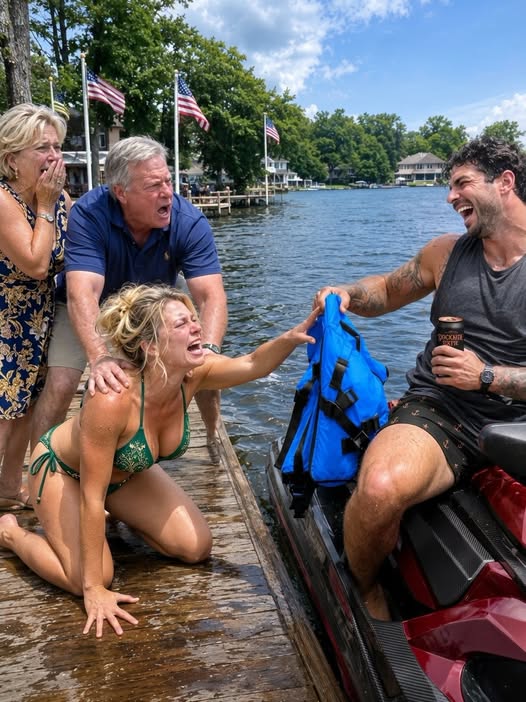
My name is Gwen Delgado. I’m 38. I’m an insurance adjuster in Springfield, Missouri.
Every 4th of July, my family goes to my parents’ lake house on the Lake of the Ozarks. Fireworks. Barbecue. Too much beer.
My younger brother, Rhett, is 34. He’s my parents’ golden boy. He’s also been arrested twice for drunk driving. My parents call it “a rough patch.” It’s been a rough patch for twelve years.
My daughter, Winnie, is seven. She can swim, but not well. Not in open water.
So she wears a bright orange life jacket every time she’s near the lake. My mother thinks it’s “overkill.”
Before every trip, I teach Winnie the same rule.
“If you ever fall in deep water, don’t panic. Find something that floats. Hold on. Mommy will come.”
That afternoon, I went inside to get sunscreen. I was gone for maybe four minutes.
When I came back to the dock, Winnie was gone.
So was Rhett’s jet ski.
“Where’s Winnie?”
My mother waved her drink at the lake. “Relax. Rhett took her for a spin. She was begging.”
“He’s been drinking since noon!”
“He’s fine,” my father said. “He grew up on this lake.”
I shaded my eyes. Far out on the water, I could see the jet ski. Fast. Too fast. Weaving.
Then it hit a wake.
I saw a tiny shape in a pink swimsuit fly off the back.
The jet ski kept going.
I screamed. My father grabbed my shoulder.
“Don’t make a scene. He’ll go back for her.”
He didn’t.
The jet ski curved around in a wide loop and came roaring back to the dock. Rhett cut the engine and climbed off, laughing.
He was holding Winnie’s orange life jacket in his hand.
“She didn’t want to wear it,” he said. “Said it was for babies. I told her she could hold on to me.”
My blood went cold.
“Rhett. She fell off. Without her vest. Where?”
He blinked, swaying. “She’s fine. She can swim.”
“WHERE?”
He pointed vaguely at the middle of the lake.
My father stepped between us.
“Gwen. Listen to me. Do not call the police on your brother. He’s already got two DUIs. A third one, he goes to prison.”
“My daughter is in the lake!”
“He’s had a hard year,” my mother said. “You always ruin everything.”
I didn’t argue with them.
There was no time to argue.
Here’s what my family always forgot.
Before I was a mother, before I was an insurance adjuster, I swam the 1,500 meters for the University of Missouri. I taught lifeguard classes for six summers.
I kicked off my sandals. I grabbed the orange vest out of Rhett’s hand.
And I handed my phone to my nephew, who’s sixteen.
“Call 911. Tell them a child is in the water off this dock without a life jacket. Tell them it was a jet ski. Tell them the driver is drunk. Use those words.”
My father shouted, “Gwen, don’t you dare…”
I dove off the end of the dock.
Three hundred yards is a long way when you’re terrified. I swam like I was nineteen again. Every stroke, I lifted my head and looked for orange. For a head. For anything.
Behind me, boats were starting to come out from the shore. People had heard me screaming.
I reached the spot where I’d seen her fall.
Nothing.
Just the wake of a passing boat rolling under me.
“Winnie! WINNIE!”
I spun in a circle in the water.
Then I saw it.
Floating a few feet away. Bobbing on the surface.
Her pink hair tie.
The one with the little plastic strawberry.
But no Winnie.
I made myself stop.
Panic wastes air. I’d taught that for six summers, standing on a pool deck in a red swimsuit, telling sixteen-year-olds that the first thing a rescuer must do is look, not thrash.
So I trod water and looked.
The lake was choppy from the holiday boat traffic, glittering and loud. The hair tie had drifted with the current, so I turned the way it had come and did what I’d been trained to do: I followed the water. Wind out of the southwest. Wake rolling northeast. A small body without a vest would drift with both.
“Winnie, it’s Mommy! Say something! Holler as loud as you can!”
Nothing. Then, faintly, so faintly I thought I’d imagined it:
“…Mommy?”
It came from my left, maybe forty yards off, past a patch of chop.
I swam harder than I have ever swum in my life.
I saw her before I reached her, a small, dark head, a pair of thin arms hooked over something yellow. A floating cushion, the kind that comes loose from pontoon boats, drifted from somebody’s party earlier. She had both arms and one knee wrapped around it. Her lips were blue-white, and her teeth were chattering so hard she could barely talk.
“I found something that floats,” she gasped. “I held on. Like you said.”
I reached her and pulled her into my arms and cried, a great ugly cry, with lake water in my mouth.
“You did everything right,” I said. “Everything, baby. Everything.”
I got the orange vest over her head and cinched it tight. Her fingers were icy against my neck.
“I yelled for Uncle Rhett,” she whispered. “He didn’t come back.”
“I know. I’m here.”
“I thought you wouldn’t find me.”
“I will always find you,” I said. “Always.”
Behind us, a pontoon boat was cutting toward us, a stranger in a ball cap at the wheel, shouting, “Ma’am! We’ve got you! We’ve got you!”
The stranger’s name was Dale Pruitt, a retired fireman from Jefferson City, and the woman beside him, his wife, wrapped Winnie in a beach towel and then in a fleece blanket and held her tight against her chest, humming under her breath.
“Her temperature’s low but she’s talking,” Dale said. “That’s good. I called it in. Sheriff’s marine patrol is two minutes out, and there’s an ambulance at the public dock.”
I sat on the deck of that pontoon with my arms around my daughter, shaking so hard my teeth hurt.
The marine patrol boat arrived a few minutes later, white and blue, lights flashing. A deputy, a woman in her forties with a braid, climbed aboard, checked Winnie’s pulse and pupils, and said the words I had been waiting to hear:
“She’s going to be fine, ma’am. She’s cold and scared, but she’s okay.”
I nodded, and kept nodding.
“Ma’am, I need to ask,” she said gently. “Your son called dispatch, and he said the driver of the jet ski was intoxicated?”
“My nephew. Yes. My brother.”
“Is he still at your parents’ dock?”
“He was.”
She spoke into her radio. Then she looked at me.
“We’ll take your daughter to the ambulance first. Then I’d like you to tell me exactly what happened.”
I told her all of it.
I told her about the four minutes. About my mother waving her drink. About my father grabbing my shoulder. About the life jacket in Rhett’s hand, and she didn’t want to wear it. I told her what my father said, and what my mother said.
The deputy didn’t write that down at first. She just listened. Then she wrote all of it.
By the time the ambulance took Winnie to Lake Regional, a crowd had gathered on my parents’ dock.
My nephew, Sam, had done exactly what I’d asked. He’d called 911 and used every word. Then, according to a neighbor, he had stood on the dock holding my phone with both hands, tears running down his face, while my father yelled at him to hang up.
He hadn’t.
Sam found me in the hospital hallway an hour later, still in his swim trunks, a towel around his shoulders. He was sixteen and thin and looked ten.
“Aunt Gwen,” he said. “I’m sorry. I should’ve gone after Uncle Rhett sooner. I saw him drinking. I saw him take her.”
“Sam. Look at me.” I put my hands on his shoulders. “You did the one thing I needed. You called. You said the words. You did exactly right.”
“Grandpa said I was ruining everything.”
“Grandpa was wrong.”
He started to cry again. I held him in a hallway that smelled of antiseptic and floor wax, and I thought of how my father had grabbed my shoulder, and how I’d been taught to be quiet for thirty-eight years.
Winnie came through it fine. A cold, a little water in her lungs, a night of observation, and a nurse who let her pick out a sticker for each finger prick. She wore a hospital bracelet with a cartoon whale on it, and she wouldn’t let me out of her sight.
“Mommy,” she said, near midnight, her small hand curled in mine. “Is Uncle Rhett in trouble?”
“Yes.”
“Because of me?”
“No, sweetheart. Because of what he did.”
She considered this.
“I did what you said,” she whispered. “I found something that floats.”
“You did,” I said. “You saved yourself, Winnie. And I came.”
Rhett was arrested at the dock that evening.
He’d had a blood alcohol level of 0.19 when the deputy tested him, nearly two and a half times the legal limit. He’d also, according to two neighbors and the marine patrol’s review, been operating the watercraft recklessly in a crowded no-wake zone for most of the afternoon.
He was charged with boating while intoxicated, child endangerment, and reckless operation of a vessel. Because of his two prior DUI convictions, the prosecutor, a calm, careful man named Mr. Holloway, told me the penalties could be severe.
“It’s going to be hard,” he said. “Your family will pressure you.”
“They already have.”
My mother called eleven times in the first day. The first message was furious. The second was hurt. By the sixth, she was weeping.
Gwen, please. He’s your brother. You’ve ruined his life over one mistake.
I did not call back.
My father called once, late on the second night. I answered, because I wanted to hear what he would say.
“Gwen.” His voice was gruff. “I’d like you to talk to the prosecutor. Ask him to go easy.”
“Dad. He threw my seven-year-old into the middle of a lake and left her.”
“She wasn’t hurt.”
“Because she was brave. Because she remembered a rule I taught her.”
“He’s your brother…”
“And she’s your granddaughter.”
Silence.
“You told me not to call the police,” I said. “With my child in the water.”
“I was thinking about Rhett.”
“I know,” I said. “That’s the problem.”
I hung up. My hands were steady. I hadn’t known they could be.
The hearing was in September.
Rhett wore a gray suit that didn’t quite fit. He had lost weight. He looked, for the first time I could remember, like a man who understood the thing in front of him.
His lawyer argued that Rhett was a troubled man with an alcohol problem who deserved treatment, not prison. The judge listened, a heavyset man with a gravelly voice and a pair of reading glasses perched on his forehead.
I testified for forty minutes. I described the four minutes, the swim, the hair tie. I described my daughter’s blue lips.
The judge asked me one question.
“Ms. Delgado, what would you like this court to do?”
I’d thought about it for weeks.
“I’d like my brother to get treatment,” I said. “Real treatment, not a weekend program. And I’d like him never to be allowed near a child unsupervised again, or near a boat, or a car, while he’s drinking.” I paused. “I’d like him to understand what happened. And I’d like that to matter more than being punished.”
The judge looked at me for a long moment.
He sentenced Rhett to three years in state prison, followed by five years of probation, with mandatory inpatient treatment during the first year and a lifetime ban on operating any watercraft. As he read the sentence, my mother began to sob in the gallery.
My father didn’t look at me.
Afterward, in the corridor, Rhett’s attorney asked if his client could speak to me for a moment. I agreed, with a bailiff nearby.
Rhett stood in front of me in handcuffs, his eyes red.
“Gwen,” he said. His voice was hoarse. “I don’t remember it. I remember the jet ski, and I remember her laughing, and I remember the dock. I don’t remember her falling.”
“I know.”
“I would never…” He swallowed. “I would never hurt her.”
“You did, though.”
He closed his eyes.
“Is she okay?”
“She’s okay. She’s seven. She asks sometimes why you didn’t come back.”
His shoulders shook. I let him cry. I didn’t comfort him. That wasn’t my job anymore.
“I hope you get better,” I said finally. “I mean that. But I’m not going to be your safety net. Not ever again.”
He nodded, once, and the bailiff led him away.
Final Part
Winnie started swim lessons again in October, at the Y, in a heated indoor pool.
She hadn’t wanted to. For weeks, she’d cried at the sight of water, even the bathtub. A child therapist, Dr. Marsh, taught her slow breathing and let her draw the lake over and over until it stopped looking so big.
Then one afternoon in the fall, she looked up at me from the kitchen table and said, “I want to learn how to swim far.”
“Far?”
“So I can save somebody else.”
I put down my coffee. I didn’t trust my voice for a moment.
“Okay, baby. Let’s learn.”
By spring, she could swim a full length of the pool. By summer, she could tread water for five minutes and float on her back, her hair fanned out like a halo. She wore her orange vest every time we went near a lake, and when my mother said, at the one family dinner I attended that year, that it was “overkill,” Winnie looked straight at her.
“It’s not overkill,” she said. “It’s what keeps you alive.”
The table went silent. My mother’s face went pink. Then, to my surprise, she looked down at her plate.
“You’re right,” she said quietly. “I’m sorry.”
It was the first apology I had ever heard from her.
My father took longer. He came to the house in November, alone, holding his hat. He stood on my porch for a full minute before knocking.
“Gwen,” he said, when I opened the door. “I was wrong.”
I waited.
“I put your brother ahead of your daughter. I told you not to call.” His voice was rough. “I’ve thought about it every night since. I keep seeing you go off that dock.”
“Dad.”
“I’ve been telling myself for twelve years that Rhett’s trouble was a rough patch. It wasn’t. It was a disease, and we fed it.” His eyes filled. “I’d like to apologize to Winnie, if you’ll let me.”
I thought about it for a long time.
“Not yet,” I said. “But maybe someday. If you keep showing up.”
He nodded, as if I’d given him something precious.
“I will,” he said.
He did. Every Sunday for a year, he drove to my house with a pie from the bakery and sat on the porch swing. He didn’t ask for anything. Eventually, in a bright, cold March, Winnie came out in her mittens and sat down beside him.
“Hi, Grandpa,” she said.
His chin trembled.
“Hi, sweetheart.”
“Mom says you said sorry.”
“I did.”
She looked at him with the serious, searching gaze she has.
“Okay,” she said, and leaned her head against his arm.
On the second anniversary of that Fourth of July, Winnie and I went to a different lake, a smaller one, quiet, a few hours from home. We rented a rowboat. She wore her orange vest and her pink strawberry hair tie, which I’d fished out of the water that day and kept in a drawer, and which she had asked for after her third session with Dr. Marsh.
We drifted for a while, side by side, while the sun slid orange across the water.
“Mommy?”
“Yes?”
“Remember the rule?”
“Which one?”
“Find something that floats. Hold on. Mommy will come.”
“I remember.”
She trailed her hand in the water.
“You always came,” she said. “Even when it was far.”
I looked at my daughter, my brave, soaking, extraordinary girl, and thought of every stroke I had taken that afternoon, every breath. I thought about my parents’ dock, and the shoulder I’d shaken free.
“I’ll always come,” I said.
She smiled, small and certain, and the little boat rocked gently, and out on the water a loon called, long and low, and the evening went on.
The Aftershocks
The courthouse doors slammed shut behind us with a heavy, final thud that seemed to vibrate straight up through the soles of my shoes. Outside, the midday sun was blinding, reflecting off the chrome bumpers of parked sedans and scorching the cracked asphalt of the county square.
My mother’s heels clicked against the concrete in a frantic, irregular rhythm. She was walking fast, pulling my father along by his forearm as if she were trying to outrun a storm that was already inside her clothes.
“Gwen,” she called back, her voice tight, brittle with suppressed rage and humiliation. She didn’t turn around. She didn’t have to. The message was clear: You did this. You broke the family.
I stood on the top step of the courthouse, the same steps I had climbed that morning with my stomach hollowed out by fear and resolve. My phone buzzed in my pocket—a text from the babysitter saying Winnie had finished her lunch and was asking if we were coming home for the puzzle we’d left out on the living room rug.
“I’m coming, Sarah,” I muttered into the screen, my thumbs stiff.
The drive home was quiet. The radio was off. I rolled the driver’s side window down just enough to let the hot July air whip across my face, trying to scrub the smell of stale courthouse coffee and wet wool out of my nose. In the rearview mirror, my own eyes looked back at me—hollowed out, bruised at the corners, but undeniably steady.
For twelve years, my family’s universe had revolved around Rhett’s orbit. If Rhett was spinning out of control, everyone adjusted their trajectory to keep him from crashing. If Rhett needed money, you gave it to him and didn’t ask what it was for. If Rhett showed up late to Thanksgiving dinner reeking of cheap bourbon and excuses, my mother would quickly slide a plate in front of him, laughing off his slurs as “just Rhett being Rhett,” while my father retreated to the den with a newspaper he wasn’t really reading.
I had been part of that machinery for a long time, too. I had bailed him out of two minor traffic fines in my twenties. I had lied to my college roommates about why I couldn’t lend them rent money (because Rhett had “borrowed” my savings to fix the transmission on a truck he later wrecked). I had told myself that loyalty meant never letting go of the rope, no matter how badly your hands were blistered.
It took four minutes in thirty feet of black, weed-choked water to cure me of that delusion.
When I unlocked the front door, the scent of cinnamon apples and warm peanut butter hit me. Winnie was sitting cross-legged on the floor, surrounded by a mess of cardboard puzzle pieces shaped like the United States.
“You’re back,” she said, looking up. Her hair was still cut short around her ears—not quite grown back from the emergency chop the emergency room nurses had given her to clear the lake weeds out of her tangles.
“I’m back, sweet girl,” I said, dropping my keys into the ceramic bowl by the door and sinking down onto the rug beside her. I pulled her into my lap, burying my face in her neck, breathing in the scent of baby shampoo and sun-warmed skin. She felt solid. She felt real. She was breathing.
“Did the judge help Uncle Rhett?” she asked quietly, her small fingers picking up a blue piece that belonged to Wyoming.
“The judge made sure Uncle Rhett goes to a place where doctors can help him stop drinking,” I told her carefully, choosing my words the way Dr. Marsh had advised: honest, simple, and entirely without malice. “And he won’t be coming around us for a long time.”
Winnie nodded once, satisfied, and snapped Wyoming into place. “Good. Because my tummy still feels funny when I think about the dock.”
“My tummy feels funny too,” I whispered, kissing the crown of her head. “We’ll get through it together.”
The Empty Sunday Dinner
August arrived with a heavy, suffocating humidity that turned the lawns brown and forced everyone indoors under the hum of wheezing window-unit air conditioners.
Traditionally, Sunday dinner at my parents’ house was non-negotiable. Even when I was married—before Kevin packed his bags and moved two states away with a paralegal from his firm—we were expected to sit at that long mahogany table and pretend that everything was normal. We passed the gravy boat across an invisible minefield of unspoken resentments.
On the second Sunday of August, my phone rang at noon. It was my mother.
“Are you and Winnie coming?” she asked. There was no greeting, no preamble. Just the demand for attendance.
“No, Mom,” I said, standing at the kitchen sink while Winnie colored with crayons at the small laminate table.
“Gwen, don’t be ridiculous. Your father carved a roast. It’s too much food for just the two of us.” Her voice dropped an octave, turning into the familiar weaponized whisper she used whenever she wanted to make me feel small. “Are you punishing us because of Rhett? Because we’re his parents? What are we supposed to do, just pretend we don’t have a son?”
“You can do whatever you want, Mom,” I said, my voice remarkably even. It surprised me how little her anger weighed on me now. The anchor had been cut. “I’m not punishing you. But Winnie and I aren’t coming to Sunday dinner anymore.”
“Ever?”
“Not right now. Not while things are like this.”
“You’re cutting us out over an accident,” she hissed.
“It wasn’t an accident, Mom. An accident is dropping a glass on the kitchen floor. Leaving a seven-year-old child in the middle of a deep lake on a jet ski while you’re blackout drunk is a choice. A series of choices.”
“He has a disease—”
“And he’s getting treatment for it now. Which is what I wanted. But I am not going to sit at your table and pretend that nothing happened, and I am certainly not going to let Winnie grow up thinking that kind of behavior is something we just smile and forgive over pot roast.”
There was a long, sharp silence on the other end of the line. I could hear the faint hum of her refrigerator in the background, and the heavy sigh she gave before speaking again.
“Your father misses his granddaughter.”
“Dad knows where we live,” I said. “He’s welcome to call. Or visit. Without her.”
“He won’t come without me, Gwen. You know that.”
“Then I guess he won’t come.”
I hung up before she could answer. I turned back to the counter, my hand slightly steady, though my heart was beating a frantic rhythm against my ribs. Winnie looked up from her coloring book, her blue crayon paused mid-stroke.
“Was that Grandma?”
“Yes, honey.”
“Are we going over there?”
“No. We’re going to make pancakes and watch a movie.”
Winnie beamed, her bright, gap-toothed smile banishing the shadow of the phone call instantly. “Can we put chocolate chips in them?”
“As many as you want.”
Letters from Stateville
In September, the leaves began to turn from dusty green to a brilliant, defiant gold and amber. The air turned crisp, carrying that sharp, wood-smoke scent that always made me feel like anything was possible.
With the change in seasons came the mail.
I recognized the return address immediately: State Correctional Facility, Unit 4B.
It was a thick, legal-sized envelope, addressed in Rhett’s familiar, loopy handwriting—the same handwriting that used to sketch comic book heroes in the margins of his notebooks when we were kids. For three days, the letter sat on my desk, half-hidden beneath a stack of unpaid electric bills and grocery flyers. Every time I walked past it, my chest tightened.
On Thursday night, after Winnie was fast asleep in her room, I finally picked it up, sliced the top open with a butter knife, and pulled out three pages of lined yellow legal paper.
Dear Gwen,
I’m writing this because the counselor here says I have to write down my amends, even if the people I’m writing to never write back. She says it’s part of the program. Step eight. Or nine. Honestly, they blur together after a while.
They have me working in the facility laundry room now. The hours are long, and the steam makes it hard to breathe sometimes, but it keeps my hands busy. I don’t shake anymore. Not like I used to. Without the booze, everything is just… loud. The walls are loud. The other guys are loud. My own head is the loudest thing of all.
I watched a video clip on the rec room TV last week about kids learning how to swim. A little girl with red hair popped up on the screen and for a second my heart stopped. I thought it was Winnie. It wasn’t, obviously. But I sat there on that plastic bench and I cried. The guy next to me thought I was losing my mind, and maybe I was.
I don’t expect you to forgive me, Gwen. I know what I did. Every night when I close my eyes, I see that water. I see her little pink hair tie floating on the surface like a flower petal. I didn’t think I was a monster back then. I thought I was just having a good time. That’s the scariest part—that I was having fun while my niece was drowning.
Tell Winnie I’m sorry. Tell her I’m trying to be someone she wouldn’t be scared of anymore. If you never want to write back, I understand. But thank you for not letting me drown either.
— Rhett
I sat at the kitchen table for a long time, the yellow paper trembling slightly in my fingers. There was no anger left in me—only a profound, hollow exhaustion.
I didn’t write back. Not that week, and not the next. I folded the letter neatly, slid it back into its envelope, and placed it in the back drawer of my filing cabinet beneath the folder labeled Medical & Legal.
He was doing the work he needed to do. I was doing mine. That was the boundary, and I intended to keep it.
The First Snow and the First Knock
Winter descended upon our small town like a heavy wool blanket. By December, the lake behind my parents’ house was frozen solid, a sheet of gray-white ice where skaters occasionally ventured out with hockey sticks and thermoses of hot cocoa.
We stayed away from the water entirely. Dr. Marsh had suggested we avoid any large bodies of water until the spring thaw, focusing instead on indoor pools and dry-land activities. Winnie had taken up gymnastics at the community center, throwing her small body across foam mats and balancing on low beams with a fierce, concentrated joy.
Then came the afternoon of November 14—the anniversary of my father’s first visit.
I was standing at the stove stirring a pot of tomato soup when I heard the crunch of heavy boots on the snowy front porch. It wasn’t the light, pattering step of the delivery driver, and it wasn’t the hurried pace of a neighbor. It was slow, deliberate, and heavy.
I wiped my hands on a dish towel and walked to the front door. Through the frosted glass panel, I saw the silhouette of a man in a thick wool coat, holding a familiar cardboard bakery box tied with red string.
I opened the door just a few inches.
My father stood there, his breath pluming in the freezing air like white smoke. His hair had gone entirely white over the past year, and his shoulders seemed permanently rounded, as if he were carrying an invisible weight.
“Gwen,” he said quietly.
“Dad.”
“It’s cold out here,” he said, offering a small, self-deprecating smile that didn’t reach his eyes. “Apple pie. From the bakery on Main Street. The one you used to like when you were ten.”
I looked at the box, then up at his face. The lines around his eyes were deeper than they had been a year ago. The arrogance that had defined him for most of my life—the booming authority of a man who owned three hardware stores and believed his word was law—seemed to have eroded away, leaving something older, softer, and much more fragile.
“Come in before you freeze,” I said, stepping back and pulling the door wide.
He stepped inside, stamping his boots carefully on the rubber mat before unbuttoning his coat. He didn’t look around the house as if inspecting it; he kept his eyes fixed on the floor, respectful of the space, waiting for permission.
“Winnie’s in the living room,” I said, leading him toward the kitchen. “She’s building a Lego castle.”
My father stopped in the doorway of the living room. Winnie looked up from her pile of plastic bricks, her blue eyes wide and analytical. She didn’t run away, but she didn’t smile either. She just sat back on her heels and looked at him the way a scientist might examine a rare, unpredictable specimen.
“Hi, Grandpa,” she said.
My father’s throat worked visibly. He swallowed hard, clutching the bakery box to his chest like a shield.
“Hello, sweetheart,” he said, his voice cracking slightly. “You’ve… you’ve gotten so tall.”
“I’m in level two gymnastics now,” Winnie informed him, holding up a pink plastic brick. “I can do a cartwheel on the beam.”
“Is that right?” My father set the pie box gently on the edge of the kitchen counter and walked slowly toward the living room rug, stopping a few feet away from her. He looked down at me, asking a silent question with his eyes.
I nodded once.
He knelt down—cautiously, with a low groan from his stiff knees—and sat cross-legged on the carpet across from my daughter.
“Your mom tells me you swim like a fish now,” he said softly.
“I swim the full length of the Y pool,” Winnie said proudly. “And I always wear my orange vest when I go near boats. Mommy says the water doesn’t care if you’re brave or not.”
My father closed his eyes for a fraction of a second, a flicker of pain crossing his features. When he opened them, his gaze was clear and steady.
“Your mommy is right,” he said. “She’s smarter than all of us put together.”
Winnie considered this for a moment, then slid a small, yellow Lego block across the rug toward him. “You can help me build the gate,” she said. “If you want.”
My father’s hands shook slightly as he picked up the yellow block. “I’d love nothing more,” he said.
Healing the Fault Lines
Over the next year, the rhythm of our lives settled into something resembling peace. It wasn’t the loud, messy, chaotic family life we used to have, but it was solid, honest, and entirely our own.
My father became a fixture on our porch swing every Sunday afternoon. My mother didn’t come with him at first—her pride was a stubborn, prickly thing that took much longer to thaw—but by the spring of our third year post-accident, she started walking up the driveway alongside him, carrying a small potted geranium or a bag of fresh strawberries.
She never apologized directly for the things she had said at the courthouse, but her apologies came in other ways. She learned to knock before entering. She stopped offering unsolicited advice about how I should live my life, raise my daughter, or manage my career as a freelance graphic designer. And when she looked at Winnie, the defensive edge in her posture was gone, replaced by a quiet, watchful tenderness.
Rhett was transferred from the state facility to a work-release program in a city two hours away. He had completed his inpatient treatment, maintained his sobriety for thirty months, and found a job at an industrial supply warehouse.
He didn’t call, and he didn’t visit. The restraining order and the boundaries I had set remained firmly in place. But occasionally, my father would pass along a brief update.
“He’s doing the program every night, Gwen,” my father told me one Sunday as we sat on the porch while Winnie chased a butterfly across the lawn. “He’s got an apartment above a hardware store. Small place. Clean. He sponsors a couple of younger guys now.”
“I’m glad to hear it, Dad,” I said, sipping my iced tea.
“He still talks about her every time I see him. Asks if she’s still doing gymnastics. Asks if she’s still afraid of the lake.”
“Tell him she’s not afraid anymore,” I said quietly. “Tell her she’s the bravest person I know.”
My father looked over at me, the sunlight catching the silver in his hair. “You know, you saved him too, in a way.”
“I saved Winnie,” I corrected him. “Rhett had to save himself.”
He was silent for a long moment, then nodded in agreement. “You’re a remarkable woman, Gwen. I don’t think I ever told you that enough when you were growing up.”
“You’re telling me now,” I said, and smiled.
The Second Lake
On the third anniversary of the Fourth of July—the exact date that had split our lives cleanly into before and after—Winnie and I packed a wicker basket with turkey sandwiches, sliced watermelon, and two cans of apple juice.
We didn’t go back to the family lake. That water belonged to ghosts and old history.
Instead, we drove an hour north to Silver Lake—a smaller, quieter body of water nestled in a valley of pine trees, surrounded by state-protected timberland where motorboats were strictly prohibited. The water was glass-clear, reflecting the towering green pines and the vast, cloudless summer sky.
We rented a small wooden rowboat from the park ranger’s station. The man behind the counter handed Winnie a bright orange life jacket, and she slipped her arms into it automatically, clicking the heavy plastic buckles herself with practiced efficiency.
“Check?” she asked, looking up at me.
“Snug and secure,” I said, double-checking the straps the way the swim instructor taught her.
We pushed off from the wooden dock, the oars sliding smoothly into the lock-pins with a rhythmic creak-splash, creak-splash. The water was so clear I could see school of small perch darting among the smooth river stones ten feet below us.
We rowed out to the center of the lake, where the water turned deep and dark-blue, like a spilled bottle of ink. I shipped the oars and let the boat drift, the gentle ripples rocking us like a cradle.
Winnie sat in the bow, her legs crossed, wearing her favorite denim shorts and the pink strawberry hair tie on her wrist—the exact one I had fished out of the weed bed three years ago, washed and mended and kept safe in her memory box ever since.
“Mommy?” she asked, trailing her fingers in the cool water.
“Yes, sweetie?”
“Do you remember the rule?”
I smiled, feeling the warm summer breeze lift my hair off my neck. “Which one?”
“Find something that floats. Hold on. Mommy will come.”
“I remember,” I said, my voice steady and clear across the water.
She looked down at her life jacket, then out across the vast, peaceful expanse of the lake. There was no fear in her eyes—only a deep, quiet confidence that belonged to a child who knew she was protected not by luck or denial, but by love, boundaries, and the hard-won truth of survival.
“You always came,” she said simply. “Even when it was far.”
I reached across the wooden slats of the boat and took her small, warm hand in mine, squeezing her fingers gently.
“I’ll always come, Winnie,” I said. “No matter how far.”
She smiled—bright, beautiful, and completely unbroken—and out across the glassy water, a loon lifted its head and called out, a long, hauntingly sweet note that echoed against the pine trees and faded slowly into the afternoon sky, leaving us entirely at peace.
Rebuilding the Foundation
Life without chaos has a texture all its own. In the fourth year following the accident, the quiet rhythms of our household felt as natural as breathing.
Winnie was ten now—all long limbs, scraped knees, and fierce independence. She had joined the local youth swim team, not out of necessity or fear, but because she loved the rush of cutting through the water, the clean smell of chlorine, and the sound of her own breathing echoing off the tiles of the indoor pool.
I watched her from the bleachers every Tuesday and Thursday afternoon, curled up with a sketchbook or a paperback novel, while Coach Miller—a stern, patient woman with graying hair and a whistle around her neck—put the kids through their paces.
Dr. Marsh and I had had our final session six months prior.
“You don’t need me anymore, Gwen,” she had said, closing her leather-bound notebook with a definitive click. “You’ve successfully rewritten the narrative. You didn’t just survive the trauma; you built a fortress around your daughter using truth instead of silence.”
“It took a long time,” I admitted.
“Trauma asks us to carry things that aren’t ours,” Dr. Marsh replied, looking at me over her wire-rimmed glasses. “You dropped what wasn’t yours to carry, and you kept what mattered. That’s not just healing; that’s grace.”
The professional side of my life was thriving too. My graphic design business had expanded from a few sporadic freelance clients to a steady roster of local small businesses, including the bakery on Main Street where my father bought his weekly pies. I had even hired a part-time assistant—a sharp college student named Maya who handled our invoicing and social media management, giving me more afternoons free to spend with Winnie.
Our relationship with my parents had settled into an unspoken, respectful truce. My mother still possessed moments where her old controlling instincts flared up—like the time she tried to buy Winnie a necklace that was entirely too expensive and ornate for a ten-year-old—but a gentle, firm “No thank you, Mom” was usually enough to check her impulses. She no longer tested the boundaries. She knew that the door, once locked, could be locked again permanently.
My father, on the other hand, had become a genuine presence in our lives. He didn’t just show up on Sundays anymore; he helped us paint the back porch in the spring, helped Winnie build a massive wooden birdhouse for the oak tree in the front yard, and never once mentioned Rhett unless I asked first.
The Meeting at the Diner
In November, exactly four years to the day after my father’s first apologetic knock on my front porch, I received a phone call from an unfamiliar number with a local area code.
“Gwen?” a voice asked. It was hesitant, rough around the edges, like sandpaper dragged across wood.
My breath caught in my throat. I didn’t need him to identify himself. I knew the cadence, the timbre, the slight hesitation before the second syllable.
“Rhett?” I whispered.
“Yeah,” he said. There was a long pause filled with the static hum of a cellular connection and background traffic noise. “I’m out. Finished the program. I’ve been living in the city for six months, working the docks down by the river. I have my own truck. A little apartment over a bakery.”
I didn’t say anything. My hand tightened around the receiver of the kitchen phone.
“I’m not calling to ask to see Winnie,” he hurried to add, his voice sounding panicked now, as if he expected me to hang up at any second. “I swear to God, Gwen, I wouldn’t do that. Dad told me… Dad told me how well she’s doing. School, swimming, all of it. I’m glad. I’m so damn glad.”
“Why are you calling, Rhett?” I asked, keeping my voice level.
“My probation officer… she suggested I reach out to anyone I owed restitution or amends to. Not to demand forgiveness. Just to say… I’m sorry. In person, if you’re ever willing. If not, I understand. I’ll mail the letter.”
I stood by the kitchen window, looking out at the bare oak branches swaying in the cold autumn wind. The anger I had carried for years felt distant now—not gone, exactly, but transformed into something small and hard, like a polished stone at the bottom of a river.
“There’s a diner on Route 9,” I said slowly. “The Silver Diner. Booth by the window.”
“Gwen—you don’t have to—”
“Next Tuesday at ten in the morning,” I interrupted. “I’ll give you twenty minutes. No more.”
There was a ragged breath on the other end of the line. “Thank you.”
“Don’t thank me yet,” I said, and hung up.
Twenty Minutes
The Silver Diner on Route 9 smelled of stale coffee, sizzling bacon, and floor wax. It was mostly empty at ten o’clock on a Tuesday morning, save for a truck driver reading a newspaper in the corner booth and an elderly couple sharing a plate of scrambled eggs.
I sat in the booth by the window, a ceramic mug of black coffee cooling between my hands.
At 9:55 AM, the door chimed.
Rhett walked in. He looked older—his hair was threaded with gray at the temples, and he had put on a little weight, filling out his frame in a way that looked healthy rather than bloated. He was wearing a clean flannel shirt and a canvas jacket. He stood near the entrance for a moment, his eyes scanning the room until they found me.
He walked over slowly, his boots clicking on the linoleum. When he reached the table, he didn’t sit down immediately. He stood there, his hands shoved deep into his pockets, looking down at me with an expression of profound, quiet humility.
“Can I sit?” he asked.
“Twenty minutes,” I reminded him, gesturing to the vinyl bench across from me.
He nodded and slid into the booth. For a long moment, neither of us spoke. A waitress walked over, poured a cup of coffee for him without asking, and walked away. Rhett wrapped his large, calloused hands around the warm ceramic mug, staring at the dark liquid inside.
“You look good, Gwen,” he said softly.
“I am good, Rhett.”
“Dad told me you started your own business. And that Winnie is on a swim team.” He looked up, his eyes shining with unshed tears. “I saw a picture of her at Dad’s house. In her swim team jacket. She looks… she looks so much like you when we were kids.”
“She’s strong,” I said. “And she’s safe.”
“I know she’s safe. That’s… that’s the main thing I wanted to say.” He swallowed hard, his throat working. “I don’t expect you to ever trust me again. I don’t expect you to let me back into your life, or Winnie’s life. I wouldn’t let me near her, if I were you.”
“Good,” I said. “Because you won’t be.”
He nodded slowly, accepting the sentence without argument. “I got a sponsor. I go to meetings three times a week. I’ve been sober for four years, eight months, and twelve days. Not that a number makes up for what I did. It doesn’t. But it’s the only way I can wake up in the morning and look at myself in the mirror without wanting to put my fist through the glass.”
I watched him. I looked for the old Rhett—the charming, reckless younger brother who could laugh off any disaster and charm our parents into bailing him out. He was gone. In his place was a broken man who had finally stopped running from the wreckage of his own choices.
“I don’t hate you, Rhett,” I said quietly. The words surprised me as much as they seemed to surprise him. “For a long time, I did. But hate takes too much energy. I have a daughter to raise and a life to live.”
“I understand,” he whispered. A single tear broke free and tracked down the side of his nose, dropping unheeded onto the table. “Thank you for coming. Thank you for giving me twenty minutes.”
“That’s your twenty minutes,” I said, standing up from the booth and leaving a five-dollar bill on the table to cover the coffee.
I walked out of the diner into the crisp autumn air. The sun was breaking through the gray clouds, casting long, golden shafts of light across the pavement. My car was parked just fifty feet away, its engine warm and waiting.
As I opened the driver’s side door, I looked back once toward the diner window. Rhett was still sitting there in the booth by the glass, looking out at the parking lot. He wasn’t crying anymore. He was just sitting straight, hands folded on the table, breathing.
I got into the car, started the ignition, and pulled out onto the highway, heading home where Winnie was waiting for me after school, her backpack packed with her pink goggles, her towel, and the bright orange vest that hung by the front door like a shield against the dark water of the past.
THE END..!