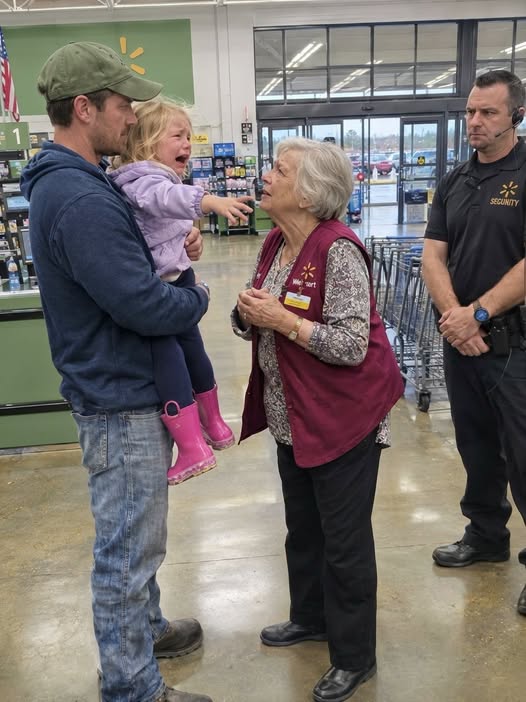
My name is Mabel Truesdale. I’ve been a greeter at a big store in Joplin, Missouri, for nine years.
I retired from the post office at sixty. I got bored. My husband passed. So I took a job saying hello to people.
I keep a roll of smiley-face stickers in my vest pocket. Every kid who walks in gets one. Some of them come back every Saturday just for the sticker.
On a Tuesday afternoon in March, a man walked toward the exit carrying a little girl. Three, maybe. Curly hair. Pink rain boots.
She was screaming. Not a tantrum scream. A scared scream.
I held out a sticker.
“Hi, sweetheart. Want a smiley face?”
She grabbed my vest with both hands.
“You’re not my daddy!” she screamed at the man. “I want my mommy! I want my mommy!”
The man smiled at me. Tight.
“Terrible twos. She’s tired. Excuse us.”
He tried to walk past me.
I stepped in front of the door.
“Sir, I’m sure you understand. She’s very upset. Can I just ask her name?”
“Get out of my way, lady.”
“What’s her name, sir?”
He hesitated. One second too long.
“Piper,” he said. “Her name’s Piper. I’m her father.”
“Piper,” I said gently. “Is this your daddy?”
She shook her head and screamed.
“No! He took me! He took me from Miss Odessa’s!”
The man’s face went red.
“She’s three. She doesn’t know what she’s saying. Move, or I’ll move you.”
I didn’t move.
I’m not a big woman. But I spent thirty-one years delivering mail in neighborhoods where you learn to stand your ground. I had been chased by dogs, snowed on, and cussed at by men twice his size. A scared little girl was not going out that door on my watch.
“I’m going to ask my manager to come over,” I said calmly. “Just to be safe.”
Mr. Pruitt, my manager, walked over. Thirty-five. Polo shirt. Always worried about complaints.
The man pulled out his wallet and showed him a driver’s license. Then a photo on his phone of himself holding a baby.
“See? My daughter. This old woman is harassing me.”
Mr. Pruitt looked at the license. Looked at the photo. Then he looked at me like I was a problem.
“Mabel, step aside. Now. He’s her father. You’re embarrassing the store.”
“Mr. Pruitt, she says he took her from someone named Miss Odessa.”
“Mabel. Step. Aside.”
I stepped aside.
But while the man walked out, I followed him to the doors. I took out my phone. I took three pictures.
His face. The little girl’s face through the car window.
And his license plate.
Then I called 911.
The next morning, Mr. Pruitt fired me.
“You made a scene. You followed a customer into the parking lot. You took photos of him. He’s filed a complaint with corporate.”
Three weeks later, I got a letter from a lawyer.
The man’s name was Dale Rutherford. He was suing me for $250,000. For assault, defamation, and “emotional distress.” His lawyer said I’d “grabbed his arm” and “publicly accused him of being a kidnapper.”
I’d never touched him.
The trial was set for October.
I couldn’t afford a lawyer. A young man from legal aid took my case for free. His name was Teddy Marsh, and he looked about twelve, but he read every page of that file twice and never once told me not to worry.
On the first day of trial, Dale Rutherford sat at the table across from me in a pressed suit. His lawyer called me “a confused old woman with a hero complex.”
I folded my hands in my lap and kept quiet. Thirty-one years of mail route had taught me that too.
The judge asked if there were any more witnesses before opening statements.
That’s when a young woman in the back row stood up.
She was holding a little girl in pink rain boots.
“Your Honor,” she said, her voice shaking. “I’m Piper’s mother.”
The whole courtroom turned around.
Dale Rutherford’s face went gray.
The little girl in the young woman’s arms saw me and pointed.
“Sticker lady!”
My heart did something I can’t describe. I hadn’t seen that child since the day she screamed in my arms, and here she was, clean and combed, with a bow in her hair, grinning at me as if we were old friends.
The judge, a silver-haired woman named Judge Alvarado, asked the young woman to come forward. Her name was Marisol Vance. She was twenty-six. She worked as a nursing assistant at a long-term care center.
“Your Honor,” she said, “that man is Piper’s biological father. He lost custody when she was one, after he put me in the hospital. He’s had a protective order against him for two years.”
A sound went through the gallery, low and disgusted.
Rutherford’s lawyer shot to his feet. “Your Honor, this is highly irregular, we weren’t notified…”
“Sit down, counselor,” the judge said, without looking at him. “Ms. Vance, continue.”
Marisol took a breath.
“On March the fourteenth, he walked into Piper’s in-home daycare, told the provider, Miss Odessa, that there was a family emergency, and took my daughter. Miss Odessa didn’t know about the order. I found out an hour later when she called me at work. The police issued an Amber Alert.”
She looked at me across the courtroom.
“But by the time the Amber Alert went out, the police already had his license plate. And a photo of his face. And a photo of my daughter in his back seat.”
I put my hand over my mouth.
“Because this woman stood in front of a door,” Marisol said, her voice breaking, “and asked my baby her name.”
The courtroom was so quiet I could hear the clock over the jury box.
She told the rest in a steady voice, the way people do when they’ve said it to detectives a dozen times. Troopers had stopped Rutherford’s truck on the interstate ninety minutes after he left the store, heading for the Oklahoma border. Piper was asleep in the back seat. No car seat. A fast-food bag and a bottle of cough syrup were on the floorboard, and an officer later testified that Piper had been given a dose that was not hers. She had slept through two hours of the ride.
I felt sick. I had been so sure, standing at that door, and still I hadn’t known the worst of it.
Rutherford had been charged with kidnapping, interference with custody, and violating a protective order. He’d been released on bond while waiting for his criminal trial.
And while he waited, he’d sued me.
“To scare me into changing my statement,” I said quietly. I hadn’t meant to say it out loud.
The judge heard me anyway.
“Mrs. Truesdale,” she said, “you’ll have your turn.”
She turned to Rutherford’s lawyer, then to Rutherford, and looked at him for a very long time.
“Mr. Rutherford. I have presided over this courtroom for nineteen years. I’ve seen men try many things. I have rarely seen a pending kidnapping defendant file a civil suit against the principal witness against him.”
“Your Honor, my client was the victim of a false accusation…”
“Your client’s own license plate was recorded by the woman he’s suing. His own photograph is in the evidence log of an Amber Alert.” Her voice sharpened. “Counsel, I’d advise you to stop talking.”
Teddy Marsh, my twelve-year-old-looking lawyer, rose with a single sheet of paper. “Your Honor, the defense moves to dismiss with prejudice.”
“Granted.”
She said it so simply that for a moment I didn’t understand what had happened.
“The case is dismissed with prejudice,” she said again, looking at me kindly. “Mrs. Truesdale, that means Mr. Rutherford may never file this suit again. You are free to go.”
Then she turned back to the man at the other table.
“Mr. Rutherford, using a civil lawsuit to intimidate a witness in a criminal case may itself be a crime. I am referring this matter to the county prosecutor’s office for review. You will remain seated until the bailiff has spoken with you.”
Two deputies were already walking toward him.
I stood on legs that didn’t feel like mine. Teddy squeezed my arm, grinning like a boy who had just won the county fair.
Then Marisol Vance was crossing the courtroom toward me, still carrying Piper, with tears running down her face and no attempt to wipe them.
“Mrs. Truesdale,” she said. “I never got to thank you.”
“Honey, you don’t have to.”
“I do.” She shifted Piper to her other hip and took both my hands. “I was at the state trooper’s barracks when they called to say they’d found her. I had been sitting in a plastic chair for two hours, and I had stopped being able to feel my hands. And the officer said, ‘A woman at a store stopped him. Photographed everything.’ I asked who. He said, ‘A greeter. Sixty-something.’ I said I needed to find you. I didn’t even know your name.”
“Mabel,” I said, my voice cracking. “Everyone calls me Mabel.”
“Mabel,” Marisol repeated. “I’m going to say your name every night for the rest of my life.”
Piper reached out and patted my cheek with her small, warm hand.
“Sticker?” she asked hopefully.
I laughed. I couldn’t help it. It came out wet and cracked, and half the courtroom laughed with me.
I pulled the roll from my vest pocket, the same pocket I’d kept it in all those years, and tore off a smiley face. She pressed it onto her own jacket, right over her heart.
Dale Rutherford was tried for kidnapping in December.
I testified for two hours, and I was terrified. I’d never been on a witness stand in my life. But Teddy had helped me practice at his kitchen table with his wife playing the prosecutor, and when the real prosecutor asked me what I’d seen, I told it the way I’d told it to the 911 operator. The little girl’s scream. The hesitation before the name. The look on his face when she said, He took me.
The jury was out less than three hours.
Guilty on every count. The judge gave him twelve years, with no chance of release before eight. I wasn’t in the courtroom when the sentence was read, but Marisol called me from the hallway, and I sat down on my kitchen floor, hand pressed to my chest, listening to her cry and laugh at the same time.
“He can’t touch her,” she kept saying. “He can’t touch her for a long, long time.”
“No, honey,” I said. “He can’t.”
Then the strangest thing happened. People started calling.
A reporter from the Joplin Globe wanted an interview. Then a TV station in Springfield. I said no to most of them, but Teddy talked me into one, a local station that came to the house and filmed me making coffee. They asked what made me step in front of that door.
I told them the truth. “I just listened. She said it wasn’t her daddy. Somebody ought to believe a child.”
That line ended up on the evening news. By the weekend, I had a stack of cards on my kitchen table from people I’d never met. A grandmother in Tulsa. A school bus driver in Kansas. A woman who said she’d been taken at four years old, and nobody had stopped the man who did it, and she wished someone like me had been standing at that door.
I read that one three times. Then I put it in the drawer by my bed with my husband’s old watch.
The store’s corporate office called the week after the lawsuit was dismissed.
A vice president. Her name was Carolyn Whitaker, and she apologized for twenty minutes. I don’t think she took a breath.
“Mrs. Truesdale, what happened to you was unacceptable. You did exactly what we hope every associate would do, and you were punished for it. We’d like to offer your position back, with back pay, a raise, and a formal letter of commendation. And we want to ask you something.”
“What’s that?”
“We’re implementing a new policy in every store in the region. If a child says, ‘That’s not my parent,’ staff call the police. Every time. No matter what identification anyone shows, no matter how calm or convincing the adult seems. We’d like to name it the Truesdale Rule.”
I said nothing for a moment.
“I’d rather you didn’t,” I said at last. “It’s not my rule. It’s every little kid’s rule. You just call it the Believe Her Rule, or the Believe Him Rule. Whatever the child is. Believe the child.”
There was a pause.
“We can do that,” Carolyn Whitaker said softly.
Mr. Pruitt was transferred to a store in another state. I heard he took a mandatory course on child safety and abduction response. I hope he learned something. I think he might have. A man came by the store a month later, a regional supervisor, and said Pruitt had asked him to pass along a message.
It said, I should have listened to her.
I folded the note and kept it. It wasn’t much, but it was honest, and some days that’s enough.
I went back to work on a Saturday in January.
The store looked the same. The same blue carpet, the same squeaky cart, the same gust of cold air every time the automatic doors opened. Folks I’d greeted for nine years stopped to shake my hand. A man I didn’t know pressed a twenty into my palm and wouldn’t take it back. A teenager in a hoodie said, “Hey, you’re the sticker lady from the news,” and I said, “I am,” and he said, “That’s badass,” and I decided to take it as a compliment.
At ten o’clock that morning, the doors slid open.
A little girl in pink rain boots came running in ahead of her mother.
“Sticker lady!”
Piper was almost four now. She’d grown an inch and lost the baby-round cheeks, and she’d learned to say my name, sort of. She called me “Miss Mabber.” I would have given her the whole store if she’d asked.
She held out her hand, palm up, with the grave dignity of a child who knows exactly what she’s owed.
I gave her a smiley face. Then another. Then, because it was that kind of day, I gave her the whole roll.
Marisol caught my eye over her daughter’s head. She was wearing a new coat, a bright yellow one, and she looked rested in a way I hadn’t seen before. The shadows under her eyes were gone.
“We’re doing okay,” she mouthed.
“I can see that.”
Piper stuck one of the stickers on my vest, right over my name tag.
“Now you have one too,” she said.
I looked down at the little yellow face grinning up from my chest, and my eyes went hot and blurry.
For nine years, I’d handed out those stickers like a habit, a little something to brighten a Saturday. I never once thought that the roll in my pocket and the spine in my back were one and the same thing. I never thought a smiley face and a stubborn old woman standing in a doorway could stop a car on its way to the interstate.
But maybe that’s what ordinary courage is.
It isn’t a cape or a speech. It’s an old woman with a roll of stickers, standing where she’s supposed to stand, asking a scared child one gentle question, and refusing, when everyone tells her to step aside, to step aside.
Piper tugged my sleeve.
“Miss Mabber? Can you give me another one?”
I laughed, wiped my eyes, and reached into my vest.
I had a spare roll in the other pocket.
I’d been carrying one ever since.
You would think that once the dust settled, life would go right back to normal. You put on your blue vest, you clock in at seven, you hand out your stickers, and you go home to watch the evening news with a cup of decaf. That is how it is supposed to work when you are sixty-nine years old in Joplin, Missouri.
Except the world has a funny way of keeping hold of you once it decides you belong to it.
By February, the letters stopped coming in ones and twos and started arriving in rubber-banded bundles. My regular mail carrier, a sweet boy named Devon who took over my old route three years back, started walking them right up to my porch instead of stuffing them into the box on the street.
“You’re famous, Miss Mabel,” he told me one crisp Tuesday morning, handing over a stack tied with twine. “Half the sorting facility wants to know if you’re coming back to work just so they can get an autograph.”
“Tell them I’m too busy earning my living,” I said, though I took the letters inside and read every single one at my kitchen table.
Some were from mothers thanking me. Some were from teachers. A few were from store greeters in other states—an old fellow in Ohio, a retired nurse in Florida—who said they had pinned my newspaper clipping up in their break rooms. They wrote that management looked at them a little differently now. Like they weren’t just furniture standing by the sliding doors.
One letter, though, didn’t have a return address. Just a postmark from Tulsa, Oklahoma, and neat, slanted handwriting on lined notebook paper.
Dear Mrs. Truesdale, it read. My name is Clara. I am forty-two years old. In 1988, my father took me from a grocery store parking lot in Bartlesville while my mother was putting bags in the trunk. I screamed. A cashier saw us, and my father told her I was having a fit because I couldn’t have candy. She smiled and waved us through. I didn’t see my mother again for eleven years. Thank you for not smiling. Thank you for not waving.
I sat with that piece of paper for a long time. The coffee in my mug went stone cold.
When my husband, Arthur, was alive, he used to say I had a stubborn streak wide enough to park a mail truck on. Usually, he said it when I refused to call a plumber for a leaky trap under the sink or when I insisted on walking my route through an ice storm because the chains on my boots were still good. I always thought stubbornness was just a flaw you learned to live with, like bad knees or a tendency to talk to yourself in the garden. Reading Clara’s letter, I realized it might just be a tool God puts in your pocket until the day you actually need it.
That Saturday, Marisol and Piper came by the store like they had started doing every weekend. It had become our little ritual. Marisol would pick up a few groceries—milk, bananas, a box of those little crackers shaped like whales—and Piper would spend ten minutes inspecting the sticker roll like a diamond merchant before choosing the exact yellow circle she wanted.
“Miss Mabber,” Piper said solemnly, pressing a sticker onto the back of her winter mitten. “Mommy’s learning to do needles.”
I looked up at Marisol, who laughed, a little pink in the cheeks.
“Phlebotomy,” Marisol explained, adjusting the strap of her purse. “Carolyn Whitaker—the vice president from your company? She called me last month. Said the company has a foundation that gives scholarships for healthcare training, and asked if I wanted to apply. I start night classes at the community college on Monday.”
“Well, look at you,” I said, feeling a swell of pride so big it nearly crowded out my lungs. “Drawing blood! You’ll be running the whole clinic before Piper hits second grade.”
“I just want to be able to buy her rain boots without checking my bank balance three times first,” Marisol said softly. Her eyes dropped to Piper’s feet—still the same pink boots, though they were getting snug at the toes. “And… I wanted to tell you something else. Dale’s mother called me.”
My smile faded. “Evelyn Rutherford?”
“You know her?”
“I delivered mail on Sycamore Street for fifteen years, honey. I know everybody’s mama.” I lowered my voice so Piper wouldn’t catch the tone, though she was busy trying to stick a smiley face onto a shopping cart wheel. “What did she want?”
“She wanted to see Piper. Said she’s her grandmother, and she shouldn’t be punished for what Dale did.” Marisol bit her lip. “I don’t know what to do, Mabel. She wasn’t mean. She sounded old, and tired, and she cried on the phone. Part of me feels awful for her. Part of me remembers that she bailed him out of jail two years ago when he broke my nose.”
I looked at Marisol—twenty-six years old, carrying the weight of the whole world on shoulders barely wider than a coat hanger—and I thought about how easy it is for good-hearted people to get talked out of their own common sense.
“Sweetheart,” I said gently, “a woman can be sad, and old, and tired, and still have terrible judgment. You don’t owe anybody access to your baby just because they cry on the telephone. If you ever decide to let her see Piper, you do it at a park, in broad daylight, with another grown-up sitting right beside you. And you don’t do it until you’re ready. Not one minute before.”
Marisol let out a long breath, as if she had been holding it since the phone call. “Okay,” she whispered. “Okay. That makes sense.”
“Now go get your whale crackers,” I told her, patting her arm. “Before this child decorates the entire fleet of carts.”
Spring came early to southwest Missouri that year, bringing dogwood blossoms and thunderstorms that rattled the windows at three in the morning. By April, the excitement at the store had mostly died down. Customers still nodded and smiled, and the teenager in the hoodie—whose name turned out to be Tyler, and who now worked in the stockroom—always gave me a two-finger salute when he wheeled pallets past the front doors.
Then came the call from Jefferson City.
A state senator named Patricia Morales was introducing a bill—Senate Bill 412—that would require retail chains, daycare centers, and public transit hubs across Missouri to train staff on child abduction red flags and establish a mandatory protocol when a child verbally disputes a guardian’s identity. They were calling it the “Speak Up for Kids Act,” though the local paper immediately nicknamed it “Mabel’s Law.”
Teddy Marsh, my young legal aid lawyer, drove over to my house on a Sunday afternoon with a manila folder and two slices of lemon meringue pie from the diner on Main Street.
“They want you to testify before the Judiciary Committee next Thursday,” Teddy said, scraping the last bit of meringue off his fork. He looked a little older now than he had in October—maybe fourteen instead of twelve—and he had a framed newspaper clipping of our courtroom victory hanging behind his desk at the legal aid office. “I’ll drive you up. My wife will pack sandwiches. You don’t have to say anything fancy, Miss Mabel. Just tell them what happened.”
“I don’t own anything fancy to wear to the state capitol, Teddy,” I said, looking down at my sensible orthopedic shoes.
“Wear your blue vest,” he grinned. “I guarantee half the senators in that room won’t listen to a guy in a suit, but nobody argues with a woman in a greeter’s vest.”
I didn’t wear the vest—corporate had rules about uniforms outside store hours—but I wore my best navy blazer and pinned a single yellow smiley-face sticker right on the lapel.
The hearing room in Jefferson City was bigger than Judge Alvarado’s courtroom, all dark oak paneling and brass lamps that hummed quietly overhead. There were six senators sitting behind a raised curved desk, looking down at a little wooden table with a microphone in the center.
I sat at that table, folded my hands just like I had in October, and waited my turn.
Before me, a lobbyist from a retail association spoke for fifteen minutes. He had smooth hair and a gold watch, and he used words like operational liability and undue burden on frontline associates. He said that requiring store employees to intervene in domestic disputes could expose businesses to lawsuits and put minimum-wage workers in physical danger.
“We already have security cameras,” he concluded smoothly. “Turning greeters and cashiers into amateur detectives is simply not practical.”
When he finished, the chairwoman, Senator Morales, thanked him and looked down at me.
“Mrs. Truesdale? Whenever you’re ready.”
I leaned toward the microphone. It smelled faintly of peppermint and old metal.
“Good afternoon,” I said. My voice echoed a little, which startled me, so I cleared my throat and started again. “I’m not a detective. I delivered mail for thirty-one years, and for the last nine I’ve stood on a rubber mat by the front door of a discount store. Most days, my biggest job is telling folks which aisle the canning jars are on.”
One of the senators at the far end cracked a smile.
“The gentleman before me talked about liability,” I continued, looking straight at the row of faces behind the oak desk. “I know a little bit about that. I got fired for asking a little girl her name. Then I got sued for a quarter of a million dollars. If it hadn’t been for a young lawyer who worked for free, I might have lost the house my husband and I paid off in 1998.”
I paused, resting my hands flat on the table.
“That man had a driver’s license. He had a baby picture on his phone. On paper, he looked just fine. If we had relied on paper, or security cameras, Piper would have been across the Oklahoma line before anyone even knew she was missing. The only thing that stopped him wasn’t a policy manual. It was a three-year-old girl screaming that she wanted her mommy, and an old woman who decided not to call her a liar.”
The room was dead quiet. Even the retail lobbyist in the second row stopped looking at his phone.
“Nobody’s asking cashiers to tackle grown men,” I said softly. “Just don’t tell us to look away. Give folks permission to make the phone call. Protect them when they do. Because if a grown-up won’t stand in front of a door for five minutes to save a child’s life, then I don’t know what we’re all doing here.”
Senator Morales looked at me for a long moment. Then she picked up her gavel and tapped it once.
“Thank you, Mrs. Truesdale. I believe you’ve said everything that needs to be said.”
The bill passed out of committee unanimously that afternoon. By June, the governor signed it into law. He sent me the pen he used to sign it, mounted in a little walnut box. I put it on the mantel next to Arthur’s bowling trophy.
If you think the story ends with a pen in a walnut box, you haven’t lived long enough to know how tangled people’s lives really are.
August in Joplin is hot enough to fry an egg on a mailbox. On a Tuesday evening, just as I was watering my tomatoes in the backyard, a silver sedan pulled up to the curb in front of my house.
I turned off the hose and walked around the side of the porch, wiping my hands on my apron.
A woman was stepping out of the passenger side. She was in her late sixties, thin as a rake, wearing a pale blue cardigan despite the eighty-five-degree heat. Her gray hair was pinned back in a neat bun, and she was gripping a white purse with both hands like she was afraid someone might snatch it.
I recognized her immediately. Evelyn Rutherford.
“Mrs. Truesdale?” she called out hesitantly from the sidewalk. “I’m sorry to bother you at home. I didn’t know where else to go.”
I stood by the porch steps, keeping the screen door within reach. “Mrs. Rutherford. What can I do for you?”
She looked down at her shoes, then back up at me. Her eyes were red-rimmed, the skin beneath them thin as tissue paper. “I’m Dale’s mother. I… I imagine you know that.”
“I do.”
“I’m not here to make excuses for him,” she said quickly, her voice trembling. “I know what he did. I sat in that courtroom in December. I heard the testimony about the cough syrup. I haven’t slept through the night since.”
I didn’t say anything. Years at the post office teach you that silence makes people tell you what they really came to say.
Evelyn swallowed hard. “I bailed him out two years ago when he hurt Marisol. He told me it was an accident. He told me she fell against the counter, and I wanted to believe him so badly that I wrote the check without asking a single question. That’s on my conscience. I’ll carry that to my grave.”
A cicada buzzed loudly in the oak tree overhead.
“Then why are you on my sidewalk, Evelyn?” I asked, not unkindly, just plain.
“Because Marisol won’t answer my calls,” she said, a tear finally spilling over her cheek. “And I don’t blame her. Truly, I don’t. Why would she trust me? I’m the mother of the monster who tried to steal her baby. I just… Piper is my only grandchild. I haven’t seen her since she was fourteen months old. I know you’re close to Marisol. I saw you together in court. I thought—maybe if you told her I’m not asking to take Piper anywhere. I don’t even need to hold her. I just want to sit on a bench somewhere and watch her play for ten minutes. Just to know she’s okay.”
I studied her face. I looked for the tightness around the mouth I had seen on her son at the store doors—that hard, entitled look of someone who thinks the rules don’t apply to them. I didn’t see it. What I saw was a broken old woman who had spent years making excuses for a bad son and had finally run out of lies to tell herself.
Still, wanting something badly doesn’t make it safe.
“Evelyn,” I said, stepping down onto the grass, “I’m going to tell you the truth, because I’m too old to sugarcoat things. You made a choice two years ago when you wrote that bail check. You chose your son over a young woman lying in a hospital bed. Marisol has spent every day since then trying to keep her daughter alive and whole. She has every right to lock the door and throw away the key.”
Evelyn nodded slowly, wiping her cheek with the back of her hand. “I know. You’re right.”
“However,” I added, “I also believe people can wake up. Even late in the game. I won’t pressure Marisol. Not an inch. If I mention you came by, and she says no, that’s the end of it, and you never drive down this street again. Do we understand each other?”
“Yes, ma’am,” Evelyn whispered. “Completely.”
“All right. Go on home out of this heat. I’ll talk to her when the time is right.”
I didn’t bring it up that Saturday, or the Saturday after that. Marisol was in the middle of her clinical rotations at the hospital, exhausted and proud, showing me the laminated badge with her picture on it. Piper had started half-day preschool, carrying a backpack shaped like a dinosaur that was nearly as big as she was.
It wasn’t until late September, when the leaves were just starting to turn bronze along the creek, that Marisol stayed after her shift to have iced tea with me in the store’s little break room.
“You seem like you have something on your mind, Mabel,” she said, wrapping both hands around her plastic cup. “You’ve been quiet all afternoon.”
So I told her. I didn’t dress it up, and I didn’t plead Evelyn’s case. I just laid out the facts: Evelyn had come to my yard, she had owned up to the bail money, and she had asked for ten minutes on a park bench with zero strings attached.
Marisol stared down at the table for a long time. Her jaw tightened, and for a second I saw the fierce, protective mother who had stood up in the back of Judge Alvarado’s courtroom.
“She enabled him for years,” Marisol said quietly. “Every time he lost a job, every time he punched a hole in a wall, she paid his rent and told him he was just misunderstood.”
“I know,” I said.
“Piper doesn’t remember her. She doesn’t even ask about a grandma.”
“She doesn’t need another grandma,” I agreed. “She’s got you, and she’s got me when you need a sitter.”
Marisol looked up at me, a small, crooked smile touching the corner of her mouth. Then it faded.
“When I was growing up,” Marisol said softly, “my dad left before I could walk. My mom worked two jobs at the poultry plant in Carthage. We didn’t have anybody. When Piper was born, I wanted her to have a big family so badly. That’s why I stayed with Dale longer than I should have. I kept thinking, At least she’ll have a dad. At least she’ll have a grandmother.“
She traced a water ring on the laminate table with her finger.
“If Evelyn shows up, and Piper gets attached, and then Dale gets out in eight years and Evelyn goes right back to taking his side…” Marisol shook her head. “I can’t put my daughter through that.”
“Then don’t,” I said immediately. “Tell me to tell her no, and I’ll call her tonight.”
Marisol was silent for another minute. Then she let out a breath.
“What if it’s just once?” she asked, looking at me uncertainly. “At Cunningham Park. Saturday morning. You come with us. No gifts, no promises about next time. Just ten minutes so she can see with her own eyes that Piper is happy and doesn’t need anything from her.”
I looked at that twenty-six-year-old girl and marveled at the grace it took to even consider it.
“If you’re sure,” I said, “I’ll be sitting right on that bench beside you.”
Saturday morning at Cunningham Park was crisp and golden, the kind of October weather that makes you forgive Missouri for August.
Evelyn was already there when we walked up the path. She was sitting on the far end of a green wooden bench near the swings, her hands folded tightly over her white purse. She hadn’t brought a single toy, bag, or card. She had kept her word.
Piper spotted the swings first and took off running, her pink rain boots—brand new ones Marisol had bought with her first phlebotomy paycheck—thudding against the woodchips.
Marisol stopped ten feet from the bench. I stood just half a step behind her, my hands in my cardigan pockets.
Evelyn stood up slowly, as if her knees hurt. She didn’t step forward. She just looked across the playground at Piper climbing onto a rubber swing, pumping her little legs furiously even though she wasn’t moving an inch.
“She has your eyes, Marisol,” Evelyn said softly.
“Yeah,” Marisol said, her voice steady and cool. “She does.”
Evelyn swallowed, her throat working. She looked at Marisol—really looked at her, taking in the clean scrubs Marisol had come straight from work in, the confident posture, the clear eyes.
“I’m sorry,” Evelyn whispered. “I should have believed you. When you came to my house with that bruise on your cheek, and I told you to go home and try to be more patient with him… God forgive me, Marisol. I was a coward.”
Marisol didn’t say It’s okay, because it wasn’t okay. Instead, she nodded once. “Thank you for saying that.”
Across the woodchips, Piper yelled, “Mommy! Push! High as the trees!”
Marisol glanced at me. I gave her a tiny nod.
“I’m going to push my daughter on the swings,” Marisol told Evelyn. “You’re welcome to watch from here for a few more minutes.”
She walked over and gave Piper a gentle push. Piper shrieked with delight, her curly hair flying back in the autumn breeze.
Evelyn didn’t sit back down. She stood beside the bench, tears running silently down the lines of her face, watching her granddaughter soar back and forth against the bright blue sky. She didn’t call out. She didn’t try to wave or get Piper’s attention. She just stood there, taking it in like a person memorizing a painting before a museum closes.
After about ten minutes, Evelyn looked at me.
“Thank you, Mabel,” she whispered. “For giving me this.”
“You thank Marisol,” I replied quietly. “She’s the one who did the hard part.”
Evelyn nodded, turned around, and walked back toward the parking lot without looking back.
Marisol kept pushing the swing until Piper got dizzy and asked for apple juice. When Marisol walked back over to where I was standing, her shoulders were loose, as if a knot she had been carrying for two years had finally untied itself.
“I don’t think she’ll call again,” Marisol said, watching the empty path.
“No,” I agreed. “I think she got what she needed. And I think she knows she doesn’t deserve more.”
Piper ran up and hugged my knees, nearly knocking me into the hydrangeas. “Miss Mabber! Did you see me? I touched a cloud!”
“I saw you, sweetheart,” I laughed, reaching into my cardigan pocket. “Here. You earned two today.”
Winter came around again, marking a full year since that Tuesday in March.
In December, the county prosecutor’s office finally wrapped up the separate charge Judge Alvarado had referred—the witness intimidation case from the bogus $250,000 lawsuit. Dale Rutherford pleaded guilty in exchange for the sentence running concurrently with his kidnapping time, which meant he wasn’t getting any extra years, though it put a permanent felony mark on his record for trying to bully a senior citizen in civil court.
Teddy Marsh called me from the courthouse steps to tell me the news.
“He didn’t even look up when the judge read the plea,” Teddy said, wind rushing across his phone microphone. “Just stared at the table. Oh, and Miss Mabel—before I forget, the legal aid board is having their annual fundraising dinner next month. They want to give you their Citizen Courage Award. Free roast beef, and I promise nobody’s going to make you give a speech unless you want to.”
“I’ll go for the roast beef,” I told him. “Tell your wife to sit next to me so I have somebody sensible to talk to.”
Life settled into a comfortable rhythm after the new year. At the store, corporate had rolled out the “Believe the Child” training across all four hundred locations in the Midwest. Carolyn Whitaker sent me a copy of the training video they filmed. In it, an actor playing a store greeter—a nice-looking woman with gray hair and a bright smile—hears a little boy say, That’s not my dad, and immediately hits the silent alert button at the customer service desk while keeping the man talking about store coupons until the police arrive.
When I watched it on my laptop at the kitchen table, I chuckled to myself. “Well,” I muttered to the empty room, “at least they gave her better shoes than mine.”
By spring of the following year, I turned seventy.
Marisol threw me a surprise party in the community room at the library. Half my old post office crew showed up, along with Teddy and his wife, Tyler from the stockroom, and three dozen customers who had been coming through my doors on Saturdays for ten years.
Piper, who was four and a half now and missing one bottom tooth, presented me with a homemade birthday card. She had drawn a picture of a stick figure with white hair holding a giant yellow circle, standing next to a smaller stick figure in bright pink boots. Across the top, with Marisol’s help, she had printed: HAPPY BIRTHDAY MISS MABBER.
I put that card on the refrigerator right next to Arthur’s old fishing license.
That summer, something unexpected happened at the store.
It was a Wednesday afternoon—slow, rainy, the kind of day when folks only come in for lightbulbs, umbrellas, or ice cream. I was standing by the carts, straightening the hand-sanitizer dispenser, when a woman walked in with a little boy about two years old.
The woman looked exhausted. Her hair was pulled back with a claw clip, her sweatshirt had a stain on the shoulder, and she was trying to juggle a diaper bag, a purse, and a squirming toddler who had decided he wanted to lie flat on the wet rubber mat by the entrance.
I walked over and knelt down—slowly, because seventy-year-old knees don’t bend without complaining—and held out a smiley-face sticker.
“Rough afternoon, little buddy?” I asked.
The boy stopped crying mid-sob, stared at the yellow sticker, and stuck it straight onto his forehead. His mother let out a laugh that sounded half like a sob.
“Thank you,” she breathed, shifting the diaper bag. “I’m sorry. We just drove four hours from Arkansas. My husband’s at the VA hospital up the road, and I forgot the baby’s favorite blanket at a rest stop.”
“Don’t apologize to me, honey,” I said, standing back up. “You need a cart? Let me grab you one with wheels that don’t squeak.”
As I turned toward the cart corral, I noticed a young woman in a blue store vest watching me from the customer service counter. Her name was Brianna. She was nineteen, saving up for nursing school, and it was only her second week on the job.
Later, during my afternoon break, Brianna sat down across from me in the break room, peeling an orange.
“Mrs. Truesdale?” she said shyly. “Can I ask you something?”
“Sure, sweetheart. What’s on your mind?”
“Everyone here knows about what happened last year. With the little girl and the guy at the door.” Brianna looked down at her orange peel. “Honestly? It kind of scares me. What if something like that happens when I’m working the front? I don’t know if I’d be brave enough to stand in front of a grown man like that.”
I looked at her—nineteen years old, hands still smooth, voice soft—and I remembered how my own knees had knocked together behind my slacks on that Tuesday in March.
“Brianna,” I said, leaning forward, “let me let you in on a secret. I wasn’t brave that day. My heart was hammering so hard I thought my ribs were going to crack. When Mr. Pruitt yelled at me, I wanted to crawl under the clearance rack.”
Her eyes widened a little. “Really?”
“Really. You don’t have to feel brave to do the right thing. You just have to decide ahead of time what kind of person you’re going to be when the moment shows up. Once you decide that, your feet pretty much stay where you put them.”
Brianna thought about that for a second, slowly nodding. Then she smiled. “Do you have an extra roll of those stickers? Just in case?”
I reached into my left pocket and slid my spare roll across the table. “Keep it in your apron. You never know when you’re going to need it.”
Three years passed before I heard from Teddy Marsh again with anything other than a Christmas card.
By then, Piper was seven years old and in second grade. She had outgrown the pink rain boots twice over and had moved on to light-up sneakers that flashed red and blue every time she took a step. Marisol had finished her phlebotomy certification, worked two years at the clinic, and was now taking prerequisite classes to become a registered nurse. Every time I saw her, she looked taller—not in inches, just in the way she carried herself. Like a woman who had built a house from scratch and knew every nail in the floorboards.
It was a crisp November morning when Teddy called me at home.
“Miss Mabel,” he said, his voice brisk and lawyerly, “are you sitting down?”
“I’m drinking my coffee, Teddy. What’s wrong?”
“Nothing’s wrong. In fact, it’s good news, though it might surprise you.” There was a rustling of papers on his end. “I just got a call from the Missouri Department of Corrections. Dale Rutherford has been denied parole at his initial eligibility review—which we expected—but that’s not why they called. He asked the prison chaplain to forward a letter to the victim’s family and to you. The prosecutor’s office screened it first to make sure there were no threats or violations of the no-contact order. Marisol already read hers. She said it was okay if I brought yours by.”
My coffee cup paused halfway to my mouth. “Dale Rutherford wrote me a letter?”
“I can throw it straight in the shredder if you don’t want to see it,” Teddy said quickly. “You don’t owe him five seconds of your day.”
I looked out my kitchen window at the bare branches of the maple tree in the yard. Seventy-three years old now. My joints ached when it rained, and I had finally retired from the store the previous spring—though I still stopped by on Saturdays to visit Brianna, who had taken over my spot by the front doors.
“Bring it by, Teddy,” I said quietly. “Curiosity never killed anybody who survived the U.S. Postal Service.”
He dropped the envelope off on his lunch hour, stayed long enough to eat two oatmeal raisin cookies, and left me alone with it.
The envelope had a prison return stamp from Jefferson City. Inside was a single sheet of lined paper written in blocky, careful capital letters.
Mrs. Truesdale,
I am writing this because my counselor told me part of recovery is owning what you broke, even if it can never be fixed. I am not asking you to forgive me. I know what I did to Marisol, and I know what I almost did to Piper. That day in the store, I hated you more than I have ever hated anyone in my life. I spent the first two years in here blaming you for everything I lost.
Last month, my mother passed away from heart failure. The warden let me attend the graveside service in shackles. Nobody came except the funeral director and a pastor. Standing there, I realized that if you hadn’t stood in front of that door, I would have ruined my daughter’s life the exact same way I ruined my own.
Thank you for stopping me. I mean that. Piper deserves a better life than anything I could have given her.
Dale Rutherford
I read the letter twice.
I thought about Evelyn Rutherford standing beside that green bench at Cunningham Park three years ago, watching her granddaughter swing up toward the clouds. I was glad Marisol had given her those ten minutes. Sometimes a small mercy is the only warm thing a person gets to carry with them to the end.
I folded the letter neatly, put it back in the envelope, and slid it into the bottom drawer of my desk—not with Arthur’s watch or the card from the woman in Tulsa, just in a plain file folder at the back. Some things don’t need to be kept close to your heart, even when they’re true.
That evening, Marisol called me.
“Did Teddy bring it?” she asked softly.
“He did.”
“How do you feel?”
I leaned back in my kitchen chair, listening to the furnace kick on with a familiar low hum. “Honestly, honey? Relieved. Not because of him. Just because it feels like the door finally clicked shut.”
“Yeah,” Marisol breathed. “That’s exactly how I felt. Hey—Piper wants to tell you something before she goes to bed.”
I heard the phone shuffle, followed by a burst of loud breathing right into the receiver.
“Miss Mabber!”
“Hello, sweetheart. How’s second grade?”
“Good! Guess what? Today at recess, a new kid in kindergarten was crying by the fence because he couldn’t find his class. And nobody was helping him. So I went over and asked him his name, and I walked him all the way to Mrs. Gable’s room!”
My throat tightened so fast I couldn’t speak for a second.
“Did you now?” I managed to say, my voice thick.
“Uh-huh! And guess what else? I gave him one of my smiley stickers from my pencil box. He stopped crying right away.”
I closed my eyes and smiled, wishing Arthur could have heard that.
“You did real good, Piper,” I whispered. “Real good.”
People always ask me, when they recognize me at the grocery store or the church potluck, whether I ever regret it.
They mean the firing. The six months without a paycheck when I had to dip into my savings to pay the property taxes. The weeks when my hands shook every time the mail truck pulled up, wondering if another envelope from Dale Rutherford’s lawyer was going to drop through the slot. The sleepless nights before the criminal trial, staring at the ceiling fan and wondering if I was going to forget a single detail on the witness stand.
“Was it worth all that trouble?” a man asked me once at the hardware store while we were both waiting for keys to be cut. “For somebody you didn’t even know?”
I looked at him—a perfectly decent fellow in a flannel shirt, probably a good neighbor, probably pays his taxes on time—and I realized he wasn’t being cruel. He genuinely didn’t understand.
“Friend,” I said, “if you find a twenty-dollar bill on the sidewalk, you pick it up. If you see a kid about to step in front of a bus, you grab their coat. You don’t stand on the curb calculating what it’s going to cost your dry-cleaning bill.”
That is the part folks miss when they put you on the evening news or give you a walnut plaque. They want courage to be something grand. They want music swelling in the background and a speech you practiced in front of the bathroom mirror.
Real life doesn’t give you a script. Real life gives you a Tuesday afternoon in March when your feet hurt, your shift ends in twenty minutes, and a little girl in pink rain boots grabs your vest like you’re the only solid thing in a spinning world.
Last spring, the local school district invited me to speak to the third-graders at Piper’s elementary school during Safety Week.
I almost said no. Talking to six senators in Jefferson City was one thing; facing sixty eight-year-olds hopped up on chocolate milk is another matter entirely. But Piper begged me, and Marisol promised to drive me and buy me lunch afterward, so I ironed my best blouse and went.
The gymnasium smelled like floor wax and sneakers. The kids sat cross-legged on the polished wood floor, staring up at me with wide, curious eyes. Piper was right in the front row, beaming like she owned the building, wearing a yellow cardigan she had picked out specifically to match my sticker roll.
The principal introduced me, read a little blurb from the newspaper, and handed me the microphone.
I looked out over all those little faces—curly hair, missing front teeth, scuffed shoes, bright backpacks lined up against the bleachers—and suddenly I wasn’t nervous at all.
“Good morning, everybody,” I said.
“Good morning, Miss Mabel!” they shouted back in unison, loud enough to rattle the basketball backboards.
“I’m going to keep this short,” I told them, “because I know recess is in fifteen minutes, and nobody ever learned anything important on an empty stomach.”
A few teachers along the wall laughed.
“People like to call me a hero because I stood in front of a door,” I said, pacing slowly along the baseline. “And that’s very nice of them. But I’m going to tell you a secret. I wasn’t the bravest person in that store. The bravest person in that store was three years old.”
I looked down at Piper, whose cheeks went bright pink.
“She was scared. A grown-up told her to be quiet. Everything around her was loud and confusing. And she still used her voice. She told the truth, loud enough for someone to hear.”
I stopped in the middle of the gym floor and looked out at all sixty of them.
“So here is my rule for all of you. If you are ever scared, or hurt, or somebody is taking you somewhere you know you shouldn’t go—you yell. You make a fuss. You don’t worry about being polite, and you don’t worry about getting in trouble. You use your voice until somebody listens.”
Then I looked past them, toward the teachers and aides standing along the bleachers.
“And for the grown-ups in the room—our job is even simpler. When a kid uses their voice, we stop what we’re doing, we put down our phones, we ignore our schedules, and we listen.”
When I finished, Piper jumped up and ran over to hug my waist, nearly tipping me over in front of the whole third grade. Half the kids clapped, and the other half immediately lined up to see if I had brought enough stickers for everyone.
I had brought three whole rolls. Every single kid walked out to recess with a yellow smiley face stuck to their shirt.
Now that I’m retired, my mornings move at a gentler pace.
I still wake up at six—thirty-one years of sorting mail before dawn sets an alarm clock in your bones that never quite turns off—and I sit on my front porch with my coffee until the sun clears the rooftops across the street. Devon still waves when his mail truck rolls past at ten-thirty. My tomatoes still try to take over the backyard every July, and I still lose the battle against the squirrels every August.
But every Saturday morning at ten o’clock, I put on my walking shoes, grab my purse, and drive down to the big store on Rangeline Road.
I don’t wear the blue vest anymore. They gave me an honorary gold name tag when I retired, which I keep in my jewelry box, though I don’t wear it out in public because it makes folks want to stop and take selfies in the produce aisle.
Instead, I just walk through the automatic doors, feel that same blast of cool air, and say hello to Brianna.
She’s twenty-two now, finishing up her last semester of nursing school, and she runs the front end like a seasoned general. Every time she sees me coming, she taps her apron pocket to show me she’s got her sticker roll ready.
“Morning, Miss Mabel,” she calls out. “Your regulars are already inside.”
And sure enough, over by the seasonal display, there’s Marisol—wearing hospital scrubs now, with a stethoscope tucked into her bag and a bright smile that reaches all the way to her eyes. She passed her state nursing boards last month on the first try. Next week, she starts her new job in the pediatric ward at Freeman Hospital.
And right beside her is Piper.
She’s eight now. Tall as a beanpole, all elbows and knees, with the same wild halo of curls she had when she was three. She doesn’t wear pink rain boots anymore—she’s into high-top canvas sneakers with mismatched shoelaces—but when she sees me come through those sliding doors, she still yells the exact same thing across the store.
“Sticker lady!”
People turn their heads, smile, and go back to their shopping carts. Half of them don’t even know the story anymore. To them, I’m just an old woman getting a hug from a kid near the door.
And honestly? That’s my favorite part.
Piper runs up, wraps her arms around my waist, and looks up at me with those big brown eyes.
“Miss Mabber, guess what? Mom said we can get ice cream after we buy groceries. Mint chocolate chip. Want to come with us?”
“I don’t know, sweetheart,” I tease, tapping my chin. “Did you remember to bring your manners today?”
She grins, showing a brand-new front tooth that still looks slightly too big for her face, and holds out her hand, palm up, with the exact same grave dignity she had at three years old.
I reach into my coat pocket, pull out my roll of yellow stickers, and peel one off. I press it right onto the back of her hand.
“Now I’m ready,” Piper says seriously.
Marisol walks up, looping her arm through mine as we head toward the grocery aisles together. Outside, the Joplin traffic hums along, ordinary and busy, full of people rushing to errands and appointments and weekend plans.
None of them know what might be waiting behind the next set of sliding doors. None of us ever do.
Sometimes, late at night when the house is quiet and the clock on the mantel ticks away the hours, I take Arthur’s old pocket watch out of the nightstand drawer and hold it in my palm.
It doesn’t keep time anymore—the mainspring broke ten years ago, and neither of us ever bothered to get it fixed—but it has a good, solid weight to it. Beside it in that drawer sits the letter from Clara in Tulsa, Mr. Pruitt’s folded note, and a laminated newspaper clipping Teddy Marsh gave me on the day my lawsuit was dismissed.
I look at those things, and I think about how thin the line is between a tragedy and a Tuesday.
One hesitation. One phone call. One old woman who didn’t step aside.
A few months ago, a young reporter from a national magazine called me. She was writing a piece about ordinary people who step in during emergencies, and she wanted to know what advice I would give to folks who freeze up when they see something wrong happening in front of them.
“People are scared of being wrong,” she told me over the phone. “They’re scared of embarrassing themselves, or getting yelled at, or getting sued. How do you get past that?”
I sat at my kitchen table, looking at the morning sun hitting the linoleum, and thought about how to put seventy-four years of living into one simple sentence.
“You have to decide which regret you’d rather live with,” I told her. “You can live with the regret of looking foolish for five minutes if you’re wrong. You can’t live with the regret of walking away if you’re right.”
She was quiet on the other end for a moment, scribbling notes. “That’s good, Mrs. Truesdale. Can I quote you on that?”
“You can put it on a billboard if you want,” I said.
That is really all there is to it. Life doesn’t ask most of us to climb mountains or cure diseases or stand in front of tanks. Most of the time, it just puts us near a doorway, hands us a small responsibility, and watches to see whether we’ll pay attention.
Tomorrow is Saturday.
My alarm will go off at six. I’ll make my coffee, water my ferns, and iron my cardigan. I’ll check my purse to make sure I have my keys, my wallet, and a fresh roll of yellow smiley-face stickers—plus a spare in the side pocket, just in case.
Because somewhere out there, a little kid is going to walk through a door needing someone to notice them. And if I’m standing anywhere near that doorway, I intend to be ready.
THE END..!