PART 1
My father, Richard Whitmore, invited our entire family to Thanksgiving dinner as though we were the kind of family who smiled warmly around a table and actually meant it.
We weren’t.
By five in the afternoon, the dining room in my parents’ house in Westchester, New York, glowed with candles, crystal glasses, and the smell of roasted turkey.
My older sister Vanessa arrived wearing a cream cashmere dress, with her husband and two children.
My brother Logan arrived laughing loudly, already carrying a bottle of expensive bourbon.
My aunts, uncles, and cousins filled the house with noise.
And I, Emma Whitmore, sat alone in the kitchen.
My mother, Diane, had pointed toward the apron hanging on the pantry door and said, “You know the kitchen better than anyone. Don’t embarrass us by sitting out there looking miserable. Cook, serve, and stay useful.”
Useful.
That was what I had been called since I was sixteen, when my father’s business nearly collapsed and my mother decided my college fund should save the family image.
Vanessa became “the beautiful one.”
Logan became “the future.”
I became the daughter who worked two jobs, helped pay the bills, and still got seated near the trash cans at family events.
So I cooked.
I basted the turkey.
I stirred the gravy.
I carried plates into the dining room while my mother introduced Vanessa’s children as “the pride of the family.”
Nobody asked why I wasn’t sitting with them.
Nobody asked if I had eaten.
Two hours passed.
I was washing a pan when the doorbell rang.
The dining room suddenly went quiet.
A moment later, heavy footsteps crossed the hallway.
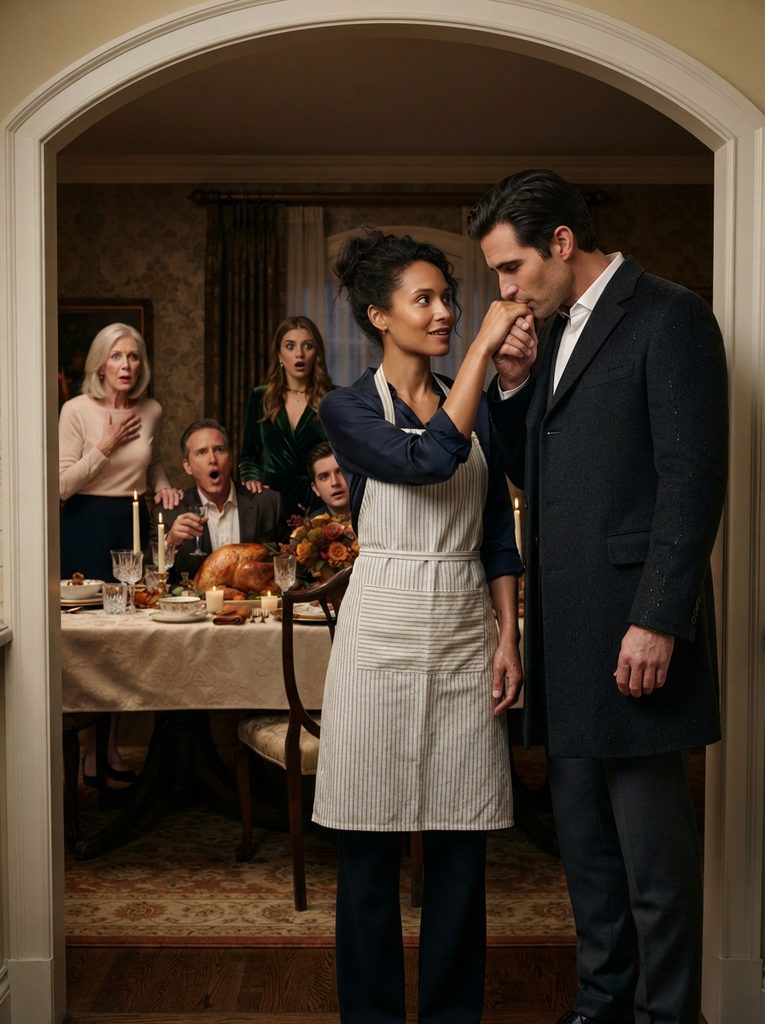
Then a man in a black suit appeared at the kitchen entrance.
He was tall, with dark hair, calm eyes, and the kind of presence that made people lower their voices without knowing why.
His coat was damp from the November rain.
He looked past everyone else and walked straight toward me.
Before I could say anything, he gently took my wet, soap-covered hand, lifted it, and kissed my knuckles.
“Sorry, darling,” he said in a low, steady voice. “I was late.”
Every fork in the dining room froze.
Vanessa stood first.
Logan’s mouth fell open.
My mother’s face lost all its color.
Because the man standing in my parents’ kitchen was not just anyone.
He was Alexander Hayes, billionaire real estate investor and owner of the hotel chain where my father had been begging for a contract for the last six months.
And he had just called me darling.
My father slowly rose from his chair.
“Emma,” he said, his voice shaking. “Do you… know Mr. Hayes?”
Alexander looked at me, then at the apron tied around my waist.
His expression hardened.
“She’s my fiancée,” he said. “And I’d like to know why she’s serving dinner instead of eating it.”
PART 2
Nobody answered him.
The silence stretched so long I could hear the grandfather clock in the hallway and the gravy bubbling softly on the stove.
I should explain something. Alexander was not my fiancé.
Not yet, anyway.
We had met eight months earlier, on a rainy Tuesday, when I was working the evening shift at a catering company in Manhattan. A client’s event had gone sideways, a chef had walked out, and I had quietly taken over the kitchen and saved a dinner for two hundred people. The client turned out to be Alexander’s company. He found me afterward, sitting on an overturned crate behind the loading dock, eating cold bread because I hadn’t had time for lunch.
“You saved my night,” he’d said. “Can I buy you a real meal?”
I’d said no. Then he came back the next week, and the next. He never pushed. He asked questions and actually listened to the answers. When he learned my last name, he said nothing, and only months later did I realize he’d known about my father’s pursuit of his company long before he met me.
“I wanted you to tell me yourself,” he said, when I finally asked. “Without it being about him.”
Three weeks ago, he’d asked me to marry him. I’d said I needed time, because I’d spent twenty-six years learning that wanting something and being allowed to have it were different things.
This afternoon, I had texted him: Thanksgiving at my parents’. I’ll be in the kitchen. Don’t come.
He’d come anyway.
Now he stood in my mother’s kitchen, still holding my hand, and I felt every pair of eyes in that house on my back.
“Mr. Hayes,” my mother said at last, in the bright voice she saved for guests. “What a lovely surprise. Emma is just being modest. She enjoys cooking for the family.”
“Does she?” Alexander turned to me. “Emma, do you enjoy it?”
I opened my mouth. Twenty years of habit rose in my throat like a reflex: It’s fine. I don’t mind. Don’t make a scene.
Then I looked at my hands. Red from hot water. A burn on my left wrist from the oven rack.
“No,” I said.
My mother’s smile flickered.
“No, I don’t enjoy it. I was told to do it. I’ve been told to do it for a long time.”
Vanessa gave a small, brittle laugh. “Emma, don’t be dramatic. Everyone helps out at Thanksgiving.”
“Everyone?” I said. “Vanessa, did you make anything tonight?”
She hesitated. “I brought dessert.”
“From the bakery on Main Street. I saw the box.”
Someone coughed. One of my cousins suddenly became interested in his napkin.
My father cleared his throat. “Emma, perhaps this isn’t the time…”
“When is the time, Dad?” I untied the apron. My fingers shook, but I got it off, folded it, and set it on the counter. “When I was sixteen, you told me it was only for a year. That my college fund would help the business and you’d pay me back when things recovered. Things recovered eight years ago.”
The room went still.
“I finished my degree at night,” I said. “Part-time, while working two jobs. I paid for most of it myself. Nobody came to the graduation.”
“We were busy,” my mother said faintly.
“You were at Vanessa’s charity luncheon. I saw the photos.”
Alexander hadn’t spoken. He stood beside me, close enough that I could feel his warmth, and he did not let go of my hand. He didn’t step in front of me, and he didn’t speak for me. He was simply there, solid as a wall, and for the first time in my life, I felt like I was standing in a room with someone behind me.
“Emma,” my father said, and his voice had changed. It was low, almost pleading. The voice of a man who had just realized how much he stood to lose. “Let’s sit down and talk about this as a family. Mr. Hayes, please. Come, have dinner with us. There’s plenty.”
“Thank you,” Alexander said politely. “But I’ll be eating with Emma. At the table. Where she should have been sitting all evening.”
He looked at my mother.
“Mrs. Whitmore, could you please set another place?”
My mother’s face went through three expressions in two seconds, and she settled on none of them. “Of course,” she said, and went to the cabinet.
My brother Logan finally found his voice. “Hold on. Emma, you’re really engaged to him? You never said anything.”
“You never asked me anything, Logan,” I said. “About anything. For years.”
He looked at his bourbon.
I walked into the dining room. Alexander walked beside me. Forty-one people watched us cross that hardwood floor, and I realized, with a startled little shock, that I wasn’t afraid of any of them.
My mother had to take a chair from the corner. She set it at the head of the table, beside my father, a seat I hadn’t occupied in a decade.
Alexander pulled it out for me.
I sat.
PART 3
Dinner was the strangest meal of my life.
The food I’d cooked sat on the table, still hot. My aunt Patricia, who had never said ten words to me, leaned over and said, “Emma, this stuffing is wonderful. Did you really make all of it?”
“I did,” I said. “And the turkey, and both pies, and the rolls.”
“Why didn’t anyone tell me?” she said, mostly to herself.
“Nobody tells you anything about me, Aunt Patricia,” I said, with a small smile to take the edge off. “That’s the pattern.”
She looked at my mother, and my mother looked at her plate.
Alexander talked easily with my uncle about baseball, with my cousin about law school, and with Vanessa’s husband about golf. He was charming and warm, and he never once mentioned my father’s contract. But every time someone tried to steer the conversation back to business, he brought it back to me with a quiet question: Emma, tell them about the restaurant you’re opening.
I stared at him. “I haven’t told anyone about that.”
“You told me,” he said gently. “It’s good. They should know.”
So I told them.
I told them about the little place I’d been planning for three years: twenty seats, a short menu, and a wall of mismatched plates collected from thrift shops. I’d found a lease in Tarrytown. I’d saved most of the deposit. I’d been afraid to say it out loud, because in my family, an ambition spoken aloud was an ambition waiting to be crushed.
Nobody crushed it.
My cousin Daniel asked about the menu. Aunt Patricia asked about the name. Vanessa’s daughter, who was eight, said she wanted to come on opening day and sit in the kitchen.
“You’d like that,” I told her. “It’s the best seat in the house.”
After dessert, my father asked if he could speak with me alone.
We stood in his study, among shelves of leather-bound books he’d never read. He looked old. I had never noticed that before.
“Emma,” he said. “I owe you an apology.”
I waited.
“The college fund. It wasn’t a loan. I never meant to pay it back. It was easier to tell myself you didn’t need it.” He rubbed his eyes. “I told myself you were strong. That you’d manage. And you did, and I let it become an excuse.”
“Dad.”
“Let me finish. I invited you tonight because Mr. Hayes’s company has been ignoring my calls for six months, and your mother thought if you were here…” He stopped. His mouth tightened. “I don’t know what she thought. That’s not true. I know exactly what we thought. We thought you’d be useful.”
The word landed in the quiet room like a dropped plate.
“I’m sorry,” he said. “It’s not enough. But I’m sorry.”
I looked at him for a long moment.
“Thank you for saying it,” I said. “I’m not going to pretend it fixes anything.”
“I wouldn’t ask you to.”
“And I won’t ask Alexander for your contract. I never would have. You should know that.”
He closed his eyes. “I know.”
“If you want it, you’ll earn it, like anyone else.”
“Yes,” he said. “That’s fair.”
When I came out, my mother was waiting in the hallway, her hands knotted in front of her.
“Emma.” Her voice was stiff, and I could tell she’d practiced it. “I may have been… hard on you.”
“Mom.”
“I thought I was teaching you to be strong.” Her eyes were bright. “My mother did the same to me. I thought that was what you did. You made the daughters strong by making them useful.”
“I know,” I said, more gently than I expected. “I think you did your best with what you were given.”
“That doesn’t make it right.”
“No,” I agreed. “It doesn’t.”
She took a shaky breath. “Would you let me help? With the restaurant? I don’t know anything about it, but I could wash dishes. Fold napkins.”
I considered it honestly.
“Not yet,” I said. “Maybe someday. But I need to know it’s because you want to be there, and not because of who I’m marrying.”
“Are you?” she whispered. “Marrying him?”
I looked down the hallway, through the dining room doorway, at the tall man in the black suit laughing with my seven-year-old cousin over a plate of pumpkin pie.
“I think so,” I said. “But that’s my answer to give. And I’ll give it when I’m ready.”
Alexander drove me home through the rain. The windshield wipers beat a steady rhythm, and for a long while neither of us spoke.
“You were furious that I came,” he said finally.
“I was.”
“I’m sorry. I couldn’t sit in a restaurant eating alone while you were scrubbing pots for people who…” He stopped, jaw tight. “I’m sorry. You asked me not to.”
“You didn’t take over,” I said. “That’s what I was afraid of. That you’d come in and fix it, and I’d just be the girl who got rescued. But you didn’t. You asked me a question and waited. You let me say no.”
“I would never say it for you.”
“I know.” I watched the headlights sweep over wet pavement. “That’s why I’m going to say yes.”
The car slowed. He glanced at me, startled.
“Yes?”
“To the proposal. Three weeks ago, I said I needed time. I think I needed to find out whether I could stand up in that house first. I can.” I smiled, and my eyes stung. “Also, I’d like to be clear that I’m still opening the restaurant, with my own savings, under my own name.”
He laughed out loud, a warm, startled sound, and pulled over beneath a streetlight. “Emma. I wouldn’t have it any other way.”
He kissed me, and it tasted like rain and pumpkin pie.
The restaurant opened eleven months later.
It was called Useful, a name that made my mother wince the first time she saw the sign. I’d kept it on purpose. On the first night, I framed the apron I’d worn that Thanksgiving and hung it behind the register, with a small brass plate beneath it: Everyone deserves a seat at the table.
My father came on opening night, alone, and paid for his dinner. He left a tip so large that I had to take it back, and he argued with me for ten minutes in the kitchen, and I won. He did not mention the hotel contract. Months later, after an honest proposal and three interviews with Alexander’s procurement team that I had nothing to do with, he got a smaller contract than he’d wanted. He seemed oddly proud of it.
My mother started coming on Tuesday afternoons. She folded napkins in the back, said very little, and never once told me how to run my kitchen. One day she brought a recipe card in her mother’s handwriting, for a cranberry relish I’d never tasted, and set it on my counter.
“I never made this for you,” she said. “I should have.”
I put it on the menu that November.
Vanessa came with her kids on a Sunday. She stood near the door with a stiff, uncertain expression until her daughter ran into the kitchen, shouting, “Aunt Emma! I’m here to sit in the best seat!” and I put her on an overturned crate by the stove, with a wooden spoon and a bowl of batter. Vanessa watched from the doorway. When I looked up, her eyes were wet.
“I’m sorry I didn’t help,” she said quietly. “I want to learn how to be better at it.”
“Okay,” I said.
“Okay?”
“It’s a start.” I smiled. “Grab an apron.”
On the first Thanksgiving after we married, we hosted.
Alexander and I had bought a modest house in Tarrytown, with a crooked porch and a kitchen that smelled of cinnamon. The whole family came: my parents, Vanessa and her husband, Logan with a girlfriend whose name he’d actually remembered, aunts, uncles, cousins.
I cooked.
Not because I’d been told to. Because I loved it.
But this time, a dozen hands helped. Aunt Patricia peeled potatoes. Logan, to everyone’s astonishment, made the gravy, with instructions shouted from across the room. My father carved the turkey badly and with great dignity. My mother set the table, and when I walked into the dining room, I saw that she had put a card at the head of the table with my name on it.
Beside it was a card for Alexander. And beside that, a card that read Useful, in her careful, looping handwriting, with a small drawing of an apron.
I looked at her. She looked at me.
“I’ve changed my mind about the word,” she said. “I think it’s the best thing a person can be. As long as they also get to sit down.”
My eyes filled.
“Sit down, Mom,” I said.
She did. Alexander squeezed my hand under the table, and my father said grace, stumbling over the words, and for the first time in my life, nobody was sitting alone in the kitchen.
Not a single one of us.