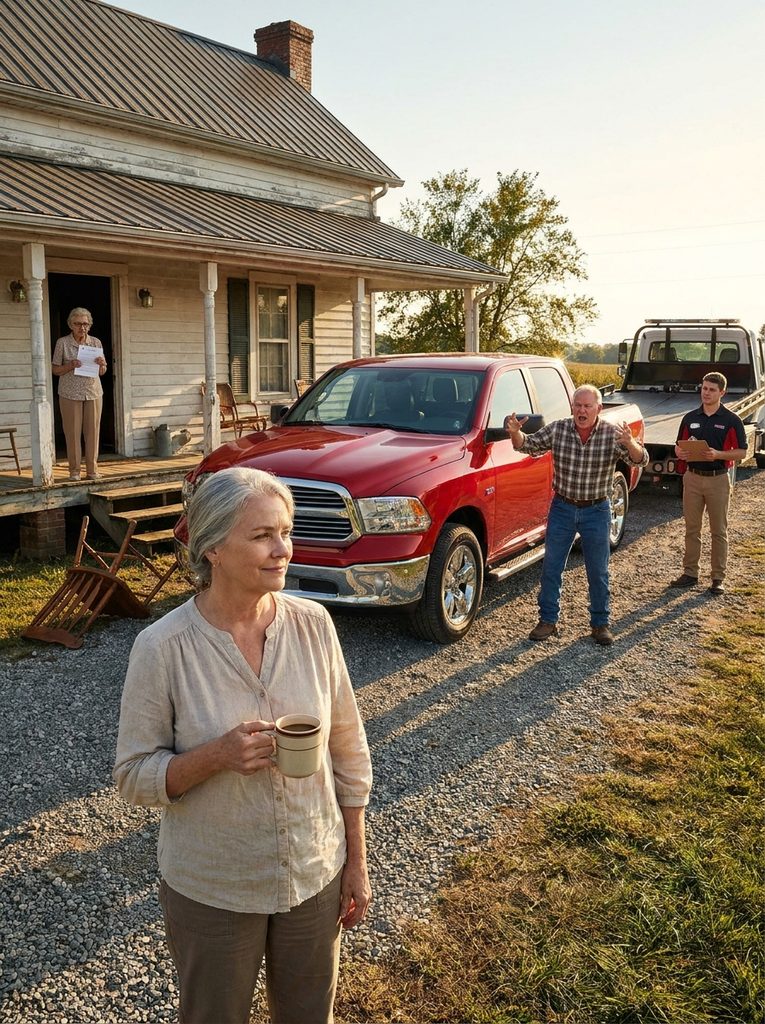
She didn’t look up.
“Be quiet, Delmas. I’m reading.”
The young man from the dealership shifted his weight.
I stood beside the porch post, holding my coffee cup with both hands.
The evening air smelled like wood smoke and fried apples. Somewhere down Pine Branch Road, a dog was barking.
Ethelene read the paper again.
Then she looked at her son.
“Sixty-eight thousand dollars?”
Delmas swallowed.
“That’s the price of a good truck nowadays.”
“Sixty-eight thousand dollars,” she repeated. “And you bought it without having the money?”
“I had an arrangement.”
“What arrangement?”
He pointed at me.
“Stell was going to pay.”
Ethelene slowly turned her head.
“Did you tell her that before you bought it?”
Delmas opened his mouth.
Nothing came out.
“Did you ask your wife?”
“Mother, don’t start.”
“Did you ask her?”
He kicked at the porch mat.
“She has the money.”
I took a sip of coffee.
“Had it,” I said. “Had the money from Mama’s house.”
Ethelene looked at me.
“Stell, did you promise him any of it?”
“No, ma’am.”
“Did you sign anything?”
“No, ma’am.”
“Did you tell the dealership you would pay?”
“No, ma’am.”
Ethelene nodded once.
Then she turned back to the young man.
“Take the truck.”
Delmas stared at her.
“What?”
“Take it.”
“Mother, that’s my truck!”
“No, son. That’s a truck you borrowed from a dealership because you thought your wife was too afraid to tell you no.”
His face turned red.
“You don’t know what you’re talking about.”
Ethelene folded the paper carefully.
“I know more than you think.”
The young man started toward the truck.
Delmas stepped in front of him.
“You can’t take it! I made a deal!”
The young man remained polite.
“Sir, the dealership has not received the agreed payment. We need to follow the paperwork and the terms of the agreement.”
Delmas pointed at me again.
“She has the money! Ask her!”
I looked at him.
“Delmas, you keep pointing at me like I’m the bank.”
Ethelene made a small sound.
It took me a second to realize she was trying not to laugh.
The young man climbed into the truck and started the engine.
Delmas stood there watching as his shiny red pickup rolled up onto the flatbed.
That big white bow was still tied to the hood.
It fluttered in the evening wind.
And just like that, the most expensive thing Delmas had ever owned was headed back to Hazard.
He stood in the driveway until the taillights disappeared.
Then he turned toward me.
“You embarrassed me.”
I set my coffee on the porch rail.
“No, honey. I didn’t.”
“You told them where I was!”
“They asked where the truck would be.”
“You could’ve helped me!”
“I could’ve done a lot of things. I could’ve bought you a truck. I could’ve bought you a boat. I could’ve bought you a little island somewhere. But I didn’t.”
He looked at his mother.
“You’re going to let her talk to me like that?”
Ethelene took off her glasses.
“Delmas, you’re sixty-eight years old. You ought to be embarrassed all by yourself.”
He turned away.
“I’m leaving.”
“Where are you going?” she asked.
“Home.”
“Then go home. But don’t come back here expecting me to tell you you’re right.”
He walked toward our car.
I followed him slowly.
Before I got in, Ethelene caught my hand.
“Stell.”
“Yes, ma’am?”
She looked toward the road.
“Your mama was a good woman.”
I nodded.
“Yes, she was.”
Ethelene squeezed my fingers.
“She told me something about this day.”
I stopped.
“What day?”
“The day you sold her house.”
I stared at her.
Ethelene looked at me for a long moment.
“She told me that if Delmas ever tried to take what she left you, I was to give you something.”
My stomach tightened.
“What did she give you?”
Ethelene reached into the pocket of her apron.
She pulled out a small yellow envelope.
My name was written across the front.
Stella.
In Mama’s handwriting.
I hadn’t seen that handwriting since March.
My knees felt weak.
“Where did you get that?”
“Your mama brought it to me last winter.”
“Why?”
Ethelene glanced toward the road, where Delmas was sitting in the driver’s seat of our old sedan.
“She said you’d know when it was time.”
I took the envelope.
It was sealed.
And on the back, Mama had written six words.
Open this when he shows you who he is.
I didn’t open it that night.
I put it in my purse.
Some things need a quiet room.
And some things need a little time before a woman is ready to hear what her mother has been trying to tell her.
That night, Delmas didn’t speak to me.
Not when we got home.
Not when I washed the dishes.
Not when I turned off the television.
He slept facing the wall.
I lay beside him, holding that yellow envelope in my hand.
At two in the morning, I got up and went into the kitchen.
I turned on the little light over the stove.
Then I opened it.
Inside was one folded sheet of paper.
And one small brass key.
I unfolded the paper.
“Stell,
If you’re reading this, then something happened that I hoped wouldn’t.
I know your husband. I’ve known him for forty-four years, and I’ve watched you make yourself smaller so he could feel bigger.
I didn’t raise you to live that way.
The key is for the box at First Mountain Bank. The box number is written on the back.
There’s something in there you need to see.
Don’t tell Delmas.
And whatever happens, remember this:
A house can be sold.
Land can be divided.
Money can be spent.
But a woman must never sell the part of herself that knows her own worth.
Love,
Mama.”
I sat at that kitchen table until daylight.
Then I turned the paper over.
Box number 117.
I knew that bank.
Mama had kept an account there for years.
But I had never known about a safety deposit box.
And I had a feeling the worst of the story hadn’t even started.
PART 3 — THE SECRET MAMA LEFT BEHIND
Monday morning, I told Delmas I was going to Hazard to buy thread.
That wasn’t a lie.
I did need thread.
I also needed to find out what Mama had left in that bank box.
Delmas was sitting at the kitchen table eating biscuits.
He didn’t look up.
“Don’t forget milk.”
“I won’t.”
“And bring back cigarettes.”
“You quit smoking three years ago.”
“Then bring back whatever I want.”
I looked at him.
For forty-four years, I’d been answering remarks like that with a smile.
That morning, I simply picked up my purse.
The bank was downtown, two doors past the old pharmacy.
A young woman behind the counter asked how she could help me.
I showed her the key.
“My mother left me something here.”
She checked her computer.
“Your mother’s name?”
I told her.
She typed for a minute.
Then she looked at me differently.
“Would you mind waiting just a moment, Mrs. Stella?”
She disappeared through a door.
A few minutes later, a gray-haired man came out.
He introduced himself as Mr. Hensley, the bank manager.
“Your mother was a very particular woman,” he said.
I almost smiled.
“That she was.”
He led me into a small private room.
On the table was a metal box.
He unlocked it and stepped outside.
I sat alone.
For a moment, I couldn’t bring myself to open it.
Then I remembered Mama’s handwriting.
I lifted the lid.
Inside were three things.
A thick envelope.
A small leather notebook.
And a photograph.
The photograph showed Mama standing beside a younger Ethelene in front of the white house on the creek.
They were both smiling.
I turned it over.
Summer of 1989. Two women who knew better than to trust the same man.
I frowned.
What man?
I opened the thick envelope.
The first document was a deed.
I read it twice.
Then a third time.
It was a deed to twenty acres of land adjoining the forty acres behind Mama’s house.
The property was in my name.
Not Delmas’s.
Not Mama’s estate.
Mine.
I looked at the date.
It had been transferred to me twenty-three years earlier.
I had never known.
There was another document.
A letter from an attorney explaining that Mama had arranged the transfer to protect the land she wanted me to inherit.
The property had been held separately, with no ownership interest belonging to my husband.
I sat back.
Twenty acres.
Another piece of land.
Another thing Mama had quietly protected.
Then I opened the leather notebook.
The first pages were filled with Mama’s handwriting.
Dates.
Names.
Amounts of money.
And notes.
Some were ordinary.
Paid electric bill.
But several pages mentioned Delmas.
I read one entry.
October 2007. Delmas asked Stella to borrow against the house. I told her not to do it. He says he wants to help his brother. I don’t believe him.
Another entry:
May 2011. Delmas told Stella the family needed money for a business. The business never existed.
My fingers went cold.
I kept reading.
Then I found an entry dated eight years earlier.
August 2018. Ethelene brought me copies of the papers. Delmas has been asking about the land again. He thinks Stella doesn’t know what her own property is worth.
I stopped.
I picked up the photograph again.
Two women.
One secret.
And suddenly I understood why Ethelene had been waiting for me on that porch.
I took the documents to Mr. Hensley.
“Can you tell me if these are still valid?”
He examined them carefully.
Then he nodded.
“They appear to be properly recorded documents. You should have an attorney review them, but the property records show the transfer in your name.”
I swallowed.
“How much is the land worth?”
He gave me a number.
I thought I’d heard him wrong.
“Could you repeat that?”
He did.
I sat down again.
The additional land was worth considerably more than I’d imagined.
But that wasn’t what frightened me.
It was the final page in Mama’s notebook.
A note written in blue ink.
Stell, if Delmas ever buys something with money he doesn’t have, don’t rescue him. If you rescue him every time, he’ll never learn that your money is not his.
I closed the notebook.
Mama had known.
Not just about the truck.
She had known the kind of man Delmas could become when he thought nobody would stop him.
I drove to the lawyer’s office that afternoon.
His name was Mr. Caldwell.
He reviewed everything and told me the property was properly recorded, subject to confirmation of the full chain of title.
He also advised me to keep my inheritance and accounts separate and to make sure no one had access to my financial information without my permission.
I thanked him.
Before I left, I asked one question.
“Can my husband sell anything that belongs to me without my signature?”
“Not simply because he’s your husband,” he said. “But we need to review any documents he may have signed or any accounts he may have accessed.”
That sentence stayed with me.
Because when I got home, Delmas was waiting.
And he wasn’t alone.
His brother, Raymond, was sitting in my kitchen.
There were papers on the table.
Delmas stood up.
“Where have you been?”
“Out.”
“Doing what?”
“Buying thread.”
Raymond laughed.
“Thread must be expensive nowadays.”
I put my purse down.
Delmas pushed a document toward me.
“We need you to sign something.”
I looked at the paper.
It was a loan application.
The collateral listed was the land behind Mama’s house.
I stared at it.
“Who prepared this?”
“Raymond knows a man at the bank.”
I looked at Raymond.
“And why does he need the land?”
Raymond leaned back.
“Business opportunity.”
“What business?”
“Equipment.”
“What equipment?”
“Trucks and machinery.”
I looked at Delmas.
“Didn’t you just lose one truck?”
His face darkened.
“Don’t start that again.”
I pushed the paper back.
“I’m not signing.”
Raymond stood up.
“Now, Stell, let’s not make this difficult.”
I looked at him.
“You can leave my kitchen.”
He laughed.
“Excuse me?”
“You heard me.”
Delmas slammed his hand on the table.
“You’re going to sign that paper.”
For the first time in forty-four years, I didn’t lower my eyes.
“No.”
He stared at me.
Then he said something I would remember for the rest of my life.
“You think that money makes you somebody?”
I looked at the man I’d cooked for, washed for, worked beside, and defended for most of my adult life.
“No, Delmas. But apparently not having it made you think you could be somebody by taking mine.”
Raymond grabbed his jacket.
Delmas stood motionless.
I picked up the loan application and tore it in half.
Then I handed the pieces back to him.
“Take your business somewhere else.”
That night, I called Ethelene.
I told her everything.
She was quiet for a long time.
Then she said:
“Stell, there’s something else you ought to know.”
“What?”
“Your mama didn’t just leave you that land.”
I sat down.
“Then what did she leave?”
Ethelene sighed.
“She left you the truth about what happened to your money twenty years ago.”
PART 4 — THE TRUTH THAT CHANGED EVERYTHING
The next morning, I drove to Ethelene’s house.
She was sitting at her kitchen table, peeling apples.
Her glasses were resting on top of her head.
There was a pot of coffee on the stove and a plate of biscuits covered with a towel.
She looked up when I walked in.
“Sit down, Stell.”
I did.
She poured coffee into two cups.
For a while, neither of us spoke.
Then she reached into a drawer and pulled out an old photograph.
It showed Delmas standing beside a man I recognized.
Raymond.
They were younger, probably in their forties.
Behind them was a small piece of machinery.
“What is this?” I asked.
“Something your mama asked me to keep.”
I studied the photograph.
Ethelene took a deep breath.
“Years ago, Delmas and Raymond wanted to buy some land. They told everybody they were going to build a repair shop.”
“I remember.”
“You remember giving Delmas money?”
I nodded.
“Twenty thousand dollars.”
“Your mama gave you that money, didn’t she?”
My hands tightened around the cup.
“Yes.”
“She sold some timber off the back acreage and gave you the money for a savings account. She wanted you to have something of your own.”
I remembered that summer.
Delmas had come home talking about an opportunity.
He said his brother had found a good deal.
He said we would have something to retire on.
He asked me to put the money into the business.
I had believed him.
“What happened to it?” I asked.
Ethelene looked down.
“Your mama found out the business never happened.”
I felt my throat tighten.
“Where did the money go?”
“Some of it went to pay off Delmas’s debts. Some went to Raymond. And some went into a truck.”
I stared at her.
“Another truck?”
“An old one. Not a new one like this red thing.”
I sat back.
“Did Mama know?”
“She found out a year later. She wanted to tell you, but you were so determined to keep your marriage together.”
I covered my face.
For a moment, I was twenty-eight again.
I could see myself standing in Mama’s kitchen, telling her that Delmas was going to make something of himself.
I remembered Mama’s expression.
She hadn’t argued.
She had just said:
“Stell, a man who loves you won’t need you to go broke proving it.”
I thought she was being hard on him.
Now I understood.
Ethelene pushed the photograph toward me.
“Your mama kept copies of everything.”
“Why didn’t she tell me?”
“She said you’d have to find the truth yourself. Otherwise, you’d spend the rest of your life thinking she was trying to turn you against your husband.”
I wiped my eyes.
“She knew me too well.”
Ethelene reached across the table.
“She loved you too much to lie to you.”
I stayed until lunchtime.
Before I left, Ethelene gave me another envelope.
“This one is mine,” she said. “Not your mama’s.”
I opened it.
Inside was a handwritten statement.
It described what she knew about the old business arrangement, including dates and the money Delmas had received.
At the bottom, she had signed her name.
“Why are you giving me this?”
“Because I’m eighty-nine years old, and I don’t intend to spend whatever time I’ve got left pretending my son has never done anything wrong.”
I hugged her.
She hugged me back.
And for the first time in years, I felt like I wasn’t standing alone.
When I got home, Delmas was in the living room.
He had been drinking coffee.
He looked at me.
“Where have you been?”
“Ethelene’s.”
His expression changed.
“What did she tell you?”
“Enough.”
He stood up.
“She’s old. She gets confused.”
“She seemed clear to me.”
He walked closer.
“You need to stop letting people put things in your head.”
I took off my coat.
“Delmas, I don’t need anybody to put anything in my head. I have my own.”
He shook his head.
“You’re making a big mistake.”
“No. I think I made a few mistakes a long time ago.”
He stared at me.
Then he lowered his voice.
“What do you want?”
I thought about that question.
For most of my marriage, I had wanted simple things.
A little peace.
A little kindness.
A husband who asked how my day had been.
A man who didn’t treat my hard work like it belonged to him.
I looked at him.
“I want you to stop spending money you don’t have and stop making promises with money that isn’t yours.”
He laughed bitterly.
“That’s it?”
“That’s a start.”
He walked away.
I thought the conversation was over.
But I was wrong.
Because two days later, I received a letter from the dealership.
It wasn’t addressed to Delmas.
It was addressed to me.
Inside was a copy of the purchase paperwork.
And a note explaining that the dealership had received a call from someone claiming to be my husband, requesting that they contact me about payment.
There was another document attached.
A financial application.
My name was printed on it.
My signature appeared at the bottom.
I stared at it.
I had never signed that paper.
I took it straight to Mr. Caldwell.
He looked at the document and then at me.
“Did you authorize anyone to sign this?”
“No.”
“Did you give your husband permission?”
“No.”
He examined the signature.
“I can’t determine whether it’s forged just by looking at it. But we can preserve the original and address this properly.”
He explained the steps I could take, including notifying the dealership that I disputed the signature and making sure my credit records were protected.
I did exactly that.
Then I went home.
Delmas was sitting on the porch.
I put the papers on the table in front of him.
“What is this?”
He glanced down.
His face changed.
“Where’d you get that?”
“From the dealership.”
He said nothing.
“Did you sign my name?”
“No.”
“Then tell me who did.”
He rubbed his forehead.
“I was going to explain.”
“When?”
He didn’t answer.
“Before or after they took money out of my account?”
He stood up.
“Stell, listen to me.”
I held up my hand.
“No. You listen to me.”
My voice was quiet.
But I had never been more certain of anything.
“You bought a truck with money you didn’t have. You told people I promised to pay. You tried to borrow against land that belongs to me. And now there’s paperwork with my name on it that I never signed.”
He looked toward the window.
“Raymond said it would be fine.”
I felt something inside me go still.
“Raymond?”
“He said it was just paperwork. He said once the money came through, nobody would care.”
I shook my head.
“You’re a grown man, Delmas.”
“I know.”
“Then start acting like one.”
He sat down.
For the first time, he looked frightened.
Not angry.
Not offended.
Frightened.
And I realized that the thing he was most afraid of losing wasn’t me.
It was the life he’d become accustomed to having at my expense.
PART 5 — THE WOMAN WHO FINALLY SAID NO
The next week was the longest week of my life.
I changed the passwords on my accounts.
I spoke with the bank.
I gave the dealership a written statement disputing the signature.
Mr. Caldwell helped me understand the legal options and what documents needed to be preserved.
I didn’t shout.
I didn’t threaten.
I simply stopped allowing people to use my name without my permission.
Delmas spent most of those days in the garage.
He barely ate.
One evening, he came into the kitchen while I was making soup.
“Stell?”
“Yes?”
“Can we talk?”
I turned off the burner.
He pulled out a chair.
“I’ve been thinking.”
“That’s good.”
He looked at the floor.
“I shouldn’t have bought that truck.”
“No.”
“I shouldn’t have told people you were paying.”
“No.”
“And I shouldn’t have signed those papers.”
I folded my dish towel.
“Did you sign them?”
He took a long breath.
“Raymond helped me.”
“That’s not what I asked.”
He looked up.
“Yes.”
I nodded.
The truth was painful.
But it was still better than another lie.
“Why?”
He rubbed his hands together.
“I wanted something nice. Everybody around here has new trucks. I figured after all those years, I deserved one.”
“Then you should’ve saved for one.”
“I thought you had plenty.”
“I did have plenty. It was Mama’s.”
He looked away.
“She was your mother. You were going to inherit it anyway.”
I stared at him.
“Do you hear yourself?”
He didn’t answer.
“She worked for what she had. She saved it. She left it to her daughter. And you decided that meant you could spend it?”
His eyes watered.
“I’m sorry.”
I believed he was sorry.
But I wasn’t sure what he was sorry for.
Losing the truck?
Being caught?
Or hurting me?
Those are three different things.
I sat down across from him.
“Delmas, I don’t know what happens next.”
He nodded.
“I know.”
“I’m not paying for that truck.”
“I know.”
“I’m not signing the land over to you.”
“I know.”
“And I’m not pretending that paperwork didn’t happen.”
He stared at his hands.
“What do you want me to do?”
I took a breath.
“I want you to tell the truth. I want you to cooperate with the bank and the dealership. I want you to stop blaming your brother. And I want you to understand that saying sorry doesn’t erase what happened.”
He nodded slowly.
For once, he didn’t argue.
The following Monday, we met with Mr. Caldwell.
Delmas gave his account of what had happened with the truck paperwork.
The attorney advised him to obtain independent legal advice about his own responsibilities.
Raymond was contacted as well.
He was furious.
He called me twice.
The first time, I didn’t answer.
The second time, I picked up.
“Stell, you’ve got this all wrong.”
“Then explain it.”
“Delmas and I were trying to make something happen.”
“With my money?”
“Family money.”
I closed my eyes.
“Raymond, Mama left that money to me.”
“You’re his wife.”
“And you’re his brother.”
He went quiet.
I continued.
“That doesn’t mean either of you owns what I own.”
He hung up.
Two days later, Ethelene called.
“He’s been here.”
“Who?”
“Raymond.”
“What did he want?”
“Money.”
I sighed.
“Of course he did.”
“He wanted me to tell Delmas to stop talking.”
I leaned against the counter.
“What did you say?”
“I told him to go home.”
I smiled.
Ethelene was eighty-nine years old, but she could still put a grown man in his place with six words and a look.
Then she said something that surprised me.
“I want you and Delmas to come for supper Saturday.”
I hesitated.
“Are you sure?”
“Yes.”
“Will Raymond be there?”
“No.”
“Then we’ll come.”
Saturday arrived.
I wore my blue dress.
Delmas wore his Sunday shirt.
We drove to Pine Branch Road in the old sedan.
The driveway looked strangely empty without the red truck.
Ethelene was standing at the kitchen window.
When we came in, she had fried chicken, mashed potatoes, green beans, biscuits, and apple pie waiting.
She looked at her son.
“Sit down.”
He sat.
She placed a plate in front of him.
Then she looked at me.
“Stell, I want you to hear something.”
I set down my fork.
Ethelene took a breath.
“I knew what Delmas was doing years ago. I knew about the money from your mama. I knew about the business that never happened.”
Delmas stopped chewing.
“Mother.”
She raised one finger.
“Not one word.”
He looked down.
She continued.
“I didn’t tell Stella because I thought I was protecting my son. I was wrong. I should’ve told her.”
Her eyes filled.
“Your mama was a better woman than me in that regard.”
I reached across the table and held her hand.
“You did what you thought was right.”
“No,” she said. “I did what was easy.”
Nobody spoke for a moment.
Then she looked at Delmas.
“Son, I love you. But loving you doesn’t mean helping you lie.”
Delmas put down his fork.
“I know.”
Ethelene nodded.
“Good. Then perhaps there’s hope for you yet.”
We finished supper quietly.
When I got up to help with the dishes, Ethelene stopped me.
“Leave them.”
“Who’ll wash them?”
“I’ll get to them.”
I smiled.
“You’re eighty-nine.”
“And you’re sixty-six. Between us, we ought to manage a few plates.”
We laughed.
It was the first real laugh I’d had in weeks.
PART 6 — WHAT MAMA REALLY LEFT ME
Three months passed.
The legal and financial matters took time.
Delmas cooperated with the process, and the disputed paperwork was addressed through the appropriate channels.
The dealership had its truck back.
The red pickup was eventually sold to another buyer.
I never found out who bought it.
I didn’t care.
What mattered was that my inheritance remained mine.
Mr. Caldwell helped me review Mama’s property documents.
The additional twenty acres were properly confirmed as belonging to me.
I also learned that Mama had left a small savings account specifically for repairs to the creek house.
It wasn’t a fortune.
But it was enough to fix the roof, repair the porch, and replace the old windows.
One Saturday, I drove out to the property.
The little white house stood beside the creek, just as it had when I was a girl.
The porch needed painting.
The screen door still squeaked.
A few boards on the steps were loose.
But the place was beautiful.
I walked through every room.
Mama’s bedroom.
The kitchen where she’d taught me to make biscuits.
The little living room where she used to sit and sew while the radio played.
I opened the window.
The sound of the creek came through.
And for a moment, I could almost hear her.
“Don’t stand there looking sad, Stell. There’s work to do.”
I laughed.
Then I cried.
Not because I was unhappy.
Because I finally understood that Mama hadn’t left me just a house.
She’d left me a place where I could remember who I was before I spent forty-four years trying to make everybody else happy.
I hired a local carpenter to repair the porch.
I had the kitchen painted a soft yellow.
I planted flowers along the walkway.
I kept Mama’s old rocking chair.
And I put the brass key from the bank in a little wooden box on the mantel.
A reminder.
Not of money.
Of the truth.
Delmas and I continued living in the house we’d shared.
But things were different.
I opened my own mail.
I kept my own financial records.
I made my own decisions.
And when Delmas asked for money, I no longer handed it over without questions.
Sometimes he complained.
Sometimes he was quiet.
But I didn’t return to the old ways.
One afternoon, he came into the kitchen.
“Stell, I was thinking about getting another truck.”
I looked up from my sewing.
“What kind?”
“Used one. Something reasonable.”
“How much?”
“Maybe fifteen thousand.”
“Do you have fifteen thousand?”
He hesitated.
“Not all of it.”
I put my sewing down.
“Then you don’t have fifteen thousand.”
He nodded.
“I figured you’d say that.”
I almost smiled.
“Well, at least one of us is learning.”
He went outside.
I returned to my sewing.
And that was that.
I didn’t have to yell.
I didn’t have to explain.
I simply didn’t give away what I couldn’t afford to lose.
By October, I had finished fixing the creek house.
I invited Juanice over for lunch.
She brought a pie.
We sat on Mama’s porch, listening to the water.
She looked around.
“Stell, your mama would be proud.”
I looked at the white curtains moving in the breeze.
“I hope so.”
Juanice took a bite of pie.
“Do you think you’ll keep it?”
I nodded.
“I think so.”
“What’ll you do with it?”
I smiled.
“Something Mama would’ve liked.”
The next spring, I started a little sewing group.
Nothing fancy.
Just a few women from the county who came on Thursday afternoons.
We repaired old quilts.
We made curtains.
We taught younger women how to sew buttons and mend hems.
Sometimes we sat around the kitchen table and talked.
Sometimes we cried.
Sometimes we laughed so hard that somebody nearly dropped a cup of coffee.
I called it Mama’s Table.
It started with four women.
Then eight.
Then twelve.
A widow from Jenkins came.
A retired teacher from Whitesburg came.
Juanice brought her granddaughter.
Nobody paid anything.
If a woman needed help with fabric or supplies, we found a way.
And every Thursday, I put out cornbread.
Just like Mama used to.
One afternoon, Ethelene came by.
She walked slowly up the porch steps.
I helped her into the kitchen.
She looked around.
“Well, I’ll be.”
“What?”
“This place feels like home.”
I smiled.
“It is.”
She sat down.
I poured her coffee.
Then she looked at the old photograph of her and Mama, now sitting in a frame on the shelf.
“Your mama would’ve liked this.”
I sat beside her.
“She would’ve liked you coming, too.”
Ethelene reached over and patted my hand.
“Stell, I’ve been meaning to tell you something.”
“What is it?”
“Delmas has been asking about you.”
I raised an eyebrow.
“He lives with me.”
“I know. But he’s been asking what you’re doing out here. He says you seem happier.”
I looked out the window.
The creek was shining in the afternoon sun.
“I am happier.”
Ethelene nodded.
“Good.”
Then she said something I never expected.
“He told me he misses the woman you used to be.”
I laughed softly.
“The woman I used to be spent forty-four years saying yes when she wanted to say no.”
Ethelene smiled.
“Then perhaps he ought to get acquainted with the woman you’ve become.”
We both laughed.
And for the first time, I didn’t feel guilty about it.
PART 7 — THE LAST LETTER
The following March, one year after Mama passed, I went to the cemetery.
I took flowers.
White ones.
Mama’s favorite.
I cleaned the little stone and sat beside it.
The grass was wet.
The wind was cold.
I placed the flowers in the vase.
“Well, Mama,” I said, “you certainly left me a mess to sort out.”
I smiled.
Then I told her about the truck.
About the bank.
About the twenty acres.
About Ethelene.
About the sewing group.
I told her that I had finally learned to say no.
And that saying no didn’t mean I had stopped loving people.
It just meant I had started loving myself, too.
I sat quietly for a while.
Then I remembered the final page of the notebook.
There was another sentence I’d never paid much attention to.
There is one more letter. Give it to Stella on the anniversary of my passing.
I had found it tucked between the pages.
But I hadn’t opened it.
I brought it with me that morning.
The envelope was small.
My name was on the front.
I opened it carefully.
“Stell,
If you’ve made it this far, then you’ve learned something I tried to teach you all your life.
You cannot make a person respect you by giving them more of yourself.
You cannot buy peace by paying for everybody else’s mistakes.
And you cannot keep a marriage alive by letting one person do all the living.
I know you loved Delmas.
I know you still do, in whatever way a woman loves a man after forty-four years.
I won’t tell you to leave him.
I won’t tell you to stay.
That choice belongs to you.
But I want you to understand something.
You were my daughter before you were anybody’s wife.
You were a little girl before you were anybody’s helper.
You were a person before the world started telling you what you owed it.
Don’t forget her.
Don’t forget yourself.
The house was never the most important thing I left you.
The land was never the most important thing.
Even the money wasn’t.
It was the freedom to choose what happens next.
Use it wisely.
And when you make your biscuits, don’t forget the salt.
You always did forget the salt.
Love you forever,
Mama.”
I laughed.
Then I cried.
Because even from the grave, Mama could still find a way to tell me I was doing something wrong in the kitchen.
I folded the letter and put it back in my purse.
Before I left, I touched the top of her headstone.
“I love you, Mama.”
Then I stood up.
I had somewhere to be.
Twelve women were waiting at the creek house.
And I had cornbread to make.
PART 8 — THE RED TRUCK CAME BACK
That summer, something happened I never expected.
I was sitting on the porch at Mama’s house when I heard an engine coming up the gravel road.
A red pickup.
Not the same one.
An older model, with a dent in the driver’s door.
It stopped near the gate.
Delmas got out.
He walked toward me slowly.
I set down my sewing.
“Well, look who’s here.”
He looked at the house.
“Looks nice.”
“Thank you.”
He stood there for a moment.
Then he looked at the chair beside mine.
“Can I sit?”
I nodded.
He sat down.
For a while, we listened to the creek.
Then he spoke.
“I bought a truck.”
“I see that.”
“Used one. Paid cash.”
“That’s good.”
He rubbed his hands together.
“I sold some tools. Took extra work. Saved for it.”
I looked at him.
“Well, congratulations.”
He nodded.
Then he looked down.
“I wanted you to know I paid Raymond back some of the money.”
“That’s between you and him.”
“I know.”
He was quiet.
Then he said:
“I’ve been thinking about what your mama wrote.”
I turned toward him.
“You read Mama’s letter?”
“No. Ethelene told me some of it.”
I smiled.
“She talks too much.”
“She sure does.”
We both laughed a little.
Then Delmas looked at me.
“Stell, I know I hurt you.”
I didn’t answer.
“I know I acted like everything you had belonged to me.”
I folded my sewing.
“I did a lot of things wrong.”
He swallowed.
“I don’t expect you to forget.”
“Good.”
“I just wanted to tell you I’m sorry.”
I looked at him.
There was a time when those words would’ve been enough to make me forgive everything.
But I wasn’t that woman anymore.
“Delmas, I appreciate you saying that.”
He nodded.
“But trust isn’t something you get back just because you ask for it.”
“I know.”
“And I don’t want to go back to the way things were.”
He looked toward the creek.
“I don’t either.”
I studied him.
He looked older.
His shoulders were lower.
The anger that used to sit on his face had softened.
Maybe losing that truck had taught him something.
Maybe the years had.
Maybe it was both.
I poured another cup of coffee.
“Do you want some?”
He nodded.
I brought him a cup.
He took a sip.
Then he looked at me.
“Your mama made good coffee.”
“She did.”
“She never liked me.”
I laughed.
“She liked you fine when you behaved.”
He smiled.
For a little while, we sat there like two ordinary people.
Not a husband and wife fighting over money.
Not a man and woman trying to win an argument.
Just two people who had shared a long life and were trying to figure out what came next.
Before he left, Delmas stood at the gate.
“Stell?”
“Yes?”
“Are you coming home tonight?”
I looked at the house.
Then at him.
“I’ll come home when I’m ready.”
He nodded.
“All right.”
And he drove away.
I watched the red truck disappear down the road.
Then I went back inside.
The women would be arriving soon.
There were quilts to finish.
Coffee to make.
And a pan of cornbread waiting to go into the oven.
FINAL PART — WHAT $214,000 COULDN’T BUY
It’s been two years since the day I sold Mama’s house.
The closing check was $214,000.
I remember the number because I thought it would change my life.
It did.
Just not in the way Delmas expected.
He thought that money would buy him a brand-new red truck.
He thought it would make him the talk of Main Street.
He thought he’d finally have something shiny enough to show everybody that he was doing well.
But that money bought me something far more valuable.
It bought me the chance to stop being afraid.
I still live with Delmas, though our marriage is different now.
We have separate financial accounts.
We talk about major decisions.
And I don’t agree to things just to keep the peace.
Some days are good.
Some days are difficult.
I don’t pretend that forty-four years of habits disappear overnight.
But I don’t make excuses for him anymore.
He works.
He pays his bills.
He drives his used truck.
And when he wants something expensive, he saves for it.
Sometimes he even asks me what I think.
I suppose that’s progress.
Ethelene is still with us.
She’s ninety-one now.
She still makes supper on Saturdays, though her granddaughter helps with the cooking.
She keeps Mama’s photograph on her living room shelf.
And every time I visit, she says the same thing.
“Your mama knew.”
I always answer:
“Yes, she did.”
The sewing group at the creek house has grown.
We now have seventeen women.
We made quilts for three families who lost their homes in a fire.
We repaired curtains for the senior center.
We taught six young girls how to sew.
And last Christmas, we made little cloth angels and gave one to every woman who came through the door.
I kept one for Mama.
It sits on the windowsill beside her old rocking chair.
Sometimes, when the afternoon light comes through the curtains, I sit there and think about the woman I used to be.
The woman who never wanted to upset anybody.
The woman who apologized when someone else hurt her.
The woman who believed that keeping a marriage meant keeping her mouth shut.
I wish I could go back and tell that younger Stella something.
I’d tell her that being a good wife doesn’t mean being an unpaid bank.
I’d tell her that love doesn’t require a woman to surrender every dollar she earns or inherits.
I’d tell her that a man can be disappointed without her being responsible for fixing it.
And most of all, I’d tell her that sixty-six is not too old to begin again.
Last Saturday, Delmas came with me to Mama’s grave.
He carried the flowers.
He stood beside me while I cleaned the stone.
Then he looked down at the inscription.
“She was a strong woman.”
I nodded.
“Yes, she was.”
He was quiet for a minute.
Then he said:
“She raised one, too.”
I looked at him.
He wasn’t smiling.
He meant it.
I didn’t say anything.
I just put my hand on his arm.
When we got back to the car, he opened the passenger door for me.
I climbed in.
He walked around to the driver’s side.
And before he started the engine, he said:
“You know, Stell, I never did get that new red truck.”
I looked out the window.
“Well, honey, you sure did get to see one.”
He laughed.
I laughed, too.
And for the first time, the memory didn’t hurt.
That evening, I sat on Mama’s porch with a cup of coffee.
The creek was running high from the rain.
The little white curtains were moving in the breeze.
I took Mama’s letter from my purse and read the last line again.
Don’t forget the salt.
I smiled.
Then I heard Juanice calling from the driveway.
“Stell! You got that cornbread ready?”
I stood up.
“Coming!”
I went into the kitchen.
The pan was on the counter.
The women were arriving.
And there was enough food for everybody.
I thought about the day I sold Mama’s house.
I thought about that $214,000 check.
I thought about the red truck with the big white bow.
And I thought about Ethelene standing on her porch, reading those papers while her son shouted that his wife would pay.
If I could go back to that day, I wouldn’t change a single thing.
Not the truck being taken.
Not the argument.
Not even the tears.
Because sometimes the thing that gets taken away from you is the very thing that shows you what was never yours to begin with.
Delmas thought the truck was the prize.
I thought the money was the inheritance.
But Mama knew better.
The real inheritance was the freedom to stand on my own two feet.
And if there’s one thing I’ve learned at sixty-eight years old, it’s this:
A woman can spend forty-four years making a home for somebody else and still have time to build one for herself.
So I locked the screen door, put the kettle on, and set another plate at Mama’s table.
Because the house was quiet no longer.
And neither was I.
THE END.