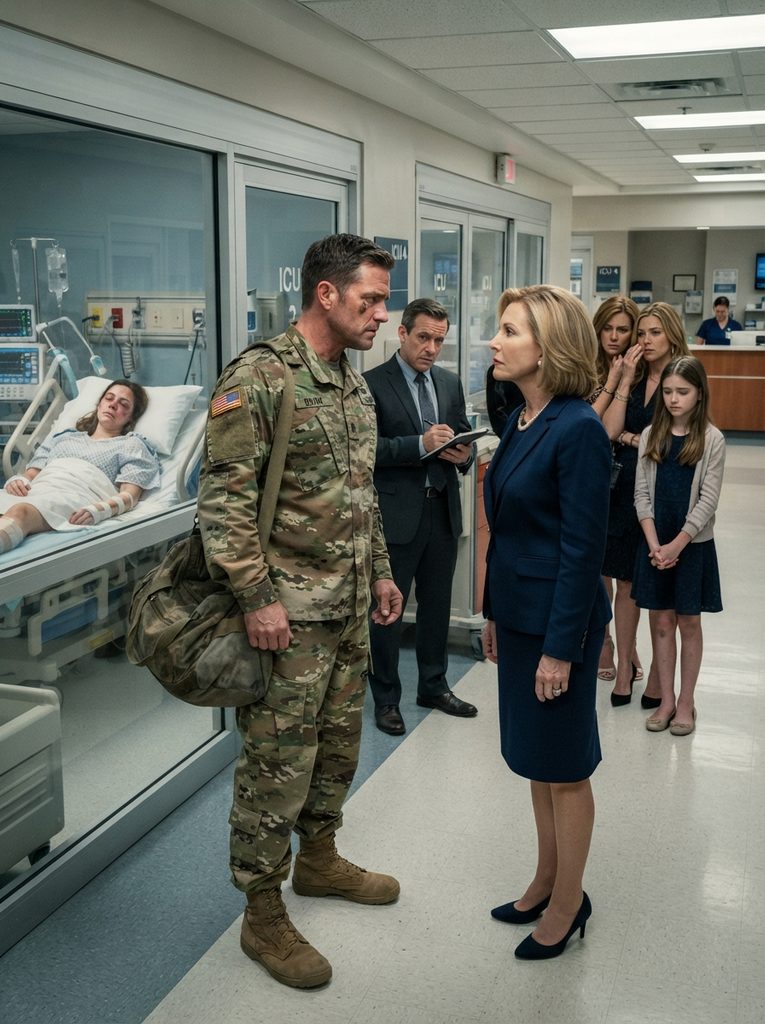
I stepped off a classified military transport plane and walked straight into the intensive care unit, where my wife lay struggling to breathe with twenty seven broken bones and a fractured skull.
Outside her hospital room, her mother and six sisters stood smiling in the hallway as if they were casually waiting for a table at an upscale restaurant. The local detective assigned to her case leaned closer to me and whispered that this wealthy family practically owned the entire county.
I looked through the glass window at my wife’s bruised and swollen face and told him quietly that my authority reached far beyond their county lines.
My name is Wyatt Mercer, and I had spent the past seven months serving on a top secret Army deployment overseas. Every single day of that mission, I counted down the hours until I could finally return home to my wife, Tessa.
I had pictured her waiting on our front porch in Virginia, pretending she had not spent the entire afternoon staring down the gravel driveway for my truck.
Instead of a warm welcome, my satellite phone rang eleven hours before my transport plane was scheduled to touch down at Fort Bragg. The emergency nurse on the other end of the line spoke with urgent panic and told me that my wife was in intensive care and needed me immediately. When I finally rushed through the sliding doors of Mercy Crest Medical Center, fine desert dust still coated my combat boots.
Dr. Owen Gallagher was waiting near the nurses station outside the secured intensive care ward with a grim expression on his face. I gripped his shoulder tightly and asked him to tell me everything about her condition right away.
“Your wife is alive, Captain Mercer, though she is in critical condition,” Dr. Gallagher told me carefully while checking his clipboard.
“What exactly happened to her, Doctor?” I asked, trying to keep my voice steady despite the rage building in my chest.
“She suffered twenty seven distinct fractures across her body, including five broken ribs, shattered bones in both wrists, a broken left femur, and multiple severe fractures to her face and skull,” he explained quietly. “She is also dealing with dangerous internal bleeding and heavy head trauma, which is why we placed her on a ventilator.”
The hallway around me seemed to narrow until nothing else in the world mattered except the woman lying behind that glass wall. I took a deep breath and asked him how many people he thought had attacked her inside our house.
“The pattern of her injuries strongly suggests that more than one person was involved in this assault,” Dr. Gallagher replied, lowering his voice so no one else could hear.
“It looks like someone held her down while another attacker swung a heavy metal object, possibly a fireplace poker or a framing hammer.”
I pushed open the heavy door and walked slowly toward Tessa’s bed, feeling my heart break with every step. Her face was so badly swollen that I could barely recognize the gentle woman I had married four years ago. Part of her long dark hair had been shaved away for surgery, both of her wrists were locked in thick splints, and her injured left leg was suspended high in metal traction.
I had seen brave soldiers pulled from burning armored vehicles after devastating ambushes in the middle of the night. Nothing in my military career had ever prepared me to see my own wife broken like this in a hospital bed.
I gently rested my calloused hand on her uninjured right shoulder and leaned close to her ear.
“Tessa, sweetheart, it is Wyatt, and I am finally home with you,” I whispered softly, hoping she could hear my voice through the darkness.
Only the steady mechanical rhythm of the ventilator answered me in the quiet room. I walked back out into the bright corridor and turned my attention toward the group of women standing near the waiting area.
Margaret Dawson, Tessa’s mother, sat stiffly beneath the harsh fluorescent lights wearing a tailored navy suit and an expensive strand of pearls. Standing right beside her chair were all six of Tessa’s sisters, namely Lauren, Rachel, Brooke, Kayla, Jenna, and Molly.
The Dawson family owned Dawson Aviation Systems, a massive defense contracting corporation with deep political ties stretching across the entire state of Virginia. Yet not a single one of those seven women looked remotely sad or worried about Tessa fighting for her life.
Lauren was casually scrolling through social media on her phone without looking up.
Brooke was quietly laughing at a joke that Jenna had just whispered in her ear, while Margaret glanced impatiently at her gold wristwatch as if she had a luncheon to attend.
Detective Craig Dalton stood beside them holding a small notepad, looking uncomfortable whenever Margaret glanced his way. I walked straight over to the detective with my boots thudding against the linoleum floor.
“Detective, I want to know what happened inside my house tonight,” I demanded firmly, keeping my eyes locked on his face.
“We believe it was a residential burglary gone wrong, Captain,” Detective Dalton replied quickly, shifting his weight from one foot to the other. “Your wife apparently came downstairs and surprised the intruders in the dark.”
“What did the thieves actually steal from my home?” I asked, narrowing my eyes because nothing about his story made sense.
“They took some electronics, jewelry, and possibly some cash from the kitchen,” he answered vaguely while avoiding direct eye contact.
“How did they manage to break into the house in the first place?” I pressed him further, knowing my security locks were top grade.
“They came in through the rear kitchen door,” Detective Dalton said, pausing briefly to glance in Margaret’s direction before continuing. “We are still investigating whether the lock was forced open from the outside.”
A cold knot tightened in my stomach as I realized the detective was hiding something important. I stepped closer to him and asked how long Tessa’s family had been waiting at the hospital.
“They actually arrived at the emergency room before the ambulance even pulled into the bay,” Detective Dalton admitted in a low whisper.
I stared at him in total disbelief, wondering how they could possibly have known about an attack at an isolated farmhouse miles outside of town.
When I asked him how they found out so fast, the detective simply shrugged and claimed he did not know.
“Captain, there is something you really need to understand about this town,” Detective Dalton murmured as he glanced nervously down the hall. “The Dawson family holds enormous power around here, and they have close friends inside the sheriff’s department, the district attorney’s office, and the hospital board.”
“Are you telling me you are going to sweep this under the rug?” I asked sharply, feeling disgust rise in my throat.
“Margaret practically funds half the county budget, so there is really not much my department can do against her wishes,” he muttered before walking away toward the elevator.
I looked back through the glass window at Tessa, focusing on the deep, narrow wound near her left temple. This brutal assault had never been a random burglary by desperate thieves looking for loose cash.
Someone had planned this attack with cold precision, and they had intended to make sure Tessa never woke up again.
Margaret stood up from her chair and walked toward me with a practiced, emotionless smile on her face. “Wyatt, my family will be taking over all decisions regarding Tessa’s medical care from this moment forward,” she announced in a cold, commanding tone.
“She is my legal wife, Margaret, and I am making her medical decisions,” I replied evenly, refusing to back down an inch.
“You are never even in the country to take care of her,” Margaret snapped back as Lauren stepped forward to back her mother up.
“You have been gone for seven whole months, Wyatt, leaving her completely alone,” Lauren added with a smug smirk on her face.
“I was serving on an active military deployment for this country,” I answered calmly, glaring at both of them.
“Besides, Tessa spent the last five years trying to get as far away from this toxic family as possible.”
Heavy silence fell over the hospital corridor as my words echoed off the walls. I shifted my gaze past Margaret and looked directly at Molly, the youngest of the six sisters.
Molly was the only person in that entire group who refused to meet my eyes. She kept staring down at her shoes, and I noticed her hands were trembling slightly against her coat.
I took two steps toward Molly and asked her softly to tell me what really happened inside my house that night. Before Molly could open her mouth, Margaret stepped directly between us and raised her hand like a shield.
“You will not interrogate my daughter in a public hallway, Wyatt,” Margaret hissed angrily.
“Tessa is your daughter too, in case you forgot,” I reminded her coldly, staring straight into her eyes.
Margaret’s expression turned to pure ice as she leaned forward slightly. “Tessa stopped being my daughter a very long time ago,” she said without a shred of remorse.
There it was, spoken out loud in front of witnesses, practically confirming everything I already suspected. I leaned down closer to Margaret so only she could hear every word I was about to say.
“If Tessa does not survive these injuries, there is not a corporation, political donor, courthouse, or private security team anywhere in this country that will save the people responsible,” I warned her quietly.
Margaret let out a short, bitter laugh that held no real humor at all. “You are just one lonely soldier, Wyatt, and you have no idea who you are dealing with,” she sneered.
I looked through the hospital window one more time at my bruised wife, then turned back to face Margaret with absolute certainty.
“I am the husband none of you ever expected to come home alive,” I told her firmly.
They truly believed their family fortune and political influence had already buried the truth forever. Yet they had made two fatal mistakes tonight, because Tessa was still breathing, and they had given me the exact reason I needed to tear their empire apart
During my first long night sitting beside Tessa’s bed, a sympathetic night nurse quietly pulled me aside near the supply closet. She warned me that hospital administrators were already preparing paperwork to transfer Tessa to a private rehabilitation facility owned entirely by the Dawson Foundation.
“If they move her to that private clinic tonight, Captain, you will never get past their security guards to see her again,” the nurse whispered urgently before hurrying back to her desk.
I thanked her and immediately called two trusted military police friends from my base to stand guard outside Tessa’s door while I drove back to our farmhouse on Cedar Ridge Road. When I pulled into my driveway just past midnight, I was shocked to see that local deputies had already removed the yellow crime scene tape in less than thirty six hours.
My elderly neighbor, a retired Marine named Hank Miller who lived across the pasture, walked over to my porch carrying a flashlight and a thick manila envelope.
Hank told me he had been sitting on his porch with binoculars earlier that evening when he spotted a black corporate sedan parked behind my barn.
“Two big men in dark jackets walked out of your back kitchen door right around eight o’clock, Wyatt,” Hank told me grimly. “About five minutes later, Tessa’s youngest sister Molly pulled up in her white coupe, ran inside screaming, and called nine one one from her cell phone.”
“Are you sure it was Molly who called the ambulance, Hank?” I asked, gripping the porch railing tightly.
“Positive, son, and she looked terrified out of her mind,” Hank replied before handing me the sealed manila envelope. “Tessa gave this to me three weeks ago and made me swear on my honor to put it straight into your hands if anything ever happened to her.”
I tore open the heavy envelope right there under the porch light and pulled out a small brass safe deposit key alongside a glossy photograph.
The photo showed a certified military rotor assembly stamped with a Dawson Aviation serial number, marked clearly with red ink showing it had failed critical metal fatigue tests.
Beneath the photograph was a handwritten letter from Tessa explaining that she was terrified of her mother and begging me never to leave her alone in a room with Margaret. Her note confirmed beyond any shadow of a doubt that this brutal attack had been a calculated hit rather than a random house burglary.
Following the specific instructions Tessa had written at the bottom of her letter, I drove early the next morning to meet with Special Agent Bryce Campbell at the federal building in Richmond. Agent Campbell looked over the brass key and the photograph with wide eyes before inviting me into a secure conference room.
“Your wife has been working with our federal task force as a confidential informant for the past four months, Captain Mercer,” Agent Campbell revealed quietly.
“She uncovered proof that Dawson Aviation has been falsifying safety inspection records on military utility helicopter components.”
“Wait a minute,” I said, feeling my blood run cold as a terrible memory surfaced in my mind. “Are you talking about the hydraulic rotor assemblies used on the transport helicopters in my division?”
“Yes, Captain, and our engineers confirmed those defective parts directly caused the training crash that killed four soldiers from your unit eight months ago,” Agent Campbell answered heavily.
Before I could even process the horrifying truth that Margaret’s greed had killed my own men, my phone buzzed with an urgent text message from Dr. Gallagher. I rushed back to Mercy Crest Medical Center only to find two armed county deputies blocking the entrance to the intensive care ward.
Margaret stood beside the hospital administrator holding up a stamped court document with a triumphant smirk plastered across her face.
“You are officially barred from seeing Tessa, Wyatt, because she filed for divorce two weeks ago and I just secured an emergency medical guardianship order,” Margaret announced loudly.
“That is a complete lie, and you know it,” I said calmly, refusing to give her the satisfaction of losing my temper in front of the deputies.
I stepped out into the stairwell and immediately called my close friend from college, Major Garrett Shaw, who worked as a senior military prosecutor at the Pentagon. I sent him clear photos of the court petition and the notary stamp, and Garrett called me back in less than twenty minutes.
“The notary public who stamped that divorce petition is currently on the payroll at Dawson Aviation, Wyatt,” Garrett informed me with satisfaction in his voice.
“Even better, I just checked the official state notary logs, and there is zero record of Tessa ever signing any legal paperwork this year.”
PART 3
While Garrett filed an emergency federal injunction to throw out the fake guardianship order, the vigilant nursing staff inside the intensive care unit caught a man wearing stolen surgical scrubs sneaking toward Tessa’s bed at midnight. The nurses tackled the intruder and called security when they discovered he was carrying an unmarked syringe filled with a lethal dose of potassium chloride.
“That man works as a private security contractor for Dawson Aviation,” Dr. Gallagher told me furiously after hospital security detained the suspect. “They tried to stage a fatal heart attack right under our noses.”
Within two hours, Special Agent Campbell arrived at the hospital with a full team of armed federal marshals to secure the entire fourth floor.
Agent Campbell officially designated Tessa as a protected material federal witness in an active defense fraud investigation, permanently stripping Margaret and the local sheriff of any authority over her room.
That same evening, a loud knock echoed against my front door back at the farmhouse, and I opened it to find Molly standing on the porch with tears streaming down her face. She stepped inside quickly, looking nervously over her shoulder at the dark road before collapsing onto my living room sofa.
“I cannot protect them anymore, Wyatt, because my mother is a monster and she tried to kill my sister,” Molly sobbed, wiping her eyes with her sleeve.
“Take a deep breath, Molly, and tell me everything from the beginning,” I urged her gently, sitting down across from her.
“Nobody in town knows the real truth, except our family,” Molly confessed in a trembling voice.
“Tessa is not Margaret’s biological daughter, because Tessa’s real mother was Evelyn Ross, the brilliant aerospace engineer who actually founded Dawson Aviation with my father thirty years ago.”
I stared at Molly in shock as she explained how Margaret had married her father after Evelyn passed away and spent decades trying to erase Tessa’s rightful claim to the company.
“When my father died five years ago, his will left fifty one percent of all voting shares in Dawson Aviation to Tessa, to be transferred automatically on her thirty fifth birthday,” Molly continued urgently. “Her birthday is only nine days away, Wyatt, and if Tessa is brain dead or incapacitated before next Friday, full control of the company reverts permanently to my mother.”
“So Margaret ordered those men to attack Tessa to stop her from turning over the safety records and to steal her inheritance at the same time,” I said, piecing every single clue together.
“Yes, and I followed my mother’s security men to your house that night because I had a bad feeling, which is how I found Tessa and called the ambulance,” Molly admitted, crying softly.
Armed with Molly’s sworn testimony and the brass safe deposit key Tessa had hidden with our neighbor, federal agents obtained an emergency warrant the next morning to open Tessa’s private bank vault. Inside the metal box, investigators found hard drives, original engineering logs, and signed memos proving Margaret had personally approved shipping the defective helicopter parts to the military.
Realizing that federal investigators were closing in on her corporate headquarters, Margaret made one final desperate move on Thursday afternoon. She sent a message demanding that I meet her alone at the Dawson family boathouse on Lake Gaston, claiming she wanted to settle everything quietly.
“If you walk away right now and hand over that brass key, I will wire twenty million dollars into an offshore account for you tonight,” Margaret offered smoothly as I walked onto the wooden dock where she stood waiting with her corporate lawyer.
“Do you really think twenty million dollars buys the lives of the four soldiers who died in that helicopter crash, Margaret?” I asked her coldly.
“Those soldiers were acceptable losses in a billion dollar defense contract, Wyatt, and you are a fool if you turn down this money,” Margaret snapped angrily, revealing her true nature without realizing every word was being recorded.
At my signal, three unmarked federal boats roared up to the dock while armored tactical teams surrounded the boathouse from the woods. Special Agent Campbell stepped onto the wooden planks and placed Margaret under arrest for attempted murder, conspiracy, and federal defense fraud.
“How did you find out about the offshore accounts and the falsified test logs?” Margaret screamed in fury as federal agents snapped steel handcuffs around her wrists.
“I wore a wire during every family dinner this week, Mother, because Tessa deserved justice,” Brooke said quietly, stepping out from behind the federal agents with tears in her eyes after bravely cooperating with the prosecutors.
Over the following six months, federal courts handed down lengthy prison sentences to Margaret, her corrupt corporate executives, and the hired attackers who had assaulted my wife. The Pentagon immediately grounded every helicopter carrying the faulty Dawson parts and replaced the entire fleet with safe, certified components to protect our troops in the field.
Tessa slowly woke up from her medically induced coma two weeks after the arrests, squeezing my hand tightly when she saw me sitting beside her hospital bed. With months of dedicated physical therapy and unwavering support, she made a remarkable recovery and walked into the corporate boardroom on her thirty fifth birthday to officially claim majority ownership of Dawson Aviation Systems.
Under Tessa’s honest leadership, the company restructured its entire safety division and donated millions of dollars to support wounded military veterans and their families.
One year after returning from my deployment, I honorably retired from the Army so I could build a quiet, peaceful life beside the bravest woman I have ever known.
The Brass Key and the Crash File
The fluorescent lights of the hospital corridor hummed softly as I backed away from the nursing station, my pulse hammering against my ribs. Two familiar faces from Fort Gregg-Adams—Sergeant First Class Miller and Corporal Reyes—were already waiting near the elevator bank in civilian clothes, their posture unreadable and their eyes scanning the hallway like they were back in a forward operating base.
“No one moves her without my say-so or a federal court order,” I told them quietly, keeping my voice low enough that it wouldn’t carry down the ward.
“If hospital administration tries to roll her bed toward that private transport van downstairs, you call me first and hold the line.”
“Copy that, Captain,” Miller said, adjusting the strap of his duffel bag. “Nobody’s sneaking past us tonight.”
Leaving Tessa under their watch tore something loose inside me, yet I knew the farmhouse on Cedar Ridge Road held threads I couldn’t afford to leave dangling. By the time my truck’s headlights swept across the gravel lane just past midnight, the yellow crime scene tape that had framed the porch steps earlier that evening was gone—neatly folded and tossed into the bed of a county pickup idling near the gate, or already carted off entirely. No patrol car lingered at the end of the drive.
For a felony assault that had left my wife in a medically induced coma, the local response had evaporated with unnatural speed.
A beam of warm yellow light cut through the darkness before I even reached the front steps. Hank Miller stood at the edge of his porch with a heavy brass flashlight in one hand and a thick, creased manila envelope tucked under his arm. Even in his late seventies, Hank carried himself with the squared-off stillness of a man who had spent twenty years in the Corps and never stopped watching his perimeter.
“You’re back late, Wyatt,” Hank said as I climbed the steps. He didn’t waste time on pleasantries. His eyes were sharp, lined with exhaustion and quiet anger. “I’ve been sitting out here since dusk with my glass. Figured you’d want to know what rolled past your fence.”
Hank walked me through every detail of what he had seen through his binoculars: a black sedan with tinted windows idling behind the hay barn just before twilight, two broad-shouldered men in dark windbreakers exiting the rear kitchen door at eight o’clock sharp, and Molly arriving minutes later in her white coupe, pale and frantic as she dialed nine-one-one.
“Are you sure it was Molly who called the ambulance, Hank?” I asked, gripping the wooden porch rail until my knuckles ached.
“Positive, son, and she looked terrified out of her mind,” Hank answered without flinching. He held out the sealed manila envelope, his weathered fingers pressing the heavy paper into mine. “Tessa gave this to me three weeks ago and made me swear on my honor to put it straight into your hands if anything ever happened to her.”
Under the amber glow of the porch lamp, I broke the dry adhesive seal and slid out a small brass safe deposit key and a crisp eight-by-ten photograph. The image showed a precision-machined military rotor assembly resting on a shop bench, stamped with a Dawson Aviation serial code.
Across the inspection tag, red ink circled a set of hairline stress fractures and stamped a blunt rejection: FAILED CYCLIC FATIGUE — DO NOT RELEASE.
Folded beneath the glossy print was a single sheet of lined notebook paper written in Tessa’s neat, hurried script. She wrote that she was terrified of her mother, begged me never to leave her alone in a room with Margaret, and listed a single name and federal field number at the bottom. What had looked like a botched burglary was a surgical strike meant to silence her before morning.
At dawn, I drove straight to the federal building in Richmond with the key locked in my center console and the photograph in my jacket pocket.
Special Agent Bryce Campbell greeted me with a firm handshake, examined the rejected rotor tag under a desk lamp, and ushered me into an interior conference room with frosted glass walls and heavy acoustic doors.
“Your wife has been working with our federal task force as a confidential informant for the past four months, Captain Mercer,” Agent Campbell said, sitting back with his hands steepled. “She uncovered proof that Dawson Aviation has been falsifying safety inspection records on military utility helicopter components.”
“Wait a minute,” I said, a cold weight dropping straight into my stomach as a memory from eight months earlier flared behind my eyes—the rotor wash, the radio static, the four empty coffins draped in flags. “Are you talking about the hydraulic rotor assemblies used on the transport helicopters in my division?”
“Yes, Captain, and our engineers confirmed those defective parts directly caused the training crash that killed four soldiers from your unit eight months ago,” Agent Campbell replied gravely.
Before I could even speak the names of the four men who had died on my watch, my phone vibrated against the table with an urgent alert from Dr. Gallagher. I left the federal building at a dead sprint, my mind racing back to the fourth floor of Mercy Crest.
When I pushed through the double doors of the intensive care wing, two uniformed county deputies stepped directly into my path, their hands resting near their belts. Margaret stood ten feet down the hall beside the hospital administrator, holding a thick packet of court papers with a practiced, triumphant smile.
“You are officially barred from seeing Tessa, Wyatt, because she filed for divorce two weeks ago and I just secured an emergency medical guardianship order,” Margaret announced loudly enough for half the hallway to hear.
“That is a complete lie, and you know it,” I said evenly, forcing my jaw to unclench so she wouldn’t get the spectacle she wanted.
I turned on my heel, ducked into the fire stairwell, and dialed Major Garrett Shaw at the Pentagon. Within minutes, I had texted clear photos of the guardianship order and the notary seal to his secure line. Nineteen minutes later, my phone rang back.
“The notary public who stamped that divorce petition is currently on the payroll at Dawson Aviation, Wyatt,” Garrett said, his prosecutor’s voice crisp and sharp. “Even better, I just checked the official state notary logs, and there is zero record of Tessa ever signing any legal paperwork this year.”
Midnight in the ICU and Molly’s Confession
Garrett wasted no time drafting an emergency federal motion to vacate the fraudulent guardianship order, while inside Mercy Crest’s intensive care unit, the night shift proved why good nurses are worth their weight in armor.
Just past midnight, a man wearing loose surgical scrubs and a paper mask slipped past the visitor check-in desk, moving swiftly toward Tessa’s room with a sealed medical tray.
Charge Nurse Denise Alvarez noticed immediately that his badge didn’t match any staff rotation and that his gait was too stiff for someone rushing between rounds. When she stepped into the alcove and saw him uncapping an unmarked glass syringe loaded with clear liquid—a lethal bolus of potassium chloride designed to trigger cardiac arrest and look like a sudden complication—she didn’t hesitate. She shoved him hard against the supply cart and screamed for security.
Within seconds, two orderlies and a hospital security officer pinned him to the linoleum floor while another nurse hit the code button.
“That man works as a private security contractor for Dawson Aviation,” Dr. Gallagher told me later that night, his face pale with anger as hospital police escorted the handcuffed suspect toward a waiting cruiser.
“They tried to stage a fatal heart attack right under our noses.”
By 2:30 a.m., the fourth floor looked less like a civilian hospital and more like a federal command post. Special Agent Campbell arrived with six armed deputy marshals, set up a perimeter outside Tessa’s room, and formally placed Tessa under federal witness protection as a material witness in an active defense procurement fraud investigation. Neither Margaret nor the county sheriff had a shred of lawful authority left over her care.
Back at the farmhouse later that evening, rain tapped a steady rhythm against the tin roof over the back porch. A firm knock sounded at the front door around nine o’clock. When I pulled it open, Molly stood shivering on the mat, mascara smeared beneath red-rimmed eyes, clutching her handbag like a shield.
“I cannot protect them anymore, Wyatt, because my mother is a monster and she tried to kill my sister,” Molly sobbed, stepping inside the moment I opened the door and glancing warily over her shoulder into the dark trees before sinking onto the sofa.
“Take a deep breath, Molly, and tell me everything from the beginning,” I said, pulling a straight-backed chair across from her and keeping my tone steady.
She swallowed hard, wrapping both arms around her ribs. “Nobody in town knows the real truth, except our family. Tessa is not Margaret’s biological daughter, because Tessa’s real mother was Evelyn Ross, the brilliant aerospace engineer who actually founded Dawson Aviation with my father thirty years ago.”
The pieces began clicking together with chilling clarity as Molly laid out the family history. Evelyn Ross had designed the original rotor damper patents that built Dawson Aviation from a modest machine shop into a defense contractor. When Evelyn died young, Margaret married Arthur Dawson and systematically pushed Evelyn’s name out of the company’s public story while treating Tessa like an inconvenient reminder of the first marriage.
“When my father died five years ago, his will left fifty one percent of all voting shares in Dawson Aviation to Tessa, to be transferred automatically on her thirty fifth birthday,” Molly said, her voice shaking.
“Her birthday is only nine days away, Wyatt, and if Tessa is brain dead or incapacitated before next Friday, full control of the company reverts permanently to my mother.”
“So Margaret ordered those men to attack Tessa to stop her from turning over the safety records and to steal her inheritance at the same time,” I said quietly.
“Yes, and I followed my mother’s security men to your house that night because I had a bad feeling, which is how I found Tessa and called the ambulance,” Molly admitted, tears spilling over her cheeks.
Armed with Molly’s sworn statement, the brass safe deposit key, and the rejected rotor photograph, federal investigators obtained a sealed warrant before nine o’clock the next morning.
Inside Tessa’s bank vault in Richmond lay two encrypted solid-state drives, bound laboratory notebooks from quality-control engineers who had been fired for speaking up, and signed executive directives bearing Margaret’s initials—authorizing shipments of uncertified rotor components despite failed fatigue tests.
The Trap on Lake Gaston
By Thursday afternoon, federal subpoenas had already begun hitting Dawson Aviation’s headquarters in Fairfax and Richmond. Corporate counsel was scrambling, compliance officers were turning over documents under threat of obstruction charges, and Margaret’s carefully constructed empire was cracking from the inside out.
Around two o’clock, my encrypted burner phone chimed with a direct message sent from Margaret’s personal number. It didn’t sound like a woman cornered by the Department of Justice; it sounded cold, calculated, and certain she still held a card I hadn’t seen.
She demanded that I meet her alone at the Dawson family boathouse on Lake Gaston by four-thirty, claiming she wanted to settle everything quietly before indictments became public.
I forwarded the message straight to Agent Campbell and Major Shaw. Within forty minutes, we had a plan. A tactical riverine team and federal agents would stage out of sight along the wooded coves and tree line thirty minutes ahead of time, while I wore a concealed audio transmitter and walked onto the dock alone.
The late-afternoon sun sat low over the water when I pulled onto the gravel drive near the boathouse. Pines crowded down to the shoreline, their needles slick from an earlier squall. Margaret stood at the far end of the weathered cedar dock beside Harrison Vance, Dawson Aviation’s sharp-suited outside counsel.
“If you walk away right now and hand over that brass key, I will wire twenty million dollars into an offshore account for you tonight,” Margaret said smoothly as my boots hit the planks.
She didn’t look rattled; she looked like a woman buying a signature.
“Do you really think twenty million dollars buys the lives of the four soldiers who died in that helicopter crash, Margaret?” I asked, stopping ten feet away with my hands visible at my sides.
“Those soldiers were acceptable losses in a billion dollar defense contract, Wyatt, and you are a fool if you turn down this money,” Margaret snapped, her composure slipping into pure contempt as she gestured toward the lake.
Before Vance could even blink, the quiet water erupted. Three unmarked federal boats rounded the point at full throttle, bow wakes foaming white against the green timberline, while dark-clad tactical agents moved silently through the brush behind the boathouse. Special Agent Campbell stepped onto the dock first, badge clipped to his belt, and read Margaret her rights as agents secured the perimeter.
“How did you find out about the offshore accounts and the falsified test logs?” Margaret demanded, her face flushing crimson as steel cuffs clicked shut around her wrists.
“I wore a wire during every family dinner this week, Mother, because Tessa deserved justice,” Brooke said softly, stepping out from behind the federal agents with glistening eyes after choosing to cooperate with investigators rather than bury the truth.
Paper Trails and Grounded Blades
The arrest on Lake Gaston set off a chain reaction across both the Pentagon and the federal courts. Within twenty-four hours of Margaret’s detention, the Department of Defense issued an immediate safety directive grounding every rotary-wing aircraft fitted with suspect Dawson Aviation rotor assemblies until full metallurgical inspections and part replacements were completed.
For me, seeing those aircraft grounded wasn’t a political victory—it was the bare minimum owed to four men who had trusted their machines to fly them home from training flights. In the weeks following the raids, I sat through briefings with aviation safety investigators, reviewing stress-test charts and maintenance logs that showed how corners had been cut to meet delivery quotas and protect profit margins.
Meanwhile, federal prosecutors built a sprawling case combining defense procurement fraud, wire fraud, conspiracy, and attempted murder.
Corporate executives who had signed off on falsified airworthiness certificates quickly began weighing cooperation agreements against decades behind bars. The hired assailants and the contractor caught with the syringe in the ICU were indicted in separate counts, with cell-tower records, financial transfers, and security logs tying the chain of command directly back to the top floor of Dawson’s executive suite.
Fracture Lines in the Family
Investigations rarely leave families untouched, and the Dawson household fractured along lines that had been stressed for years. Molly spent hours giving detailed depositions to federal agents and prosecutors, laying out how Arthur Dawson’s estate trust had been structured and how Margaret had tried to treat Tessa’s impending thirty-fifth birthday as a deadline that had to be erased.
Brooke faced a harder road in public view.
Having spent years moving inside her mother’s orbit, she had to answer tough questions from investigators and reconcile her own past blind spots before her cooperation earned leniency. Still, when federal prosecutors recounted how Brooke’s recordings had corroborated offshore account numbers and internal directives, even skeptical investigators acknowledged she had chosen to break the silence when it mattered most.
As for me, my nights remained split between legal updates, military duties, and the quiet chair beside Tessa’s bed in the protected ICU suite. Every monitor beep felt magnified in the stillness of the room. I talked to her about ordinary things—the oak trees behind the farmhouse, Hank’s stubbornness, the weather changing over Cedar Ridge Road—holding onto hope with everything I had.
First Movement
Fourteen days after the arrests at Lake Gaston, the steady rhythm of the ventilator and heart monitor shifted. Around ten o’clock on a Tuesday morning, Tessa’s eyelids fluttered against the soft light of the room.
Her fingers, resting inside mine, tightened with a sudden, unmistakable pressure.
“Tessa?” I leaned forward immediately, keeping my voice calm and clear so I wouldn’t startle her. “I’m right here. You’re safe.”
She blinked slowly, her gaze wandering from the ceiling tiles to my face before settling on my eyes. A faint breath escaped her lips, and her grip held firm—a quiet anchor after two long weeks of waiting.
Dr. Gallagher and the ICU team moved in for a neurological check within minutes, shining a penlight, testing her responses, and noting every encouraging sign. She wasn’t out of the woods yet—recovery from severe trauma and prolonged sedation takes time, patience, and stubbornness—but the fog was finally lifting. When the doctors stepped out to update the chart, Tessa turned her head slightly toward me and gave a barely perceptible nod.
Months of Hard Ground
Recovery in real life doesn’t happen in a single montage; it happens one physical therapy session, one frustrating balance drill, and one quiet evening at a time.
Over the next several months, Tessa worked through grueling rehabilitation—rebuilding strength, coordination, and stamina with therapists who praised her grit even on the days when fatigue hit hard.
There were setbacks—headaches, muscle soreness, and moments of sheer frustration when her body moved slower than her mind—but she never backed down. Whenever she needed a breather, I was there with water, a steady hand, or a bad joke to break the tension. Around us, the legal machinery kept turning: sentencing hearings rolled out for Margaret, the corrupt executives, and the men who had attacked her, bringing formal accountability to crimes that had tried to hide behind corporate letterhead.
By the time autumn rolled around again, Tessa was walking on her own with steady strides, sharp-minded and resolute.
The girl who had been hunted for what she knew was now the rightful majority owner of Dawson Aviation Systems, stepping into a company that needed a complete moral reset.
Thirty-Five and Rebuilt
On her thirty-fifth birthday, Tessa walked into the glass-walled boardroom of Dawson Aviation Systems not as an outsider being pushed aside, but as the majority shareholder under the terms of her father’s will. There were no theatrics—just a stack of restructured governance charters, a newly appointed independent safety board, and a clear mandate that every component leaving the factory meet or exceed federal airworthiness standards without exception.
Under her leadership, the company overhauled its quality-assurance labs, instituted whistleblower protections with real teeth, and established a dedicated veteran and gold-star family fund backed by millions in company commitments.
Every dollar sent to families of wounded or fallen service members carried a quiet promise: profit would never again sit above human life inside those walls.
After the Uniform
One year after returning from deployment, I stood in my dress uniform one last time as my retirement paperwork became official. Leaving the Army after years of service wasn’t an end to who I was; it was a deliberate choice to turn toward the life we had fought so hard to keep.
Back on Cedar Ridge Road, the morning air smelled of damp earth and pine. Tessa stood on the porch with a mug of coffee in each hand as I walked up the steps, the brass key from our old safe deposit box long since handed over to federal evidence vaults and the storm behind us finally history. We didn’t have every answer for every tomorrow, nor did we need one—we had our health, our honesty, and a quiet morning ahead of us.
THE END..!