Chapter 1: The Descent into the Marble Palace
I was eight years old when I learned that the weight of a dying boy was significantly lighter than the crushing judgment of the world.
The August sun beat down on the manicured pavements of the Brookstone District, radiating a suffocating, shimmering heat that warped the horizon into a watery mirage. I was a ghost in this neighborhood of billionaires and black cards. My reality consisted of blistered heels, a torn gingham blouse, and the heavy, cardboard box of Almond Marzipan Candies hung around my neck by a frayed nylon string. I was supposed to be invisible, right up until the moment I stumbled out of the park and saw him.
He was tiny, maybe six years old, dressed in a pristine nautical sailor shirt that probably cost more than my aunt’s entire trailer. He was on his knees near a wrought-iron bench, his hands clawing desperately at his own throat.
I didn’t think. I just dropped my remaining inventory and ran.
When I reached him, his lips were already tinting into a terrifying shade of bruised violet. His chest heaved in violent, erratic spasms, trying to pull air through a windpipe that was swelling shut. I screamed for help. Businessmen in tailored suits hurried past, their eyes averted, pretending the dirty street urchin screaming on the grass was merely a nuisance. Women with designer dogs crossed the street. To them, I wasn’t a child in a panic; I was a statistical anomaly trying to run a scam.
I have to do it myself, I realized, a cold dread coiling in my gut. If I leave him to find an adult, he’s going to die right here on this manicured lawn.
I hauled his limp body onto my back. He was heavy, a dead weight of muscle and bone, but terror has a funny way of fueling muscles that haven’t seen a proper meal in days. I ran. I ran until my lungs felt like they were stuffed with burning fiberglass, my scraped knees bleeding freely down my shins. I ran two agonizing kilometers toward the glass spire of Brookstone Private Hospital.
The moment I pushed through the revolving glass doors, the sterile chill of the air conditioning hit my sweat-drenched skin like a physical blow. I stumbled into an expanse of polished Italian Carrara marble that reflected my filthy silhouette like a twisted funhouse mirror.
“Don’t go near that girl. She’s probably here to ask for money or steal something!”
The receptionist’s sharp, acrylic voice sliced through the hum of the lobby. She didn’t see the dying boy in my arms. She only saw the dirt crusting my bare feet and the ripped fabric of my shirt.
I ignored her. My eyes remained fiercely locked on the boy’s horrifyingly pale face. His chest had stopped moving.
“Stay awake, handsome… please don’t fall asleep… we’re here…” I whispered through cracked, exhausted lips, my voice breaking.
He didn’t answer. His head lolled backward, a doll with severed strings.
“He’s dying!” I finally shrieked, my legs buckling beneath me as I collapsed to my bruised knees, cradling his head to keep it from striking the unforgiving stone.
A young physician in scrubs snapped his head toward my scream. He dropped his steaming coffee—the ceramic shattering, the brown liquid pooling on the marble—and sprinted toward us. He didn’t look at my rags. He pressed two fingers to the boy’s neck, and the color instantly drained from his own face.
“Get a stretcher! Move now! He’s going into anaphylactic shock!”
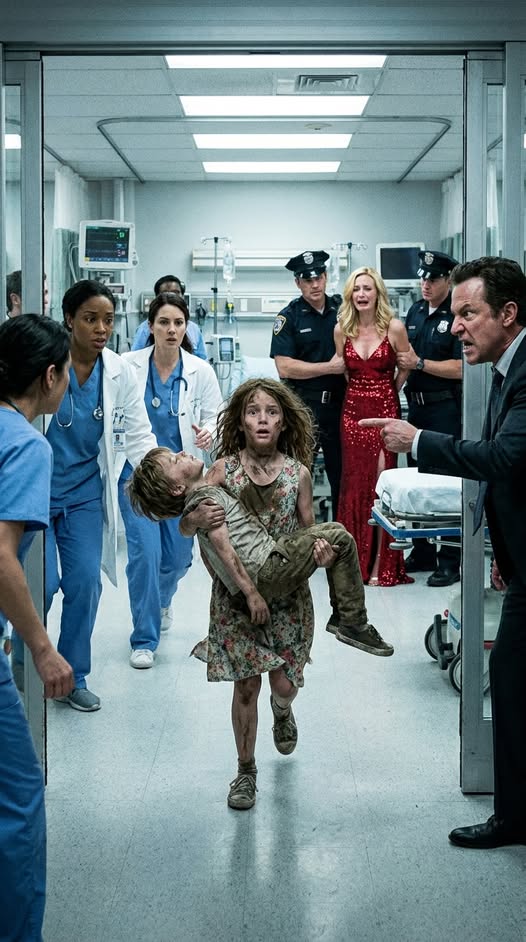
A swarm of nurses descended like white-clad angels, lifting the boy from my aching arms. I tried to stand, to follow the stretcher as it burst through the swinging double doors of the emergency bay, but a massive hand clamped down on my frail shoulder like a steel vise.
I looked up into the glaring eyes of a hospital security guard.
“You stay right where you are,” the guard snarled, his grip bruising my collarbone. “Where exactly did you get that child?”
“I found him there… the lady left him…” I stammered, tears carving clean tracks through the grime on my cheeks.
“What lady?”
But before I could formulate an answer, the heavy glass doors of the lobby violently hissed open, and the true nightmare began.
Chapter 2: The Handcuffs and the Heir
Daniel Carter looked exactly like the men who owned the world. Known across the eastern seaboard for his ruthless intellect and his sprawling empire of luxury resorts, he possessed a flawless public image that was currently disintegrating into absolute terror. His custom Italian suit was rumpled, his tie undone, his chest heaving.
“Where is my son?” his voice boomed, rattling the reception desk.
The receptionist, suddenly entirely too eager to please, pointed a manicured finger directly at me. She looked at me the way one might look at a rat caught in a glue trap. “She brought him in, Mr. Carter. She claims she ‘found’ him.”
Daniel’s gaze snapped to me. The sheer, unadulterated panic in his eyes instantly morphed into a blinding, protective rage. He stormed across the lobby, his leather shoes echoing like gunshots, and roughly yanked me to my feet by the fabric of my torn blouse.
“What did you do to my son?” he demanded, his voice dropping to a dangerous, lethal register.
“Nothing, sir… I swear! I carried him… he couldn’t breathe…” I whimpered, shaking uncontrollably like a leaf in a hurricane.
“Liar! Noah was with my fiancée and my private security detail in the park. Were you trying to kidnap him for a ransom?”
Before I could mount a defense, the doors parted again. Vanessa Sterling floated into the lobby. She looked as though she had just stepped off a runway rather than emerged from a kidnapping scene. Oversized, gradient tortoiseshell sunglasses framed her perfectly contoured face. She wore staggering stilettos and an expression of impeccably rehearsed, theatrical distress.
“Daniel! Oh, Daniel, it was horrific,” she gasped, throwing herself against his chest. “I looked away for barely a minute to purchase a bottle of sparkling water. When I turned back, our Noah was just… gone. And this girl! I’ve seen her lurking around the park gates like a vulture. I knew she was watching us!”
My eyes widened in sheer, incredulous horror. The audacity of her lie paralyzed my vocal cords.
“That’s not true…” I finally managed to squeak out, my voice trembling. “You left him on the grass… you were right there…”
Vanessa laughed—a cold, brittle, terrifying sound that held zero mirth. “Listen to her, Daniel. Now the little street rat is inventing fairy tales to cover her tracks.”
Overwhelmed by a potent cocktail of fear for his heir and manipulated fury, Daniel didn’t even hesitate. He turned toward the two uniformed police officers who had just jogged into the lobby in response to the hospital’s panic button.
“Take this creature away,” Daniel ordered, his voice devoid of any human empathy. “I want her locked up. I don’t want her breathing the same air as my son.”
The officers didn’t ask questions. They didn’t take my statement. They grabbed my wrists.
The handcuffs were comically, tragically enormous around my eight-year-old bones. The cold steel bit into my skin, a physical manifestation of the world’s absolute unfairness.
I didn’t scream. I didn’t thrash or fight. I had learned early on the streets that poor people fighting back only resulted in deeper bruises. I simply twisted my neck to look back toward the swinging doors where the nurses had taken the boy.
“Please tell him…” I whispered to the empty air, “please tell him we made it.”
As the officers marched me toward the flashing red and blue lights of the cruiser parked at the curb, Vanessa leaned in close. Her expensive, floral perfume made me want to gag.
“Girls like you,” she hissed, her voice a venomous thread only I could hear, “always end up exactly where they belong. In the gutter.”
They shoved me into the back of the cruiser. The heavy door slammed shut, sealing me in a cage of hard plastic and stale sweat. As the engine rumbled to life, I slumped against the window, the cold glass pressing against my forehead. I realized then with agonizing clarity that saving a rich boy’s life was going to be the very thing that destroyed my own.
Chapter 3: The Diagnostic Reckoning
I sat in the suffocating heat of the patrol car, waiting for the officers to finish their paperwork on the hood, completely unaware that a hurricane of truth was about to tear through the hospital lobby.
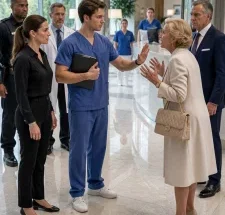
Daniel would later recount to me how the very foundation of his reality fractured in the minutes after I was dragged away. He had been pacing the marble floor, his hands buried in his hair, when the emergency room doors slammed open. Dr. Collins, the young physician who had taken Noah, strode out. His scrubs were stained, his jaw set like granite.
“Who is Noah’s father?” the doctor barked, bypassing the receptionist entirely.
Daniel stepped forward, his chest puffed out with a mixture of authority and dread. “I am. I’m Daniel Carter. Tell me exactly what that street beggar did to my boy.”
Dr. Collins stopped dead in his tracks. He didn’t cower before the billionaire. Instead, he leveled a stare so frigid it could have frozen the Atlantic.
“She didn’t hurt your son, Mr. Carter.”
Vanessa, hovering just behind Daniel’s shoulder, stiffened. Her manicured fingers dug into her designer handbag. “Doctor, please. Be reasonable. She could have slipped him a narcotic. She could have—”
“No,” Dr. Collins cut her off, his voice ringing like a bell through the silent lobby. “Noah did not ingest a narcotic. He suffered a catastrophic, stage-four anaphylactic reaction due to a severe peanut allergy, compounded by extreme dehydration and a minor blunt-force head trauma from collapsing onto the pavement. If that little girl had not carried him in here exactly when she did, your son’s heart would have stopped permanently within ten minutes. She is the only reason he is drawing breath right now.”
Daniel felt the polished marble floor vanish beneath his expensive leather shoes. The breath left his lungs in a ragged exhale.
“But…” Daniel stammered, turning a bewildered gaze toward his fiancée. “She… she told the guards that someone just abandoned him.”
Dr. Collins crossed his arms, his stethoscope swaying. “Given the physical evidence of his trauma and the delay in medical response, I’d suggest you consider the possibility that the girl in handcuffs was the only one telling you the truth.”
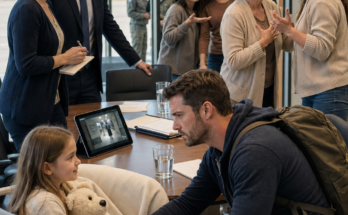
Before Vanessa could launch into another defensive tirade, the heavy doors of the hospital lobby slid open once more. Marcus Thorne, Daniel’s hulking, ex-military chief of security, marched in. His face was a mask of restrained fury, and his massive hands gripped a sleek, silver tablet.
“Sir,” Marcus said, his voice unusually tight. He completely ignored Vanessa, stepping directly into Daniel’s personal space. “My team just pulled and decrypted the municipal surveillance footage from the park. You need to watch this immediately. Before you let the police process that child.”
Marcus thrust the glowing screen toward Daniel’s chest.
“Watch it, sir. And prepare yourself.”
Chapter 4: The Digital Ghost
The high-definition footage played out on the tablet like a silent horror film.
Daniel stared at the screen, his heart hammering against his ribs. The video showed the sun-drenched expanse of the park. There was little Noah, sitting quietly near a bronze statue, suddenly dropping his ice cream cone. The boy’s hands flew to his throat. He began to thrash, his small legs kicking at the dirt.
A mere twenty feet away, standing comfortably in the shade of an oak tree, was Vanessa.
She wasn’t buying sparkling water. She was on her gold-plated cell phone.
On the screen, Noah staggered to his feet, a tiny, suffocating ghost, and stumbled toward her. He reached out, his fingers brushing the fabric of her expensive silk skirt.
Vanessa glanced down at him. The high-resolution camera clearly captured her expression. It wasn’t panic. It was profound, unadulterated annoyance. She swatted his hand away, turned her back, and continued her phone conversation.
Seconds later, Noah’s eyes rolled back. He collapsed hard onto the concrete path, his head bouncing violently against the stone.
Daniel let out a sound—a choked, wounded noise that didn’t sound human.
The footage continued relentlessly. On the screen, Vanessa finally turned around. She looked down at the boy convulsing at her feet. She took a half-step toward him. Then, she stopped. She looked around the empty park. She deliberately raised her left wrist and checked her diamond-encrusted watch.
And then, with the casual grace of a woman strolling through a boutique, she walked away. She headed toward the south exit. She didn’t dial 911. She didn’t scream for help. She abandoned a dying six-year-old boy because dealing with a medical emergency was inconvenient to her schedule.
“No…” Daniel whispered, a single tear escaping his eye and tracking down his jaw. “No, no, no.”
“Keep watching, sir,” Marcus commanded gently.
Thirty seconds later, a tiny figure blurred onto the edge of the frame. It was me.
The camera caught me dropping my box of marzipan candies, the plastic containers shattering and scattering across the concrete. It caught me sprinting across the grass, falling to my knees beside Noah. It recorded me begging two passing adults, who physically stepped over us to avoid getting involved.
It showed a malnourished, eighty-pound eight-year-old girl hauling a sixty-pound boy onto her back, staggering under the weight, and beginning a desperate, agonizing march toward salvation.
Daniel slowly lowered the tablet. The silence in the lobby was absolute, heavy as lead. He turned his head by slow, terrifying degrees until his eyes locked onto Vanessa.
“What did you do?” he asked. His voice wasn’t a roar anymore. It was a hollow, shattered whisper that carried the promise of absolute destruction.
Vanessa’s immaculate face lost every drop of its color. She backed up, her stiletto catching on the tile. “Daniel, darling, it isn’t what it looks like! The camera angle… I was trying to get a cellular signal to call an ambulance!”
“You had your phone pressed to your ear,” Daniel stated, stepping toward her.
“I panicked! You know how Noah is, he’s always acting up, he’s always seeking attention! I thought he was throwing a tantrum!”
“My son was dying on the concrete,” Daniel said, his eyes dead, his soul seemingly evacuated from his body.
He didn’t wait for her next excuse. He spun on his heel and sprinted out of the hospital doors, bursting into the oppressive afternoon heat. He ran directly to the patrol car where I was imprisoned and slammed his bare fist against the reinforced glass window, startling the officer leaning against the hood.
“Unlock this door. Let her out. Right now!” Daniel roared.
The police officer blinked, hesitant. “Mr. Carter, you just filed an official kidnapping complaint. We have protocols—”
“And now I am filing a new charge!” Daniel screamed, pointing a trembling finger back toward the hospital entrance, where Vanessa stood frozen in terror behind the glass. “I want her arrested! Felony child abandonment, reckless endangerment, and failure to provide medical aid! Cuff her!”
Inside the lobby, Vanessa completely unraveled, screaming as Marcus and the second officer moved toward her. “You can’t do this to me! I am Vanessa Sterling! We are supposed to be married!”
“A wife,” Daniel spat, his voice echoing off the concrete, “does not leave my child to choke to death on the dirt.”
The officer quickly unlocked the rear door of the cruiser. I stepped out into the blazing sun, my legs trembling so violently I could barely stand. The officer uncuffed me. Angry, red welts circled my tiny wrists where the steel had bitten into my skin. I rubbed them, thoroughly confused, terrified that this was some cruel new trick.
Daniel Carter, the billionaire who had looked at me like garbage ten minutes ago, dropped to his knees on the scorching pavement, uncaring of his suit. He looked at me, a man utterly broken by his own arrogance.
“I am so sorry,” he wept, tears streaming freely down his face. “I judged you. I was a monster. I am so sorry.”
I looked down at him, my exhaustion overriding my fear. “I don’t care about that,” I whispered. “I just wanted him to wake up.”
The hospital doors flew open again. A nurse leaned out, breathless. “Mr. Carter! Noah’s eyes are open. The swelling is down. He’s… he’s asking for the girl who carried him.”
I took a hesitant step forward. But as I moved, Vanessa, now flanked by officers and wearing the very handcuffs I had just shed, was marched out of the hospital. She thrashed against the cops, locking her hateful eyes on me.
“Don’t you dare get your hopes up, you filthy little brat!” she shrieked, her mask of elegance entirely ripped away. “Even if he thanks you, you are nothing! You belong in the gutter! You will never belong in their world!”
Daniel rose from the pavement. He didn’t yell at her. He didn’t need to. He simply looked at Vanessa with an expression of such cold, absolute finality that it silenced her mid-scream.
“That,” Daniel said softly, “is not your decision to make.”
I didn’t understand the gravity of what he meant. Not yet. But as Daniel turned back to me and gently offered his massive, warm hand, I looked at it. For the first time in my miserable, short life, I allowed myself to wonder if something miraculous might actually happen.
Chapter 5: The Shattered Glass Slipper
The sterile smell of bleach and saline rushed into my lungs as I stepped into the pediatric intensive care unit. Noah lay in a massive bed, dwarfed by the pristine white sheets. Intravenous tubes snaked into his small arms, and a clear oxygen cannula rested beneath his nose.
Despite the machinery, when he saw me, his pale lips curved into a weak, genuine smile.
“I knew you wouldn’t leave me behind,” he rasped, his throat still raw.
I stepped closer, ignoring the grime still caking my legs, and managed a smile in return. “I promised you we’d make it. I don’t break promises.”
Daniel stood silently in the doorway, watching us. He would tell me years later that witnessing that exchange hurt him more profoundly than any financial ruin ever could. His own son, his flesh and blood, had immediately trusted a penniless street vendor over his own future stepmother. I was the child he had treated like a criminal, yet I was the only reason his universe hadn’t collapsed into ash.
“Dad,” Noah whispered, his eyes finding Daniel. “Vanessa saw me fall down. I tried to grab her dress. I asked her to help me. She just walked away.”
Daniel closed his eyes, leaning his forehead against the heavy wooden doorframe. There was no hiding from the brutal truth anymore. The illusion of his perfect life was dead.
The fallout was swift and merciless. Vanessa was formally charged with felony criminal negligence. Her high-priced defense attorneys waged a vicious media campaign, arguing she suffered from temporary panic-induced psychosis, extreme confusion, and stress blindness.
But the truth is a stubborn ghost. The municipal surveillance footage was leaked to the press. The agonizing audio recordings from the subpoenaed cell phone records showed she had been arguing with her wedding planner about floral arrangements while Noah suffocated. And finally, a six-year-old boy took the stand in a preliminary hearing and told the quiet, devastating truth.
The socialite who once graced the glossy covers of Vogue and Vanity Fair ended up doing her latest photoshoot in an orange jumpsuit, wrists bound in iron. She fell from grace not because she lacked resources, and not because she had too much of it, but because she looked at a child’s desperate plea for life and decided that saving him would ruin her afternoon itinerary.
While Vanessa’s empire burned, Daniel turned his formidable resources toward a different kind of investigation: me.
He hired private investigators to trace the frayed strings of my existence. What they uncovered shattered his heart all over again. They found my guardian—my mother’s sister, Aunt Beatrice. She lived in a rotting trailer park on the industrial edge of the city. Beatrice was a cruel, bitter woman who used me as an indentured servant. She forced me to wander the blistering streets hawking candy from sunrise until the streetlights buzzed on, confiscating every crumpled dollar I earned to fund her gambling addiction. I hadn’t seen the inside of a classroom in over two years. I slept on a moldy mattress on the floor of a closet.
Three days after the incident, Daniel’s black SUV pulled into the dirt lot of that trailer park. He didn’t bring police. He brought a phalanx of terrifyingly calm corporate lawyers. I don’t know what threats were whispered or what documents were signed in the stench of that trailer, but within twenty minutes, Aunt Beatrice threw my pathetic sack of belongings out the door and told me to get out.
Daniel knelt in the dirt, heedless of the mud on his slacks, and picked up my bag. He looked at me, his eyes shining with a fierce, protective light.
“Lily,” he asked gently, his voice rumbling like distant thunder. “Would you like to come stay with us? Just for a while. Just while we figure things out.”
I stared at the gleaming, armor-plated SUV, terrified. It felt like stepping onto a spaceship bound for a galaxy I wasn’t meant to survive in.
Chapter 6: The Velvet Cage
The Oakridge Hills estate didn’t look like a home. It looked like a museum where someone had accidentally left the lights on. Massive iron gates parted to reveal acres of manicured gardens, a sprawling stone manor, and a driveway paved with crushed white quartz.
When we stepped inside the grand foyer, I froze, clutching my tattered canvas bag to my chest.
“I don’t know how to live in a place like this, Mr. Carter,” I whispered, terrified to step onto the pristine Persian rug with my scuffed sneakers. “I’m clumsy. I might break something expensive.”
Daniel stopped, turning back to me. He crouched down so we were eye-to-eye, placing a warm hand on my shoulder. He smiled, and for the first time, it looked like a sad, genuine expression.
“Lily, listen to me,” he said softly. “In this house, things can be replaced. Chandeliers, vases, carpets—they are just things. But people? People cannot be replaced. You are the most valuable thing in this building.”
That first evening, the housekeeping staff prepared a guest suite for me. It was larger than Aunt Beatrice’s entire trailer. It had a towering four-poster bed draped in white, cloud-like linens. There were soft, cashmere blankets folded at the foot. A small army of pristine stuffed animals sat in the corner, waiting for a childhood I never had.
It was everything a child could ever dream of. And it terrified me.
At three o’clock in the morning, the silence of the mansion was deafening. Daniel, unable to sleep, walked down the hallway to check on me. He silently pushed the heavy mahogany door ajar.
The magnificent bed was perfectly made, completely empty.
Panic flared in his chest until he looked down. There, wedged into the narrow gap between the heavy oak wardrobe and the wall, I was curled into a tight ball. I was fast asleep on the hard hardwood floor, my arms fiercely clutching my battered, empty cardboard candy box like a shield against the dark.
Daniel didn’t wake me. He didn’t try to force me into the bed. He understood that wealth doesn’t erase trauma overnight. He simply walked into the room, sat down on the floor a few feet away, leaning his back against the wall, and kept watch.
A few minutes later, the door creaked open further. Little Noah appeared, dragging his favorite superhero fleece blanket behind him. He looked at his father, then at me. Without a word, Noah padded over to the wardrobe, curled up on the floor directly beside me, and draped half of his blanket over my shivering shoulders.
“She doesn’t feel so alone when it’s like this, Dad,” Noah whispered into the dark.
Sitting in the shadows of his sprawling, empty mansion, Daniel Carter buried his face in his hands and wept in absolute, silent gratitude.
But as the sun rose on our strange new reality, a dark cloud gathered on the horizon. The temporary custody hearing was approaching, and the state, suspicious of a billionaire adopting a street kid so quickly, was threatening to pull me back into the foster system—a system Vanessa’s lawyers were secretly bribing to ensure I never saw the Carter family again.
Chapter 7: A Legacy of Scraped Knees
The legal battle was grueling. The foster system bureaucrats, fueled by whispered rumors and Vanessa’s lingering venom from behind bars, argued that Daniel was merely acting out of survivor’s guilt, that I was a PR stunt to repair his damaged public image.
Months dragged on. Seasons shifted. The leaves in Oakridge Hills turned from emerald to fire, then fell away. Through it all, Daniel fought. He unleashed a legal armada, turning the same ruthlessness he used in corporate boardrooms toward the family courts.
Eventually, a weary family court judge granted temporary custody. And then, finally, the gavel fell on the permanent adoption.
I remember standing in the sterile, wood-paneled courtroom. I wasn’t wearing rags anymore. I wore a crisp, navy-blue school uniform. My hair, once matted with street dirt, was neatly braided down my back. I gripped Noah’s small hand so tightly my knuckles were white.
The judge, an older man with kind eyes peering over half-moon spectacles, looked down at me from his towering bench.
“Lily Vance,” the judge said, his voice echoing in the quiet room. “Do you truly understand what becoming a permanent part of the Carter family means?”
I didn’t look at my new shoes. I didn’t look at the expensive lawyers. I looked at Daniel.
I took a deep, steadying breath. “Yes, Your Honor,” I spoke clearly. “I know it doesn’t mean having a big house or being rich. It means… it means that if I fall down and scrape my knees, someone will finally be there to help me stand back up. And if they fall down, even if they’re too heavy for me, I will carry them. That’s what a family does.”
In the gallery, Daniel covered his mouth, his broad shoulders shaking as he lost the battle against his tears.
The gavel struck the block. Granted.
On the same day I officially became Lily Carter, Vanessa Sterling received her final sentencing. She lost absolutely everything she had fought so desperately, so callously to protect. Her flawless reputation was ashes. Her engagement ring was returned. Her luxurious lifestyle was traded for a concrete cell, and her freedom was revoked for the next seven years.
Yet, as the tabloids would later note, perhaps the most agonizing punishment of all was the irony of her downfall. The little girl she had spat upon, the child she had labeled “filthy,” now legally carried the powerful family name Vanessa had committed a crime to secure for herself.
A year later, the trauma of that blistering August day felt like a distant, faded nightmare.
The afternoon sun filtered through the ancient oaks of the estate garden. Noah, healthy, vibrant, and laughing uncontrollably, raced across the manicured lawn chasing a black-and-white soccer ball. I sat beneath the sprawling branches of a willow tree, reading a battered copy of Treasure Island aloud, completely unconcerned about grass stains on my jeans or dirt on my sneakers.
Up on the stone terrace, Daniel watched us.
He wasn’t wearing a Tom Ford suit. He wore a faded college t-shirt and loose sweatpants. He held no phone, checked no itinerary. He was no longer the untouchable billionaire architect of a hospitality empire. He was just a humbled man with a profoundly grateful heart.
As a breeze rustled the leaves, scattering a handful of autumn gold across the lawn, I caught him smiling down at us. It was a smile of a man who had survived a shipwreck and found himself washed ashore on a paradise he never knew existed.
That day, he finally understood a universal truth—a truth forged in the crucible of a hospital lobby and cemented on the cold hardwood floor of a bedroom.
Family doesn’t always arrive perfectly packaged, wrapped in the suffocating comforts of privilege and high society. Sometimes, family arrives barefoot and bleeding, with scraped knees and tired, trembling arms, carrying the person you love most in the world out of the dark.