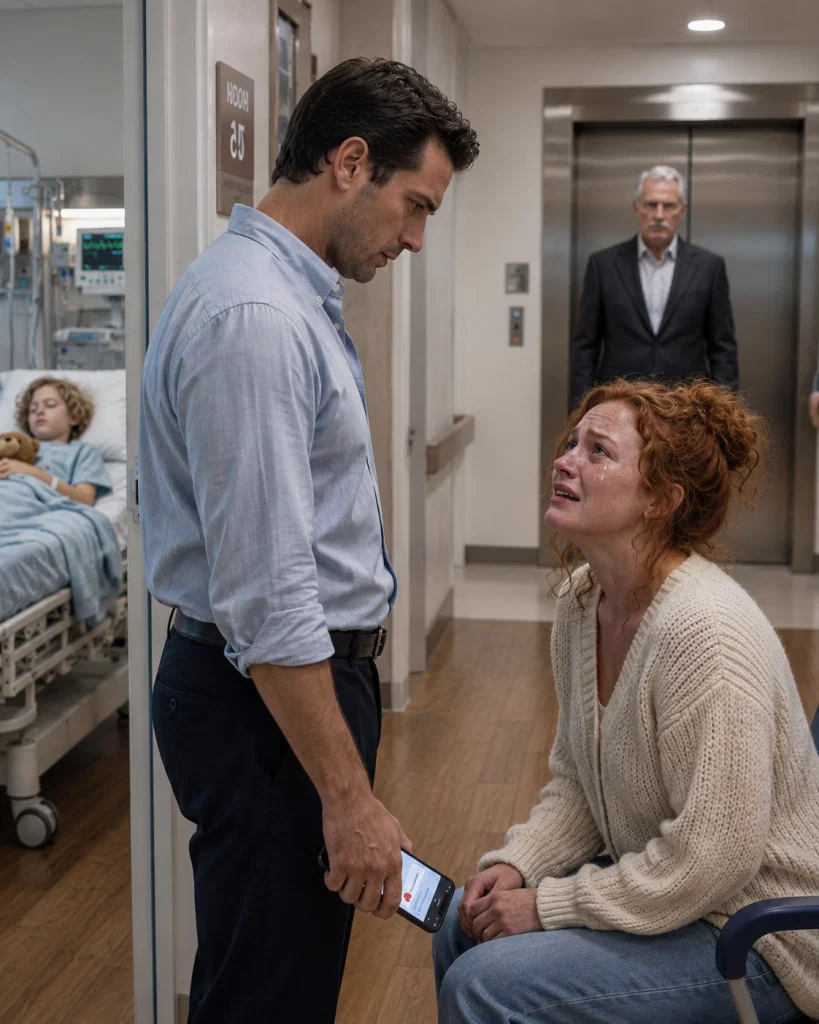
My husband ignored eighteen phone calls while our five year old son, Leo, lay in the intensive care unit softly whispering his father’s name. This was not because his phone had malfunctioned or because he was caught in some unavoidable emergency, but rather because he was wrapped in silk sheets inside a luxury hotel with another woman while I stood under the harsh, sterile lights of the pediatric unit praying for God to grant our little boy just one more breath.
The heart monitor finally went flat at precisely 11:47 p.m., emitting one long, cruel, and endless tone that filled the entire room. I had heard that specific sound many times before as an emergency nurse who had watched strangers lose their husbands, mothers, and precious children, but when it was my own son’s small hand turning cold inside mine, every bit of my professional training evaporated instantly.
There was only Leo, five years old, a boy who loved dinosaur pajamas and sticky, syrup-sweet kisses, now gone forever. His stuffed elephant, Captain Barnaby, was tucked tightly against his side beneath the thin hospital blanket, and just hours before he had looked up at me through his oxygen mask with wet eyelashes and whispered, “Is Daddy coming?” I had pressed my mouth against his forehead and lied with every shattered piece of my heart by saying, “Yes, baby, Daddy is coming.”
Then I called my husband, Bryce, again, and again, and again. I made eighteen desperate calls while doctors pushed potent medicine into Leo’s fragile body and his asthma attack turned into something no mother should ever have to witness. I climbed onto the hospital bed to perform chest compressions on my own child because I knew that standing there feeling powerless would have destroyed me completely.
Bryce never picked up a single call. When Dr. Samuel Reed finally stepped away from the bed with a face drained of defeat, he spoke the words that tore my world into two jagged pieces. “Time of death, 11:47 p.m.”
For two hours after that, I sat beside the bed without shedding a single tear because the grief had sunk too deep to allow for crying, carving me out until even the act of breathing felt like a betrayal. At 2:17 a.m., Bryce finally appeared at the far end of the hallway wearing a camel hair coat and polished shoes, his hair messy from something that was clearly not running to reach his dying son.
The second he saw me, his expression shifted with rehearsed speed, collapsing into a look of feigned concern. “Cynthia, what happened, as my phone died and I came the moment I saw your missed calls,” he said while hurrying toward me.
I stared at the man I had married, the man our son had called for with his final breaths, and I whispered, “Our son died asking for you.”
His mouth opened and closed in a silent show of shock, but the horror did not reach his eyes quickly enough for my liking. “No, that cannot be true, it just cannot be,” he breathed out.
“It happened three hours ago,” I replied coldly.
He dropped into the nearby chair and buried his face in his hands while saying, “I am so sorry, Cynthia, I really am, I should have been here.”
“Yes, you should have,” I said as his phone slid out of his coat pocket and struck the floor with the screen lighting up between us. A message appeared clearly on the screen that read, “Jessica: Last night was incredible, call me when your wife finally calms down.”
For one single second, the entire hospital seemed to vanish into a void. Bryce grabbed the phone, but he was far too late because I had already seen every late meeting, every sudden business trip, and every cold excuse from the last year twist into one disgusting truth.
“You were with her,” I whispered as the realization settled into my bones.
“Cynthia, please just listen to me,” he started to plead.
“You were with her while our son was dying?” I screamed, the sound tearing down the quiet hallway and making nurses turn in alarm.
Bryce reached toward me, his face finally breaking with genuine panic as he said, “It is not what you think.”
I laughed a quiet, shattered, and terrifying sound that echoed against the walls. Before I could say another word, the elevator doors opened and my father, Corbin Hughes, stepped out. He was the founder of Hughes Industrial Holdings and the only man Bryce had ever truly feared in his life.
His eyes moved from my face, to Bryce’s trembling hands, and then to the phone still glowing with that message. In that instant, my father understood every single detail of the tragedy. Bryce stepped back, knowing that while grief had walked into the hospital tonight, true revenge had just arrived.
Corbin Hughes did not run when the elevator doors opened because he had built his industrial empire not by shouting or threats, but by understanding that real power never needs to hurry. As he stepped into the hallway with rain darkening the shoulders of his black overcoat, he looked less like a grieving grandfather and more like cold judgment wearing expensive leather shoes.
Bryce saw him and went absolutely still, forgetting how to breathe for a thin, fragile second. My father’s silver hair was damp from the storm, his jaw locked tight, and his gray eyes moved from my face to Bryce’s disheveled coat, then down to the phone clutched in his hand.
The message from Jessica had vanished from the screen, but it did not matter because Bryce’s guilt was written all over his face. “Corbin, I am so sorry, I just got here and I did not know,” Bryce said while forcing his voice into something soft and respectful.
My father stopped right in front of him, close enough to make Bryce step back in terror. “You did not know your son was dying?” my father asked, his voice low and dangerous.
The hallway seemed to shrink around us while a nurse at the station lowered her eyes and Dr. Reed stood near the doorway with grief carved into his face. Bryce swallowed hard and said, “My phone died.”
My father looked at the phone in Bryce’s hand and replied, “It looks very much alive right now.”
My father turned to me, and for one moment the ice in his expression cracked as he looked at my hospital scrubs, the dried tear tracks on my face, and the exhaustion in my eyes. “My Cynthia,” he whispered, and that broke me more than Bryce’s lies ever could.
He reached for me, and I stood up, collapsing against his chest with a sound that did not feel human. “He asked for him, Dad, he kept asking for Bryce,” I sobbed into his coat.
My father’s arms tightened around me as Bryce made a choking noise behind him. “Cynthia, please,” Bryce started, but my father simply said, “Do not speak,” in a tone so deadly that Bryce fell silent instantly.
I clung to my father until my knees nearly gave out, reminded of the times he had held me when I was a child and broke my arm or when my mother passed away. After a long moment, my father eased me back onto the bench and removed his coat to place it around my shoulders.
“Where is my grandson?” he asked quietly, and when I pointed to room 412, he turned toward it.
Bryce stepped forward quickly and said, “I want to see him,” but my father blocked him with one hand against his chest.
“No,” I said, the word coming out before my father could answer.
Bryce looked at me as if I had slapped him across the face. “Cynthia, he is my son.”
I stared at him, seeing clearly now that Bryce Johnson did not look like a father destroyed by grief, but rather like a man terrified of the consequences. “No, he was your son when he was begging for you, and he was your son when I called you eighteen times,” I said firmly.
Bryce flinched, and my father turned slowly to ask, “What does she mean by that?”
Bryce’s lips parted, but nothing came out. I reached for my phone with shaking fingers, opened the call log, and said, “Show him the message, Bryce.”
“Please, do not do this here,” Bryce begged, but my father simply extended one hand and said, “Phone.”
Bryce stared at him, and my father repeated, “My grandson died tonight, so privacy died with him.”
Bryce glanced toward the nurses and then toward me, calculating his best path, but there was no clean path left. His thumb shook as he unlocked the screen, and my father took the phone to read the message from Jessica: “Last night was incredible, call me when your wife calms down.”
My father read it once, and then he read it again, his expression not changing at all, which is how I knew Bryce was finished. “Who is Jessica?” my father asked.
Bryce rubbed a hand over his mouth and muttered, “Someone from work, it was a mistake.”
“A mistake is missing an exit on the highway,” my father said, “but this was a choice.”
Bryce’s eyes reddened, but still no tears fell as he said, “I loved Leo.”
My chest twisted so violently I thought I might be sick. “Do not say his name,” I whispered.
Bryce turned to me, desperate now, and said, “Cynthia, I did love him, you know that, I was a good father.”
“You missed his preschool play, you missed his birthday breakfast, and you missed the night he died,” I countered.
His mouth shut because there was no excuse left that could survive that silence. My father handed the phone back like it was contaminated and walked into the hospital room.
For thirty seconds, no one moved, and then I heard a sound from inside the room, not a shout or a sob, but a broken breath. My father had faced hostile takeovers and market collapses, but when he saw Leo lying still beneath that little blanket, he made a sound I had never heard before, the sound of a man losing the last soft thing he had left.
I stood slowly and followed him into the room, where he stood beside the bed with one hand pressed over his mouth. He kissed Leo’s forehead and whispered, “My brave boy.”
When he finally looked up at me, something terrible had settled into his face. “Tell me everything,” he commanded.
I told him about the first cough, the wheezing, the inhaler that did not help, and the frantic drive through the rain while I begged Leo to hold on. I told him how Leo cried for Bryce when the oxygen mask went over his face, how I called again and again, and how I had to perform chest compressions because my body refused to accept he was gone.
My father listened without interrupting until his face had gone gray. “And he answered none of the calls?” he asked.
“None,” I said.
My father looked toward the hallway where Bryce waited. “Three hours and thirty minutes after Leo died,” he noted, his voice sounding like steel.
“Dad, please do not make this public tonight, I cannot survive people talking about him like some scandal,” I whispered.
He looked at me, and the hardness faded just enough for love to show through. “I will not let anyone touch Leo’s memory, but Bryce’s reputation is not Leo’s memory.”
His phone buzzed, and he stepped aside to answer with one word: “Now.”
I listened as he commanded his team to pull security footage from the hotel and match the name Jessica to corporate records. “Use legal, use private security, but do not leak anything yet,” he said before hanging up.
He opened the door to the hallway and walked out with me following him. Bryce spun around, and my father said, “I told you to leave.”
“I am not leaving my family,” Bryce insisted.
My father laughed, a sound worse than anger, and said, “Your family is in that room, but you abandoned him.”
“You do not get to decide what kind of father I was,” Bryce shouted.
“No,” my father said, “Leo did when he asked for you.”
Bryce recoiled, and for a moment I thought he might finally break, but he only looked at me and said, “We need to talk without him.”
“No,” I said, “anything you say, you can say in front of him.”
Bryce stepped closer, lowering his voice, “Cynthia, you are grieving and you are not thinking clearly.”
“I am thinking clearly for the first time in years,” I replied.
“There are things you do not understand,” he argued.
“Then explain them,” my father commanded.
Bryce exhaled and said, “Jessica does not matter.”
I stared at him, “She mattered enough for you to ignore eighteen calls.”
“My phone was on silent, I did not know he was sick,” Bryce defended himself.
“Because you were not home,” I noted.
“I had needs too, Cynthia,” he said, and the hallway went deathly silent.
My father stepped forward, and Bryce stepped back as my father said, “Say one more word, and I will forget my daughter asked me not to make a scene.”
Bryce’s phone began to vibrate loudly inside his coat pocket, and he did not move until my father said, “Answer it.”
He pulled out the phone, and the name Jessica glowed on the screen like a second crime. He declined the call, and a text message appeared: “Bryce, why is someone from Hughes security asking hotel staff about us, you said your wife did not know and the kid situation was handled.”
I read the words over his shoulder and the floor tilted beneath me. “What does that mean?” I whispered.
Bryce looked sick as he said, “Nothing.”
I snatched the phone from his hand, and he lunged for it, but my father caught his wrist. I opened the message thread and saw dozens of messages, including one from Bryce sent two days earlier: “Leo’s asthma is getting worse again, Cynthia is hovering like always, I will tell her I have investor drinks Friday so we can actually breathe.”
Below it, Jessica had replied: “Poor baby, you deserve a night without hospitals and inhalers.”
And Bryce had written: “Exactly, she can handle it, she is a nurse.”
I looked up at him, “Did you know he was sick tonight?”
“No,” he muttered.
“Did you know he had been worse this week?”
His silence answered, and a small, broken sound left my mouth. “You left anyway.”
Bryce’s eyes filled with tears, but they were useless to me. “I thought you had it under control,” he said.
My father took the phone from my hand, read the messages, and looked at Bryce with an expression that was a final verdict. “You are done,” he said.
“Done?” Bryce laughed bitterly, “You do not own me.”
“I own the company that funds your division, I own the board seat your father begged me to secure, and I own every secret you were foolish enough to create while using my daughter’s loyalty as a shield,” my father stated.
For the first time, Bryce truly looked terrified. “You would not,” he stammered.
My father tilted his head, “You let my grandson die asking for you.”
“It was not my fault,” Bryce cried.
“No,” I said quietly, “the asthma attack was not your fault, but being absent was.”
Hospital security appeared, and my father said, “Escort Bryce Johnson out.”
Bryce spun toward me, “Cynthia, do not do this, please, let me see Leo just once.”
For one agonizing second, I nearly broke because Leo had loved him with the blind faith only children possess. But then I remembered Leo’s last whisper, and I said, “No, you do not get to say goodbye after making him wait.”
Security stepped in as Bryce shouted, and my father stood beside me, saying softly, “You were his disappointment.”
After the elevator doors closed, I turned back toward the room, exhausted beyond language. My father touched my shoulder and said, “Go sit with him,” as I asked what he was going to do.
“I will make sure the truth has teeth,” he said.
I sat with Leo, and the hours between night and morning bent in ways that did not feel real in the hospital. My father stayed mostly in the hallway, making quiet calls about press, discretionary accounts, and security footage.
At 5:03 a.m., a gray dawn pressed against the windows, and my phone rang with an unknown number. A message arrived: “You do not know the whole story, Bryce was not the only one lying tonight.”
A photo loaded beneath the text showing a hotel room at the Grand Regency, with Jessica sleeping in a white sheet. Beside her on the nightstand lay Bryce’s wedding ring, and next to it, partially hidden beneath a glass of champagne, was an orange prescription bottle. I zoomed in and saw the label: “Leo Johnson.”
My stomach turned as I stood up, and my father opened the door instantly. I handed him the phone, and he looked at the photo, then every drop of color drained from his face. “What is that?” I whispered.
My father’s expression turned into something ancient and lethal, and he walked out of the room to call someone. “Pull the pharmacy records now,” he commanded, and then he looked at me and said, “Someone picked up Leo’s emergency medication yesterday.”
“I did not,” I said.
“I know,” he replied.
Another message arrived: “Ask your husband why your son’s inhaler was empty.”
The photo did not look like betrayal; it looked like evidence. Jessica lay asleep while Bryce’s ring sat on the nightstand, but the message made the hallway tilt beneath me. Bryce stood several feet away, staring at the screen and whispering, “What is that?”
“That is what I would like to know,” I said.
My father stepped toward him and asked, “Who has access to that room?”
“No one,” Bryce said too quickly, but he had already given himself away.
I knew then it was a routine, a secret life with champagne while Leo died calling for his father. My phone buzzed again: “Ask Bryce what Jessica was promised, ask him why she was in Chicago at all, ask him who paid for the suite.”
My father’s hand extended, “Give me your phone.”
I handed it to him, and he asked, “Bryce, what did you promise her?”
“Nothing,” Bryce insisted.
My father smiled without warmth, “Wrong answer,” and he turned to his security chief. “Find the number, trace the hotel, pull the footage.”
Bryce’s eyes widened, but my father said, “My grandson is dead, do not confuse my restraint for mercy.”
A nurse approached quietly, “Mrs. Johnson, the funeral home is asking,” and the word “funeral” split me open.
“Let me help her,” Bryce offered, but my father turned on him so fast the air seemed to crack. “You help her by disappearing.”
My father’s security chief returned, phone pressed to his ear, and said, “Sir, the suite was not booked under Bryce’s name.”
“Whose?” my father asked.
The man glanced at me, then at Bryce, and said, “Jessica Hale.”
“Farah Hale,” my father said slowly, and Bryce turned pale. “No.”
“Jessica is Farah Hale’s younger sister,” the security chief noted.
I did not understand until pieces moved in my mind like knives. Farah Hale, the woman my father had destroyed ten years earlier after she tried to leak his financial records, had sworn she would make him lose everything he loved.
My phone buzzed a final time: “Your husband was bait, your son was never supposed to die, but now Corbin Hughes knows how it feels to lose blood.”
The hallway went silent, and for the first time that night, my father’s face lost all color.
By sunrise, Leo’s death had become a crime scene. Bryce sat alone in a plastic chair, ruined, while my father moved through the hospital like a man rebuilding the world around one terrible truth.
My father’s investigator returned at 7:22 a.m. “The hotel cameras show Jessica leaving the room at 10:03 p.m., but Bryce stayed asleep until after midnight.”
“Asleep?” Bryce lifted his head.
“Your bloodwork is being processed, but the champagne bottle from the room tested positive for sedatives,” the investigator noted.
I turned slowly to Bryce, “You were drugged?”
He stared at me, horror crawling across his face, “Cynthia, I do not remember anything after dinner.”
“You still went with her,” I said.
“Yes,” he admitted, and that single honest word destroyed the last piece of our marriage.
“Where is Jessica now?” my father asked.
The investigator hesitated, “She is dead, found in a service stairwell of the Palmer Hotel at 5:40 a.m. from an apparent overdose.”
I pressed a hand to my mouth, not for Jessica, but for the person behind her, because dead women do not send text messages. “Farah,” my father said.
Bryce looked between us, dazed, “Who is Farah?”
My father did not answer him, but he looked at me, and I saw the past I had never been told. Farah Hale had been a brilliant analyst under my father until she secretly transferred client files to a rival, leading to her family’s ruin.
“She blamed me,” my father said, “she told me one day I would understand what it meant to lose family.”
“And you never told me?” I asked.
“I believed she was gone,” he said.
“People like that do not vanish,” I replied.
Bryce stepped toward me, shattered, “Cynthia, I swear I did not know.”
I looked at him for a long time, the man who had missed eighteen calls and whose affair had opened the door to a monster. “I know,” I said.
Hope flickered in his eyes, but then I killed it, “But not knowing does not make you innocent.”
A police detective named Mara Klein entered minutes later, questioning us all before looking at me and saying, “Mrs. Johnson, there is something unusual in the toxicology order.”
“Meaning?” my father asked.
“The hospital ran a secondary screen after his sudden decline, and Leo had a trace compound in his bloodstream that should not have been there,” she said.
“What compound?” I whispered.
“A cardiac suppressant,” she said.
Bryce made a strangled sound, and my father grabbed the back of a chair.
“Who had access to him?” my father asked.
“Hospital staff, family, approved visitors,” the detective replied.
I remembered the volunteer who brought Leo a stuffed dinosaur, a woman whose badge read, “M. Hale.”
The stuffed dinosaur still sat beside Leo’s hospital bed, green, soft, and smiling. I had not touched it after he died, but now Detective Klein lifted it with gloved hands and sealed it in a plastic bag.
“We will test it for residue,” she said.
By noon, Farah Hale had a face, and her old employee badge photo was compared to the newer one of her as a hospital volunteer. She had stood three feet from my son and smiled at me while she may have helped kill him.
“You made this enemy,” I said to my father.
The words were unfair, but they were true.
“I never imagined she would come for Leo,” my father said.
“No one imagines monsters choosing children,” I whispered, “that is why they do.”
Bryce pushed past the guard, “Stop blaming him, blame me.”
“You cannot resurrect him with guilt,” I told him.
“I know,” he said.
“Then what do you want?”
He took a small recorder from his pocket and said, “I found this in Jessica’s purse, I do not know when she left it there.”
Detective Klein took it and pressed play, and we heard Jessica’s voice, trembling, “Farah, this has gone too far, the boy is sick.”
Then Farah answered, “Corbin Hughes took my father from me, I am taking his legacy from him.”
“He is a child,” Jessica sobbed.
“He is a Hughes,” Farah stated.
The room was silent after the recording ended, and Detective Klein looked at Bryce, “You just became the most important witness in a murder investigation.”
Bryce nodded, but his eyes stayed on me as he said, “I will testify against anyone, I will give up everything.”
“You already did,” my father noted.
That night, I returned home for the first time without Leo, and after hours of silence, a soft click came from the hallway.
“Dad?” I called, but no answer came.
The bedroom door opened slowly, and a woman stood there in the dark with auburn hair and pale eyes. “Hello, Cynthia,” Farah Hale whispered, “I am sorry about your son.”
I did not scream; instead, I reached for the small baseball bat Leo kept beside his bed. Farah saw it and smiled, “Careful, you do not want another tragedy tonight.”
“What did you do to my son?” I asked.
“Your son was not supposed to die quickly,” she said, “Corbin Hughes needed time to suffer, a slow decline.”
I lunged, but she moved faster, seizing my wrist as the bat struck the doorframe. I drove my knee into her stomach, and she gasped, allowing me to run to the kitchen where my phone sat connected to an open call with my father.
“Cynthia!” his voice roared through the speaker.
Farah froze, and blue and red lights flashed across the windows as Detective Klein’s voice thundered, “Farah Hale, step away from Cynthia Johnson!”
Farah turned to me, “You think this ends with me?”
The front door burst open, and police flooded the house as they forced her hands behind her back. “Ask Corbin about the second account,” she said, “ask him what he hid in Leo’s name.”
My father arrived minutes later, pulling me into his arms.
The next morning, Detective Klein confirmed Farah had injected a cardiac suppressant into the tubing near Leo’s IV. Bryce testified, and Farah’s arrest should have felt like justice, but it did not fill Leo’s empty chair.
That afternoon, I went to my father’s office, where he placed a folder on the desk containing a trust account in Leo’s name funded with two hundred million dollars.
“What is this?” I asked.
“It was protection from Bryce,” my father said.
I thought of Bryce’s gambling debts and hidden loans, and my father said, “I structured it so Bryce could never touch a cent.”
“Did Farah know?” I whispered.
“She must have,” he said.
I backed away from the desk, “So Leo died because of your enemies, Bryce’s weakness, and everyone’s secrets.”
My father flinched, and Bryce stood at the door, “I knew about the debt, but I never would have touched his money.”
My father’s expression hardened, “You sold your wedding ring.”
My entire body went still, “What?”
“I sold the original six months ago to cover a payment,” Bryce admitted.
“Who fed Farah information?” my father asked.
Bryce handed a paper to Detective Klein, who unfolded it and said, “Dr. Andrew Johnson,” Bryce’s older brother and Leo’s uncle.
Detective Klein’s voice was grim, “Andrew had access to Leo’s chart.”
I remembered Andrew standing beside the IV pump and adjusting the tubing before calling a nurse. “Farah may not have touched the IV at all,” I whispered.
Andrew was found at a private airfield trying to board a charter flight, and his confession revealed he had been paid by Farah to “complicate” Leo’s treatment. He had known Leo’s body was too fragile, but his greed had overridden his humanity.
Every person involved was charged, and Bryce Johnson signed over every asset he owned into a foundation in Leo’s name.
At Leo’s funeral, Bryce stood far from the grave, separated by rain and shame. I returned home alone, but in Leo’s blue treasure box, I found a drawing of our family with a message on the back: “Mommy, do not be sad forever, I want you to smile when I am in heaven, Grandpa says love is bigger than goodbye.”
Years later, I adopted a little girl named Eudora from the same hospital wing, and for the first time, laughter filled the house again.
“Can you be mine too?” Eudora asked me.
“Yes,” I whispered, “always.”
My father arrived the next morning with pancakes shaped like dinosaurs, and as the first snow fell over Chicago, I realized that while Farah Hale had tried to steal everything, she could never steal the love Leo left behind.
THE END