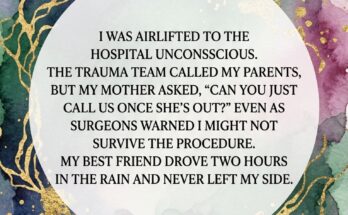
Chapter 1: The Architecture of Willpower
I was exactly thirty-four years old when the brittle illusion of my lineage shattered into irreparable shards. The revelation did not arrive with a dramatic flourish, but rather crept in through a phone call at precisely 8:14 on a Tuesday evening. My nine-year-old daughter, Kora, was crashing in a sterile hospital bed ninety miles from our front door, while my two younger sons were asleep in their shared room with absolutely no one to watch over them. Driven into a corner by the sheer terror of the moment, I committed an act I had fiercely avoided for my entire adult life: I dialed my own mother’s number and begged for a lifeline.
What she whispered back into the receiver is a cruelty I will eventually dissect. Yet, astonishingly, her venom wasn’t even the most abhorrent thing I would hear that week. The woman who had replaced me in my ex-husband’s bed held that distinct dishonor. And as for my retaliation—the quiet, devastating maneuver I executed a year later, the part I can still barely articulate without a tremor in my jaw—none of them possessed the foresight to see it coming. Some doors you spend decades bruising your knuckles against, praying they will open. Others, you finally grant yourself the profound mercy of locking forever.
If you have ever swallowed your pride, reached out to the blood in your veins for rescue, and been met with the deafening roar of silence, this chronicle is dedicated to you.
For the vast majority of my existence, asking for assistance felt akin to confessing that the entire scaffolding of my life was fundamentally compromised. Therefore, I simply refrained. I was raising three children in a cramped, two-bedroom rental, financing our survival the only way my skillset allowed: stringing words together. I drafted grant proposals, medical newsletters, and the sort of meticulously calibrated philanthropic copy that compels strangers to part with their wealth. I composed everything in graphite first, pressing a No. 2 pencil into the cheap, fibrous paper of yellow legal pads I procured by the dozen from the local dollar store. Kora used to pilfer them, sketching galloping horses in the narrow margins. Theo, who was six, found the yellow pads dreadfully mundane, while four-year-old Wyatt was merely captivated by the crisp sound of the pages tearing.
We possessed very little in the way of material wealth, but we moved to a steadfast rhythm, and that cadence kept us afloat. School drop-offs were executed with military precision at eight in the morning; I hammered at my keyboard until midnight; lunches were compartmentalized in Tupperware the evening prior to ensure no one missed the bus. I convinced myself I could shoulder the weight of the world, provided I engineered a meticulous enough spreadsheet. I maintained a ledger for groceries, a ledger for fuel, and a ledger for pediatric dental cleanings scheduled three months in advance.
The singular variable I had failed to budget for was the necessity of a second capable adult.
Mark had abandoned our marital home two years prior, back when Wyatt was still waddling in diapers. In the wake of his departure, I simply metamorphosed into a more ruthless, efficient machine. It is the natural adaptation of a woman who realizes there is no safety net to catch the fragile things slipping through her fingers. The other mothers in the school pickup line frequently called me “strong.” For a prolonged period, I naively accepted the label as a badge of honor. Looking back through the lens of clarity, I recognize it for what it truly was: a convenient mechanism for them to absolve themselves of any obligation to help. There is a monumental disparity between carrying a heavy burden and carrying it in absolute, terrifying isolation. I had spent thirty-four years obstinately refusing to acknowledge that difference.
That Tuesday night, the mathematics of my isolation finally cornered me.
Kora had originally been diagnosed with acute lymphoblastic leukemia at the tender age of seven. We had already waded through the grueling trenches of that initial war—the agonizing spinal taps, the steroid-induced mood swings where she would shriek at me for slicing her morning toast into the wrong geometric shapes. Eventually, she achieved remission, gifting us twelve glorious months that masqueraded as a normal life. She celebrated her ninth birthday in March.
By April, the hematology reports returned laced with dread.
The pediatric oncologist deployed the word relapse, cushioning the blow with a barrage of gentler, clinical terminology. But I had ghostwritten enough oncology pamphlets to decode the grim reality: a relapse following a primary remission charts a significantly steeper, darker trajectory, with precious few detours left on the map. They mandated immediate admission for an aggressive, inpatient block of chemotherapy. The specialized unit was an hour and a half away, a straight, desolate shot up Route 9, and Kora required a parent stationed at her bedside.
Here is the brutal truth that society conveniently glosses over: I am a freelance contractor. The gig economy does not bestow the benevolent twelve weeks of job-protected family leave that salaried employees enjoy. There was no reservoir of paid time off to tap into. No sympathetic HR department. Every hour I spent clutching my daughter’s frail hand was an hour I was hemorrhaging income. Already, two of my most lucrative corporate clients were quietly migrating toward other copywriters who possessed the luxury of responding to emails within the hour.
The arithmetic was barbaric. I was required to exist in two locations, separated by ninety miles, possessing only one mortal body. Theo and Wyatt could not be left to fend for themselves in an empty apartment. And with my physical presence demanded at the ward, my weekly earnings had evaporated by more than half. Full-time childcare for two rambunctious boys ran just shy of four hundred dollars a week—a figure that now eclipsed my entire dwindling income. I sat in the dimly lit hospital parking garage that first terrifying evening, calculating the remaining fuel in my tank by pennies rather than gallons.
Then, I broke my cardinal rule. I retrieved a pen and drafted a list of potential saviors.
There was exactly one name occupying the top slot. My mother.
Diane had given birth to me when she was twenty-six, a biological event she has spent every subsequent year treating as an unpaid debt. She had forsaken nursing school—a martyrdom she enthusiastically broadcasted at every Thanksgiving dinner—specifically because of the pregnancy that yielded me. She maintained an invisible, immaculate ledger of her maternal sacrifices, and the moral balance was perpetually running in the red against her offspring.
I was intimately acquainted with her psychological architecture, which is precisely why my palms were slick with nervous sweat when I dialed her landline at nine o’clock that first night. I kept the pitch concise. Kora was back in the oncology ward. I required emergency supervision for the boys for a handful of weeks. Perhaps just the mornings. Perhaps just a few days a week.
A suffocating pause stretched across the cellular connection, vast enough for me to hear the frantic thrumming of my own pulse in my ears.
She did not explicitly say no. She deployed a tactic far more insidious. She began lobbing interrogations that were thinly veiled indictments. Exactly how long is this disruption going to last? Did you ever stop to consider the logistical nightmare of breeding three children you clearly couldn’t finance? Is this little writing hobby ever going to manifest into legitimate employment, or do you intend to perpetually leech off the goodwill of others?
Standing in the drafty concrete stairwell of the parking structure, I felt my physical form shrinking, regressing into a scolded adolescent. “Mom,” I pleaded, my voice cracking. “She has leukemia. I am not asking for a financial handout. I am literally begging for a warm body to sit in the living room while my toddlers sleep.”
Diane drew a sharp, audible breath through her teeth. It was a sonic cue I had been conditioned to fear since childhood—the intake of oxygen that always preceded the unspeakable. I dug my fingernails into the rusted metal handrail and braced for impact, repeating a silent mantra: Whatever she unleashes, you can absorb it. You have always absorbed it.
I was profoundly mistaken.
“You chose this life, Fiona,” Diane said, her voice dropping to a theatrical, icy whisper. “Do not try to make it ours.”
Will Fiona find a way to save her family, or will this ultimate betrayal break her completely?
Chapter 2: The Currency of Empty Words
The sentence reverberated in my skull, unfurling its toxic petals the longer I allowed it to echo. You chose this life. As if my nine-year-old daughter’s bone marrow had convened a democratic assembly and voted for cellular mutation. As if Theo and Wyatt had submitted formal applications for the privilege of a broken home.
Diane continued to prattle on, filling the void because the silence of her own cruelty likely made her uncomfortable. She recited a laundry list of justifications as to why my tragedy was entirely outside her jurisdiction. She and my father were technically retired now. They possessed strict daily regimens. There were obligations to the suburban garden club. They had placed a non-refundable deposit on a Caribbean cruise.
My father, Roy, was hovering somewhere in the ambient background of the call. I could faintly detect the drone of a televised baseball game and the distinct, cowardly texture of his silence. It is the specific quiet of a man who has convinced himself that abstaining from the cruelty is synonymous with maintaining moral purity. He never picked up the extension. He did not attempt to call me back in secret later. Throughout my entire upbringing, I had witnessed him execute this precise maneuver—folding his tall frame into a submissive posture behind whatever decree my mother issued. I used to comfort myself by calling him “gentle.” Standing in that stairwell, the illusion evaporated. Gentle was merely the polite synonym we employed to avoid calling him a coward.
“Okay,” I whispered.
I am still uncertain why I offered that single word of concession. Perhaps because the negotiation had reached a dead end, and a human being can only grovel on a concrete landing for so long before the psychic toll of begging outweighs the actual value of the assistance.
I terminated the call. I drove the ninety miles back down a pitch-black Route 9, my headlights cutting weakly through the fog, and let myself into a silent house. My sons were slumbering safely in their beds, an arrangement secured solely because I had promised the teenager two doors down forty dollars I did not actually possess. I sank onto the hallway floorboards, pressing my forehead against the plaster wall. I refused to grant them my tears. Instead, I began assembling a secondary roster of hope.
We maintained a digital family group chat. Diane had christened it ‘The Youngs’ several years prior, appending a little blue heart emoji to the title, back during a phase when she was deeply invested in projecting an image of matriarchal closeness to her Facebook audience. By that fateful week, the chat had devolved into an arena where I was forced to watch my blood relatives actively choose everything except me.
The following morning, I cast a message into the digital void. It was brief, devoid of dramatic flair, and laced with the specific dread of a woman who already anticipates the rejection but feels a maternal obligation to exhaust every avenue.
Kora’s relapsed. She’s admitted for an intensive block of chemo. If anyone has the capacity to take Theo and Wyatt for even a single afternoon, it would be an indescribable relief.
I watched the microscopic gray text materialize beneath the bubble: Delivered.
A few agonizing hours later, the status shifted to Read. Diane had read it. Roy had read it. My maternal aunt, residing in Ohio, had read it.
Not a single soul typed the three dancing ellipsis dots. Nobody formulated a response.
What they did accomplish that very same afternoon was to actively post in auxiliary group chats and on public social media platforms where I remained a captive audience. That is the exquisite, inescapable torture of the modern digital era. Diane ‘liked’ a distant cousin’s album of tropical vacation photographs. She deposited an enthusiastic comment on an acquaintance’s sourdough bread post, complete with three exclamation points and a desperate plea for the recipe.
She was conscious. She was holding her device. She was actively dictating, in real-time, exactly where her thumb—and her empathy—would be allocated. And it was unequivocally not going toward the cancer ravaging her granddaughter’s body.
I ceased expecting the screen to illuminate with a rescue mission. Read receipts, I came to understand that week, are an incredibly articulate form of refusal. They simply lack the spine to articulate the rejection out loud.
I placed the phone face-down on the faux-wood laminate of the hospital cafeteria table, ignoring a cup of coffee that tasted like hot ash, and forced myself to acknowledge the final entry on my list.
Mark.
He was Kora’s biological father. He held the same title for Theo and Wyatt, albeit entirely in the clinical sense that genetics demands, regardless of whether a man’s actions validate the title. He had relocated an hour in the opposite direction following our finalized divorce, swiftly marrying a woman named Belle. They had promptly produced a new infant and acquired a sprawling piece of real estate featuring a wraparound porch I had only ever witnessed blurred in the background of their holiday posts.
Every fiber of my being recoiled at the prospect of dialing his number. I initiated the call regardless, because Kora was half his genetic material, and motherhood frequently demands you to publicly immolate your pride.
Belle intercepted the call. Through the receiver, I could decipher the chaotic symphony of a thriving household—a babbling infant, the clatter of culinary endeavors, upbeat jazz humming from a smart speaker. I announced my identity, a redundant formality. I relayed the grim data: Kora was hospitalized, the prognosis was severely compromised, and I desperately required logistical support with the toddlers so I could anchor myself to her bedside.
A sharp, abrasive exhalation traveled down the line—a sound that mimicked a laugh but contained zero amusement.
Then, Belle delivered the sentence that would become branded into my psyche for the next twelve months. She tossed it off with a terrifying, airy lightness, as if she were reading the nutritional information off a carton of almond milk.
“Well, you’re just a poor writer, Fiona. Deal with it.”
The audio briefly muffled, suggesting a palm had been slammed over the microphone. A moment later, Mark’s voice materialized. He contributed precisely one sentence to the catastrophe of his daughter’s life.
“Now’s not really a convenient time for us,” he muttered, his tone clipped. “Not a good time for them.”
I stood anchored in the claustrophobic hospital corridor, bathed in the sickly yellow glow of a malfunctioning fluorescent bulb, gripping a piece of technology that had just informed me—twice in forty-eight hours, via two separate factions of my supposed family—that my child’s battle for her life was an irritating inconvenience to the people biologically mandated to cherish her.
I severed the connection. I pushed open the heavy wooden door to Kora’s room. She was adrift in a chemically induced slumber. I reached into my tote bag, extracted a dollar-store legal pad and my graphite pencil, and began to architect my own salvation.
How long can a single mother hold up the sky before it crushes her completely?
Chapter 3: The Ghost at 8:14
I constructed a makeshift existence out of sheer desperation and psychological duct tape, and miraculously, for a fleeting period, the structure held.
The savior I found did not share my DNA. Mrs. Linkfist, the seventy-eight-year-old widow residing two houses down, harbored a specific brand of quiet loneliness that frequently manifests as profound generosity. She commandeered the boys on most mornings, vehemently refusing the crumpled twenties I attempted to secretively leave on her kitchen island. To circumvent her pride, I resorted to smuggling the cash inside the folds of her morning newspaper delivery.
The hospital’s designated social worker, an unflappable and deeply empathetic man named Dennis, navigated the bureaucratic labyrinth to secure us a modest room in the adjacent family lodging facility. It was a utilitarian cinderblock structure designed specifically for parents whose bank accounts had been depleted by tragedy, but who could not fathom putting geographical distance between themselves and their dying children.
My new reality fractured into agonizing nocturnal shifts. I established a mobile office in the sterile hallway outside Kora’s door at two o’clock in the morning, my battered laptop precariously balanced on my kneecaps. I churned out SEO-optimized newsletters for a thriving cardiology practice, pretending to care about heart health while the relentless, rhythmic beep of Kora’s IV pump mocked me through the cracked door.
Dennis, with his gentle, probing eyes, occasionally inquired if there was an extended support network I could mobilize to spell me. I deflected, stating they were “tied up.” I offered no further elaboration. There existed a tempting alternative universe where I fabricated a narrative of total destitution, embellishing my financial ruin on the hospital intake forms, conveniently omitting the sporadic freelance checks that kept us barely breathing. Sitting in that hollow corridor at 3:00 AM, staring at the terrifyingly low balance on my banking app, the temptation to lie to the system was overwhelming. But I harbor a visceral aversion to deceit. I meticulously documented the truth on every bureaucratic document, accepting only the meager aid my brutal honesty afforded me.
It was never going to bridge the gap. I liquidated my secondary asset—a battered sedan. I canceled my own medical and dental appointments. I became an obsessive connoisseur of local fuel prices, memorizing which station on the Route 9 corridor offered gasoline three cents cheaper per gallon, planning my refueling stops with the precision of a tactical military strike.
And yet, every night, before I allowed my exhausted body to fold into the vinyl hospital recliner, I succumbed to the masochistic ritual of checking my phone. The family thread remained a barren wasteland. Eventually, the element of surprise was replaced by a dull, throbbing numbness.
The pediatric oncology ward operates on its own warped temporal continuum. The civilian world outside is dictated by morning commutes and weekend leisure, but inside those locked doors, the earth rotates on the axis of blood draws, fluctuating vitals, and the profound, haunting hush that descends between three and five in the morning, when the building seems to hold its collective breath.
That was my sanctuary for writing.
One particular night, a figure breached the perimeter of my solitary light. It was an oncology nurse I recognized vaguely—a woman in her early fifties with reading glasses permanently wedged into her silver-streaked hair, wearing a badge that identified her simply as Angela. She paused, her gaze sweeping over my bruised knees, the yellow legal pad, the pencil, and the cardiology propaganda I was furiously typing out.
She did not demand an explanation for my nocturnal vigil. She didn’t offer a tilt of the head—that agonizing, patronizing angle of pity I had developed a violent allergic reaction to. Instead, she offered a statement of fact.
“You need to consume calories. There’s surplus pudding in the staff refrigerator that no one lays claim to. The vanilla kind.”
That was the entirety of the exchange. No unsolicited counsel, no probing interrogations regarding my absent husband or ghosts of parents. She vanished and reappeared twenty minutes later, clutching two plastic cups of vanilla pudding. She deposited one beside my laptop without fanfare, peeled the foil off the second, and consumed it while standing guard in the hallway, as if we were merely two colleagues pulling the graveyard shift in the trenches.
Inside the dimly lit room, Kora was remarkably alert and characteristically dictatorial, despite the poison coursing through her veins. She was currently stage-managing a video call with her brothers.
“Theo, adjust the camera angle, you’re cutting off your head!” she commanded, her voice raspy but authoritative. “Wyatt, that is fundamentally not how you construct a Lego fortress.”
She was a nine-year-old girl orchestrating a domestic symphony from a motorized bed, a surgical port embedded in her frail chest. Watching her reprimand Wyatt for his architectural failures, I thought to myself, This is a child who fully intends to grow up.
I did not yet comprehend the magnitude of Angela’s presence in our lives. I wrongly categorized her as simply the benevolent custodian of the vanilla pudding. I was gloriously, profoundly mistaken about her.
I fractured myself into two entirely distinct mothers that month, neither incarnation possessing a whole soul.
The morning mother was the commuter. The woman who white-knuckled the steering wheel down Route 9, slapping on a manic smile to flip pancakes and field the relentless artillery of Theo’s inquiries. Theo had reached the age of demands.
“What day is Kora being discharged?” he would press, day after exhausting day, exhibiting that uniquely devastating patience of a child who genuinely believes adults control the universe. “Is she going to be home to help blow out my birthday candles? Can she still be the co-captain of my science fair project?”
I spoon-fed him the truth in micro-doses, fracturing the reality into fragments small enough not to choke him. It was a merciful form of lying, and I despised every syllable of it. Wyatt, conversely, retreated into a mute, clinging terror. He would fuse his small body to my thigh whenever I reached for my car keys to return to the ward. One morning, the separation anxiety crescendoed into violence; he sank his teeth into my forearm, drawing blood, before collapsing into apocalyptic sobs. I sank to the linoleum kitchen floor, cradling him against my chest until the clock dictated we were inexcusably late for the world.
The afternoon mother belonged exclusively to the bedside. This version of me was a hollowed-out entertainer, cheerfully reciting the exact same chapter of a battered equestrian novel four consecutive times because the cocktail of steroids had eroded Kora’s short-term memory.
Desperation makes fools of us all. Mid-month, I attempted to breach my mother’s fortress one final time. I circumvented the group chat, sending a direct, isolated text. I couldn’t survive the auditory assault of a phone call.
Mom. I am actively drowning here. Is there any conceivable way?
The three dancing ellipsis dots materialized. My chest seized in a pathetic, involuntary spasm of hope.
Then, the dots evaporated into the digital ether. No text bubble followed.
Sitting in my stifling vehicle within the parking garage, the engine long gone cold, I experienced a sudden, chilling epiphany. I realized I had subconsciously stopped glancing at my own driveway when I arrived home. I had ceased straining my ears for the crunch of tires on gravel, fantasizing that Diane and Roy had finally decided to manifest. You rarely notice the exact moment hope packs its bags and vacates the premises. You only register, in the barren aftermath, that the vigilant listening has ceased. The silence is its own distinct flavor of mourning, and it moved into my bones long before the actual death arrived.
The very same week I transmitted that desperate SOS to Diane—the one she coldly absorbed and ignored—I committed a cardinal sin of self-preservation. Instead of closing the social media application, my thumb scrolled down the family feed.
Diane had, in fact, uploaded content that evening. Not a lifeline for her daughter. A photograph.
It was a panoramic shot of the suburban garden club. A gaggle of women draped in pastel cashmere cardigans, clustered around an immaculate banquet table adorned with crustless sandwiches. A floral banner in the background declared it the Spring Luncheon. Diane was positioned dead center, her head thrown back in a portrait of uproarious laughter, a flute of pale champagne clamped in her manicured hand.
The caption read: Feeling so incredibly blessed by my girls today! Followed by forty-one validating ‘likes’.
I fixated on the image until the pixels blurred. There was a microscopic, gray date and time stamp anchored to the bottom corner of the post. Something about that specific string of numbers snagged in the delicate tissue of my brain, refusing to dislodge—like a microscopic splinter you can’t visually locate but intimately feel with every movement.
I was too spiritually bankrupt to investigate the splinter that night. Kora required her four o’clock anti-nausea medication, and bone-deep fatigue always overrides curiosity. But the gray numbers lay dormant in my subconscious, biding their time.
I would hunt them down soon enough. I would spend the rest of my life wishing I hadn’t.
What catastrophic secret was hidden in the digital timestamps of a family that had abandoned their own?
Chapter 4: The 8:14 Code
A handful of days later, the fragile equilibrium shattered. Kora spiked a fever in the dead of night.
It was not the mundane, manageable heat of childhood illness. It was the lethal, volatile fire that immediately vacuums all calm from a hospital room, replacing it with a swarm of medical personnel donning sterile gloves and grim expressions. The digital thermometer’s numbers surged upward, and the rhythmic green peak on her cardiac monitor devolved into a jagged, frantic scrawl. We endured an excruciating two-hour purgatory where the unspoken, terrifying possibility—the ‘code’ they were desperately trying to prevent—squatted in the corner of the room, breathing down my neck.
I required a guardian at my house. If the atmosphere in this room metastasized into the absolute worst-case scenario, I could not physically tear myself away from Kora’s fading pulse to drive ninety miles, nor could I stomach the thought of Theo and Wyatt waking up to a uniformed police officer.
I dialed Diane’s number at precisely 8:14 PM. The line trilled endlessly, ringing out into the void. I didn’t bother sending a follow-up text.
By the time the sun bled over the horizon, Kora’s vitals had mercifully plateaued. I was hollowed out by a visceral, shaking relief that felt obscenely similar to grief’s identical twin. Seated in the grim confines of the family lodging, clutching a styrofoam cup of tepid coffee, I knew my boys were safe only because Mrs. Linkfist had answered her rotary phone on the first frantic ring.
It was in that quiet aftermath that I finally decided to excavate the splinter.
I unlocked my phone. I navigated back to the family thread. I located the garden club photograph. I zoomed in on the microscopic gray timestamp.
The champagne-soaked luncheon photo had been uploaded to the server at exactly 8:14 PM.
It was the precise, identical minute I had been standing paralyzed over my daughter’s convulsing body, clutching the phone to my ear, listening to the hollow ringing echo through Diane’s empty living room.
Because grief transforms you into a meticulous forensic accountant, I did not stop there. I cross-referenced the platforms. I navigated to Belle’s public profile. There it was: a stylized ‘story’ from the very same evening. A chic, dimly lit wine bar. Two crystal goblets clinking together in a boomerang loop. The caption, written in an elegant font, read: Date night with hubs! followed by a pulsating red heart.
The upload time: 8:14 PM.
They shared the same hour, the same timezone, the same rotating earth. While my nine-year-old daughter was burning alive from the inside out in a sterile bed, the two matriarchal figures who possessed the power to alleviate my suffering were holding up alcoholic beverages for an imaginary audience.
I did not unleash a primal scream. I did not shed a single tear. I lowered the glass screen onto the cheap motel bedspread with the excruciating care one reserves for an unexploded bomb.
In that suffocating silence, a profound and permanent psychological shift occurred. The decision had been orbiting my subconscious for weeks, but the math finally settled it. You cannot continuously attempt to withdraw funds from a spiritual bank account that has never, in thirty-four years, held a single dime in your name.
From that morning forward, the frantic, desperate bird fluttering in my ribcage went entirely still. I ceased squandering my emotional currency on the ghosts who were never coming, and diverted every remaining ounce of my soul into the child who was rapidly running out of time.
I must confess, the subsequent weeks were a bizarre departure from what one might anticipate. Stripped of the agonizing burden of expectation, they were, in a twisted, sacred way, almost joyous. When you permanently sever the hope of a rescue cavalry, you stop agonizingly watching the horizon. When you stop watching the door, you are finally capable of seeing the beauty contained within the room.
And Kora was magnificent.
We established an impromptu nail salon on her tray table, painting a chaotic spectrum of colors across her tiny, bruised fingers because she stubbornly refused to commit to a single shade. She offered fiercely held, unsolicited opinions on everything from hospital cuisine to global politics. We orchestrated comedy routines during video calls with the boys, pushing the absurdity until Wyatt literally tumbled off the living room sofa in hysterics. We devoured the equestrian novel, immediately procured the sequel, and cracked the spine on a third.
One evening, Angela materialized after her grueling twelve-hour shift, having swapped her fluid-resistant scrubs for civilian clothes. She quietly deposited a heavy object on the windowsill of our lodging room. It was a substantial, glass casserole dish, crowned with a distinctive blue lid. It radiated heat. A handwritten note, secured by a rubber band, read: From the Floor Staff.
I would discover much later that a ‘floor staff culinary fund’ was a complete fabrication. It was solely Angela, standing in her own kitchen on her only day off, pouring her resources into a stranger’s survival.
We devoured it at the wobbly laminate table—Theo and Wyatt projected on the iPad screen, Kora and I wielding actual metal forks. It was the first meal prepared by human hands with actual warmth that I had consumed in longer than I cared to calculate. I scrubbed the glass dish spotless that evening, intending to return it to Angela the following day.
It remained sitting by my lodging door for weeks. I kept harboring the delusion that I would hand it back when the chaos subsided. I allowed myself the luxury of believing we had an abundance of weeks remaining.
I was entirely ignorant of the fact that the blue-lidded dish would still be sitting by that door when my world officially ended.
The aggressive experimental protocol that was designed to purchase us years abruptly ceased functioning. The leukemia mutated, outsmarting the poison. I will spare you the visceral, clinical agony of the medical decline. If you have occupied that specific ring of hell, you do not require my descriptions. If you have been spared it, I will not force the nightmare into your head.
Instead, I will document who she was at the finish line, because that is the treasure I am entitled to keep.
She remained uncompromisingly bossy. She retained her razor-sharp wit. A mere forty-eight hours before the veil tore, she gripped my hand with a terrifying, ancient solemnity and extracted a blood oath from me: I was strictly forbidden from allowing Wyatt access to her secret stash of premium chocolate secreted in a shoebox beneath her bed, because Wyatt lacked a sophisticated palate and would inevitably “chew it incorrectly.”
I swore the oath. I would have promised to pull the sun from the sky.
In those twilight days, she began posing strange, crystal-clear inquiries—the specific genre of questions that materialize when a child’s soul has outpaced the adults in the room.
“Is the final part going to hurt, Mama?” she asked, her eyes unblinking.
I offered her the unvarnished truth, assuring her that the doctors possessed powerful elixirs to ensure she felt nothing but warmth. She offered a curt, managerial nod, apparently satisfied with the logistical plan.
During another quiet hour, she caught me scribbling frantically on my yellow legal pad, the pencil scratching loud in the hush.
“Mama,” she rasped. “Are you sad when you write the words about me?”
I had never explicitly confirmed that she was the subject of my manic documentation. I wasn’t entirely certain I had admitted it to myself. But children are emotional savants; they observe everything from the periphery.
“Sometimes,” I confessed, my voice trembling. “But mostly, it makes me profoundly grateful. Because it ensures I get to keep a piece of you trapped on the paper, forever.”
She digested this concept, her brow furrowing in concentration. “Then promise me you’ll only write the good parts. Write about the painted nails and the horse books. Leave the hospital out of it.”
“Okay, my sweet girl,” I lied softly. “Only the good parts.”
She let her heavy eyelids fall shut. I sat paralyzed in the vinyl chair, the pencil suspended above the fibrous yellow paper, gripped by the devastating realization that my nine-year-old daughter had just gracefully acknowledged her impending death without uttering the word. She was gently managing my emotional collapse, utilizing the same managerial tone she used to dictate Wyatt’s Lego construction.
I surrendered to her grace. I let her manage me.
She departed this earth on a Sunday morning, before the sun had fully breached the horizon. It is the hour when the hospital corridors are devoid of traffic and the massive structure breathes in a slow, mechanical rhythm. I had maintained a vigil in the chair all night. Sometime around five in the morning, her features smoothed into a serene landscape—a peacefulness that my maternal instincts instantly recognized as the absolute, final kind.
I crawled into the narrow mechanical bed, navigating around the tangle of plastic tubing and wires, and cradled her fragile body against my chest. I held her in the exact same posture I had adopted on the very first morning of her existence, back when she was eight pounds of furious, squalling crimson life, and I had been terrified by the sheer magnitude of my love.
Angela was there. Her shift had technically concluded an hour prior, but she remained anchored in the room without demanding recognition for her sacrifice. It was simply her nature. When the digital monitor’s rhythmic chirp began to stretch, flatten, and soften into a continuous, harrowing tone, Angela reached across the machinery and manually muted the volume. She ensured that my daughter’s final seconds belonged entirely to us, untainted by the screech of clinical failure.
The subsequent moments are locked in a vault. They belong exclusively to me.
I will share only this: eventually, the room settled into an oppressive, heavy stillness. The morning sun began filtering through the plastic blinds, casting long, gray shadows. A young, visibly shaken medical resident stepped into the doorway and gently inquired if there was a family patriarch or a grandmother they could summon to my side. Was there anyone who should be here?
A hysterical, jagged laugh nearly escaped my throat. The honest answer was a resounding no. The people you summon in the aftermath of a catastrophe are the people who have a history of showing up. I had spent the preceding thirty days receiving a masterclass in precisely who occupies that category, and who comfortably watches a phone vibrate into silence.
I offered a slow shake of my head. Angela rested her warm hand on my trembling shoulder for a fraction of a second—an anchor in a storm—before stepping away to execute the grim, bureaucratic necessities of death.
I stared down at my empty hands. These palms had spent nine years memorizing the exact gravitational pull of this specific child. From the smoldering wreckage of that terrible dawn, I salvaged the only indisputable truth I possessed.
I gave every drop of my essence to her. Everything I had, I poured into her vessel.
I deliberately snapped the yellow legal pad shut. I stood up on legs that felt like lead, and I walked out to locate a telephone. I had two little boys waking up in a house ninety miles away who were entirely oblivious to the fact that their sister was gone.
How does a mother survive the theater of a funeral when the grief of the audience is entirely fabricated?
Chapter 5: Sentences of Soot and Ash
The agonizing stretch of time immediately following the death of a child defies the standard laws of physics. The days do not progress linearly; they exert a gravitational pull, dragging you through a dense, suffocating mire.
I possess only fragmented, cinematic flashes of that week. I remember the visceral horror of breaking the news to Theo, witnessing his innocent face contort into an expression of agony I pray to forget. I remember Wyatt’s initial, blissful incomprehension, followed by a delayed, violent understanding three hours later while sitting in the soapy water of the bathtub—which is apparently where a four-year-old’s capacity for existential grief resides.
I vividly remember Angela’s glass casserole dish, still sitting unwashed, mocking me by the front door of our rental.
And I remember the grotesque theater of the funeral. Because that is the specific venue where my estranged family finally decided to make their grand entrance.
They arrived draped in immaculate, somber black garments, projecting a volume of public mourning that far exceeded anything I had witnessed from them in decades. Diane wept with a ferocity that commanded the attention of the entire chapel. She stationed herself near the vestibule, clutching the hands of distant acquaintances, graciously absorbing their condolences as if she had been the one sleeping upright in a vinyl hospital recliner for a month, rather than sipping champagne at a garden club luncheon at 8:14 PM on the night my world fractured.
I caught an auditory snippet of her whispering to a second cousin, utilizing that hushed, reverent tone people inexplicably adopt around caskets. “We exhausted every possible avenue,” she murmured, dabbing her dry eyes with a monogrammed handkerchief. “We did absolutely everything in our power.”
I was positioned a mere ten feet away, a fierce grip on the hands of my two surviving sons. I did not march over and publicly eviscerate her narrative. You do not initiate a brawl over your firstborn’s coffin. Furthermore, a detached, clinical sector of my brain recognized that the fabrication was the psychological scaffolding required for her to physically occupy that room without collapsing under the weight of her own guilt.
Belle outsourced her condolences. She commissioned a sprawling, ostentatious wreath of pristine white lilies—undoubtedly the most financially exorbitant floral arrangement in the venue. A glittering gold ribbon was strung across the blossoms, emblazoned with the words: Beloved Kora. Mark and Belle did not grace us with their physical presence. They let the expensive vegetation speak for them. I quietly instructed the funeral director to banish the monstrosity to the darkest corner of the overflow room.
My father, Roy, spent the entirety of the service bolted to the back wall. He engaged with no one. His eyes were perpetually damp, his large hands hanging utterly useless at his sides. For one fleeting, electrified second, our lines of sight intersected across the sea of mourners.
He was the first to break the connection, dropping his gaze to the carpet.
Their physical manifestation at that memorial service felt infinitely colder and more invasive than their prolonged absence had ever been. At the very least, their absence possessed the dignity of honesty.
I promised you an unvarnished account of this journey, and I refuse to compromise that vow now. There was a specific evening, roughly five days after we lowered Kora into the earth, where I found myself anchored to the kitchen table long after the boys had succumbed to sleep. I was staring into the abyss, and I harbored a profound, terrifying desire for the sun to simply never rise again.
I will not linger in the macabre details. Those who have occupied that specific, pitch-black geographical location of the soul know precisely the coordinates I am referencing. For those who haven’t, I pray you never require the map. Let it suffice to say that the absolute rock bottom of human grief is a tangible destination. I was standing on it. The universe had contracted into a microscopic, silent point, and the silence was singing a seductive siren song of surrender.
The tether that violently yanked me back from the precipice was auditory.
The house was steeped in the heavy, expectant silence unique to two o’clock in the morning. Piercing through that void came the rhythmic respiration of my sons from the adjacent bedroom. Theo’s deep, rhythmic inhales, juxtaposed against Wyatt’s rapid, fluttery exhalations, perpetually out of sync.
I sat immobilized in the gloom, forcing myself to analyze the sound. Here were two boys who had just endured the catastrophic amputation of their older sister. They possessed a biological father whose official stance on their existence was, “Now’s not a convenient time.” They had grandparents who possessed the emotional capacity to let a phone ring into infinity while their granddaughter coded.
If I surrendered to the abyss, they would be thrust into a world with zero advocates. I had spent the preceding thirty days accumulating empirical evidence that the singular human being who reliably crossed the threshold for my children was me.
Therefore, I made the agonizing choice to continue existing. Not fueled by some wellspring of cinematic strength, but driven by the brutal calculus that they required oxygen to breathe, and I was their only remaining atmosphere.
Exactly one week post-burial, a rhythmic knocking echoed from my front door.
I was dangerously close to ignoring it. My physical and emotional state rendered me entirely unfit for human interaction, and I cynically assumed it was merely another well-intentioned neighbor bearing baked ziti. (In our community, tragedy is universally addressed with aluminum foil pans).
The knocking persisted. It was a patient, unhurried rhythm, devoid of the frantic energy of an intruder. A bizarre compulsion forced me to my feet.
I pulled the door ajar. It was Angela.
She was off the clock, clad in civilian attire—a worn pair of denim jeans and a thick, oversized cardigan that transformed her from a clinical savior into someone’s beloved, eccentric aunt. In her grasp, she balanced two items.
The first was a glass casserole dish, crowned with a blue lid, identical in geometry to the one still festering by my coat rack. Because, in Angela’s universe, a single casserole was never sufficient.
The second item was a notebook. It possessed a rigid, austere black cover—the inexpensive variety peddled in the stationary aisle of local drugstores. It was pristine, the neon clearance sticker still stubbornly adhered to the upper right corner.
She did not presume to cross the threshold. She remained planted on the concrete stoop and offered a gentle disclaimer. “I am acutely aware that this is stepping far outside my professional boundaries.”
I choked out a response, assuring her that she was arguably the only human on the eastern seaboard who possessed the right to cross those boundaries.
She extended the cheap black notebook toward my chest and delivered the mandate that would permanently alter the trajectory of my existence.
“You did not sit in a drafty hallway at three in the morning, exhausted to the point of hallucination, scribbling on legal pads for your health,” she stated, her voice ironclad. “There was a purpose to it. So, write the damn thing down, Fiona. Document every excruciating detail. Even the horrors you cannot stomach saying aloud. Especially those.”
My trembling fingers accepted the notebook. I offered no verbal guarantees. I was entirely incapable of honoring promises in that era of my life. But as I clutched that inexpensive binding against my sternum on my own front porch—the very same architectural stage where, twelve months later, a vastly different delegation would demand entry—I felt a microscopic, calcified knot in my chest loosen by a fraction of a millimeter.
I did not commence writing that night. I waited for the dawn. Before the boys stirred, I sat at the kitchen island with a newly sharpened pencil and my familiar yellow legal pads, because grief cannot easily dismantle ancient habits.
The maiden sentence I inscribed was undeniably true, and it was deceptively small. It detailed the catastrophic morning of the toast. I documented how Kora had shrieked at me with a steroid-induced fury because I had bisected her bread into pedestrian squares when she had explicitly, fundamentally required triangles. I began with the toast because it is the exact caliber of memory that is routinely excised from eulogies—it is too remarkably ordinary, too violently alive to be fabricated.
Once I anchored myself to one indisputable truth, the subsequent sentence flowed. I documented the obsession with equestrian literature. I described the chaotic, multi-colored nail polish. I immortalized her dictatorial bedside management of her siblings.
And, in direct defiance of her dying wish, I documented the hospital horrors. I recorded the parts she had commanded me to omit, because she was only nine years old, and she was fundamentally incorrect regarding the mechanics of trauma. The solitary method available for me to carry the weight of those horrors was to physically transfer them onto the pulp of the paper.
I documented the deafening ring of the telephone at 8:14 PM. I immortalized the digital timestamp on the garden club photograph and the wine bar boomerang. I transcribed, verbatim, the specific arrangement of syllables Belle had spat at me: “You’re just a poor writer. Deal with it.” I etched it onto the paper exactly as it had been weaponized, because externalizing it was the first instance I could examine the wound without violently flinching.
I cleaved into two distinct entities once more. By daylight, I was the pragmatic matriarch, flipping pancakes, organizing science fair poster boards, and absorbing the terrifying mechanics of parenting two fatherless boys alone. Under the cover of darkness, I was the architect of vengeance with a No. 2 pencil.
I must emphasize: I did not embark on this project with literary ambitions. Publication was not the objective. I wrote simply to force oxygen into my collapsing lungs.
The yellow and graphite-smudged pages began to monopolize the real estate on the kitchen table. Insidiously, without seeking my explicit consent, the fragmented memories began to coalesce into a discernible narrative arc.
Several weeks into this manic documentation, Angela casually mentioned a community bereavement circle that congregated on Thursday evenings at the municipal library. They met in a drab utility room bathed in oppressive fluorescent lighting, but she promised they brewed exceptionally good coffee. I was resistant. I attended solely because Angela volunteered to babysit the boys, and a woman who manually silences a cardiac monitor to grant you peace has earned eternal compliance.
The circle consisted of eight battered souls, a clinical facilitator, and a centrally located box of Kleenex that remained entirely untouched—because grief, once it breaches a specific subterranean depth, becomes a completely arid landscape.
The facilitator gently inquired if anyone possessed material they wished to share aloud.
I had a folded sheet of yellow paper shoved into my purse. I had not premeditated the act, but my hand operated autonomously, extracting the page. I cleared my throat and read the assembly the narrative of the toast. I read about the squares, the triangles, and the unadulterated, screaming fury of a dying seven-year-old.
When I finally raised my gaze, the atmosphere in the room was suspended. Absolute, reverent stillness.
An older woman seated directly across the circle—a mother who had buried her own adult son—leaned forward, rested her weathered hand upon my wrist, and offered absolute silence.
It marked the genesis of my truth landing in the laps of strangers. They did not attempt to sanitize it. They did not offer hollow platitudes. They simply bore witness. No one in that basement accused me of ‘choosing this life’. No one commanded me to ‘deal with it’. The act of being truly heard was a solid foundation I could finally stand upon.
The woman anchoring my wrist was named Patricia. It transpired that in her previous life, prior to retirement, she had been a formidable literary editor. The legitimate variety—a professional who had dedicated three decades to transmuting raw human agony into bound volumes.
Over a cup of the promised excellent coffee, Patricia delicately inquired if there existed more material beyond that single yellow page. I confessed there was an entire kitchen table groaning under the weight of it. She requested permission to review the manuscript.
My initial instinct was a violent refusal. The pages were a private sanctuary; they belonged to Kora and me, and no one else. But Patricia possessed the agonizing credentials of a mother who had surrendered a child to the earth. I entrusted her with the manuscript, utilizing the specific brand of trust reserved exclusively for those who have burned in the same furnace.
She devoured the pages over a fortnight. When we reconvened, she stripped away all flattery. She stated, with clinical precision, that the collection of essays was, in fact, a cohesive book. It demanded to exist in the world, and she possessed the contact information for an acquisitions editor at an independent Midwestern publishing house who needed to review it immediately.
I am obligated to interject a dose of reality here, because digital culture fetishizes the narrative of instant, meteoric success—the fairy tale where the right influential figure glancess at your manuscript on a Tuesday, and you are bathing in champagne by Friday. That is a fabricated mythology.
The primary editor Patricia contacted swiftly declined. The second contact followed suit. The third offered a polite, agonizing critique: the prose was undeniably muscular, but the subject matter—pediatric mortality and familial estrangement—was simply too grim a commodity for the current market. I have spent years actively working to forgive that specific sentence.
It required nearly twelve grueling months and a formidable stack of euphemistic rejection letters before a small, independent press finally issued a contract. The financial advance offered was insultingly modest. I wept over the meager check regardless. The currency was irrelevant. A professional entity, possessing absolutely no personal obligation to coddle my feelings, had scrutinized the most catastrophic year of my existence and concluded that the public deserved to bear witness to it.
We christened the book pulling a quote from Kora’s twilight days. She had been drifting in a narcotic haze, murmuring about the equines in her novel escaping a blazing inferno. She had observed that the horses were somehow more breathtaking in the aftermath, with the dark soot still clinging to their coats.
From Ashes, she inadvertently titled it.
The memoir was released into the wild on a mundane Tuesday in the spring, coinciding almost precisely with the one-year anniversary of Kora’s final breath. For the initial fourteen days, the book performed exactly as obscure, small-press memoirs typically do: it plummeted into absolute obscurity.
Then, the tectonic plates shifted. A prominent internet personality—a mother who wielded a massive following and carried the hidden scar of losing her own child—stumbled upon a copy, consumed it, and published a raw, weeping review across her platforms.
The dam shattered.
The book began to propagate utilizing the precise mechanics of grief—ferociously, hunting for a vocabulary to explain itself. It was passed hand-to-hand, shared in private group chats, and circulated through the exact digital ecosystems where women in my demographic navigate their authentic struggles. It breached a regional bestseller list, then steadily climbed a national one. Independent bookstores I had never set foot in were desperately submitting reorders.
The deluge of correspondence began. I received hundreds of handwritten letters and thousands of emails from women who had spent months contorted in vinyl hospital chairs while their blood relatives attended luncheons. Women who had been commanded to ‘deal with it’. Women who had dragged the unbearable weight of isolation, entirely convinced they were a singular anomaly.
They were not an anomaly. I was not alone. That was the profound, earth-shattering thesis of the book, and it was detonating exactly where it needed to.
Here is the crucial logistical detail that catalyzes the climax of this narrative: I had stubbornly refused to alter a single identifying detail in the manuscript, with the exception of adopting Kora’s name as a badge of honor. I documented the unvarnished truth regarding the phone call echoing at 8:14. I detailed the spring luncheon and the wine bar timestamp.
And, permanently embedded in black ink on page 204, any consumer who purchased the volume could digest the exact phonetic arrangement my ex-husband’s wife had weaponized against me while my daughter was actively dying.
“You’re just a poor writer. Deal with it.”
A fiercely intelligent critic for a national literary syndicate extracted that specific quote to serve as the headline for her glowing review. The phrase went viral. Belle had tossed it off in the privacy of her custom kitchen, operating under the assumption of eternal impunity. Now, her callousness was being dissected and analyzed by book clubs spanning forty states.
I had never once elevated the decibel of my voice. I had never drafted a singular, vitriolic text message. I had simply meticulously documented the empirical truth, and allowed several hundred thousand strangers to serve as my jury.
The infamous ‘Youngs’ family group thread had lain dormant, a digital graveyard, for over twelve months. The blue heart emoji had gathered dust since the afternoon Kora was lowered into the soil. That arrangement was perfectly agreeable to me. I had banished the thread to the hidden archives of my phone and purged it from my memory.
Therefore, the violent buzz of a notification immediately commanded my attention.
The memoir had been circulating in the cultural zeitgeist for roughly four weeks, and the bestseller lists had functioned as an inescapable megaphone. Apparently, an investigative reporter from a regional newspaper had contacted Diane’s landline, requesting a quote regarding her granddaughter’s highly publicized death. That is how my mother was abruptly informed that her catastrophic failure was now available for purchase in hardcover.
Suddenly, the dead thread possessed a frantic heartbeat.
Diane uploaded a crisp photograph of the book’s dust jacket.
I am just bursting with pride for my incredible daughter! she typed, appending a vibrant red heart emoji—the exact digital icon she had previously assigned to the sourdough bread recipe while I was begging for salvation.
So proud. As if maternal pride were a retroactive currency you could deposit a year late and still expect a return on investment.
Then—and this is the specific maneuver that compelled me to physically place my phone on the counter and march into the backyard to inhale oxygen—Belle manifested. She submitted a glowing, five-star review on a massive public retail platform.
I always knew she possessed this magnitude of talent, her public review declared. Such an impossibly brave, gifted woman.
Belle. The woman who had birthed the ‘poor writer’ insult was now actively reviewing the very text that immortalized her cruelty, labeling the author ‘brave’ without a shred of perceptible irony, or, more likely, without having bothered to read beyond the acknowledgments.
I analyzed the digital text three times to confirm I wasn’t hallucinating.
Not a single message in that sudden, frantic barrage of digital affection—not Diane’s hollow pride, not Belle’s performative five stars—contained Kora’s name. They had successfully located the spotlight. They remained entirely oblivious to the child.
I should have possessed the tactical awareness to anticipate their next maneuver.
When the ghosts of your past arrive demanding a share of your present, how do you finally lock the door?
Chapter 6: The Porch of Reckoning
A week after the digital resurrection, the ghosts arrived in the flesh.
My financial reality had shifted, and we had relocated to a new dwelling. It was nothing ostentatious—a modest, sturdy structure anchored at the terminus of a quiet cul-de-sac. But it boasted a sprawling, fenced yard for the boys, three legitimate bedrooms, and a wide, welcoming front porch.
The porch is the specific battleground where this confrontation transpired, because the universe frequently insists on poetic symmetry, even when you would prefer a mundane Tuesday.
It was a brilliant Saturday afternoon in early June. Theo and Wyatt were deeply engaged in a territorial dispute over a pile of mulch in the backyard. A sharp, assertive knock echoed through the hallway.
When I swung the heavy door open, the entire delegation was assembled on the painted floorboards of my porch.
Diane was positioned at the vanguard, draped in her premium winter coat despite the ambient humidity. Roy loomed behind her, his large hands securely anchored deep within his trouser pockets. Flanking them were Mark and Belle, whom I had not encountered in the flesh since the ink dried on our divorce decree. They were impeccably styled, projecting the nervous, overly-rehearsed energy of actors stepping onto a stage.
Diane was clutching a bouquet of generic, supermarket-grade flowers, the cheap cellophane wrapping crackling aggressively in the breeze.
For one protracted, surreal heartbeat, I simply visually processed them. This was the united front that had, in their own bespoke methodologies, informed me that my survival was not their concern, during a season where their refusal could have triggered my total annihilation.
The previous instance a human being had stood on my front step offering an object, it had been Angela wielding a fifty-cent notebook and salvation. This tableau was the grotesque, photographic negative of that sacred memory.
Diane initiated the offensive. Her ocular cavities were already glistening with tears—a professional grade of moisture she could weaponize on command.
“Fiona, darling,” she cooed, her voice trembling with manufactured emotion. “We have all been doing an immense amount of soul-searching. We are here to repair the breach. Blood is blood. We are family. We will always be family.”
Behind her shoulder, Roy offered a solemn, cowardly nod to the porch planks. Belle contorted her facial features into a mask of aggressive, terrifying warmth. Mark’s gaze drifted toward the backyard, visually calculating the presence of Theo and Wyatt—sons he had not requested access to in over fourteen months—with the detached scrutiny of an auditor verifying the condition of an abandoned asset.
I stood rooted in the doorway of a sanctuary my own agony had financed, and the absolute clarity of the situation washed over me. The very individuals who had instructed me to drag my tragedy into an isolated corner to die had frantically rushed back the precise millisecond my life generated a commodity worth leeching onto.
I did not invite them across the threshold. I stepped forward onto the porch and pulled the heavy wooden door shut behind me until the latch clicked, ensuring the toxicity could not contaminate the air my sons were breathing.
What ensued was the most grotesque, transparent sales pitch I have ever been subjected to, and I possess a decade of experience drafting corporate marketing copy.
Diane launched the initial salvo, relying heavily on the mythology of biological obligation. “Kora would have desperately wanted us to heal this rift. She would want us united.”
She weaponized the name of my deceased daughter as a negotiation tactic. I did not interrupt her. I allowed the silence to stretch, because if you afford a narcissist enough quiet runway, they will inevitably reveal their true objective.
Predictably, the conversation pivoted toward the tangible. Diane casually referenced the memoir’s success, aggressively hinting at how utterly delightful it would be if my subsequent publication focused on the “cherished family memories”—the mythical, joyous holiday gatherings that existed solely in her revisionist history.
Then, Mark cleared his throat, offering a surprisingly soft suggestion. He proposed that, given my recent… financial windfall, it would only be logical and “reasonable” for us to revert to a system of mutual assistance. “Helping each other out, between family,” he phrased it.
There it was. The ultimate betrayal hidden in plain sight. Help.
It was the exact, identical noun I had wept into a concrete stairwell at 9:00 PM an eternity ago, now boomerang-ing back at me from the mouths of the very people who had hoarded it. Except, in this current iteration, my bank accounts held capital. Suddenly, “help” was a beautiful, reciprocal tradition families engaged in.
Mark then proceeded to deliver the fatal blow to his own ambush, utterly oblivious to the landmine he had stepped on. He casually mentioned that he had been reflecting, and he felt it was time he resumed regular visitation with Theo and Wyatt. “It’s fundamentally unjust for a father to be alienated from his boys,” he stated, puffing out his chest.
Instantly, Belle’s posture went rigid beside him. A microscopic, silent transmission passed between them—a tightening of the jaw, a darting of the eyes. I recognized the frequency immediately, because it was the exact same vibration I had deciphered over the phone a year prior.
Now’s not a convenient time for us, he had declared while Kora was dying. Us.
A staggering twelve months of absolute silence, and the very first time the pressure cracked him, he instinctively sought permission from his new wife rather than fighting for his flesh and blood. I did not possess subpoenaed documentation of how the emotional blockade had been constructed, and I realized with absolute clarity that I didn’t require it. Whatever Faustian bargain they had struck in the privacy of their custom kitchen, the biological father had willingly permitted himself to be sequestered from his living children for over a year, and was only demanding re-entry now that their mother possessed a recognizable name and a royalty check.
The sheer, breathtaking injustice of that dynamic, aimed squarely at my innocent boys, was the singular element of their theatrical performance that managed to elevate my pulse.
Belle, sensing the atmospheric pressure plunging, lunged forward, amplifying her manic smile. “Fiona, please, you have to listen. We never genuinely meant that entire ‘poor writer’ comment. Honestly! It was an incredibly high-stress day for everyone involved. We didn’t mean a syllable of it.”
I experienced a fleeting moment of genuine awe at the sheer audacity.
Here is the ultimate lesson the preceding year of hell had burned into my psyche—the thesis statement I had bled onto hundreds of yellow pages: You are never obligated to match a maniac’s volume in order to secure victory.
I did not raise my voice. I did not scream. The more frantic and terrified their pitch became, the quieter, colder, and more precise my articulation grew. Because I required absolutely zero commodities from any of them. And a human being who requires nothing from you is the singular entity on the planet you are powerless to manipulate.
I stated, with the terrifying calm of a sniper, that I acknowledged their geographical effort in driving here, but the answer was an absolute, non-negotiable negative. Negative on the sequel. Negative on the mythical holiday dinners. Negative on the reciprocal financial ‘help’.
Diane’s manufactured, professional tears instantly evaporated when she realized the currency was void. The authentic emotion lurking beneath the veneer violently breached the surface: unadulterated, venomous rage.
“After the mountainous sacrifices I made to keep you alive!” she shrieked, her volume shattering the suburban quiet. “You have the unmitigated gall to stand on this porch and abandon your own flesh and blood?”
Abandon. The matriarch who had monitored my desperate SOS texts without flinching for thirty days was actively indicting me for abandonment on my own property.
Belle eagerly joined the skirmish, her words tumbling out in a rapid-fire assault. She accused me of catastrophic unfairness, shrieking about how I was maliciously punishing her innocent infant for adult misunderstandings, how I had vindictively weaponized their “private, out-of-context remarks” in a mass-market publication to publicly humiliate her.
The two women escalated into a chaotic, overlapping cacophony of grievances. I simply maintained my ground, my spine pressed against the solid oak of my front door, allowing them to publicly demonstrate, in the bright sunlight of a Saturday afternoon, the exact same monstrous apathy they had executed via cellular towers a year prior.
Mark remained mute. Mark’s defining characteristic has always been his muteness.
And then, my father—my perpetually silent, cowardly father, a man who had dedicated six decades to minimizing his physical and moral footprint behind the wake of Diane’s destruction—executed an action he had never previously attempted in his natural life.
He lifted his gaze from the painted floorboards. He looked directly into my eyes, and his were shining with genuine, unmanufactured moisture. And for the first time in thirty-four years, he did not avert his gaze first.
“Fiona,” he rasped, his voice splintering violently on the syllables of my name. “I should have…”
The sentence aborted. It simply hung suspended in the humid summer air, a fractured monument to cowardice. The remaining words were unequivocally too massive for him to hoist after sixty-three years of dedicating his musculature to lifting nothing.
For one agonizing, crystal-clear millisecond, I perceived the entire, tragic architecture of the man. He was fully aware. He had possessed the awareness the entire time. And he had actively chosen the path of least resistance so consistently that silence had calcified into his native tongue.
Then, Diane snapped his name like a whip. “Roy!”
He flinched, snapped his jaw shut, and retreated a half-step, realigning himself slightly behind her right shoulder. He selected her again. He would perpetually select her. It was the most profoundly devastating spectacle on that entire porch.
I allowed it to be devastating, and I allowed it to alter absolutely nothing.
When their adrenaline reservoirs finally depleted, when the screaming exhausted its momentum and hit a dead end, the porch descended into silence. And that silence belonged entirely to me, because I was the sole occupant who was completely devoid of fear.
I locked eyes with Diane, and I delivered the singular, unshakeable truth I had salvaged from the wreckage of the hospital ward.
“I gave every molecule to her,” I stated, my voice echoing like a gavel. “I poured everything I possessed into my daughter. Every waking hour, every remaining dollar, every shred of my sanity. I did this while the four of you formed a consensus that it was outside your job description. Therefore, there is zero surplus remaining on this side of the door for any of you. I am not withholding access out of petty spite. The well is simply dry. I gave it all to her.”
I paused, allowing the verdict to settle into her bones. Then, I gifted her the very words she had poisoned me with.
“You informed me, explicitly, that I chose this life,” I said softly. “You commanded me not to make it yours. You were remarkably accurate on one front, Diane. I did choose it. I choose these boys, I chose their sister, and I choose to stand in the fire when it burns. So, here is the fundamental divergence between us: I chose this beautiful, agonizing life, and I will be damned if I ever allow you to make it yours again.”
Diane’s jaw unhinged, but her vocal cords failed to produce sound.
Finally, I pivoted to Belle. She was still desperately manipulating her facial muscles, hunting for the specific configuration of a smile that might crack my armor. I experienced a fleeting, sickening wave of pity for her, standing on my property, vehemently denying the reality she had structured her entire comfortable existence upon.
“Do you want to know what my genuine assessment of you is?” I asked her. She leaned forward, pathologically starved for validation.
“I think you can purchase a copy and read it exactly like the rest of the general public. It’s immortalized on page 204.”
I depressed the heavy brass thumb-latch, stepped backward into the cool, quiet sanctuary of my home, and pushed the door shut with controlled, gentle precision.
I did not slam it. A slammed door is a theatrical gesture executed by an individual who still harbors a desperate need to prove a point. I had nothing left to prove.
Through the thick oak barrier, I could detect the muted, shrill escalation of Diane’s fury, before it gradually faded into the distance. I imagine Roy, in a rare display of utility, finally shepherded her down the concrete steps toward their vehicle.
Through the rear kitchen window, I observed Theo gently pushing Wyatt on a tire swing suspended from the ancient oak tree. The ambient noise of the cicadas had masked the confrontation. They had not absorbed a single syllable of the toxicity. That was the sole remaining objective on this planet I cared about securing, and I had successfully defended the perimeter.
I unlocked the back screen door and walked out into the sun to push my sons.
Chapter 7: The Blue-Lidded Dish
The invading force did not launch a secondary assault.
There was a brief, pathetic flurry of activity on the digital thread for a few weeks—Diane oscillating wildly between the persona of the grievously wounded martyr and the furious matriarch. Eventually, the digital void reclaimed even that. I did not execute a dramatic block of their numbers, nor did I ceremoniously delete the group chat. I simply disabled the notifications.
There is a profound distinction between violently slamming a door to demonstrate your anger, and quietly, deliberately walking away from a structure that is collapsing. I had finally acquired the wisdom to differentiate the two.
My world contracted into a smaller, infinitely warmer sphere, which was the only trajectory I had ever desired.
The financial influx from From Ashes provided a luxury I had never encountered in my adult existence: the ability to inhale without counting the cost of the oxygen. I am not speaking of yachts or lavish excess; I am speaking of breathing room. I established irrevocable trust accounts bearing Theo and Wyatt’s names, ensuring that no offspring of mine would ever again be forced to hear the words, “We don’t have enough.”
We remained in the modest house with the sturdy oak tree. I continued to string words together. I simply shifted my schedule to the mornings instead of 3:00 AM, and I obstinately continued to draft in graphite on yellow legal pads. Because when a mechanism is fundamentally sound, you do not dismantle it.
Angela transitioned into a role in our lives that defies a neat, tidy linguistic label. She graces our table for Sunday dinner nearly every week. Theo addresses her casually by her first name, while Wyatt, in his infinite, chaotic wisdom, has christened her “Grandma Angela.” She accepts the title with a wry smile. The first time the phrase echoed through my kitchen, I was forced to hastily retreat to the pantry so they wouldn’t witness the dam breaking on my face.
One particular Sunday afternoon, a little over a year following the porch confrontation, I finally executed the task I had been delaying since the cinderblock family lodging.
I retrieved the heavy glass casserole dish—the one crowned with the blue lid, the artifact that had silently stood guard by two separate front doors through the most agonizing epoch of my existence. I scrubbed the glass until it caught the afternoon sun, and I filled it to the brim with my own culinary efforts.
I presented it back to Angela across the expanse of a kitchen island bathed in golden hour light. There were three place settings officially laid out, and a fourth, permanent, invisible setting we maintain regardless, honoring the nine-year-old girl who inadvertently titled the bestseller.
“This is from the floor staff,” I whispered, sliding the heavy glass toward her.
Angela threw her head back and unleashed a genuine, booming laugh, because we shared the intimate, heartbreaking knowledge that a benevolent floor staff had never existed. In the final, brutal calculus of survival, there had only ever been her. There had only ever been the individuals who chose to step into the fire.
Those are the exclusive VIPs who earn a seat at my table.
The blue-lidded dish operates as a pendulum now, swinging back and forth between our households, perpetually full in both directions.
That, I have discovered, is the authentic definition of family. It is a warm, heavy dish that consistently finds its way back to your door. I spent three decades operating under the delusion that family was dictated by genetic coding and shared bloodlines. I buried that toxic mythology in the same plot of earth where I buried my firstborn.
Here is my current, unshakeable theology: Family is comprised of the warriors who manifest at 3:00 AM when you are utterly bankrupt and possess zero assets to offer in return. And the opportunists who only bother to knock when the weather is fair and the harvest is bountiful? They forfeit the right to cross the threshold.
That is my chronicle. It is the story of one fierce daughter I would surrender the universe to embrace for five more seconds. It is the story of one renegade nurse who pounded on my door when my soul was bankrupt. And it is the story of two resilient boys who remain tethered to this earth because, on one desperately quiet night, the sound of their breathing was loud enough to call their mother back from the ledge.
If there is a human being in your orbit who consistently shows up in the dark, do not wait for a tragedy to validate them. Tell them today, before the universe forces you to learn the agonizingly hard way who actually would.
Like and share this post if you find it interesting.