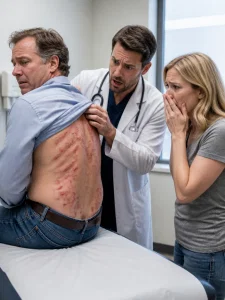
But my stomach turned. At the clinic, the doctor leaned in, then went strangely still. His lips parted, eyes draining of color. He whispered, “Don’t go home. Call the police. Now.”
The bumps were too neat to be a rash. They formed three crimson rings across Ethan Mercer’s back, each circle made of tiny punctures, as if something had been pressed against his skin and allowed to feed.
“It’s nothing,” my husband said, pulling his shirt down. His laugh cracked in the middle. “Probably that cheap detergent you bought.”
He always did that—turned fear into my fault.
For twelve years, Ethan had treated me like furniture: useful, quiet, replaceable. He controlled our accounts, mocked my bookkeeping job, and reminded me that the house belonged to his mother’s family trust. Lately, his sister Monica Mercer had joined in, sweeping through our kitchen in designer heels and calling me “the little wife with the calculator.”
I had stopped correcting them.
What Ethan never understood was that before I married him, I had worked seven years in forensic accounting for the state attorney general. I left after my father died, but I never lost the habit of noticing patterns.
I had also quietly reopened my old encrypted case archive, storing bank statements, photographs, and voice notes beyond Ethan’s reach. He believed my silence meant surrender. In truth, silence had become the cleanest room in which I could think and prepare.
And Ethan had become a pattern.
Late-night drives. Cash withdrawals under reporting limits. Calls from Monica that ended when I entered the room. A locked basement storage room he claimed held moldy furniture. Then, two weeks earlier, I found a veterinary invoice in his coat for imported tropical insects.
So when the clinic doctor stared at Ethan’s back and went pale, I did not scream.
Dr. Patel shut the exam-room door. “Mrs. Mercer, take your purse. Do not return home.”
Ethan sat up sharply. “What are you talking about?”
The doctor ignored him. His voice dropped. “Those are feeding marks from triatomine insects. Kissing bugs. But the arrangement is artificial. Someone confined them against his skin.”
Ethan’s face emptied.
Dr. Patel continued, “One specimen was trapped beneath his waistband. It had been altered. Its abdomen contains a colored veterinary marker used in controlled colonies.”
I looked at my husband. “Controlled by whom?”
He lunged for his phone.
I grabbed it first.
The lock screen flashed with a message from Monica: DID SHE TOUCH THE SAFE YET? WE NEED HER PRINTS BEFORE TONIGHT.
Ethan’s eyes met mine, and the fear in them answered everything.
Dr. Patel whispered, “Call the police. Now.”
I did—but not before forwarding the message, photographing the screen, and emailing both to an evidence vault Ethan did not know existed.
For the first time in our marriage, he looked at me without contempt.
He looked at me like prey that had suddenly turned around.
Part 2
Police separated us before Ethan could invent a story. Detective Maya Ortiz listened while Dr. Patel documented every mark, bagged the insect, and called the county health department. Ethan claimed Monica had bought the bugs for a university project and that he had accidentally opened their container.
Ortiz raised an eyebrow. “Against your bare back? In three strapped circles?”
He stopped talking.
I told her about the basement, the invoice, and the message. I also told her something Ethan did not know: for six months, I had been copying our financial records. The withdrawals he called business expenses led to a shell company owned by Monica. That company had purchased laboratory cages, sedatives, disposable restraints, and a life insurance policy on me worth four million dollars.
The beneficiary was Ethan.
His lawyer arrived within an hour and began calling me unstable. Ethan recovered his smirk.
“You’ve always been dramatic, Elena,” he said as officers escorted him for questioning. “Go home, calm down, and stop embarrassing us.”
I smiled. “I’m not going home.”
Monica texted me ten minutes later from Ethan’s phone, unaware police had returned it under supervision.
COME TO THE HOUSE. WE SHOULD TALK BEFORE THIS GETS UGLY.
Ortiz wanted to arrest her immediately. I asked for twenty minutes.
“Why?” she said.
“Because she thinks I’m stupid.”
We arranged a recorded call. I told Monica I was frightened and willing to cooperate. She softened instantly.
“That’s better,” she purred. “Open the basement safe, touch the silver case inside, and bring it to me. Ethan says the combination is your birthday.”
My birthday. The little insult almost made me laugh.
“What’s in it?” I asked.
“Proof that Ethan is sick because of you.”
There it was.
Monica believed the plan still worked. They had intended to drug me, strap infected insects against my skin, then frame me as the careless keeper of an illegal colony. If I died slowly from complications, Ethan collected the policy. If I survived, the planted fingerprints and purchase records made me criminally responsible.
But they had tested the restraint device on Ethan first.
They had targeted the wrong person twice: first by underestimating my training, then by letting their own cruelty mark one of them.
They had mistaken patience for ignorance, and routine obedience for helplessness. But every receipt they hid had taught me exactly where to look for evidence.
A tactical team entered the house while I remained at the clinic. In the basement, they found the silver case, straps shaped exactly like Ethan’s lesions, sedatives, forged invoices bearing my name, and a hidden camera aimed at the worktable.
Then Ortiz called me.
“Natalie,” she said, “there’s another room.”
Inside were photographs of me sleeping, copies of my medical records, and a calendar counting down to our anniversary dinner.
Tomorrow night.
At the bottom, in Monica’s handwriting, were four words:
FINAL EXPOSURE. PAYMENT RELEASED.
I felt no panic now.
Only focus.
“Detective,” I said, “don’t arrest her yet. Let her come collect the case.”
Part 3
Monica arrived at midnight wearing a coat and the expression of a woman coming to clean up someone else’s mess. The police had replaced the contents of the silver case, dusted it, and wired the basement for sound. I watched from an unmarked van with Ortiz.
Ethan had been released pending further questioning and agreed to meet Monica after his lawyer warned him the evidence could bury them both. He thought he was helping himself. In reality, he was wearing a microphone.
Monica entered the basement and slapped him before the door fully closed.
“You idiot,” she hissed. “You let them bite you?”
“The strap slipped.”
“And Natalie?”
“She knows something.”
Monica opened the case, saw the empty cages, and froze. “Where are the insects?”
Ethan’s voice shook. “You said you moved them.”
“I moved the infected colony into the guest-room vent. She was supposed to sleep there after the anniversary wine.”
Ortiz looked at me. That confession was enough for attempted murder, conspiracy, insurance fraud, and possession of prohibited biological material.
But Monica kept talking.
“When she got sick, we would find the colony, blame her, and produce the forged orders. You signed the policy. I created the paper trail. All you had to do was keep your pathetic wife calm.”
Ethan whispered, “She isn’t pathetic.”
It was the first honest thing he had said about me in years.
Monica heard movement upstairs. “What was that?”
I stepped into the basement behind six officers.
“Your payment being released,” I said.
Her face collapsed.
Ethan backed against the wall. Monica pointed at him. “This was his idea!”
He pointed back. “She chose the insects!”
Their loyalty lasted less than three seconds.
The arrests were almost quiet. No dramatic struggle, no last-minute escape—just steel cuffs, evidence bags, and two arrogant people learning that consequences rarely shout.
The investigation uncovered more. Monica had diverted money from the family trust, while Ethan had forged my signature on loans and used our home as collateral. My financial files gave prosecutors a map. In exchange for immunity from financial charges connected to accounts opened in my name, I testified about every transaction and surrendered my records.
They pleaded guilty before trial. Monica received nineteen years. Ethan received sixteen and lost every claim to the house, trust distributions, and insurance policy. His mother called me a destroyer outside the courthouse.
I handed her copies of her children’s theft records.
“They destroyed themselves,” I said. “I only balanced the books.”
Eighteen months later, the basement was gone. I sold the house, bought a sunlit apartment near the river, and returned to the attorney general’s financial crimes unit. Dr. Patel’s warning was framed inside my desk—not as a memory of fear, but of the moment my life reopened.
On quiet mornings, I drank coffee beside the window and watched the city wake.
Ethan once told me I was useful only when silent.
He was right about one thing.
Silence was useful.
It gave me time to collect everything.