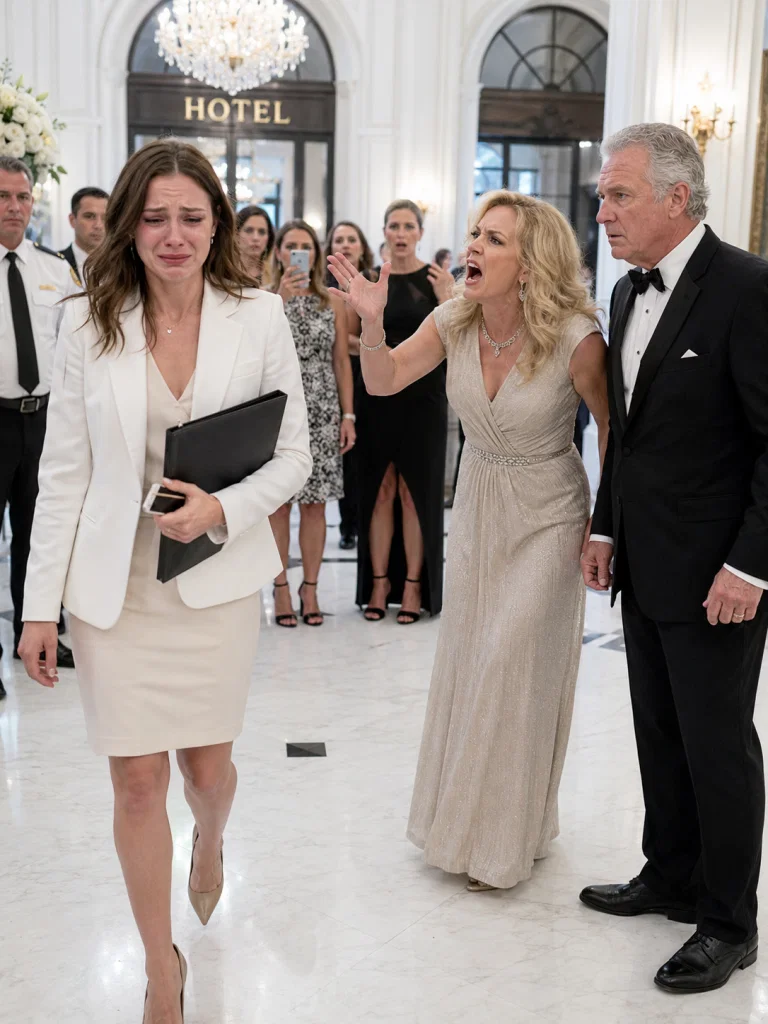
I stepped into my father’s hotel gala and heard my stepmother bark, “Security, remove her.” I walked out without a word, then quietly moved the hotel, the land, and $24 million into my trust. Within minutes, my phone erupted with 74 missed calls. By midnight, she was banging on my door.
I entered the ballroom of the Grand Sovereign Hotel five minutes after the donors’ toast had started, still in my navy work dress and the pearl earrings my mother had left to me. The room fell silent in stages, first the servers saw me, then the board members, then my father, Alistair Robinson, standing beside the ice sculpture with a champagne flute in his hand and guilt already gathering around his mouth.
At last, my stepmother noticed me. Seraphina Robinson turned away from the mayor’s wife, her silver gown flashing beneath the chandeliers as her smile froze and then turned sharp.
“What is she doing here?” she asked with a sneer.
I stopped just inside the ballroom entrance while my dad stepped forward once and started to say, “Camille,” before Seraphina snapped her fingers toward the lobby.
“Security, remove her,” she commanded, and the words struck harder than a slap.
Two security guards looked at me, then at my father, and everyone waited for Alistair Robinson to correct her because he owned the hotel and the event. He even owned the legacy my mother had built with him before she died, yet he said nothing.
I looked at him for three seconds, which was all I gave him, before I turned and left without a scene or tears or any raised voice. In the lobby, beneath the brass clock my mother had picked out twenty two years earlier, I opened my phone and called my attorney.
“Bennett,” I said, keeping my voice calm. “Execute the trust transfer tonight.”
There was a pause before he asked if I was certain, so I glanced back toward the ballroom doors where I could see Seraphina laughing again, already pretending I had never existed.
“Yes,” I said. “Move the hotel, the land parcel, and the operating reserves.”
“The full twenty four million?” he asked again.
“All of it,” I confirmed.
My mother had been cautious and before her cancer treatment failed, she had rewritten everything so the hotel and the land beneath it had never belonged to my father to sell, borrow against, or hand over to Seraphina’s son. He had only been managing them on paper, and I had been the legal beneficiary since my twenty eighth birthday, which had been three weeks ago.
I had intended to let Dad continue running the hotel, but then Seraphina ordered security to remove me from my mother’s ballroom and Dad allowed it. At 9:14 p.m., Bennett texted that the files were recorded and confirmed, and at 9:17, my phone started vibrating with calls from Dad, Seraphina, and even unknown numbers.
By 10:02, I had seventy four missed calls and at midnight, someone hammered on my apartment door hard enough to shake the chain.
“Camille!” Seraphina screamed from the hallway. “Open this door right now!”
I stood barefoot in the dark, watching the doorknob tremble, and for the first time that night, I smiled.
I did not open the door while Seraphina continued pounding, her bracelets clinking against the wood like loose keys.
“You think you can steal from this family?” she shouted. “You spoiled little parasite!”
Across the hall, my neighbor, Mrs. Montgomery, opened her door and her calm voice cut through Seraphina’s fury.
“Ma’am, I have already called building security,” she stated firmly.
“This is a family matter,” Seraphina hissed in response.
“No,” I said through the door, finally speaking up. “It became a legal matter at 9:14.”
Silence followed, and then my father’s voice came from farther down the hallway, sounding weary and thin. “Camille, please. Open the door. Let’s talk.”
I rested my hand on the lock but did not turn it as I told him he had his chance in the ballroom.
“I was shocked,” he said. “I didn’t know she was going to say that.”
“But you knew how to speak,” I replied coldly.
Seraphina snapped at him to stop begging because she thought I was bluffing, but I told her I was not.
“The Grand Sovereign belongs to the Laura Vance Trust,” I continued through the door. “The transfer was triggered by my birthday and finalized tonight.”
I explained that the land deed was recorded and the operating account had moved, meaning the reserve fund was no longer accessible to Alistair or Seraphina. Seraphina became quiet in a way that felt calculating, and Dad whispered that payroll was due on Friday.
“Yes,” I said. “And the employees will be paid.”
“What about the gala contracts?” he asked with rising anxiety.
“Honored,” I said.
“The renovation loan?” he pressed further.
“Reviewed,” I replied again.
Seraphina called me a little witch and accused me of waiting until tonight to humiliate them.
“No,” I said. “I waited twenty eight years to see whether my father would choose me without being forced.”
No one answered, and when I opened the peephole cover, Dad stood in the hall in his tuxedo with his bow tie hanging loose, looking older than he had that afternoon. Seraphina stood beside him with mascara smudged under one eye and a diamond necklace shining at her throat, while behind them, building security waited near the elevator.
“You need to return control by morning,” Seraphina said, lowering her voice. “Do you understand what will happen otherwise?”
“Yes,” I said. “Your son’s management contract will be canceled.”
Her expression changed because that was the true injury, as Fletcher, her thirty two year old son, had been consulting for the hotel for sixteen thousand dollars a month while living in Miami and answering no emails. Seraphina had planned to make him operations director after my father retired and had even already ordered business cards.
“You have no idea how business works,” she said with a sneer.
“I know enough to read invoices,” I replied.
Dad closed his eyes, and when Seraphina asked what I was talking about, I slid a folder under the door until it stopped against her shoe.
“Start with page six,” I said. “The vendor called Silverline Hospitality doesn’t exist at the address listed, but it has received eight hundred and forty thousand dollars from the hotel in fourteen months, and the account holder is connected to Fletcher.”
For once, Seraphina did not scream as she slowly bent down, picked up the folder, and stared at it as though the paper might burn her hands.
Dad called out my name, but I told him I had copies and so did Bennett.
Seraphina’s voice dropped low as she asked if I would dare, and I told her I already had.
The elevator doors opened and building security stepped closer as Mrs. Montgomery’s door clicked shut. My father looked through the peephole, and for one second, I saw the man who used to carry me through the hotel kitchen so the chefs could sneak me strawberry tarts, but then Seraphina touched his arm, and he looked away.
I told them to leave, and they did, but at 12:38 a.m., Bennett called me with a sharp, awake voice.
“Camille, Seraphina just filed an emergency petition claiming undue influence, financial incapacity, and trust fraud,” he reported.
I looked down the hallway, now empty except for the folder Seraphina had dropped near the elevator, and asked if she could win.
“No,” Bennett said. “But she can make noise.”
I walked to my window and looked across the downtown skyline where the Grand Sovereign sign glowed gold against the black sky.
“Let her,” I said. “Tomorrow morning, we make noise too.”
By 7:00 a.m., Seraphina had already made three mistakes, the first being that she believed loudness was the same thing as power. She sent an email to the entire hotel leadership team describing me as unstable, vindictive, and temporarily in possession of assets I did not understand, ordering the staff to ignore any instructions from me or my attorney.
Her second mistake was copying the hotel’s outside accountant, and her third was copying me. I was sitting in Bennett’s conference room when the email came through, surrounded by trust documents, payroll reports, and a fresh pot of coffee.
Bennett read the email over the top of his glasses and noted that it helped our case. Across from us sat Diane Walters, the interim operations consultant I had hired at 5:40 that morning, who was a practical woman well known in local hospitality circles for saving hotels from family disasters.
“She just gave us cause to bar her from administrative systems,” Diane said.
“Do it,” I replied, and Bennett nodded to his paralegal to freeze Seraphina’s credentials, Fletcher’s credentials, and my father’s discretionary authority pending review.
My phone buzzed with another call from Dad, but I let it ring.
Diane turned a page and said my employees were scared, and that was the first thing to fix, not Seraphina. I knew she was right, as the hotel had two hundred and six employees, including housekeepers who had worked there longer than Seraphina had been married to my father, and kitchen workers who still remembered my mother by her first name.
At 8:15, I joined a video call with the department heads where some faces were tense, some curious, and a few openly afraid.
“My name is Camille Robinson,” I said. “As of last night, ownership control of the Grand Sovereign and its land has transferred to the Laura Vance Trust.”
I told them payroll would be processed on schedule and existing benefits would remain in place, emphasizing that no employee should respond to instructions from Seraphina or Fletcher.
“Are we closing?” a banquet manager named Hector Ruiz asked.
“No,” I said firmly.
“Are people getting fired?” a housekeeping supervisor named Janice Bell leaned closer to her camera to ask.
“Not because of last night,” I said. “There will be a financial review, and if someone has stolen from the hotel, that is different.”
No one spoke until the executive chef, Malcolm Price, cleared his throat and mentioned that my mother used to come into his kitchen every Thanksgiving to check on the staff meal. I smiled despite myself as I confirmed she loved the pumpkin, pecan, and apple pies.
After the call, Bennett handed me a printed copy of Seraphina’s emergency petition, which was dramatic, careless, and filled with claims that my father had been coerced and my mother had been unstable.
“She forgot the part where she ordered security to remove you,” Diane said.
“No,” Bennett replied. “She included it and called it a reasonable safety response.”
I stared at the page, realizing that was Seraphina’s gift, as she could turn cruelty into policy if the font looked official enough. At 10:30, we filed our response, which included my mother’s medical competency records, signed statements from the estate planning team, and the complete trust terms.
By noon, the local business press had the story, not from us, but from Seraphina, who gave an interview outside the courthouse wearing oversized sunglasses and calling me a disturbed young woman weaponizing grief. She said she and my father were fighting to protect a beloved institution from reckless destruction, and the clip spread online quickly.
At 12:19, my father finally left a voicemail asking me to call him because he claimed Seraphina was handling things badly. I listened once, deleted it, and went back to thinking about my mother, which was exactly what had brought us to this point.
At 1:05, Diane and I entered the Grand Sovereign through the employee entrance, the one by the loading dock where the beige walls smelled faintly of citrus cleaner and coffee. Janice Bell was waiting there in her housekeeping uniform, and after studying my face, she pulled me into a brief, fierce hug.
“You look like Laura,” she said, and I almost lost control as I thanked her.
We spent the next four hours inside the hotel, and while Diane reviewed staffing schedules, I walked the property with Hector, Malcolm, Janice, and a maintenance chief named Owen Briggs. Owen showed me leaking valves, delayed elevator inspections, and a roof repair that had been postponed because Fletcher had redirected funds to brand development.
“What brand development?” I asked.
Owen shrugged and told me Fletcher wanted the staff gym turned into a cigar lounge, even though he didn’t even smoke cigars.
By 5:00, the pattern was obvious because Seraphina had not simply been spending; she had been hollowing out the hotel. There were fake vendor accounts, renovation deposits paid to shell companies, luxury floral invoices routed through a cousin’s boutique, and event commissions collected twice. My father’s signature appeared on some of these approvals, and even if not all of them, it was enough.
At 6:20, Dad arrived alone, and he looked smaller in the daylight with his suit wrinkled and his eyes red.
“Mara,” he said, but I corrected him and told him my name was Camille.
The front desk agents pretended not to listen while Diane left us standing beside the marble columns my mother had imported from Italy during the renovation. Dad put both hands in his pockets and said Seraphina hadn’t told him about Silverline.
“But you signed the payments,” I said.
“She said Fletcher was managing modernization,” he defended himself.
“And you didn’t ask what that meant?” I asked, and when he flinched, I didn’t soften my voice.
I reminded him that he had taught me to read every contract twice and never sign under pressure.
“I was lonely after your mother died,” he said, which wasn’t an excuse but the closest thing he had to one.
“I was lonely too,” I said.
He swallowed and asked if he could fix it, but I told him not by asking me to hand everything back.
“I’m not asking that,” he insisted.
“What are you asking?” I asked.
He looked older but clearer as he said he wanted to stay involved without Seraphina or Fletcher and would sign whatever restrictions Bennett wanted. I studied him and asked if he was leaving her, and when he looked away, I knew the answer.
I closed the folder in my hands and told him no.
“You cannot keep one hand in this hotel and the other in Seraphina’s house,” I said. “She tried to legally erase me this morning and accused me of fraud.”
“I can control her,” he claimed.
“You couldn’t control her in a ballroom full of witnesses,” I retorted, and his face went pale.
Behind him, the elevator chimed, and Seraphina stepped out, of course, wearing cream silk, diamonds, and a smile designed for cameras. Fletcher followed her in a blue suit, looking tanned and empty eyed, while two men with briefcases came behind them.
“Camille,” Seraphina called sweetly. “There you are.”
Dad turned and told her it wasn’t the time, but she ignored him as she introduced her counsel and Fletcher.
“You are trespassing,” I said.
Seraphina laughed as if that were ridiculous in her husband’s hotel, but I reminded her she was in trust property where her access had been revoked. The expensive attorney stepped forward to threaten me with an injunction if I interfered with business operations.
Bennett’s voice came from behind me then as he stepped out with Diane and a uniformed police officer.
“Wonderful,” he said. “Then you can accept service while you’re here.”
He handed over a packet that included notice of civil claims related to suspected misappropriation of hotel funds and formal notice barring Seraphina and Fletcher from the premises. Fletcher’s smile vanished when he heard about the misappropriation, but Diane held up a tablet and confirmed the three accounts were linked to his personal phone number.
Dad whispered, “My God.”
Seraphina’s face hardened as she called me an ungrateful little girl and said my father had given me everything.
“No,” I said. “My mother protected what you tried to take.”
The police officer stepped forward and told her she had been asked to leave, and when she looked to my father, he finally stood up for himself.
“Leave, Seraphina,” he said firmly.
Her expression changed more violently than if he had struck her, not because she loved him, but because he had disobeyed her in public. Fletcher muttered for her to go, but Seraphina wasn’t finished and took one step toward me.
“You think this ends with paperwork?” she asked. “I know donors, judges, council members, and every dirty little weakness in this family.”
“And I know where the money went,” I said.
That stopped her, and for the first time since I had known her, Seraphina looked afraid. She left with her son and the attorneys, with the police officer following them to the door.
The lobby stayed silent until Malcolm Price, who had been standing near the restaurant entrance, mentioned that dinner service started in twenty minutes, and the hotel began breathing again.
The court hearing happened two days later, and while Seraphina arrived dressed like a widow going to war, Dad arrived alone and Fletcher did not appear at all. The judge had no patience for theatrics and, after listening to Bennett present the documents and the evidence of financial irregularities, he remained focused on facts.
When the judge finally looked up, his voice was flat as he denied the emergency petition.
“Temporary control remains with Ms. Robinson as trustee-beneficiary under the governing documents,” the judge stated.
Seraphina’s jaw tightened, and Dad closed his eyes.
Outside, Seraphina tried to speak to reporters, but her attorney touched her elbow to stop her. I gave only one statement, telling them the hotel would remain open, employees would be paid, and the financial review would continue.
Over the next month, the hotel changed in ways guests barely noticed, but employees noticed immediately. Fletcher’s contracts were terminated, the cigar lounge plan died, and the staff gym reopened. A new rule required two independent approvals for payments over ten thousand dollars, and I made sure Hector received authority over banquet vendor selection while Janice got the equipment she needed.
My father moved out of Seraphina’s house nine days after the hearing, but he did not move back into my life completely. We met every Thursday morning in the hotel café with Bennett or Diane present to discuss operations, occupancy rates, and lawsuits.
Slowly, smaller things began to slip into our conversations, like him asking if I was sleeping or me asking if he had found an apartment. He told me he had started therapy, and when I told him I was not ready to forgive him, he said he knew, which helped more than an apology.
Seraphina did not vanish, as people like her rarely do, and she sued twice more unsuccessfully while giving interviews suggesting I had manipulated my father. But the Grand Sovereign survived, and by autumn, the lobby flowers were fresh again and the employees stopped lowering their voices when I walked into a room.
On Thanksgiving, I entered Malcolm’s kitchen carrying three pies, and he looked at me and said my mother would approve. I placed the boxes on the prep table and could almost see my mother there, laughing with the dishwashers.
Dad arrived ten minutes later with a paper bag of whipped cream, telling me my mother hated the canned stuff. I looked at the bag and then at him before telling him to put it in the fridge, and his shoulders lowered just barely.
It was not forgiveness, and it was not a happy ending wrapped with a ribbon, but it was a door left unlocked. That evening, I walked alone through the ballroom where the chandeliers glowed softly over empty tables.
The room where Seraphina had ordered me removed now belonged to the trust my mother had built for me, but ownership was not the real victory. The victory was quieter, as no one could use my silence against me anymore, and no one could hide behind my father’s name or spend my mother’s work into dust.
At midnight, my phone buzzed with a message from an unknown number that said, “You think you won.”
I knew it was Seraphina, so I blocked the number, turned off the lights, and walked through the lobby toward the exit.
Outside, the air was cold and bright as the hotel sign glowed gold above me. For years, I had believed inheritance meant receiving something after someone died, but now I understood that sometimes, it meant standing guard.
And this time, when someone tried to remove me from my mother’s house, I did not leave.
I took the keys.
THE END.