Chapter 1: The Impossible Arrival
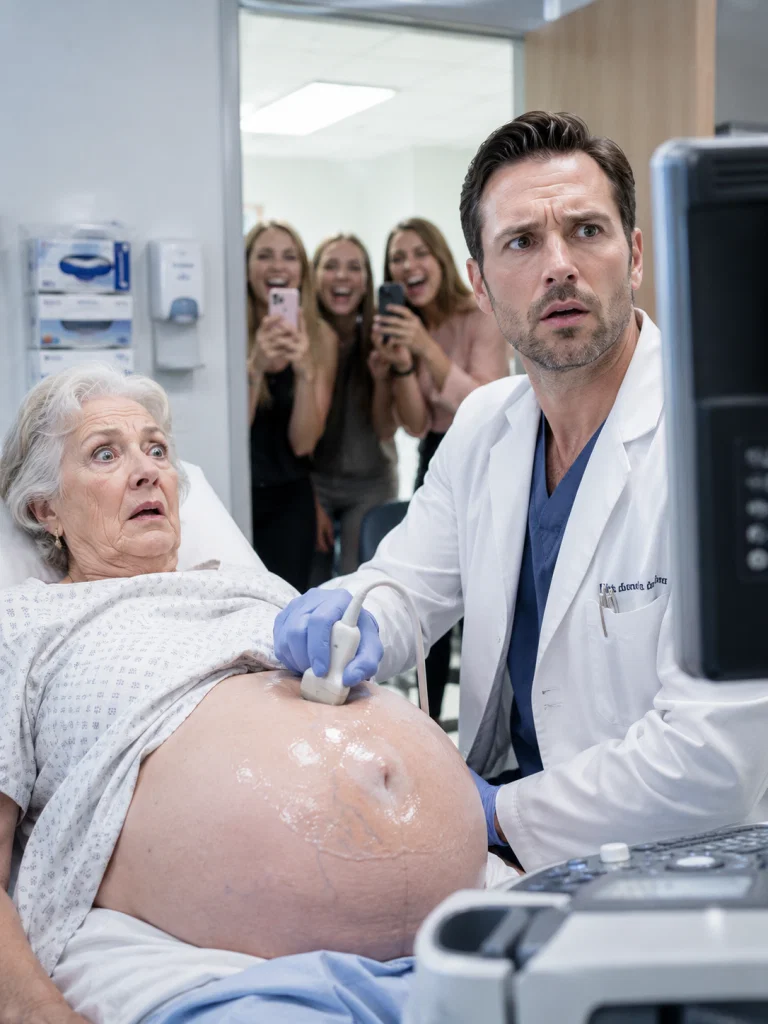
At sixty-six years old, Mrs. Evelyn arrived at the busy medical office clutching a bag of diapers and announcing to the entire room that she was about to give birth. The receptionist looked up from her desk so quickly that she nearly sent her half-finished coffee cup tumbling onto the floor.
“I am sorry, did I hear that correctly?” the receptionist asked, her eyes widening in sheer disbelief.
“I am nine months along,” replied Evelyn Ross, resting one hand on her significantly protruding belly while the other hand gripped a plastic bag filled with diapers she had just purchased from the corner pharmacy.
Behind her, her three adult children stood in a tight huddle and could not even begin to contain their mocking laughter.
“Why don’t you tell the doctor that we also brought an imaginary crib to go along with the diapers?” Jessica whispered loudly enough for everyone in the waiting room to hear.
Peter let out a dry, hacking laugh that sounded more like a cough than actual amusement.
Thomas, the youngest of the siblings, did not even bother to remove his noise-canceling headphones from his ears. He simply held up his smartphone to record a short video of the scene, treating his mother’s public humiliation like a funny family anecdote he intended to upload to his social media feeds later that evening.
Evelyn lowered her gaze, feeling the weight of the room pressing down on her shoulders. The private practice was located in a trendy district of town, filled with sleek gray armchairs, expensive artificial plants, and young women waiting patiently with neatly organized folders of medical documents.
Evelyn could feel the burning sensation of their stares piercing through her skin. She was an elderly woman with a swollen, pregnant belly, a grandmother buying baby supplies, and a clearly confused person walking around in comfortable flats.
She knew what they were thinking, but she was absolutely certain she was not crazy. At least, that was the desperate truth she had been trying to convince herself of for the last several months.
It had all started seven months earlier at her quiet, dusty home in the outskirts of Oakwood Heights. First, there was only a slight, unexplainable swelling around her waist that made it impossible to fasten the top button of her favorite floral dress.
Then came a persistent, dull ache radiating just below her navel, as if something heavy and solid had taken up permanent residence inside her body. After the physical pain came the waves of nausea, the overwhelming exhaustion, and the absolute loss of appetite that left her feeling like a ghost in her own house.
Most unsettling of all was that strange, undeniable sensation of movement deep within her core. One night, while she was standing at the kitchen sink washing a single coffee mug, she felt a distinct, firm push against the wall of her abdomen.
She was so startled that the mug slipped from her soapy fingers and shattered into a dozen jagged pieces on the hardwood floor. Evelyn stood perfectly still, her hands dripping with water, her heart hammering against her ribs, and her eyes filling with hot, stinging tears.
“Is it really possible?” she whispered to the empty, quiet kitchen.
She was sixty-six years old, and her husband, Harold, had passed away peacefully five years ago, leaving her entirely alone in the large, aging house. Her body had long since moved past any biological possibility of motherhood, but a doctor at the local community clinic had once reviewed her hormone levels and told her something that felt like a ray of blinding light combined with a sharp, warning thorn.
“Mrs. Ross, some of your blood work results appear to be consistent with the markers of a pregnancy,” the physician had said. “It is incredibly rare, perhaps even medically unheard of at your age, but you absolutely need to see a specialist to be sure.”
She never went to that specialist at first, not out of fear, but because of a fragile, blooming sense of hope that she hadn’t felt in decades. For years, her children had treated her like a piece of outdated furniture that was only useful when they needed to clear out her attic or borrow money for their failed business ventures.
Jessica visited only when she needed medicine from the cabinet to check what else of value was left in the house. Peter asked more questions about the estimated value of the land than he ever asked about his mother’s high blood pressure. Thomas only showed up when he had broken up with a girlfriend and needed a hot meal and a place to vent his frustrations.
So, when this impossible, absurd, and almost sacred possibility entered her life, it felt like a gentle, warm caress from heaven. She went to the downtown market and bought several balls of soft, sunshine-yellow yarn.
She spent her nights knitting tiny, delicate socks that would fit a newborn’s feet. She tracked down a gently used wooden crib from an online listing and dragged it into the spare room.
She stocked her bedroom wardrobe with stacks of diapers and onesies, and she began to whisper stories to her growing belly as if she were tucking a child into bed. “If you have truly come into this world to keep me company in my final years, please forgive me for taking so long to believe that you were real,” she would murmur.
The neighbors on the street soon began to whisper behind their curtains. They said that Mrs. Ross was surely pregnant, while others laughed and claimed she had finally lost her grip on reality since Harold had died.
When her children finally forced their way into her home and discovered the nursery she had prepared, they were not concerned about her health or the pain she was clearly experiencing. They were only worried about how ridiculous they looked to their friends and colleagues.
“Mom, you are being absolutely pathetic,” Jessica spat out while kicking a box of baby supplies across the floor.
“We cannot just let you continue to walk around this neighborhood talking nonsense,” Peter added, his face twisted in a sneer.
“We are going to see a high-end specialist this afternoon,” Thomas declared, not even looking up from his screen.
They did not take her to the clinic out of any sense of love or familial duty. They took her because someone in the neighborhood had posted a comment on a public forum: “The old lady on Cedar Street is running around telling everyone she is having a baby at sixty-six.”
Shame was a much stronger motivator for them than compassion. The gynecologist they eventually settled on was named Dr. Duane Miles, a man with steel-gray hair and eyes that looked like they had seen too much sadness.
Unlike her children, he did not offer a mocking smile when Evelyn sat down to explain the symptoms that had been plaguing her for months. “Pain, inflammation, significant weight loss, and the sensation of physical movement,” he repeated, scribbling notes onto his clipboard with intense focus.
Jessica crossed her arms tightly over her chest and tapped her foot impatiently. “Doctor, my mother clearly needs psychiatric intervention, as she has even gone as far as buying diapers for a baby that does not exist.”
Evelyn clutched the plastic bag tightly against her chest, her knuckles turning white. “I just wanted to make sure that I was properly prepared for what was coming,” she defended herself.
The doctor did not correct her or dismiss her claim immediately, but he did instruct her to lie down on the examination table. The table was covered with a sheet of cold, crinkling paper that felt like ice against her skin.
When the cold conductive gel was applied to her abdomen, a violent shiver raced through her entire body. Gray, ghostly shadows began to appear on the monitor, showing smudges and shapes that Evelyn could not possibly interpret.
She searched the screen desperately for the image of a small head, a tiny hand, or the flickering rhythm of a heartbeat. She saw nothing but the dry, rhythmic buzzing of the machine as it scanned her internal landscape.
“Where is the baby?” Evelyn asked in a voice that was barely a whisper.
The doctor moved the transducer over her skin again, his movements becoming more calculated and urgent. He pressed harder, and his forehead began to furrow with deep lines of concern.
Peter stepped forward, leaning over the doctor’s shoulder. “Just give it to us straight, Doctor. Is she pregnant or is she just delusional?”
The doctor did not respond to the question. Suddenly, his hand went completely still as he zoomed in on a specific quadrant of her abdomen.
He looked at the grainy image on the screen, then he looked at Evelyn, and then he looked at her children. The color drained from his face until he looked as pale as the paper on the table.
“I need all of you to leave this office immediately,” he said, his voice dropping to a low, authoritative tone.
Jessica frowned and tried to stand her ground. “We are her children, and we have a right to know what is going on.”
“That is exactly why you need to leave right now,” he snapped.
Nobody moved, frozen by the sudden shift in the room’s energy. The doctor reached over and pressed a large red button on the side of the table.
A nurse rushed in almost immediately, her face pale as she saw the look on the doctor’s face. “Is something wrong, Doctor?”
He spoke in a low voice, but the silence in the room was so heavy that Evelyn heard every word. “Prepare an urgent transfer to the surgical unit and notify the trauma team at the hospital.”
Evelyn felt as though the entire world was slipping through her fingers like dry sand. “Doctor, please tell me, where is my baby?”
On the screen, a massive, shifting shadow occupied the entire space where she had desperately imagined a new life. It did not look like a child, and it certainly did not look like anything a mother could ever give a name to.
Then, the doctor turned the screen slightly, and the nurse put a gloved hand over her mouth to stifle a gasp. Within that dense, chaotic mass, something white and curved appeared, aligned in a way that looked disturbingly like a row of jagged teeth.
Jessica dropped the bag of diapers she had been holding. The yellow knitted socks she had grabbed out of spite tumbled onto the clinical floor.
Evelyn finally understood, far too late, that her womb had never hidden a miracle. She had been harboring something that was slowly killing her from the inside out, while her children stood by and laughed at her decline.
Chapter 2: The Weight of Deception
“Your mother is not suffering from a simple delusion,” Dr. Miles stated, his voice echoing off the sterile walls of the exam room. “Your mother is in a state of critical medical danger.”
The phrase landed in the room with more force than a physical blow. Jessica tried to regain her usual posture of superiority, though her hands were beginning to shake. “But she is not actually pregnant, right?”
“No,” the doctor replied, not bothering to sugarcoat the situation for them. “She has a massive ovarian mass, a teratoma of significant size. It could rupture or twist at any moment, leading to internal hemorrhaging. She requires emergency surgery to survive the next twenty-four hours.”
Peter swallowed hard, his face turning a sickly shade of gray. “Is the surgery something that needs to happen today?”
“If she were my own mother, I would not wait a single hour longer than necessary,” the doctor said.
Thomas finally pulled his headphones down around his neck, looking at his mother for the first time with something approaching actual recognition. “And exactly how much is all of this going to cost?”
Evelyn closed her eyes, feeling a fresh wave of tears prickling at her lids. They did not ask if she was going to live or if she was in pain. They asked about the bill.
The doctor noticed the lack of empathy immediately, and his expression hardened into one of cold, professional distrust. “I am going to request an ambulance and, frankly, I am calling in a social worker to oversee this case.”
Jessica tensed up, her voice rising in pitch. “A social worker? Why on earth would we need one of those?”
“Because an elderly woman just arrived with months of documented pain, severe weight loss, and massive abdominal distension, while her own family seems much more interested in calling her crazy than in ensuring she doesn’t die on their watch,” the doctor answered sharply.
No one dared to answer him. The nurse quietly picked up the yellow socks from the floor and placed them gently into the bag. “Do not leave these behind, ma’am,” she whispered to Evelyn. “Even if they were not for a real baby, you made them with a heart full of love.”
Evelyn cried in total silence as they transferred her onto a gurney. As they wheeled her down the long, fluorescent-lit corridor, she could hear her children whispering and arguing just behind the heavy double doors.
“This whole thing has completely gotten out of our control,” Peter complained.
“We definitely should not have brought her to a doctor who asks so many questions,” Jessica muttered.
“And what happens now if she refuses to sign the property transfer papers?” Thomas asked, his voice full of greed.
Evelyn opened her eyes as they turned a corner. Property transfer? She felt a chill that had nothing to do with the air conditioning.
At the hospital, a social worker named Adriana visited her before she was taken to the operating theater. She wore sensible glasses, had a firm and steady voice, and carried a thick blue file folder.
“Mrs. Ross, I need to ask you a few direct questions to ensure your safety,” Adriana said, pulling up a chair. “Do you understand why you are here?”
“Yes, I do,” Evelyn replied, her voice weak. “I don’t have a baby. I have something very bad growing inside of me that needs to be taken out.”
Adriana nodded sympathetically. “That is correct. Now, have you signed any legal documents in the last few weeks?”
Evelyn felt a different kind of cold creeping through her veins. She remembered Jessica coming over to her house two weeks ago, bringing her some guava tea and sweet pastries.
“Mom, these are just new government forms for senior citizens that we need to get in order,” Jessica had said while stroking her hair. “We have to make sure everything is official before the baby arrives, just to be safe.”
Evelyn had signed three pages without reading them closely. She had trusted her own daughter. Now, that memory burned in her mind like hot coals.
“My daughter brought me some papers,” Evelyn said, looking up at the social worker.
Adriana gripped her pen tightly. “Do you own your own home?”
Evelyn looked toward the door. The house in Oakwood Heights was the one place where Harold and she had spent thirty years building a life. It had cracked walls, a small backyard filled with pots of basil, and a front porch where she spent her evenings.
It was the same house a regional construction company had been trying to buy for years because the entire neighborhood was being redeveloped into high-rise apartments. Her children were not ashamed of her belly; they were simply in a massive hurry to sell the land out from under her.
If they could get her declared incapacitated, they would control her assets and sell the house without her consent. Before they took her into the operating room, Jessica leaned down and tried to kiss her on the forehead.
Evelyn turned her face away. “What exactly did you make me sign that day?”
Jessica smiled without any joy in her eyes. “Mom, please do not start with this right now.”
“I am asking you a question. What did I sign?”
Peter stared at the floor, unable to meet her gaze. Thomas shoved his hands deep into his pockets. “They were just legal papers to help protect you, Mom,” Jessica said, her voice dripping with artificial sweetness.
“That is a lie,” Evelyn whispered.
Her daughter’s smile hardened into a mask of pure irritation. “Do you see why we need to keep a close watch on your affairs? You were buying diapers, talking to your own belly, and putting a crib by the window. You are not okay, and we are doing this for your own good.”
The gurney began to roll toward the double doors. Evelyn did not get a chance to answer. The lights on the ceiling passed over her like a series of white lightning flashes.
For the first time in her life, she did not pray for her children’s happiness. She prayed that God would protect her from them.
The surgery lasted for nearly five hours. When she finally woke up, her mouth was dry, her stomach was wrapped in tight bandages, and she felt a profound sense of emptiness that was somehow heavier than the pain.
Dr. Miles was sitting in a chair by her bedside. “The surgery went well, Mrs. Ross. It was a very large teratoma, but we successfully removed it. We have sent the samples to the pathology lab to be sure, but we caught it just in time.”
Evelyn touched her flat, aching abdomen. She started to cry, not because of a child that never existed, but because she realized she had spent months speaking with tenderness to a literal tumor, believing it was a sign of love.
“Did my children ask about how I am doing?” she whispered.
The doctor lowered his eyes, and that was all the answer she needed. “They asked if I could sign some documents regarding your medical guardianship,” he said quietly.
Adriana entered the room with another folder. “There is someone here who wants to see you. She says she has something important from your husband’s estate.”
It was Gladys, her neighbor from across the street who sold homemade jam at the local community center. She came in wearing a heavy shawl, carrying a plastic bag, and her eyes were fierce.
“You stubborn woman,” Gladys said, setting the bag down. “Why did you never tell me you were in this much pain?”
Evelyn tried to laugh, but the wound in her abdomen burned. Gladys pulled a manila folder from her bag. “Harold gave me these copies years ago. He told me, ‘If my children ever try to get too clever with their mother, you make sure you are smarter than them.’”
Inside the folder were the original deeds, bank receipts, a copy of the will, and a letter written in Harold’s own handwriting. Evelyn opened it with shaking hands.
Larisa, our children are ours, but that does not mean they are good people. If one day they try to make you feel useless just to take the house, remember: you and I built this life, not them.
Evelyn covered her mouth to stop a sob. Her husband had seen through their children long before she ever did.
The next day, her three children walked into the room believing they could still manipulate her. They did not know that sitting on the bedside table, right next to the yellow socks, was the folder that would expose every single one of their lies.
When Jessica said, “Mom, we have come to talk about your recovery and your home,” Evelyn looked up and replied, “No. You did not come for my recovery. You came for my house.”
Chapter 3: A New Foundation
The room fell into an uncomfortable silence. Jessica blinked repeatedly, as if she had just heard a dead woman speaking from inside a coffin.
“Mom, please do not talk such nonsense,” Jessica said, her voice straining for control.
Evelyn was pale, physically weak, and her lips were dry, but her eyes were no longer those of a confused, lonely old woman. They were the eyes of someone who had returned from the edge of the abyss, carrying a heavy truth in her hands.
“It was foolish of me to believe that you actually wanted to help me,” Evelyn said, her voice gaining strength. “It was foolish to sign any papers for you just because you brought me tea and spoke to me with a fake, sweet voice.”
Peter took a hesitant step backward, his face flushed. “I did not know the exact details of what Jessica was doing with those documents.”
Evelyn turned her sharp gaze toward him. “But you knew there were papers, and you knew I was not in the right state of mind to be signing anything. That makes you just as guilty.”
He did not have an answer for that. Thomas sat down in the chair by the door, as if his legs had suddenly lost the ability to hold his weight. “Mom, I only signed as a witness because Jessica told me it was to protect your assets.”
“You were always excellent at closing your eyes when it suited your convenience,” Evelyn replied.
Jessica’s face hardened into a mask of pure hostility. “And what exactly did you want us to do? Leave you alone in that old, decaying house, talking to a fake pregnancy and buying supplies like a little girl? You were becoming a massive problem for the whole family!”
The word hung in the air like an accusation. Problem.
Evelyn felt it more deeply than the surgery she had just endured. That daughter, for whom she had sewn every dress in her closet as a child, was now calling her a problem to be discarded.
Adriana, the social worker, entered the room accompanied by a lawyer from the hospital’s legal department. “Mrs. Jessica, we have a copy of the notarized request you filed to gain power of attorney over your mother’s assets. We also have your written statement claiming that Mrs. Ross suffers from persistent, severe delusions and is unable to manage her own estate.”
Jessica lost all the color in her face. Peter put a hand to his forehead, realizing the gravity of the legal trap they had set for themselves.
Thomas whispered, “I did not know the statement said all of that.”
Evelyn let out a bitter, dry laugh. “Of course you did not know. You signed first and planned to understand the consequences later.”
The lawyer explained that the fraudulent document was being challenged, and the hospital was filing an official report for attempted financial exploitation of an elderly individual. No family member would be allowed to force her to sign anything while she was under hospital care.
Jessica exploded in a fit of rage. “That house is falling apart, and the development firm offered us a fortune! You do not understand, Mom! You are going to die alone in there, surrounded by old dust and flowerpots!”
Evelyn looked at her for a long time, not with hate, but with a profound, crushing weariness. She looked at her with the exhaustion of a mother who finally realized that danger does not always break in through a window; sometimes it has a key, a familiar name, and childhood memories.
“We are all going to die somewhere, Jessica,” Evelyn said calmly. “But I am not going to die while I am still alive just so you can afford a new apartment in the city.”
Jessica opened her mouth to argue, but found no further response. Peter followed her out of the room, looking smaller than he ever had before. Thomas stayed for a few more seconds, hesitant.
“Mother, please,” Thomas said.
“Not today,” Evelyn replied.
“Can you ever forgive me?”
“Not today,” she repeated.
He left the room, his shoulders slumped, leaving his headphones in his bag as if he finally realized that the noise in his life was not coming from the outside world. The recovery process was slow, but the pathology report came back a week later confirming the mass had been fully encapsulated and removed.
Dr. Miles smiled for the first time. “We found it just in time, Evelyn. A little longer, and the story would have had a very different ending.”
Evelyn thought about the swelling she had carried for months. For so long, she thought it was a disgrace, but in the end, it had been a biological alarm. Her body was screaming for help while her children were busy laughing at her.
She returned home twenty days later. Gladys welcomed her with homemade chicken soup, freshly baked bread, and a living room full of flowers from the neighbors. The same people who had whispered behind her back were now sweeping her front walk, watering her plants, and bringing her fresh meals.
“Just look at you,” Gladys said as she cleaned the kitchen. “In the end, there was indeed a birth here.”
Evelyn frowned, touching the fresh surgical scar under her blouse. “What kind of birth are you talking about?”
Gladys pointed to the bandage. “You, my friend. You were born again.”
Evelyn started to cry, standing in the middle of her kitchen with her hands full of wrinkles and her heart finally feeling light. The crib was still by the window. She did not throw it away.
Instead, she cleaned the wood with a damp cloth, polished the rails, and filled the center with small, thriving pots of basil, mint, and geraniums. She stored the yellow socks in a small wooden box, not as a symbol of shame, but as proof of her survival.
Thomas was the first to return to the house weeks later. He arrived one afternoon with a bag of fresh oranges and no excuses in his pocket.
“I am not here to ask for a quick forgiveness,” he said, setting the oranges on the counter. “I am here so you can teach me how to be a person who is not a coward.”
Evelyn opened the door for him. She did not hug him immediately, but she handed him a knife and a cutting board. “Start by peeling these oranges and listening to me.”
He listened for three hours. He did not check his phone once. For the first time in years, he sat across from his mother, acting like a person who understood that there was still time to change, even if it was not as much as he once thought.
Peter arrived later that month. He brought medication, a new chair for her living room, and a mountain of guilt that was clearly weighing him down. He cried in the kitchen while Evelyn was making chamomile tea.
“I honestly thought Jessica knew what she was doing,” Peter admitted.
“No, Peter,” Evelyn said, stirring the tea slowly. “You thought it was more comfortable not to think at all.”
He lowered his head in shame. “We almost lost you.”
“No,” Evelyn corrected him. “They almost handed me over to be discarded.”
That phrase left him entirely speechless. She saw Jessica months later during a formal legal hearing. Jessica arrived dressed in an expensive suit, accompanied by a high-priced lawyer, and carried the air of a concerned daughter.
She told the judge that everything had been done out of love, that her mother was vulnerable, and that a woman who claimed to be pregnant at sixty-six could not possibly make sound financial decisions. Evelyn had the yellow knitted socks in her bag.
When it was her turn to speak, she placed them on the table in front of the judge. “I was sick and entirely alone,” she said. “My body was trying to warn me that something was killing me from the inside. They saw madness where there was actually a cry for help. They saw a ridiculous belly where there was a medical emergency, and they saw an empty house where a woman was trying to live her life.”
The judge listened to every word. The power of attorney was permanently revoked, and the court put strict measures in place to protect her estate. Jessica had to sign a legal agreement stating she could never file paperwork on her mother’s behalf without independent legal counsel.
It was not a prison sentence, and it was not a dramatic soap opera revenge. It was much cleaner than that. It was simply a closed door in the face of greed.
In time, Evelyn wrote her own will. The house would not pass to her children. When she eventually passed away, it would become a local center for elderly women in the neighborhood who had nowhere else to go.
She decided to call it The Yellow Socks.
Gladys said it sounded like a daycare center, but Evelyn just smiled. “Better than that,” Evelyn replied. “Many old women have to learn how to take care of themselves as if we were just born.”
During the first spring after her recovery, Evelyn walked slowly down the street with Gladys. She did not try to walk all the way to the church because her body was still tired, but they sat on a park bench watching the ice cream vendors and families walking in the sun.
Evelyn touched the scar under her dress. There was no longer a belly, and there was no longer a miracle, but there was a permanent mark. It was a warning, a second chance, and a lesson.
On her way home, she saw a bag of diapers in a pharmacy window that looked exactly like the one she had bought months ago. Before, the sight would have broken her heart. This time, she just smiled.
She understood that something had indeed been born within her. It was not a baby, and it was certainly not the insanity everyone accused her of. It was a new version of herself.
It was a woman who no longer confused abandonment with destiny. It was a woman who learned late, but finally learned, that her body was always speaking to her, that children were capable of betrayal, and that a mother could love her family without handing over the keys to her life.
As night fell, she unlocked the front door of her house. The flowerpots were watered, and the crib by the window smelled faintly of mint. Evelyn sat down in her favorite chair with a hot cup of tea.
Every morning, she watched those plants grow in the exact place where she had once placed an impossible hope. She remembered the truth of her journey. Her belly did not conceal a child, but it did hide the secret that saved her life.
From that day on, whenever someone knocked on her door, Evelyn no longer asked herself if they came out of genuine affection or hidden self-interest. She stood by the window, she took the time to think, and then she decided.
She only opened the door when she truly wanted to. Because that house, and the woman who lived inside it, belonged only to her.
THE END.