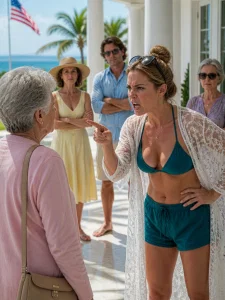
“What is this old parasite doing here? There’s no room for you.”
She smiled as if she had already won.
But she had no idea what I was carrying in my purse.
For twenty years, that house had been my sanctuary. Not a luxury mansion, not a showpiece for social media—just a simple coastal home with white shutters, weathered wicker furniture, a narrow garden path, and an ocean view that helped me breathe again after loss.
I bought it after my husband died. Every single payment came from my own work—sewing dresses late into the night, repairing clothes, stitching uniforms for nurses who stopped by exhausted after long shifts. I didn’t inherit it. I didn’t marry into it. I earned it stitch by stitch, year by year.
So when I pulled into my driveway that morning and saw unfamiliar cars filling the space, I didn’t move right away. Music spilled through the air. Laughter echoed across the yard. Strangers walked through my garden like they belonged there. Wet towels covered my chairs. Empty bottles lay near the flowers I had planted myself. My late husband’s framed photo had been removed and replaced with a cooler.
That was the moment I felt it—not anger first, but disbelief.
Then Chloe appeared.
My daughter-in-law stood in the doorway like she owned everything. Barefoot, sunglasses pushed up, holding a drink as if she were the hostess of my life. And over her outfit, she wore my apron—the one I had carefully embroidered years ago.
She looked at me and laughed. Then she said the words that froze the air:
“What is this old parasite doing here? There’s no room for you.”
The terrace went silent for a moment… then came the laughter of strangers. Her mother sized me up with disdain. “So this is Brandon’s mother? I expected… more.”
I asked for my son.
“He’s working,” Chloe replied coldly. “Unlike you, he actually has responsibilities.” Then she gestured toward the house. “There’s no space left. Every room is taken. You’ll only make everyone uncomfortable, Evelyn.”
Everyone. A word that somehow no longer included me.
Inside my own home, I saw people I didn’t recognize lounging on my furniture, eating in my kitchen, treating my life like a rental property. And near the hallway stood two garbage bags. At first, I thought they were trash. Then I saw my belongings spilling out—folded clothes, books, family photos—dumped like they no longer mattered.
My chest tightened, but I didn’t break. There is a kind of pain that makes you cry. And there is another kind that makes you clear-headed.
I said nothing. I didn’t argue. I didn’t beg for respect. Instead, I looked at the apron again—and smiled.
Chloe mistook it for surrender. “I’m glad you understand,” she said.
But I understood everything. This wasn’t a misunderstanding. This was an attempt to erase me from my own life.
So I turned away, drove to a nearby inn, and spent the night watching the ocean while strangers slept in my home. Inside my purse was a sealed cream-colored envelope I had almost forgotten. Almost.
The next morning, I returned. I was told my things had been dumped in the garage because I was “taking up space.” I stood there quietly, looking at the house I built, the life I earned, and the people who believed I would simply disappear under humiliation.
Then I touched the envelope inside my purse. My hand stopped shaking.
I didn’t argue. I didn’t enter. I just walked back to my car and made one calm phone call.
And by sunset, Chloe was still standing on my terrace—but this time, when she saw who was walking toward her behind me… all the color drained from her face.
Part 2
When I found forged documents in my own hidden closet, I felt something shift inside me. They weren’t just disrespectful. They were trying to legally erase me.
So I left quietly—but not defeated. I gathered evidence, froze my finances, and contacted a lawyer. Within days, everything changed.
Police arrived with eviction orders. Legal notices were served. Chloe and her family were forced to pack their things as neighbors watched in shock.
My son, Brandon, arrived, desperate to fix what had already collapsed. But there was nothing left to negotiate. He admitted what I already knew—that he had allowed it to happen because he believed I would never truly stand against him.
But he was wrong. Because I had spent my entire life building independence, and I was not about to lose it in silence.
By the end, they were gone. And for the first time in a long time, my home was mine again. Not just legally—but emotionally.
Months later, I began rebuilding my life in peace. I spent time by the ocean, planted flowers again, and slowly healed from what had happened.
Brandon eventually came back—not for money, not for control—but to apologize. He stood at a distance, no longer the boy I raised, but a man finally understanding the damage he had caused.
Forgiveness didn’t come immediately. It never does. But slowly, through time and honesty, we began to rebuild something different—not the old relationship, but a fragile new understanding.
I also learned something important from this experience: being family does not give anyone the right to take what you’ve built. And strength is not about never being broken—it’s about refusing to stay broken.
Now my house still stands on the Malibu coast, facing the endless ocean. But more importantly, so do I.
Part 3
The three police cruisers parked directly behind my sedan, their tires crunching heavily on the gravel driveway. The uniform officers stepped out in unison, their faces serious, followed closely by my attorney, Sarah Jenkins, and a representative from the county clerk’s office.
When Chloe saw the badges moving up the walkway, her casual smile vanished. She walked to the edge of the terrace, still wearing my hand-embroidered apron, her sunglasses dangling from one hand. Her mother and cousins peered out from the living room windows, their laughter instantly dying.
“What is going on here?” Chloe demanded, her voice losing its smugness as she glared at the police. “Evelyn, did you seriously call the cops because you’re mad about the rooms?”
Sarah Jenkins stepped forward, pulling a stack of certified documents from her briefcase. “Mrs. Sterling, we are not here about a domestic dispute. We are here to execute an emergency eviction and asset-freeze injunction.”
Chloe’s mother stepped onto the terrace, her expression haughty. “You can’t evict us. This is Brandon’s house. He gave us full permission to stay here while he manages the estate.”
“That is where you are completely wrong,” Sarah said, handing the top document directly to Chloe. “This house belongs entirely to a private trust owned solely by Evelyn Sterling. Furthermore, we have spent the last twenty-four hours reviewing the property registry. We found the fraudulent deed transfer you attempted to file last week using a forged power of attorney.”
Chloe’s hands began to shake as she looked down at the court order.
I took a step forward, finally looking my daughter-in-law dead in the eye. “Inside my purse yesterday was the original, certified deed of trust that my late husband and I signed twenty years ago. The hidden closet where you found my personal files didn’t contain my surrender, Chloe. It contained the trap you walked right into.”
“Officers,” Sarah instructed, turning to the police. “The court has granted immediate possession back to the rightful owner. Everyone who is not Evelyn Sterling has exactly thirty minutes to remove their personal belongings from the premises. Anything left behind will be considered abandoned property.”
The terrace erupted into a chaotic frenzy. Chloe’s mother began shrieking about her rights, while her cousins frantically scrambled to gather their suitcases and wet towels from the yard. Chloe stood frozen, staring at me as the legal reality of her cruelty completely crushed her artificial kingdom.
Final Part
By sunset, the cars were gone, leaving nothing behind but tire tracks and empty bottles in the gravel. The locksmith had already finished changing every deadbolt on the doors, handing the new set of brass keys directly into my palm.
I walked into my kitchen, peeling off the hand-sewn apron that Chloe had left thrown on the counter. I threw it directly into the washing machine, watching the stains of their intrusion wash away.
Just as the sky turned a deep, bruised purple over the Pacific, a lone car pulled into the driveway. It was Brandon. He walked up the steps slowly, his shoulders hunched, his head hanging low. He didn’t try to use a key; he knocked softly on the glass of the front door.
I opened it, standing under the porch light.
“Mom,” he whispered, his eyes bloodshot, his voice cracking with a heavy, hollow shame. “I’m so sorry. I… I didn’t know she was going to go that far. I didn’t know about the forgery.”
“But you knew she wanted me gone, Brandon,” I said, my voice steady, entirely devoid of the tears he probably expected. “You knew she called me a parasite in my own home, and you turned your phone off because it was easier to let her break me than it was to stand up to her.”
He dropped his gaze to the wooden deck. “She told me you were getting older… that you needed to be in a facility… I thought I was doing what was best for the family.”
“You forgot who your family was,” I told him calmly. “I built this life stitch by stitch while your father was dying, and I raised you to respect the ground people work for. You allowed her to throw my memories into garbage bags.”
He began to cry, reaching out a hand, but I didn’t take it. Not yet.
“I’m going to cooperate with the prosecutor regarding Chloe’s forgery charges,” I said, looking out at the dark horizon. “And as for you, Brandon, I love you because you are my son. But love does not grant you residency in a house you refused to protect.”
“Can I ever fix this?” he choked out.
“That depends entirely on whether you’re ready to start working for your own independence, instead of living off mine,” I replied.
I closed the door gently, turning the new deadbolt into place.
Six months have passed since that evening. The courts systematically processed Chloe’s fraud charges, resulting in a hefty fine, five years of strict probation, and a permanent restraining order barring her from ever stepping foot on my property. Brandon eventually filed for divorce, moving into a small apartment of his own and taking a secondary job to pay off his legal debts. He calls me every Sunday now—not to ask for money, and not to manage my life, but simply to ask how the ocean looks.
Forgiveness is a long, slow tide. It hasn’t reached the shore yet, but the water is moving.
This morning, the sun rose bright and golden over the Malibu coast. I walked down my narrow garden path, carrying a fresh cup of coffee, looking at the white shutters and the weathered wicker furniture that have finally been restored to their rightful places.
Being family never gives anyone the license to steal the foundation you built with your own blood, sweat, and tears. Strength isn’t about hiding from the storm; it’s about standing on the shoreline, holding your ground, and refusing to let the waves wash you away.
My house still stands proud against the endless, powerful ocean. And today, so do I.