Chapter 1: The Seeds of Disrespect
The smell of lemon oil and ancient, suffocating dust always clung to the mahogany walls of the Pendelton estate in Boston. It was a house that demanded silence, a sprawling architectural monolith of old money and rigid expectations where the air itself felt heavy, engineered to press down on anyone who hadn’t been born with a silver spoon lodged firmly in their mouth. I was an intruder in that world, a fact I was never allowed to forget.
I am Dr. Evelyn Harper. When I married Arthur Pendelton, a venture capitalist whose family crest carried more weight in New England than federal law, I was a surgical resident running on stale coffee and sheer, unrelenting ambition. I loved him, or at least, I loved the polished, attentive version of him that he presented during our courtship. I believed that my fierce dedication to reproductive surgery, my quiet drive to reconstruct shattered lives and bodies, would be respected. Instead, within the walls of that Boston mansion, my medical degree was viewed as an embarrassing, tedious hobby. To the Pendeltons, marriage was not a partnership of equals; it was an acquisition. A contract drawn up to secure a biological heir, ensuring the trust funds and the legacy had a vessel to inherit them.
For four years, that house was my personal purgatory. The whispering campaigns began subtly. A side-eye at a charity gala from Arthur’s mother, Eleanor Pendelton, when I opted for water instead of champagne. “Still not expecting, Evelyn? Perhaps if you spent less time elbow-deep in other women’s abdomens, your own might function properly.”
The systemic emotional abuse was a slow, dripping poison. It started with Arthur suggesting I cut back my hours at the medical research center. When I refused, the narrative shifted. We had been trying to conceive for two years with no success. As a doctor, I knew the protocol. I knew the statistics. But logic held no jurisdiction in that house. I subjected myself to the grueling regimen of fertility tracking. My thighs were perpetually bruised black and blue from hormone injections. I charted my basal body temperature with clinical obsession, forcing myself into a rigid, soul-crushing schedule.
Yet, whenever I gently, rationally suggested that Arthur undergo a simple, standard semen analysis, the suggestion was met with absolute, towering rage.
“A Pendelton male is biologically flawless,” Arthur had hissed one evening, slamming his scotch glass down onto the marble counter so hard I thought the crystal would shatter. “My father had me at sixty. My grandfather fathered five. Do not insult me by projecting your anatomical failures onto my genetics, Evelyn.”
I was the defective product. I was the barren soil. That was the reality they constructed, and eventually, exhaustion wore down my defenses until I almost believed them. I stopped fighting the narrative. I retreated into the sterile, predictable sanctuary of the operating room, where I had control, where my hands could fix what was broken.
The final evening in the Pendelton estate was devoid of any warmth. It was raining, the droplets clawing at the leaded glass windows of the formal dining room. Arthur sat at the far end of the long mahogany dining table, a chasm of polished wood between us. He didn’t look at me as a husband looks at a wife. He looked at me the way one looks at a bad investment.
With a flick of his wrist, he tossed a thick, cream-colored medical and legal folder onto the wood. It slid down the length of the table, coming to a halt an inch from my untouched plate of cold asparagus.
“My mother has spoken with the family attorneys, Evelyn,” he said. His voice was flat, an empty, hollow sound entirely devoid of emotion. “We have tried for three years, and your body has failed to perform its only necessary function for this family. A Pendelton cannot build a legacy on empty promises and late-night surgeries.”
He paused, leaning back in his antique chair, adjusting the cuffs of his bespoke shirt. “You are a brilliant doctor, perhaps. But as a wife, you are incomplete.”
I looked at the divorce papers resting beside my plate. I felt the sharp edges of the paper under my fingertips. I waited for the tears, for the familiar sting of heartbreak, but nothing came. It felt as if a fault line had cracked open right through my chest, and everything weak and desperate had simply fallen into the abyss, leaving behind a cold, hard bedrock of clarity. I did not cry. I merely looked at the man I had loved, realizing with absolute, chilling certainty that his affection was, and always had been, entirely contingent on my biological utility.
I was not a human being to Arthur. I was an incubator that had failed to turn on.
I didn’t argue. I didn’t defend myself. I quietly picked up the heavy gold fountain pen resting beside the documents and signed my name. I relinquished any claim to the Pendelton estate, their trusts, their properties. I wanted nothing but my freedom. I wanted to escape the toxic, necrotic tissue of this family.
As I stood to leave, pushing my chair back against the Persian rug, I saw Eleanor watching from the doorway. Her face was a mask of aristocratic triumph, her posture rigid with generations of unearned arrogance.
As I walked past her, she didn’t move an inch. She simply leaned in, the scent of her powdery perfume nauseatingly strong, and whispered.
“You will die alone in your sterile hospital, Evelyn. No one wants a woman who can only offer a medical degree.”
Chapter 2: The Catalyst of Success and the VIP Encounter
The air in New York City tasted different than Boston. It tasted like electricity, like kinetic energy, like a place where you could build yourself from the ground up without anyone asking who your grandfather was. Two years had passed since the heavy oak doors of the Pendelton estate closed behind me for the last time. Two years of eighty-hour weeks, of relentless research, of pouring every ounce of the grief and inadequacy Arthur had shoved down my throat into my surgical precision.
I was no longer the exhausted resident shrinking under the shadow of old money. I was the Chief of Reconstructive Reproductive Surgery at Manhattan Memorial Hospital, a world-renowned institution. I had rebuilt my life entirely on my own terms. I was highly respected, fiercely financially independent, and most importantly, I was at peace. My sanctuary was the exclusive, restricted-access VIP wing on the top floor of the hospital. It was a hushed, marble-floored expanse where high-profile patients—politicians, celebrities, foreign dignitaries—underwent private medical consultations away from the prying eyes of the press.
It was a Tuesday afternoon. The rain outside mirrored that final night in Boston, beating a steady rhythm against the floor-to-ceiling windows overlooking the East River. I was standing in the quiet VIP reception area, a cup of green tea growing cold on the desk beside me, deeply engrossed in a complex patient chart. I was reviewing the surgical margins for an upcoming uterine reconstruction, my mind purely analytical, completely detached from the ghosts of my past.
Then, the heavy double doors of the wing swung open with an aggressive, disruptive force.
The silence of the room shattered. I didn’t need to look up to know who it was; my body remembered the sheer, suffocating gravity of his presence. A cold dread coiled in my gut, an involuntary response to a pathogen I thought I had eradicated from my system.
I slowly raised my eyes from the iPad.
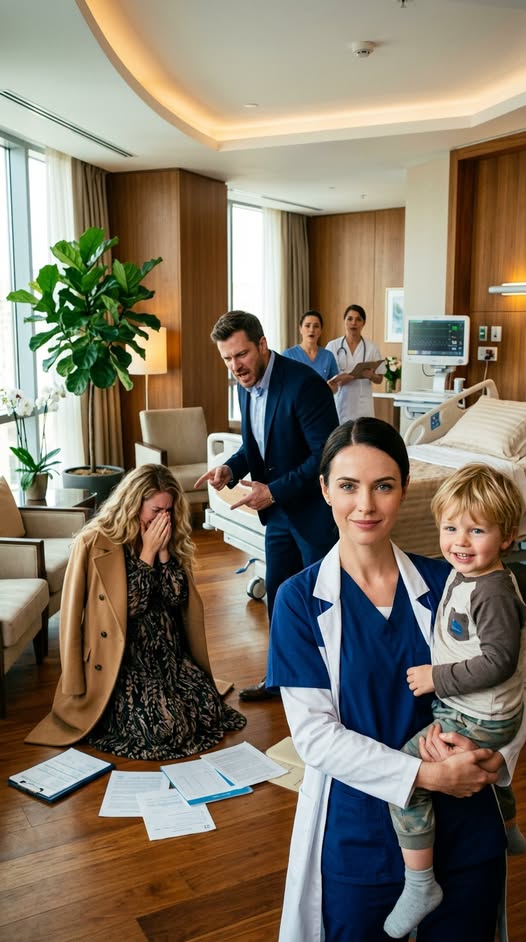
Arthur walked in, exuding that exact same effortless, inherited confidence that had once intimidated me into silence. He wore a charcoal Tom Ford suit that cost more than most nurses made in a year. But it wasn’t Arthur who caught my immediate attention. Clinging tightly to his arm, radiating a practiced, camera-ready glow, was his new wife, Olivia. She was a glamorous socialite from a similarly wealthy Connecticut background, her face a staple on the society pages. She was draped in a loose-fitting, impeccably tailored designer maternity coat, her left hand resting deliberately, performatively, on a barely visible bump.
They had bypassed the standard reception downstairs, arrogant enough to assume the VIP floor would accommodate their unannounced arrival. As Arthur turned to demand attention from the head nurse, his gaze swept across the room. The moment his eyes adjusted to the soft lighting and landed on me, standing there in my white lab coat with my name embroidered in dark blue silk, time seemed to stutter and stop.
I saw the exact moment the shock registered on his face, quickly swallowed and replaced by a familiar, ugly sneer. His need to establish dominance, to shrink me down to the size of the woman he had discarded in his dining room, was immediate and visceral.
“Well, well. Look who it is,” Arthur announced, his voice booming, deliberately loud enough to draw the attention of the surrounding medical staff, the security detail by the elevator, and the few elite patients waiting in the private alcoves.
He unhooked his arm from Olivia’s and stepped closer, invading my professional space, looking down his nose at me.
“Dr. Harper,” he mocked, letting the title roll off his tongue like a dirty word. “Still lurking in the hallways of hospitals, I see. Still playing god because you couldn’t build a real family of your own.”
The nurses at the desk froze. A heavy, suffocating tension dropped over the marble lobby. Arthur smiled, a cruel, razor-thin expression, and gestured back to Olivia, who was watching the exchange with a mixture of polite disdain and detached curiosity.
“Look at you, Evelyn,” he gloated, his voice dripping with condescension. “All that money, all this so-called success, yet you’re still only half a woman. Olivia is pregnant with my son. The Pendelton heir. Something you could never, ever do.”
He stood there, chest puffed out, waiting for me to crumble. He was waiting for the tears, for the flush of humiliation, for me to run back into the shadows exactly as I had done for four years.
But I didn’t flinch. I didn’t retreat a single inch. My pulse was steady.
I slowly lowered the medical chart to my side. I looked at Arthur, really looked at him, and saw nothing but a loud, insecure boy wearing his father’s watch. Then, my eyes dropped from his smug face and locked onto Olivia.
I watched as the polite disdain on her flawless face instantly evaporated. Her confident smile faltered. The color drained from her cheeks, leaving her looking like a wax mannequin. Her knuckles turned bone-white as she reached out, gripping Arthur’s sleeve in a sudden, silent, suffocating panic.
She knew. And she knew that I knew.
Chapter 3: Unearthing the Deception
The universe has a bizarre, razor-sharp sense of humor.
The night before this explosive encounter, I had been sitting in my quiet, darkened office at the end of the hall. The only illumination was the stark, blue glow of my dual monitors reflecting off the glass windows. As Chief of Reconstructive Surgery, I was routinely asked to consult on highly complex, confidential cases from around the globe. A few days prior, my department had received an urgent, encrypted medical file transferred from an elite, hyper-private clinic in Geneva, Switzerland. The file had been transferred under a legal, maiden name, heavily redacted to protect the identity of a high-net-worth individual who had recently relocated to New York and required an English-speaking specialist to monitor a “delicate anatomical baseline.”
The name on the file had been Olivia Kensington. The same Olivia who was now plastered across Arthur’s social media as his beautiful, fertile savior.
When I first opened the file, I hadn’t made the connection. I viewed it purely through the lens of a surgeon. But as I read through the comprehensive surgical reports, the detailed imaging, and the extensive post-operative notes, the clinical reality painted a picture of extraordinary medical intervention.
Olivia was born with complete uterine agenesis.
In the medical community, it’s known as Mayer-Rokitansky-Küster-Hauser syndrome, or MRKH. It is a congenital condition where a woman is born with a normal chromosomal pattern and functioning external genitalia, but the internal structures—specifically the uterus and the upper vagina—fail to develop. She was born without the organs necessary to carry a child. She had no uterus.
The records from Geneva documented the extensive, highly experimental, and wildly expensive cosmetic reconstructive surgeries she had undergone in her late teens. The Swiss surgical team had essentially created a functional anatomy for her, a brilliant piece of plastic and reconstructive engineering that allowed for a normal physical life. But it was entirely cosmetic.
I clearly remembered staring at the screen, reading the final summary report written by the lead Swiss surgeon in cold, clinical terms: “Patient is biologically incapable of gestation. Egg retrieval possible; surrogacy required for biological offspring.”
A profound, almost dizzying sense of irony had washed over me in the silence of my office.
Arthur, the man who had subjected me to years of psychological torture, who had thrown me away like garbage because I couldn’t conceive within his arbitrary timeline, had proudly boasted that his new wife was the “perfect specimen of womanhood.” He had blamed my demanding medical career for my supposed “infertility” without ever letting a doctor test him. And now, he had married a woman who possessed the exact biological limitation he had so viciously despised in me.
But Olivia hadn’t told him. That much was brutally obvious from the way Arthur paraded her around. She had hidden her truth behind a wall of generational wealth, expensive Swiss cosmetic procedures, and, as I now realized looking at her in the lobby, forged prenatal scans.
She was faking the pregnancy.
It was a desperate, catastrophic lie. She was likely buying time, using a silicone prosthetic bump while secretly arranging a private surrogacy behind Arthur’s back, hoping to present him with a child before he ever realized she hadn’t carried it. She was trying to fulfill his manic demand for an heir before the illusion shattered.
And she had made one fatal, unfathomable oversight.
When she moved to New York, knowing she would eventually need a specialist who understood her unique reconstructed anatomy just in case of complications, she had requested her private medical records be transferred to the most prestigious reproductive reconstructive department in the city.
She had no idea that her new husband’s discarded, “worthless” ex-wife was the Chief of that very department. She had essentially handed the weapon of her own destruction directly to the woman her husband had destroyed.
Standing in the VIP lobby, listening to the echo of Arthur’s insult fade into the stunned silence of the room, I watched Olivia’s eyes dart toward the exit. She was trapped. I was the gatekeeper of a secret that was about to bring her entire, carefully constructed dynasty crashing down onto the marble floor.
Chapter 4: The Climax of Truth
The silence in the VIP reception area was absolute. The kind of heavy, expectant quiet that precedes a violent storm. Two nurses had stopped typing. A security guard by the elevator shifted his weight, his hand resting on his radio.
Arthur’s smug, aristocratic smile was still plastered on his face, but it was beginning to curdle at the edges. He was waiting for my reaction. He was waiting for me to break, to cry, to flee the room in shame so he could chuckle with his new wife and recount the story to his mother over expensive scotch.
Instead, I calmly reached into the pocket of my lab coat and pulled out a fresh pair of surgical gloves. I snapped the right one onto my hand, the sharp smack of the latex echoing like a gunshot in the quiet lobby.
I didn’t raise my voice. I didn’t need to. True power doesn’t have to shout.
I looked directly into Arthur’s eyes, stripping away the ghost of the husband I once knew, seeing only the arrogant, foolish man standing before me. Then, I slowly shifted my gaze back to Olivia. She looked as though all the oxygen had been vacuumed from her lungs. Her breathing was shallow, rapid, her chest heaving under the expensive designer maternity coat.
“Arthur,” I said, my voice smooth, clinical, and entirely devoid of anger. I spoke to him the way I would speak to a medical student who had misdiagnosed a simple fracture. “Before you continue celebrating your genetic triumph in the middle of my hospital… has she told you about the secret reconstructive surgery she had in Switzerland?”
Arthur’s sneer instantly vanished, replaced by a flicker of genuine, disorienting confusion. His brow furrowed. He looked down at Olivia, then back at me.
“What the hell are you talking about, Evelyn?” he snapped, his voice losing its theatrical boom, dropping into a sharp bark of annoyance. “Are you out of your mind? Olivia is pregnant with my son.”
I tapped the medical tablet I was still holding in my left hand.
“The encrypted medical records from the Geneva clinic,” I stated clearly, ensuring every word hung in the air for the surrounding staff to hear. “Transferred to my department three days ago under the name Olivia Kensington. They detail a very comprehensive, very expensive series of surgeries to address complete uterine agenesis.”
I stepped one pace closer to him. I wanted him to see my eyes. I wanted him to see the absolute certainty of science crushing his inherited arrogance.
“She was born with the exact same ‘infertility’ you so violently blamed me for, Arthur. Except, in her case, it isn’t an assumption. It is an anatomical certainty. She has no uterus.”
Arthur opened his mouth, but no sound came out. His face went entirely slack.
“That child she’s supposedly carrying?” I continued, my voice dropping to a whisper that somehow carried further than a shout. “It isn’t yours. Because she is physically incapable of carrying one. The bump is a prop, Arthur. The pregnancy is a lie.”
The reaction was instantaneous and catastrophic.
Arthur whipped his head around to look at his wife. “Olivia? What is she talking about? Tell her to shut her mouth. Tell her she’s lying!”
But Olivia couldn’t speak. Pure, breathless horror distorted her beautiful features. The polished socialite vanished, leaving behind a terrified, cornered animal. She stumbled backward, away from Arthur, instinctively clutching her stomach—not to protect a baby, but as if she were trying to physically hold her crumbling lie together.
“Arthur, I…” she choked out, a pathetic, reedy sound.
Her hand shook so violently that she lost her grip on her oversized, heavy designer handbag. It slipped from her fingers and crashed onto the polished marble floor. The gold clasp snapped open on impact.
A cascade of papers spilled out, scattering across the floor directly between Arthur’s Italian leather shoes.
Right on top of the pile, stark and damning under the bright hospital lights, were three high-gloss forged ultrasound documents. And resting perfectly beside them was a crisp, itemized invoice. I recognized the letterhead immediately—it was from Genesis Solutions, one of the most exclusive, hyper-expensive private surrogacy agencies in California.
Arthur stared down at the documents. The silence returned, thicker and more suffocating than before. He looked at the receipt, then at the fake ultrasounds, and finally up at Olivia, who was now quietly, hysterically sobbing into her hands.
The invincible Pendelton legacy, built on cruelty and arrogance, lay scattered like trash on my lobby floor. I didn’t smile. I didn’t gloat. I simply turned around, walked over to the nurses’ station, and picked up my cup of cold green tea.
Chapter 5: The Fall of the Dynasty
The fallout was spectacular, swift, and entirely public.
You cannot keep a secret of that magnitude quiet when it erupts in the middle of a hospital lobby, especially not when the people involved occupy the uppermost echelons of Manhattan and Boston society. Within a week, the whispers began at the country clubs. Within a month, the details of Olivia’s grand deception, the fake pregnancy, and the secret surrogacy contract had somehow leaked to the society pages and the tabloids.
The Pendelton family name, which Arthur and his mother had guarded with the ferocity of rabid dogs, was suddenly the punchline of every joke at every gala on the East Coast.
The divorce between Arthur and Olivia was a bloodbath. It was ugly, vindictive, and entirely devoid of the cold, corporate efficiency that had characterized his separation from me. They tore each other apart in the courts. Olivia’s family fought back, leaking details of Arthur’s verbal abuse and his mother’s tyrannical behavior to justify Olivia’s extreme measures to secure her position.
I watched it all unfold from a distance, feeling completely detached. It was like watching a house burn down from the safety of a hill on the other side of a river. I didn’t engage in the drama. I declined every interview request from tabloids offering obscene amounts of money for my “side of the story.” I chose instead to dive deeper into my work, focusing entirely on my patients, my research, and the profound, quiet satisfaction of my independence.
Three months after the encounter in the VIP lobby, the past made one final, desperate attempt to drag me back down.
I was scrubbing in, preparing for a delicate, six-hour reconstructive surgery, when my assistant, Maria, poked her head into the scrub room. She looked deeply uncomfortable.
“Dr. Harper,” she said softly. “Arthur Pendelton is downstairs. In the main public reception. Security was going to escort him out, but he’s begging for just five minutes of your time. He says he won’t leave until you speak to him.”
I stopped scrubbing. I looked at the soap suds on my hands, my mind calculating the intrusion. A part of me wanted to let security throw him onto the street. But a larger, more resolute part of me knew that to truly close a wound, you have to look at the scar one last time.
“Tell him to wait in the east courtyard,” I said, rinsing my hands. “I’ll be down in five.”
It was misting outside, a cold, miserable New York drizzle that chilled the bone. I walked out into the courtyard, pulling my white coat tighter around my shoulders.
When I saw him standing by the stone fountain, I almost didn’t recognize him.
The sharp, polished, utterly arrogant venture capitalist was gone. In his place stood a hollowed-out, tired man. His posture, once so rigid with unearned superiority, was slumped. The expensive tailored suit hung loosely on his frame, as if he had dropped twenty pounds. His hair was unkempt, and when he looked up at me, his eyes were bloodshot, rimmed with the deep, bruising red of absolute exhaustion and excessive scotch.
“Evelyn,” he whispered, his voice cracking as he took a hesitant step forward. The rain dotted his shoulders.
“Five minutes, Arthur. I have a patient waiting,” I said, keeping my distance, my voice neutral.
He swallowed hard. “I made a mistake,” he choked out, the words seeming to tear at his throat. “A terrible, catastrophic mistake. I was lied to. I was manipulated. I let my mother’s voice in my head, I let my own stupid, blind pride ruin the only real thing I ever had.”
He reached a hand out toward me, desperate, pleading. “I have nothing left, Evelyn. The family is a laughingstock. My mother won’t even speak to me. Please… can we just talk? Let me buy you dinner. We can find a way to make this work. We can start over.”
I looked at him. I searched my heart, my gut, my mind, looking for a trace of the anger that had fueled my late nights, looking for the heartbreak that had shattered me in his dining room.
I found nothing. No anger. No malice. Just a quiet, profound, overwhelming pity. He was a pathetic creature, a man who only recognized value when it was walking away from him, a man who needed to break someone else to feel whole.
“Arthur,” I said softly, the rain misting between us. “I spent four years of my life feeling smaller, feeling less than human, because of you and your mother. I let you convince me that my worth was tied to my biology. But I don’t belong in your world anymore. I outgrew it the moment I walked out of your house.”
His hand fell to his side. The desperate hope in his eyes shattered.
“I am not your savior, Arthur. And I am certainly not your fallback plan. I have a surgery to perform. A life to change. Please, don’t ever come back to my hospital.”
I didn’t wait for his response. I turned on my heel and walked back toward the glass doors of the hospital, leaving him standing entirely alone, shivering in the cold rain.
As I stepped back into the sterile, comforting warmth of the surgical wing, the heavy doors sealing shut behind me, my phone vibrated in the pocket of my scrubs. I pulled it out.
It was an urgent email notification from the hospital’s board of directors. The subject line glowed brightly on the screen: Official Nomination – Global Lifetime Achievement Award in Reproductive Medicine.
Chapter 6: A New Dawn
Time is the ultimate surgical tool; it excises the necrotic tissue of the past and allows the healthy, vibrant parts of a life to regenerate and thrive.
Two years later, the suffocating memory of the Pendelton estate felt like a bad movie I had watched a lifetime ago. I was standing backstage at the Geneva Convention Center, nestled in the heart of Switzerland—the very country where Olivia Kensington had tried to bury her secrets. Today, however, Geneva represented something entirely different. It represented the pinnacle of my global recognition.
The grand hall was massive, a cavernous space of glass and steel, filled to capacity. As I was introduced, the applause began before I even reached the podium. It swelled into a deafening roar. I walked out into the blinding stage lights, looking out at a sea of thousands of faces—leading surgeons, brilliant researchers, eager medical students from over eighty different countries, all standing in my honor.
I adjusted the microphone, a quiet smile playing on my lips.
For the next hour, I didn’t speak of vengeance or past hurts. I presented my groundbreaking, peer-reviewed research on uterine reconstruction and tissue regeneration. I spoke of the technology and surgical techniques that my team and I had developed, techniques that were already changing the lives of women globally, offering hope where there had previously been only dead ends. I spoke with the authority of a woman who knew exactly what she was capable of.
When the keynote concluded, the standing ovation lasted for a full five minutes.
Later that evening, after the banquets and the endless handshakes, I slipped away from the crowded reception hall. I walked out onto the expansive stone balcony overlooking Lake Geneva. The night air was crisp, clean, biting with the chill of the distant snow-capped mountains. The water below was a mirror of black glass, reflecting the scattered, brilliant lights of the city.
I stood at the railing, taking a deep, shuddering breath of the mountain air. I closed my eyes and let the silence wash over me.
My mind drifted back, just for a fraction of a second, to a rain-swept dining room in Boston. I remembered Arthur’s cold voice telling me I was incomplete. I remembered Eleanor’s toxic whisper, promising I would die alone in a sterile hospital. I remembered being told, in front of my own staff, that I was only “half a woman.”
I opened my eyes and looked at my hands resting on the stone railing. These were the hands that had rebuilt lives. These were the hands that had signed my own declaration of independence. Today, looking out over the world I had conquered, I knew with absolute, unshakable certainty that I was complete. I was whole. I was entirely self-made, and my worth had never, ever been defined by my ability to conform to the narrow, pathetic expectations of a broken man.
My phone chimed, breaking the quiet spell of the evening.
I pulled it from my evening gown. It was a brief text message from an old medical colleague back in Boston, someone who still kept an ear to the ground of the city’s elite gossip.
Just thought you should know. Eleanor passed away last month. Arthur finally sold the family estate to a commercial developer yesterday. He filed for bankruptcy and left the city permanently. No one knows where he went.
I stared at the glowing text for a long moment. The great Pendelton legacy, reduced to a liquidation sale and a disappearing act.
I felt a brief flicker of something—not joy, not sadness, just a final, absolute severing of a ghostly tether. A faint smile touched the corners of my mouth. I swiped left on the screen, hit delete, and slipped the phone back into my pocket without replying.
I turned my back to the dark lake and walked back inside, stepping into the warm, golden light of the hall to join the colleagues who respected me, who celebrated me, for exactly who I was.
If you want more stories like this, or if you’d like to share your thoughts about what you would have done in my situation, I’d love to hear from you. Your perspective helps these stories reach more people, so don’t be shy about commenting or sharing.