The Architecture of Betrayal: A Father’s Protocol
I built a life on truth and tactical precision, but the greatest threat was the woman in my bed and the monster who raised her.
For a decade, I operated in a world of absolute certainties. As a tactical detective turned high-end security consultant, my survival, and the survival of those I protected, relied entirely on my ability to anticipate the worst in human nature. I saw the invisible angles. I calculated the hidden risks. Yet, when the collapse of my universe finally arrived, it didn’t come from a faceless adversary in a shadow-draped alley. It came from the pristine, echoing dining room of a Bellevue estate, dressed in the guise of family.
My name is Garrett Miller. Up until a Tuesday in late autumn, I believed I had successfully bridged two incompatible worlds. There was my world: grounded, hyper-vigilant, built on the grit of the streets and the unshakeable oath to protect. Then there was the world of my wife, Sienna, a realm of inherited wealth, suffocating expectations, and a chilling detachment. That world was entirely governed by her father, Franklin, a powerful pharmaceutical executive whose empire was built on sterile laboratories and ruthless patents.
The cracks in our marriage hadn’t shattered all at once. They had spider-webbed slowly, tracing along the edges of Sienna’s increasingly erratic behavior. But I ignored them, blinded by the one perfect thing we had created: our sweet, six-year-old daughter, Maya. She was the gravity that kept my feet on the earth.
The suffocating reality of my blind spot crystallized during what was supposed to be a routine Sunday dinner at Franklin’s sprawling mansion. The rain outside was a relentless, hammering sheet against the floor-to-ceiling windows, mirroring the growing chill in my own home. The dinner table was agonizingly quiet. The only sound was the scrape of silver against porcelain and the soft, rhythmic scratching of crayons from the corner where Maya was quietly coloring a picture of a golden retriever.
I watched as Franklin poured a heavy, dark red wine into his crystal glass. His eyes, pale and predatory, never left Maya.
“She has her mother’s unique physiology, Garrett,” Franklin murmured, his voice laced with a cold, analytical pride that made the hairs on my forearms stand at attention. He swirled the wine. “We must ensure her genetic potential is fully protected. Standard medicine isn’t enough.”
Sienna sat rigidly beside him. Her posture was bone-straight, her eyes vacant and glassy, staring at a fixed point on the pristine linen tablecloth. She nodded in silent, robotic agreement. A cold dread coiled in my gut. Franklin’s unusual, obsessive interest in Maya’s recent “medical checkups” had been gnawing at the edges of my tactical paranoia for weeks.
I reached across the table, desperate to find the woman I loved beneath this frozen exterior. I squeezed Sienna’s hand. Her skin was ice-cold, clammy to the touch. She flinched, pulling her hand away sharply to adjust her silk collar, refusing to meet my eyes.
The silence that followed was louder than a gunshot.
The next morning, the Seattle sky was the color of bruised iron. As I dropped Maya off at her elite prep school, I knelt in the damp parking lot and zipped her bright yellow jacket. I kissed her forehead, breathing in the scent of strawberry shampoo and rain.
“Have a good day, monkey,” I whispered.
“I love you, Daddy,” she smiled, clutching her backpack.
Before I handed it to her, my fingers slipped into a concealed tear in the inner lining of the canvas. Working purely on muscle memory and a habit born from years of tactical paranoia, I embedded a custom GPS tracker—an AirTag integrated into a rugged, military-grade frequency emitter—deep inside the fabric. It was an insurance policy. A whisper of reassurance against the screaming alarms in my head.
I drove to my downtown office, trying to drown out the memory of Franklin’s predatory gaze with the mundane tasks of security audits and firewall configurations. But at exactly 1:15 PM, as I sat behind my mahogany desk, the silence of the room was shattered.
My phone vibrated violently, walking itself across the glass surface of my desk.
I snatched it up. The screen glowed red with a critical geo-fence alert from Maya’s backpack. She wasn’t in her afternoon science class on the prep school campus. My lungs seized. The flashing digital beacon on my map showed her tracker moving at seventy-five miles per hour, heading directly north on Interstate 5 toward the Canadian border.
The transition was instantaneous. The loving, worried father evaporated in a fraction of a second, incinerated by the cold, calculating tactical operator that took his place. The furnace roared to life in my chest, but my mind turned to absolute ice.
My fingers flew across my laptop keyboard, bypassing the prep school’s rudimentary security systems with a few aggressive lines of code. I didn’t need to ask permission. I pulled up the front office registry. Maya had been checked out twenty minutes prior. The authorized signature was a digital scrawl, but the name attached to the release form made my blood turn to battery acid: Franklin. He had used a fabricated emergency dental appointment as the pretense.
I didn’t pause to breathe. I opened a dedicated terminal on my machine, utilizing an advanced cybersecurity backdoor I kept for high-level corporate espionage tracking. Franklin drove a registered, armor-plated Mercedes SUV. A vehicle like that was practically a rolling server rack. It took me eighty-six seconds to shatter the firewall of his vehicle network.
“Give me eyes,” I muttered to the empty room, my jaw clenched so hard my teeth ached.
The live cabin feed flickered to life on my secondary monitor. The audio channel hissed with the rhythmic, mechanical thud of windshield wipers battling the torrential Washington downpour.
Then, Franklin’s harsh, imperious voice filled my quiet office.
“Keep her quiet, Sienna. If she wakes up and starts crying at the border crossing, they will ask questions.”
My heart stopped. A physical blow to the sternum couldn’t have robbed me of breath more effectively.
The grainy camera feed panned slightly as the vehicle hit a bump, adjusting its auto-focus to reveal the backseat. Maya lay slumped heavily against the tinted glass of the window, her small frame completely limp, utterly unconscious.
Standing over her, strapped awkwardly into the middle seat, was Sienna.
Her face was deathly pale, streaked with dark, ruined makeup and silent tears. Her hand was trembling violently. Pinched between her delicate fingers was a medical syringe, the barrel filled with a thick, viscous amber liquid.
“I’m sorry, baby,” Sienna whispered to our sleeping child. Her voice was a broken, haunting rasp. Her thumb rested hesitantly on the plunger. “It’s the only way to save grandfather’s work.”
The monitor illuminated the total devastation of my reality. The woman I had loved, the woman I had sworn to protect for seven years, was actively sedating our daughter to facilitate an illegal flight across an international border. She had chosen her abuser over her child.
I slammed the laptop shut. I grabbed my service weapon—a customized Glock 19—from the biometric safe under my desk, shoving it into my shoulder holster, grabbing two extra magazines. I sprinted out of the office, bypassing the elevator, taking the concrete stairs down to the parking garage three at a time.
I burst through the heavy steel fire door, sprinting toward my customized tactical truck.
I stopped dead in my tracks.
The truck was sitting flat on its rims. All four thick, all-terrain tires had been professionally, deeply slashed. I threw open the driver’s side door and jammed the key into the ignition. Nothing. I looked under the dash; the ignition harness had been cleanly severed. Franklin’s security team had anticipated me. They had neutralized my pursuit before it could begin.
Stranded, my chest heaving with a desperate, animalistic panic, I sprinted out of the underground garage and into the blinding Seattle rain. I looked wildly up and down the grey, slick avenue. The traffic was crawling. I had no vehicle. I was losing minutes I didn’t have.
Then, through the curtain of heavy rain, my eyes locked onto the flashing strobe of a blue-and-white Washington State Patrol cruiser cruising slowly down the adjacent street. I sprinted through the intersection, ignoring the blaring horns and screeching brakes of oncoming traffic, waving my arms frantically.
The cruiser skidded to a halt. The window rolled down, and through the rain-streaked glass, I recognized the sharply angled jaw and piercing eyes of the officer behind the wheel. It was Trooper Wyatt Davies.
“Get in!” Wyatt barked, not even blinking at the sight of me drenched in rain and radiating lethal intent.
I didn’t hesitate. I threw myself into the passenger seat, water instantly pooling on the rubber floor mats.
“I owe you my life, Garrett. We’re getting your girl back,” Wyatt said, his voice a low, steady rumble of absolute conviction. Five years ago, during a joint task force operation that went catastrophically wrong, Wyatt had been pinned down in a blind alley during a violent cartel shootout. I had breached the flanking wall and dragged him out by the tactical vest while laying down suppressing fire. He had a scar on his neck from that night. We shared a bond of deep, unspoken loyalty that surpassed the badge.
“I-5 North. They have a thirty-minute lead. Armor-plated Mercedes SUV,” I said, my voice eerily calm as I pulled my waterproof mobile tactical unit from my jacket.
Wyatt slammed the cruiser into drive. The siren wailed to life, a high-pitched scream that parted the dense Seattle traffic like a scythe. He pushed the heavy Ford interceptor past ninety miles per hour, the tires fighting for grip on the rain-slicked asphalt, the windshield wipers thrashing violently.
As the highway blurred past the windows, I tethered my mobile unit to the cruiser’s encrypted network. I needed to know why. Custody disputes didn’t involve amber sedatives and border runs. I tapped into the federal database, utilizing a set of old, highly classified credentials I had retained from my consulting days with the DOJ. I cross-referenced Franklin’s pharmaceutical holding company with active federal warrants.
The loading bar crawled across my screen. When the files decrypted, the truth that flooded the monitor was a horror show worse than any scenario my paranoid mind could have engineered.
Franklin’s multi-billion-dollar empire was collapsing. The FBI was currently, at this very hour, raiding his corporate headquarters and his Bellevue estate for illegal, off-the-books clinical testing.
But it was the subject of those tests that made the blood freeze in my veins.
Years ago, when Maya was a toddler, she had suffered a severe, seemingly incurable autoimmune crisis. Standard medicine had failed. Franklin had stepped in, offering a proprietary, experimental treatment from his private labs. Sienna had begged me to trust him. It had worked. Maya was cured.
The federal files told a different story. It wasn’t a cure. It was an experimental, highly illegal gene therapy. And Maya wasn’t just a patient; she was Patient Zero. She was the only successful subject of a biological protocol that could rewrite human cellular degradation.
Franklin wasn’t just fleeing the FBI. He was saving his life’s research. He was trafficking his own granddaughter to a private, non-extradition laboratory compound in British Columbia. His plan was to systematically harvest her blood and unique genetic profile to sell the synthesized results to the highest-bidding foreign buyers.
And Sienna? The files detailed years of psychological profiling. She was a victim of Franklin’s systematic, narcissistic abuse since childhood, completely broken and reshaped in his image. When the FBI raid became imminent, she had chosen her father’s survival and his twisted definition of legacy over her daughter’s freedom.
“Wyatt,” I said, the word tasting like ash in my mouth. “They aren’t just taking her. They’re going to harvest her.”
Wyatt’s grip on the steering wheel tightened until his knuckles turned bone-white. The speedometer needle buried itself past one hundred. “Not on my watch, brother.”
We were closing the gap. The GPS tracker on my screen showed we were less than two miles behind the Mercedes. I drew my Glock, checking the chamber, my mind locking into a state of absolute, predatory focus.
Just as we crested a steep, forested ridge, a massive, blacked-out heavy dual-axle pickup truck surged from the obscured highway shoulder. It didn’t merge; it launched itself like a missile.
The armored grill of the truck slammed violently into the passenger side of Wyatt’s patrol car. The impact was a deafening explosion of tearing metal and shattering glass. The cruiser violently fishtailed, hydroplaning across the slick lanes. The truck surged again, grinding against our doors, its engine roaring, deliberately trying to force us off the crumbling asphalt shoulder and down into the jagged, deep mountain ravine below.
Sparks showered across the windshield as metal ground against metal. The world spun in a chaotic blur of rain, grey sky, and black asphalt.
“Hold on!” Wyatt roared over the screaming tires.
He didn’t hit the brakes. That’s what the mercenary driving the truck expected. Instead, Wyatt slammed his foot down on the accelerator, dropping the cruiser’s transmission into a lower gear. The Ford surged forward just enough to break the truck’s pinning angle. With a violent, calculated twist of the steering wheel, Wyatt executed a flawless, high-speed PIT maneuver. The heavy reinforced bumper of the cruiser clipped the rear quarter-panel of the attacking truck.
Physics did the rest. The massive black truck spun out of control, its tires catching the muddy lip of the shoulder before it barrel-rolled violently down into the treeline, disappearing in a cloud of snapping pines and shattered glass.
Wyatt fought the wheel, regaining control of the battered, smoking cruiser. The passenger side door was caved in, pressing heavily against my leg, but the engine still roared.
“Keep moving,” I commanded, my eyes locked on the GPS monitor. “He’s deviating. He knows the main border checkpoints will be flagged by now.”
The glowing dot on my screen banked hard to the east. Franklin was taking a secluded logging bypass road—a dark, wet, unpaved artery that wound through the dense Pacific Northwest forest, crossing the Canadian border in a blind spot unmonitored by federal cameras.
Wyatt took the exit, the cruiser’s tires tearing through deep mud and scattering gravel. The heavy canopy of the ancient pine forest swallowed us, blocking out the little daylight that remained. It was a tunnel of green and black.
A quarter-mile south of the border, the road narrowed aggressively, flanked by a sheer rock face on one side and a steep drop into a swollen river on the other.
And there it was. The sleek, black, armor-plated Mercedes SUV.
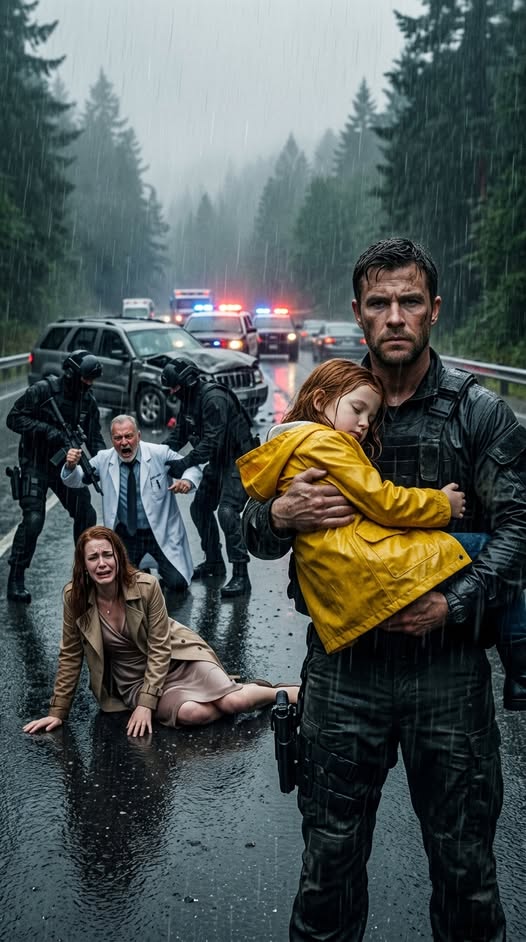
Wyatt hit the accelerator one last time, drifting the cruiser sideways and slamming on the brakes. We formed a blockade of scarred metal and flashing strobe lights directly across the narrow logging road, completely sealing Franklin’s path forward.
The Mercedes screeched to a halt, its anti-lock brakes stuttering violently in the mud, stopping mere inches from our doors. They were trapped between the impenetrable pine forest, the barricaded road, and me.
I kicked the caved-in passenger door open. It groaned in protest, snapping off its lower hinge. I stepped out into the freezing rain.
The tactical operative was fully in control now. I felt no rage, no sorrow, only the cold, mechanical precision of a father executing a rescue protocol. I measured my steps, each one heavy with the finality of what I was about to do. I leveled my service pistol, the tritium sights locking perfectly onto the center of the Mercedes’ reinforced windshield.
The driver’s side door opened. Franklin stepped out into the downpour. His bespoke suit was instantly ruined by the rain, his silver hair plastered to his skull. His face was contorted in a mask of aristocratic fury, utterly oblivious to the lethal reality he had just stepped into.
In the passenger seat, through the rain-slicked glass, I saw Sienna. She was cowering against the door panel, her eyes wide with terror, clutching the amber syringe to her chest like a protective amulet.
“Step back, Garrett!” Franklin shouted, his voice cracking over the sound of the rain and the rushing river. He pointed a trembling, manic finger at me. “You don’t understand what is at stake here! She is a medical marvel! She belongs to my legacy! She is my intellectual property!”
I didn’t flinch. I didn’t lower the weapon. I closed the distance, walking slowly toward the hood of his vehicle.
“She is my daughter, Franklin,” I said. My voice wasn’t a shout. It was quiet, carrying the heavy, terrifying weight of absolute authority. It cut through the rain like a razor. “And you are a dying old man with nowhere left to run.”
I shifted my gaze past his raving silhouette, meeting Sienna’s tear-filled eyes through the wet glass.
“Sienna,” I commanded, my voice dropping an octave, demanding the remnants of her maternal soul to awaken. “Look at her. Look at your child.”
Sienna sobbed, her shoulders shaking violently. She turned her head slowly, looking into the backseat where Maya lay pale and motionless.
“If you let him inject her with that sedative, her heart rate will drop too low. She won’t survive the night in that condition. You know this,” I said, projecting my voice so it vibrated against the glass. “You are her mother. Choose your daughter, or choose his grave.”
The silence hung in the air, heavy and suffocating, punctuated only by the drumming of the rain.
Inside the cabin, Sienna’s hand trembled. A guttural sob tore from her throat. Her fingers opened, and the amber syringe slipped from her grasp, tumbling down into the dark floorboard of the SUV. She pressed her face into her hands, completely broken, but finally surrendering.
But Franklin saw the betrayal. He realized in an instant that his control over his daughter was broken, and his multi-billion-dollar empire, his legacy, was lost in the mud.
His eyes widened in a psychotic panic. With a speed I hadn’t anticipated from an old man, Franklin whipped his hand into his tailored coat pocket and drew a small, concealed semi-automatic pistol. He didn’t aim it at me. He spun around, leveling the weapon directly through the rear window of the SUV, pointing the barrel straight at Maya’s unconscious chest.
Time fractured, slowing to a microscopic crawl.
I saw the tension in Franklin’s wrist. I saw the slack coming out of the trigger of his subcompact pistol. My own Glock was raised, but the angle was compromised; the reinforced steel pillar of the Mercedes blocked a clean center-mass shot on Franklin, and shooting through the glass risked a deflection that could strike Maya.
I needed a fraction of a second. A miracle.
CRACK.
The deafening roar of a heavy caliber rifle tore through the dense forest canopy.
Before Franklin could depress the trigger, the passenger side window of the Mercedes exploded outward in a cloud of tempered glass dust. A high-velocity sniper round, fired from the elevated tree line where Wyatt had quietly repositioned himself with his cruiser’s designated marksman rifle, struck Franklin’s weapon hand.
The impact was surgical and devastating. Franklin shrieked, spinning backward, his pistol clattering uselessly into the deep mud. He collapsed against the side of the vehicle, clutching his ruined hand, his aristocratic facade shattering into pathetic, agonizing whimpers.
I didn’t waste a heartbeat on him. I holstered my weapon and lunged for the rear door of the SUV. I ripped the handle open.
The heavy smell of leather and fear poured out of the cabin. Maya was slumped sideways, her breathing shallow but steady. I reached in and unbuckled her, pulling her small, limp body into my chest. The sheer weight of her in my arms was a grounding shock, a jolt of electricity that brought the humanity rushing back into my veins.
She stirred slightly, groaning.
“I’ve got you, baby. Daddy’s here,” I whispered fiercely, burying my face in her hair. I stripped off my heavy tactical jacket and wrapped it tight around her shivering, rain-dampened frame, shielding her eyes and ears from the nightmare unfolding around us.
The distant wail of multiple sirens echoed through the canyon. Wyatt had called in the federal cavalry the moment we initiated the PIT maneuver. Within minutes, the logging road was swarming with black SUVs and heavily armed FBI tactical agents.
I stood by the barricade, holding my daughter, refusing to let the medics take her from my arms until they had checked her vitals right there in the rain. She was groggy, confused, but unharmed. The amber sedative had never entered her system.
Through the sea of flashing blue and red strobes, I watched the sterile, clinical destruction of my former life. Franklin was pinned face-down in the wet gravel, a federal agent kneeling heavily on his spine as they bound his uninjured hand. He was screaming about patents and diplomatic immunity, sounding like a madman howling at the moon.
Then, the agents brought Sienna around the front of the vehicle.
Her wrists were locked tightly in steel handcuffs. The rain had washed away the last traces of the wealthy, detached socialite. She looked small, hollowed out. She stared at me, and then down at the bundle of my jacket where Maya was safely tucked against my chest. Her expression was a devastating mixture of profound, inescapable regret and a strange, quiet relief. She had remained silent during her arrest, offering no resistance, accepting the cold steel around her wrists as the ultimate, necessary price for her daughter’s survival.
As an FBI agent placed a hand on her head to guide her into the back of a hardened transport van, Sienna paused. She locked eyes with me, her gaze piercing through the chaos.
She leaned out slightly, her voice barely a whisper, yet it carried perfectly over the noise of the idling engines, a chilling final transmission from a ghost.
“My father’s overseas buyers already paid for her, Garrett,” Sienna whispered, her eyes dead and flat. “They won’t stop looking just because he is in a cell.”
One year later.
The sharp, biting cold of the Seattle rain was a ghost of the past, replaced by the brilliant, unbroken Oregon sun breaking through the morning coastal fog. It cast a warm, golden, forgiving light over the jagged shoreline and the endless expanse of the Pacific Ocean.
I sat on the worn wooden porch of our modest, secluded cedar cabin, inhaling the sharp tang of salt and pine. The air here was clean. It didn’t smell of corporate sterility or hidden agendas.
Down by the shoreline, where the waves gently kissed the packed sand, Maya was running. She was seven now, a whirlwind of energy and uninhibited laughter. She chased a clumsy, oversized golden retriever puppy through the shallow surf, kicking up fans of sparkling water. Her cheeks were flushed with health, her eyes bright and filled with genuine, unshadowed joy. The trauma of that night in the woods had been met with therapy, time, and an overwhelming wall of a father’s love. She was free from the shadow of corporate exploitation, a child allowed to simply be a child.
I took a slow sip of black coffee, watching them. My service weapon was no longer holstered on my hip. It was locked deep inside a biometric heavy-steel safe in the basement, oiled and ready, but hopefully never to be drawn again.
I hadn’t ignored Sienna’s final warning. Over the past twelve months, I had leveraged every contact, every dark-web backdoor, and every federal favor I had ever earned. With Wyatt’s quiet, off-the-books assistance, I had systematically dismantled the remnants of Franklin’s criminal associates. We had hunted down the overseas buyers, exposing their operations to international authorities, burning their networks to ash. We had built an invisible, impenetrable fortress around this coastal town.
I looked down at the heavy manila envelope resting on the small porch table next to my mug. It was a final dispatch from the federal prosecutor in Seattle.
Franklin’s life sentence in a maximum-security federal penitentiary had been finalized. No parole, no appeals. His empire was liquidated, his patents seized by the government. Sienna’s plea deal had secured her a reduced, but still lengthy, sentence in a minimum-security facility. The psychological evaluations noted she had begun a long, painful path to rehabilitation, finally severing the psychological chains her father had forged.
I picked up the letter, folded it carefully, and tossed it into the small metal fire pit on the porch. I struck a match and watched the paper curl and blacken, letting the sea breeze carry the ashes of my past worries away into the vast blue sky.
True protection isn’t just about tactical precision or anticipating threats. It’s about having the courage to walk away from the battlefield and build a sanctuary of peace from the ruins.
My phone, resting face-up on the wooden table, buzzed.
A spike of adrenaline hit my system—an old, ingrained habit of a tactical operator. My jaw tensed. But as I glanced down at the illuminated screen, the tension melted into a quiet smile.
It was a picture message from Trooper Wyatt. The image showed a gleaming, newly minted Detective’s badge resting on a dashboard. Beneath the photo was a simple text:
“The Pacific Northwest is safe today, brother. Enjoy the silence.”
I locked my phone, slipped it into the pocket of my flannel jacket, and walked down the wooden stairs. The sand was warm beneath my boots. I walked toward the water, leaving my shadows behind, ready to join my daughter in the sun.
If you want more stories like this, or if you’d like to share your thoughts about what you would have done in my situation, I’d love to hear from you. Your perspective helps these stories reach more people, so don’t be shy about commenting or sharing.