Chapter I: The Architecture of a Trap
The fire chief didn’t begin his interrogation by asking me who ignited the inferno. He asked me something infinitely more terrifying.
“Miss Parker, why were you the only soul occupying the second floor?”
I stared at him through the fog of my oxygen mask, the rhythmic hiss of the machine the only anchor I had in the sterile hospital room. The acrid stench of burning timber still clung to the back of my throat, battling the biting odor of clinical antiseptic.
“What?” I croaked, my voice a ragged ribbon of sound.
He didn’t repeat the question. Instead, he unclasped a manila folder and dealt three glossy photographs across my tilted hospital tray like a tarot reader predicting doom.
The first image captured my parents, shivering but unharmed, standing barefoot on the dew-kissed front lawn of our estate. The second revealed my younger brother, cocooned in a thermal shock blanket, sipping water beside the flashing lights of an ambulance. The third was a charred nightmare: the gutted upstairs hallway where a rescue team had eventually dragged my unconscious body from the rubble.
Finally, he tapped a manicured finger against a laminated floor plan of the estate. “Everyone else’s primary bedrooms were located downstairs,” he murmured, his gaze heavy with unspoken accusations. “Yours was the single occupied suite on the upper level.”
I frowned, a sharp jolt of pain radiating across my bandaged forehead. “No. You’re mistaken. My grandfather’s suite was upstairs, too. He was right down the hall from me.”
The chief nodded, a slow, deliberate motion that made my blood run cold. “Exactly.”
A cold dread coiled in my gut, tightening like a rusted winch. My name is Emma Parker. I was twenty-eight years old, an architect by trade, a daughter by biological misfortune. Society, and extended family, had always whispered that my parents harbored a deep, undeniable favoritism toward my younger brother, Ryan. Even I had accepted that bitter pill long ago.
I just never possessed the dark imagination required to believe there would come a day when my mother and father would coldly calculate that only one of their children deserved to walk away from a blazing inferno alive.
Chapter II: The Final Invitation
Three days before our ancestral home immolated into a pyre of greed, my grandfather, William Parker, telephoned me. His baritone voice crackled through the receiver, sounding more robust and commanding than it had in a grueling eighteen months of declining health.
“Emma, my dear, can you make the drive home this weekend?”
“Of course, Grandpa. Is everything all right?”
“I’ve summoned everyone,” he said, pausing just long enough for the silence to feel heavy. “I have finalized a decision regarding the future.”
Grandpa William was a man forged from steel and mortar; he never articulated matters of profound importance over cellular waves. He demanded to look his adversaries, and his family, directly in the eye. Thus, I tossed a few essentials into a leather duffel and piloted my sedan toward the sprawling, heavily wooded ridge overlooking Asheford Lake.
It was the very same estate where my grandparents had birthed Parker Construction out of the dirt—armed with a single rusted pickup truck, two loyal laborers, and a surplus of grit. Every ounce of wealth, land, and legacy our bloodline claimed originated on this soil.
As my tires crunched onto the gravel driveway, I noted the vehicular arrangement. Ryan’s ostentatious sports car gleamed aggressively near the garage. My father’s heavy-duty truck flanked it. But it was my mother’s luxury SUV that sat parked flush against the front portico—the prime real estate she aggressively insisted belonged exclusively to her. Some narcissistic habits never withered.
Before my boot could even strike the bottom porch step, the heavy oak door swung open.
“There she is!” Ryan crowed, bounding down the stairs. He threw his arms around me in a crushing embrace.
The gesture caught me so entirely off guard that my arms remained pinned to my sides. We hadn’t exchanged a physical embrace since high school graduation.
“You look sufficiently bewildered,” he chuckled, stepping back to inspect me.
“I am.”
“I’m making a conscious effort, Em. Trying to be the brother you deserve.”
The phrasing sounded vaguely sincere, yet a phantom chill brushed the nape of my neck. It felt relentlessly rehearsed.
Inside, the manor was deceptively warm, heavily perfumed with the scent of rising yeast and aged cedar. Grandpa sat positioned beside the hearth, a pair of reading glasses perched on his nose as he studied a dog-eared engineering periodical. The instant his eyes met mine, his face transformed. It was a genuine, radiant smile—entirely distinct from the tight, diplomatic grimace he reserved for the rest of his genetic lottery.
He rose with a stiff dignity and wrapped me in a gentle hug. “You made it.”
“I wouldn’t miss a summons from the chairman,” I teased softly.
He peered over my shoulder toward the dining room, where the clatter of silverware signaled the gathering storm. “Neither, it seems, would they.”
Dinner was an anomaly. It was suffocatingly peaceful. My father politely inquired about my latest commercial high-rise project in the city. My mother, Helen, actually praised the tailoring of my blouse—a first in a decade. Ryan even offered a sheepish apology for ghosting my birthday dinner six months prior. Had a stranger observed us through the bay windows, they would have documented the quintessential, harmonious American dynasty.
Grandpa remained notably taciturn. He merely observed, his sharp eyes cataloging every smile, every passed dish, listening far more than he spoke.
As the plates were cleared for espresso, he finally tapped his spoon against a crystal water goblet. “I will be delivering a binding announcement tomorrow at precisely noon.”
My father’s lips curled into a ravenous grin. Ryan shifted in his chair, practically vibrating with suppressed adrenaline. And my mother—she casually reached across the linen tablecloth and firmly squeezed Ryan’s forearm.
I watched Grandpa track that microscopic gesture. His warm smile evaporated into a mask of profound sorrow, just for a fraction of a second.
That night, slumber eluded me. The air in the house felt thick, charged with an invisible static. Near eleven o’clock, parched and restless, I descended the grand staircase to fetch a glass of water.
As I crept past the heavy mahogany doors of Grandpa’s study, a murmur of voices bled into the hallway. The door was ajar by a mere inch.
“If he actually executes this document…” my father grumbled, pacing the floorboards.
“He won’t change his mind,” my mother clipped, cutting him off with surgical precision. “We have exhausted our diplomacy.”
Ryan’s voice trembled, a stark contrast to his earlier bravado. “So, where does that leave me? What happens to my position?”
A suffocating silence suffocated the study. When my mother finally replied, her tone was so devoid of human warmth, so absolute in its chilling pragmatism, that I barely recognized the woman who raised me.
“You will secure the exact future you deserve, my sweet boy. Whatever it takes.”
I shrank back into the shadows, terrified my erratic heartbeat would betray my presence, totally unaware that the “future” they were plotting required my immediate eradication.
Chapter III: The Weight of Silver
Dawn broke with a bruised, grayish light. I sought refuge in the glass-paned greenhouse situated behind the main property, seeking the solace of silence. I found Grandpa already there, meticulously pruning his prized hybrid roses.
“You heard the wolves pacing last night,” he stated. It wasn’t framed as a question.
I swallowed hard, nodding slowly. “I didn’t catch the details. Just… tension.”
“You heard enough.” He laid his shears down on the potting bench with a heavy sigh. “Emma, I have sacrificed forty years of my life bleeding for this enterprise.” He turned, leveling a gaze at me that was both fierce and utterly exhausted. “My most catastrophic error was not misplacing my trust in cutthroat competitors. It was operating under the delusion that shared blood automatically engineered loyalty.”
He reached deep into the breast pocket of his cardigan and withdrew his clenched fist. Reaching out, he deposited a small, weighty object into the center of my palm.
It was a key. Forged of antique silver, dense and cold, its head ornately engraved with archaic scrollwork.
“What lock does this belong to?” I whispered.
“You will comprehend its purpose when the hour arrives.”
I forced a weak smile. “You’ve always possessed a frustrating penchant for answering direct questions with cryptic riddles.”
“This is no riddle, child.” He reached out, his rough, calloused fingers closing mine tightly around the jagged metal. “If the winds shift today, if anything unforeseen transpires, you guard this with your life. Do not let a single one of them pry it from your hands.”
Before I could demand an explanation, the greenhouse door rattled. Ryan leaned his head inside, checking his luxury wristwatch. “Grandpa? The board members are getting restless. We’re all waiting on you.”
Grandpa William took one lingering, melancholic look around his beloved sanctuary of blooming flowers. Then, in a voice barely louder than the rustling leaves, he murmured, “I pray to God I have miscalculated.”
The corporate announcement was slated for midday. By eleven-thirty, the great room was swarming with influential guests: senior board directors, loyal vice presidents, and a smattering of oblivious family friends. The ambiance was eerily celebratory, awash with the clinking of champagne flutes.
At three minutes to noon, the crystal chandeliers flickered. A sharp, electrical spasm.
No one paused their networking.
Sixty seconds later, the lights surged, then dimmed completely.
Grandpa paused mid-conversation. He whipped his head toward the ceiling, his jaw locking tight. His eyes widened in sudden, horrifying realization. He pushed back from the table so violently his heavy oak chair crashed to the floor.
“Everyone evacuate! Out of the house!” he roared, a battle cry that silenced the room instantly.
My father chuckled, a condescending, nervous sound. “Dad, what on earth are you—”
“NOW!” Grandpa bellowed.
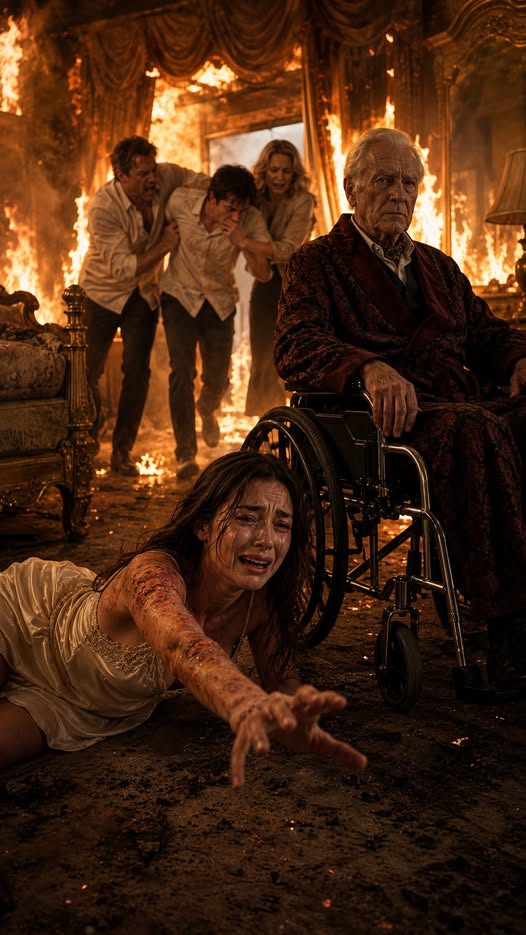
Simultaneous to his scream, a concussive boom detonated from somewhere deep within the bowels of the estate. The floorboards buckled violently beneath my heels, throwing guests to their knees. The remaining lights shattered. Instantly, every shrieking smoke detector in the mansion triggered, a deafening mechanical wail.
Within the span of a single breath, a noxious cloud of pitch-black smoke vomited outward from the air vents, swallowing the hallway.
Pandemonium erupted. Fine porcelain shattered. Voices shrieked in terror as the smell of accelerant and burning insulation flooded our lungs. I lunged forward, hooking my arm through Grandpa’s.
“We need to move! Now!” I screamed over the din.
We scrambled toward the grand staircase, aiming for the front egress, just as a wall of blistering orange flame exploded through the archway of the chef’s kitchen below, blocking the main path.
Through the churning, toxic haze, Ryan stumbled into view on the opposite side of the growing inferno. He was coughing violently, trapped.
“Dad!” Ryan shrieked, panic pitching his voice an octave higher.
Without a millimeter of hesitation, my father sprinted headlong into the smoke. For one fleeting, naive second, my heart swelled. I truly believed he was charging into the breach to extract all of us.
Instead, my father violently seized Ryan’s collar with his right fist. With his left, he planted his open palm squarely against my sternum.
He didn’t just push me away. He launched me.
The forceful shove sent me hurtling backward into the rapidly combusting upstairs corridor. I slammed spine-first into the plaster wall beside Grandpa. Above our heads, heavy velvet drapery ignited into a tower of fire.
Gasping for air, I reached a desperate hand out through the smoke. “Dad!”
He didn’t flinch. He didn’t turn back. He simply kept dragging Ryan toward the open front doors.
From outside on the lawn, the frantic shriek of my mother pierced the roar of the flames. “What about Emma?!”
My father’s voice, booming and resolute, answered without a shred of remorse. “Leave her.”
There was a singular, agonizing heartbeat of silence. The crackle of the fire seemed to pause. Then, my mother delivered the sentence that would forever incinerate every illusion of love I harbored for my lineage.
“We cannot risk losing our son.”
The heavy oak front door slammed shut, severing us from salvation. They were gone. And they had locked us in a tomb of fire.
Chapter IV: The Falling Timber
The smoke was no longer just air; it was a physical entity, clawing down my throat. Grandpa clamped his hand onto my wrist. His face was ghostly pale beneath a layer of soot.
He dragged me toward the east wing, leaning in so close his lips brushed my ear. “The primary library… behind the third architectural bookshelf—”
Before the sentence could fully materialize, the structural integrity of the mansion surrendered.
When a century-old timber ceiling fails, it doesn’t instantly collapse. It gives you a sadistic warning. It groans like a dying beast. It twists. Then, it judges you.
The flaming support beam plummeted from the ceiling, crashing down directly between Grandpa and me. The impact was apocalyptic, showering the hallway in a blinding explosion of sparks and splintered, burning wood. The kinetic force threw me backward.
The hidden doorway of the library vanished instantly behind an impenetrable sheet of roaring fire.
“Grandpa!” I shrieked, my lungs searing with the effort.
Through the inferno, I saw his silhouette. He shouted something back, but the roaring blaze consumed his voice. I only managed to decipher two words by the frantic movement of his lips.
Keep going.
Every primal instinct screaming in my DNA demanded I throw myself into the flames to reach him. But the ambient heat was climbing to unsurvivable temperatures. The flesh on the backs of my hands was beginning to blister and weep.
Sobbing, I yanked my blouse over my nose and mouth, dropping to my knees. I dragged myself blindly toward the corner he had pointed to, feeling the woodwork until my bloody fingers found the subtle seam in the paneling. I threw my weight against it, tumbling into darkness.
It wasn’t a spacious panic room. It was a suffocating, forgotten maintenance corridor built during the Prohibition era, barely three feet in diameter, framed by damp stone and reinforced steel beams.
The air here was stale but blessedly cool. I crawled. My kneecaps scraped against raw, unforgiving concrete, tearing through my slacks. Twice, the lack of oxygen caused the edges of my vision to tunnel into blackness, threatening unconsciousness.
Just as my muscles refused to contract any further, my trembling hands struck a rusted iron latch above my head. I pushed. The oxidation held it firm. Screaming in pure, unadulterated desperation, I thrust both palms upward with every remaining ounce of strength.
The hatch shrieked and gave way.
I hauled myself up, collapsing into the wet, glorious grass hidden behind the carriage house, nearly two hundred yards away from the main estate.
Rolling onto my spine, I stared up at a sky stained the color of bruised plums. The mansion was a colossal, shrieking torch.
Then came the wail of sirens. One. Three. A dozen.
Heavy boots pounded the earth, rushing in my direction. A firefighter, encased in heavy turnout gear, dropped to his knees beside me. “Stay with me, miss! Try to breathe!”
I grabbed the thick canvas of his coat, my grip fueled by hysteria. “My grandfather… he’s in the east wing! The library! Please!”
The first responder pressed a radio to his shoulder. “We’re initiating search and rescue. Your family—the others—they are safe on the front perimeter.”
Safe.
That single syllable struck me with more concussive force than the falling timber. They were safe because they had orchestrated my demise.
Chapter V: The Architecture of Arson
Hours melted into a narcotic haze. I drifted back to consciousness within the sterile confines of the Intensive Care Unit. The doctor, a blur of scrubs, recited my damages: severe pulmonary smoke inhalation, second-degree thermal burns across my forearms, and a grade-two concussion. My physical vessel would endure. My soul felt like an empty, scorched crater.
The following afternoon, the door swung open to admit a man in a crisp windbreaker. Daniel Ortiz, the lead arson investigator for the county, did not approach my bed with inquiries. He approached with solemnity.
“I have dissected fire scenes for twenty-six years,” Ortiz began, pulling a sleek tablet from his briefcase. “I have rarely had to deliver news of this nature.”
What? My pulse hammered against my bruised ribs.
“We are unequivocally certain this event was not accidental.” He swiped the screen, projecting a 3D wireframe model of the Parker estate onto the monitor. Four menacing red circles pulsed in unison. “The chef’s kitchen. The basement archives. The utility room. The main study.”
“I don’t understand.”
“Four entirely separate, simultaneous points of ignition,” Ortiz stated flatly. “The fire bloomed in all four locations within a ninety-second window.”
The rhythmic beeping of my heart monitor accelerated into a frantic trill. “Someone deliberately burned our house down.”
“Yes. But it is the secondary evidence that concerns me.” He zoomed in on a photograph of the rear exit leading from the kitchen. The heavy deadbolt was warped by extreme heat. “Notice the exterior handles.”
I squinted. Thick, industrial-grade steel chains were wound tightly around the exterior pulls, secured with a heavy-duty padlock.
“That door swings outward,” I whispered, the realization stealing my breath.
“Precisely,” Ortiz confirmed. “Someone chained the rear exits shut. They weren’t trying to keep intruders out. They were guaranteeing someone remained inside.”
Before the horror could fully paralyze me, a sharp rap echoed from the doorframe. A young woman stepped into the room, clad in faded denim and a navy-blue station jacket, clutching a scuffed yellow fire helmet under her arm.
“Apologies. I hope I’m not derailing the investigation.”
Ortiz frowned. “You are.”
She ignored him, walking directly to my bedside and extending a calloused hand. “Leah Morgan. I’m the firefighter who pulled you out of the carriage house shaft.”
I recognized her soot-stained eyes instantly. I nodded, too overwhelmed to speak.
“I actually came to return personal property,” Leah said softly. She reached into her pocket and placed a clear plastic evidence pouch on my lap.
Inside sat the antique silver key Grandpa had pressed into my palm.
“It slipped out of your jacket while the EMTs were loading you into the rig,” she explained.
I picked it up, my bandaged fingers trembling. The intense heat had charred the metal, stripping away centuries of tarnish. Only now, glinting under the harsh fluorescent lights, could I see the microscopic lettering etched along the teeth of the key.
Vault 7.
Ortiz leaned in, his brow furrowed. “Does that engraving mean anything to you, Miss Parker?”
“No,” I lied effortlessly. The survival instinct had finally overridden my shock.
Leah lingered, hesitating before she unzipped her canvas backpack. “There is one more thing. My captain cleared me to show you.” She produced a severely burned, leather-bound notebook. “We recovered this beneath the charred remains of William Parker’s desk. The fire consumed ninety percent of it. Only a single page survived intact enough to process.”
She slid an iPad toward me. “Our forensics lab utilized multi-spectral imaging to enhance the carbon residue. Look at the text.”
The digital scan revealed Grandpa’s unmistakable, aggressive cursive script:
If Emma survives…
The bottom quadrant was severely degraded, but the enhanced digital overlay brought the phantom words to life.
…tell her Helen will come for Vault 7 before she comes for me.
Helen. Not ‘your mother.’ Not ‘my wife.’ Helen.
I stared at the screen, a chilling numbness spreading through my veins. Why would Grandpa write about his daughter-in-law with such clinical detachment?
Before I could voice the question, Ortiz’s cellphone shattered the silence. He answered, his expression shifting from professional curiosity to profound disbelief in a matter of seconds.
“Understood. Send the file immediately.” He lowered the phone, staring at me as if I were a ghost.
“What is it?” I demanded.
“The insurance conglomerate just flagged us. They received a comprehensive, multi-million dollar claim for the total destruction of the property.”
I frowned, my head throbbing. “Already? It hasn’t even been forty-eight hours.”
“The speed isn’t the anomaly, Miss Parker,” Ortiz said, his voice dropping to a grave whisper. “The timestamp is. The claim was submitted into their system almost two full hours before emergency dispatch received the first 911 call about the fire.”
The room plunged into an abyssal silence.
Someone hadn’t just panicked and fled. Someone had driven to a computer, formally requested the payout for a pile of ash, and then calmly struck the match.
Chapter VI: The Forensics of Betrayal
I did not sleep that night. Every time my eyelids fluttered shut, I was trapped in an infinite loop of my father’s hands striking my chest, propelling me back into the jaws of the fire. I heard my mother’s voice echoing in the darkness. We cannot risk losing our son.
By daybreak, the paralyzing grief had burned away, leaving behind something infinitely more dangerous: absolute, crystalline rage.
Investigator Ortiz returned at eight o’clock sharp. This time, he brought reinforcements. A woman in an impeccably tailored charcoal suit strode into my room, hauling two heavy, locked Pelican cases.
“I am Catherine Ellis,” she announced crisply. “Forensic Fraud Investigator for Northbridge Insurance.”
“Insurance investigators don’t make house calls to burn wards,” I rasped, adjusting my incline.
“They don’t,” Catherine agreed, snapping the latches on her first case. “Unless the payout borders on criminal conspiracy.”
She arranged a series of printed logs across my blanket. “The claim was filed at precisely 10:07 AM yesterday morning. One hour and fifty-three minutes prior to ignition.”
“Who authorized the submission?”
“We traced the IP address,” Catherine replied, tapping a heavily redacted page. “It did not originate from a mobile device or a remote VPN. It was transmitted from a secure desktop terminal located inside Parker Construction’s corporate headquarters.”
I closed my eyes. The execution was flawless. Drive to the office, initiate the fraud, drive back to the estate, light the fuse, play the victim.
Catherine popped the second case. “Here is the master policy.” She handed me a thick document requesting an eleven-million-dollar payout. “Look at the authorization signature.”
I stared at the sprawling ink at the bottom of the page. “That isn’t my grandfather’s signature.”
Catherine raised an eyebrow. “You’re certain?”
“He always aggressively underlined the final ‘r’ in Parker. He said a name without a foundation was bound to fall. This signature lacks the line.”
“Our handwriting analysts came to the exact same conclusion,” she said, leaning back. “Someone forged William Parker’s consent to increase the policy limits just weeks prior.”
The door pushed open again. Leah, the firefighter, entered, holding a secure police tablet. “I tapped into the county grid. We pulled the traffic camera footage from the primary suspension bridge leading into your valley.”
She hit play. The timestamp read 11:42 AM. My father’s heavy-duty truck rumbled across the bridge.
“Normal,” I noted. “He went to pick up ice for the caterers.”
“Keep watching,” Leah said.
At 11:45 AM, my mother’s luxury SUV crossed.
Then, at 11:58 AM—a mere two minutes before the explosion—a black corporate SUV sped aggressively over the bridge, heading away from the estate.
“Pause it,” I commanded, leaning in so close my nose nearly brushed the glass. “Enhance the license plate.”
Leah zoomed in. The vanity plate and the Parker Construction logo on the door panel were undeniable.
“That vehicle belongs to Harold Bennett,” I whispered, the final puzzle piece locking into place with a sickening click. “He’s our Chief Financial Officer. He’s worked alongside my grandfather for thirty years. He eats Thanksgiving dinner at our table.”
Ortiz crossed his arms. “So why was Harold fleeing the scene seventeen minutes before the fire officially started?”
“Because,” Catherine Ellis murmured quietly, “his job was already finished.”
This was no longer a tragic tale of a panicked family abandoning a daughter to save a son. This was a synchronized, corporate assassination.
Ortiz’s phone buzzed aggressively. He glanced at the text, and all the color drained from his face.
“My team just breached the structural remnants of the study,” he said slowly. “They located your grandfather’s floor safe.”
“And?”
“It’s entirely empty. But Miss Parker… it wasn’t blown open by the fire, and it wasn’t drilled. Someone inputted the correct combination and emptied it before the house burned.”
Leah looked down at the tarnished silver key resting on my bedside table. “Perhaps they realized the real prize wasn’t in the safe.”
I picked up the key. Vault 7.
A suppressed memory violently clawed its way to the surface of my mind. I was fourteen. Grandpa had dragged me into the claustrophobic archives beneath the original Parker Construction headquarters downtown. He had pointed a trembling finger at a yellowed, architectural blueprint tacked to the cinderblock wall.
Six vaults for the paper trails, Emma, he had told me. But the seventh… the seventh is for the truth.
I looked up at Ortiz, my heart hammering a furious rhythm against my ribs. “I know exactly where Vault 7 is.”
Before Ortiz could rally a response, the hospital television mounted on the wall flashed to breaking local news. A reporter stood shivering outside the glass facade of Parker Construction headquarters.
“…an emergency meeting of the Board of Directors has been convened this afternoon, following the tragic blaze that left company founder William Parker presumed dead…”
My breath caught in my throat.
“Sources indicate the board is aggressively pushing to vote in interim leadership before the markets close today.”
Leah looked at me. “They aren’t even waiting for his ashes to cool.”
“Because they don’t know I know,” I said. “And they need to solidify the transfer of power before the police figure out it was murder.”
Suddenly, my cell phone, resting on the tray, began to vibrate violently. An unknown caller ID.
I swiped the screen and pressed it to my ear. For five agonizing seconds, I heard nothing but labored, wheezing breaths.
Then, a voice—raspy, weak, but dripping with absolute authority—spoke from the grave.
“Emma.”
I bolted upright, ignoring the white-hot agony in my arms. “Grandpa?”
“Do not stop them from voting,” the ghost commanded.
“What? Grandpa, where are you? They’re trying to steal—”
“Let them take the bait, Emma,” he wheezed, coughing violently. “Let them show you exactly who they are really working for. Then, you spring the trap.”
The line clicked dead.
Chapter VII: The Resurrection Protocol
I did precisely as my purportedly deceased grandfather instructed. I permitted the board to assemble. Not because I was conceding defeat, but because, for the first time in my life, I recognized that Grandpa William played chess while my family was busy playing with matches.
Against the furious protests of the nursing staff, Leah drove me to the corporate headquarters. The burns wrapping my forearms throbbed with a vicious, rhythmic agony beneath the fresh gauze. Every strained breath I took was a haunting reminder of the smoke. Every step I took toward the boardroom doors was fueled by the memory of my father’s hands shoving me into the fire.
The heavy, frosted glass doors of the executive boardroom were sealed shut when we arrived in the antechamber.
Inside, twenty of the most ruthless directors in the state sat flanking a monstrous walnut table. My mother sat primly beside Ryan, dabbing her dry eyes with a silk handkerchief. My father stared blankly at the polished wood, looking decades older. And Harold Bennett, the CFO, practically radiated a greasy, arrogant confidence at the head of the table.
I pushed the doors open just as the Chairman of the Board stood up to speak.
“With William Parker presumed tragically deceased in yesterday’s fire, corporate bylaws dictate we must appoint immediate interim leadership to stabilize our stock valuation.” The Chairman adjusted his spectacles, surveying the vultures. “All those in favor of Ryan Parker assuming the mantle of Chief Executive Officer, please signify.”
Hands shot into the air like bayonets. One. Five. Ten. A unanimous wave of betrayal.
Then, the Chairman’s eyes darted past Ryan, locking onto me standing in the threshold. The air in the room evaporated.
My mother’s face drained of all pigmentation, transforming into a mask of pure, unadulterated horror. She gripped the edge of the table so hard her knuckles turned white.
“Emma?” my father whispered, sounding as if he had just witnessed an apparition. “You… you’re supposed to be in the burn unit.”
“I discharged myself,” I stated, my voice echoing off the glass walls. I walked slowly into the room, refusing to break eye contact with my brother. Ryan couldn’t even lift his chin to look at me. He stared at his expensive shoes, trembling.
The Chairman cleared his throat, attempting to salvage his authority. “Miss Parker, while we mourn your ordeal, this is a closed session. We are in the midst of a critical vote.”
“I am well aware of what you are doing,” I replied icily. “I am here because my grandfather requested my presence.”
My mother let out a sharp, brittle laugh. It sounded like shattering glass. “Don’t be hysterical, Emma. The grief has made you delusional. William is dead.”
“No,” a thunderous voice boomed from the corridor behind me. “He is merely disappointed.”
Every director in the room snapped to their feet simultaneously. Chairs tipped over. Gasps echoed off the ceiling.
Grandpa William limped slowly into the boardroom, leaning heavily on a silver-handled cane. His face was smeared with soot, his clothing smelling faintly of ash, but his eyes burned with the intensity of a dying star.
Harold Bennett let out a strangled gasp and physically backed away from the table, dropping his leather portfolio.
Grandpa offered the room a terrifying, razor-thin smile. “I apologize for my tardiness, ladies and gentlemen. Traffic from the afterlife was quite congested.”
The Chairman stuttered, his face pale. “William… the police, the news… we were explicitly told you perished in the collapse.”
“I am intimately aware of the narrative you were fed,” Grandpa said, his gaze locking onto Harold like a sniper scope. “Because someone in this room worked tirelessly to ensure you believed it.”
He didn’t bother taking a seat. He bypassed his rightful chair and slammed a thick, dust-covered envelope onto the center of the mahogany table. It bore the unmistakable insignia of Vault 7.
“I have spent forty-three years bleeding to build this empire,” Grandpa snarled, the frailty vanishing from his frame. “And I have spent the last twenty-three years anticipating the exact moment the leeches would try to bleed me dry.”
My mother crossed her arms defiantly, though her jaw twitched. “What exactly is the meaning of this theater, William?”
Grandpa ignored her. He looked at the Chairman. “Open the seal.”
With trembling fingers, the Chairman broke the wax seal. He slid the contents onto the table. Notarized bank ledgers. Patented engineering schematics. Original bearer bonds. And one document, printed on heavy stock paper, entirely distinct from the rest.
The header read: SUCCESSION PROTECTION PROTOCOL.
The Chairman read the text silently for sixty agonizing seconds. When he finally looked up, his face was a portrait of defeat.
“What does it say?” a board member demanded.
The Chairman swallowed hard. “Twenty-three years ago, Mr. Parker and his late wife amended the foundational corporate charter.”
“I have audited those charters for decades,” Harold Bennett stammered, sweating profusely. “I have never seen this addendum.”
“You weren’t meant to, Harold,” Grandpa retorted softly. “It was locked in a vault you didn’t know existed.”
The Chairman read aloud, his voice shaking. “Should any candidate for the office of Chief Executive Officer become the subject of suspected violence, coercion, fraud, or attempted murder within thirty days of a succession vote… all board appointments are hereby rendered null and void. Furthermore, an independent forensic audit of all executive officers must commence immediately.”
The boardroom descended into the stillness of a crypt.
Grandpa leaned heavily on his cane, looking calmly around the table. “My granddaughter’s unexpected arrival did not suspend your little coup today. The coordinated attempt on her life did.”
Chapter VIII: The Ashes of Dynasty
Every eye in the room slowly, inevitably, rotated toward my family.
Harold Bennett slammed his hands on the table. “This is a farce! You have no proof of anything!”
“Don’t I?” Grandpa asked gently.
He nodded toward the glass doors. Investigator Ortiz and Catherine Ellis strode into the room, flanked by two uniformed police officers. Leah followed, carrying the heavy evidence boxes.
Ortiz dumped the photographs onto the table. The charred, chained exterior doors. The chemical analysis of the four ignition points. Catherine Ellis threw down the forged insurance application and the timestamped logs from Harold’s computer.
“We have the traffic camera footage of your vehicle fleeing the estate seventeen minutes before ignition, Mr. Bennett,” Ortiz stated loudly.
The room erupted into chaotic, panicked whispers. Board members physically edged away from Harold, treating him like he was highly contagious.
Harold’s bravado shattered. He pointed a trembling finger at my mother. “I only executed the instructions she gave me!”
My mother spun on him, her eyes wide with feral panic. “You incompetent fool! You swore to me those digital records would be permanently erased!”
Harold closed his eyes, a broken man. “I also warned you it was madness to ignite the fire with them still inside.”
Silence dropped over the room like a guillotine blade.
Ryan finally lifted his head. He stared at our mother, his face contorted in agony. “You told me… you told me the explosion was just a theatrical diversion. Just smoke to scare Grandpa into signing the trust over.”
My mother refused to look at him. She stared rigidly ahead.
Ryan took a shaky step away from her. “You knew Emma was sleeping upstairs. You knew Grandpa was in the library.”
Still, she offered nothing but a cold, stony profile.
Finally, my father spoke. His voice was hollow, stripped of all its former booming authority. “Helen,” he choked out, staring at the woman he had loved for thirty years. “Did you know Emma was trapped behind the fireline when we ran?”
My mother slowly, deliberately turned her head. She looked at him with an expression of pure, unadulterated contempt. “I knew precisely where she was, Richard.”
My father’s knees buckled slightly. He grabbed the back of a chair to steady himself, a man whose entire reality had just collapsed. “You told me… outside… you swore to me she had already evacuated through the kitchen.”
A profound, sickening realization washed over me. My father was a coward. He was deeply complicit in the corporate fraud, and he had callously pushed me away in a moment of sheer panic to save the golden boy. But he had not authored my murder.
My mother had lied to every single person in the room. She manipulated Dad’s panic, exploited Ryan’s greed, weaponized Harold’s ambition, and engineered my funeral—all for absolute control.
Grandpa looked at her, his eyes glistening with unshed tears of mourning for the family he never truly had. “I warned you the day my son married you, Helen. I warned you that a parasite’s greed is never satiated until the host is dead.”
She laughed, a harsh, ugly sound. “I built the modern infrastructure of this company! You’re a dinosaur, William!”
“No, Helen,” Grandpa corrected softly. “You tried to conquer it. Those are entirely different pursuits.”
The Chairman of the Board, reading the writing on the wall and desperately trying to distance himself from the radioactive fallout, stood up and straightened his tie.
“The Board of Directors has reached a consensus regarding the succession protocol.” He looked directly across the table at me. “Emma Parker. Subject to your willingness to assume the burden, we unanimously confirm you as the permanent Chief Executive Officer of Parker Construction.”
I looked around the room. I looked at the terrified executives. I looked at the police officers waiting with handcuffs. I looked at my grandfather, smiling through his exhaustion.
Then, I looked at Ryan.
My brother quietly reached up and unclipped his heavy corporate identification badge. He placed it gently on the mahogany table, then walked slowly toward me.
“I do not deserve your forgiveness, Emma,” he whispered, his eyes swimming with tears.
“No,” I replied, my voice steady. “You do not.”
He nodded, accepting the judgment. “I know. But I refuse to spend the rest of my miserable life pretending I didn’t stand there and watch while you burned.” He turned toward Grandpa. “I am formally resigning my position. I will provide full cooperation and testimony to the authorities regarding the fraud.”
Grandpa offered a single, respectful nod. “That is the first honorable decision you have made in a decade, son.”
Epilogue: The Architecture of Character
Months later, the ruined shell of the Parker estate was bulldozed into the earth. We never rebuilt the mansion. The soil felt too poisoned, the memories too toxic to build a home upon.
Instead, the sprawling acreage overlooking Asheford Lake was transformed. It became the William and Eleanor Parker Fire Safety and Skilled Trades Academy, entirely funded by the corporate trust I now controlled. It was a state-of-the-art facility designed to educate young architects, train elite firefighters, and forge a new generation of builders who understood that a strong foundation requires more than just concrete.
Near the front entrance, nestled between two ancient, towering oak trees that had survived the inferno, we installed a simple bronze plaque.
It did not mention the arson. It did not mention the corporate coup, or the fact that my mother and Harold Bennett were serving federal sentences. It carried only a single sentence—a philosophy my grandfather had relentlessly whispered to me throughout my childhood.
Character is not forged when the sea is calm; it is revealed in the exact moment a person must choose who they will become in the fire.
The night our world burned, my parents chose the cowardice of greed. My grandfather chose the terrifying leap of trust.
I chose to survive.
And in the end, that made all the difference in the world.