The Scars of the Pacific Star: A Captain’s Reckoning
Part 1: The Gilded Slaughterhouse
The sound of my black silk blouse tearing down the spine was shockingly loud, a violent, jagged rip that sliced through the symphony of clinking crystal and polite laughter.
For one frozen, agonizing second, the entire ballroom of the Harrington Naval Club ceased to breathe. Waiters froze with silver trays suspended in mid-air. The bubbling champagne in two hundred flutes seemed to stop moving.
The venue was an opulent fortress of manufactured glory. Thousands of imported white roses choked the grand pillars. Massive crystal chandeliers threw fractured, kaleidoscopic light across the faces of naval officers, defense contractors, compromised senators, and old-money sycophants. They were all gathered here, applauding in unison for a twenty-foot velvet banner that celebrated the illustrious retirement of my father, Arthur Harrington—the man who had amassed a staggering fortune supplying emergency equipment to the United States fleet.
And then, standing completely still in the center of the polished marble floor, there was me.
Evelyn Harrington.
The disgraced daughter. The phantom who had evaporated into thin air exactly five years ago. The black sheep whom my family had systematically assured the public was hopelessly unstable, bitterly ungrateful, and living in quiet, medicated shame somewhere out of sight.
Directly behind me stood my older sister, Celeste. Her manicured fist was still wrapped tightly in the ruined, torn fabric of my blouse. She was panting slightly, a feral, triumphant smile stretching across her face as if she had just delivered the final, lethal blow in a blood sport only she knew we were playing.
“Look at her,” Celeste brayed, her voice echoing off the vaulted ceiling. Her diamond tennis bracelet flashed blindingly under the chandeliers as she pointed at my exposed flesh. “Five entire years gone, and she crawls back tonight dressed like an absolute nobody. No husband. No career. Just these hideous scars.”
A collective, low murmur of horror and morbid fascination rippled through the elite crowd.
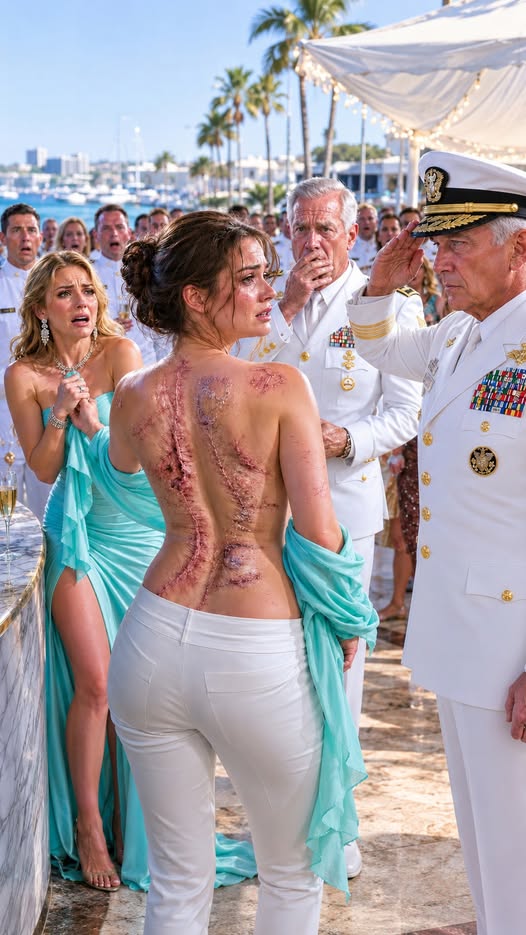
I felt the heavily air-conditioned breeze of the ballroom touch my bare skin. It grazed the massive, jagged keloid scars that stretched across my shoulder blades and down my spine. They were pale, thick lines of brutalized tissue—souvenirs from a burning ship corridor, a collapsed, melting steel door, and a night of unspeakable, screaming agony that absolutely no civilian sipping scotch in this room would ever be able to comprehend.
I did not cross my arms over my chest. I did not attempt to pull the shredded silk back together.
I did not shed a single tear.
Up on the raised dais, standing beside a ridiculous, five-tiered retirement cake, was my father. His hand was wrapped loosely around a heavy crystal tumbler of twenty-year-old bourbon. His face was a mask of smooth, patrician control. He possessed the specific, terrifying handsome quality of a powerful man who genuinely believes his mere silence can rewrite history.
“Evelyn,” he commanded, his voice as cold and flat as a winter lake. “Leave this premises immediately before you embarrass this family any further.”
At a table near the stage, my mother nervously averted her eyes, staring deeply into her wine glass. My younger brother, Preston, leaned back in his chair and offered a lazy, entitled smirk.
Celeste stepped closer, her hot breath grazing my ear. “You should have stayed vanished, Evie,” she whispered viciously. “You’re nothing but a freak now.”
Instead of running for the mahogany double doors, I slowly turned my body, leaving my ruined back fully exposed to the crowd, and locked my eyes directly onto my father.
“Are you absolutely certain you want me to leave, Arthur?” I asked, my voice carrying a quiet, terrifying resonance.
A muscle feathered in his tight jaw. His eyes narrowed. “You were never very good at making threats, Evelyn. Security will escort you out.”
That was the exact moment Admiral Thomas Reed stepped out from the front row of the crowd.
The atmospheric pressure in the ballroom instantly shifted. Every single junior officer in the vicinity instinctively snapped their spines straight. The idle chatter died a sudden death. Reed was not merely a ceremonial flag officer; he was the Commander of Naval Sea Systems. He was the apex predator of this ecosystem, the man whose solitary signature could make billion-dollar defense contracts materialize or violently evaporate overnight.
He marched directly toward me, his heavy black shoes clicking sharply against the marble. His weathered, deeply lined face was set in stone, but his eyes were bright with a fierce, burning emotion.
He stopped a mere two feet in front of me.
Then, in full view of my corrupt father, my cruel sister, and two hundred of the most powerful people on the eastern seaboard, Admiral Reed drew his shoulders back, raised his right hand, and executed a flawless, knife-edge salute.
“Captain Harrington,” Admiral Reed barked, his voice echoing like cannon fire. “Welcome home.”
The ballroom went completely, terrifyingly dead quiet.
Celeste’s triumphant smile instantly vanished, replaced by a slack-jawed mask of total incomprehension.
Up on the stage, the heavy crystal tumbler slipped through my father’s paralyzed fingers. It hit the floor, shattering into a hundred glittering, jagged pieces at his expensive leather shoes.
Part 2: The Resurrection of the Ghost
Captain?
The whispered word hissed through the crowd like a lit fuse.
Admiral Reed held his rigid salute. He did not lower his hand until I raised my own, snapping off a crisp, perfectly practiced return salute. My torn shirt hung uselessly off my left shoulder, but my posture was wrought iron.
Celeste stared at me, her eyes darting frantically over my face as if I were a shapeshifter who had just morphed into a predator.
“That’s… that’s literally impossible,” she stammered, pointing a trembling finger at my chest. “She didn’t even finish her master’s degree. She’s a dropout.”
“I finished my education at sea, Celeste,” I replied, my voice steady and cold.
My father finally unfroze. He stepped rapidly off the stage, his polished shoes crunching over the shards of his broken glass. He forced his charming, political smile back onto his face, though it looked entirely synthetic.
“Admiral Reed, please,” Arthur chuckled nervously, holding his hands out in a placating gesture. “I am quite sure there has been some sort of bizarre administrative misunderstanding here. Evelyn has always had a rather unfortunate talent for melodrama.”
Reed slowly turned his head to look at my father. He looked at Arthur Harrington the way a man looks at black mold rotting beneath an expensive Persian rug.
“There is no misunderstanding here, Mr. Harrington,” Reed growled, his voice vibrating with absolute contempt. “Your daughter didn’t run away. She commanded a highly classified, covert recovery unit in the immediate aftermath of the Pacific Star incident. She waded into a thousand-degree inferno. She personally pulled thirty-one trapped, burning sailors out of a flooding hull.”
The whispers in the room escalated into audible, horrified gasps.
The Pacific Star disaster had dominated global news cycles five years ago. It was a massive Navy logistical supply vessel that had caught fire in the South China Sea. It burned for seven agonizing hours because the primary emergency fire suppression systems—and the automated blast doors—had catastrophically failed to deploy.
My father’s company, Harrington Defense, had been the exclusive supplier of those specific systems.
In the chaotic, heavily politicized aftermath of the disaster, Arthur’s army of lawyers had swiftly scapegoated three junior naval engineers. The internal investigation was quietly suffocated, the contracts remained intact, and I—the only person inside the family who had noticed the doctored safety schematics before the ship launched—was threatened into silence and subsequently vanished.
My family had gleefully informed their social circle that the grief of the tragedy had broken my fragile mind.
The truth was vastly simpler, and far more dangerous. I had gone to the one place their corporate tentacles could not reach me. I went into the dark.
Celeste, driven by a lifetime of coddled entitlement, recovered her malicious bravado faster than I anticipated. Cruelty had always been her substitute for courage.
“So what?” she snapped, stepping in front of Admiral Reed as if he were a bellhop. “You joined the military and pulled a few people out of a fire. Congratulations, Evie. You want a medal? That doesn’t make you inherently better than us.”
“No,” I said, locking my eyes onto hers. “It didn’t make me better. It made me incredibly patient.”
Her eyes narrowed in confusion.
Arthur lunged forward, grabbing my bare bicep. His fingers dug into my muscle, squeezing hard enough to leave dark, plum-colored bruises.
“You will not ruin this night,” he hissed under his breath, his breath smelling of bourbon and panic. “You will walk out that door right now, or I will destroy whatever pathetic little career you’ve built.”
I slowly lowered my gaze to his hand gripping my arm.
“Remove it,” I commanded softly.
He hesitated, his eyes blazing with fury. I didn’t blink. For the very first time in his entire life, Arthur Harrington looked at me and realized he possessed absolutely no leverage. He slowly released his grip, his hand falling to his side.
Behind him, the heavy mahogany double doors at the back of the ballroom pushed open. Two men and one woman wearing stark, dark suits entered. Federal agents from the Defense Criminal Investigative Service. They did not announce themselves. They did not draw weapons. They simply crossed their hands over their belts and waited silently by the exits, sealing the room.
My father saw them. A second later, Celeste saw them.
Arthur’s face changed by perhaps half an inch. A microscopic tightening of the ocular muscles. A slight parting of the lips. To anyone else, he looked perfectly calm. But I had spent the last five years in hostile territories, learning how to read the subtle telemetry of mortal fear in men who were experts at hiding it.
“Evelyn… what exactly have you done?” he asked, his voice suddenly stripped of all its commanding bass.
I stepped past him, brushing my shoulder against his tailored tuxedo. I walked methodically toward the empty stage. Every single eye in the ballroom tracked my movement. The ruined, shredded silk of my blouse hung uselessly from my shoulder, exposing the scars of my survival, but I walked up those carpeted steps as if I were clad in heavy titanium armor.
I reached the center of the dais and gripped the edges of the wooden podium. I leaned into the microphone.
“My father has spent four decades building a pristine reputation predicated on his supposed loyalty to the United States Navy,” I projected, my voice echoing off the crystal chandeliers. “Tonight, the centerpiece of this gala was supposed to be his announcement of a new veterans’ foundation in his name. A noble foundation heavily funded by your donations, by government tax grants, and by lucrative sub-contracts theoretically tied to the rehabilitation of wounded service members.”
Down on the floor, Arthur’s jaw clenched so hard I thought his teeth might shatter.
Celeste let out a shaky, hysterical laugh. “This is pathetic, Evelyn! Stop talking!”
I turned my head and looked directly down at her. “Do you remember the night before I vanished, Celeste?”
All the blood instantly drained from her face, leaving her looking like a wax mannequin.
“You and Dad sat in the library,” I continued, my voice echoing relentlessly. “You willingly told the federal investigators that I had stolen internal company files because I was bitterly jealous of Preston’s promotion. You eagerly handed them my personal laptop, which you had loaded with falsified emails. You called me emotionally unstable. You told them I was insanely obsessed with blaming this family for the Pacific Star fire.”
“Evelyn, that is enough!” my father roared, finally losing his composure.
I smiled. A faint, deadly curve of the lips.
“You were right about exactly one thing, Arthur,” I said softly. “I was absolutely obsessed.”
At the back of the room, the lead federal agent raised a hand and pressed two fingers to his earpiece.
Admiral Reed stepped up onto the stage and took his place standing directly beside me, a silent, immovable monolith of military authority.
I reached into the pocket of my slacks and pulled out a small, encrypted titanium flash drive. I held it up between my thumb and forefinger, letting the stage lights catch the metal.
“For five years,” I declared, my voice ringing with the clarity of a tolling bell, “I tracked every single falsely certified invoice. I recovered every altered metallurgical safety test. I traced the routing numbers of your offshore shell companies. I documented every single bribe paid to safety inspectors to bury the truth about the blast doors.”
I lowered the drive and looked at my terrified sister.
“I didn’t come back here tonight for an apology, Celeste. I came back because you finally did the hard work for me. You gathered every single conspirator, and every single witness, into one enclosed room.”
Part 3: The Fire This Time
At a hidden signal from Admiral Reed, a young naval intelligence officer stationed at the soundboard flipped a switch.
The massive digital projector screen hanging behind the stage violently hummed to life.
Arthur spun around so fast he nearly lost his footing, grabbing the edge of the cake table to steady himself.
Illuminated on the twenty-foot screen were the original, unredacted safety stress reports. They were internal documents, explicitly bearing Arthur Harrington’s digital signature, unequivocally proving that Harrington Defense had known the emergency thermal doors installed on the Pacific Star would melt and fuse shut at temperatures exceeding six hundred degrees.
The slide transitioned. It displayed the heavily altered, falsified versions of those exact same documents—the ones submitted to the Navy procurement auditors.
The screen shifted again. Money trails. Massive, inexplicable wire transfers routed directly through Celeste’s “luxury event planning” LLC. Fraudulent invoices billed to phantom charities. Eight-figure offshore accounts registered under my brother Preston’s name in the Cayman Islands.
The ballroom was entirely silent, save for the rhythmic, mechanical click of the projector advancing slides, and the ragged, shallow breathing of the trapped elites.
Celeste backed away from the stage, shaking her head frantically. “That… that’s fabricated. All of it. It’s fake!”
“No, Ms. Harrington,” Admiral Reed’s voice boomed, cutting through her panic. “It is federal evidence.”
Arthur pointed a trembling, manicured finger at me. His face was a mottled, apoplectic red. The charming mask had completely burned away, leaving only the vicious, cornered predator underneath.
“You ungrateful, treasonous little liar!” he spat, spittle flying from his lips. “Everything you have, the clothes on your back, the food you ate, came from my money! From my empire!”
I stepped away from the podium, moving closer to the very edge of the stage, looking down at him.
“No,” I corrected him, my voice as cold as the ocean floor. “Everything I survived, I survived despite you.”
Arthur’s panicked eyes darted frantically around the room. He looked at the federal agents. He looked at the grim faces of the naval officers. He looked at his billionaire donors and political allies, all of whom were now subtly inching away from him as if his corruption were a highly contagious pathogen.
“You actually think you can destroy me?” he sneered, puffing out his chest in a final, desperate display of dominance. “I own this town. I know sitting senators. I play golf with joint chiefs. I buy federal judges for breakfast!”
Admiral Reed stepped forward, his presence suffocating Arthur’s bluster.
“And I know the names of the thirty-one American sailors who burned to ash in a sealed corridor because your company chose quarterly profit margins over their lives,” Reed stated, his voice a low, lethal rumble.
That permanently silenced him.
The three federal agents began walking forward. The crowd parted for them like the Red Sea.
The lead agent approached my father, pulling a pair of heavy steel handcuffs from his belt, and began loudly reading him his Miranda rights. A second agent smoothly flanked Celeste.
She spun toward me, her eyes finally welling with tears. They were not tears of remorse; they were the tears of a narcissist who had just realized actions have consequences.
“Evie, please!” she sobbed, holding her hands out. “Please, tell them to stop! I’m your sister!”
I looked down at the scrap of ruined black silk still clutched unconsciously in her trembling fist.
“You were my sister ten minutes ago, Celeste,” I said quietly. “Right when you were laughing at the scars on my back.”
Her mouth trembled violently. “Dad made me do it! He made me lie to the investigators!”
“No,” I replied softly, shaking my head. “Dad just taught you how the game was played. You enthusiastically chose to become him.”
The agent seized her wrists, pulled them roughly behind her back, and locked the steel cuffs in place. Celeste let out a high, thin wail that went entirely ignored by the crowd.
Across the room, my brother Preston attempted to quietly slip through the kitchen service doors, but a fourth plainclothes agent stepped out of the shadows and tackled him against a stainless-steel prep counter before he could escape.
My mother had collapsed heavily into a gilded chiavari chair. She was staring blankly at the polished marble floor, her hands resting limply in her lap, looking as though the suffocating weight of her lifelong, complicit silence had finally crushed her spine.
As they slapped the cuffs onto Arthur, he did not beg. Men of his specific breed never beg at first. They are conditioned to threaten, to bully, until the world finally proves that it no longer fears them.
As the agents led him toward the exit, they marched him directly past the edge of the stage. He stopped, straining against the agent’s grip, and looked up at me. His eyes were black pits of hatred.
“You ruined this family, Evelyn,” he hissed, spitting the words like venom.
I looked down at the man who had traded human lives for stock dividends, and I felt absolutely nothing. No anger. No sorrow. Just the clean, sterile emptiness of a surgeon removing a tumor.
“I didn’t ruin anything, Arthur,” I said evenly. “You did that five years ago, the moment you decided to bury the truth.”
Outside the heavy doors of the naval club, the explosion of camera flashes lit up the night sky like lightning. The exclusive retirement party had officially become a federal crime scene before the clock even struck midnight.
By sunrise the next morning, every single major news network across the globe was running the exact same, devastating headline:
DEFENSE TITAN ARRESTED AFTER ESTRANGED DAUGHTER EXPOSES PACIFIC STAR COVER-UP.
Part 4: Salt and Peace
The fallout was swift and absolute.
Within six months, Harrington Defense was permanently stripped of every single federal contract. The company filed for catastrophic bankruptcy. My father was convicted on thirty-four counts of fraud, criminal obstruction, and conspiracy to commit manslaughter. He will die in a federal penitentiary.
Celeste’s luxury event company was completely dismantled under the weight of massive money-laundering charges. My brother, Preston, proved his cowardice by immediately trading his testimony against his father in exchange for a slightly shorter prison sentence. Upon his eventual release, he fled the country, living somewhere in quiet, forgotten ruin.
As for me? I returned to the sea.
On a brilliantly clear, crisp spring morning, I stood on the polished steel deck of an active Navy destroyer. The wind whipped my uniform lapels.
Lined up along the railing were thirty-one grieving families. We stood in solemn silence as a massive wreath of white lilies was slowly lowered into the churning, dark blue water of the Pacific.
Admiral Thomas Reed stood shoulder-to-shoulder with me. But this time, there were no suffocating crystal chandeliers. There was no flowing champagne. There was no cruel, entitled laughter echoing off marble walls.
There was only the howl of the wind. The sting of the salt. And, for the very first time in half a decade, profound peace.
A little girl, perhaps seven years old, walked away from the railing. She was the daughter of a petty officer I had physically carried out of a smoke-filled, collapsing corridor five years earlier. She approached me holding a single white rose she had saved from the wreath.
She held it out to me. Her eyes were bright and serious.
“Thank you for bringing my dad’s truth home, Captain,” she said softly.
I took the rose carefully by the stem. I lowered myself to one knee so that my eyes were perfectly level with hers.
“He brought me home too, sweetie,” I told her, and I genuinely meant it.
That night, alone in my small, Spartan quarters on the ship, I took off my uniform shirt. I stood in front of the small metal mirror above the sink and looked over my shoulder.
I looked at the thick, jagged, pale scars crisscrossing my back. I traced the raised tissue with my fingertips, and for the very first time in my life, I felt absolutely no urge to hide them.
They were not a brand of shame. They were not proof that I had been broken by my family’s sins.
They were irrefutable proof that I had walked straight through the fire, returned alive, and forced the very monsters who had mocked my wounds to kneel before the absolute truth.
Disclaimer: This story is a work of fiction created for entertainment purposes. Any resemblance to real persons, events, or places is entirely coincidental.
If you found Evelyn’s journey of courage and ultimate justice compelling, please like this post, share it with your friends, and leave a comment below! We would love to hear what part of her revenge you found most satisfying.